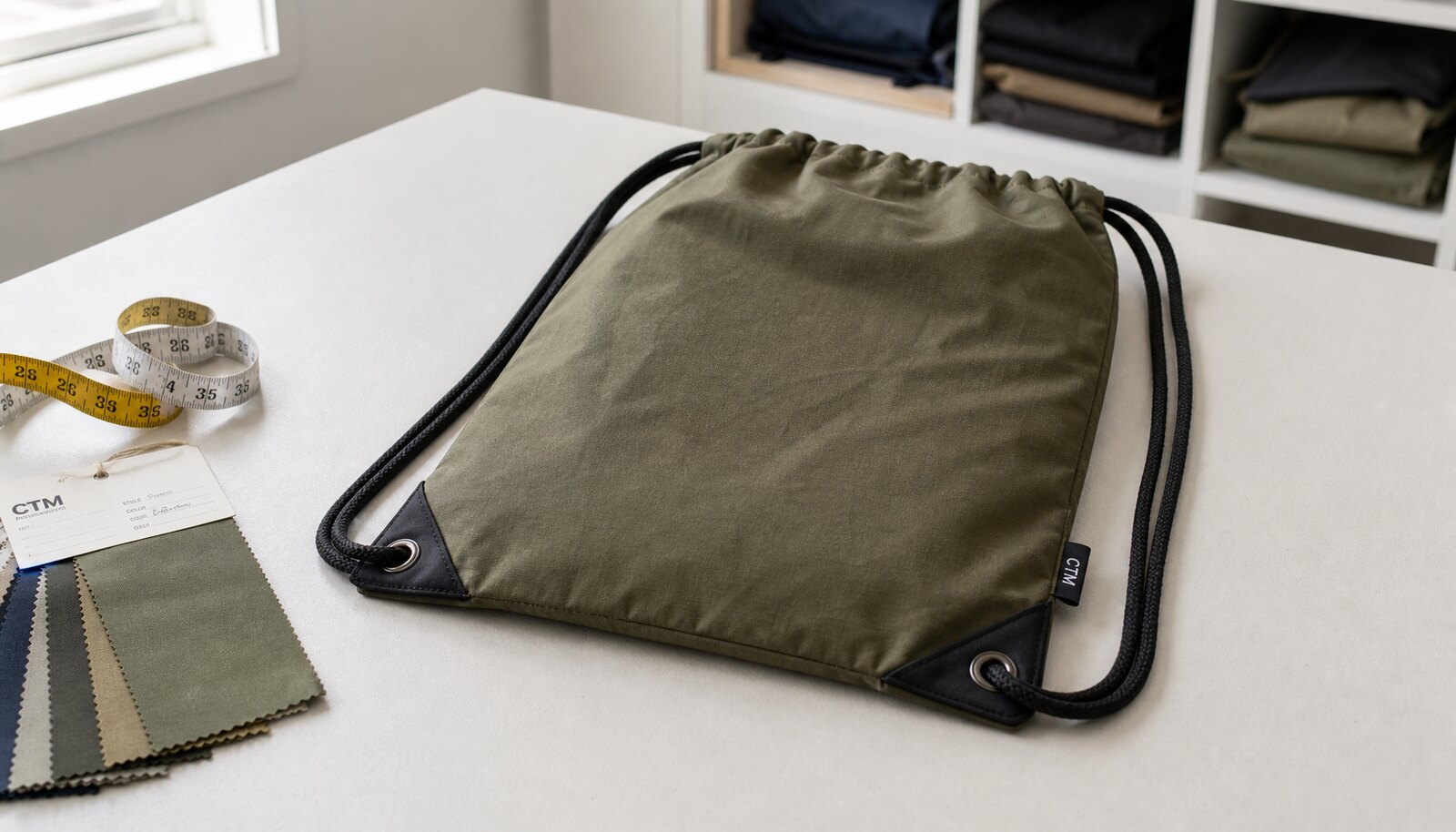
Why event buyers need a different drawstring bag spec
Custom drawstring backpacks for events are not the same purchase as a school bag, a sports backpack, or a retail daypack. In the event channel, the bag is usually a carrier for brochures, samples, a T-shirt, a bottle, a notebook, or a welcome kit. It has to move quickly through registration, look clean on a table, and stay within a budget that also has to cover printing, packing, and freight. That changes the buying logic. A bag that is technically cheap can still be a bad buy if it tears at the booth, arrives with a crooked logo, or slows down kit assembly.
Procurement teams usually get better results when they define the event task first and then build the bag around that job. A one-day trade show giveaway can use a lighter 210D polyester or nonwoven option if the logo is simple and the bag is not expected to be reused. A brand activation that wants the bag used after the event should move to heavier polyester or cotton canvas and tighten the stitch spec. If the bag must hold heavier inserts, the cord channel, top hem, and corner reinforcement are part of the commercial specification, not minor sewing details.
There is also a cost discipline issue. Event programs often compare only the piece price, then discover later that a thicker bag increases carton weight, a better print method adds setup cost, or a retail-style fold adds labor. The right starting point is not “How low can the unit price go?” but “What is the minimum spec that still protects the brand and the event workflow?” That approach produces quotes that are actually comparable and easier to defend internally.
- One-day promo: prioritize low unit cost, fast packing, clean logo visibility, and enough strength to reach the exit without failure.
- Multi-day event kit: prioritize a better hand feel, stronger seams, stable print adhesion, and a bag that can be reused after the event.
- Retail resale or premium brand events: prioritize heavier fabric, cleaner finishing, tighter QC, and a more refined branding method than a basic one-color print.
- If the bag must support weight, test the loaded carry condition in sample approval rather than assuming a factory will naturally understand the real use case.
Fabric, weight, and construction: what actually changes the quote
Fabric is the first line in the quote that buyers should slow down and inspect. For event bags, the common routes are 210D polyester, lighter polyester such as 190T, nonwoven polypropylene, and cotton canvas. Polyester is popular because it is light, easy to print on, and generally efficient to pack in volume. Nonwoven is often the lowest-cost route for short-life campaigns. Cotton canvas looks more premium and usually carries better brand perception, but it increases fabric cost, sewing time, and freight weight. If the bag will be reused, the extra cost can be justified; if it is only a handout item, the premium may not earn back its price.
For comparison purposes, ask the factory to state the material in measurable terms. For polyester, that means denier, coating if any, and whether the fabric is plain woven or laminated. For cotton or canvas, ask for GSM and whether the fabric is pre-shrunk or finished. If a supplier says good quality fabric but cannot define it, the quote is not ready for procurement comparison. Two bags that look similar in a product photo can behave very differently in production and transit.
Construction details matter nearly as much as fabric. A neat top hem, reinforced corners, and stable cord insertion are what keep the bag from twisting or tearing when a kit is dropped in. If the bag is intended for bottles or heavier inserts, ask whether the factory uses bar-tacks, extra stitching rows, or corner reinforcement. A few cents added to sewing can save a much larger cost if the event team avoids repacking failures on-site.
- 210D polyester: lower cost, lightweight, decent print surface, easy to ship in volume.
- 80–120 gsm nonwoven: best for short-life giveaways where appearance is less important than distribution volume.
- 120–140 gsm cotton: softer hand feel and a more natural brand look, but higher sewing and freight cost.
- 180–280 gsm canvas: stronger and more structured, suitable when the bag needs repeat use or premium positioning.
- Ask the factory to identify denier, GSM, weave type, coating, and whether any base fabric is stock or custom-dyed.
Construction details that deserve line-item attention
If the quote only names the fabric and print method, the buyer is missing the details that usually cause defects. For this product, the load path runs through the top hem, side seams, cord channel, and corner reinforcement. Ask how the bag is assembled: single-needle or double-needle stitching, whether the top edge is folded once or twice, and whether the cord channel is self-fabric or separate tape. Those choices change both durability and cost, but they also change how the bag feels in hand.
The cord entry point is a frequent weak spot. Reinforced eyelets, stitched loops, or a properly turned channel reduce the risk of fraying and twisting. If the bag will hold heavier contents, ask whether the supplier can add bar-tacks at the corners or extra stitch passes where the cord anchors. This is not over-specification; it is the kind of detail that separates a bag that survives booth distribution from one that gets left behind because it feels flimsy.
Dimension control matters too. A buyer who needs the bag to fit a registration kit should ask for finished measurements after sewing, not cut-piece dimensions. Add a clear note on tolerance so the factory knows what is acceptable. If the bag is only a loose giveaway, tolerance can be a little wider. If it must hold a bottle, notebook, and brochure set, a few millimeters can be the difference between a smooth fit and a bloated carton.
- Ask for the seam type, stitch count, and whether the top edge is double-folded or tape-bound.
- Specify reinforcement at corners, cord entry points, and any load-bearing seam.
- Request finished size, not cut size, and write the tolerance in millimeters.
- If the bag must fit an event insert, test the exact contents in the sample, not just in a product photo.
Print method selection: cost, detail, and real failure points
The print method often determines whether the bag looks promotional or polished. A simple one-color logo on the front panel is usually best suited to screen print, especially at larger quantities. It is economical and can be durable when the artwork has bold shapes and enough open space. If the design includes multiple colors, gradients, or small type, DTF or heat transfer may be the more practical option because it can reproduce detail that screen print struggles to hold. For premium event programs, a woven patch, sewn label, or combination of print plus label can create a more finished appearance than a large direct print alone.
Buyers should not select the print method based only on the first unit price they see. Screen print often has a setup charge but a lower running cost. Transfer methods can reduce setup friction for artwork complexity, but they may feel heavier on thin fabric, and the edges can show lift if the curing or pressing parameters are weak. A woven patch looks premium, but it adds sewing steps and can force the factory to adjust placement if the bag shape is narrow. In other words, the cheapest print method can still be the most expensive after rework or quality disputes.
A good RFQ should force the supplier to state the practical limits. Ask for minimum line thickness, minimum readable text size, and the maximum print area they can run without distortion near seams or cord channels. If the logo includes small text, insist that the sample shows it at actual size. Many bag problems are not obvious in a flat mockup; they appear when the fabric flexes, the bag is filled, or the image lands too close to a stitched edge.
- Screen print fits simple logos, large runs, and buyers who want low running cost.
- DTF or heat transfer fits multi-color artwork, gradients, and moderate-run campaigns.
- Woven patch or sewn label suits premium launches, repeat-use bags, and programs where tactile branding matters.
- Ask the supplier for the smallest text size and thinnest line they can print clearly, then use that as a QC reference.
Event scenarios by segment: what the bag needs to do in the real world
The strongest RFQs name the event scenario instead of describing a generic promo bag. A trade show handout is different from a conference registration kit. A sports activation needs different carry behavior than a sponsor welcome pack. The bag should be specified around the contents, handling path, and audience expectation. That is what prevents mismatch between the product and the event operation.
For trade shows, the bag usually needs to handle brochure weight, a sample item, and quick distribution at peak traffic. A smooth front panel for logo visibility matters, but so does fast packing and light carton weight. For conferences, the bag may need to hold a notebook, program, water bottle, and sponsor inserts; here, a slightly sturdier fabric and more controlled size are worth the extra cost. For sports or outdoor events, moisture resistance and stronger reinforcement may matter more than a premium hand feel. For sponsor packs or VIP kits, the presentation is usually the priority, which can justify a cleaner print finish or a sewn label instead of a basic logo print.
If the event is retail-adjacent, the buyer should think beyond the event date. A bag that will be reused in public becomes a brand asset, so the seam and print standard should rise accordingly. In that case, ask the supplier for a higher stitch density in load-bearing areas and a cleaner finishing standard around loose threads, label alignment, and print edges. The product then functions as both a giveaway and a walking brand sign.
- Trade show handout: focus on speed, volume, and a clear logo on the front panel.
- Conference kit: focus on fit, controlled packing size, and a bag that works with notebook-and-bottle inserts.
- Sports or outdoor event: focus on stronger seams, stable cords, and better resistance to wear from active use.
- VIP or sponsor pack: focus on finish quality, cleaner branding, and a more polished unpacking experience.
How to compare supplier quotes without getting trapped by low unit price
Event buyers often receive quotes that look similar on the surface but are built on different assumptions. One supplier may price a thin fabric, a smaller logo, and bulk packing only. Another may include a heavier fabric, a larger print area, and carton packing that is easier for the warehouse team to receive. If those details are not aligned, the lowest unit price is not the lowest purchase cost. In procurement terms, the quote is incomplete until the factory has shown the same spec on every line.
The most reliable way to compare suppliers is to standardize the request before the quote goes out. Require the same finished size, same fabric specification, same print size and position, same packing format, and the same delivery term. Then compare unit price, setup charge, sample charge, estimated carton volume, and freight assumptions side by side. For larger event programs, it often makes sense to accept a slightly higher piece price if it reduces damage risk, packing labor, or receiving delays. That is the commercial reality buyers feel on the back end, even if it does not show up in the first spreadsheet.
Another useful question is whether the supplier is quoting as a bag maker or simply as a middleman. A factory that actually cuts, prints, and sews the bag can usually speak more clearly about stitch details, sample timing, and defect control. A trader may still be a valid source, but then the buyer needs extra visibility into where the work will happen and who will own sample approval. If the quote cannot identify the actual production route, the buyer is taking on hidden schedule risk.
- Match the same size, same fabric, same print area, same carton count, and same delivery term before comparing prices.
- Separate setup charges from recurring unit cost so one-time artwork or screen fees do not distort the order math.
- Ask for estimated carton dimensions and CBM; freight can reverse the ranking of two similar quotes.
- Confirm whether the quote includes folding, labels, polybags, outer carton marks, and export paperwork.
- Identify whether the seller is the actual factory or a trader managing production elsewhere.
MOQ logic for event bags: why quantity affects structure as well as price
MOQ is not just a seller policy; it is often linked to how the factory schedules fabric cutting, printing, and sewing. A 500-piece run may be possible, but the factory may need to open a separate line if the order uses a special cord color, a custom print position, or an unusual fabric. That is why two quotations with the same quantity can still have different pricing structures. Buyers sometimes treat MOQ as a negotiable number only, when in fact it is also a production logic problem.
For event procurement, the cleaner approach is to think in terms of standard versus custom inputs. Standard fabric, standard cord, and one-color print are easier to place into an existing production flow, so the MOQ can stay lower. Custom cord colors, oversized print areas, or mixed packaging usually push MOQ higher because they create setup time and material reservations. If the event date is fixed, a slightly higher MOQ may be worth accepting if it avoids an unstable partial run or a delayed production slot.
It also helps to ask whether the factory can use stock fabric or must source fresh material. Stock material reduces lead time and sometimes lowers MOQ, but it can limit color or texture options. Fresh-dyed or custom-finished material gives more control but usually increases both time and cost. Buyers should choose the route based on event calendar and branding need, not on habit.
- Standard materials and standard cord colors usually lower MOQ pressure.
- Custom cord colors, special labels, lining changes, or oversized print areas often raise MOQ.
- Lower MOQ is possible, but it often comes with setup premiums or fewer finishing choices.
- Ask whether the factory will use stock fabric or a fresh production run, because that changes both lead time and risk.
Sample approval: the control point that prevents expensive mistakes
For custom drawstring backpacks for events, the sample is not a courtesy item. It is the approval gate that protects the whole order. A digital mockup can confirm logo layout, but it does not verify how the bag feels when loaded, how the cord runs through the channel, or whether the print lands cleanly after stitching and turning. If the event has a fixed date, sample approval should happen early enough that the factory still has time to make corrections without jeopardizing shipment.
A useful sample workflow starts with a short written spec, not a long email chain. The buyer should lock the finished size, fabric, cord type, print method, color references, and packing method before sample making begins. When the sample arrives, test it with the actual event contents. Load the brochure set, T-shirt, notebook, or bottle that the bag is supposed to carry. Pull the cords open and closed several times. Check whether the top opening remains usable and whether the bag twists to one side when loaded. These are not cosmetic issues; they are the difference between a bag that works at registration and one that creates repacking work for staff.
If the sample is wrong, revise it before mass production. The factory should either send a corrected sample or show clearly what changed and why. Do not let production start on the basis of a sample that is close enough but not formally approved. The cost of a correction at this stage is usually much lower than the cost of a lot dispute after shipment.
- Measure actual finished dimensions, not only cut-panel size.
- Check print placement relative to seams, folds, and cord channels.
- Load the sample with real event contents before approval.
- Approve packing format, carton labeling, and fold method if the event team will receive pallets directly.
- Keep the approval version in one dated file so the factory cannot refer back to an older revision.
QC thresholds buyers should write into the RFQ
QC is usually where event-bag orders become vague. Buyers may ask for good quality or AQL standard without defining what good means for this particular product. That is not enough. A useful QC note should separate critical, major, and minor defects and then map them to the event use case. For a free giveaway, a small trim defect may be acceptable if the bag is still functional. For a premium launch or retail resale, the same defect may be a reject. The supplier needs to know the line before production starts, not after cartons are packed.
The most practical QC checks for drawstring backpacks are size, stitching, cord function, print adhesion, fabric appearance, and carton count. Dimensions should be checked after turning and pressing, not just at cut stage. Stitching should be inspected at the top hem, side seams, cord channel, and any reinforcement points. Cord function should be tested under repeated open-close handling and a manual load condition using the intended event contents. Print should be rubbed lightly after curing to confirm adhesion and to expose weak transfer or under-cured ink. Carton count should be confirmed before sealing, because a short count becomes a warehouse issue even if the bags themselves are acceptable.
Buyers should also define an escalation path for failures. If the first lot shows a material defect or repeated stitch failure, can the supplier rework, replace, or hold shipment? Who approves the rework? How quickly must the seller report a nonconforming lot? These are simple questions, but they prevent the most common dispute pattern in event sourcing: the buyer opens cartons too late and the supplier says the issue was never reported during packing.
- Set size tolerance in writing for width, height, and any gusset or depth.
- Define print tolerance for placement, sharpness, and color deviation.
- Require no broken stitches, skipped stitches, or loose corner reinforcement on load-bearing areas.
- State whether minor cosmetic variation is acceptable within the lot or whether the order is zero-tolerance on appearance.
- Write the nonconforming-lot path in advance: rework, replacement, credit, or shipment hold.
Packing and carton strategy for event distribution
Packing is one of the easiest places to hide cost. A low-priced bag can become expensive if the folding method increases carton volume, if every piece must be individually polybagged, or if labels and insert cards add manual labor. Event buyers often need cartons that can be opened quickly, counted easily, and moved into an on-site kit assembly process without re-sorting. For that reason, bulk packing is usually the default route when the bags are being distributed at the venue or inserted into kits later.
The carton spec matters because it affects both freight and receiving labor. Ask the supplier to quote the piece count per carton, the carton dimensions, and the gross weight. Then compare how the bag folds in practice. A bag folded too tightly can show hard crease marks under lighting, which is a presentation issue for VIP kits. A bag folded too loosely can waste volume and increase the freight bill. The right answer depends on event use, but the factory should not decide the packing method unilaterally. It should be part of the RFQ.
If the bags are going into retail-style kits or premium sponsor packs, individual polybags may be justified. They add material and labor cost, but they can protect the surface print and keep the bags clean. In that case, also ask whether the polybag is resealable, whether desiccant is required, and whether the carton marks need to show batch or lot numbers for traceability.
- Bulk pack is best for lower cost and fast on-site distribution.
- Individual polybags help cleanliness and presentation but add labor and carton volume.
- Carton count should be simple enough for warehouse teams to verify quickly at receiving.
- Ask for carton dimensions before freight booking, not after sample approval.
- If the bag is part of a premium kit, include the fold method in the spec so the factory does not choose a convenience fold.
Specification comparison for buyers
| Spec decision | Recommended option | When it fits | Buyer risk to check |
|---|---|---|---|
| Sourcing route | Direct factory with proven event-bag production and packing capability | You need control on fabric, logo placement, carton count, and ship-ready packing | Ask for photos or records of prior drawstring bag runs, not only tote bags; cord channels, top hems, and reinforcement points are easy to underbuild if the factory is not used to this product |
| Fabric choice | 210D polyester for value programs, 80–120 gsm nonwoven for very short-life giveaways, 120–140 gsm cotton or canvas for reuse-focused events | Choose by event duration, brand tier, and carry load | Thin fabrics reduce cost but may show print strike-through, panel twisting, or weak opacity; heavier fabrics improve feel but raise sewing time, carton weight, and freight exposure |
| Print method | Screen print for simple logos, DTF or heat transfer for multi-color art, woven patch or sewn label for premium branding | Match the method to artwork complexity and volume | Lower-cost methods can still fail if line thickness is too fine, artwork is too close to seams, or cure/adhesion is not checked under a simple rub test |
| Closure style | Dual drawcord with reinforced eyelets or stitched cord channel; cord lock only if the event use case needs it | Standard for conferences, sports events, and promotional handouts | Weak corners, loose stitches, or uneven cord lengths create a functional defect even when the bag looks acceptable in a flat photo |
| Bag size | Common event size around 34 × 42 cm for brochures, notebooks, bottle, and T-shirt inserts; increase depth or gusset if pack-out items are bulky | Fits most registration kits without over-inflating freight | Oversized bags drive up unit cost and CBM; undersized bags force the event team to repack or remove items at the booth |
| MOQ strategy | 500–1,000 pcs for standard event runs; lower MOQ only when setup charges are accepted and material options are limited | Useful for pilot launches, regional roadshows, or sponsor-specific runs | Very low MOQ often means higher unit cost, fewer fabric options, and less control over color matching or print setup |
| Packing format | Bulk packed by count per carton, with inner polybag only if cleanliness, retail presentation, or kit assembly requires it | Best for cost-sensitive event fulfillment and warehouse insertion | Retail-style folding, labeling, and individual polybags add labor and carton volume; check whether the factory is quoting packing labor separately |
| Sample workflow | Physical pre-production sample approved before mass cutting and printing release | Best when the order has fixed dates or branded inserts | Without a signed sample, disputes over size tolerance, logo placement, and fabric shade are hard to resolve at shipment |
| Logistics route | Cartonized sea freight for larger campaigns; air freight only for urgent launches or low-volume premium orders | Depends on lead time, carton density, and final destination | A low factory price can be erased by volumetric weight, carton inefficiency, or extra receiving labor if packing is not planned early |
Buyer checklist before sampling
- Confirm final bag size, fabric type, and target fabric weight or denier before requesting quotes; do not ask factories to price against a vague "promo bag" description.
- Provide artwork in vector format, list Pantone targets if color accuracy matters, and define the exact print area in millimeters and its distance from seams, hems, or cord channels.
- State the event use case: one-day giveaway, multi-day conference kit, sports promotion, sponsor pack, or retail resale; the usage changes the fabric and QC target.
- Specify required packing method, carton count, carton label format, and whether individual polybags, hang tags, or barcode labels are needed.
- Request a pre-production sample or confirmed digital mockup with exact cord color, reinforcement style, and logo placement; approve only one final version in writing.
- Ask the supplier to quote carton dimensions, gross weight, pieces per carton, and estimated CBM so freight can be compared before placing the order.
- Write acceptable tolerance for size, print placement, and color variation into the RFQ; if the bag must sit in a welcome kit, tolerance should be tighter than for a loose giveaway.
- Ask whether the factory will use stock fabric or fresh-dyed material, and whether material availability changes MOQ, lead time, or price.
- Request the factory’s inspection method for stitching, cord pull, print adhesion, and carton count; ask for photos or a checklist rather than a generic "QC passed" note.
- Align the order quantity with the event calendar so the factory does not split production into unstable partial runs that increase defect risk or delay shipment.
Factory quote questions to send
- What exact fabric options do you recommend for this event use, and what are the finished denier, GSM, weave, or coating details for each option?
- Which print method gives the best balance of cost, logo detail, and durability for our artwork, and what is the minimum readable line thickness or text size you can hold?
- What is your MOQ by fabric, print method, and cord color, and what cost changes if we reduce quantity or add a second logo position?
- Can you provide carton size, packing quantity per carton, estimated gross weight, and CBM for our order before we confirm the PO?
- Will you supply a pre-production sample, what exactly will it represent, and which changes are still allowed after sample approval?
- What are your standard size tolerances, print position tolerances, and color deviation tolerances for this bag style?
- How long is sample lead time, production lead time, and packing lead time after artwork and sample approval?
- What quality checks do you perform on seam stitching, cord pull strength, print adhesion, final count, and carton packing accuracy?
- If a lot fails inspection, what is your escalation path: rework, replacement, credit, or partial shipment hold?
- Can you confirm whether the quote includes inner polybags, labels, carton marks, and export documents, or are those charged separately?
Quality-control points to confirm
- Bag dimensions: measure finished width and height after stitching and turning, not the cut panel size. Write an acceptance range in the RFQ, such as ±5 mm on standard event bags or tighter if the bag must fit a specific insert.
- Stitching: no skipped stitches, open seams, popped seams, or loose top-corner reinforcement. Check at least the cord channel, side seams, top hem, and any load-bearing gusset seam.
- Cord function: cords should pull evenly and not slip through the channel. Set a minimum pull test expectation, such as no visible failure after repeated open-close cycles and a manual load test with the intended event contents.
- Cord strength: ask the supplier what cord diameter or construction is used, and test that the cord does not fray, snap, or cut into the fabric under normal loaded carry conditions.
- Print adhesion: no cracking, peeling, blocking, or visible edge lift after a simple rub test. For screen print or transfer print, inspect after cure and after light abrasion with the intended hand contact.
- Print registration: logo placement must stay inside the approved print box and not drift into seams, folds, or drawcord channels. Set a placement tolerance so the factory knows how much movement is acceptable.
- Color control: compare against the approved sample under daylight or a consistent light source. If brand color is critical, require the supplier to state the Pantone target and acceptable variation window.
- Fabric defects: reject holes, tears, oil marks, severe slubs, shade inconsistency between panels, visible coating defects, or foreign fibers that cannot be trimmed without damaging appearance.
- Carton count and carton labeling: verify piece count per carton, outer carton marks, and batch labels before shipment. A count mismatch can create a receiving problem even if the bags themselves are fine.
- Defect thresholds: distinguish critical, major, and minor defects in writing. For example, a wrong logo position or broken seam is critical, while a small loose thread may be minor if trimmed and isolated.