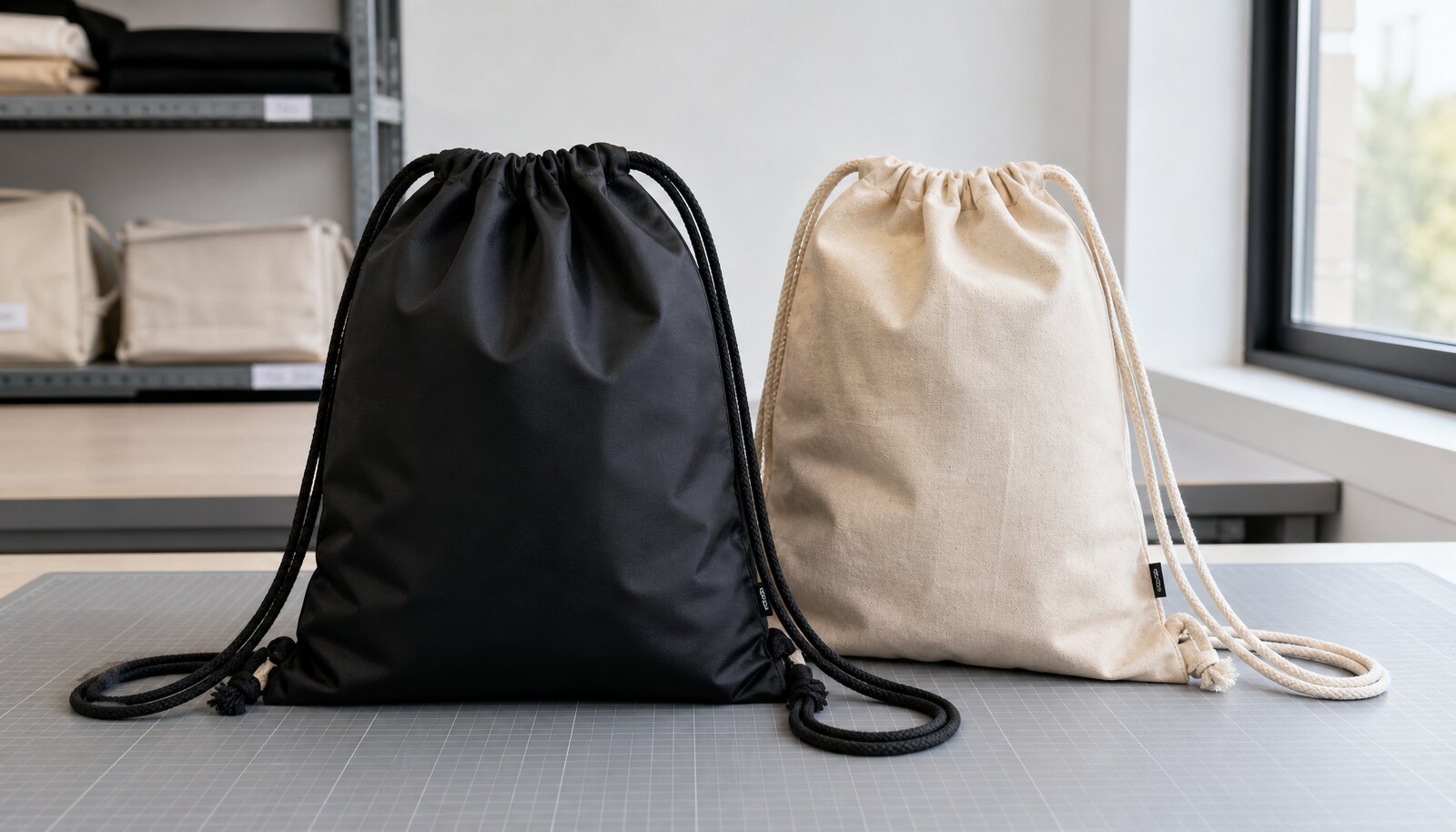
What Ecommerce Buyers Actually Need From a Drawstring Backpack
For ecommerce, the bag is not just a simple giveaway. It has to survive warehouse handling, fit inside a sales photo, open cleanly for the customer, and arrive without wrinkles, broken stitching, or a crooked logo. That is why the real buying problem is usually not the bag shape. It is the mismatch between the intended use, the decoration method, and the way the product is packed for fulfillment.
If you only send a picture and a target price, suppliers will fill in the blanks differently. One quote may assume a thin promo bag, another may assume a heavier retail-grade build, and a third may include a folded retail insert that your 3PL does not want. Start by defining whether the bag is meant to carry lightweight apparel, event swag, school items, or premium merchandise. That decision drives fabric weight, cord strength, print coverage, and carton economics.
- State the selling channel: DTC parcel, marketplace, retail shelf, or bundled gift pack.
- Define the maximum packed weight the bag must hold without seam distortion.
- Specify whether the bag needs to look premium in unboxing content or only function at low cost.
Choose Fabric Weight Based on Use, Not Habit
The most common mistake is overbuying fabric because the sample feels better in hand. A 210D polyester bag is often enough for light ecommerce use and keeps the landed cost under control. Move up to 300D or 420D polyester when you need more structure, a better print surface, and less wrinkling in the packing line. If the brand position is more natural or gift-oriented, 8 to 10 oz cotton canvas can make sense, but it raises sewing time and can increase freight because the bag carries more bulk.
Do not treat GSM or denier as decoration only. It changes how the bag folds, how the print sits, and how the cord holes wear over time. A thin bag can look acceptable in a flat lay image and then collapse in the customer's hands. A heavier body can solve that, but it also pushes up material cost, stitch time, and carton volume. The right spec is the lowest weight that still protects the product and holds the brand image you need.
- 210D polyester: good for entry-level ecommerce, short promotion cycles, and large quantity repeat orders.
- 300D to 420D polyester: better for a sturdier handfeel, more body, and less visible print distortion.
- Cotton canvas: suitable when brand positioning matters more than absolute unit cost and shipment weight.
Print Method Changes Both Cost and Failure Rate
For custom drawstring backpacks for ecommerce, decoration is often where the quote diverges fastest. Screen print is usually the cleanest choice for one to two spot colors because the setup is straightforward and the result is durable if the ink and curing are controlled. Heat transfer helps when the art has small text or many colors, but it can add a plastic feel and may show wear at the folds. Woven labels, patches, and embroidery are useful when you want a more premium brand signal and lower ink coverage on the body fabric.
Keep the artwork practical. If the logo has fine lines, gradients, or very small type, the supplier may simplify it unless you state the minimum readable size. Ask for print position measured from seam lines, not from the bag edge, because edge-based placement drifts once sewing tolerance is added. On a drawstring backpack, a logo that is 10 mm too high or too wide can cross a fold line and look misaligned in photos even if it passes a casual inspection.
- Use screen print for simple brand marks and stable reorders.
- Use heat transfer when the artwork needs detail but not heavy abrasion resistance.
- Use a woven label or patch when the body fabric is dark, textured, or prone to print show-through.
Size, Cord, and Reinforcement Should Match the Product Load
Most ecommerce buyers do better with a narrow set of sizes instead of a custom dimension for every campaign. A common retail size around 14 x 17 in or 15 x 18 in works for many apparel, accessory, and event use cases, but the right answer depends on the product pack-out. A bag that is too tall wastes material and creates a sloppy folded appearance. A bag that is too shallow can bulge at the bottom and put stress on the cord exits.
The cord is not a small detail. A 4 mm polyester cord with proper heat-cut ends and bar-tacked attachment points is usually safer than a thinner cord that feels soft but slips under load. Reinforcement matters at the stress points where the cord enters the body and where the lower corners carry the product weight. Ask the factory how many stitches are used, what thread type is standard, and whether the corners are bar-tacked or only seam-stitched.
- Match bag size to the actual cartonized product set, not to the widest possible SKU.
- Specify cord diameter and finish so the supplier does not downgrade it to save cost.
- Require reinforcement details in the sample photos, not just in the written quote.
How Supplier Options Affect Quote Accuracy
The same backpack can be quoted very differently depending on whether you buy from a direct factory, a trading company, or a local decorator. A direct factory usually gives the best control over fabric, sewing, and reinforcement, which matters when you need repeat orders and predictable quality. A trading company can help when you want to combine multiple products or need someone to manage smaller runs, but you should expect less visibility into the real sewing line and the real fabric source.
For ecommerce buyers, the tradeoff is usually control versus convenience. If your launch is highly customized and the SKU is likely to repeat, direct factory sourcing is normally the cleaner path. If you are testing demand and need a smaller mixed order, a trading route may be workable, but insist on a real sample from the actual production path, not just a sales sample. The quote should tell you who prints, who sews, and who packs.
- Direct factory: strongest for repeat quality, lower long-run ambiguity, and construction changes.
- Trading company: useful for consolidated buying, but verify the actual maker and keep sample control tight.
- Local decorator: useful for short lead times, but not always cost-efficient on sewn construction and high volume.
Use the Table to Compare the Right Buying Route
The comparison table is there to keep the discussion grounded in commercial choices, not general preferences. A good quote is not just a number. It is a statement of what the supplier assumed about fabric, print, reinforcement, packing, and order structure. When those assumptions are different, the prices are not directly comparable.
If you are unsure about the spec, compare the options row by row and force the quote to align with your intended use. That is especially important for ecommerce where the bag is handled multiple times before it reaches the customer. A slightly higher factory price can still win if it reduces returns, carton damage, or repacking labor.
- Use one reference spec sheet for all suppliers so the quote math stays comparable.
- Separate base bag cost from decoration and packing cost before comparing offers.
- Reject quotes that do not state the assumed fabric weight, print method, and carton count.
MOQ Logic: Lower the Risk Without Weakening the Bag
MOQ is not just a factory gatekeeping number. It reflects setup time, fabric buying, print plates or screens, labor scheduling, and the risk of leftover material. If your demand is not yet stable, keep the body bag as standard as possible and vary only the print, woven label, or hangtag. That lets the factory keep the same cutting and sewing process while changing only the branding layer.
A quote can look cheap at a low MOQ and then become expensive once setup, packing, and sample revisions are added. Ask for the cost structure in pieces: body bag, decoration, packing, cartonizing, and any test or inspection fee. For a simple ecommerce program, the quote usually shifts most when you change fabric weight, increase print coverage, add embroidery, or demand custom retail packing. Those changes affect machine time and reject rates more than most buyers expect.
- Keep one core construction and vary branding elements if the launch volume is uncertain.
- Ask for separate setup charges for screens, labels, embroidery, and special packing.
- Be wary of extremely low MOQ offers that hide later costs in packing or decoration.
Sample Approval Needs More Than a Nice-Looking Bag
A sample should prove the production method, not just the appearance. Request a pre-production sample after the factory has the final fabric, cord, print file, and packing plan. Then compare it against a written approval list that includes size, stitch count, print position, label location, fold style, and carton count. A photo alone is not enough, because it will not show seam tension, bar-tack quality, or whether the bag actually closes evenly.
When approving, use the same standard every time. Open and close the bag several times, check that the cords slide without binding, and inspect the print after the fabric is folded and unfolded. If the art is on a seam or near a cord exit, confirm that it still reads cleanly after production tolerance is applied. A good sample process prevents the worst kind of factory dispute: the bag is technically close, but it is not the same product you thought you approved.
- Approve one golden sample with measurements written on it if possible.
- Record the exact fabric lot, print method, and label type tied to that sample.
- Do not release bulk production until the sample and the spec sheet match exactly.
Packing and Cartonization Matter More in Ecommerce Than in Wholesale
Ecommerce buyers should treat packing as part of the product, not as a warehouse afterthought. If the bag ships flat in a polybag, the fold pattern must be defined so the logo lands in the right place and the customer sees a clean first impression. If the bag is pre-packed with inserts, labels, or warning text, those steps need to be quoted and tested before bulk production. The difference between a neat unit and a messy one is often just a few minutes of labor and a clear packing spec.
Carton count also affects landed cost and inbound efficiency. A smaller carton count can protect shape, but it raises shipping volume. A denser carton can cut freight cost, but it may wrinkle the print or crush the bag edge. For a fulfillment-driven business, the best packing format is the one your warehouse can receive, scan, and store without rework. Ask the factory for the packed unit dimensions, not just the flat bag size.
- Specify fold direction, polybag thickness, and barcode position.
- State whether the carton should prioritize shape protection or freight efficiency.
- Ask for packed carton dimensions before you finalize the freight plan.
Lead Time, Risk Points, and Landed Cost
A realistic schedule usually includes sample development, material booking, printing, sewing, packing, and outbound inspection. The longest delay is often not the sewing line itself. It is late artwork approval, missing packing details, or a revised sample that changes the print or label position. If the launch date is fixed, build a buffer for one round of sample correction and one round of bulk photo approval before shipment.
Landed cost should include the parts buyers often ignore: sample freight, setup charges, packing materials, inspection time, and carton volume. Two quotes that look similar at the factory gate can diverge sharply once they are packed for ecommerce and moved through a warehouse network. If you are comparing options across suppliers, make them quote the same spec, the same packing format, and the same incoterm. Otherwise, you are not comparing the same product.
- Build time into the schedule for artwork correction and sample sign-off.
- Compare FOB or EXW only after packing assumptions are identical.
- Count freight volume, not just unit price, when the bag is bulky or lightly loaded.
Specification comparison for buyers
| Spec decision | Recommended option | When it fits | Buyer risk to check |
|---|---|---|---|
| Fabric weight | 210D or 300D polyester for budget programs; 420D polyester or 8 to 10 oz cotton canvas for heavier handfeel | Best when the bag is a low to mid-price ecommerce item and you need a clean balance of cost and durability | Thin fabric can show print strike-through, wrinkle badly, and fail at the cord exits if the load is too high |
| Cord material | 4 mm polyester cord with heat-cut ends and bar-tacked attachment points | Use when the bag will be opened and closed often or packed with small retail items | Soft cotton cord looks premium but can stretch, soil faster, and lose tension if the knotting is weak |
| Print method | Screen print for 1 to 2 spot colors, heat transfer for detailed art, woven label or patch for low-ink branding | Works when the artwork is simple enough to keep setup and reject risk under control | Fine text, gradients, and edge-to-edge coverage can fail during production or crack after folding |
| Construction style | Single-layer with bound seams for low cost, or lined body with reinforced seam tape for better shape | Choose lined construction for premium ecommerce launches or heavier contents | Unlined bags can fray at cut edges and look cheap in opening videos and customer photos |
| Reinforcement | Bar tack or X-box stitching at cord holes and stress points | Needed when buyers expect repeated use, gift packing, or heavier filling | Weak reinforcement is hard to spot in a sample but shows up fast in field use and returns |
| Bag size | Common retail size around 14 x 17 in or 15 x 18 in, adjusted to the product pack-out | Use the smallest size that safely fits the planned SKU mix and folding method | Oversized bags waste freight and carton space; undersized bags create fit complaints and awkward bulging |
| Packing route | Flat packed in polybags for ecommerce fulfillment, with carton counts set to your warehouse process | Best when a 3PL or fulfillment center needs fast inbound handling and barcode control | Loose packing can raise labor cost, damage the print, and create inconsistent count accuracy |
| Sourcing route | Direct bag factory for custom specs and repeat orders; trading company only when you need consolidated sourcing or smaller order support | Direct factory fits buyers who need tighter control over fabric, print, and sewing details | Trading routes can hide the actual mill or sewing line, which makes sampling and repeat quality less predictable |
| MOQ strategy | Keep the body bag standard and vary only print, label, or insert when launch volume is uncertain | Use this for ecommerce tests, seasonal drops, or SKU launches with limited forecast confidence | Too much customization at low MOQ drives setup charges, stock risk, and slower quote turnaround |
Buyer checklist before sampling
- Confirm the exact use case: promo giveaway, retail add-on, subscription insert, or standalone ecommerce SKU.
- Lock the target fabric weight, cord diameter, and stitch reinforcement before requesting quotes.
- Send vector artwork, color references, and print size limits with the RFQ.
- State the folding method, polybag requirement, barcode needs, and carton count target.
- Define the target buyer load, not just the bag size, so the factory can judge seam strength.
- Request a pre-production sample and a photo or video of the sewing and print stage if the order is large.
- Ask for a quote split between base bag, decoration, packing, and testing so you can compare offers cleanly.
- Specify whether the supplier can keep repeat dye lots, repeat cord color, and repeat print registration across reorder batches.
Factory quote questions to send
- What exact fabric, GSM or denier, and coating are included in the quote?
- Is the quoted price for blank bags, printed bags, or fully packed retail units?
- What is the setup charge for print, woven label, patch, or embroidery, and is it repeatable on reorders?
- What is the minimum order quantity for each decoration method and color count?
- How are cord ends, stitch reinforcements, and seam binding included in the standard construction?
- What packing format is assumed, including polybag thickness, barcode label, and carton quantity?
- How many days are needed for sample making, production, and final packing after sample approval?
- What defect rate or rejection policy applies if print position, seam tension, or color shade drifts outside the agreed sample?
Quality-control points to confirm
- Measure finished size, gusset width, and cord length against the approved spec sheet, not against eye judgment.
- Check print placement, registration, opacity, and rub resistance after the bag is folded once and reopened.
- Pull-test the cord exit area and bottom corners to confirm the reinforcement stitching holds under normal load.
- Inspect seam allowance and edge finishing for fray, skipped stitches, and exposed raw edges.
- Verify that the packed unit matches the agreed fold, polybag, label position, and carton count.
- Check color consistency between bulk production and the approved pre-production sample under daylight or neutral light.
- Confirm that the barcode scans after packing and that the label is visible without opening the polybag.
- Spot-check carton compression and corner crush resistance if the shipment will move through multiple warehouses.