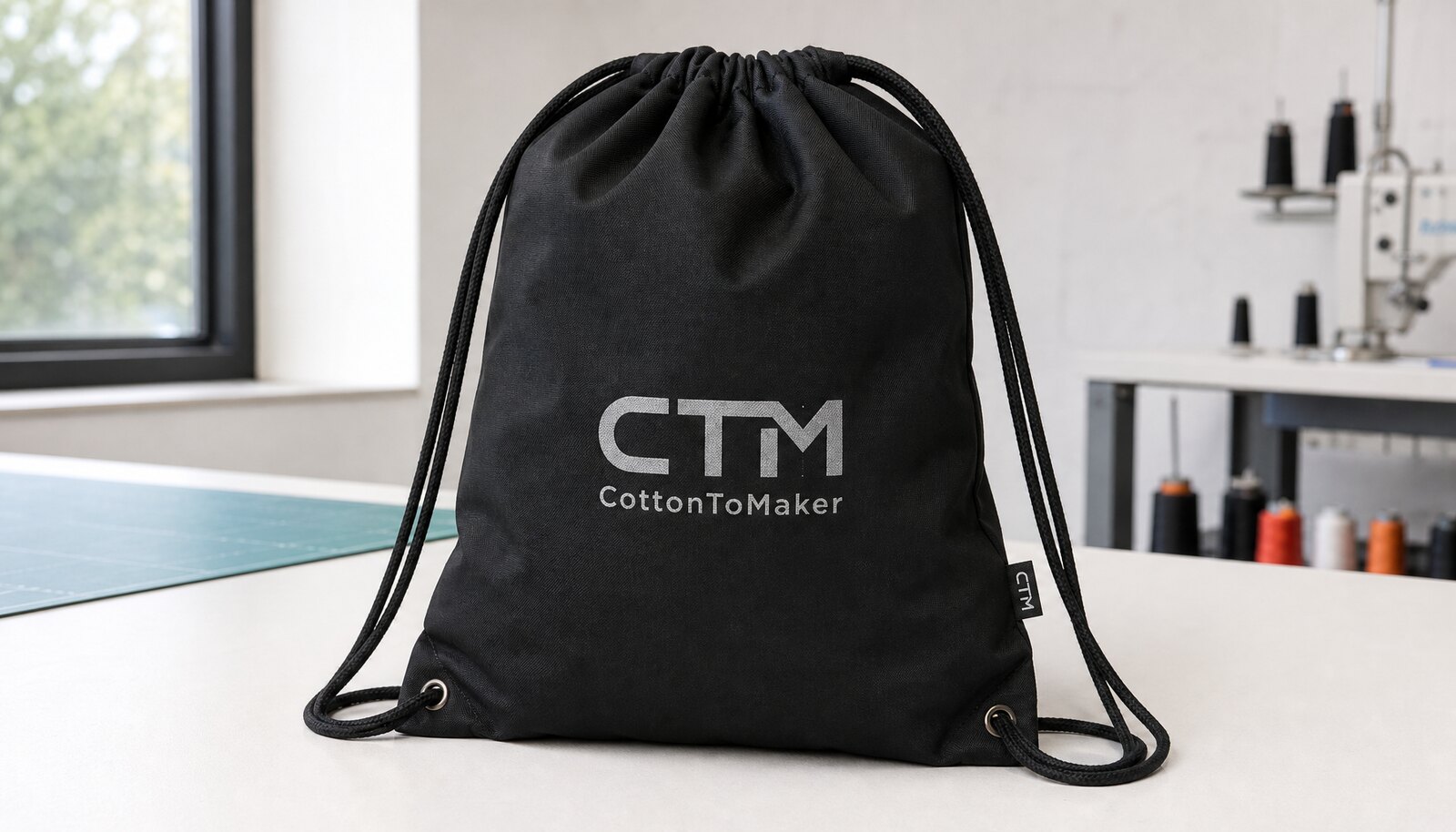
What buyers are really solving when they source launch backpacks
For a brand launch, a drawstring backpack is not just a low-cost bag. It is usually a packaging extension, a giveaway item, or a retail add-on that has to carry a logo cleanly, survive handling, and look consistent across the whole run. The buying problem is usually not the bag shape itself. It is the balance between unit cost, print quality, and how much risk the buyer can accept before the first shipment lands.
That is why the quote should start with the use case. A launch bag for an event kit can be lighter and simpler than a retail bag that sits beside apparel or footwear at point of sale. If procurement does not define the end use, suppliers will quote different constructions that are hard to compare. One factory may quote 210D polyester with a basic print, another may offer 300D with a better hem, and both may look similar on paper until the samples arrive.
- Event giveaway: lowest cost, simple branding, predictable packing
- Retail add-on: cleaner look, better stitching, stronger print durability
- Launch kit insert: needs visual consistency with other packaging items
- Distributor order: often needs flexible MOQ and carton clarity
Choose the fabric first, because it drives price and perception
The fastest way to improve a quote is to specify the fabric properly. For custom drawstring backpacks for brand launches, 210D polyester is the common entry point because it is light, easy to sew, and gives a good printed surface. If the bag needs a more substantial handfeel, 300D polyester is a better middle ground. For a more premium or natural look, 8 oz canvas can work, but it increases sewing time, material cost, and carton weight.
GSM or denier should be written into the RFQ. Buyers often say 'poly bag' or 'cotton bag' and then receive wildly different quotes. If the launch is price-sensitive, a stocked black or navy 210D polyester bag with a one-color print is usually the most efficient combination. If the launch must support a stronger retail shelf presence, the buyer may accept 300D or canvas, but the print and seam details should also move up in quality.
- 210D polyester: best for low-cost launch campaigns and large volume
- 300D polyester: better structure, slightly stronger handfeel, more retail-friendly
- 8 oz canvas: premium appearance, better for branded merchandising, higher freight cost
- Avoid vague fabric wording; use GSM, denier, and color basis in the RFQ
Print method decisions: the logo is where cheap bags get exposed
Logo decoration is the detail that most often separates an acceptable sample from a rejected bulk order. For one-color logos, screen print is usually the most economical route, especially above 1,000 pieces. It gives good opacity on dark bags if the ink and mesh count are matched to the fabric. For short runs or more complex artwork, heat transfer can be useful, but the buyer should know that some transfer films do not age as well under repeated flexing.
If the brand is launching with a minimalist look, a woven label plus a smaller print can be cleaner than a full-panel graphic. That route can also reduce registration problems on textured fabric. For buyers who want a premium retail impression, the decoration should be designed around the bag construction rather than forced onto it. Large artwork across heavy folds, cord channels, or seams increases reject risk and looks uneven in carton inspections.
- Screen print: best unit economics for simple logos and high volume
- Heat transfer: useful for short runs and multi-color art, but test for cracking
- Woven label: works well for restrained branding and longer wear
- Keep small text and thin lines out of low-cost print methods
MOQ logic: how to avoid paying retail pricing for a launch quantity
MOQ is not only a factory rule; it is a cost structure. A factory sets a minimum because cutting, print setup, sewing coordination, and carton packing all carry fixed labor. For custom drawstring backpacks, 1,000 to 3,000 pieces per color and style is usually where pricing becomes efficient. Below that, the unit cost can rise quickly unless the factory is using stock fabric and a very simple decoration.
Procurement teams should compare quotes by MOQ logic, not just by unit price. One supplier may quote a lower per-piece number but require higher setup charges, while another may offer a slightly higher unit price with lower total tooling cost. If the launch is a pilot or a distributor test, 300 to 500 pieces may still be workable, but the buyer should expect tighter color choices and fewer construction options.
- Ask whether MOQ applies per color, per artwork, or per carton pack
- Separate setup charges from unit price before comparing suppliers
- Use stock color fabric to reduce MOQ pressure when speed matters
- For very low quantities, expect fewer options and higher risk of inconsistency
Compare sourcing routes before you compare quotes
The cheapest quoted price often comes from a different sourcing route, not a better bag. A direct manufacturer usually has better control over cutting, stitching, decoration, and packing, which matters when the launch needs repeatable output. A trading company may still be useful if the buyer needs a smaller order or mixed products, but the price structure and accountability can be less transparent.
For launch programs, the buyer should know whether the supplier is actually making the bags in-house or farming out printing and sewing. Outsourced steps create schedule and quality risk that may not show in the first sample. When a supplier can provide the same base fabric, the same print process, and the same packing line, the buyer gets a cleaner approval path and a more stable re-order base.
- Direct factory: better process control, stronger repeat-order consistency
- Trading route: sometimes easier for small mixed orders, but less visibility
- Subcontracted decoration: can cause print shade variation and schedule drift
- In-house packing is valuable when carton count and retail presentation matter
Product-specific comparison table: how to pick the right supply option
The table below compares common sourcing options for custom drawstring backpacks for brand launches. It is built around buyer decisions, not just spec names. Use it to decide whether the job should go to a direct factory, a trading supplier, or a stock-program route. That choice affects price, timing, and how much control you have over decoration and packing.
If the launch has a fixed date, compare options by total landed risk, not by quote headline alone. A slightly higher unit price from a direct manufacturer may still be cheaper if it reduces remake probability, sample confusion, or delay at booking stage.
- Write decisions in measurable language, not only descriptive wording.
- Ask for sample photos plus one physical approval sample for important orders.
- Keep quotation, sample approval, and inspection notes tied to the same spec version.
Comparison table
Packing rules should cover fold direction, cord protection, bundle count, carton compression, moisture bag, and retail label position. These details affect cost, damage rate, receiving speed, and whether the goods can move directly into retail or distribution.
A drawstring backpack can pass product QC and still create claims if cartons are mislabeled, overpacked, crushed, damp, or mixed. Treat packing as part of the specification, not an afterthought.
- Write decisions in measurable language, not only descriptive wording.
- Ask for sample photos plus one physical approval sample for important orders.
- Keep quotation, sample approval, and inspection notes tied to the same spec version.
Sample approval: treat the first sample as a production contract, not a souvenir
A launch bag should never move to bulk on a vague sample. The sample must represent the final fabric, final print method, final cord type, and final packing format. If the sample is made on different cloth or decorated by a different method than the bulk order, it cannot be used as a real approval reference. That mistake is common when buyers focus only on the logo appearance and ignore the construction basis underneath.
A good sample review is practical. Measure finished size, check print placement against a ruler, pull the drawcord several times, and look at the cord channel after flexing. If the bag includes a front pocket, test the zipper travel and seam tension at the pocket corners. For retail launches, the sample should also be packed the same way the bulk order will be packed, because packing mistakes often surface only when cartons are opened at destination.
- Approve only when sample fabric, print, and trim match bulk intent
- Record dimensional tolerance and print placement on the approval note
- Test drawcord smoothness, seam strength, and logo durability by handling
- Keep one signed sample as the sealed reference for QC at shipment
Packing choices and carton data can change your landed cost fast
Packing is often underestimated in launch sourcing. Bulk-packed drawstring backpacks usually cost less to prepare and ship, but retail or e-commerce programs may need individual polybags, barcode labels, or insert cards. Every extra packing step adds labor and can change carton size. That matters because carton volume drives freight cost, especially if the bags are light but bulky.
Ask for carton dimensions, pieces per carton, and gross weight in the quote stage. Those figures let procurement estimate freight before order placement and compare suppliers on a real landed-cost basis. If the supplier cannot provide dependable carton data, the quote is incomplete. For launch programs, that missing information is a warning sign because it usually means packing is being treated as an afterthought.
- Bulk pack: lowest labor cost, best for wholesale and distribution
- Individual polybag: needed for retail presentation or cleanliness control
- Barcode label: important for retail receiving and warehouse scanning
- Carton count and size must be fixed before freight booking
Lead time and schedule risk: where launch orders usually slip
A realistic lead time for custom drawstring backpacks depends on fabric availability, artwork complexity, and whether the order is stocked or custom-dyed. Once the sample is approved, bulk production is often faster than buyers expect, but the front end can still be slow if artwork changes late or if the supplier is waiting for fabric confirmation. A launch plan should include time for sample revisions, not just bulk sewing.
The most common delay points are fabric shade approval, print setup approval, and packing sign-off. If the order involves multiple colors or a special finish, that risk increases. Buyers should separate calendar time into sample, production, and freight rather than treating the supplier lead time as a single number. That makes internal planning cleaner and gives the procurement team a better chance to protect the launch date.
- Stock fabric and simple print move fastest
- Custom color, custom label, or special trim adds approval time
- Late artwork changes often reset print setup or sample approval
- Always build a buffer for export booking and port congestion
Specification comparison for buyers
| Spec decision | Recommended option | When it fits | Buyer risk to check |
|---|---|---|---|
| Fabric route | 210D polyester for lowest unit cost, 300D polyester for better feel, 8 oz canvas for premium retail positioning | Launch giveaways, bundled merch, mass retail promos, or higher-value brand drops | Too-light fabric can look cheap after printing; too-heavy fabric raises freight and unit cost without adding real use value |
| Print method | 1-color screen print for volume, heat transfer for short runs with complex art, woven label plus small print for premium restraint | Simple logos, launch events, multi-color brand marks, or mixed-SKU programs | Fine text and gradients blur on low-cost methods; heat transfer can crack if the fabric is too textured or the print area flexes heavily |
| Closure style | Standard drawcord top with reinforced grommets; add zippered front pocket only if the buyer needs small-item separation | Student promos, event kits, gym bags, and retail add-ons | Extra pockets increase sewing time, reject points, and quote variance; weak grommet reinforcement leads to tearing at the top hem |
| Size target | 34 x 42 cm for everyday use; 35 x 45 cm if the bag must carry a hoodie, brochure set, or shoes | Brand launches where the bag is part of a welcome kit or retail bundle | Oversized bags raise material usage and carton volume; too-small bags cause customer complaints even if decoration looks good |
| MOQ logic | 1,000-3,000 pcs per color/style for efficient factory pricing; 300-500 pcs only if using stock fabric and simple decoration | First launches, pilot runs, seasonal campaigns, or distributor test orders | Low MOQs often mean higher unit price, limited color flexibility, and weaker consistency across dye lots and print placement |
| Color strategy | Use stock black, navy, red, or natural whenever possible; custom dye only when brand guidelines require it | Fast launches, tight budgets, and buyers who need predictable lead times | Custom-dyed fabric adds lab dip approval, shade variation risk, and longer scheduling; stock colors can still vary between mills unless approved against a physical swatch |
| Packing route | Bulk pack in export cartons with master polybag protection; individual retail polybag only when the channel needs shelf-ready presentation | Wholesale, e-commerce backstock, or promo distribution | Retail-packed bags need clearer carton counts, barcode control, and more labor; loose bulk packing risks scuffing if print cure is weak |
| Factory type | Direct manufacturer with in-house cutting, printing, sewing, and packing control | Buyers needing repeat orders, stable specs, and better price control | Trading routes can hide the real factory capability; inconsistent subcontracting often shows up in stitch quality, print registration, and lead-time slippage |
| Sampling path | Pre-production sample with final fabric, final print, and final packing reference before bulk approval | Any launch where timing and brand presentation matter | A sewn sample made from different fabric or a different print process is not a valid bulk standard and can create dispute later |
Buyer checklist before sampling
- Confirm target use: giveaway, retail add-on, event kit, or distribution item, because the use case drives fabric weight, print area, and packing.
- Lock the finished size, drawcord style, and whether the bag needs a front pocket, side loop, or reinforced corner patches.
- Specify fabric type and GSM/denier range in the RFQ, not just the phrase 'polyester' or 'canvas'.
- Provide artwork in vector format with Pantone references or clear color callouts, plus minimum line thickness and text size if relevant.
- State the expected carton pack, inner polybag requirement, and barcode label position before sample approval.
- Define acceptable sample tolerances for print placement, stitch density, color shade, and finished dimensions.
Factory quote questions to send
- What fabric options are available at the target price point, and what is the exact GSM or denier for each?
- Is the quoted price based on stock fabric or custom-dyed fabric, and does it include lab dip or color approval time?
- Which print method is included, how many colors are covered, and what are the setup charges per artwork version?
- What is the MOQ by color, by print, and by packaging format?
- Can you supply a pre-production sample using final fabric, final print, and final packing before bulk approval?
- What are the standard carton dimensions, pieces per carton, and gross weight for shipment planning?
- What is the production lead time after sample approval, and what parts of the schedule are most likely to slip?
- Do you manufacture in-house or outsource any cutting, printing, or packing steps?
Quality-control points to confirm
- Finished dimensions should stay within the agreed tolerance, typically within +/- 1 to 1.5 cm depending on size and fabric stretch.
- Drawcord tension must move smoothly through the channel without snagging, and both cords should be equal length at packing.
- Top hem and grommet areas should show clean reinforcement with no tearing, puckering, or loose threads.
- Print registration should sit inside the approved placement window, with no ghosting, bleeding, or cracked edges after light flexing.
- Stitch density should remain consistent at stress points such as side seams, bottom corners, and cord-channel joins.
- Color shade should match the approved physical sample or signed-off swatch, especially across repeated dye lots.
- Carton packing should match the agreed count, inner protection, and master label format, with no mixed colors unless authorized.