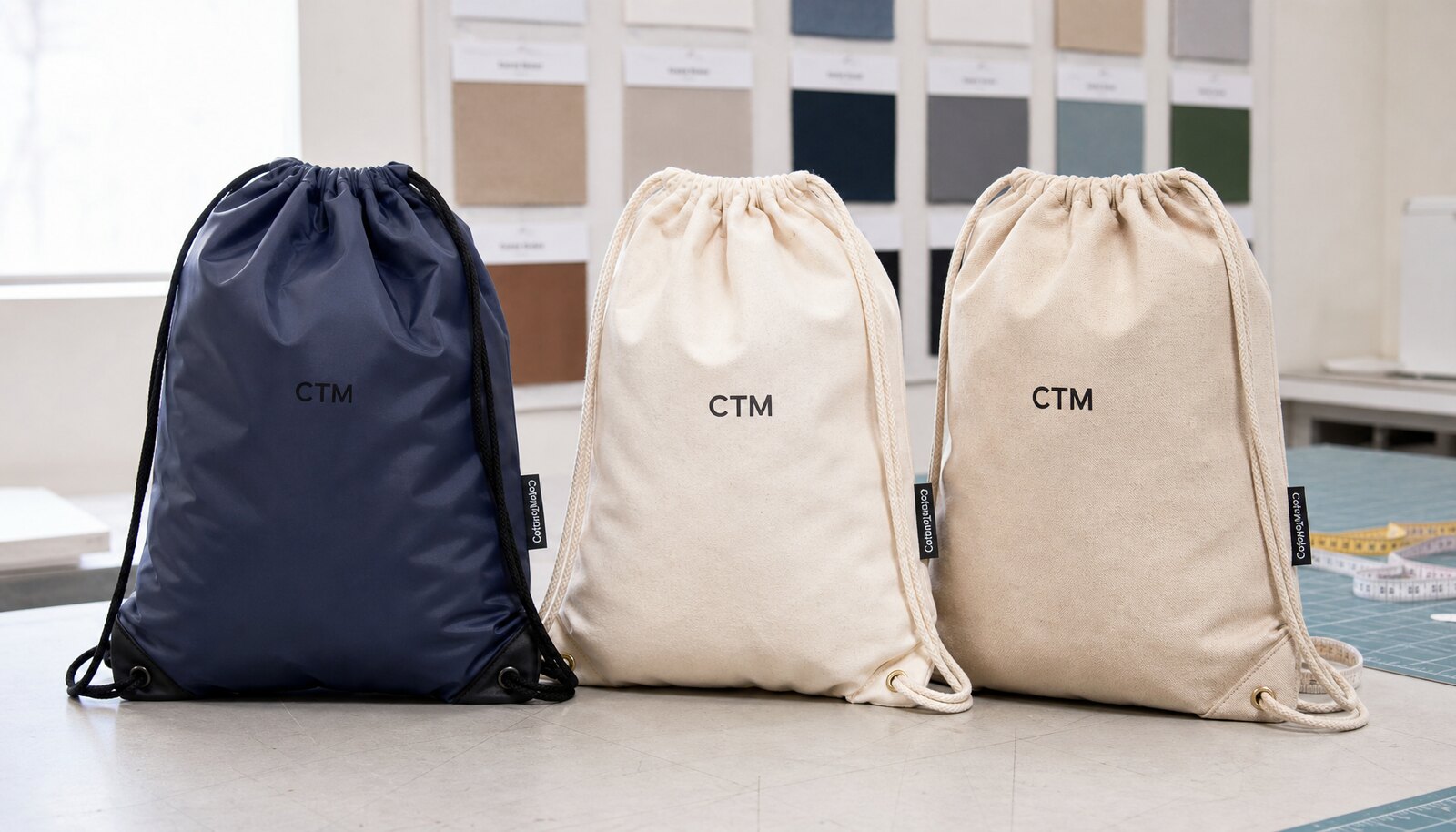
Why MOQ and Price Change So Much on Drawstring Backpacks
A custom drawstring backpack looks simple, but the price is built from several small decisions: fabric type, fabric weight, bag size, drawcord, reinforcement, print method, packing, and how many colors or designs are being produced. When buyers ask only for the cheapest unit price, supplier quotes often look inconsistent because each factory may be assuming a different construction.
For procurement teams, the key is to compare like with like. A 210D polyester backpack with one-color screen print is not comparable to an 8oz cotton backpack with two-color print, barcode labels, and individual packing. If the specification is not pinned down, the lowest quote is often just the least complete quote.
- MOQ usually follows fabric availability, print setup, and cutting efficiency.
- Price usually changes more from material and packing than from stitching labor alone.
- Small order quantities carry higher setup cost per piece, especially when artwork has multiple colors.
- A quote without fabric basis, print method, and packing details is not a reliable quote.
Set the Fabric Spec Before You Ask for Pricing
Fabric choice drives both the buyer experience and the factory’s MOQ. Polyester options such as 210D or 300D are common for promotional backpacks because the fabric is light, stable, and suitable for screen printing. Cotton and canvas versions feel more natural and retail-friendly, but the higher fabric weight increases material cost, carton weight, and sometimes sewing difficulty.
Use caution when comparing GSM, denier, and ounce-based descriptions. These are not clean one-to-one conversions. Two fabrics that are both described as “lightweight” can still behave very differently if the weave, coating, or finish is different. For that reason, the best sourcing practice is to request a physical swatch or a pre-production sample before comparing suppliers on price alone.
- 210D polyester: common for budget promotions; light, compact, and lower cost.
- 300D polyester: stronger hand-feel than 210D; useful when the bag should feel less disposable.
- 5oz-6oz cotton: suitable for lightweight natural-style promotions and packaging campaigns.
- 8oz cotton: better structure and print coverage for brand use.
- 10oz-12oz canvas: more durable and premium, but needs stronger stitching and better cord exit reinforcement.
Indicative Price Bands and MOQ Ranges
The ranges below are only benchmarks for bulk sourcing and assume typical factory production, standard bag sizes, and simple artwork. They are not a market guarantee. The final quote can move up or down based on bag size, print color count, custom dyeing, packing, quality standard, and destination terms.
As a rough procurement guide, basic stock-fabric orders may start around 500-1,000 pieces per color/design, while custom fabric colors, special cord colors, woven labels, or retail-ready packing often push MOQ higher. If a supplier offers a much lower MOQ, ask what part of the construction has been simplified or substituted.
- Basic stock-fabric promotional bags often start around 500-1,000 pcs per color/design.
- Custom fabric color, special cord color, or added labels often raise MOQ to 3,000 pcs or more.
- Retail packing, barcode labeling, and mixed-SKU cartons can raise the practical MOQ even if the factory accepts a lower production quantity.
- The safest comparison is price at the same quantity break, same bag spec, and same packing method.
MOQ Logic: What the Factory Is Really Calculating
MOQ is not only a sales policy. It is connected to how fabric is purchased, how the cutting table is set, how print screens are prepared, and how many pieces are needed to run production efficiently. A factory may accept a lower MOQ for stock fabric and standard drawcord colors, but require a higher MOQ for custom dyed fabric, special cord, woven labels, or multiple artwork versions.
When reviewing quotes, separate total order quantity from quantity per SKU. A 5,000 piece order split into 10 colors may be less efficient than a 3,000 piece order in one color. Each bag color and each print design can create additional setup, color matching, and packing control work.
- Lower MOQ is more realistic when using stock fabric colors and one standard print design.
- Higher MOQ is common for custom dyed fabric, custom cord color, or special hardware.
- Multiple artwork versions may require separate screen setup and separate sample approval.
- Mixed colors in one carton can increase packing error risk unless the carton plan is clear.
- Retail label or barcode requirements can create additional MOQ limits from label suppliers.
Print Method Choices That Affect Unit Price and Durability
The print method should be selected based on artwork, fabric, and expected use. Screen printing is usually the most practical option for simple logos and solid colors. Heat transfer is better for full-color artwork, gradients, and small details, but buyers should still ask for a wash, rub, or fold-resistance check on the approved sample. Embroidery is possible on some heavier fabrics, but it is less common for lightweight drawstring backpacks because the fabric can pucker.
For procurement comparison, ask each supplier to state the print method in the quote. A low price may exclude Pantone matching, use a smaller print size, or assume one-color artwork when your design has several colors. If the supplier says a print is “durable,” ask what test they used or whether that statement is only based on visual inspection.
- Screen print: cost-effective for solid logos; needs screen charge by color.
- Heat transfer: good for full-color designs; check peeling, cracking, and edge lift after folding.
- Digital print: useful for small batches or detailed artwork; confirm fabric compatibility.
- Embroidery: best on heavier cotton or canvas; not ideal for thin 210D unless backed properly.
- Woven label: useful for a subtle brand mark; needs label MOQ and sewing position approval.
Sample Approval Checks Before Bulk Production
A drawstring backpack sample should not be approved only by looking at the logo. It should be checked as a production reference. The sample tells the factory what fabric hand-feel, stitch spacing, drawcord length, print color, and packing format are acceptable.
For repeat orders, keep one signed approved sample with the buyer and one with the factory. For new designs, approve the sample before bulk material cutting whenever the product has custom color, special print, or a retail packing requirement.
- Measure finished size, drawcord length, and opening width.
- Check whether the print is centered and straight when the bag is lying flat and when it is filled lightly.
- Rub the print with a dry and slightly damp white cloth to identify obvious transfer issues.
- Pull the cord exits and bottom corners to see if reinforcement is enough for the intended use.
- Check if fabric shade changes under different light, especially for black, navy, natural cotton, and custom dyed colors.
- Confirm the packed sample, not only the loose bag, if the order is for retail or distributor delivery.
Packing and Carton Details That Change the Landed Cost
Packing is often treated as a small detail, but it affects labor cost, carton volume, warehouse receiving, and claim risk. A loose bulk pack is cheaper and faster, while individual polybag packing protects the bag and makes counting easier. Retail buyers may need barcode stickers, warning text, country-of-origin labels, or color/size sorting by carton.
For importers and distributors, carton data should be requested at quotation stage. Carton size and gross weight affect freight planning, pallet loading, and warehouse handling. A very low unit price can become less attractive if the carton volume is inefficient.
- Bulk pack: lower packing cost, suitable for event distribution or repacking by buyer.
- Individual polybag: cleaner handling and easier counting, but adds material and labor cost.
- Paper band or paper sleeve: useful for plastic-reduction programs, but needs durability testing in transit.
- Barcode label: required by many retail and distributor warehouses; must be checked against PO data.
- Export carton marks: should include item number, quantity, color, PO number, and carton sequence if required.
Lead Time: What Buyers Should Put in the RFQ
Lead time should be divided into sample time, approval time, material preparation time, production time, packing time, and inspection time. If the buyer gives approval late, changes artwork after sample approval, or delays barcode files, the production schedule changes. A clean RFQ reduces these delays.
Do not rely only on a supplier’s shortest stated lead time. Ask what the lead time is based on: stock fabric or custom dyed fabric, one design or multiple SKUs, simple bulk pack or retail-ready packing. This makes the delivery schedule more realistic.
- Sample lead time depends on fabric availability, artwork complexity, and print method.
- Bulk lead time starts after final sample approval, artwork confirmation, deposit, and packing data approval.
- Custom dyed fabric can add time compared with stock color fabric.
- Multiple SKUs need extra time for line setup, packing separation, and final inspection.
- Pre-shipment inspection should be planned before the final delivery date, not after goods are packed for dispatch.
Specification comparison for buyers
| Spec decision | Recommended option | When it fits | Buyer risk to check |
|---|---|---|---|
| Indicative budget range | About $0.40-$0.90 ex-factory at 1,000-3,000 pcs for basic 210D polyester, one-color print, bulk pack | Giveaway programs, schools, events, short-use promotions | Price usually excludes freight, duties, and special packing; confirm what is included |
| Indicative mid-range range | About $0.90-$1.80 ex-factory at 1,000-3,000 pcs for 300D polyester or 6oz cotton, one- or two-color print | Brand promotions where the bag must be reused several times | MOQ and setup charges rise if color matching, custom cords, or retail labels are required |
| Indicative premium range | About $1.80-$3.50+ ex-factory at 1,000-3,000 pcs for 8oz-10oz+ cotton or canvas, larger print, and retail-ready packing | Merchandise, lifestyle brands, higher perceived value programs | Heavier fabrics increase sewing time, carton weight, and sometimes rework on cord exits |
| Entry promotional backpack | 210D polyester, often quoted as a light promotional fabric; some factories also describe it by denier only, so ask for actual fabric weight or sample swatch | Events, schools, low-cost giveaways, short campaign use | Do not assume denier alone defines thickness; weave and coating change hand-feel and opacity |
| Mid-range reusable backpack | 300D polyester or 6oz cotton; if a supplier uses GSM instead of oz, ask them to state both the quoted fabric basis and a sample | Brand promotions where the bag must survive repeated use | Conversions between GSM, oz, and denier are approximate, not universal, so compare the actual swatch |
| Natural cotton backpack | 5oz-8oz cotton, usually better for retail or eco positioning | Retail packaging, eco campaigns, lifestyle brands | Cotton can shrink, vary in shade, and absorb print differently from polyester |
| Heavy canvas backpack | 10oz-12oz canvas, with reinforced eyelets or stitched cord channels | Merchandise, clubs, premium giveaways, heavier contents | Needle marks, seam strength, and cord abrasion should be checked in samples |
| Full-color artwork | Heat transfer or digital print on suitable fabric | Gradients, photos, small text, multi-color artwork | Check cracking, peeling, and rub resistance after folding and handling |
Buyer checklist before sampling
- Confirm bag size in width x height and state whether a tolerance is acceptable, for example +/- 1 cm.
- Specify fabric type and the exact basis used by the supplier, such as 210D polyester, 300D polyester, 6oz cotton, 8oz cotton, or 10oz canvas.
- Ask the factory to state whether it is quoting by denier, GSM, or ounce weight, because these are not interchangeable without caveats.
- Send logo files in vector format and define print size, print position, Pantone references, print method preference, and any minimum text size.
- State expected order quantity by color and design, not only total quantity, because MOQ usually changes by SKU.
- Confirm drawcord material, cord thickness, cord color, and whether reinforced bottom corners, eyelets, or stitched cord tunnels are required.
- Define packing method, inner quantity, carton limit, barcode label needs, and any retailer routing requirements.
- Request pre-production sample approval before bulk cutting if the order has custom fabric color, multiple prints, or retail packing.
- Ask the factory to separate mold, screen, sample, packing, and freight-related costs from the unit price.
- Ask for an itemized quote that shows unit price at several quantity breaks, so you can benchmark whether the savings are real or only tied to a larger MOQ.
Factory quote questions to send
- What is the MOQ per fabric type, per bag color, and per artwork design?
- Can you quote a price ladder at 500, 1,000, 3,000, 5,000, and 10,000 pieces so we can compare break points?
- Does the quoted price include drawcord, reinforced corners, logo printing, individual packing, and export cartons?
- Which fabric basis are you quoting, and can you provide the actual denier, GSM, or ounce weight plus a sample swatch?
- If you use equivalence between GSM and denier, what is the exact fabric construction and coating assumption behind it?
- What print method do you recommend for this artwork, and what are the limits for small text, gradients, and Pantone matching?
- What is the sample cost, sample lead time, and what sample charges are refundable after bulk order confirmation?
- What is the production lead time after artwork approval, sample approval, and deposit?
- What are the carton dimensions, gross weight, net weight, and estimated CBM for the quoted quantity?
- What inspection standard do you use for seam strength, print adhesion, color tolerance, and packing accuracy?
Quality-control points to confirm
- Check finished bag size against the approved sample, especially width, height, cord length, and channel opening.
- Confirm fabric weight and hand-feel match the approved sample, not only the written specification.
- Inspect print color, print position, edge sharpness, opacity, cracking, and rubbing resistance.
- Pull-test cord exits, bottom corners, eyelets, and side seams because these areas usually fail first in use.
- Check color consistency between panels, drawcords, labels, and printed logo.
- Verify packing quantity, barcode labels, carton marks, polybag warning text if required, and mixed-color carton accuracy.
- Review needle holes, loose threads, skipped stitches, dirty marks, and fabric creases before final packing.
- If the bag will be reused, ask for a simple bend-and-rub check on the print area so you can spot obvious durability issues before approval.