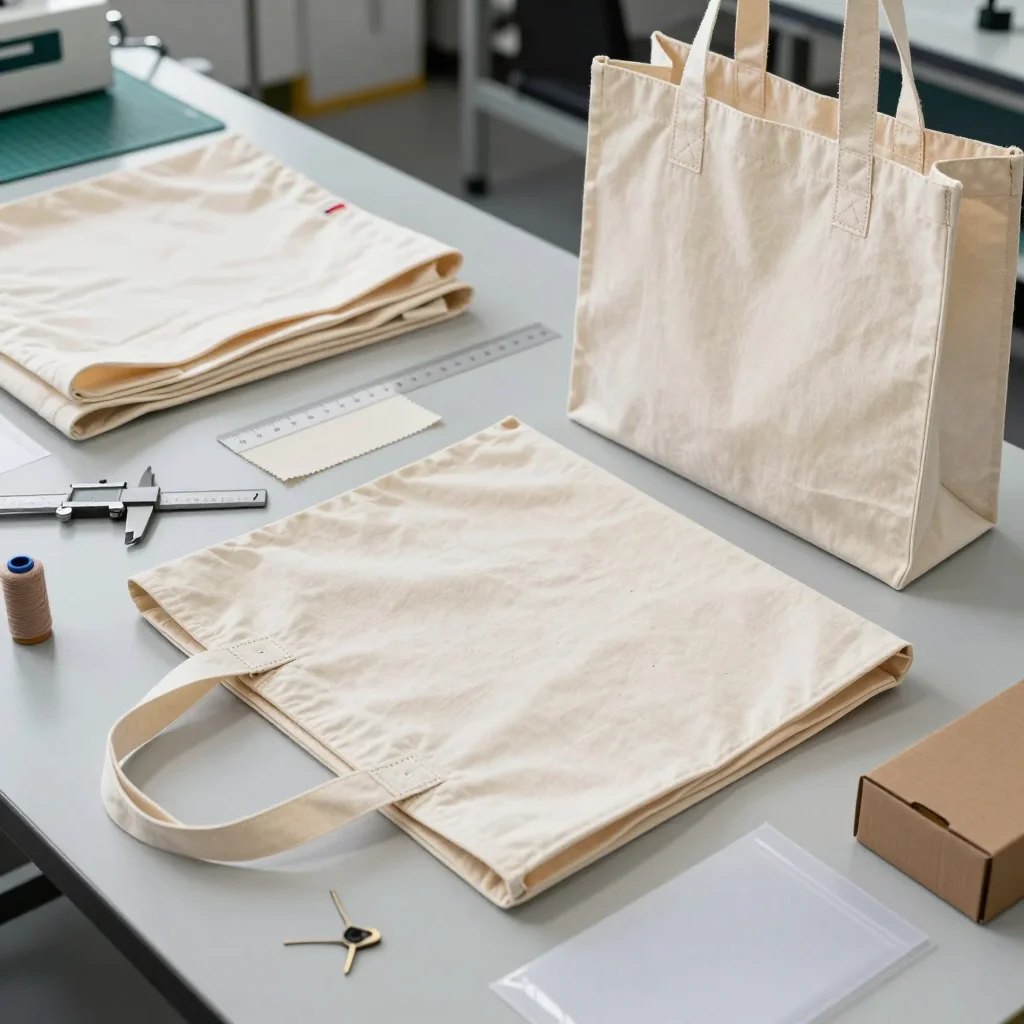
Buyer Problem
Custom cotton tote bags look simple in a catalog, but a B2B RFQ needs more than a product name. Cotton can mean a light regular cotton promotional tote, a tighter cotton canvas bag, or a heavier structured canvas style. Those choices affect handfeel, sewing difficulty, print result, carton volume, and price. If the RFQ only says cotton bag, suppliers can quote different products while appearing to answer the same brief.
The goal is to turn a general tote-bag request into a controlled specification: fabric class, weight, finished size, gusset, handle construction, print method, packing, carton data, sample route, inspection checks, and approval timing. That lets procurement compare suppliers on a like-for-like basis instead of comparing catalog labels.
- Visible byline and Article/BlogPosting JSON-LD author: Person named Vincent Xi, jobTitle Editorial Author, URL https://cottontotemaker.com/authors/vincent-xi/.
- Approved Editorial note: Vincent Xi is the Editorial Author. His articles use cited public sources and distinguish documented claims from buyer checks that require current verification. No first-person experience, credentials, tenure, factory visits, testing, customer projects, or certifications are claimed.
Define The Use
Start with the job the tote must do. An event giveaway may prioritize low cost, flat construction, simple artwork, and bulk packing. A retail tote usually needs cleaner presentation, controlled handfeel, stronger-looking stitching, and packing that works for resale or fulfillment. A grocery, book, or merchandise-kit tote needs usable depth, handle comfort, and construction suited to dense or bulky contents.
Use-case language also keeps internal stakeholders aligned. Marketing may want a large front print, operations may need carton markings, and retail may require individual packing or hangtags. Put those needs in the RFQ before sampling, or a cheap default can become a revised quote, new sample, or repacking problem.
- For event giveaways, ask for a lighter regular cotton option and a cotton canvas option if handfeel has not been approved.
- For retail packaging, define canvas weight, seam finish, print area, folding method, carton markings, and individual packing if needed.
- For grocery or daily carry, add gusset depth, handle drop, handle reinforcement, top-edge finish, and bottom construction detail.
- For resale programs, include barcode, hangtag, label placement, mixed-SKU rules, and carton separation by purchase-order line.
Cotton Or Canvas
The phrase custom cotton tote bags is not specific enough for factory pricing because canvas may also be cotton. The Pamusan source describes regular cotton tote fabric as a lighter single-ply plain weave, while canvas is described as a tighter plain or twill weave with more structure. For procurement, the key distinction is not only fiber; it is construction and finished behavior.
Write the RFQ in terms a supplier can build and a buyer can inspect. Ask for regular cotton plain weave when the target is a soft, foldable promotional bag. Ask for cotton canvas when the target is a tighter, more structured bag for retail, grocery, or repeated-use programs. If handfeel has not been approved, request parallel samples rather than deciding from a spreadsheet.
A heavier canvas can look more substantial, but it can also change needle marks, folding thickness, carton volume, print handfeel, and sewing cost. A lighter cotton can reduce packing volume and unit cost, but it may not deliver the same structure. The correct choice is the one that fits contents, artwork, packing, and distribution route.
- State fiber and construction together, such as regular cotton plain weave or cotton canvas.
- Do not accept a quote that only says cotton bag unless fabric stage, weight, and construction are clarified.
- Approve fabric by swatch or production sample because catalog wording may not match handfeel.
- Keep selected fabric constant when comparing price breaks across suppliers.
Weight And GSM
Fabric weight is useful only when the supplier states the unit and fabric stage. The Pamusan source at https://pamusan.com/blogs/news/what-is-the-difference-between-canvas-tote-bags-and-regular-cotton-tote-bags, retrieved 2026-07-13, lists mid-weight cotton at 5-6 oz and 170-200 gsm for gift bag or conference tote use. The same excerpt lists light canvas at 8 oz and 270 gsm for everyday shopping tote use, and standard canvas at 10 oz and 280 gsm for grocery tote and retail bag use.
Use those figures as sourcing references, not universal requirements. A 170-200 gsm cotton conference tote and a 280 gsm canvas retail tote may both be valid, but they are not equivalent quotes. Ask whether the quoted weight refers to greige fabric, dyed fabric, washed fabric, finished fabric, or a catalog naming convention.
Connect weight to finished dimensions. A heavier fabric in a small flat tote may feel structured, while the same fabric in a large gusseted tote may still need stronger handle anchoring and a better seam finish. Fabric weight narrows the options, but it does not replace sample approval.
- Ask each supplier to state oz per square yard and gsm in the quotation.
- Ask whether the stated weight is measured on greige, dyed, washed, or finished fabric.
- Request a swatch or cutting from the proposed fabric before approving bulk production.
- Compare price only after fabric class, weight, size, handle, print, and packing are aligned.
Print Method
Printing is part of the bag specification, not a separate decoration line. A smooth light cotton, tight canvas, and heavily textured canvas can handle ink and transfers differently. The Custom Ink source at https://www.customink.com/blog/tote-bag-guide, published 2026-04-02 and retrieved 2026-07-13, lists cotton canvas as suitable for screen printing and gives a cotton canvas flat-tote imprint reference of up to 15 inches wide by 16 inches high.
Treat that 15 inches wide by 16 inches high figure as a flat-tote planning reference, not a rule for every custom bag. Gussets, pockets, zippers, seams, mini formats, curved panels, and handle placement can reduce the safe print area. The supplier should confirm the maximum safe print area on the exact construction being quoted.
Artwork needs production detail. State print dimensions, position from top and side reference points, color count, color references, file format, and whether the artwork includes fine lines, small lettering, gradients, or large ink coverage. For full-color artwork, ask whether heat transfer, DTF, or another process is proposed, then approve it on the selected fabric before bulk production.
- For spot-color artwork, request screen-print pricing by color count and print position.
- For small lettering, ask for minimum font size and line thickness on the selected fabric.
- For large ink coverage, review handfeel, edge sharpness, curing, cracking risk, and color consistency.
- For gusseted or pocketed bags, require the supplier's confirmed safe print area for that exact sample.
Bag Construction
A tote can use acceptable fabric and still miss buyer expectations if construction is weak or inconsistent. Handle anchoring, stitch density, seam finish, top-edge finishing, thread trimming, and bottom construction all affect perceived quality. The ToteBagFactory excerpt at https://totebagfactory.com/blogs/news/bulk-canvas-tote-bags-the-technical-checklist-for-orders-over-10-pieces, retrieved 2026-07-13, flags handle stitching below 6-8 stitches per inch for regular-use bags as a red flag.
Use the 6-8 stitches per inch figure as an inspection prompt, not as a universal pass-fail standard or CottonToMaker test result. The buyer still needs an agreed inspection method, sample reference, and acceptance criteria for the actual order. A retail tote with visible stitching may need tighter cosmetic control than an internal-event bag, while a grocery or book tote may need more attention to handle attachment and bottom construction.
Specify handles in measurable terms: handle material, width, total length, handle drop, stitch type, reinforcement pattern, thread color, and whether the handle is self-fabric or separate cotton webbing. Also define the top edge, side seam, gusset depth, and bottom seam finish.
- State handle drop from the bag opening to the top of the handle loop.
- Define whether the top edge is folded, bound, overlocked, or finished by another method.
- Ask the supplier to identify the reinforcement pattern used at the handle attachment.
- Check the approved sample against bulk pieces from different cartons, not only the first carton opened.
Sample Approval
The useful sample is the one that represents production. A showroom blank may help with rough handfeel, but it is not enough for a custom order unless the buyer is purchasing that exact stock bag with the same fabric, handle, print, and packing. For custom cotton canvas tote bags, the pre-production sample should use production fabric, production handle material, final dimensions, intended seam finish, final print method, and intended packing.
Approve in sequence. First approve fabric and construction, because changing from regular cotton to canvas or from flat to gusseted construction can alter cost and production. Then approve print method, placement, color, and handfeel on the selected fabric. Finally, approve the complete pre-production sample with packing, labels, and carton assumptions if those are part of the order.
If the supplier substitutes fabric, handle material, print method, thread, packing, or visible trim in the sample, require that exception in writing. Otherwise, the buyer may approve one item while the supplier prices and produces another. Dated approval comments and annotated photos create a practical reference for production and inspection.
- Measure width, height, gusset depth, handle length, and handle drop on the sample.
- Compare stiffness, weave density, shade, and surface texture against the approved swatch.
- Check print placement from top edge, side seams, and bottom fold instead of relying on visual centering.
- Approve the sample with dated comments so inspection has a fixed reference.
MOQ And Cost
MOQ is rarely one clean number. A supplier may have a minimum for blank stock bags, another for printed production, another for dyed fabric, another for custom handles, and another for individual packing or labels. If procurement asks only for MOQ, the answer may hide the real constraint and make two quotes look comparable when they are not.
Separate unit price from setup and service costs. Screen setup, artwork handling, sample courier, packing labor, carton marking, label application, inspection support, and remake terms can change the buying result. The lowest unit price may not be the lowest total cost if it excludes the services needed for the actual order.
Quote comparison should hold the product constant. Ask each supplier to quote the same fabric class, weight, finished size, handle, print method, print position, packing method, carton count assumptions, approval route, and inspection support. If a supplier suggests a lower-cost alternative, list it as an alternate specification rather than mixing it into the baseline comparison.
- Request quantity breaks while keeping specification, packing, and artwork constant.
- Ask whether fabric is in stock or requires weaving, dyeing, washing, or finishing.
- Separate screen, setup, sample, label, hangtag, and packing charges from the unit price.
- Ask what changes if the buyer revises quantity, artwork, packing, or delivery split after sample approval.
Packing And Timing
Packing affects cost, freight, warehouse handling, and presentation. Flat bulk packing may suit giveaways and internal distribution. Individual packing, barcode labels, hangtags, carton sorting, or retail-ready presentation can add labor and materials. A serious RFQ should ask for pieces per carton, carton dimensions, gross weight, net weight, carton marking format, moisture-control method, and mixed-SKU separation.
Lead time should be broken into stages rather than accepted as one broad promise. Ask for sample timing, buyer approval window, fabric preparation, printing, sewing, QC, packing, and handover date after approval. Also ask what happens if artwork is late, fabric is not in stock, packing labels change, or the sample requires revision.
For import or multi-location distribution, carton data matters early. A deeper gusset, heavier fabric, or individual packing method may increase carton volume even when unit price looks acceptable. The retrieved source excerpts do not establish freight cost, carton size, or lead time; those must come from supplier quotes and logistics checks.
- State whether bags ship folded, flat, rolled, bulk packed, or individually packed.
- Confirm whether cartons need inner liners, desiccant, moisture protection, or pallet instructions.
- Ask whether colors, prints, or SKUs are mixed by carton or separated by PO line.
- Require the supplier to list buyer approvals needed before bulk production starts.
Evidence And Limits
The evidence base for this article is the source research set retrieved on 2026-07-13. Exact figures are listed in the data_points array with unit, scope, as-of context, source URL, and evidence note. They are useful for RFQ planning, but they do not replace supplier confirmation, approved samples, inspection criteria, or current product documents.
No certification, retailer compliance result, factory visit, independent test, customer outcome, or first-person experience is claimed. Standards should be named only when the buyer has a current requirement or supplier document. If a supplier claims organic cotton, recycled content, restricted-substance compliance, food-contact suitability, retailer approval, or any market-entry claim, request current documents showing standard name, product scope, market, issuing body, and validity date.
A chart is not included because the available figures mix different scopes: fabric weight references in gsm, flat-tote imprint dimensions in inches, and stitch-density inspection context in stitches per inch. These values are useful procurement checkpoints, but they should not be forced into one chart as though they measure the same thing.
- Use the data points as quote-planning references, then verify them against supplier fabric sheets, samples, and production documents.
- Ask suppliers to state whether their figures are measured production values, catalog references, or quotation assumptions.
- For load-bearing expectations, define the buyer's acceptance method rather than relying on a general article excerpt.
- For compliance-sensitive programs, require current documentation before using any claim in packaging, listings, or sales material.
Specification comparison for buyers
| Spec decision | Recommended option | When it fits | Buyer risk to check |
|---|---|---|---|
| Fabric class | Define regular cotton or cotton canvas before asking for price. | Regular cotton fits light events; cotton canvas fits retail, grocery, and repeated-use programs. | A quote that only says cotton bag can hide different weave, stiffness, print surface, and packing volume. |
| Fabric weight | Ask suppliers to state oz per square yard and gsm, then tie the value to the actual fabric stage. | Useful when comparing light promotional bags with more structured canvas bags. | Catalog weight, greige fabric, dyed fabric, washed fabric, and finished fabric may not mean the same thing. |
| Canvas range | Shortlist light, standard, and heavier canvas options before sampling. | Good for buyers still deciding between lower cost, better structure, and retail handfeel. | Heavier canvas can change needle marks, folding thickness, carton volume, print handfeel, and sewing cost. |
| Print method | Use screen printing for simple spot-color artwork; review transfer or DTF only after a fabric-specific sample. | Works when artwork, fabric texture, and print coverage are known before approval. | Confirm ink type, curing, color tolerance, print size, print position, and sample route. |
| Artwork size | Keep large front prints inside the supplier's confirmed safe print area for the exact bag construction. | Relevant for flat totes and simple front-panel graphics. | Do not apply a flat-tote source limit to gusseted, zipper, pocket, mini, or shaped bags without confirmation. |
| Handle construction | Specify handle length, handle drop, handle width, webbing material, stitch pattern, and stitch density. | Shoulder carry, grocery use, and book use need different handle details. | Weak anchoring can make an otherwise acceptable fabric feel unreliable. |
| Gusset and bottom seam | Use a bottom gusset when the tote must stand, hold boxed products, or carry bulky goods. | Flat totes pack efficiently; gusseted totes work better for retail and grocery contents. | Confirm finished width, height, depth, seam finish, and bottom reinforcement on the actual sample. |
| MOQ and setup | Separate blank MOQ, printed MOQ, dyed fabric MOQ, sample MOQ, and packing MOQ. | Helps importers compare suppliers on the same product instead of different assumptions. | A low unit price can exclude screens, setup, sample courier, packing labor, labels, or inspection support. |
| Packing | Quote bulk packing, individual packing, carton labels, and retailer-style packing as separate options. | Bulk packing suits giveaways; individual packing suits retail, kits, and fulfillment. | Confirm pieces per carton, carton dimensions, weights, moisture protection, and mixed-SKU separation before approval. |
Buyer checklist before sampling
- Define the intended use: event giveaway, retail sale, grocery carry, book fair, merchandise kit, or reusable brand packaging.
- State whether the bag should be regular cotton or cotton canvas, then add target fabric weight in oz per square yard and gsm.
- Ask for a lighter cotton option and a canvas option when fabric handfeel has not been approved.
- Specify finished width, height, gusset depth, handle length, handle drop, handle width, seam finish, and any pocket, zipper, label, or hangtag.
- Attach artwork with print dimensions, print position, color references, color count, and notes on fine lines or small lettering.
- Require a pre-production sample using production fabric, production handles, final print method, and intended packing.
- Ask suppliers to identify any substitute material or process used in the sample before approval.
- Request carton quantity, carton size, gross weight, net weight, packing method, carton marking format, and mixed-SKU plan.
- Separate sample lead time, fabric preparation, printing, sewing, QC, packing, buyer approval time, and shipping handover date.
- Compare total buying impact: setup, sample, wastage, packing, inspection support, carton volume, remake terms, and approval assumptions.
Factory quote questions to send
- What fabric weight are you quoting in oz per square yard and gsm, and is it based on greige, dyed, washed, or finished fabric?
- Is the quoted bag regular cotton plain weave, cotton canvas plain weave, twill canvas, or another construction?
- Can the pre-production sample be made from the same batch fabric planned for bulk production?
- What finished size tolerance applies to width, height, gusset depth, handle length, and handle drop?
- What handle material, handle width, stitch type, stitch density, and reinforcement pattern are included?
- Which print method is included, what ink or transfer type is proposed, and what setup charges apply by color and position?
- What is the maximum safe imprint area on this exact bag size and construction?
- What MOQ applies to blank bags, printed bags, dyed fabric, custom handles, labels, hangtags, and individual packing?
- What are the sample lead time, bulk production lead time, QC window, packing completion date, and handover date after approval?
- How many pieces are packed per export carton, and what are the carton dimensions, weights, moisture-control method, and carton marking format?
Quality-control points to confirm
- Check fabric weight against the approved swatch and supplier specification; do not rely on color or handfeel alone.
- Measure finished width, height, gusset, handle length, and handle drop on pieces pulled from different cartons.
- Inspect weave density by holding the fabric to light and comparing gaps against the approved sample.
- Count handle stitches per inch and verify that reinforcement matches the approved sample.
- Pull-test the handle joint according to the buyer's own acceptance requirement or agreed inspection method.
- Check bottom seam reinforcement on bags intended for books, groceries, bottles, or boxed goods.
- Review print registration, edge sharpness, ink coverage, curing, color consistency, and adhesion on the ordered fabric.
- Confirm trimming quality, including loose threads, skipped stitches, needle holes, stains, oil marks, and uneven folded edges.
- Verify packing count, carton markings, moisture protection, individual bagging, barcode or label placement, and mixed-SKU separation.