Start With the Job, Not the Logo
A wholesale order for custom cotton drawstring pouches should start with the job the pouch has to do, not with the artwork. A pouch used for a badge, pen, and folded agenda can be lighter and simpler than a pouch carrying glass sample vials, boxed cosmetics, small tools, or premium VIP gifts. Trade show exhibitors also work under real operating constraints: kits may be packed at a warehouse, topped off at a booth, shipped to a venue, or handed out during a product launch. Those details affect fabric weight, size, closure, print method, packing count, carton labeling, and lead time.
The common procurement mistake is to send suppliers only a pouch size and a logo file. That leaves too much open. One supplier may quote 140 GSM cotton with a single drawstring and bulk loose packing; another may quote 200 GSM cotton, double drawstrings, and fixed-count inner bags. Both look like custom cotton drawstring pouches wholesale, but they are not the same product. A solid RFQ tells suppliers what the pouch carries, how it will be handled, what quality level is acceptable, and which details are non-negotiable.
- Define the event use case before pricing: giveaway, sample pack, VIP kit, badge kit, retail insert, distributor program, or resale pouch.
- List the contents with dimensions and weight, including boxes, inserts, bottles, cables, cards, samples, or loose components.
- Note where the pouch will be filled: supplier factory, third-party kitting center, company warehouse, venue receiving area, or booth storage room.
- State whether the pouch is expected to be disposable, reusable, retail-presentable, or part of a premium brand experience.
- Identify hard constraints early, such as plastic-free packing, organic cotton, exact brand color, QR readability, or venue delivery date.
Turn Fabric Terms Into Buying Specs
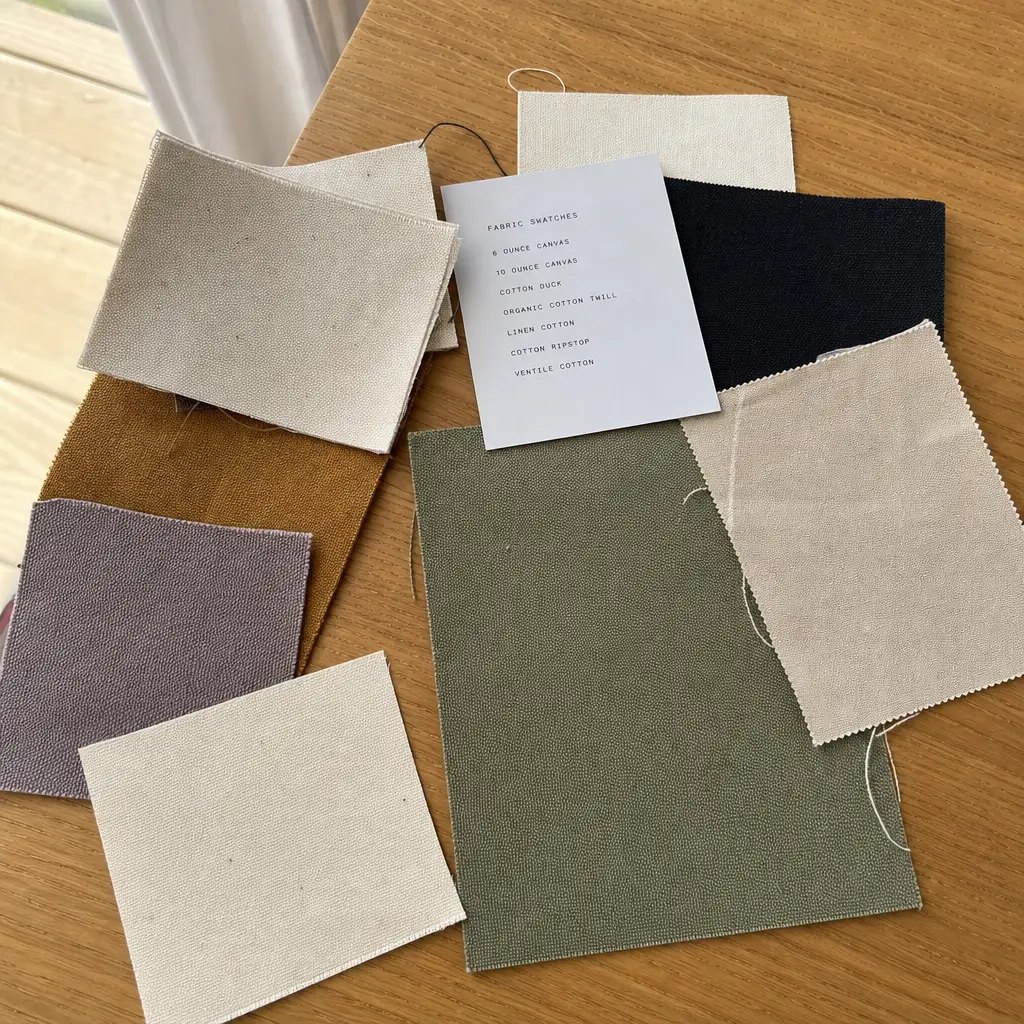
Cotton pouch fabric gets described in ounces, GSM, canvas, calico, muslin, or plain weave, but those terms are not interchangeable. GSM means grams per square meter. Ounces for cotton bags usually refer to ounces per square yard. As a rough guide, 4 oz cotton sits in the light promotional range, 5-6 oz is a practical middle range for trade show pouches, and 8 oz cotton canvas has a heavier, more structured feel. Because yarn count, weave density, finishing, and washing can change handfeel, weight should be backed by a physical swatch, not treated as the only quality measure.
For B2B buyers, the goal is to remove ambiguity. Ask the supplier to quote fabric weight, composition, weave, color, and finishing. Natural unbleached cotton is usually the simplest choice because it avoids dye-lot matching and often supports faster sampling. Bleached cotton gives a cleaner white base for certain logos but can show marks more easily. Dyed cotton can match a campaign better, but it should come with lab dip approval or a defined shade tolerance. Organic or recycled cotton should be supported by the documentation your compliance team requires, rather than used as a vague marketing label.
- Use 140-170 GSM cotton for very light, budget-driven giveaways with flat or low-weight contents.
- Use 170-200 GSM, often sold as 5-6 oz, for most trade show sample pouches, badge kits, and reusable giveaway bags.
- Use around 270 GSM, often sold as 8 oz, when the pouch needs more structure, opacity, or perceived value.
- Request a fabric swatch before approval if the pouch will be photographed, reused, displayed at the booth, or paired with premium contents.
- For dyed cotton, ask for lab dip approval and confirm whether bulk shade variation will be evaluated under a standard light source.
- For organic, recycled, or chemical-safety requirements, specify the certificate or test report needed instead of accepting a general claim.
Size the Pouch Around Usable Space
Finished pouch size is not the same as usable internal space. A drawstring pouch loses area to side seams, bottom seam, fabric thickness, and the top drawstring channel. The closure also gathers fabric, which reduces the practical opening width. If a box is 150 mm wide, a 150 mm pouch is not a working fit. For flat items, buyers should allow clearance so staff can insert the contents quickly. For rigid or thick items, the pouch may need a larger flat size, gusset, or different bag construction.
This matters because event packing is labor-sensitive. A pouch that technically fits after careful handling may still fail in the warehouse if staff need to force in every kit. If the pouch is prefilled, ask for a fit sample using the actual contents or a size-equivalent dummy. Provide product dimensions, weight, and packing order to the supplier. When requesting a quote, state the finished pouch size as width x height after sewing, and confirm whether the height includes the drawstring channel. For most non-critical promotional pouches, +/-5 mm on small sizes and +/-10 mm on larger sizes is a practical production tolerance, but product-fit programs may need tighter control.
- Quote finished size, for example 180 x 240 mm, instead of fabric cut size or approximate flat size.
- Confirm whether the stated height includes the drawstring channel and top opening allowance.
- Leave clearance for contents, especially if products are boxed, rigid, thick, sharp-cornered, or packed in multiples.
- Measure usable internal height below the channel if the contents must sit fully below the drawstring.
- Approve a physical fit sample when the pouch must hold a fixed kit, a retail insert, or a product set that cannot be resized.
- Avoid making the pouch just large enough on paper; kitting speed and seam stress matter as much as theoretical fit.
Choose the Print Method by Risk, Not Habit
For custom cotton drawstring pouches, screen printing is usually the first method to consider for wholesale trade show orders. It is effective for solid logos, one to three spot colors, and simple event artwork. The variables that affect quality include fabric texture, ink opacity, mesh selection, curing, and the line weight in the artwork. A logo that looks sharp on coated paper may soften on cotton because the fabric has yarn texture and absorbs ink differently.
Heat transfer can be useful for gradients, photographic images, small multi-color artwork, or designs that are not economical to separate into screens. Embroidery can look premium for a small emblem, but it is less suitable for large filled areas, fine sponsor text, QR codes, or lightweight pouches that may pucker under stitching. Dark fabric often needs an underbase for bright print colors, which can change handfeel and cost. The safer procurement approach is to approve print on the selected fabric, not only on a digital mockup.
- Send vector artwork whenever possible, with fonts outlined and Pantone references noted for spot colors.
- State print size and position in millimeters, such as centered 65 mm below the top seam or 40 mm above the bottom seam.
- Ask for minimum printable line weight and minimum text height on the selected cotton fabric before approving small details.
- For QR codes, test the printed sample with common phones at normal scanning distance; do not rely on a PDF proof.
- For dark or dyed fabric, confirm underbase requirements and whether the print may feel thicker than on natural cotton.
- For multi-color screen print, ask about registration tolerance and whether slight shifts are acceptable for the design.
Specify the Drawstring and Construction Details
The drawstring system is a functional component, not a minor finishing touch. Cotton cord gives a cohesive natural look and fits eco-positioned event kits. Polyester cord can offer brighter color consistency, smoother pulling, and better abrasion resistance. Cord diameter should match the pouch size and channel width. Too thin, and it can cut into the channel or feel cheap; too thick, and it can bunch, jam, or make small pouches difficult to close.
Construction should be described clearly in the RFQ. A single drawstring is cost-effective for simple flat giveaway pouches. A double drawstring, pulled from both sides, usually feels more balanced and easier to open and close. For heavier contents, the drawstring channel and side seams should be checked for skipped stitches, puckering, and stress points. If the pouch will be opened repeatedly or carried around the show floor, ask the supplier how they reinforce the seam ends and whether cord length is controlled across production.
- Specify single drawstring or double drawstring; do not leave the closure style to supplier assumption.
- Confirm cord material, color, approximate diameter, knot style, cut-end finish, and whether any metal or plastic tips are allowed.
- Check that the channel width allows smooth cord movement after sewing and pressing.
- Require consistent cord length so the finished pouches look uniform and pack cleanly.
- For heavier kits, ask for a simple seam and cord pull test using the intended filled weight or an agreed load.
- Reject construction with blocked channels, open seam ends, severe puckering, loose threads, or drawstrings that cannot close the pouch evenly.
Build a Quote That Lets You Compare Suppliers
A good RFQ makes suppliers quote the same product. That matters for custom cotton drawstring pouches wholesale buying because small specification changes move cost quickly. Fabric GSM, custom dyeing, double drawstring construction, print method, print colors, individual packing, carton marks, inspection, and Incoterm all affect price. If those details are missing, the lowest quote may simply reflect a lower specification rather than a better offer.
Use a structured quote sheet and ask suppliers to separate unit cost from one-time costs. Screen charges, sample charges, custom dye charges, private label costs, inner packing, and freight should be visible. Also ask for carton dimensions and gross weight at the quote stage, because freight cost depends on carton volume and weight. For event buyers, the delivery term is not a small detail. EXW, FOB, CIF, DAP, and delivered-to-venue quotes include different responsibilities and costs, so they should not be compared as if they were identical.
- Include finished size, quantity, fabric weight, fabric color, print method, number of colors, print size, closure style, packing method, and delivery deadline.
- Attach artwork and state whether colors are Pantone targets, approximate brand colors, or supplier-recommended matches.
- Ask suppliers to quote multiple quantity breaks, such as 1,000, 3,000, 5,000, and 10,000 pieces, if your final event quantity may change.
- Separate unit price from setup charges, sample fees, packing upgrades, inspection cost, freight, duty, customs clearance, and local delivery.
- Request carton dimensions, carton quantity, net weight, gross weight, and estimated CBM so logistics can estimate landed cost.
- Record the quoted Incoterm and named place, such as FOB Ningbo, CIF Los Angeles, or DAP Chicago warehouse.
Approve Samples With Measurable Criteria
Sampling should answer specific questions. An existing sample helps you understand general workmanship. A blank size sample confirms dimensions, closure behavior, and fit. A print strike-off tests artwork on the selected fabric. A full pre-production sample confirms the complete specification: fabric, color, weight, size, cord, print, stitching, and packing. For a trade show order with a fixed launch date, the pre-production sample should become the reference for bulk production and final inspection.
Avoid approving samples with comments like good or approved unless the measurable details are written down. Measure width, height, channel depth, print size, print placement, and cord length. Test the pouch with the real contents and open and close it several times. If the sample uses substitute fabric or a temporary cord because final material is not ready, document the difference in writing. For critical orders, keep a sealed approval sample and require the factory inspection team to compare bulk output against it.
- Measure finished pouch size after sewing, not while fabric is flat before construction.
- Check print position against the approved drawing, with a practical placement tolerance such as +/-3 mm to +/-5 mm depending on pouch size.
- Compare print color against the approved Pantone target or signed sample under consistent lighting.
- Test QR codes, fine text, sponsor logos, and reversed artwork on the physical sample.
- Fill the pouch with the intended contents and check insertion speed, closure, seam strain, and appearance.
- Photograph the approved sample beside a ruler and keep a signed or clearly labeled reference for production and inspection.
Set QC Rules Before Production Starts
Quality control should be defined before production begins. Cotton pouches are textile products, so small variation is normal, but the buyer should decide what variation is acceptable. Common control points include finished size, fabric shade, fabric weight, print placement, print opacity, stitching, drawstring movement, seam strength, cleanliness, odor, and quantity. If the pouch is part of an event kit, count accuracy and packing configuration are as important as appearance.
For larger or event-critical orders, state the inspection approach on the purchase order. Many buyers use sampling standards such as ANSI/ASQ Z1.4 or ISO 2859-1 with agreed AQL levels, but the standard only works if defects are classified clearly. A stain on the front of the pouch, unreadable logo, open seam, blocked drawstring, or wrong quantity should not be treated the same as a minor loose thread. Inspection samples should come from multiple cartons, not only the easiest carton to open.
- Define critical defects, major defects, and minor defects before inspection starts.
- Treat wrong item, wrong print, unsafe contamination, severe odor, mold risk, and major quantity shortage as critical issues.
- Treat open seams, skipped stitches, blocked drawstrings, visible front stains, unreadable logos, and severe shade mismatch as major issues.
- Treat small loose threads, slight wrinkle, or minor shade variation within agreed tolerance as minor issues when function and presentation are not affected.
- Pull samples from different cartons and, where practical, different pallet positions or packing layers.
- Require inspection photos showing ruler measurements, logo close-ups, seam details, cord function, inner packing, carton labels, and sealed cartons.
Plan Packing for Warehouse and Venue Reality
Packing choices affect labor, cleanliness, sustainability, and shortage control. Individual polybags can keep each pouch clean and retail-presentable, but they increase cost, plastic use, and unpacking time. Bulk loose packing may reduce material use, but it can slow counting and create disputes if quantities are not controlled. For many trade show programs, fixed-count inner bags or bundles of 50 or 100 pieces provide a practical balance: warehouse staff can count quickly, cartons are traceable, and pouches do not need to be individually unwrapped.
Carton labeling deserves the same attention as the pouch itself. A trade show receiving team may be handling many promotional items at once. Cartons should show item code, description, pouch size, color, quantity, carton number, total cartons, gross weight, destination, and event name if helpful. Keep carton gross weight manageable for manual handling, especially for venue deliveries. If a third party will prefill the pouches, specify packing orientation, whether the drawstring should be tied or left open, and whether mixed versions need inner labels.
- Use fixed-count inner bags or bundles when the pouches will be counted, kitted, or distributed in batches.
- Choose individual polybags only when cleanliness, presentation, or multi-step handling justifies the extra material and labor.
- Specify carton marks before packing starts, including item code, quantity, carton number, and event or project reference.
- Ask for carton dimensions and gross weight before shipment so the forwarder can plan freight and receiving teams can plan handling.
- For mixed colors, sizes, or artwork versions, require separate inner labels and carton separation to prevent wrong-kit assembly.
- Request packing photos before shipment release, including open carton view, inner count format, carton mark, and sealed carton.
Work Backward From the Booth Deadline
Trade show deadlines are unforgiving. The date that matters is not the factory's production completion date; it is the date the goods must be available for kitting, booth setup, or venue receiving. A realistic timeline includes artwork finalization, supplier technical review, sampling, sample transit, buyer review, revisions, bulk production, curing or finishing, inspection, packing, export handling, freight, customs clearance, local delivery, and buffer time. Each step can slip if decisions arrive late or specifications change.
For urgent programs, simplify the spec before compressing the schedule. Natural cotton, standard fabric weight, one-color screen print, standard cord, and fixed-count bulk packing can usually move faster than dyed cotton, multi-color artwork, custom labels, embroidery, and individual retail packing. If the event date is fixed, ask the supplier for the last safe approval date and the latest shipment date under the chosen freight method. When timing is tight, a split shipment can protect the event quantity, but it should be costed deliberately rather than discovered after delays.
- Freeze artwork and pouch specification before sampling to avoid repeated setup and approval cycles.
- Allow time for physical sample delivery and internal stakeholder approval, not only factory sample-making time.
- Build in inspection time before final payment or shipment release.
- Confirm the venue receiving window, warehouse cutoff date, and any appointment requirements for delivery.
- Ask for production milestones, such as fabric arrival, cutting, printing, sewing, packing, and inspection readiness.
- Use air freight or split shipment only when the first batch covers the event need and the extra cost is justified by deadline risk.
Specification comparison for buyers
| Spec decision | Recommended option | When it fits | Buyer risk to check |
|---|---|---|---|
| Fabric weight | 140-170 GSM cotton for very light, cost-sensitive contents; 170-200 GSM or 5-6 oz for standard trade show pouches; around 270 GSM or 8 oz for premium or heavier kits | Use 5-6 oz when the pouch holds badges, brochures, USB drives, small cosmetics, sample tubes, or light product inserts; move to 8 oz when the pouch needs more structure or may carry boxed items | Very light fabric can look translucent, distort under print, and stress the seam or channel when overfilled |
| Fabric color | Natural unbleached cotton for faster sourcing; bleached, dyed, organic, or recycled cotton only when the brief or compliance policy requires it | Natural cotton reduces shade-matching work and is practical for most exhibitor kits; dyed fabric fits strict brand palettes or retail-style gifts | Dyed fabric may require lab dips, higher MOQ, and shade approval; organic or recycled claims need documentation |
| Finished size | Quote finished size after sewing, with tolerance stated: usually +/-5 mm for small pouches and +/-10 mm for medium or large pouches | Use when the pouch must fit a known product set, insert card, badge pack, sample bottle, or boxed giveaway | Quoting cut size or nominal size can cause fit failures because seams, the top channel, and shrinkage reduce usable space |
| Print method | Screen print for 1-3 solid spot colors; heat transfer for gradients, photos, or small multi-color art; embroidery only for small premium marks | Screen print is usually the best cost-to-performance choice for wholesale cotton trade show pouch orders | Fine text, QR codes, reversed lines, and tight registration can blur or fill in on textured cotton unless tested on production fabric |
| Print tolerance | State print size, position, Pantone target, and placement tolerance such as +/-3 mm to +/-5 mm depending on pouch size and print area | Useful when logos must align to a centerline, bottom edge, sponsor lockup, or retail insert layout | Approving only a digital mockup can hide fabric slub, ink absorption, underbase needs, and top-channel distortion |
| Cord style | Cotton cord for a natural matched look; polyester cord for brighter color consistency and abrasion resistance; flat tape only when the style calls for it | Cotton cord suits eco-positioned kits; polyester cord fits bright colors, smoother pulling, and repeated opening | Cord that is too thin can cut into the channel; cord that is too thick can jam in small pouches or make closure bulky |
| Closure construction | Single drawstring for simple low-cost giveaway pouches; double drawstring for easier opening, balanced closure, and a more finished feel | Single draw works for flat lightweight items; double draw is better for gift sets, retail inserts, and repeated handling | Uneven cord length, narrow channels, or weak bartacks slow kitting and make the pouch feel poorly controlled |
| Packing method | Fixed-count inner bags or bundles, then export cartons with item code, quantity, carton number, gross weight, and destination mark | Best for exhibitors, distributors, and fulfillment teams that need fast receiving and kit assembly | Loose mixed packing creates counting delays, shortage disputes, and difficulty tracing defects to a carton or batch |
| Inspection level | Use a written QC checklist and, for larger orders, a defined sampling plan such as ANSI/ASQ Z1.4 or ISO 2859-1 with agreed AQL levels | Useful when the order is event-critical, multi-carton, multi-color, or prefilled | Without agreed inspection criteria, disputes become subjective after production and there may be no time to remake before the show |
Buyer checklist before sampling
- Define the pouch use case: low-cost giveaway, sample pack, VIP kit, badge kit, retail insert, distributor pack, or reusable merchandise bag.
- List every item going into the pouch with dimensions, weight, packaging form, sharp corners, and whether items are boxed, loose, liquid-filled, or fragile.
- Specify finished pouch size in width x height after sewing, and state whether height includes the drawstring channel.
- Add size tolerance to the RFQ, such as +/-5 mm for small pouches and +/-10 mm for medium or large pouches, unless your product fit requires tighter control.
- Choose fabric by weight and composition, for example 170-200 GSM natural cotton or 8 oz cotton canvas, instead of using only words like standard or premium.
- Confirm whether the cotton must be natural, bleached, dyed, organic, recycled, OEKO-TEX certified, or accompanied by any compliance document.
- Send vector artwork with Pantone references, print size, print position, minimum line weight concerns, and notes for QR codes, sponsor names, or small legal copy.
- State the print method you want quoted or ask the supplier to recommend one based on artwork, quantity, fabric color, durability needs, and budget.
- Define drawstring type, cord color, cord diameter or width, single or double draw closure, knot style, end finish, and whether metal tips or plastic parts are allowed.
- Request the correct sample type: blank size sample, printed strike-off, full pre-production sample, or sealed approval sample for inspection reference.
Factory quote questions to send
- What exact fabric weight, composition, weave, and color are included in the price, and will bulk production use the same fabric as the approved sample?
- Is the quoted size the finished pouch size after stitching and pressing, and what tolerance do you apply to width, height, drawstring channel, and print placement?
- What is the usable internal height below the drawstring channel, and can our stated contents fit without stressing the seam or blocking the closure?
- Which print method is included, what is the maximum print area, what ink or transfer type will be used, and are screen, setup, or plate charges separate?
- Can you print a strike-off on the selected cotton fabric to test small text, QR codes, reversed lines, gradients, opacity, and registration before bulk production?
- What is the MOQ for this exact combination of fabric weight, pouch size, fabric color, cord type, closure style, print method, and packing method?
- What price breaks apply at higher quantities, and do those breaks change because of fabric roll yield, screen setup, sewing line setup, or carton packing efficiency?
- What sample options are available: existing sample, blank size sample, printed strike-off, pre-production sample, sealed approval sample, and production pilot run?
- How many working days are required for artwork review, sample making, sample transit, bulk production, finishing, inspection, packing, and export handover after approval?
- What packing is included: individual polybag, fixed-count inner bag, bundle, desiccant, master carton, carton mark, carton size, carton gross weight, and palletization?
Quality-control points to confirm
- Finished pouch width and height should stay within the approved tolerance after stitching, pressing, and packing, not only at fabric cutting stage.
- Usable internal space below the drawstring channel should fit the approved contents without seam stress, bulging that prevents closure, or distorted logo placement.
- Fabric GSM should match the approved specification within the supplier's stated tolerance, and bulk fabric should not feel visibly thinner or looser than the approval swatch.
- Fabric shade should be consistent within the order, especially for dyed or bleached cotton, with no obvious mixed lots in the same carton unless approved.
- Print color, opacity, edge sharpness, curing, and placement should match the approved sample within agreed textile tolerance and should not crack or transfer under normal handling.
- Small text, QR codes, sponsor names, and legal copy should remain readable at the approved size on the production fabric, not only on the digital proof.
- Side seams, bottom seams, and drawstring-channel stitching should be straight, secure, and free from open seams, skipped stitches, broken thread, severe puckering, or loose ends.
- Drawstrings should move smoothly, with consistent length, clean cut ends, firm knots if used, no fraying that affects function, and no channel blockage.
- Cord pull and seam stress should be tested when pouches carry heavier samples; the test should use the intended item weight or an agreed load, not an undefined hand pull.
- Pouches should be free from visible stains, oil marks, water marks, mildew risk, strong odor, excessive lint, needle damage, and foreign matter.