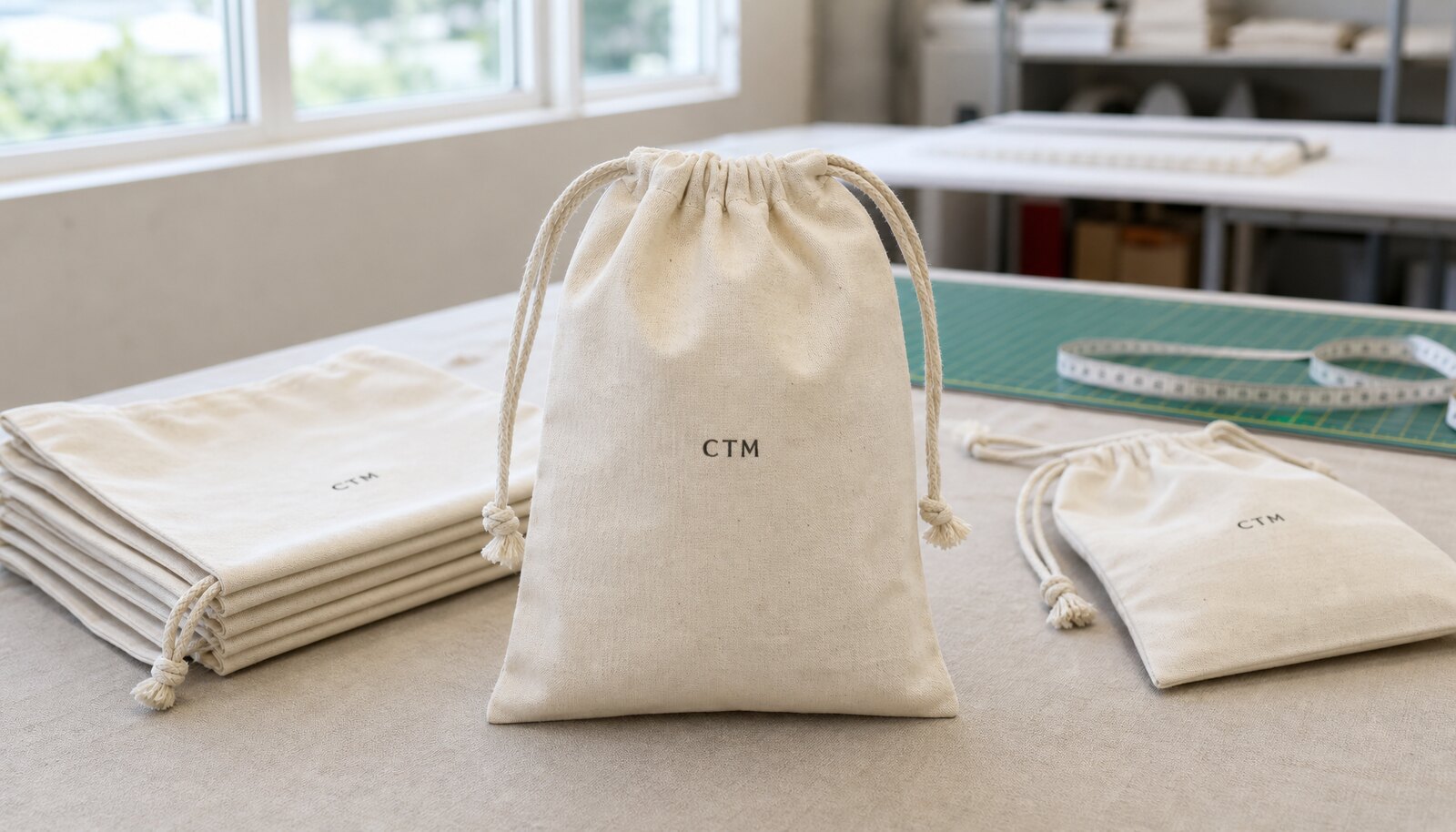
Start With the Retail Job, Not the Bag Spec
Custom cotton drawstring pouches only look simple until they are used in a gift shop program. The bag may need to hold a candle one week, a soap bar the next, and a jewelry set after that. If the team starts with a logo file or a target unit price, the quote often misses the actual selling problem: how the pouch feels in hand, how it presents merchandise at the counter, and whether it survives repeated customer handling without looking cheap.
For wholesale buying, define the retail job first. State what goes inside the pouch, whether it will be sold as packaging or as a standalone reusable product, and how the customer will see it on shelf or in a display basket. A pouch for small accessories can run lighter and simpler than a pouch for heavier gift sets. If the supplier does not understand that use case, the quote may be low but the product will still underperform.
- List the actual merchandise categories the pouch will carry.
- State whether the pouch is a primary product, a gift insert, or a branded carry bag.
- Define the shelf setting: counter display, basket, hanging display, or shipped flat inside a gift set.
- Set a clear expectation for hand-feel: soft, crisp, rustic, or premium.
Choose Fabric Weight and Build for the Real Load
Fabric weight is one of the easiest ways to control both perception and cost. In this category, 120 to 150 GSM is common for standard gift shop use when the contents are light and the pouch is mainly decorative. If the buyer wants a more substantial hand-feel, better opacity, or less visible show-through, 160 to 180 GSM usually gives a better result. Very light fabric can save money, but it also makes seams, drawcord channels, and print registration less forgiving.
Construction matters just as much as the fabric. A folded top edge with a clean cord channel usually looks more finished than a rough hem. Single drawcord and double drawcord options change the handling feel and the amount of sewing required. Natural cotton, bleached cotton, and dyed cotton each behave differently in print and in color consistency, so the quote should name the exact fabric type and not just say cotton pouch.
- Use 120 to 150 GSM for small, light gift items and cost-sensitive programs.
- Move to 160 to 180 GSM when the pouch must feel premium or carry more weight.
- Ask whether the fabric is natural, bleached, or dyed before comparing quotes.
- Confirm whether the pouch will use one cord, two cords, or a loop style closure.
Pick the Print Method That Matches the Artwork
Most gift shop buyers want the logo to stay clean after packing, shipping, and shelf handling. For one-color or simple multi-color art, screen printing is usually the most stable route because it gives strong coverage and a predictable retail look. If the artwork has many colors, fine gradients, or photographic detail, the factory may propose transfer methods or a different decoration process, but the buyer should treat that as a tradeoff rather than an automatic upgrade. Some methods look sharper at first and then lose durability under rubbing.
The safest move is to lock the artwork rules before sampling. Confirm the exact print size, the placement from the side seam and top edge, the Pantone reference if color matters, and whether the logo can be printed across a seam. Many disputes start when the buyer sends only a logo file and assumes the factory will size it correctly. For pouches, placement errors are more visible than on larger bags because there is less blank space to hide them.
- Use screen print for simple logos and repeat orders.
- Use woven label branding when you want a subtle premium look and less ink risk.
- Reserve transfer methods for short runs or complex art, and test rub resistance first.
- Approve logo placement on a physical sample, not only on a digital proof.
Understand MOQ Logic Before You Negotiate Price
MOQ in this category is not just a factory rule; it reflects setup work. The supplier is managing fabric stock, cutting layout, stitching time, screen preparation, and packing labor. A quote for one size, one fabric color, and one print location can often start at a lower MOQ than a program with three sizes and two logo colors. Once the order adds labels, custom cords, or special carton marking, the true MOQ can move even if the factory does not spell it out clearly.
When comparing supplier quotes, do not treat the lowest unit price as the best number. Ask for the full breakpoints, including price at 500, 1,000, 3,000, and 5,000 units if the supplier can quote them. A slightly higher unit price with lower setup charges can be better for a first gift shop test order. On the other hand, a lower unit price that hides high screen or sampling fees is usually expensive by the time the order lands.
- Request price breaks at realistic order levels instead of a single headline quote.
- Separate unit price from setup charges, sampling charges, and freight.
- Ask what changes the MOQ: extra colors, extra sizes, extra labels, or special packing.
- Compare total landed cost, not just ex-factory price.
Compare Supplier Routes Before You Lock the RFQ
Gift shop buyers often choose between direct factory sourcing, a trading company, or a domestic decorator using blanks. Each route has a different strength. Direct factory sourcing usually gives the best control over fabric, sewing, and print consistency when the team can manage artwork and approvals tightly. A trading company can save time if the buyer needs multiple items in one shipment, but the buyer should still demand clear factory accountability. Domestic decorators are useful for very small launches or urgent replenishment, yet they are not always the cheapest route once the order size grows.
The right route depends on how much control the buyer wants over the production details. If the pouch is a branded retail item with repeat demand, direct factory sourcing usually gives better long-term consistency. If the pouch is part of a broader gift set and the buyer needs many SKUs through one contact, a sourcing partner can reduce admin load. The key is to understand where the risk sits: print quality, sewing consistency, hidden markup, or slow escalation when something goes wrong.
- Use direct factory sourcing when the design is fixed and repeat orders are likely.
- Use a trading company when the team needs consolidated sourcing across several product types.
- Use domestic decoration only if speed or local coordination matters more than scale pricing.
- Demand named responsibility for sample approval and rework handling.
Treat Samples as Production Controls, Not Freebies
A good sample process saves money because it exposes problems before bulk production begins. For cotton drawstring pouches, the buyer should ask for a size sample, a print proof, and if needed a pre-production sample made with the final fabric and cord. The sample should show the real print density, the actual cord tension, and the stitched finish at the opening. A digital mockup cannot show whether the pouch closes smoothly or whether the logo lands too close to a seam.
The approval method matters. Some buyers approve a sample because the logo looks correct and ignore the rest of the build. That is how small defects become a full order problem. Use the sample to confirm fabric hand-feel, seam straightness, stitch density, cord movement, and print placement. If the final lot differs from the sample in fabric weight or cord thickness, the supplier should not treat it as a minor change.
- Approve one physical golden sample before bulk sewing starts.
- Check print density, placement, and color on the real pouch, not on art files.
- Test the cord opening and closing several times on the sample.
- Record any approved tolerance changes in writing.
Set QC Thresholds That Match Gift Shop Expectations
Gift shop buyers do not need laboratory language, but they do need acceptance rules. A pouch can have some natural variation because cotton is a soft material, yet it should still look clean at retail distance. Loose threads, crooked top edges, stains, broken seams, and badly centered prints are the defects that customers notice first. If the gift shop is selling a premium item, the defect standard needs to be tighter than for a low-cost giveaway pouch.
Build the QC plan around visible retail defects and function, not just measurements. The pouch should close easily, the print should sit in the correct zone, and the seams should hold after handling. If the buyer expects the product to be reusable, then the cord and opening should be durable enough for repeated use. A tight QC list also makes the factory quote easier to compare because each supplier knows what standard they are pricing against.
- Reject any lot with print placement that is clearly off-center or too close to a seam.
- Set a tolerance for finished size and require the factory to measure the lot against it.
- Inspect for loose threads, stains, and open stitches before packing.
- If reuse matters, test the cord closure and top edge for repeated opening and closing.
Plan Packing and Cartons Before the Price Looks Final
Packing changes both unit cost and warehouse efficiency. Some buyers want pouches bulk packed in master cartons for internal rework or assembly into gift sets. Others need individual polybags, size stickers, barcode labels, or retail-ready packing. The factory should not decide this on its own because the wrong packing method can add unnecessary labor or create extra handling at the destination. For gift shops, clean retail presentation often matters more than for pure back-of-house packaging supply.
Carton planning is also a risk control issue. If the pouch count per carton is too high, the bags can arrive compressed and wrinkled. If the carton count is too low, freight cost rises. The buyer should ask for carton dimensions, gross weight, carton marks, and any moisture protection the factory will use. This is especially important for cotton goods shipped long distances or through humid ports.
- Define whether the order is bulk packed, polybagged, or retail-ready.
- Specify barcode, country-of-origin, and SKU label requirements before production.
- Ask for carton dimensions and gross weight with the quote.
- Balance carton fill to protect shape without wasting freight space.
Use Landed Cost to Decide the Winning Offer
The cheapest factory quote is not always the cheapest order. To compare offers fairly, the buyer needs to calculate landed cost, not just ex-factory unit price. That means adding sample charges, print setup, packing changes, inland freight, ocean or air freight, duty, and the internal cost of rework if the sample or bulk order is wrong. A supplier with a clean but slightly higher quote can still win if it reduces waste and avoids quality disputes.
A practical comparison sheet should show the same spec on every line. If one supplier quotes 140 GSM cotton with screen print and another quotes a looser 120 GSM build, the comparison is misleading. Normalize the quote first, then compare the number that matters: total cost per sellable pouch at your warehouse. That is the figure procurement should hand to merchandising, finance, and operations before approval.
- Normalize fabric weight, print method, size, and packing before comparing quotes.
- Include sample, setup, packing, and freight in the landed-cost view.
- Use the same payment terms and Incoterms when comparing suppliers.
- Review whether a lower price creates more inspection or rework cost downstream.
Specification comparison for buyers
| Spec decision | Recommended option | When it fits | Buyer risk to check |
|---|---|---|---|
| Supplier route | Direct factory with in-house sewing and print | Best for repeat programs, controlled branding, and better price at 1,000 units and up | Verify the factory actually owns the print process, not only the sewing line |
| Supplier route | Trading company or sourcing agent bundling multiple factories | Useful when you need mixed products, low internal sourcing bandwidth, or one contact for many items | Watch for hidden markups, vague factory names, and diluted accountability during rework |
| Supplier route | Domestic decorator using imported blanks | Works for very small launches, rush orders, or buyers who need local communication and faster sampling | Check blank bag quality, size consistency, and whether decoration changes the hand-feel |
| Fabric weight | 120-150 GSM for standard gift shop use | Good for light merchandise, jewelry, soaps, candles, and budget-friendly retail sets | Too light can look flimsy and show contents through the weave |
| Fabric weight | 160-180 GSM for premium gift presentation | Better for heavier items, stronger shelf presence, and fewer complaints about thin fabric | Heavier fabric can raise cost and may need a cleaner seam finish |
| Print method | Single-color screen print | Best for clean logos, strong opacity, and stable repeat orders | Confirm mesh count, print placement, and cure quality to avoid cracking or offset |
| Print method | Woven label or side label branding | Fits buyers who want a subtle premium look and lower risk of print rub-off | Make sure the label size, fold, and stitch position do not interfere with the cord channel |
| MOQ strategy | One size, one color, one print position | Lowest-risk structure for first orders and design validation | Extra colors, sizes, or label variants can multiply setup and scrap costs quickly |
| Packing format | Bulk packed by size with retail master labels | Efficient for warehouse handling and private-label distribution | Define carton count, polybag use, and barcode placement before production starts |
Buyer checklist before sampling
- Confirm the exact pouch use case: gift, jewelry, candle, sachet, or seasonal set
- Lock the finished size with a tolerance band, not only a flat dimension
- Choose the fabric weight in GSM and state whether the fabric should be bleached, natural, or dyed
- Specify drawcord type, cord thickness, and whether you want single or double drawstrings
- Approve the print method, print size, Pantone reference, and placement from edge and seam
- Separate unit price from setup charges, sampling charges, and freight in the quote
- Ask for pre-production sample, size sample, and print strike-off before mass production
- State packing method, inner pack count, carton count, and barcode label format
- Set acceptable defect limits for loose threads, crooked seams, stains, and print misregistration
- Align lead time with artwork approval, material availability, and shipping mode
Factory quote questions to send
- What is the finished size, cut size, and size tolerance for this pouch?
- What GSM fabric do you recommend for this use case, and what is the visual difference between the options?
- Is the fabric in stock, or will you need to weave or dye it before production?
- What is the MOQ at one color, one size, and one print location, and what changes the MOQ?
- What setup charges apply for screens, plates, labels, or embroidery files?
- What print method will you use, and how do you control wash resistance and rub resistance?
- Can you provide a pre-production sample and a print proof before bulk production starts?
- How will the pouches be packed: bulk, polybagged, bundle-packed, or retail-ready?
- What is the standard production lead time, and what is the realistic lead time after sample approval?
- What shipment data can you give: carton size, carton count, gross weight, and estimated CBM?
Quality-control points to confirm
- Fabric weight should stay within the agreed GSM range and feel consistent across the lot
- Finished dimensions should stay inside the approved tolerance on width and height
- Drawcord channel should run cleanly with no twisting, blocking, or visible raw edges
- Side seams and bottom seam should be straight, even, and secure with no skipped stitches
- Print should match the approved placement and color reference, with no major ghosting or smearing
- Loose threads, oil marks, stains, and broken stitches should be removed before packing
- Cord pull should open and close the pouch smoothly without tearing the top edge
- If a label is used, it should be centered or placed to spec and stitched flat
- Cartons should match the agreed pack count, carton mark, and barcode information
- Random samples from the finished lot should be checked against the approved golden sample