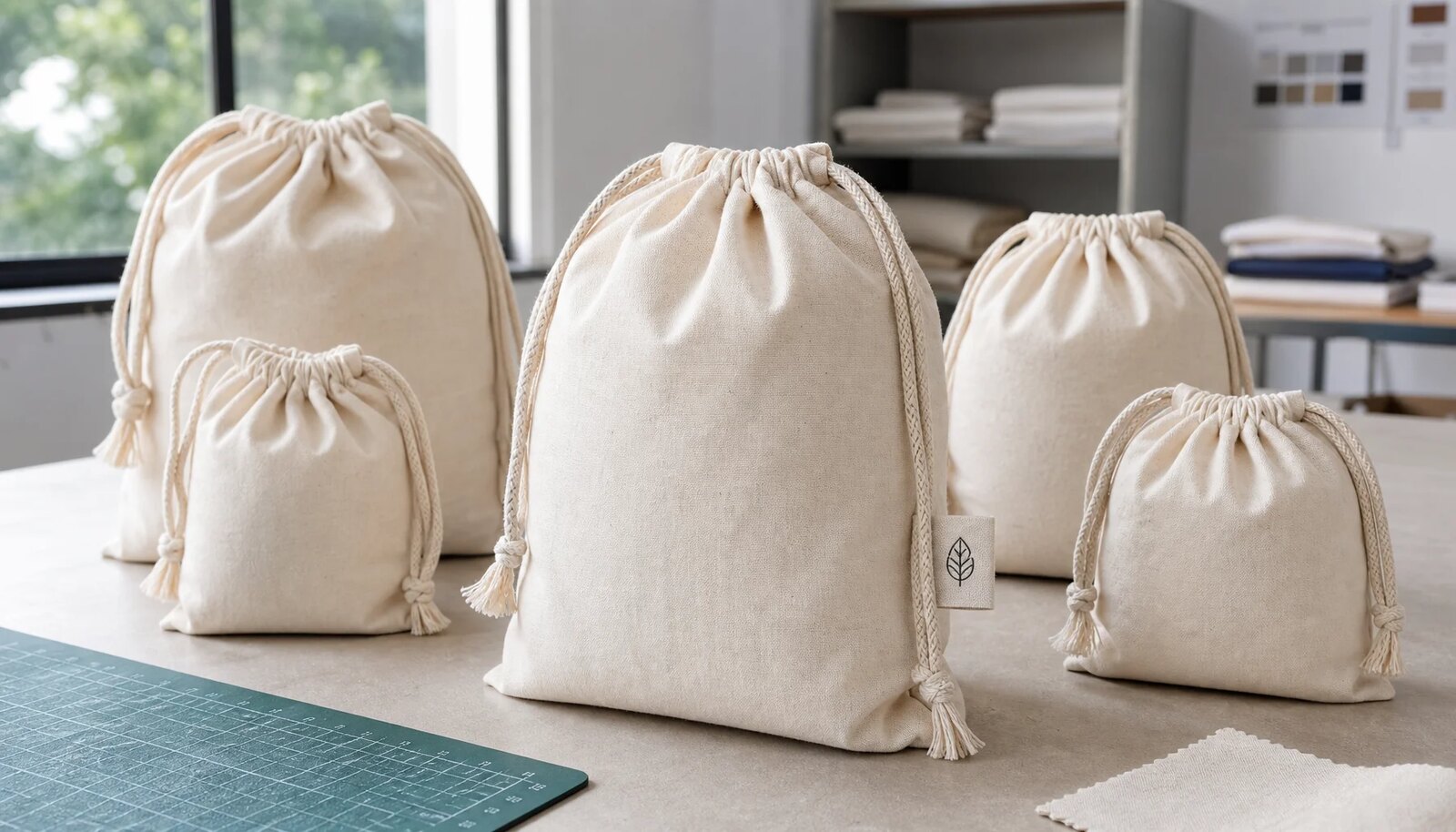
Start With the Pouch Job, Not the Supplier Catalog
Farmers market vendors use cotton drawstring pouches for very different jobs, and the buying brief should reflect that before the first supplier quote lands in the inbox. A pouch for soap bars, herbal sachets, or seed kits is a different commercial object from a pouch for jars, produce samples, jewelry, or bundled gift sets. If the order starts with size alone, the quote can look attractive while the pouch fails in use because the contents are heavier, bulkier, or handled more often than the buyer expected.
The cleaner way to write the brief is to start with the contents and the handling pattern. State what goes inside, whether inserts or tags are included, whether the pouch is part of the product or only outer packaging, and how often it will be opened and closed. A pouch sold as part of a premium gift set can justify a better fabric and a cleaner finish. A pouch used for transport or warehouse handling needs predictable pack-out and stable dimensions more than decorative detail. A pouch that lives on a retail shelf has to look good in stacked cartons, while a pouch used for recurring sampling needs to be easy to refill and reseal.
This is where custom cotton drawstring pouches wholesale buying becomes a procurement exercise instead of a style exercise. The buyer should define the job, the handling pattern, and the reordering plan before comparing prices. Once those three points are written clearly, the supplier can recommend a finished size, seam allowance, cord spec, and branding method that fits the real use case instead of a generic pouch shape. For a market vendor, that usually means one or two pouch sizes tied to a specific product line rather than a broad assortment that looks flexible but complicates inventory.
- List the exact items the pouch must hold, including inserts, tags, tissue, or protective wrap.
- State whether the pouch is for shelf display, gift packaging, transport, or customer reuse.
- Specify usable internal space, not just the cut pattern, so the supplier can account for seam allowance and the cord channel.
- If the pouch will be reused by customers, prioritize seam strength and cord smoothness over the lowest unit price.
- Write down handling constraints such as one-hand opening, flat pack-out, stacking in cartons, or repeated open-and-close cycles.
Size the Pouch Around the Product Line and the Order Volume
Farmers market buyers do better when the pouch size is tied to the actual SKU mix. A soap bar may fit comfortably in a compact pouch, but the same pouch can feel overstuffed once a paper insert, scent card, or tissue wrap is added. Seed kits need room for a label and sometimes a small insert card. Produce samples and bundled gift sets need more internal space and a more forgiving opening so the bag can be closed cleanly without crushing the contents. Start with the item dimensions and then add the room required for insertion, closure, and presentation.
Order sizing deserves the same discipline. If a vendor sells 25 to 40 pouch-packaged units per market day, a 300-unit test run may cover one season without locking too much cash into inventory. If the pouch is used across multiple weekend markets, a 1,000-unit run can make more sense because it spreads setup cost over more units and gives the supplier a cleaner production batch. Larger repeat programs benefit from a stable SKU structure: one pouch size for the core item, one backup size for bundled sets, and no extra variants unless a sales channel proves it needs them. That keeps inventory workable for a small team and reduces the chance of the wrong pouch being packed on a busy weekend.
The commercial question is not whether a pouch size sounds right in the abstract. It is whether the size supports the actual pack-out, customer presentation, and reorder rhythm. A well-sized pouch saves handling time, reduces overpacking, and makes the vendor’s stand look more organized. A poorly sized pouch creates rework at the point of packing, where labor is always more expensive than it looked on the quote.
- Map each pouch size to a specific product family instead of buying one generic size for everything.
- Use the item dimensions plus insert space, seal room, and display space to determine the finished pouch size.
- For a first test order, keep the size count low so sample approval and sell-through data stay readable.
- If the pouch will hold a rigid item, verify the opening width and not just the flat body dimensions.
- If the pouch is used as a bundled market pack, confirm that the final pack still closes cleanly after the contents are loaded.
Choose Fabric Weight, Weave, and Color for Real Handling, Not Only Appearance
Fabric is the biggest lever in both cost and perceived quality. Lightweight cotton works for samples, small accessories, and low-load giveaway items, but it can feel limp once the pouch carries anything substantial. For many retail uses, buyers start around 140 to 160 GSM because that range usually gives a better handfeel, cleaner drape, and more opacity without pushing cost too far. When the pouch must carry heavier contents or survive repeated handling at a busy market stall, 180 GSM and above is often easier to defend in a sourcing review. Those are starting points, not standards. The final decision should follow the approved sample and the real contents.
GSM alone is not the whole story. Weave density, finishing, and shrink behavior can change how the pouch feels and measures after production. Two fabrics can share the same nominal weight and still perform differently if one is tighter woven, pre-shrunk, or finished more aggressively. Buyers should ask whether GSM is measured before or after finishing, whether the factory pre-washes the cloth, and whether the fabric source is stable enough to repeat on a reorder. If the quote only gives a rounded weight and a vague fabric description, it is not ready for comparison.
Color choice changes both presentation and lead time. Natural unbleached cotton is usually the easiest option for repeatability and cost control. Bleached cotton gives a cleaner, brighter look but tends to show marks more readily. Custom dyed cotton supports stronger brand identity, but it usually adds lead time and shade-control risk, and often requires a more disciplined MOQ. For farmers market vendors, the common best-fit structure is a neutral natural pouch for the core line and a dyed version only when the pouch itself is part of the product story.
For buyers comparing options, a practical approach is to ask for three things on the same sheet: fabric weight, cloth finish, and expected shrink behavior. That makes the quote legible and lets procurement compare like with like instead of guessing what a supplier meant by a description like 'premium cotton' or 'thick natural pouch.'
- Use 110 to 120 GSM as a starting band for light samples and low-load giveaways if the fabric still feels adequate.
- Use 140 to 160 GSM as a starting band for common retail use where the pouch will be handled repeatedly.
- Use 180 GSM or more when the pouch must feel substantial or carry heavier contents.
- Confirm whether GSM is quoted before or after washing, finishing, or pre-shrinking.
- Ask whether the cloth is natural, bleached, or dyed, and whether shade variation is acceptable across the order.
Lock the Closure, Cord, and Stitching Before You Compare Price
The closure system changes the way the pouch works in hand, not just the way it looks in a photo. A single cotton cord is usually enough for light items. Heavier loads often need a wider cord, a cleaner hem channel, and a stronger exit point so the pouch does not slide open or distort at the top edge. Some buyers prefer a double drawcord because it opens evenly and feels symmetrical. Others prefer a single cord with a reinforced channel because it is simpler to sew and cheaper to produce. The commercial choice should follow the load and the presentation requirement, not habit.
The hem construction deserves the same scrutiny as the cord. The top edge should be even, the channel should be consistent, and the seam should not pucker when the cord is pulled tight. On smaller pouches, a sloppy channel can reduce usable space and make the opening feel cramped even when the finished dimensions look right on paper. If the pouch will be opened and closed many times, ask how the factory reinforces the stress points at the cord exit and whether bar-tacking, backstitching, or a reinforced seam path is used where the load concentrates. That detail matters more than a generic promise that the pouch is 'durable.'
Procurement should also define what a good draw action looks like. If the pouch snags, twists, or closes unevenly, the customer notices immediately. That is why the quote should not stop at the body fabric. Ask for cord material, diameter, length, channel method, and whether the cord ends are heat-sealed, knotted, or finished with a stopper. Small choices like these affect the unit price, but they also determine whether the pouch feels cheap or well made when a customer handles it at a market stall or opens it as part of a gift set.
- Specify single cord, double cord, or cord lock based on the use case.
- Confirm cord diameter, cord fiber, and whether the ends are finished to prevent fraying.
- Ask for reinforcement at the channel opening and any other stress points.
- Define the acceptable draw action: smooth, even, and free of snagging.
- Check seam strength at the corners and the top hem before approving bulk production.
Match Branding to the SKU Economics, Not to the Artwork File
Most quote surprises come from branding, not from the pouch body. A one-color screen print on natural cotton is often the cleanest value point for wholesale buyers because setup is straightforward and the result is durable if the factory cures it correctly. If the artwork uses multiple colors, tiny type, or a detailed graphic, the supplier may recommend digital transfer or a hybrid process. That can be the right decision, but it can also raise cost and create more risk of misregistration, especially on a small print field.
The branding decision should match the commercial role of the pouch. If it is a utility item, a small printed mark or woven label may be enough. If it will sit on a retail shelf or carry a premium gift set, logo placement, contrast, and label finish become part of the product itself. Some buyers prefer a sewn patch, woven label, or minimal side mark because it keeps the natural cotton look intact. Others want a visible print so the pouch doubles as brand media. Either path works if the artwork is designed for the actual pouch dimensions and the usable print field after seam allowances is known.
Approval should happen on real fabric, not a paper proof. Paper cannot show how ink sits on the weave, how the cloth distorts during curing, or how the logo looks after handling. The supplier should provide a pre-production sample that reflects the actual fabric, actual print method, and actual placement. That sample is the only approval point that matters when the order moves into bulk. For repeat buyers, it is worth keeping a signed visual reference of the front, back, and inside so the next reorder can be checked against the same standard.
- Use screen print for simple logos, clean lines, and repeat orders.
- Use digital or transfer printing only when the artwork genuinely requires it.
- Use woven labels or sewn patches when the brand wants a quieter, more premium look.
- Approve logo placement against the finished pouch shape, not the flat pattern.
- Set minimum line thickness and small-type rules so the artwork survives production.
Compare Supplier Routes Before You Compare the Numbers
A useful quote comparison starts with the supplier route, because not every source is built for the same order profile. A direct factory is usually the strongest option when repeatability, fabric control, and stable pricing matter. A trading company can help if you need one contact for several packaging SKUs or prefer broader sourcing support, but the buyer still needs to know who is actually sewing and printing the pouches. Local decorators and marketplace sellers can help with test orders, yet they rarely offer the same traceability or cost structure as a true production plant.
The route should match the order horizon. If the order is a small market test, speed may matter more than process depth. If the pouches will sit in seasonal inventory and be reordered, the better choice is usually a factory that can preserve the same fabric, print method, and pack method across runs. The common mistake is comparing quotes that look similar on the surface but come from very different supply chains underneath. One supplier may be quoting a blank stock pouch with a local print step, while another is quoting fully made-to-order production. Those are not equivalent offers, even if the unit price is close.
A simple order-sizing example helps here. A vendor selling a few hundred pouch-packaged units per season may want a quick local source for the first run, then a direct factory for the reorder once the size and artwork are proven. A vendor with steady weekly volume can usually justify the slower start of a direct factory because the repeatability lowers long-term labor and replacement cost. The right route is the one that matches your reorder rhythm, not the one that looks easiest on the first quote.
- Ask who owns the fabric, who prints, and who packs the final goods.
- Avoid comparing a direct-factory price with a reseller price as if they were the same route.
- If the order will repeat, prioritize the supplier who can preserve the same spec on the next run.
- Request photos or a short process description showing where sewing, printing, and packing happen.
- If traceability matters, ask for the actual factory name, not just the trading company brand.
Audit the Supplier Before You Treat the Quote as Real
For B2B procurement, the supplier check should go beyond a website and a price sheet. A credible factory or trader can usually answer basic questions about business registration, production location, main product lines, and which processes are in-house versus subcontracted. If the supplier says everything is in-house but cannot show consistent sample quality, or if the contact cannot explain where the fabric comes from, the quote deserves extra scrutiny. Buyers do not need a detective story; they need enough evidence to know whether the offer can be repeated at scale.
Country-of-origin checks matter because they affect customs, labeling, duty planning, and risk. If the product will be imported, the buyer should know where the fabric is sourced, where the pouch is sewn, and where the final packing happens. Those details can change origin rules and documentation requirements. They also matter for quality planning: a factory that sources fabric from multiple mills may be able to lower cost, but it can also introduce lot variation if the mill changes without notice. Buyers should ask whether the supplier can hold fabric source stable across reorders and whether substitutions require written approval.
A practical audit does not need to be elaborate. Ask for the factory name, address, and main process map. Request recent product photos that show consistent stitch quality and packing style. Confirm whether the supplier can share a basic QC record, a sample approval process, and the contact who owns order status after PO placement. If the supplier is serious, those answers should be straightforward. If every question turns into a general promise, the order is not yet safe to place.
- Verify the legal name and address of the entity producing the pouch.
- Ask which processes are in-house and which are subcontracted.
- Confirm the country of origin for fabric, sewing, printing, and final packing.
- Ask whether fabric source changes are allowed between sample and bulk.
- Request a named contact for production status, QC release, and shipment coordination.
Build Quotes Around Landed Cost, Not Only Unit Price
A low unit price is not useful if it excludes setup fees, freight, duties, carton charges, or destination handling. Buyers should ask for one quote format that makes the full landed cost visible. That usually means the same pouch size, the same fabric weight, the same print method, the same pack count, and the same shipment term. If one supplier is quoting EXW and another is quoting DDP, the comparison is not valid until logistics are normalized. Procurement teams should not accept a pricing exercise that hides half the cost structure in the footer.
The right comparison is the total cost to receive saleable pouches in your warehouse or distribution center. That includes one-time charges such as screens, artwork setup, labels, and carton redesign, plus recurring charges such as unit price and freight. Carton dimensions matter because freight can swing when the pack-out is inefficient, even if the unit price looks strong. A small change in carton density can change pallet count and shipping cost enough to wipe out the headline savings. Buyers should request carton size, gross weight, and inner pack details before final approval so freight can be checked independently.
The best commercial decision is often the simplest configuration that meets the sales goal. If a one-color print and a stock natural cotton body satisfy the brand, that may be more profitable than a more elaborate pouch that looks better in the quote but slows the order and raises inventory risk. The decision should be driven by landed cost, reorder ease, and the amount of labor your team will spend after the shipment arrives, not by the cheapest number in the first email.
- Compare total landed cost, not only ex-factory price.
- Separate one-time setup charges from recurring unit costs.
- Ask for carton size and gross weight so freight can be checked independently.
- Reject quotes that leave fabric, print, or pack details vague.
- Do not approve the job until the written spec and sample match.
Use Samples to Prove Sample-to-Bulk Consistency
A pre-production sample is not a visual formality. It is proof that the pouch can be made repeatedly with the same fabric, same cord, same print method, and same finish. The buyer should inspect fabric handfeel, seam regularity, cord pull, top hem reinforcement, and how the pouch behaves when filled with the actual contents. If the pouch is printed, the sample should show whether the ink sits flat on the weave, whether the logo is centered on the finished body, and whether any color shift appears after handling. A useful sample removes ambiguity before bulk fabric is cut.
The best approval system compares the sample to a clear reference, not to memory. Keep one approved golden sample for every size and artwork version, and store a photo of the front, back, and inside of the approved unit. That makes future reorders easier to inspect, especially if the supplier changes fabric lots or shifts to another production line. If the order is recurring, a stable reference sample becomes a commercial control point. It helps the buyer prove whether a change is acceptable or not.
Sample-to-bulk consistency is where many small packaging programs drift. The buyer approves a nice sample, then the bulk arrives with a different cord diameter, a shorter body, a looser print, or a seam line that is harder to draw closed. The fix is to record what was approved in measurable terms: finished size, fabric weight range, cord spec, placement tolerance, and pack count. Once those numbers are written down, the buyer can check the bulk against facts instead of subjective impressions.
- Test the pouch with the actual contents before approving bulk.
- Check seam strength at the corners and at the drawstring channel.
- Compare the sample to a signed reference for artwork position and finished size.
- Reject any sample that hides poor stitching behind a good-looking print.
- Keep an approved golden sample for every reorder and SKU variant.
Set QC Rules That Catch Real Failures, Not Cosmetic Noise
QC guidance should be specific enough that two inspectors would make the same decision. For cotton drawstring pouches, the obvious issues are size, stitching, and print, but the real acceptance criteria should be written more tightly. The buyer should specify the agreed fabric weight range, finished size tolerance, cord diameter, shrink allowance, and what a pass or fail looks like for the print. A pouch can look acceptable on a table and still fail in use if the hem channel is crooked, the cord snags, or the print rubs off during normal handling.
A useful QC sheet starts with dimensions and construction. Measure the finished width, height, opening, and channel depth after sewing and finishing. Check that seam allowance is consistent so the usable cavity does not wander from pouch to pouch. Then test the cord action and the load behavior. Fill the pouch with the real item, draw it shut, and see whether the opening stays even or collapses unevenly. If the pouch is supposed to be washed, steamed, or heated, include a shrink test before bulk approval. If it is never exposed to heat, do not add a test that creates paperwork without reducing risk.
Print and pack-out deserve equal attention. For prints, ask for a rub test or adhesion check that matches the chosen method. For packing, specify inner count tolerance, carton labeling, and whether the cartons need moisture protection. The goal is not to create an overloaded QC program. The goal is to define the few checks that prevent real failures in receiving, shelf presentation, or customer use. Buyers who keep the QC list focused usually get faster responses from the factory and fewer arguments after the shipment lands.
- Finished fabric weight should stay within the agreed range, with the exact tolerance written into the spec sheet.
- Finished size should be checked after sewing and finishing, not only against the cut pattern.
- Seam allowance should be consistent, and the top hem should be even so the cord channel does not pucker when drawn tight.
- Cord diameter should match the approved spec, and the draw action should be smooth, even, and free of snagging or twisting.
- Cord ends should be finished so they do not fray during packing or customer use.
- If the pouch uses a stopper, it should move cleanly and not cut into the fabric when tightened.
- Stitching should be straight, with no skipped stitches, broken thread, loose tails, or open corners.
- Stress points around the channel and side seams should be reinforced where the pouch will take repeated load.
- Logo placement should stay within the agreed tolerance, especially on smaller pouches where seam allowance reduces usable print area.
- Print should be fully cured, with no tackiness, flaking, ghosting, or visible misregistration under normal handling.
- Printed units should pass a simple rub check against the approved method before bulk release.
- If the pouch is dyed or bleached, color should be checked against the approved reference under the agreed light source before bulk release.
- Shrinkage should be checked against the approved allowance after a wash or heat test if the pouch will be washed, steamed, or exposed to heat in use.
- Cartons should arrive dry, correctly counted, and labeled with PO number, size, color, and quantity, and pack-out should match the agreed inner count within the written tolerance.
Specification comparison for buyers
| Sourcing route | Best fit | Commercial tradeoff | What the buyer must verify |
|---|---|---|---|
| Direct factory | Best for repeat orders, stable specs, and buyers who need to control fabric, sewing, and print at the source | Usually strongest on landed cost and repeatability, but only if the buyer gives a tight spec and can wait for production scheduling | Verify the legal factory name, confirm where sewing and printing actually happen, and ask who signs off on final QC before shipment |
| Trading company | Best when you need one contact for several packaging SKUs or want help coordinating different vendors | Convenient for multi-SKU programs, but margin layers can hide the true production source and make reorders harder to control | Ask for source disclosure, check whether fabric or print vendors may change between sample and bulk, and compare the quote against a direct-production equivalent |
| Blank-stock decorator | Best for small tests, urgent launches, or local orders that need speed | Fast turnaround, but blank stock can vary by lot and may not reorder cleanly | Confirm that the blank pouch is reorderable, check finished size after decoration, and test print durability on the actual cloth |
| Integrated factory with in-house printing | Best for repeatable logo placement and color control on ongoing programs | More process control, but setup fees, plate charges, or color minimums can raise startup cost | Ask whether printing, curing, and inspection happen on site and whether the factory documents placement tolerance |
| Private-label packaging specialist | Best when retail-ready pack-out, barcode labels, and carton marking matter | Useful for distributors and retail programs, but extras can be buried in the quote if pack services are not itemized | Verify label format, inner pack count, carton marks, and whether the same pack configuration can be repeated on the next PO |
| Marketplace seller | Best only for samples, emergency fill-ins, or low-risk tests | Easy to buy, but traceability, size accuracy, and fabric consistency are often weak | Check the sewn size against the listing, request real fabric photos, and do not rely on listing copy for QC terms |
| Small artisan workshop | Best for a premium hand-finished look or seasonal gift packaging | Can look excellent, but output may not scale cleanly to larger POs or tight repeat schedules | Confirm size tolerance, stitch consistency, and whether the same workmanship can be repeated on a reorder |
| Exporter with retail packing support | Best for importers that want carton labels, barcode-ready packs, and fewer handoffs after landing | Can reduce warehouse labor, but the pack spec must be locked before production starts | Verify carton strength, moisture protection, pack count, and whether the shipment term matches your receiving process |
Buyer checklist before sampling
- Define the pouch contents first: soap bars, herb sachets, seed kits, jewelry, produce samples, or bundled market packs.
- State the sales channel: market stall, retail shelf, distributor warehouse, fulfillment center, or direct-to-consumer ship-out.
- Write the finished size you need, not just a casual pouch size, and ask the supplier to show what portion is lost to seam allowance and the cord channel.
- Choose fabric weight around the actual load, not around the lowest quote. Treat any GSM figure as a starting point until you see the sample in hand.
- Confirm whether the cloth is natural unbleached cotton, bleached cotton, or custom dyed fabric, because that changes appearance, lead time, and reorder risk.
- Decide whether branding will be screen print, digital print, woven label, sewn patch, or no branding at all.
- Ask for MOQ by size, color, and artwork version, not only one headline order minimum.
- Request a pre-production sample made with the actual fabric, actual cord, and final artwork placement.
- Ask for a cut sheet or tech pack showing finished dimensions, seam allowance, cord width, print area, and pack-out method.
- Write down the packing method: folding style, inner quantity, carton count, carton marks, and whether the product needs moisture protection.
Factory quote questions to send
- What is the exact fabric construction and finished weight after finishing, not just the nominal fabric weight?
- Is the quoted price based on stock natural cotton, bleached cotton, or custom dyed fabric?
- Is the finished size quoted from cut size or sewn size? Show both if they differ.
- What size tolerance do you hold after sewing and finishing, and what part of the pouch is measured: body width, body height, or opening width?
- How much seam allowance is built in, and how much internal space is lost to the hem channel and cord tunnel?
- What is the cord specification, including material, diameter, end finish, and whether a single or double drawcord is used?
- How many print colors are included, and is printing on one side or both sides?
- What changes between the approved sample and bulk production, if anything at all?
- What is the minimum order quantity by size, by color, and by artwork version?
- Can you supply a pre-production sample made from the same fabric, cord, and print method that will be used in bulk?
Quality-control points to confirm
- Treat any GSM target as a written spec range, not a universal standard. For light giveaway pouches, many buyers start around 110 to 120 GSM; for common retail use, 140 to 160 GSM is a practical starting band; for heavier contents or a more substantial handfeel, 180 GSM and up may be easier to justify. Lock the agreed range in writing and compare samples against that range only.
- Check finished size after sewing and finishing, not only the cut pattern. A practical buyer-controlled approach is to set a tighter tolerance on small pouches than on larger ones, then require the factory to measure the sewn body, opening, and usable interior space.
- Inspect seam allowance for consistency from pouch to pouch. The top hem should be even so the cord channel does not pucker when the bag is drawn shut.
- Test the draw action with the real contents inside the pouch. The cord should move smoothly, close evenly, and not twist, snag, or pull the opening off-center.
- Confirm cord ends are finished so they do not fray during packing or customer use. If a stopper is used, it should slide cleanly and not cut into the fabric when tightened.
- Check stitch quality for skipped stitches, broken threads, loose tails, or open corners. Reinforce stress points where the side seam and cord channel take repeated load.
- Verify logo placement against the approved sample, not against a flat artwork proof. Small pouches have less forgiving print space once seam allowance is removed.
- Run a simple rub check on printed units if the pouch will be handled often in transit or at a market stall. The print should be fully cured, with no tackiness, flaking, ghosting, or obvious misregistration.
- If the pouch is dyed or bleached, compare color against the approved reference under the agreed light source before bulk release.
- If the pouch will be washed, steamed, or exposed to heat in use, test shrinkage against the approved allowance before production release. If it will not see heat, do not add unnecessary tests that create noise instead of control.