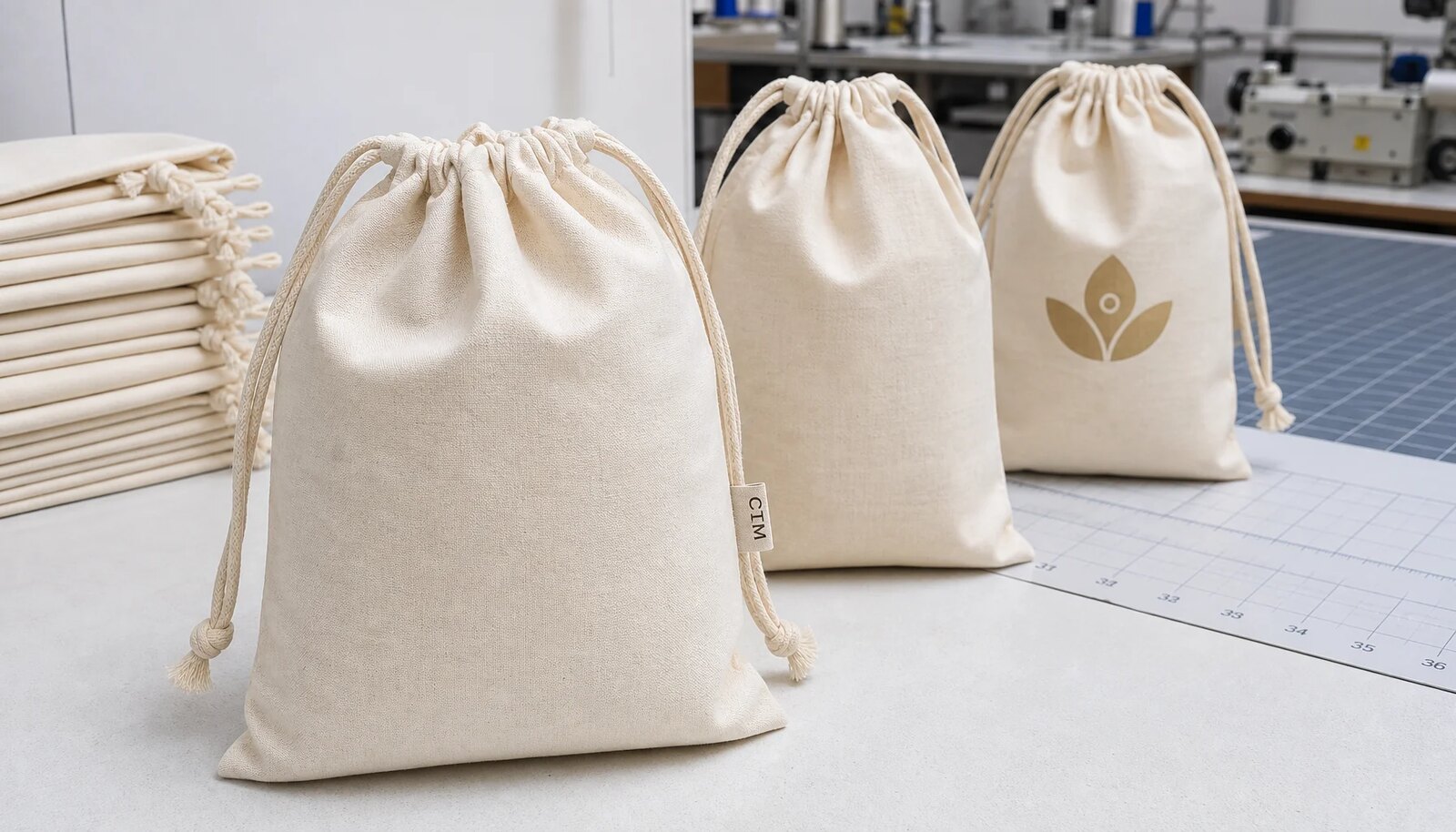
Why simple cotton pouch orders often become complicated
Custom cotton drawstring pouches look easy to buy. That is the trap. A purchase order that says “natural cotton pouch with logo” leaves too many decisions open: fabric weight, weave, finished size, print method, cord length, channel construction, packing count, carton strength, and even whether measurements are taken before or after sewing. A supplier can still quote that request, but each supplier may be quoting a different product.
For eco apparel brands, the pouch is part of the customer experience. It may protect a folded garment, replace a plastic sleeve, carry care accessories, hold a gift set, or support a reusable packaging story. If it feels flimsy, the logo looks dull, or the drawstring does not close cleanly, the issue is visible to the customer even though the pouch is technically a secondary packaging item.
A strong custom cotton drawstring pouches wholesale buying checklist for eco apparel brands turns broad expectations into measurable requirements. When every supplier quotes the same GSM, finished size, cord construction, print area, packing method, MOQ logic, and inspection standard, price comparisons become useful. Without that discipline, the lowest price may simply be the thinnest fabric, the smallest print, the loosest packing, or a different tolerance standard.
- Replace words like “premium,” “eco,” and “strong” with measurable specs where possible.
- Define the pouch role before asking for price: insert, retail bag, gift pouch, subscription item, or kitting component.
- Ask suppliers to confirm exactly what is included in the quote and what is excluded.
- Treat the approved physical sample as the production reference, not as a mood-board suggestion.
Start with the product, not the pouch size chart
The first decision is not whether the pouch should be 140 GSM or 180 GSM. It is what the pouch must hold and how it must behave when closed. A pouch for a folded T-shirt is not the same as a pouch for socks, a belt, a scarf, a cap, a jewelry set, or a repair kit. Flat product measurements can mislead buyers because the real pack has thickness, labels, folding style, tissue, hangtags, and sometimes several items stacked together.
Measure the product as it will actually be packed. Then test the closure. A drawstring pouch needs room at the top for the channel and gathered fabric. If the product fills the pouch too close to the cord channel, the bag may close unevenly, the seams may carry stress, and the front logo may shift off the intended display area. A pouch can look perfect while empty and awkward once filled.
Finished size should be written clearly. Factories may discuss cut size, finished sewn size, or approximate flat size, and those are not interchangeable. If the RFQ uses inches, confirm whether the factory pattern is managed in centimeters and how rounding is handled. For many apparel insert pouches, an allowance of 10-20 mm can help the pouch close comfortably, but the right allowance depends on product thickness, fabric weight, and the desired presentation.
- Measure the product in its real folded or packed state, including tags, inserts, tissue, or small accessories.
- Confirm that quoted dimensions are finished sewn dimensions, not cut-panel dimensions.
- Check the filled pouch from the front, side, and top before approving size.
- Leave enough height for the cord channel and gathered closure.
- For multi-item sets, size around the most rigid or bulky item, not the average item.
- If the pouch must fit inside a mailer, box, or retail carton, test that outer-pack fit before bulk production.
Choose GSM, weave, and fabric finish for the actual brand use
Fabric weight drives cost, handfeel, opacity, print behavior, and carton weight. For many everyday apparel insert programs, 140-160 GSM cotton is a practical starting point. It keeps the pouch light and cost-conscious while still giving enough structure for basic use. When the pouch is intended for reuse, gifting, cosmetics, accessories, premium apparel, or retail resale, 180-220 GSM is often the better range because it feels more substantial and hides contents better.
Heavier is not automatically better. A thicker fabric can increase unit cost, slow sewing, create bulk at the cord channel, and raise freight costs because cartons weigh more. Thin fabric has the opposite risk: it may feel weak, show the product inside, or allow print distortion. The right GSM is the one that matches the pouch’s job and landed-cost target.
Finish matters just as much as weight. Natural unbleached cotton gives the familiar eco packaging look: warm tone, visible fiber character, and small shade variation. It pairs well with black, brown, navy, forest green, and other muted inks. Bleached white cotton gives a cleaner base for bright logos, fine print, and barcode contrast, but it also shows lint, oil marks, carton dust, and handling dirt more easily. If the supplier uses terms such as muslin, cotton, canvas, or calico, ask for the actual composition, GSM, and weave. Those words are often used loosely.
- 140-160 GSM: good for lightweight apparel inserts, promotional pack-ins, and cost-sensitive programs.
- 180-220 GSM: better for premium handfeel, opacity, reusable packaging, and heavier accessories.
- Natural unbleached cotton: strong eco look, but more shade variation and less contrast for pale inks.
- Bleached white cotton: cleaner print base, but needs stricter packing and handling control.
- Canvas-style cotton: stronger and more structured, with higher cost and higher carton weight.
- If certified organic cotton, recycled cotton, or specific testing is required, include it in the RFQ before price negotiation.
Match logo decoration to artwork, quantity, and cotton color
For most wholesale cotton drawstring pouch programs, screen printing should be reviewed first. It is usually the most practical choice for simple one- or two-color logos, repeat orders, and stable brand artwork. Solid shapes, readable text, and moderate line thickness generally work well. The cost stays predictable at volume, although each color, screen, and artwork version can add setup cost.
Heat transfer and digital printing can be useful when artwork has gradients, photographs, many colors, or small seasonal runs. They are not automatically better. Buyers should check whether the print feels stiff, glossy, plastic-like, or too heavy for the fabric. On natural cotton, light colors can look muted, and fine detail can lose crispness depending on weave and ink coverage. If the pouch supports an eco apparel brand, the decoration should feel consistent with the material story, not like an afterthought applied to a soft cloth bag.
Artwork control prevents many disputes. Send vector artwork where possible. State Pantone or brand color references, print size, placement tolerance, and whether the logo appears on one side, two sides, or alongside a woven label. If the artwork sits close to a side seam, bottom seam, or cord channel, confirm whether normal sewing variation may affect alignment. For important orders, approve a print strike-off or pre-production sample on the actual fabric, not only a digital mockup.
- Screen print: best value for simple 1-2 color logos and repeat wholesale orders.
- Heat transfer: useful for detailed or multi-color artwork, but check flexibility, edge quality, and crack resistance.
- Digital print: useful for complex graphics, but review handfeel, color density, and consistency across fabric lots.
- Embroidery: premium for some designs, but can distort lighter fabrics and raise unit cost.
- Woven side label: subtle and durable, but label fold, visible size, seam position, and sewing tolerance must be approved.
- Confirm whether setup charges, screen fees, artwork adjustment, and reprint sampling are included or separate.
Do not leave cord, channel, and stitching as “standard”
The drawstring is the part the customer touches. It is also the part that often gets under-specified. “Cotton cord” does not tell the factory the cord diameter, finished length, color, knot style, channel height, or reinforcement expectation. A pouch can look acceptable in a flat photo but feel poor in use if the cord is too thin, too short, uneven, or trapped inside a tight channel.
Cotton cord is a natural fit for eco apparel brands because it matches the material language of the pouch. Polyester or blended cords may offer different color options or cleaner end finishing, but they can change the product feel. If the brand wants a custom cord color, ask early about MOQ, lab dip approval, dye tolerance, and added lead time. Cord color is small, but it can delay the whole order if treated as a late-stage detail.
Stitching should be judged by performance and appearance. Require straight seams, consistent seam allowance, locked stitch ends, no skipped stitches, no open seams, and reinforcement around channel exits. If the pouch will hold heavier accessories or be reused many times, test the filled pouch and pull the cord repeatedly. For very low-cost insert pouches, avoid over-engineering the construction; for premium pouches, avoid accepting vague “normal sewing” language.
- Define cord material, approximate diameter, color, finished length, knot style, and end treatment.
- State channel height and make sure the product does not fill into the draw area.
- Check that both cords pull smoothly and gather evenly.
- Require locked stitches at channel exits and side seam stress points.
- Inspect for loose threads, skipped stitches, puckering, broken needles, and open seams.
- If adding a woven label, approve the seam location, fold direction, visible label size, and effect on sewing tolerance.
Break down MOQ before you compare unit prices
A low advertised MOQ can be misleading. The practical minimum for custom cotton drawstring pouches may depend on fabric purchase quantity, finished size, fabric color, cord color, print artwork, label type, and packing format. If a brand needs three sizes, two logo versions, and different barcode labels by market, the supplier is not managing one simple lot. They are managing multiple smaller lots, each with setup, sorting, and waste.
Ask suppliers to quote MOQ by variation, not only by total pieces. One supplier may accept 5,000 pieces total only if they are the same size and same artwork. Another may allow mixed sizes but charge extra for cutting, print setup, or packing separation. This is especially important for apparel brands that carry seasonal colors, capsule collections, gift sets, or market-specific labels.
Separate setup cost from unit price. Print screens, artwork cleanup, custom labels, hangtags, sample fees, and retail packing labor can make a first order more expensive than the repeat order. A higher MOQ may lower the unit price by spreading setup and cutting waste, but it also increases inventory risk. For a launch test, paying more per pouch may be reasonable if it avoids dead stock. The correct decision is based on landed cost and operational risk, not factory unit price alone.
- Request MOQ by finished size, fabric color, cord color, artwork, label, and packing format.
- Ask which fees are one-time setup costs and which repeat on every order.
- Check whether multiple sizes can share one screen or need separate print setup.
- Confirm whether natural cotton fabric is stocked or purchased after order confirmation.
- Ask for realistic price breaks, not only very high-volume tiers that your brand will not order.
- Document reorder pricing if the same fabric, artwork, and packing format are used again.
Evaluate direct factory and trading routes by control and transparency
A direct factory is often the better route for repeat pouch SKUs with fixed specifications. Direct communication can make it easier to confirm GSM, approve construction, adjust print placement, and define inspection criteria. It also helps buyers understand why a heavier fabric, larger print, special cord, or retail sleeve changes the cost.
A trading company can still be the right partner. If a brand is sourcing pouches, paper boxes, labels, tissue, mailers, and other packaging together, a trading route may reduce coordination work and help consolidate shipments. The trade-off is visibility. The buyer should know who is sewing the pouches, who is printing them, who owns the sample process, and who is responsible when bulk goods do not match the approved sample.
Subcontracting is not automatically a problem, but hidden subcontracting is. If printing is outsourced, ask how strike-offs are approved and how print defects are handled. If sewing is outsourced, ask who controls fabric issue, in-line checks, and final inspection. The best supplier route is the one that gives clear quoting, accurate sampling, early warnings about limitations, and consistent reproduction of the approved pouch.
- Use a direct factory when repeatability, tighter QC, and spec control matter most.
- Use a trading route when multi-category consolidation or local account coordination is more valuable.
- Ask whether printing, cutting, sewing, and packing are in-house or subcontracted.
- Confirm who signs off on corrective action if goods fail inspection.
- Keep the RFQ, quote, sample approval, and purchase order tied to the same specification version.
- Reject vague substitutions such as “similar fabric,” “normal cord,” or “standard packing” unless approved in writing.
Approve samples with numbers, not only with a good-looking photo
A physical pre-production sample is the buyer’s best protection. Photos can hide weak fabric, print density issues, chemical odor, uneven cord pull, crooked seams, loose threads, and poor handfeel. For a wholesale order, the sample should use actual fabric, actual cord, actual decoration method, actual label, and actual packing material whenever possible. If the supplier uses substitute materials for a first mockup, that should be stated clearly, and the real components should be approved before mass production.
Review the sample empty and filled. Measure the finished width and height. Measure channel height. Pull the cords several times. Put the real product inside using the same folding method the warehouse will use. Close the pouch and check whether the logo still sits in the correct place. A pouch that looks balanced on the table may twist, bunch, or hide the print once it is filled.
Write sample comments so production and inspection teams can act on them. “Move the logo down a little” is not enough. Use a distance from the top edge, bottom edge, or centerline, with a tolerance. “Improve stitching” is also too vague. State no skipped stitches, no open seams, locked ends at stress points, and trimmed loose threads. Keep one approved reference sample with the buyer and one sealed reference sample with the supplier.
- Approve physical samples for important wholesale orders; do not rely on photo-only approval.
- Measure finished size, channel height, print size, and logo placement with a ruler.
- Test the pouch with the actual filled product and final folding method.
- Compare fabric shade and print density under consistent lighting.
- Pull the drawstring repeatedly to check smooth action and channel strength.
- Record approval comments in writing and attach measurement photos when useful.
- Keep approved samples sealed and referenced in the purchase order.
Plan packing and carton details before production starts
Many quality complaints begin after sewing is finished. Cotton can collect dust, absorb moisture, crease, and show handling marks if packing is careless. Bulk packing is economical, but it still needs clean inner protection, sensible counts, and cartons that do not crush the pouches. White and lightly colored cotton need even cleaner handling because lint, carton fibers, fingerprints, and oil marks are easier to see.
Retail-ready packing changes both cost and workflow. Individual polybags, recyclable sleeves, belly bands, barcode stickers, hangtags, and set packing add material and labor. They may also increase carton volume and freight cost. Decide early whether final packing should be done at the factory, by a consolidator, or at the destination warehouse. A low factory unit price may not be low in practice if the warehouse later has to sort, label, steam, dust off, or repack the goods.
Ask for carton details in the quotation, not after production. You need pieces per inner bag, pieces per master carton, carton dimensions, net weight, gross weight, carton marking format, and moisture protection. For multi-SKU programs, carton separation is a receiving issue as much as a factory issue. If pouches are used for kitting, pack counts should match warehouse workflow so teams are not constantly recounting or opening mixed cartons.
- Bulk packing: lower cost and good for kitting, but needs dust and moisture protection.
- Individual sleeve or bag: cleaner receipt condition and better for retail, but higher labor and material cost.
- Belly band: useful for barcode, set identification, or presentation; quote it as a separate operation.
- Carton liner or inner bag: helps protect cotton from dust and moisture during transit.
- Carton markings should show SKU, quantity, color, size, PO number, and gross/net weight where required.
- Avoid over-compressed cartons because cotton pouches may arrive heavily creased and need rework.
Build the schedule around approvals, materials, inspection, and arrival date
Lead time should be broken into real stages: artwork check, material sourcing, sample making, sample shipment, sample approval, bulk cutting, printing, sewing, packing, inspection, export handling, and transit. A supplier may quote a short production lead time, but the calendar only works if artwork, fabric, cord, label, and packing approvals are completed on time. First orders need more buffer because the components have not yet been proven together.
The slowest step is not always sewing. Custom dyed fabric, special cord colors, printed labels, barcode approval, revised artwork, or a changed pouch size can delay the production start. Even small changes after sampling can restart pattern work, price calculation, screen setup, and approval. If the launch date is fixed, freeze the pouch specification early.
For repeat orders, ask whether the supplier can reuse screens, retain approved label files, keep a reference sample, and source the same fabric construction. Still, cotton shade may vary by fabric lot. For reorders, request a swatch, top-of-production confirmation, or shipment sample when color and logo consistency matter. Work backward from the required warehouse arrival date, not from the date you hope the factory will ship.
- Separate sample lead time from bulk production lead time.
- Confirm when the production clock starts: deposit, artwork approval, material approval, or physical sample approval.
- Add buffer for custom fabric, custom cord, labels, retail packing, peak-season capacity, and re-sampling.
- Include inspection, carton marking, export documents, transit, customs, and warehouse receiving time.
- For launch-critical orders, do not approve bulk production without a physical sample.
- For repeat SKUs, check fabric lot shade and print color against the approved reference.
Specification comparison for buyers
| Spec decision | Recommended option | When it fits | Buyer risk to check |
|---|---|---|---|
| Fabric weight | 140-160 GSM cotton for everyday apparel inserts; 180-220 GSM for premium retail, reusable gift packaging, or heavier accessories | Choose lighter fabric when the pouch is a secondary pack-in item and cost matters; choose heavier fabric when opacity, handfeel, and shape retention matter | Thin fabric can show contents, distort print, and feel weak at the cord channel; heavy fabric raises carton weight, freight cost, and sewing difficulty |
| Fabric finish | Natural unbleached cotton for eco positioning; bleached white cotton when print color fidelity and clean retail appearance are priorities | Natural works for sustainable branding, low-impact presentation, and muted logos; white is better for detailed marks, bright inks, and barcode label contrast | Natural fabric varies more in shade and can mute light inks; white cotton shows lint, oil marks, and carton dust more easily |
| Print method | 1-2 color screen print for volume; heat transfer or digital print only when artwork needs gradients, photos, or many colors | Use screen print for repeat orders and simple logos; use transfer or digital for short runs, complex artwork, or multiple seasonal graphics | Complex prints may crack, shift, feel plastic, or exceed budget on low MOQ; confirm rub resistance, print handfeel, and approval standard before production |
| Cord construction | Cotton cord with reinforced channel stitching, balanced draw action, and consistent knot length | Best for apparel, jewelry, cosmetics, and gift sets where opening feel and repeat handling matter | Loose cords, uneven knotting, and weak channel stitches cause functional complaints, especially if the pouch is filled close to capacity |
| Size selection | Base size around 10x12 in, 12x16 in, or custom finished size based on actual product dimensions plus 10-20 mm ease where appropriate | Match pouch size to folded apparel, accessory sets, gift boxes, or retail bundles; test the filled product before locking size | Oversized bags waste fabric and freight; undersized bags create seam stress, crooked closure, and poor shelf presentation |
| Supplier route | Direct factory for repeat custom specs; trading company only if mixed-category consolidation or one-contact coordination is more important | Direct sourcing works best for stable SKUs, clear QC, and cost control; trading can help when buying several packaging types together | Middleman quotes can hide fabric grade, print process, packing changes, or subcontracting that appears only after sampling |
| MOQ strategy | Negotiate MOQ by size, fabric color, print design, and print plate—not only total order quantity | Useful when one brand logo is used across several pouch sizes or when seasonal colors are split | Low total MOQ can still be expensive if each size, color, or artwork needs its own setup charge, fabric minimum, or waste allowance |
| Packing method | Bulk inner bag with master carton for cost; individual recyclable sleeve, belly band, or barcode label for retail and e-commerce handling | Bulk packing fits warehouse bundling and distribution; individual packing fits store-ready, subscription, and direct-to-consumer presentation | Retail packing increases labor, carton count, and material usage; bulk packing needs stronger inner protection to avoid stains, dust, and wrinkles |
| Sample route | Physical pre-production sample with actual fabric, cord, print, and label; shipment sample or top-of-production sample when color matching matters | Use when artwork approval, handfeel, size tolerance, or retail presentation is critical | Photo samples hide print density, seam balance, cord length, odor, and fabric handfeel; approve physical samples for final release |
Buyer checklist before sampling
- Define the exact pouch use case: apparel insert, accessory bag, gift pack, subscription item, retail resale unit, repair kit, garment-care pouch, or warehouse kitting component.
- Measure the actual product in its packed or folded state, then lock the finished pouch size with allowance for thickness, cord channel, seam take-up, and fabric shrinkage.
- Choose fabric weight and finish based on handfeel, opacity, print contrast, sustainability positioning, expected reuse, and the number of times the pouch will be opened.
- Confirm fabric composition, GSM, weave type, color standard, and whether the quote is for natural unbleached, bleached white, dyed cotton, canvas, or muslin-style cotton.
- Specify print method, number of colors, Pantone or brand color reference, print area, placement tolerance, and whether decoration is one side, two sides, or includes a woven label.
- Specify cord type, cord diameter, cord color, finished cord length, knot style, channel height, and whether ends should be knotted, capped, hidden, or heat-sealed if blended material is used.
- State packaging requirements clearly: bulk pack, individual polybag, recyclable sleeve, belly band, barcode sticker, hangtag, size sticker, set packing, or carton-separated SKU packing.
- Request a physical pre-production sample with actual fabric, cord, print, label, and packing; do not release important bulk orders on photo-only approval.
- Ask for cut size, finished size, measurement tolerance, seam allowance, shrinkage expectation, and whether tolerances change after washing, steaming, or pressing.
- Compare quotes on the same basis: fabric GSM, finished size, print coverage, print setup, packing labor, carton specification, MOQ by size/color/artwork, and trade term.
Factory quote questions to send
- What exact fabric is included in the quote: composition, GSM, weave type, finish, color, and expected shrinkage allowance?
- Is the quoted size a cut size or finished sewn size, and what tolerance do you apply to width, height, and cord channel height?
- Is the quoted price based on one-side or two-side decoration, what is the maximum print area, and what is the setup cost per color or screen?
- Which logo method do you recommend for this artwork and order quantity, and can you provide print limitations for fine lines, gradients, small text, and light ink on natural cotton?
- What is the MOQ by finished size, fabric color, cord color, print design, and packing format?
- Are cord, label, hangtag, barcode sticker, and retail sleeve included in the unit price, or quoted separately?
- Can you provide a physical pre-production sample using the actual fabric, cord, print method, label material, and packing format?
- What is your standard sample lead time, bulk lead time after sample approval, and current capacity risk during our target production window?
- How are the pouches packed: pieces per inner bag, pieces per master carton, carton size, gross weight, carton marking, and moisture protection?
- What inspection standard do you apply before packing, and can we define major/minor defects, measurement tolerance, and acceptable quality level in the purchase order?
Quality-control points to confirm
- Fabric GSM matches the approved specification within an agreed tolerance; no substitution to lighter cloth or different weave without written approval.
- Fabric surface is clean and consistent, with no oil stains, excessive slubs, holes, mildew marks, dark specks beyond the agreed natural cotton range, or visible contamination.
- Finished size, opening width, channel height, and seam allowance stay within the approved tolerance; pouches close evenly without twisting or bunching.
- All seams are straight, properly locked at stress points, and free from skipped stitches, loose threads, broken needles, puckering, or open seams.
- Cord channel is even on both sides, with smooth draw action, no trapped cord, no tearing at channel ends, and consistent cord length/knot position.
- Print placement is centered or positioned according to the artwork file, within agreed tolerance, and aligned with the intended front-facing side.
- Print quality is legible and clean, with no smudge, pinholes, heavy ink bleed, registration shift, cracking, excessive handfeel, or wash-through on the reverse side beyond the approved sample.
- Logo color and fabric shade are compared against the approved physical sample under consistent light; natural cotton shade variation is controlled within an agreed range.
- Labels, hangtags, barcodes, and retail sleeves are correct by SKU, size, language, and placement; no mixed SKUs inside cartons.
- No strong chemical odor, damp smell, loose lint buildup, rust marks, packaging dust, or moisture trapped inside inner bags or master cartons.