1. Start With the Bookstore Use Case, Not a Generic Pouch Spec
A university bookstore rarely buys a cotton drawstring pouch for one single purpose. The same product category may cover an orientation welcome kit, a graduation gift set, a department giveaway, a tech-accessory bundle, an alumni merchandise package, or a private-label campus accessory sold near apparel and drinkware. Those uses should not all receive the same material specification. A low-cost pouch for one-day distribution can be lighter and simpler. A pouch sold as merchandise needs to feel intentional, look tidy on the shelf, and survive repeated customer handling. A pouch used as packaging for a mug, scarf, cable kit, or boxed item has another requirement: it must still fit and close properly after the product is inside.
For procurement teams, the danger is vague language. “Cotton drawstring pouch with logo” leaves too much room for supplier interpretation. One factory may quote thin 4 oz natural cotton with basic stitching and bulk packing. Another may quote 6 oz pre-shrunk cotton, reinforced channel openings, a smoother cord, and individual retail packing. The lower unit price may look attractive, but it may not be the same product. It may simply be a lighter, less controlled version.
Write a short use-case brief before requesting quotes. State who receives the pouch, whether it is given away or sold, what it must hold, how long it should remain presentable, and whether licensed school marks are involved. This turns material selection from a taste debate into a measurable sourcing decision. It also gives suppliers a fair basis for pricing the same product rather than guessing at different versions.
- Orientation or event giveaway: prioritize clean one-color print, cost control, simple sewing, and efficient bulk packing.
- Retail bookstore SKU: prioritize hand feel, neat seams, consistent folding, print alignment, barcode or hangtag needs, and cleaner packing.
- Gift packaging: prioritize usable capacity, drawcord closure, product fit after closing, and fabric strength at stress points.
- Licensed merchandise: prioritize approved artwork, Pantone references, print placement records, and repeatability for reorders.
- Multi-department programs: standardize one pouch size and fabric color when possible, then vary the printed department logo.
2. Choose Fabric Weight by Function and Define It in GSM
Cotton pouch fabric is commonly described in ounces, GSM, or both. Ounces usually refer to fabric weight per square yard, while GSM means grams per square meter. Because mills, factories, and sales teams may use different shorthand, university bookstore buyers should list both. That small step prevents quote confusion and helps protect repeat orders from silent downgrades.
For basic distribution, 4 oz cotton, roughly 130-150 GSM, may be acceptable when the pouch only holds light documents, small inserts, or event materials for a short period. A 5 oz cotton, around 150-180 GSM, gives a little more body while still keeping cost under control. For most bookstore merchandise, 6 oz cotton, commonly 180-220 GSM, is the practical middle range. It has better hand feel than light packaging cotton, yet it still closes easily and packs efficiently. An 8 oz cotton, often 250-280 GSM, gives a more premium retail impression, but it also increases fabric cost, carton weight, and sometimes sewing complexity.
Pouch size changes the feel of the same fabric. A small stationery pouch can feel substantial at 6 oz. A larger apparel or gift-bundle pouch may need 8 oz to avoid looking limp. Still, heavier is not automatically better. If the drawcord channel is too narrow or the cord is too soft, an 8 oz pouch can look premium but feel stiff and awkward to close. Evaluate fabric weight, channel height, cord diameter, and intended contents together.
- 4 oz / about 130-150 GSM: suitable for light event packaging where resale feel is not required.
- 5 oz / about 150-180 GSM: useful for budget campus programs that still need better presentation than very thin cotton.
- 6 oz / about 180-220 GSM: balanced option for bookstore accessories, orientation gifts, alumni items, and general merchandise packaging.
- 8 oz / about 250-280 GSM: stronger retail hand for premium gift sets, graduation items, and private-label programs.
- 10 oz and heavier: usually better for totes or rugged utility items unless the pouch design intentionally requires stiffness.
3. Select Natural, White, Dyed, or Organic Cotton Based on Approval Needs
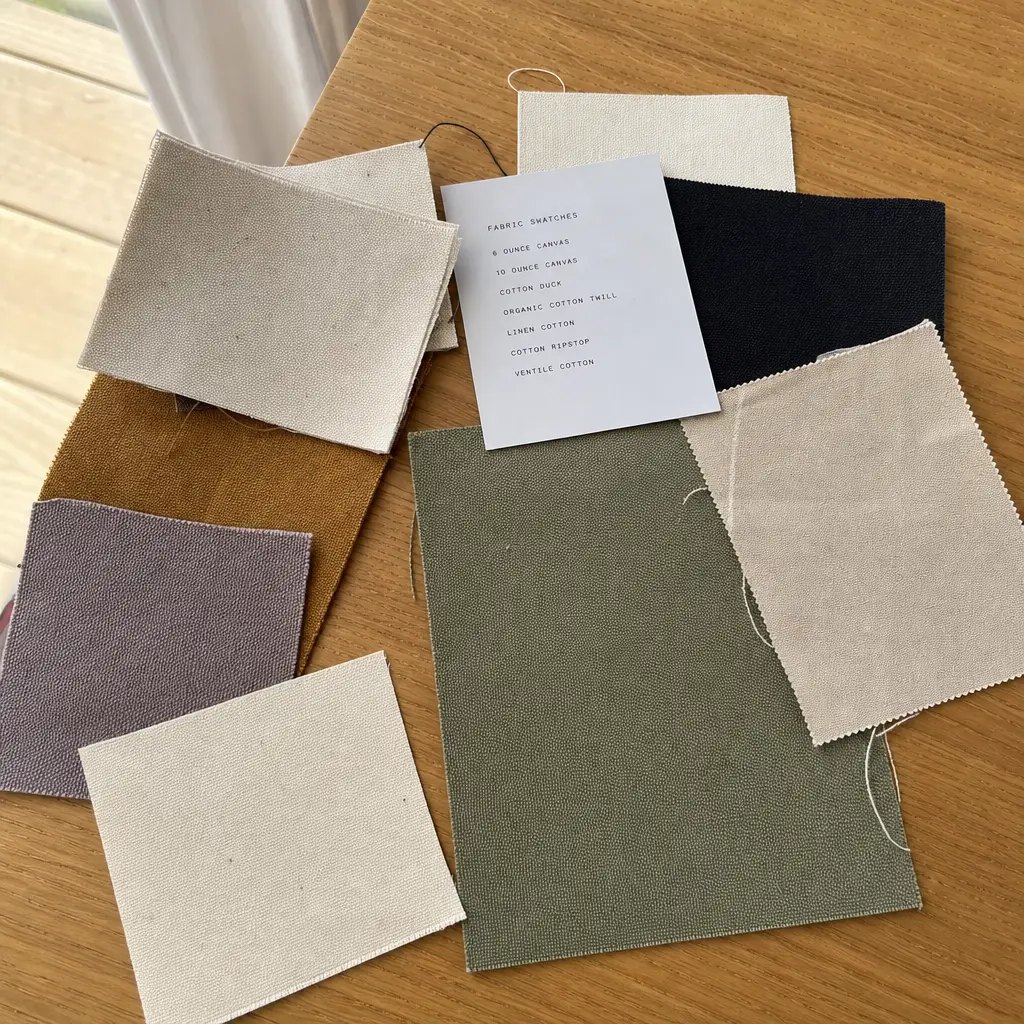
Natural cotton is common for custom cotton drawstring pouches because it has a casual, campus-friendly look. It works well with black, navy, forest green, maroon, gray, and many other solid school marks. Buyers should remember, though, that natural cotton is not pure white. Cream tone, seed flecks, and mild batch variation are normal unless the RFQ defines a different standard. Those traits can support an eco-style presentation, but they may reduce contrast for pale ink colors or fine artwork.
Bleached white cotton is better when the bookstore needs sharper artwork, cleaner retail presentation, or full-color printing. White fabric gives stronger contrast for small text, mascot detail, and multi-color graphics. It also shows stains, handling marks, sewing dirt, and lint more easily. If white pouches will be sold as clean accessories, decide early whether individual packing is needed to prevent shelf soil.
Dyed cotton is useful for school-color programs, but color approval has to be handled carefully. A website hex code is not enough for textile dyeing. Provide a Pantone reference or physical approved standard, request a lab dip, and approve shade under consistent lighting before bulk dyeing. Organic cotton belongs in the specification when the bookstore has a real claim requirement for product pages, hangtags, procurement reporting, or campus sustainability programs. If organic is requested, ask what certification documentation can be supplied and confirm the exact wording allowed on labels or marketing materials.
- Natural cotton: best for casual, eco-style programs, simple logos, and cost-conscious repeat orders.
- Bleached white cotton: best for sharp print contrast, small artwork detail, full-color graphics, and cleaner retail presentation.
- Dyed cotton: best for school-color alignment but requires lab dip approval, shade tolerance, and colorfastness checks.
- Organic cotton: best when documentation and claim language are part of the selling or procurement requirement.
- Color approval rule: approve dyed fabric from a physical lab dip or swatch, not only from an on-screen image.
4. Specify Finish, Shrinkage, and Finished Size Before Sampling
Fabric finish affects how the pouch feels, prints, folds, and fits. Cotton may be supplied natural, bleached, dyed, washed, pre-shrunk, sanforized, brushed, calendared, or pressed. Pick the finish for the actual bookstore use. A soft washed hand may suit a casual accessory. A flatter pressed finish may support cleaner folding and print presentation. Pre-shrunk or sanforized fabric helps when finished dimensions must be more repeatable.
For pouch sourcing, finished size matters more than cut size. If a buyer orders a 6 x 8 inch pouch, the factory should confirm whether that means finished flat width and height after sewing or fabric panel size before seam allowance. The RFQ should state the measurement method. A clear line might read: “Finished flat size: 152 mm W x 203 mm H, measured empty after sewing and pressing, tolerance plus or minus 5 mm.” Product-fit pouches may need tighter control or a fit sample using the actual item.
Shrinkage can create problems when fabric is dyed, washed, pressed, or handled differently between production lots. If a print is positioned near a seam or channel, size drift can make the logo look misplaced. For repeat SKUs, keep an approved swatch and a sealed approved sample with measured dimensions, fabric weight, cord details, and print placement. That sample becomes the practical reference for future production and incoming inspection.
- Define whether size is measured flat and empty, after sewing, after pressing, and before or after drawcord closure.
- Use metric measurements in production documents even if the internal request starts in inches.
- Set tolerance: plus or minus 5 mm for small pouches is common; larger pouches may allow plus or minus 10 mm if product fit permits.
- Ask whether fabric shrinkage is controlled before cutting, especially for dyed, washed, or pre-shrunk cotton.
- Do not change finish between reorders without rechecking print color, size tolerance, and drawcord closure.
5. Match Print Method to Artwork, Cotton Texture, and Quantity
Screen printing is usually the most practical method for university bookstore cotton drawstring pouches when the artwork is a solid school name, bookstore logo, department mark, class year, or simple mascot graphic. It works well for one to three solid colors and is efficient for repeatable designs. For B2B control, the quote should state how many colors are included, whether screen charges are included, the maximum print area, and whether the print is on one side or both sides.
Cotton does not behave like coated paper. A textured or slubby surface can break up very fine lines. Small reversed text, tiny trademark symbols, distressed artwork, and thin outlines may lose detail. Ask the supplier for minimum line width, minimum text height, and recommended distance from seams or drawcord channels before approving artwork. For licensed marks, a physical strike-off on the actual cotton is safer than a flat digital proof.
Heat transfer can be useful for full-color art, gradients, many small design versions, or short runs. The tradeoff is surface hand feel. Transfers sit on the fabric and may feel smoother, glossier, or more film-like than screen print. If a transfer is used, define expectations for edge adhesion, cracking, gloss consistency, and handling or wash testing if relevant. Embroidery may work on heavier pouches, but on lighter cotton it can pucker the fabric, especially around dense logos.
- Screen print: best for solid bookstore logos, school names, class years, and repeat designs at volume.
- Heat transfer: best for full-color art, gradients, photos, or many small runs with different graphics.
- Embroidery: consider only when the pouch size, logo size, and fabric weight can handle needle tension without puckering.
- Artwork proofing: check spelling digitally, but approve print quality from a strike-off or pre-production sample.
- Placement control: state print location from top opening, side seam, or center line, with a millimeter tolerance.
6. Build the RFQ Around Cost Drivers and MOQ Logic
The unit price of a custom cotton drawstring pouch is driven by more than cotton weight. Real cost drivers include fabric consumption, GSM, cotton type, dyeing, shrinkage control, print setup, number of colors, number of print positions, drawcord material, seam construction, trimming, pressing, packing labor, carton sorting, barcode work, and sample requirements. A 6 oz natural cotton pouch with one-color front print and bulk packing should not be compared directly with an 8 oz dyed pouch with two-sided print, custom cord, hangtag, and individual polybag.
MOQ logic is especially important for university bookstores. One purchasing program may involve the bookstore, alumni office, orientation team, residence life, athletics, and several academic departments. Factories often set MOQ by size, fabric color, print design, and packing style. If every department requests a different size and fabric color, the order becomes fragmented and expensive. If the buyer standardizes one size, one fabric color, one cord, and one packing method, the factory can usually manage multiple printed designs more efficiently.
A strong RFQ separates the base specification from optional upgrades. Start with a base quote such as: 6 oz natural cotton, finished size 203 x 254 mm, one-color front screen print, cotton cord, reinforced channel openings, bulk pack 100 pieces per inner bag. Then request separate adders for 8 oz fabric, dyed fabric, two-color print, two-sided print, individual polybag, barcode label, hangtag, or carton sorting by destination.
- Base-cost path: one size, natural cotton, one-color front screen print, standard cord, bulk packing.
- Balanced bookstore path: 6 oz or 8 oz cotton, neat sewing, smoother drawcord, reinforced openings, and carton separation by design.
- Higher-control path: dyed fabric, lab dip, print strike-off, barcode labels, approved carton marks, and pre-shipment inspection.
- Cost trap: many small department designs below MOQ, each with separate setup, packing, and receiving requirements.
- Quote discipline: require suppliers to show what is included and excluded, including setup fees, samples, lab dips, packing, and carton marks.
7. Treat Drawcords, Channels, and Seams as Functional Specifications
The drawcord is one of the first components customers touch. A pouch with good fabric can still feel low quality if the cord is too thin, rough, short, or difficult to pull. Cotton cord gives a natural look and pairs well with natural or organic cotton. Polyester cord can be smoother, brighter, less prone to fraying, and easier to color match. Neither option is automatically better. The right choice depends on brand presentation, handling frequency, fabric weight, and color target.
Cord diameter should suit pouch size and fabric weight. A small stationery pouch may use a thinner cord, while a larger 8 oz retail pouch often needs a stronger cord and a wider channel. The channel height should provide enough clearance for smooth movement. If the channel is too tight, customers will feel friction when opening and closing. If it is too loose, the top may look bulky or uneven.
Seam construction should be defined before sampling. Standard single-needle lockstitch is suitable for many bulk orders if tension is correct and stitch lines are straight. For cleaner retail presentation, buyers may request overlocked inside seams, bound seams, or French seams. The drawstring opening is the stress point that needs the most attention. Reinforcement can be a bartack, backstitching, dense lockstitch, or another approved method, but it should be visible in the sample and checked during inspection.
- Confirm cord material: cotton, polyester, recycled polyester, or another specified option.
- Define cord diameter, length, color, knot style, and whether ends are knotted, heat-sealed, tipped, taped, or left plain.
- Match channel height to cord diameter and fabric thickness; heavy cotton needs more clearance.
- Require reinforcement at drawstring openings for retail pouches and repeatedly handled packaging.
- Inspect seams for skipped stitches, loose thread, uneven tension, raw-edge fraying, oil marks, and bulky corners.
8. Use a Sample Approval Process That Production Can Actually Follow
A digital artwork proof is not enough for a bookstore pouch order. It can confirm logo scale, spelling, and approximate placement, but it cannot confirm fabric hand, GSM, cord function, print opacity, shade, seam quality, or product fit. Before bulk production, approve a pre-production sample made with the actual fabric, actual cord, actual print method, final dimensions, and intended packing.
The approval record should be measurable. Record finished width and height, fabric weight, fabric color, cord material, cord diameter, cord length, channel height, seam type, print size, print color reference, print position, and packing method. If the buyer approves the sample with changes, those changes must be written into the production order before cutting or printing begins. Verbal changes are hard to enforce and often create disputes later.
Fit testing is essential when the pouch is packaging for another item. Insert the actual product or a dimensionally accurate substitute and close the drawcord fully. Check whether the product bulges, whether the logo remains visible, whether the cord closes smoothly, and whether the pouch still looks presentable. For retail SKUs, view the sample as it will be sold: folded, stacked, hung, or binned under store lighting.
- Measure the sample flat after sewing and finishing; record the result in millimeters.
- Open and close the drawcord at least twenty times to check friction, cord slippage, and channel stress.
- Compare fabric shade and print color against approved swatch, lab dip, or Pantone reference under consistent light.
- Inspect print edges, ink coverage, small text, registration, and placement before approving production.
- Photograph the approved sample from front, back, inside seam, drawstring opening, print close-up, and packing view.
- Keep one approved sample sealed or clearly labeled for incoming inspection and reorder comparison.
9. Define QC Thresholds, Defect Classes, and Inspection Points
Most drawstring pouch defects are easy to identify, but they become expensive when discovered after shipment or during rush-season receiving. Common problems include wrong fabric weight, size variation, crooked print, poor ink coverage, loose threads, uneven cord length, cord fraying, stains, odor, mixed designs, weak channel stitching, and inaccurate carton counts. These issues are easier to resolve when the RFQ defines acceptance criteria before production starts.
Size and placement tolerances should match the use. A small pouch for a boxed item may require plus or minus 3-5 mm because fit is critical. A larger soft-goods pouch may allow plus or minus 10 mm. Print placement should be measured from fixed reference points, not judged by eye alone. For many retail pouches, a print placement tolerance of plus or minus 3-5 mm is a reasonable starting point for small graphics, while larger pouches or handmade constructions may need wider agreement. The key is to state it clearly.
Defect classification improves supplier communication. Critical defects make the product unusable, unsafe, legally risky, or impossible to sell as ordered. Major defects affect saleability or customer perception. Minor defects are small imperfections within the approved character of cotton. Retail-grade pouches should have stricter cosmetic standards than giveaway-grade pouches because customers judge them as merchandise.
- Critical defects: wrong logo, wrong design, wrong school color, nonfunctional drawcord, broken seam, severe contamination, or unsafe foreign matter.
- Major defects: size outside tolerance, print shift outside tolerance, visible oil mark, weak channel stitching, poor ink coverage, mixed designs, or incorrect packing.
- Minor defects: small removable threads, slight approved cotton slub, or minor shade variation within the agreed standard.
- Inspection points: fabric shade, GSM, finished size, print position, print quality, cord length, channel function, seam strength, cleanliness, quantity, and carton marks.
- Receiving check: compare carton labels and packing list against PO, SKU, design, size, color, quantity, and destination before the sales season begins.
10. Plan Packing for Bookstore Receiving, Scanning, and Storage
Packing is a sourcing decision, not an afterthought. During semester rush or graduation season, bookstore receiving teams need cartons that are easy to identify, count, and route. If multiple designs are packed together without clear carton marks, staff may spend unnecessary time sorting. Packing affects labor cost, carton volume, damage prevention, retail readiness, and sustainability goals.
Bulk packing is usually efficient for event handouts, kit assembly, and internal department distribution. It reduces packaging material and carton volume, but it should still be organized. Inner bags or paper bands with fixed bundle counts help receiving teams count quickly. Individual polybags, barcode labels, hangtags, or retail stickers make sense when the pouch is sold as a SKU or must stay clean on shelves. These requirements should be in the first quote because they add material and labor.
For multi-design orders, define carton rules. The cleanest option is one design per carton. If mixed cartons are allowed, the packing list must show the exact breakdown by carton. Carton marks should include PO number, item name, SKU or design name, size, fabric color, print design, quantity, carton number, and destination if shipping to multiple campus locations or warehouses.
- Bulk pack: efficient for events, kits, and internal distribution; specify bundle count and inner-label format.
- Individual polybag: better for resale cleanliness and barcode control, but increases material use, labor, and carton count.
- Hangtag: useful for retail information or sustainability messaging; requires artwork, placement, attachment method, and QC approval.
- Carton marks: include PO, SKU or design name, size, color, quantity, carton number, and destination.
- Mixed cartons: avoid when possible; if allowed, require a carton-level packing list with exact quantities by design.
Specification comparison for buyers
| Spec decision | Recommended option | When it fits | Buyer risk to check |
|---|---|---|---|
| Fabric weight for basic campus distribution | 4 oz to 5 oz cotton, approximately 130-180 GSM depending on mill and finish | Orientation handouts, document sleeves, welcome-kit packaging, light promotional inserts, or short-term events | May feel thin for paid retail; verify opacity, seam strength, and logo coverage on the actual fabric before approval |
| Fabric weight for bookstore merchandise | 6 oz cotton, commonly about 180-220 GSM | Stationery kits, small apparel accessories, charging cables, alumni items, private-label accessories, and general bookstore bundles | Ask for a GSM tolerance, such as target GSM plus or minus 5%, so the supplier cannot substitute a noticeably lighter cloth |
| Fabric weight for premium retail sets | 8 oz cotton, often about 250-280 GSM | Graduation merchandise, premium gift sets, higher-priced retail packaging, or pouch SKUs displayed near apparel and drinkware | Heavier fabric needs a suitable channel height and cord diameter; otherwise the pouch can look premium but close poorly |
| Cotton type | Conventional natural cotton for most programs; organic cotton only when the claim is required for procurement, labeling, or selling copy | Conventional cotton supports cost and lead-time control; organic cotton supports documented sustainability requirements | Organic claims require the right documentation and wording; request certification evidence before approving claims on tags or product pages |
| Fabric finish | Pre-shrunk, sanforized, or controlled-shrinkage cotton when size repeatability matters | Fixed product-fit pouches, repeat SKUs, prints near seams, and multi-year bookstore programs | If shrinkage is not defined, finished size and print placement can drift after dyeing, washing, pressing, or later handling |
| Color direction | Natural, bleached white, or dyed school color based on artwork contrast and inventory plan | Natural for eco-style basics, white for sharper print contrast, dyed cotton for licensed color programs | Dyed cotton requires lab dip approval, shade tolerance, and colorfastness checks; do not approve school colors from a screen image only |
| Print method | Screen print for one to three solid colors; heat transfer for full-color art or many small design versions | Screen print suits school marks, bookstore logos, class years, and department graphics at volume | Transfers can alter hand feel; define film type, press conditions, adhesion expectation, and handling or wash-test criteria if relevant |
| Drawcord material | Cotton cord for a natural hand; polyester cord when bright color, smoother pull, or lower fray risk is needed | Cotton cord fits natural or organic positioning; polyester is practical for dyed color matching and frequent handling | Cord diameter, channel height, drawcord length, knot size, and end treatment directly affect usability |
| Seam construction | Single-needle lockstitch with reinforced channel openings for standard orders; overlock, bound seam, or French seam for upgraded retail presentation | Standard seams fit bulk campus programs; upgraded seams fit premium packaging or visible retail SKUs | Skipped stitches, loose thread, raw edges, and weak channel openings are common failure points during customer handling |
Buyer checklist before sampling
- Define the commercial role first: resale SKU, gift packaging, orientation kit, department giveaway, alumni merchandise, graduation set, or private-label bookstore accessory.
- State finished pouch size as width x height after sewing and finishing; include whether the size is measured flat, empty, and before or after drawcord closure.
- Set a size tolerance in the RFQ, such as plus or minus 5 mm for small pouches and plus or minus 10 mm for larger pouches unless the product fit requires tighter control.
- Specify fabric weight in both ounces and GSM, and ask for an acceptable GSM tolerance, commonly target plus or minus 5% unless otherwise agreed.
- Choose natural, bleached, dyed, or organic cotton before artwork proofing because fabric color and cotton type affect print contrast, MOQ, sample timing, and documentation.
- Confirm the fabric finish: untreated natural, bleached, dyed, washed, pre-shrunk, sanforized, calendared, brushed, or pressed.
- Send vector artwork and include Pantone references for print ink; for dyed fabric, provide a physical color standard or Pantone reference for lab dip approval.
- Confirm print method, number of print colors, maximum print area, minimum line width, print placement tolerance, and whether the print is one-sided or two-sided.
- Define drawcord material, diameter, length, color, knot style, and end treatment; confirm the channel height is suitable for the cord.
- Specify seam type, stitch density if needed, channel construction, reinforcement at drawstring openings, and inside seam finish for retail-grade orders.
Factory quote questions to send
- What cotton fabric weight are you quoting in both ounces and GSM, and what GSM tolerance will be used during production?
- Is the quoted fabric natural, greige, bleached, dyed, washed, pre-shrunk, sanforized, organic, or another finish?
- Is the quoted size the finished flat pouch size after sewing and finishing, and what width and height tolerance will your QC team apply?
- What shrinkage range do you expect for this fabric and finish, and is shrinkage controlled before cutting?
- Which print method is included, how many print colors are priced, what print area is included, and what additional charge applies for a second print position?
- What minimum line width, minimum text height, and artwork spacing from seams or channel do you recommend for this cotton texture?
- Does the price include screen charges or transfer setup, drawcord, cord insertion labor, channel reinforcement, trimming, pressing, and standard carton packing?
- What drawcord material, diameter, color, and length are included, and can you quote cotton cord and polyester cord as separate options?
- What seam construction is included: lockstitch only, overlocked inner seam, bound seam, French seam, bartack, or other reinforcement?
- What is the MOQ per size, per fabric color, per print design, and per packing style, and what surcharge applies for small department designs below MOQ?
Quality-control points to confirm
- Finished size should be measured flat after sewing and finishing. A practical tolerance is often plus or minus 5 mm for small pouches and plus or minus 10 mm for larger pouches, unless the RFQ sets a tighter product-fit requirement.
- Fabric GSM should be checked against the approved swatch or test report. A target GSM tolerance of plus or minus 5% is a common RFQ starting point, but the buyer should define the actual acceptance range.
- Fabric shade should be compared with the approved swatch or lab dip under consistent lighting, especially for dyed school-color pouches and repeat orders.
- Print placement should be measured from fixed reference points such as top opening, side seam, center line, or bottom seam; do not rely on visual judgment only.
- For retail pouches, print placement tolerance should be stated in millimeters, often plus or minus 3-5 mm for small marks and plus or minus 5-8 mm for larger pouches depending on construction.
- Screen print coverage should be even across the cotton texture, with no large pinholes, smears, ink bleeding, ghosting, or registration problems that distort the school mark.
- Heat transfers should be checked for edge lift, incomplete adhesion, trapped lint, scorching, gloss inconsistency, cracking, and poor alignment on the cotton surface.
- Drawcord channels must pull smoothly without tight corners, seam bulk, skipped stitches, loose threads, or openings that trap the cord.
- Drawcord length should be consistent across the lot, and knots or end finishes should not slip into the channel during normal opening and closing.
- Channel openings should be reinforced because this is a high-stress area; check for bartack, backstitch, dense lockstitching, or another approved reinforcement method.