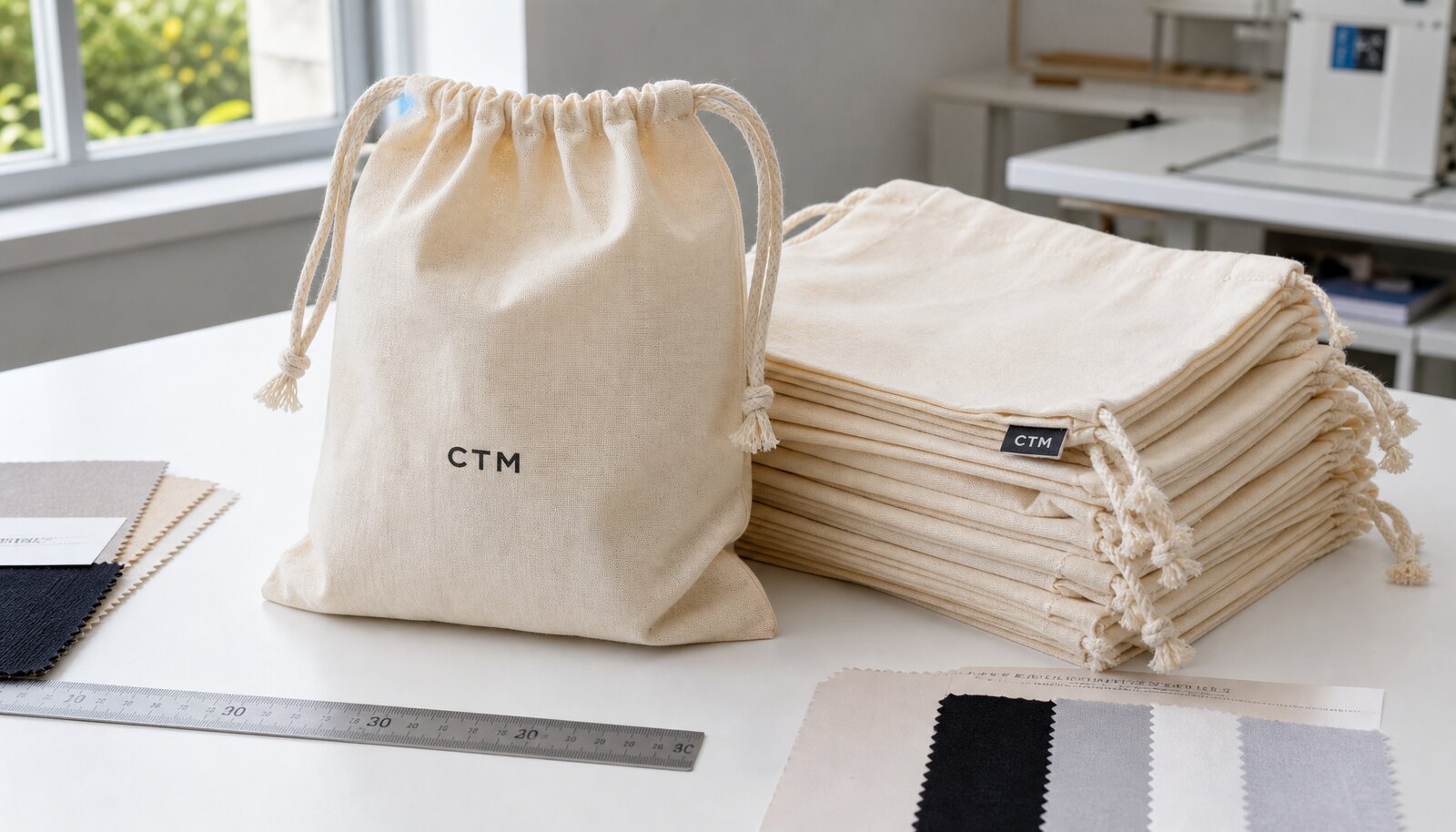
Why compliance matters even for a simple cotton pouch
Cotton drawstring pouches look straightforward, which is exactly why buyers often under-spec them. In gift shop programs, the pouch is not just a small bag; it is part of the product presentation, the shelf appearance, and the receiving workflow. A slightly wrong size can make a gift set look sloppy. A print that rubs off can create a returns issue. A carton pack that does not match the warehouse label plan can slow down intake and increase handling cost.
The practical buying goal is not to make the pouch over-engineered. It is to make the quote and the production decision measurable. If the supplier is only describing the product in general terms, you are still buying assumptions. A better approach is to lock down the build, the inspection standard, and the documents that prove the factory shipped what it promised.
For procurement teams, that means treating the pouch as a controlled retail component. Once you do that, supplier comparison becomes much clearer: you can see which factory understands the actual brief, which one is only good at sample presentation, and which one can support repeat orders without drifting on size, fabric, or packing.
- Think of the pouch as part of the customer-facing gift presentation, not a loose accessory.
- Require measurable specs for fabric, construction, print, and packing.
- Make the approval sample, quotation, and inspection plan reference the same version of the spec.
Start with fabric, construction, and use case before you ask for price
The first question is not how much the pouch costs. It is what the pouch needs to do. A pouch used for jewelry, soap, or a lightweight souvenir does not need the same cloth weight as one that carries candles, boxed sets, or multiple items bundled together. For most gift shop assortments, plain cotton around 120-140 GSM is a useful baseline. It gives enough body for presentation without pushing the cost into a premium band unnecessarily.
For products that must feel sturdier or cover contents more completely, 160 GSM is a more commercial choice. That heavier cloth usually improves opacity, hand feel, and shape retention, but it also raises material consumption and may require a different sewing feel. Buyers should not assume heavier is always better; instead, align the fabric to the object inside the pouch and the selling price of the final gift set.
Construction is where many low quotes become expensive later. A folded top with a clean drawstring channel, reinforced side seams, and a neat bottom seam is usually better than a loose edge finish. Ask for seam allowance, stitch density, channel width, and whether reinforcement stitches or bar-tacks are used at stress points. The factory should be able to explain these details in plain terms and show them on a sample photo or engineering sketch.
Useful buyer question: if the pouch is filled and opened repeatedly in store handling, where is the first point likely to fail? A supplier that knows the product should answer with a specific structural point, such as the channel edge, the cord entry point, or the bottom seam. That answer tells you more than a generic promise of 'good quality.'
- 120-140 GSM works for many standard gift shop applications.
- 160 GSM is better when the pouch needs more body, opacity, or durability.
- Ask for channel width, seam allowance, and reinforcement detail, not just overall dimensions.
- Match the fabric weight to the actual contents and the retail price point.
How to compare supplier routes without mixing apples and oranges
Not every supplier route gives the same level of control. A direct sewing factory usually offers the cleanest path for this product because the team that cuts and stitches the pouch can also confirm construction problems early. If the same facility also handles printing and final packing, it becomes easier to trace who owns each step and to correct issues before a full run is completed.
A trading company can still be useful, especially when the buyer needs coordination across labels, packaging, and multiple accessory items. But the buyer should not accept a trading quote without identifying the actual factory, the exact production steps that are subcontracted, and who is responsible for final QC decisions. If that chain is unclear, the quote comparison becomes unreliable because you do not know who really controls the product.
Specialized bag workshops are often the strongest route for detailed construction and repeatable sewing standards. They are especially useful when the pouch needs a specific cord diameter, reinforced channel, or tighter presentation finish. General promotional suppliers can work for simple giveaways, but their quotes should be treated carefully because the product may be presented as a bag while the actual risk sits in packaging, print durability, or material downgrades.
For gift shop buyers, the best route is usually the one that supports repeatability, not just the one with the lowest first quote. A slightly higher unit price is often the better commercial choice if it reduces receiving problems, relabeling, or stock delays during a seasonal launch.
- Direct factory: better traceability and stronger control of stitching and packing.
- Trading company: workable only when the actual factory and QC responsibility are named.
- Specialized workshop: good for construction accuracy and repeat orders.
- General supplier: only suitable when the spec is simple and the risk of variation is acceptable.
A commercially useful comparison table for sourcing decisions
Use the table above as a sourcing filter before you request samples. The important point is not whether a supplier says they can make cotton pouches. It is whether they can prove control over the steps that affect receiving quality: cloth, cord, stitching, print, and pack count.
If the route cannot support the level of documentation your market needs, then the lower price is not actually lower. It just shifts the cost downstream into inspection, rework, and delay. That is why buyers should compare supplier routes before they compare the headline unit price.
- Ask every supplier to quote against the same spec sheet and artwork version.
- Keep sample approval notes tied to one reference sample and one quotation version.
- Do not compare a packed retail pouch with a bulk-only quote unless the packing scope is identical.
What a proper RFQ should include so the quote is actually comparable
A useful RFQ for custom cotton pouches should leave as little room for interpretation as possible. The biggest quote gaps usually come from missing assumptions, not from real manufacturing differences. If you do not specify fabric weight, print method, and pack format, each supplier will fill in the blanks differently and the prices will not mean the same thing.
The RFQ should list the finished size, opening width, fabric composition, target GSM, logo placement, number of print colors, packing count per inner pack, and carton requirements. For retail buyers, it should also say whether the pouch must arrive pre-folded, tied, labeled, or ready for shelf display. That information changes labor cost more than many buyers realize.
Be explicit about tolerance expectations. For example, if the pouch is intended to hold a boxed gift, the opening width can be more important than the nominal bag size. Similarly, if the logo must sit centered under the closure channel, the supplier needs a placement tolerance that is small enough to keep the design looking intentional on the shelf. Buying by 'about this size' is usually what creates disputes later.
The same is true for MOQ. A supplier may quote a low MOQ because it uses existing cloth and a simple pack-out, while a different supplier needs a higher quantity to justify cutting and print setup. The key is to ask why the MOQ exists, not just to accept it as a rule.
- RFQ must include size, GSM, composition, print method, packaging, and destination market.
- Ask for size and placement tolerances in writing.
- Require suppliers to state what assumptions sit behind their MOQ and unit price.
Use quote questions that expose hidden cost drivers
Unit price alone is not enough. A smart quote request pulls out the cost items that tend to get buried. The most common drivers are fabric GSM, bag size, number of print colors, whether both sides are printed, whether the cord is cotton or another material, and whether the order includes labels or retail packaging. Each of those choices changes material use or handling time.
Ask whether the supplier includes cutting loss, print setup, sample rounds, and carton marking in the quoted number. Some factories offer a very sharp-looking piece price but exclude the add-ons needed to deliver a retail-ready shipment. If the buyer only looks at the piece price, the true landed cost can be materially higher than expected.
For gift shop buyers, packing economics matter. A pouch that arrives in loose bulk may be cheap at origin but expensive to receive, sort, or relabel in the destination warehouse. If the goods are being sold as part of a curated gift set, you should also ask whether inner pack counts can be standardized so receiving teams do not have to open and count every carton.
A practical quoting exercise is to ask the same supplier for two versions: one bare-bones pack-out and one retail-ready pack-out. That makes the cost trade-off visible. In many cases, the buyer learns that the factory charge for labels or inner packs is small compared with the warehouse labor saved later.
- Ask for a line-item quote covering fabric, sewing, printing, packing, and cartons.
- Request a second quote for retail-ready packing so destination labor can be compared.
- Make suppliers state whether print setup, plates, or screens are included.
Compliance evidence: what to ask for, and what each document should prove
Compliance language is often too vague in supplier presentations. A buyer does not need a pile of certificates that have no connection to the order. The useful question is whether the supplier can show evidence for the exact fabric, ink, cord, and label construction being used. If the sample and bulk order differ, the documents are less meaningful.
For cotton pouches, the core evidence should usually include a material declaration for the fabric, identification of any trims or labels, and current test or compliance records for the exact decorative or finishing materials used. If the product is sold in a market with packaging or labeling requirements, the supplier should also understand country-of-origin marking, fiber content statements, and carton label expectations. If the buyer is making organic, recycled, or other special claims, those claims must be supported by real chain-of-custody or certification documents, not just by marketing language.
Concrete standards and tests are more useful than general assurances. Depending on the market and product construction, buyers commonly ask about azo dye restrictions, formaldehyde content, colorfastness to rubbing or washing, pH for textile surfaces, and restricted substances relevant to packaging inks or labels. If the pouch includes printed graphics, request information on the ink system and whether the supplier has current test records for rub resistance or durability relevant to the intended use.
Region-specific compliance expectations should be stated in the RFQ. For example, if the goods are going to the EU, buyers often care about REACH-relevant restricted substances and the accuracy of fiber content and labeling. In the US, retail programs may need different labeling discipline and packaging practices, and California buyers may ask suppliers to consider Proposition 65 exposure if inks, coatings, or other components create that concern. UK buyers generally want the same kind of traceable material and labeling discipline expected in the EU market, with import paperwork aligned to the commercial shipment.
The point is not to overload a small pouch with unnecessary documents. It is to ensure that the evidence matches the actual risk of the product and the destination market.
- Request material declaration for fabric, cord, labels, and print system.
- Ask for current test or compliance records tied to the exact build, not a generic factory file.
- Specify any destination-market labeling or restricted substance expectations in the RFQ.
- If a sustainability claim is used, ask for proof that supports the exact claim being made.
Sample approval: the best time to catch construction and artwork issues
A sample should tell you whether the pouch is fit for bulk production, not whether the sales team made a pretty prototype. Start by checking the blank construction: dimensions, seam alignment, channel symmetry, cord movement, and the way the pouch stands or folds when filled. Then check the decorated version for print placement, color consistency, and whether the logo remains readable after handling.
Use the right sample stage for the right question. A blank sample verifies construction and dimensions. A print strike-off verifies artwork, placement, and color behavior. A pre-production sample verifies the full build, including the exact fabric lot, cord, label, print method, and packing format. For gift shop programs, the pre-production sample is the one to approve before bulk because it is the closest match to what the warehouse will receive.
A sample review should include simple but disciplined handling tests. Open and close the pouch repeatedly. Fill it with the intended merchandise or a weight similar to the intended load. Check whether the drawcord twists, whether the channel puckers, and whether the print looks centered once the pouch is in use rather than flat on a table. These are the small issues that often become large complaints if they are ignored.
Keep a signed reference sample in the purchasing file and, if possible, one matching sealed sample with the supplier as well. When quality questions come up later, both sides should be looking at the same reference point.
- Approve a pre-production sample, not only a sales sample.
- Test cord motion, fill behavior, and print durability under handling.
- Keep a signed reference sample for production and receiving comparison.
QC checkpoints buyers can actually act on
A good QC plan gives measurable limits, not broad statements like 'good stitching' or 'nice finish.' For pouch orders, start with fabric checks. The GSM should stay within the agreed tolerance band, and the cloth should not show obvious thin areas, contamination marks, or visible weave defects in normal viewing conditions. If the supplier uses a dyed or washed cloth, color shade should be consistent enough that a carton does not look patchy when opened at receiving.
Next, inspect construction. Finished size should fall within tolerance on both length and width. The drawstring channel should be even, with no twisting, and the cord should move smoothly without snagging. Stitching should be straight and secure along the side seams, bottom seam, and top channel. If reinforcement stitches or bar-tacks are part of the spec, they should appear consistently in the specified places and should not be loose or broken.
Print quality needs its own standard. Buyers should define acceptable color variation, placement tolerance, and how much rub resistance is expected after handling. For simple one-color logos, registration should be clean and the edges should not blur or bleed into the fabric weave. If the pouch carries a small logo, even a slight shift in placement can make the product look off-center on shelf, so placement tolerance should be tighter than many factories default to.
Inspection method matters as much as the acceptance limit. Ask the supplier what they inspect in-line, what they inspect at final packing, and whether they follow a formal sampling plan such as AQL for critical, major, and minor defects. This is especially useful when orders are large enough that one-pass visual checking is not enough. Critical defects should cover issues that make the pouch unusable, major defects should cover problems that affect saleability, and minor defects should cover small cosmetic issues that do not change function.
A practical acceptance file should include photographs of acceptable and unacceptable conditions. That way, the factory and the buyer can see the same standard instead of arguing later about wording.
- Set measurable limits for size, stitching, color, and placement.
- Use a sampling plan such as AQL if the order volume justifies it.
- Define critical, major, and minor defects before bulk starts.
- Keep photo references of approved and rejected conditions.
Packing and warehouse economics: where gift shop buyers save or lose money
Packing is not a side detail. It affects receiving speed, retail readiness, and total landed cost. A pouch shipped loose in bulk may look cheapest at the factory, but the destination team may spend time counting, sorting, folding, and relabeling it. For a gift shop program, that can erase the benefit of the lower origin price very quickly.
If the pouches go directly into retail inventory, ask whether they can be packed in consistent inner packs with a clear label on each bundle. Standard inner counts reduce warehouse handling, and clear carton marks reduce mistakes when multiple sizes or prints are ordered together. If the pouches are part of a gift set or seasonal display, ask the factory to match fold direction and cord tie style so the opening appearance is consistent at store level.
Packaging also affects freight. Carton dimensions, compression, and gross weight determine how efficiently the shipment uses container or pallet space. Even a small change in how pouches are folded or stacked can alter carton density and therefore shipping cost. Buyers should ask for carton size and estimated carton weight before approving the final packing style.
For destination markets with barcode or retail-label rules, the factory should show where the label will be placed, whether it will remain readable after handling, and whether the packaging material meets any store or warehouse requirements. This is a good place to compare suppliers because a factory that handles retail pack discipline well can reduce hidden labor downstream.
- Ask for inner pack count, carton dimensions, and gross weight before freight planning.
- Standardize folding and bundle counts where possible.
- Compare packing cost against the destination warehouse labor it saves.
Specification comparison for buyers
| Supplier option | What to verify | Commercial advantage | Buyer risk to control |
|---|---|---|---|
| Direct sewing factory | cord material proof, reinforcement close-ups, load-test photos, approved sample tag, and bulk-line first-piece record | Better sample-to-bulk control and faster production feedback | May be weaker on export paperwork or branded packing unless checked early |
| Trading company | Factory name, production photos, trim-source proof, and who owns QC decisions | Can coordinate small mixed orders and extra services | Markup can hide real factory capability and slow defect decisions |
| Specialized bag workshop | cord diameter, eyelet or reinforced channel, bottom corner reinforcement, seam allowance, bar-tack position, and load target | More practical for detailed construction, trims, and repeat programs | Capacity may be limited during peak seasons |
| Low-price general supplier | 6-10 oz cotton canvas, 210D polyester, rPET, or blended cotton with shrinkage and colorfastness expectations set before sampling | Useful for simple promotional runs with loose specs | Material downgrades, weak packing, and vague inspection scope can erase savings |
| Retail-ready supplier | fold direction, cord protection, bundle count, carton compression, moisture bag, and retail label position | Can handle labels, SKU separation, carton marks, and receiving rules | Higher unit cost must be compared against reduced warehouse work |
| Compliance-focused supplier | Fabric records, labeling review, test plan, and production traceability | Safer for retail programs and repeat brand orders | Documentation claims need evidence, not only sales language |
| Local sample room plus bulk factory | Signed sample, bulk factory handoff, first-piece photos, and deviation owner | Good for complex branding before large production | Sample room quality may not match bulk line unless handoff is controlled |
Buyer checklist before sampling
- Confirm finished pouch size, usable opening width, and cord length, and state whether measurements are before or after shrinkage.
- Specify fabric composition and target GSM with an acceptable tolerance range in the RFQ or PO.
- Define the print method, logo size, placement, color count, and acceptable color variance before sampling.
- Request compliance evidence tied to the exact fabric, ink, cord, and label used on the order.
- Approve a pre-production sample that matches bulk construction, not only a blank sample or strike-off.
- Set packing rules: inner pack count, carton count, carton marks, and whether retail barcode labels are required.
- Ask the supplier to quote lead time by stage: sample, print approval, bulk sewing, packing, and final inspection.
- Compare landed cost by adding packing, inland movement, export handling, and destination charges where applicable.
- Ask for a defect handling plan: what the supplier does if size, print, or stitch quality falls outside the agreed limit.
- Keep one signed approval sample and one signed inspection reference in the purchasing file.
Factory quote questions to send
- What is the exact fabric composition, GSM, and finishing state of the cotton you are quoting?
- Where are cutting, sewing, printing, and final packing performed, and which steps are subcontracted?
- Which print method are you recommending, and what are the limits for line thickness, small text, and number of colors?
- Can you provide current compliance documents for the exact material and ink planned for this order?
- What is the MOQ by size, print version, and packing format?
- What sample stages can you supply before bulk: blank sample, print strike-off, pre-production sample, or sealed approval sample?
- What packing options are included in the quote, and what extra charges apply for polybags, labels, hangtags, or carton markings?
- What is the realistic lead time from pre-production approval, and what normally delays the schedule?
- Which QC checkpoints do you use for stitching, cord function, print position, and carton count?
- If we reject a lot for measurable defects, how do you handle rework, replacement, or credit?
Quality-control points to confirm
- Fabric GSM within the agreed tolerance band, with no obvious thin spots, contamination marks, or uneven weave in visible areas.
- Finished length and width within tolerance, with the pouch opening and channel symmetrical on both sides.
- Cord pulls smoothly through the channel without snagging, fraying, or uneven tension.
- Stitching straight and secure on side seams, bottom seam, and channel top, with no skipped stitches, broken thread, or loose ends.
- If bar-tacks or reinforcement stitches are specified, they must be present in the correct location and consistent on the full lot.
- Print placement centered or positioned per artwork spec, with no smearing, pinholes, misregistration, or obvious shade shift.
- No oil stains, miscut panels, mixed sizes, foreign fibers, or visible needle damage on finished goods.
- Carton count must match the packing list, with labeled inner packs and legible outer carton marks.
- AQL-style inspection should be agreed in advance for critical, major, and minor defects, with a defined sampling plan and rejection action.
- If the pouch is intended for retail gifting, verify that presentation folding, cord tying, and pack consistency match store receiving needs.