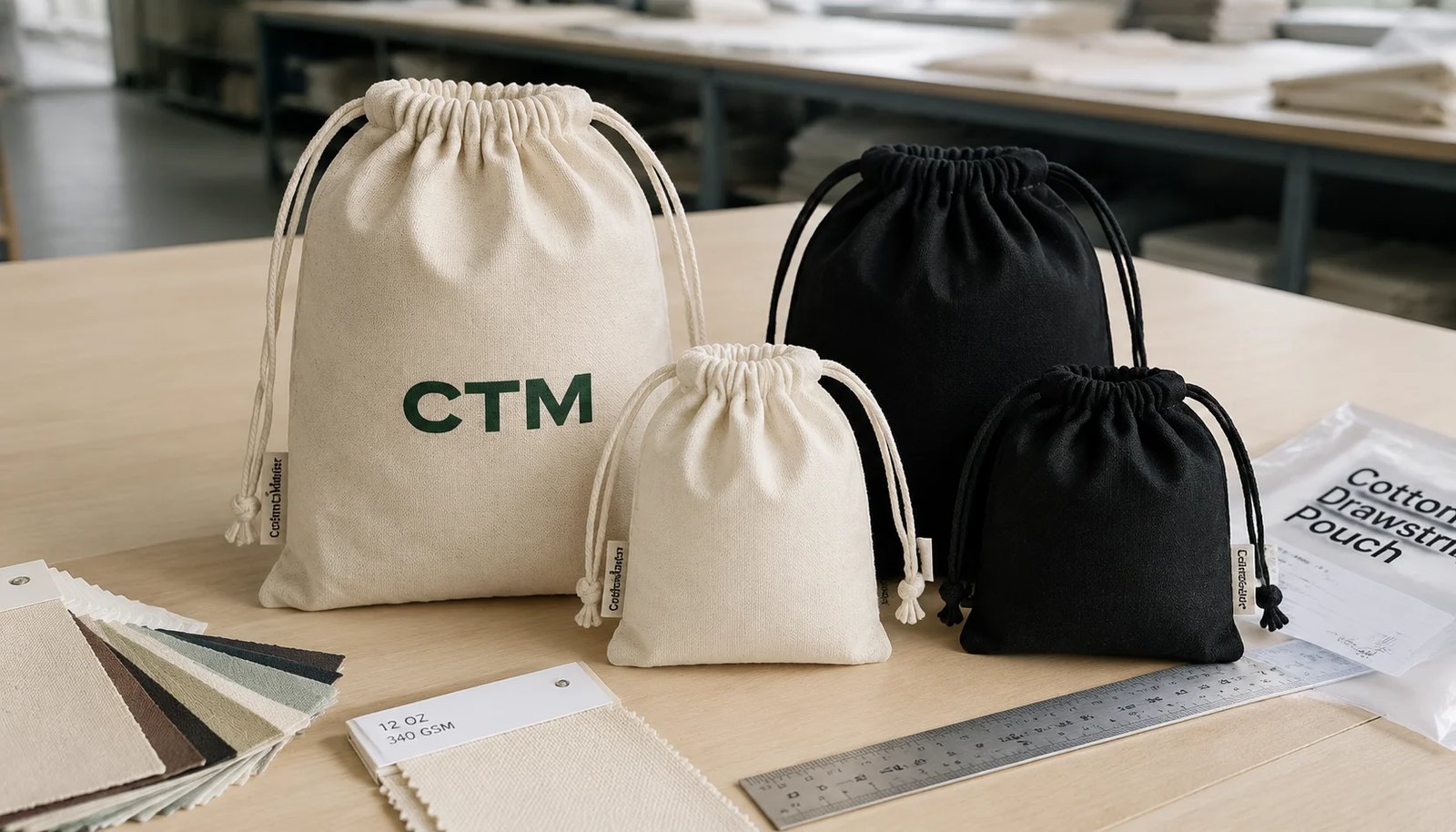
Why liquor retailers need a pouch-specific supplier compliance checklist
A custom cotton drawstring pouch may look simple, but in liquor retail it usually supports a tighter program than a generic giveaway bag. It might cover a bottle on shelf, sit inside a gift-with-purchase bundle, protect accessories, or become part of a seasonal branded pack. In every one of those cases, the pouch is not just decoration. It affects presentation, receiving, and the buyer’s risk if bulk production drifts from the approved sample.
That is why procurement cannot treat this purchase as a basic logo bag order. The real buying job is broader: bottle fit, seam durability, print consistency, SKU packing accuracy, and order-level documentation all need to line up. Leave any of those points vague and two suppliers can appear to quote the same product while building very different items.
The most common mistake is still price-only comparison. One quote may be based on 150 GSM sheeting cotton, a shallow channel, a thin stock cord, loose print tolerance, and mixed carton packing. Another may reflect 240 GSM cotton canvas, stronger channel sewing, tighter logo placement, and barcode-separated cartons. Both are called custom cotton drawstring pouches. For a liquor retail rollout, though, they are not interchangeable.
A compliance checklist solves that problem by standardizing assumptions before the quote stage gets too far. It gives sourcing teams a practical way to compare construction, not just sales language. That is especially useful when procurement is collecting offers from a direct factory, a trading company, and a specialist workshop at the same time.
- Use the checklist to standardize quote assumptions before comparing prices.
- Treat fit, fabric, print, and packing as compliance items, not optional styling choices.
- Ask suppliers for order-specific evidence instead of relying on a general company profile.
Start with bottle fit and use case before discussing certificates
The first technical question is not about paperwork. It is about the bottle. A pouch that fits a slim 750 ml wine bottle may fail on a wider spirits bottle with a broad shoulder or decorative closure. A pouch that measures correctly when laid flat can still end up too short once the drawstring channel reduces usable internal height.
For that reason, the RFQ should begin with the actual product format. Give bottle height, maximum diameter, shoulder shape, neck height, and closure type. If there is a neck tag, topper, ribbon, or insert card that must sit inside the pouch, that matters too. These details affect width, opening behavior, and how the pouch gathers once pulled closed.
It also helps to describe the intended look. Some retailers want a snug fit that clearly shows the bottle form. Others prefer a slightly looser drape for a softer premium presentation. Neither is wrong, but the supplier cannot guess correctly without a brief.
A practical sample path starts with a blank size sample. That sounds basic, yet it is one of the most cost-effective controls in the whole process. Fit can be tested before print setup, before final cord color, and before a larger development cycle starts. Once dimensions are confirmed, the buyer can move to a printed pre-production sample using the intended fabric and construction.
- Provide bottle height, maximum diameter, shoulder shape, and closure type in the RFQ.
- State whether tags, inserts, or gift accessories must fit inside the pouch.
- Record finished flat dimensions and, where needed, minimum usable internal height after the channel is sewn.
Material specification: cotton construction, GSM, and appearance standards
The phrase '100% cotton' is too broad to support accurate quoting. Buyers need to define fabric construction because sheeting, plain weave midweight fabric, and canvas behave differently in drape, opacity, print holdout, and seam stability. For liquor retail, those differences show up quickly once the pouch is loaded over a bottle and placed in a shopper-facing setting.
A simple commercial framework is often enough. Roughly 140-180 GSM sits in the lightweight promotional range. Around 180-220 GSM is a useful middle tier for many branded programs where cost and appearance need balance. Around 220-280 GSM is often chosen when retailers want a stronger hand feel and more substantial presentation around a bottle. As the fabric gets heavier, unit cost, carton volume, and trim bulk tend to rise, so it is worth checking whether the visual gain supports the spend.
Tolerance language matters as much as the target GSM itself. Cotton is not a rigid substrate, and textile lots naturally vary. Instead of writing an unrealistic specification, agree a workable tolerance in advance. That gives both sides a commercial standard for inspection.
Buyers should also clarify what they accept visually. Natural or unbleached cotton may contain small specks and character in the yarn. That may be perfectly acceptable for some eco-positioned programs, but not for a clean, bright premium gift presentation. If a cleaner look is required, the supplier needs to price and source accordingly.
When dyed fabric is involved, ask one more question early: does MOQ or lead time change by color? Many delays on custom pouch orders start there, not in sewing.
- State fabric construction, target finished GSM, and agreed GSM tolerance.
- Clarify whether natural cotton specks and slub character are acceptable.
- If using dyed fabric, confirm MOQ and lead-time impact by color before approving the quote.
Construction details that affect bottle-use performance
Because the product looks straightforward, buyers sometimes under-specify sewing. That creates room for inconsistency later. In bottle-use programs, side seam quality, seam allowance, channel depth, and reinforcement around the drawcord exit all shape how the pouch performs under real handling.
A pouch for lightweight gifting may not need much beyond standard side seams and a clean channel. A pouch used repeatedly in a premium retail setting may need more deliberate reinforcement, especially where the drawcord is tightened over the bottle neck again and again. The goal is not to over-engineer the item. It is to make sure the supplier has actually quoted for the use case rather than defaulting to a generic construction.
Drawcord details deserve their own line item in the specification. Material, thickness, finish, and pull style influence both appearance and function. A cord that is too fine can look weak against heavier canvas. A cord that is too thick may drag inside a narrow channel. If a darker pouch color is used, the buyer should also ask whether the cord is matched, stock black, natural, or custom-dyed, because trim readiness can affect the schedule.
For buyers comparing several factories, one useful test is to ask for close-up photos of seams, channel openings, and cord ends from similar work. That will not replace a physical sample, but it often reveals whether the factory is construction-aware or simply selling on price.
- Confirm side seam construction and whether back-tacking is used at stress points.
- Define channel depth and drawcord style rather than relying on a factory default.
- Match cord thickness to fabric weight so pull function and appearance stay balanced.
Printing and branding controls: quote by method, area, and tolerance
Printing is one of the easiest places for quotes to drift apart. Screen printing is often the most practical commercial method for cotton drawstring pouches when the artwork uses one to three solid colors. It usually costs clearly by color and area, and it works well with cotton texture. Even so, two screen-print quotes can still represent different quality assumptions.
The buyer should know what is included: number of colors, print area, one-side or two-side application, and whether an underbase is required on dark fabric. If a supplier prices a dark pouch without discussing opacity, there is probably a hidden assumption somewhere. The result may be lower contrast than expected or a later price adjustment.
Natural cotton needs a different conversation. Some brands are happy for slight fabric character to show through the print because it feels more organic. Others want a sharper, cleaner branded look. Neither standard is universal. It has to be named in the brief and checked in the sample.
Print position tolerance also needs to be measurable. 'Centered' is not enough. A better instruction is to define the reference point: centered on the face panel, or set a specific distance from the top seam. Then add an acceptable variation range in millimeters. That gives production a clear target and makes final inspection less subjective.
If artwork is likely to change by market or promotion, version control becomes part of print compliance too. Old logo files, outdated legal text, and wrong color calls are often document-control problems rather than print-room problems.
- Quote print by method, color count, print area, and one-side or two-side application.
- Ask whether dark fabrics require an underbase and whether that cost is already included.
- Set print position tolerance from a named reference point, not just 'centered'.
MOQ, quote structure, and what really drives cost
MOQ for custom cotton drawstring pouches is usually driven by material readiness, print setup, and production splitting more than by sewing difficulty. Natural stock cotton often allows more flexibility because it may already be available or easier to source in smaller lots. Custom-dyed fabric typically pushes MOQ higher and adds lead time because dyeing works more efficiently in larger runs.
The same logic applies to multiple sizes or SKU splits. Buyers sometimes ask for one combined MOQ across several pouch sizes. That can work in some programs, but only if the sizes share the same fabric, color, and efficient print setup. If the artwork scale changes, or if separate screens and cutting plans are needed, the apparent advantage of a single total MOQ may be limited.
This is where itemized pricing becomes valuable. Procurement teams should ask suppliers to separate fabric, printing, labels, special packing, sample charges, and setup costs. Without that breakdown, a lower unit price can hide assumptions that make the order more expensive later.
A useful buyer habit is to compare total landed logic, not just ex-factory unit price. If one supplier charges slightly more but provides cleaner SKU segregation, stronger QC records, or fewer sample revisions, that may reduce internal handling and launch risk enough to justify the difference.
- Natural stock fabric often supports lower MOQs than custom-dyed fabric.
- Multiple sizes may still require separate print setups or cutting plans.
- Ask for setup fees, sample charges, and special packing costs separately from unit price.
Sample approval path: how to reduce surprises before bulk
For B2B buyers, sample approval should answer practical production questions, not just confirm that the logo looks acceptable. The strongest sequence is usually a blank fit sample first, then a printed pre-production sample using final fabric and trims, and finally a sealed approval reference if the order is large or the retailer’s process is formal.
The blank sample stage is where buyers can catch the most expensive mistakes early. Put the actual bottle into the pouch. Check whether the shoulder catches at the opening. See how much height is lost when the channel gathers. Pull the cord several times and assess whether the closure sits where you expect. These are simple tests, but they reveal issues a digital proof never will.
The printed pre-production sample is the stage for fabric appearance, print opacity, logo placement, and loaded presentation. A pouch that looks tidy when empty may show seam puckering, print distortion, or an awkward drape once a bottle is inserted. If the pouch is shopper-facing, review it in both conditions.
For larger orders, keeping one sealed physical sample as the workmanship standard is a sensible control. It gives the factory, the buyer, and any third-party inspector the same point of reference when bulk goods are reviewed.
- Approve size first, then branding, then a final bulk reference sample if needed.
- Test loaded appearance as well as flat appearance.
- Keep one approved physical sample as the workmanship reference for inspection.
Supplier compliance evidence that procurement can actually use
When buyers ask for compliance, the most helpful response is not a huge stack of unrelated certificates. Procurement usually needs order-relevant evidence: clear material identification, controlled artwork and packing files, approval records, and production documents that show who signed off each stage.
That becomes even more important when a trading company sits between the buyer and the production line. A trader can still be an effective sourcing partner, but visibility matters. Buyers should know the actual factory, who sources the fabric, who controls print approval, and who has authority to release the shipment after final inspection. Without that clarity, defect disputes can bounce between parties instead of getting resolved.
Document control is one of the most overlooked parts of pouch compliance. Many retail failures are not caused by poor sewing. They come from the wrong carton mark, an old logo file, a mixed label, or inconsistent SKU coding. Those errors usually start with scattered approvals over email or chat rather than one controlled order pack.
A practical approach is to ask each supplier how they handle revision control. Which file becomes the final standard? How are sample comments recorded? Who checks that the approved artwork, PO quantity split, and packing marks all match before bulk starts? Strong answers to those questions often tell buyers more than a polished sales deck.
- Ask for product-relevant material and packing documents, not only broad company certifications.
- Confirm who controls QC if printing, sewing, and packing happen in different locations.
- Match PO, artwork, approved sample code, and carton mark file to one controlled reference set.
Quality-control checkpoints and practical tolerances for liquor retail orders
QC for custom cotton drawstring pouches should match the retail use case. A shopper-facing holiday program usually needs tighter visual discipline than a short-life promotional giveaway. The aim is not perfection for its own sake. It is to define a fair commercial standard before production starts, so everyone is inspecting against the same rules.
The core measurable checkpoints are straightforward: fabric weight, finished size, print position, seam integrity, drawcord consistency, visual cleanliness, packing accuracy, and total quantity reconciliation. Size deserves special attention because even small variation can affect how the pouch slides over the bottle shoulder or where the drawcord closes above the cap.
Many buyers find it helpful to classify defects by severity. Open seams, wrong artwork, missing pieces, and mixed-SKU cartons are usually critical or major issues. Slight natural slub on approved natural cotton may be minor. This language reduces subjective debates at final inspection and helps suppliers focus on the right corrective actions.
In-line control is often more valuable than relying only on a final check. Reviewing first production output lets the buyer or QC team catch drift in dimensions, stitching, or print location before the full lot is completed. That is especially useful on repeatable but visually sensitive products like pouches.
For dark dyed fabrics, ask inspectors to watch for panel-to-panel shade inconsistency. For printed logos, check not only position but also opacity, blur, pinholes, and curing marks. For drawcords, test whether the cord moves smoothly inside the channel and whether knot positions are consistent across the lot.
- Use written tolerances for size, print position, and carton gross weight.
- Review first production output in-line to catch drift before the full lot is completed.
- Define critical, major, and minor defects in practical commercial terms.
Packing, carton controls, and lead-time risk before PO release
Packing should be treated as part of supplier compliance, not a final admin detail. Liquor retail programs often involve multiple SKUs by bottle size, market, artwork version, or promotion date. If those SKUs are loosely mixed in cartons, the retailer or importer may need to re-sort, relabel, or hold stock. Any unit-price saving can disappear once warehouse labor and launch delays are added back in.
A good packing plan states pieces per inner bag, inners per carton, maximum carton gross weight, barcode or item-label position, and shipping-mark format. If the retailer has routing rules or carton limits, they should be attached to the RFQ and repeated in the PO pack. The earlier these instructions are fixed, the lower the chance of receiving trouble later.
Lead time also deserves a stage-by-stage view. Sewing itself is often not the longest step. Delays usually come from dyed fabric readiness, sample revision cycles, print approval, trim booking, or waiting on packing artwork. A supplier who can break timing into sample, material booking, printing, sewing, packing, and handover stages gives procurement a more reliable planning tool than a single short headline lead time.
Before PO release, buyers should also ask one practical question: what is the critical path item on this specific order? On some programs it will be fabric dyeing. On others it will be artwork confirmation or carton label approval. Knowing that early helps the buyer manage internal approvals more effectively.
- Lock packing rules before bulk starts, especially for multi-SKU programs.
- Set carton gross-weight limits and shipping-mark format in the PO pack.
- Track lead time by sample, material booking, printing, sewing, packing, and handover stages.
Specification comparison for buyers
| Supplier option | What to verify | Commercial advantage | Buyer risk to control |
|---|---|---|---|
| Direct sewing factory | cord material proof, reinforcement close-ups, load-test photos, approved sample tag, and bulk-line first-piece record | Better sample-to-bulk control and faster production feedback | May be weaker on export paperwork or branded packing unless checked early |
| Trading company | Factory name, production photos, trim-source proof, and who owns QC decisions | Can coordinate small mixed orders and extra services | Markup can hide real factory capability and slow defect decisions |
| Specialized bag workshop | cord diameter, eyelet or reinforced channel, bottom corner reinforcement, seam allowance, bar-tack position, and load target | More practical for detailed construction, trims, and repeat programs | Capacity may be limited during peak seasons |
| Low-price general supplier | 6-10 oz cotton canvas, 210D polyester, rPET, or blended cotton with shrinkage and colorfastness expectations set before sampling | Useful for simple promotional runs with loose specs | Material downgrades, weak packing, and vague inspection scope can erase savings |
| Retail-ready supplier | fold direction, cord protection, bundle count, carton compression, moisture bag, and retail label position | Can handle labels, SKU separation, carton marks, and receiving rules | Higher unit cost must be compared against reduced warehouse work |
| Compliance-focused supplier | Fabric records, labeling review, test plan, and production traceability | Safer for retail programs and repeat brand orders | Documentation claims need evidence, not only sales language |
| Local sample room plus bulk factory | Signed sample, bulk factory handoff, first-piece photos, and deviation owner | Good for complex branding before large production | Sample room quality may not match bulk line unless handoff is controlled |
Buyer checklist before sampling
- Define the intended bottle format using actual dimensions: bottle height, maximum body diameter, shoulder profile, neck height, closure type, and whether a neck tag, gift tag, or topper must still fit inside the pouch opening.
- State the pouch size in finished flat dimensions and identify the measurement method in the RFQ: finished width x finished height x channel depth. If appearance or fit is critical, also state the minimum usable internal height after the channel is sewn.
- Specify cotton fabric construction and target finished weight in GSM, not only '100% cotton'. Practical commercial ranges often include 140-180 GSM for lightweight promotions, 180-220 GSM for midweight use, and 220-280 GSM for stronger bottle presentation.
- Set production tolerances in writing. Common controls include finished size tolerance of about ±5 mm to ±10 mm depending on pouch size, print position tolerance of about ±3 mm to ±5 mm, and fabric GSM tolerance such as ±5% or another agreed range.
- Clarify whether the pouch is intended for one standard 750 ml bottle, a wider spirits bottle, mini bottle sets, gift accessories, or a bottle plus insert. The use case changes width, seam load, base fullness, and drawcord length.
- List artwork details precisely: print method if known, number of colors, print area in mm, one-side or two-side print, logo placement from top seam or centerline, and whether natural cotton specks showing through a light print are acceptable.
- Specify drawcord details including material, ply or diameter if applicable, color, insertion style, knot finish, end finish, and whether a single-side pull or double-side pull is required.
- Ask for compliance support tied to the actual materials on the order, including fabric, print ink where relevant, packaging components, and country-of-origin labeling requirements for your market.
- Define packing by SKU: pieces per inner bag, inners per carton, maximum carton gross weight, barcode label requirement, shipping mark format, and whether retailer-ready bundles are needed for store allocation.
- Request itemized pricing that separates fabric, printing, labels, packing, sample charges, and setup fees so quote comparisons are based on the same assumptions.
Factory quote questions to send
- What exact fabric are you quoting: plain weave cotton, sheeting, or canvas, and what finished GSM are you committing to on the bulk order? Please state tolerance and whether GSM is measured before or after printing.
- Are the quoted pouch dimensions finished external dimensions measured flat, or usable internal dimensions? Please provide width, height, channel depth, and estimated usable internal height after the channel is sewn.
- Is the quoted fabric natural stock color, bleached white, or newly dyed fabric? If dyed, what is the MOQ by color and what lead-time change should we expect versus stock natural cotton?
- What drawcord are you quoting: cotton cord, polyester cord, flat tape, or twisted rope? Please state approximate diameter or width, color, and whether the ends are knotted, heat-cut, folded, or fitted with another finish.
- What stitch construction is included in the price on side seams and drawstring channel? Please confirm stitch type, whether back-tacking is used at the channel opening, and whether reinforcement is added for heavier bottle-use programs.
- Which print method are you quoting for this artwork, how many colors are included, what is the maximum print area before the price changes, and is a white underbase included on dark fabric if needed?
- What are your standard production tolerances for finished size, print position, and carton quantity? If our requested tolerances are tighter, please confirm any price or yield impact before sampling.
- What sample stages do you provide: blank size sample, printed pre-production sample, and sealed approval sample? Please state timing for each stage and whether sample cost is credited against bulk order value.
- What QC records do you keep during production: fabric inspection, first-piece approval, in-line inspection, final random inspection, carton count verification, or metal detection if used for another category? Which of these can be shared before shipment?
- If printing, sewing, and packing are not all done in one facility, who controls final quality release and document version control? Please identify the responsible party on the quotation or order confirmation.
Quality-control points to confirm
- Fabric construction and hand feel match the approved sample, with finished GSM within agreed tolerance and no unauthorized substitution of lighter cloth.
- Finished dimensions measured flat are within approved tolerance on width, height, and channel depth, and usable internal height is sufficient for the intended bottle format.
- Shade consistency is acceptable within the agreed standard, especially on dyed black or dark colors where panel-to-panel variation is visible in retail display.
- Print location is within approved tolerance from top seam or centerline, with no obvious skew, blur, pinholes, ghosting, poor opacity, curing marks, or major color mismatch against the approved sample.
- Side seams and channel seams show no open seam, skipped stitch, broken stitch, excessive loose thread, severe puckering, or seam slippage at stress points.
- Drawcord length, insertion direction, knot position, end finish, and pull function are consistent across the lot, and the cord runs smoothly without catching inside the channel.
- Visible panels are free from major oil marks, holes, yarn defects, severe slubs beyond the approved natural-cotton standard, needle damage, mildew signs, or strong off-odor.
- Packing matches the approved packing plan by SKU, quantity per inner, quantity per carton, barcode label placement, shipping marks, and carton gross weight limit.
- Pre-shipment quantity reconciles to purchase order quantity, with any overrun or underrun controlled to the agreed allowance before shipment release.