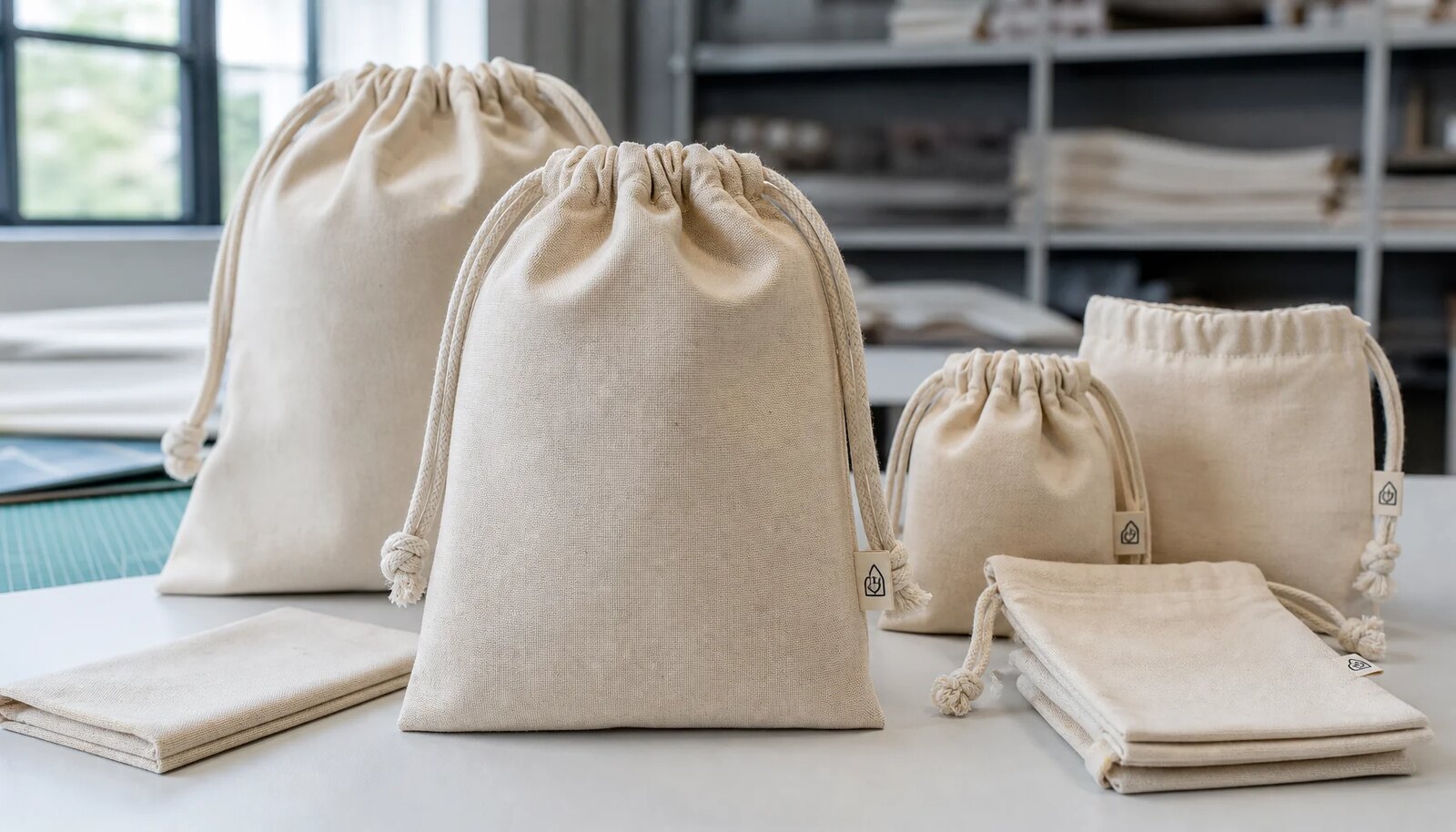
Start with the event risk, not the pouch shape
Custom cotton drawstring pouches look simple, but event orders expose every weak point in a supplier’s process. A pouch may have only fabric, seams, cord, and decoration, yet the order has to arrive on time, match the approved brand standard, and fit the receiving or kitting workflow. If the print shifts, the fabric feels thinner than expected, the drawcord frays, or cartons are mislabeled, the event team loses time sorting, repacking, or replacing items instead of preparing the program.
A strong supplier compliance checklist is not paperwork for its own sake. It is a way to prove that the supplier understands the product, the deadline, the destination, and the quality standard before the deposit is paid. For procurement buyers and event planners, the checklist also makes quote comparison fair. A low price that excludes sampling, carton labeling, inspection, or usable packing is not the same offer as a quote that includes those controls.
Use the checklist to answer four questions: what exactly is being made, who controls production, how quality will be approved, and how the finished pouches will be packed and delivered. Once those answers are written down, pricing becomes easier to judge and fewer decisions are left to chance.
- Treat the pouch as an event-critical production item, not a generic giveaway.
- Compare suppliers only after size, fabric, artwork, packing, QC, and delivery terms match.
- Use supplier evidence to confirm repeatability, not just catalog photos or confident sales language.
- Build the supplier file before deposit so there is still time to change route if risk is too high.
Define the use case before requesting price
A useful specification starts with the event flow. A pouch for badge accessories, stickers, or a light sponsor card can use a different fabric and seam standard than a pouch holding a glass jar, metal item, electronics accessory, candle, jewelry box, or premium VIP gift. The supplier needs to know what the pouch will hold, how it will be handed out, whether attendees are expected to reuse it, and whether the pouch must protect the contents or mainly present the brand.
Finished dimensions alone are not enough. A 15 x 20 cm pouch does not provide 15 x 20 cm of usable space after seam allowance, drawcord channel, fabric thickness, and bulky contents are considered. For fitted contents, share product measurements, loaded weight, and photos. Ask the supplier to confirm whether the pouch can close fully without distorting the print or stressing the seams.
Fabric weight should be chosen around function and presentation. Light cotton around 100-120 GSM can suit simple low-load giveaways. Many conference, launch, and sponsor-kit programs use roughly 120-140 GSM because it balances feel, print stability, and cost. Heavier cotton, canvas, lining, or reinforced construction may be justified for premium kits or heavier contents, but heavier fabric should solve a real handling problem rather than simply sound more premium.
- State contents, loaded weight, required closure, and reuse expectation in the RFQ.
- Specify outside size and usable internal dimensions when contents are fitted or rigid.
- Define single or double drawstring, cord diameter, cord color, gusset, lining, and seam finish.
- Ask the supplier to confirm fit with a filled sample when contents are bulky or brand-critical.
Choose fabric and decoration that can be controlled
Terms such as natural cotton, muslin, canvas, and cotton blend are too broad for procurement. Ask for GSM or ounce weight, weave description if relevant, fabric color, shrinkage expectation, and whether the fabric is bleached, unbleached, dyed, or blended. Natural cotton can show slubs, seed flecks, and shade variation. That may be part of the desired look, but the acceptable range should be visible in the approved sample.
Decoration choice affects both cost and inspection. Screen printing is often efficient for simple logos and volume runs, provided the print is properly cured and the fabric surface is suitable. Heat transfer or digital decoration can work for gradients, detailed artwork, or lower quantities, but buyers should check edge finish, hand feel, opacity, and resistance to rubbing. Embroidery and woven labels can look more premium, yet they add trim sourcing, placement control, and production time.
Logo placement should be checked in real use, not only on a flat proof. A mark that appears centered on an empty pouch may look too low once the pouch is filled or cinched. If the pouches will be photographed at registration, sponsor lounges, product launches, or retail counters, require a physical strike-off or pre-production sample on the final fabric.
- Approve natural cotton texture, slub level, and shade range instead of assuming all units will look identical.
- For dyed fabric, confirm shade standard, cord match, and colorfastness expectations.
- For fine artwork, ask for minimum line thickness, registration tolerance, and print curing method.
- For labels or embroidery, inspect puckering, backing, stitch density, edge distance, and orientation.
Compare supplier routes by responsibility
The best supplier route depends on the order, not only the unit price. A direct sewing factory can offer better control over cutting, sewing, and first-piece approval. A trading company may be useful for mixed promotional programs, lower administrative workload, or consolidation with other event items. A specialized bag workshop is often stronger when the pouch has gussets, unusual dimensions, reinforced corners, premium cords, or detailed trims. A local decorator using stock blanks can help when the calendar is already tight, but custom construction choices may be limited.
The main procurement question is who owns decisions when something changes. If printing is outsourced, who approves the first piece? If fabric shade varies, who decides whether it is acceptable? If a carton count is short, who sorts and replaces pieces? Outsourcing is common and can work well, but hidden responsibility creates delay.
Normalize quotes before ranking. One supplier may include a pre-production sample, carton marks, inspection photos, and delivery to a named warehouse, while another may quote only an ex-works pouch price. Ask each supplier to quote the same size, GSM, cord, artwork version count, packing rule, Incoterm, sample stages, and delivery point.
- Use direct factories when sample-to-bulk control is the main priority.
- Use trading companies when consolidation matters, but clarify factory access and QC authority.
- Use local decoration for urgent deadlines when stock blank quality is acceptable.
- Compare landed cost, not just unit price.
Ask for evidence that matches the order
Supplier evidence should connect the quote to real production capability. Useful proof includes company details, production location, current photos or short videos of cutting, sewing, printing, and packing, a simple production flow, and examples of carton labeling. These do not need to be polished. Dated, ordinary production photos often say more than showroom images.
Ask which steps are in-house and which are subcontracted. Fabric sourcing, dyeing, printing, embroidery, woven labels, and export packing may involve different partners. That is not automatically a problem, but each handoff should be visible. The supplier should be able to say who checks the first piece, who signs off the print, who controls final inspection, and who fixes defects.
Compliance requests should be specific to destination and use. If the pouches are for a children’s event or will be used by children in the U.S., CPSIA-related requirements may apply. If the order enters the EU, REACH restrictions may be relevant. For California distribution, Prop 65 exposure should be considered where applicable. Retail programs may need fiber content labeling, country-of-origin marking, or brand restricted-substance-list confirmation. Do not accept a generic certificate without checking whether it covers the exact fabric, dye, ink, cord, trim, and production period.
- Request current production evidence, not only catalog pages.
- List outsourced steps before deposit.
- Tie test reports and declarations to the exact quoted material and destination market.
- Connect fabric lot, artwork version, sample approval, batch number, and packed cartons for traceability.
Control MOQ and quote breakpoints
MOQ is shaped by fabric sourcing, cutting efficiency, decoration setup, trim purchasing, and packing labor. A standard natural cotton pouch with one-color screen print may have a lower threshold than dyed fabric, multiple sponsor logos, embroidery, woven labels, special cord colors, or individual packing. This is normal production logic, but it should be visible before the purchase order is approved.
Ask suppliers for quantity bands using one shared specification. For example, request 1,000, 2,500, 5,000, and 10,000 units with the same size, GSM, cord, artwork, carton count, Incoterm, and destination. If the event has multiple sponsors or locations, ask how pricing changes when the order is split by artwork version or destination code. Five versions of 1,000 pieces are not the same production cost as 5,000 identical pouches.
A clean quote separates the base pouch, decoration, setup charges, trims, sample fees, testing if required, packing labor, carton upgrades, documentation, and freight assumptions. This lets procurement make controlled budget decisions. If cost needs to come down, the buyer can reduce print colors, standardize cord color, simplify packing, or increase quantity per artwork instead of allowing hidden downgrades.
- Ask for MOQ by size, color, artwork version, print method, cord, label, and packing style.
- Separate setup fees from unit costs so repeat-order economics are clear.
- Confirm whether overage is included, optional, or charged separately.
- Document any approved cost-saving change in the PO and sample file.
Use samples as production standards
Sampling should turn a concept into a measurable standard. A digital proof is helpful for logo size, margins, and layout, but it does not prove fabric hand feel, print opacity, cord action, or stitching. For a first order, request a physical pre-production sample using final fabric, final cord, final construction, and final decoration method. If time only allows a partial sample, write down what it represents and what still needs first-piece approval.
The approved sample should be tagged and linked to the PO. Record the approval date, pouch size, GSM, fabric color, cord specification, artwork file version, print color reference, placement tolerance, and comments on acceptable cotton texture or shade. Keep one signed sample with the buyer and require the supplier to retain one matching reference.
First-piece approval is the bridge between sample and bulk. Before full sewing or printing continues, ask for photos or video of the first finished units measured against the approved sample. This is especially important for first orders, multiple artwork versions, tight event calendars, or premium attendee experiences where small shifts are visible.
- Use digital proofs for layout and physical samples for material, decoration, cord, and stitching.
- Tag the approved sample with PO number, artwork version, approval date, and tolerance notes.
- Require first-piece confirmation before full bulk production continues.
- Do not approve a generic blank sample as the final standard for a branded event order.
Write numeric QC thresholds into the PO
Quality disputes are easier to prevent than to solve. The purchase order should state the inspection standard, sample reference, and measurable tolerances. For many pouch orders, buyers can use ANSI/ASQ Z1.4 single normal inspection as a reference, with AQL 2.5 for major defects and 4.0 for minor defects, unless the brand or buyer requires stricter limits. The exact standard should be agreed before production.
Useful tolerances depend on pouch size and brand sensitivity, but examples help suppliers understand expectations. Finished dimensions might be plus or minus 5 mm for small pouches and plus or minus 10 mm for larger pouches. Print placement might be plus or minus 3 mm for small logos and plus or minus 5 mm for larger prints. Stitch density might be specified at 8-10 stitches per inch where suitable. Cord length can be controlled within plus or minus 10 mm, and carton count variance should be zero unless overage or shortage is written into the PO.
Inspection should focus on event usability and brand presentation: fabric defects, stains, odor, raw edges, skipped stitches, weak knots, misaligned print, poor curing, heavy creasing, wrong labels, and count errors. If the pouch holds a specific insert, include a fit check. If it is intended for reuse, include a practical cord-pull and seam-stress check.
- Define tolerances for finished size, print placement, shade, cord length, stitch density, and carton count.
- Measure print position from a clear reference point such as center line, top edge, or side seam.
- Inspect random cartons for fabric, sewing, cord, print, odor, stains, packing, and counts.
- State corrective actions: sort, rework, replace, add extra units, upgrade freight, or credit.
Design packing around receiving and kitting
Packing is part of the product for event buyers. Pouches may ship to a central warehouse, local kitter, hotel dock, sponsor office, retail partner, or multiple venues. Bulk packing is usually efficient when a kitting team will assemble attendee sets. Individual polybags, barcodes, hang tags, or retail labels may be necessary for fulfillment programs, but they add labor, material, inspection, and carton-volume cost.
Carton rules should be finalized before bulk packing. Define units per inner bundle, units per master carton, carton dimensions, maximum gross weight, carton sequence marks, PO number, item code, color, artwork version, and destination code. If multiple artwork versions ship together, separate cartons are usually safer. Mixed cartons should be used only when the receiver requests them and the carton map is clear.
Cotton also needs practical moisture and compression control. Pouches should be dry before packing, cartons should be strong enough for the route, and over-compression should be avoided when presentation matters. Deep creases can slow kitting and make a premium pouch look careless. At the same time, excessive presentation packing can increase freight volume, so the right packing plan balances arrival quality, count accuracy, and freight efficiency.
- Choose bulk, bundled, unit-packed, or kit-packed cartons based on the downstream workflow.
- Require carton labels that match the PO, packing list, SKU, artwork version, and destination.
- Avoid mixed cartons unless the receiver can process them without sorting delays.
- Confirm carton size, gross weight, moisture protection, and label format before freight booking.
Plan the calendar with approval gates
Production lead time is only one part of an event schedule. First orders often need artwork cleanup, digital proofing, sample making, sample shipping, stakeholder approval, deposit payment, material booking, bulk production, inspection, export handoff, customs clearance, warehouse receiving, and kitting. Asking only for sewing time creates false confidence.
A practical first-order model might allow 2-4 business days for artwork proofing, 5-10 days for a physical sample or print strike-off, 2-5 days for sample transit if shipped internationally, 2-3 days for approval routing, 12-25 days for bulk production depending on quantity and decoration, 1-2 days for inspection, and additional time for freight. Air freight may take days after handoff, while ocean or rail can require weeks plus clearance and local delivery. Repeat orders can often shorten sampling, but only if fabric, artwork, trim, and supplier route remain unchanged.
Work backward from the kitting start date, not the event date. The pouches need to be received, counted, accepted, and available before kits are assembled. Add a buffer for customs, warehouse appointment delays, shortages, and rework. If sample approval slips by three days, decide immediately whether to simplify artwork, reduce versions, switch freight mode, split production, or source a smaller emergency quantity locally.
- Set deadlines for artwork lock, sample approval, bulk start, first-piece approval, inspection, ship date, warehouse arrival, and kitting start.
- Build a buffer between warehouse arrival and event kitting, not only between ship date and event date.
- Use air, sea, or mixed freight based on carton volume, budget, and true deadline.
- Create an escalation rule for late sample approval, failed inspection, or delayed freight.
Specification comparison for buyers
| Supplier option | What to verify | Commercial advantage | Buyer risk to control |
|---|---|---|---|
| Direct sewing factory | cord material proof, reinforcement close-ups, load-test photos, approved sample tag, and bulk-line first-piece record | Better sample-to-bulk control and faster production feedback | May be weaker on export paperwork or branded packing unless checked early |
| Trading company | Factory name, production photos, trim-source proof, and who owns QC decisions | Can coordinate small mixed orders and extra services | Markup can hide real factory capability and slow defect decisions |
| Specialized bag workshop | cord diameter, eyelet or reinforced channel, bottom corner reinforcement, seam allowance, bar-tack position, and load target | More practical for detailed construction, trims, and repeat programs | Capacity may be limited during peak seasons |
| Low-price general supplier | 6-10 oz cotton canvas, 210D polyester, rPET, or blended cotton with shrinkage and colorfastness expectations set before sampling | Useful for simple promotional runs with loose specs | Material downgrades, weak packing, and vague inspection scope can erase savings |
| Retail-ready supplier | fold direction, cord protection, bundle count, carton compression, moisture bag, and retail label position | Can handle labels, SKU separation, carton marks, and receiving rules | Higher unit cost must be compared against reduced warehouse work |
| Compliance-focused supplier | Fabric records, labeling review, test plan, and production traceability | Safer for retail programs and repeat brand orders | Documentation claims need evidence, not only sales language |
| Local sample room plus bulk factory | Signed sample, bulk factory handoff, first-piece photos, and deviation owner | Good for complex branding before large production | Sample room quality may not match bulk line unless handoff is controlled |
Buyer checklist before sampling
- Define the event use case: attendee gift, sponsor insert, VIP kit, speaker pack, retail bundle, product sample pouch, or reusable storage bag.
- List the contents, approximate loaded weight, required closure, and whether the pouch must protect, present, or simply contain the items.
- Lock pouch size, usable internal dimensions, fabric GSM, cotton type, cord type, seam finish, decoration method, label or trim details, and packing method before quote comparison.
- Request pricing at shared quantity bands with the same specification, Incoterm, carton rule, artwork count, and delivery destination.
- Ask for MOQ by pouch size, fabric color, artwork version, print method, cord color, label type, and packing style.
- Separate base pouch cost, decoration cost, setup fees, trim cost, sample cost, packing labor, carton cost, testing if required, documentation fees, and freight assumptions.
- Request a physical sample in final fabric, final cord, final construction, and final decoration method before approving bulk production.
- Collect practical supplier evidence: company details, production location, current factory photos, production flow, QC process, capacity estimate, and outsourced-process list.
- Confirm compliance needs by market and use: CPSIA if intended for children in the U.S., REACH or Prop 65 where applicable, fiber content labeling for retail, and brand RSL requirements when supplied by the buyer.
- Write acceptance tolerances into the PO for size, print placement, shade, stitch quality, cord action, defects, carton counts, overage, and short-shipment handling.
Factory quote questions to send
- Which steps are in-house and which are outsourced for fabric sourcing, cutting, sewing, printing, embroidery, trims, inspection, packing, and export handling?
- Which cotton GSM and construction do you recommend for this pouch size, loaded contents, and event use case, and what tradeoffs come with that choice?
- What is your MOQ by size, fabric color, artwork version, decoration method, cord color, label type, and packing style?
- What setup fees apply for screen print, heat transfer, digital print, embroidery, woven labels, cord changes, folding, barcode labels, or carton marks?
- Can you quote 1,000, 2,500, 5,000, and 10,000 units on the same specification, packing rule, Incoterm, and delivery destination?
- What sample stages are available: blank sample, print strike-off, pre-production sample, first-piece sample, and retention sample, and what are the cost and timing for each?
- What tolerances do you hold for finished size, print placement, print color, stitch density, seam allowance, cord length, cord diameter, and carton count?
- Which documents can you provide for the destination market: material declaration, fiber content support, CPSIA-related records if children’s use, REACH or Prop 65 support where applicable, or brand RSL confirmation?
- Are existing test reports for the exact quoted fabric, dye, ink, cord, and trim, or would new testing be required?
- How do you control fabric lots, dye lots, cord lots, ink batches, artwork files, and approved samples for repeat orders?
Quality-control points to confirm
- Fabric weight matches the agreed GSM range, such as 120-140 GSM if that range is written into the PO, with no stains, holes, thin areas, major slubs, oil marks, mildew signs, or odor beyond the approved sample.
- Finished pouch dimensions stay within the agreed tolerance, for example plus or minus 5 mm for small pouches and plus or minus 10 mm for larger pouches, including height, width, channel depth, gusset, and usable internal space.
- Print placement stays within the agreed tolerance, for example plus or minus 3 mm for small logos and plus or minus 5 mm for larger front prints, measured from a defined center line, top edge, or side seam.
- Print color matches the approved sample or Pantone reference within the agreed visual tolerance, with no weak opacity, cracking, poor curing, blurred edges, registration errors, or transfer-film residue.
- Stitching is even and secure, with an agreed stitch density such as 8-10 stitches per inch where suitable, no skipped stitches, loose tails, broken threads, raw edges, or unraveling at the drawcord channel.
- Seam allowance and reinforcement match the approved construction, especially at side seams, bottom corners, gussets, label attachment points, and cord-channel ends.
- Drawcord material, diameter, length, knot position, end finish, pull action, and color are consistent across sampled cartons, with no fraying, broken ends, stuck channels, or uneven closure.
- Labels, woven tags, embroidery, or trims are attached in the approved direction and position, with no puckering, loose corners, sharp exposed edges, adhesive residue, or incorrect branding.
- Shade variance between fabric lots is controlled against the approved sample; for dyed orders, cartons from different lots should not be mixed into the same event kit unless approved.
- Carton labels, PO numbers, item codes, color marks, artwork-version marks, destination codes, carton sequence numbers, and carton counts match the packing list and shipping documents.