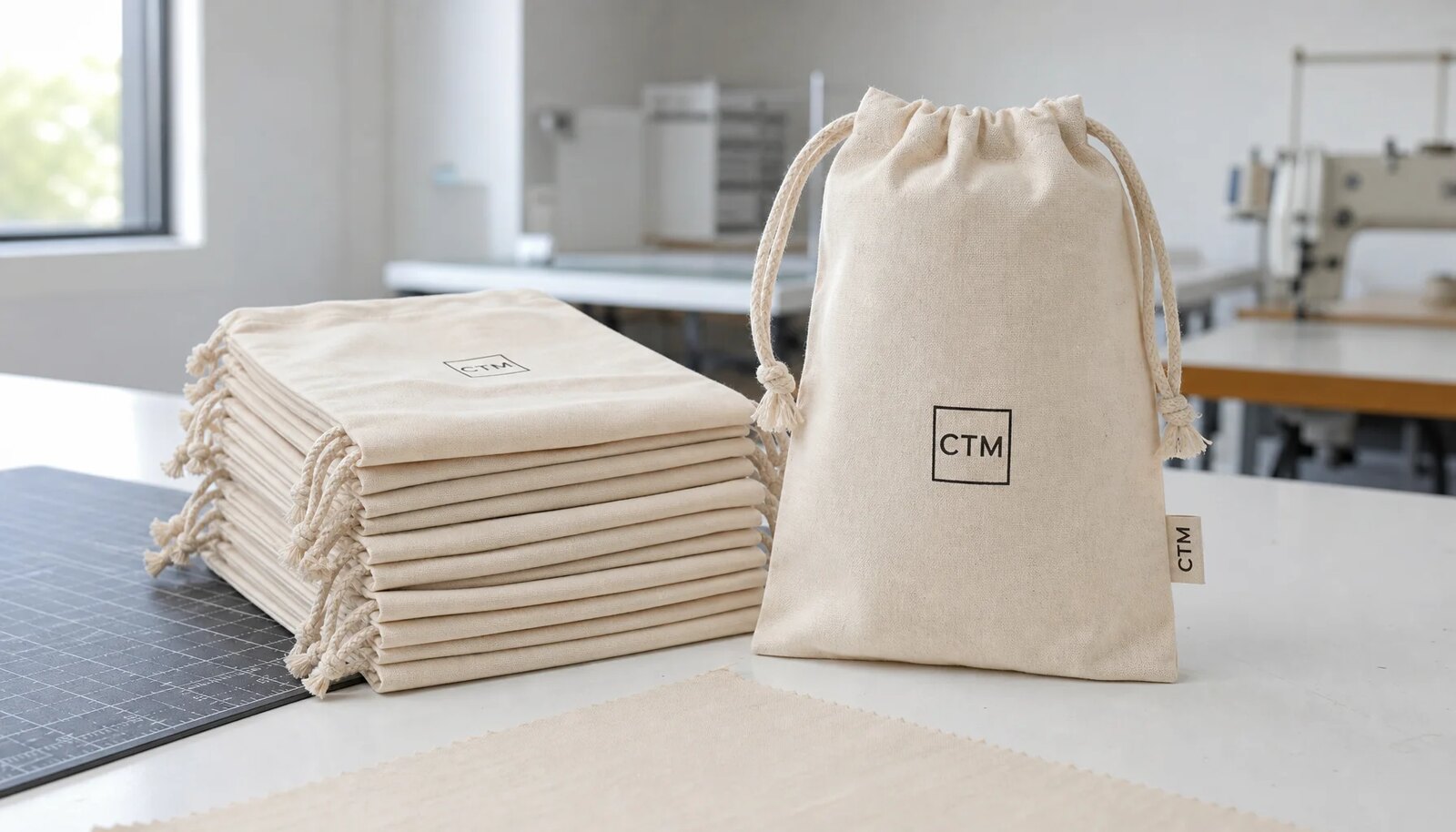
What Procurement Must Prove
A cotton drawstring pouch looks simple, which is why it can slip through procurement with too little control. The buyer is not only purchasing a small sewn bag. The buyer is approving a fabric claim, a construction standard, a brand presentation, a pack-out format, and a supplier process that must repeat consistently in bulk.
For eco apparel brands, the compliance question is sharper. If the pouch sits beside organic cotton garments, recycled trims, low-waste packaging, or retail sustainability language, a vague pouch spec can weaken the whole presentation. The goal is not to request unnecessary paperwork on every small order. The goal is to make sure the claim, product label, invoice, supplier scope, and physical pouch all say the same thing.
A strong checklist should prove five things: the pouch is built to a measurable spec, the supplier can control the required process, the documentation supports the claim being made, the quality standard is inspectable, and the pack-out will pass receiving. If a supplier cannot answer those points before the PO, the unit price is only partly useful.
- Define the product before comparing price.
- Tie sustainability wording to named documents and scope.
- Approve one golden sample before cutting bulk fabric.
- Make packing and receiving rules part of the purchase spec.
Build The Spec Around Real Use
Start with the pouch function, not the logo mockup. A garment storage pouch, a retail display pouch, a gift bag, and an e-commerce insert place different demands on fabric weight, opening width, cord strength, folding, and carton count. A pouch that photographs well can still be slow to pack, too transparent, too tight at the opening, or too weak for the intended contents.
Write finished dimensions in millimeters and show where each measurement is taken. Include opening width, body height, gusset or bottom width if applicable, channel depth, and drawcord pull length. For smaller pouches, a few millimeters of variation can look careless or affect fit. For larger apparel pouches, the opening and channel are often more important than the bottom measurement because warehouse staff need to insert folded garments quickly.
The fabric spec should describe finished GSM, not only a casual term like lightweight cotton or heavy canvas. Finished GSM can change after dyeing, bleaching, washing, or printing. Also specify weave, finish, hand-feel, opacity expectation, shrinkage behavior, and acceptable shade range. If the brand wants an undyed look, clarify whether that means raw natural cotton, unbleached cotton, a natural color dye, or simply a beige shade.
- List the contents and approximate fill weight.
- Confirm the pouch can be packed at real warehouse speed.
- Measure critical dimensions from a physical sample.
- Avoid approving a render as the production standard.
Match Claims To Documentation
Compliance problems often begin when a certificate is treated as a blanket promise. A GOTS, OCS, or GRS scope certificate may be relevant, but it does not automatically prove that your exact pouch order is covered. Check the certificate holder, expiry date, product category, processing steps, subcontractors, and site addresses. The production route matters as much as the logo on the certificate.
For organic cotton claims, buyers commonly look for GOTS or OCS documentation depending on the claim and chain-of-custody requirement. For recycled content, GRS may be relevant. For certified orders, a transaction certificate may be needed to connect the certified material movement to a specific shipment. If the pouch is only described as cotton with no certified claim, fiber-content testing or supplier material records may be more appropriate than chain-of-custody documents.
Chain-of-custody boundaries should be named plainly. Ask whether cutting, sewing, printing, dyeing, label application, and packing are covered by the documented scope or handled outside it. A fabric may be certified while the finished pouch process is not. That distinction affects label wording. Marketing copy should never promise more than the documentation supports.
Test reports are a separate path from certification. A restricted-substances report, colorfastness result, fiber-content test, pH test, or print-rub test may be required by a retailer or internal compliance team. Tie reports to the actual fabric, finish, print chemistry, and production site whenever possible, and check the report date before relying on it.
- Check scope certificate holder, site, process, product category, and expiry date.
- Ask whether transaction certificates are required for certified organic or recycled claims.
- Separate certification evidence from lab testing evidence.
- Review claim wording before artwork, label, or hangtag approval.
Choose The Supplier Route Deliberately
Supplier type affects control. A direct sewing factory can be strong when the buyer needs custom dimensions, construction feedback, and quick rework decisions. A specialized pouch workshop may be better for reinforced channels, gussets, heavier contents, or repeat programs where sewing details matter. A trading company can be useful for mixed SKUs and broader coordination, but the buyer must know which factory actually cuts, sews, prints, and packs the order.
The main question is not whether a supplier has an attractive presentation. It is where decisions are made when production changes. If fabric runs short, who approves the substitute? If the printer sees color drift, who stops the line? If the packer mixes SKU counts, who sorts cartons before shipment? Procurement should identify the decision owner before paying a deposit.
The supplier comparison table above is most useful when read by sourcing scenario. A fast stock order has different risks than a certified retail program. A low-price promotional supplier may be acceptable for simple internal packaging with no claim language, but risky for an eco apparel brand using public sustainability messaging. A retail-ready supplier may cost more per unit but reduce warehouse labor, relabeling, and receiving errors.
- Ask for the factory legal name and production address.
- Name all outsourced processes in the supplier file.
- Confirm who owns deviation approval and rework.
- Compare supplier fit by sourcing scenario, not only by unit price.
Read Quotes Like Production Records
A quote should show what the supplier plans to make. For custom cotton drawstring pouches, the quote needs the finished size, fabric composition, finished GSM, construction, cord material and diameter, print method, color count, label type, packing format, carton count, MOQ, sample fee, setup fee, lead time, payment terms, and overrun policy. If those details are missing, suppliers may be pricing different products.
Cost exclusions are often where surprises hide. One quote may include print setup, label sewing, inner packing, cartons, carton marks, and sample freight. Another may list a lower unit price because those items are not included. Ask each supplier to quote the exact same spec and to identify optional costs separately. This makes negotiation cleaner and prevents the lowest price from becoming the most expensive order after add-ons.
MOQ should be explained as a production condition. Stock greige fabric, standard natural cotton, and existing cord colors may allow smaller runs. Custom dyeing, special GSM, woven labels, multi-color printing, custom paper bands, and certified materials can increase minimums. Good suppliers can tell you which choices drive MOQ and which substitutions would lower cost without changing the product intent.
- Compare identical specs across suppliers.
- Request setup, sample, testing, and packing costs separately.
- Ask what changes at higher or lower quantities.
- Record overrun, underrun, and rework terms before the PO.
Use Sampling To Freeze Decisions
Sampling should reduce uncertainty, not create a beautiful exception that production cannot repeat. A printed photo sample may confirm logo scale, but it does not prove final fabric behavior, cord movement, stitching, label durability, folding, or carton packing. The pre-production sample should use final fabric, final cord, final print method, final label, final folding method, and final pack-out.
Create a golden sample system. The buyer keeps one signed sample, the supplier keeps one, and inspection refers to the same approved build. Record the approval date, PO number, fabric lot if known, print method, label position, measurements, and approved deviations. If bulk production changes fabric, cord, label vendor, print chemistry, folding, or carton format, require a deviation record or new sample approval.
Test the sample as the customer or warehouse will use it. Pack the intended garment. Pull the cord repeatedly. Check whether the channel catches, the print cracks, the label scratches the product, or the pouch distorts when filled. Place it beside light-colored apparel and look for lint, odor, or transfer risk. These are low-cost checks that catch problems before bulk cutting.
- Approve a pre-production sample with final materials and final pack-out.
- Keep signed retained samples on both buyer and supplier sides.
- Record measurements and approved exceptions.
- Trigger deviation approval for any material, process, or packing change.
Set Inspection Rules Before Sewing
Quality control must be written before the factory starts sewing. Define size tolerance, shade standard, stitch quality, print placement, label accuracy, odor, stains, cord function, packing count, and carton marks. A simple pouch can still fail through skipped stitches, open seams, crooked labels, cord snags, mixed shades, print bleed, oil marks, wrong barcodes, or inaccurate carton counts.
If your company uses AQL inspection, state the sampling standard, inspection level, and AQL limits in the RFQ or PO. Many buyers reference ANSI/ASQ Z1.4 or ISO 2859-1. The exact level depends on order risk and buyer policy, but the supplier should know the rule before production. Also define critical, major, and minor defects. Wrong claim labeling, severe odor, incorrect fiber content, or unsafe contamination may be critical. Broken seams, wrong size, major stains, severe print shift, or mixed SKUs are usually major. Loose threads or slight fold variation may be minor if function and appearance remain acceptable.
Use both inline and final inspection. Inline checks catch problems while the supplier can still correct stitch density, channel depth, label orientation, and cord function. Final inspection confirms packed goods against the approved sample, packing list, carton marks, and buyer receiving rules. Select units across cartons, fabric rolls, operators, and SKU groups so the inspection reflects the shipment rather than a staged handful of good units.
- Write AQL level and defect classes before the PO.
- Inspect first pieces before volume sewing continues.
- Check final goods after packing but before shipment release.
- Retain inspection samples with date, PO, supplier, and fabric lot notes.
Control Packing, Labels, And Receiving
Packing is part of compliance because it affects claims, receiving, damage risk, and customer presentation. Bulk packing may suit internal distribution and lower-waste programs. Retail-ready orders may need paper bands, hangtags, unit labels, barcodes, country-of-origin details, fiber-content labels, or SKU separation. Define the pack format before quotation approval so the supplier prices labor, materials, and carton dimensions correctly.
Labeling rules depend on market, channel, and claim. If the pouch itself is sold or used as consumer-facing packaging, confirm required fiber content, country of origin, care or warning language if applicable, barcode placement, and recycling marks. For certified claims, make sure logos and wording follow the certification body's labeling rules. For plastic-free claims, define whether tape, carton liners, label backing, desiccant bags, and moisture protection are included in the claim boundary.
Receiving teams need predictable cartons. Specify inner count, outer count, SKU separation, carton dimensions, gross weight range, carton marks, barcode orientation, and packing-list format. Natural cotton can absorb moisture and odor during storage and transit, so ask how cartons are stored, whether moisture controls are used, and how the supplier prevents crushing. A correct pouch in the wrong carton count is still a receiving problem.
- Choose bulk pack, bundle pack, or unit pack before final quote.
- Confirm required labels and claim-logo rules before printing.
- Set carton count, dimensions, weight range, and carton marks.
- Check moisture, odor, crushing, and SKU mix-up controls.
Award On Evidence And Landed Cost
The lowest ex-factory price is not always the lowest cost. A cheap pouch can become expensive if the order needs sorting, relabeling, claim correction, replacement cartons, extra inspection, or air freight after delays. Procurement should compare landed cost, including freight cube, duty, testing, packing labor, receiving time, defect handling, and the internal cost of managing unclear suppliers.
A simple scorecard keeps the decision grounded. Weight the factors that matter for the order: spec match, documentation fit, supplier scope, sample accuracy, construction quality, QC controls, packing accuracy, lead time, communication, and price. A supplier does not have to be perfect, but weak points should be visible before the deposit is paid.
When suppliers are close on price, choose the one that gives cleaner answers and better evidence. A capable supplier will ask practical questions, explain MOQ triggers, identify documentation limits, and flag claim wording that may need review. That kind of friction is useful because it happens before the brand has inventory, launch timing, and retail commitments at risk.
- Compare landed cost, not only unit price.
- Treat missing scope documents as risk.
- Use the same checklist for every RFQ round.
- Issue the PO only after spec, sample, QC, and packing rules are locked.
Specification comparison for buyers
| Supplier option | What to verify | Commercial advantage | Buyer risk to control |
|---|---|---|---|
| Direct sewing factory | cord material proof, reinforcement close-ups, load-test photos, approved sample tag, and bulk-line first-piece record | Better sample-to-bulk control and faster production feedback | May be weaker on export paperwork or branded packing unless checked early |
| Trading company | Factory name, production photos, trim-source proof, and who owns QC decisions | Can coordinate small mixed orders and extra services | Markup can hide real factory capability and slow defect decisions |
| Specialized bag workshop | cord diameter, eyelet or reinforced channel, bottom corner reinforcement, seam allowance, bar-tack position, and load target | More practical for detailed construction, trims, and repeat programs | Capacity may be limited during peak seasons |
| Low-price general supplier | 6-10 oz cotton canvas, 210D polyester, rPET, or blended cotton with shrinkage and colorfastness expectations set before sampling | Useful for simple promotional runs with loose specs | Material downgrades, weak packing, and vague inspection scope can erase savings |
| Retail-ready supplier | fold direction, cord protection, bundle count, carton compression, moisture bag, and retail label position | Can handle labels, SKU separation, carton marks, and receiving rules | Higher unit cost must be compared against reduced warehouse work |
| Compliance-focused supplier | Fabric records, labeling review, test plan, and production traceability | Safer for retail programs and repeat brand orders | Documentation claims need evidence, not only sales language |
| Local sample room plus bulk factory | Signed sample, bulk factory handoff, first-piece photos, and deviation owner | Good for complex branding before large production | Sample room quality may not match bulk line unless handoff is controlled |
Buyer checklist before sampling
- Define the pouch use case: garment storage, retail presentation, gift packaging, sample kit, accessory bag, e-commerce insert, or reusable customer packaging.
- Lock finished dimensions in millimeters, including opening width, body height, gusset or bottom width if used, channel depth, seam allowance, and acceptable tolerance.
- Specify finished fabric details: fiber composition, weave, color, finish, GSM after dyeing or washing, shrinkage expectation, hand-feel, opacity, and shade standard.
- State the drawcord spec: material, diameter, color, length, end finish, single or double pull, cord stop if any, and pull-smoothness expectation.
- Define construction: side seam, bottom seam, gusset, overlock, topstitching, French seam, reinforced channel, bar-tack position, and stitch density target.
- Write the exact claim language before RFQ release, then ask what documentation supports that wording at fiber, fabric, process, site, and packing level.
- Check certification scope where relevant: GOTS, OCS, or GRS certificate holder, product category, processing steps, subcontractors, expiry date, and whether transaction certificates are needed for the order.
- Ask for test reports tied to the actual fabric, print method, and production site when colorfastness, fiber content, restricted substances, or buyer compliance rules apply.
- Identify which steps are in-house and which are outsourced, including dyeing, printing, label production, sewing, packing, and export handling.
- Approve a pre-production sample made with final fabric, final cord, final print, final label, final fold, and final pack-out before bulk cutting.
Factory quote questions to send
- What exact fabric will be used, including fiber composition, weave, finished GSM, finish, color standard, shrinkage expectation, and whether the material is stock or custom-made?
- Which certification or claim documents apply to this order: GOTS, OCS, GRS, transaction certificate, fiber-content report, restricted-substances report, or other buyer-required testing?
- Does the certificate scope cover the production site, product category, processing step, subcontracted printer, dyer, or packer, and what sits outside that scope?
- What drawcord material, diameter, length, color, end finish, and durability check are included in the quoted price?
- What construction method, seam allowance, stitch density, channel depth, reinforcement point, and gusset shape will be used at our requested size?
- Is the logo printed before or after sewing, and what are the setup fees, screen charges, plate charges, color-match fees, artwork fees, and minimum print quantity?
- What is the MOQ at the exact size, fabric weight, cord type, label type, print method, and packing format, and which changes raise or lower that MOQ?
- What is included in the unit price: fabric, sewing, drawcord, print setup, labels, inner packing, cartons, carton marks, testing, documents, and export handling?
- Which steps are done in-house, and which are handled by subcontractors such as printers, dyers, label vendors, packers, testing labs, or export agents?
- What sample types are available, how long does each take, what revisions are included, and when will a first-piece production sample be sent for approval?
Quality-control points to confirm
- Use a clear sampling plan, such as ANSI/ASQ Z1.4 or ISO 2859-1, with the inspection level and AQL limits written into the PO when the buyer requires AQL inspection.
- Classify defects before production: critical defects may include wrong claim label, wrong fiber content, severe odor, unsafe contamination, or incorrect required marking.
- Major defects may include open seams, broken drawcords, severe print misplacement, wrong size outside tolerance, stains, holes, mixed SKUs, or incorrect carton count.
- Minor defects may include a loose thread, slight washable lint, very small print speck, or minor fold inconsistency that does not affect saleability or function.
- Inspect inline after first pieces come off the sewing line, especially for channel depth, seam security, cord movement, label orientation, and print placement before volume continues.
- Inspect final packed cartons before shipment, selecting units across cartons, operators, fabric rolls, shade lots, and SKU groups rather than only from the top carton.
- Check finished size against approved tolerance for opening width, body height, bottom width or gusset, channel depth, and drawcord pull length.
- Verify fabric GSM and shade across rolls, and quarantine any roll outside the agreed GSM, shade, odor, or flaw standard before cutting.
- Test drawcord function by repeated opening and closing; confirm smooth movement, even pull, no excessive fraying, no trapped cord, and no weak reinforcement at stress points.
- Compare print and label details to the golden sample: artwork scale, color target, placement, curing, legibility, label position, label orientation, and resistance to cracking or rub-off.