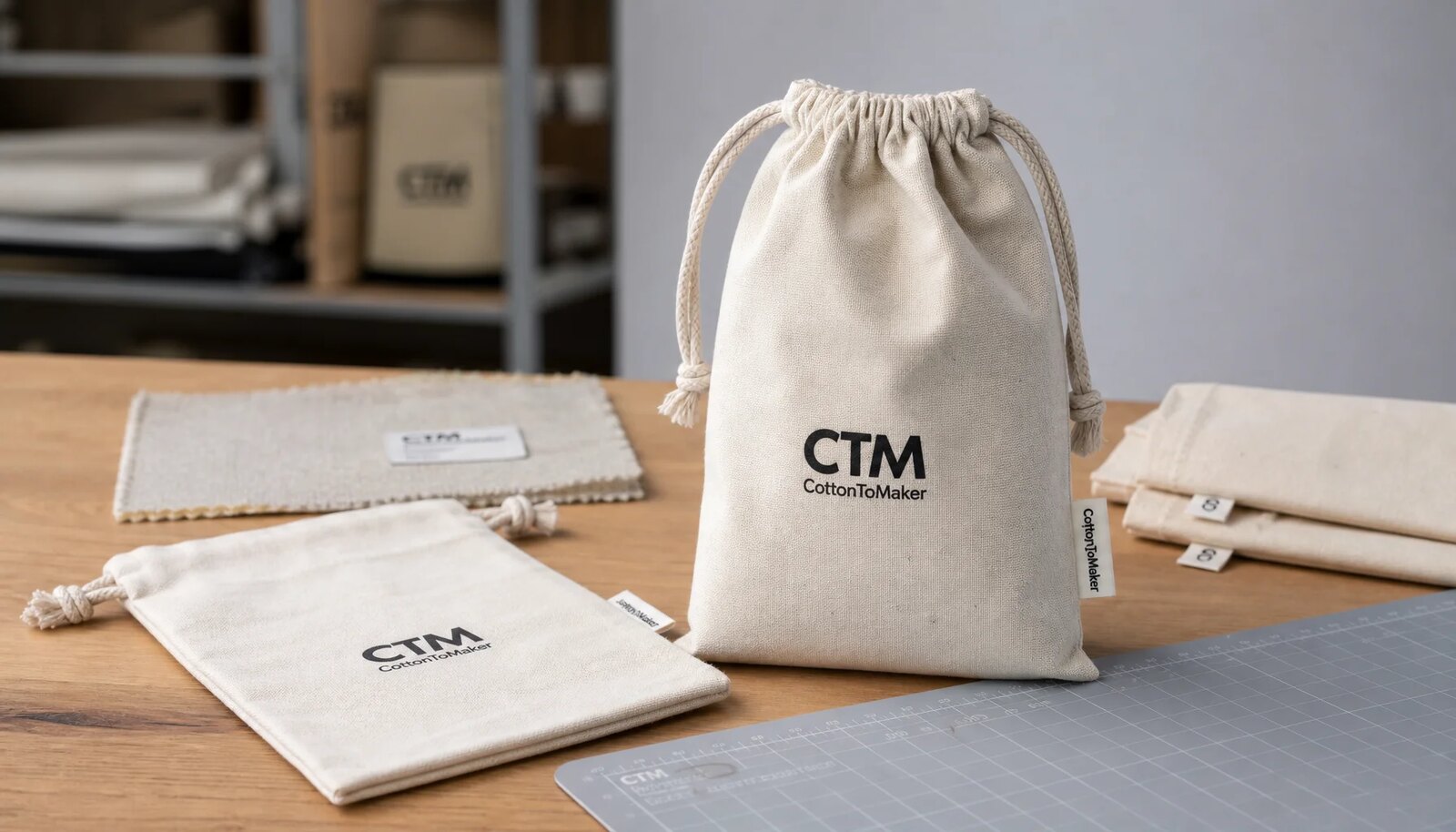
Turn a Simple Pouch Into a Controlled Specification
Custom cotton drawstring pouches look simple until several suppliers quote them differently. One request for a “natural cotton pouch with logo” can come back as 100 GSM muslin, 180 GSM plain cotton, 240 GSM canvas, single cord, double cord, screen print, heat transfer, loose bulk packing, or retail-ready inner packs. Those choices may sound close in a sales email. At a craft fair table, they feel and perform very differently.
For B2B buyers, the real compliance issue is repeatability. The approved pouch needs to fit the product, carry the logo in the right place, close smoothly, arrive clean, and be counted accurately by SKU. When the program covers soaps, candles, jewelry, ornaments, stationery, or gift sets, the pouch may become part of the selling experience rather than just a wrapper. Weak seams, uncured ink, dirty natural cotton, or mixed cartons can create event labor and customer-facing problems even when the unit price looked attractive.
A supplier compliance checklist turns assumptions into measurable requirements. It sets the finished size, fabric weight, construction, print method, packing, inspection rules, and document expectations before the supplier quotes. It also names the changes that require buyer approval. That matters because many disputes start the same way: the supplier says the bulk goods match normal practice, while the buyer expected the sample, website image, or mockup to be the binding standard.
- Treat the pouch specification as part of the purchase order, not as informal artwork notes.
- Compare suppliers only after size, GSM, construction, print method, packing, and QC tolerances are aligned.
- Use a signed pre-production sample, approved swatch, and approved print target as the control set.
- Require buyer approval for changes in fabric, shade, GSM, cord, print method, size, construction, or packing.
- Keep product-fit requirements visible so the supplier understands what the pouch must hold and how it will be used.
Define the Craft Fair Use Case Before Sourcing
Craft fair packaging faces pressure that ordinary warehouse packaging may not. Pouches may be opened by customers, filled quickly by booth staff, displayed in baskets, handled next to scented goods, or split across several event locations. A pouch for a pair of earrings does not need the same opacity, seam strength, or fabric body as a pouch for a ceramic ornament or candle tin.
Start the RFQ with a product-use matrix. List the packed item, product dimensions, packed weight, desired pouch size, required opening width, event quantity, and whether the pouch is a giveaway, retail component, or reusable branded item. This exercise often shows that the buyer can consolidate into two or three pouch sizes instead of five or six. Fewer sizes reduce cutting variation, MOQ pressure, carton mixing, and replenishment mistakes.
Presentation changes the decision too. A very soft 120 GSM pouch may be fine for scratch protection, but it may look thin when displayed upright. A 240 GSM canvas pouch improves opacity and structure, yet it costs more and can make small products look bulky. If the pouch must close around a box, bottle, candle, or soap bundle, measure the actual packed product rather than relying on catalog dimensions. Add a little room for human handling; booth staff will not have time to fight a tight opening during a rush.
- For jewelry, charms, tags, and small accessories, 100-140 GSM cotton may be acceptable when opacity is not critical.
- For soap, stationery, cosmetics, seed packets, and small gifts, 140-180 GSM cotton often gives a better balance of cost and handling.
- For candles, ceramics, jars, heavier ornaments, and premium gift sets, consider 200-280 GSM cotton canvas or reinforced seams.
- For fast booth packing, prioritize usable opening width, smooth cord movement, and a channel that does not collapse or snag.
- For reusable branded pouches, inspect print durability, seam finish, and cord quality more strictly than for one-time takeaway packaging.
- For event-kit distribution, specify bundle counts by booth, rep, store, or market location before packing starts.
Specify Fabric, GSM, Size, and Tolerances
Fabric weight is one of the biggest cost and quality drivers. Suppliers may describe it in ounces, GSM, or broad terms such as muslin, cotton, or canvas. For procurement clarity, state the fabric type and the target GSM. Lightweight pouches often fall around 100-140 GSM. General-purpose cotton pouches are commonly in the 140-180 GSM range. More structured cotton canvas pouches may sit around 200-280 GSM. These are sourcing ranges, not universal rules, so the buyer should approve the actual swatch and finished sample.
Finished size should mean finished size after sewing. Cut panels do not help the receiving team if the pouch arrives too narrow for the product. State width, height, gusset if any, channel height, usable inner height, and opening width. For small pouches, a finished-size tolerance of about ±5 mm may be practical with normal sewing variation. For larger pouches, ±10 mm may be more realistic. If the product fit is tight, do not rely on a broad tolerance. Increase the pouch size or require a fit test.
Construction details deserve space in the RFQ. A flat two-panel pouch is not the same as a gusseted pouch. Single drawcord closure is not the same as double drawcord. Overlocked seams are different from French seams or folded internal seams. Each choice changes labor, durability, appearance, and cost. If the buyer does not write these details down, suppliers may quote the easiest construction for their line rather than the construction that best protects the product.
- Write finished size as width x height after sewing, plus gusset and channel height where applicable.
- Define acceptable tolerance for finished width, finished height, gusset, channel, and print position.
- State fabric composition and finish: natural cotton, bleached cotton, dyed cotton, organic cotton, recycled blend, or cotton canvas.
- Set GSM target and tolerance, such as 180 GSM with supplier-stated normal mill tolerance, then approve a physical swatch.
- Specify seam type, seam allowance, stitch density target where needed, bottom construction, and reinforcement points.
- Define cord material, cord diameter or tape width, color reference, knot style, and single or double drawcord closure.
- Check usable inner height because a top channel can reduce packable space even when total height is correct.
Control Logo Method, Artwork, and Print Limits
Decoration is both a branding decision and a production-risk decision. Screen printing is usually practical for solid logos and one to three colors at higher quantities. Heat transfer can work for small multicolor artwork or short runs, but buyers should check hand feel, edge durability, and how the transfer behaves on textured cotton. Digital printing may support complex graphics, though color can look softer on natural cotton than on coated paper or synthetic fabric.
Artwork approval should be measured, not just viewed. A logo that looks centered on a mockup can sit too close to the drawcord channel once the pouch closes. Ink across folds, seams, or channel areas may crack, distort, or block movement. Natural cotton seed flecks can show through light ink coverage. Dyed cotton may need a white underbase for pale artwork, which can change both cost and hand feel.
The print specification should include file type, print size, print position, color references, number of colors, print method, and tolerance. For screen print, vector artwork is usually preferred. For placement, define whether the measurement starts from the finished top edge, bottom edge, side seam, or center line. For brand-critical work, request a strike-off or pre-production sample on the actual fabric. A digital mockup is useful for alignment conversations, but it is not a substitute for cured ink on cloth.
- Provide vector artwork for screen printing and identify Pantone, CMYK, or approved visual color target.
- State print width, print height, distance from top edge or bottom edge, and center alignment requirement.
- Use a realistic print position tolerance, commonly ±3-5 mm for small pouches depending on construction and size.
- Keep artwork away from drawcord channels, thick seams, and folds unless the distortion is intentionally approved.
- Confirm whether dark dyed fabric requires a white underbase and whether that cost is included.
- Approve cured print, not wet ink or a digital mockup, before bulk production begins.
- Inspect dry rub resistance, registration, opacity, pinholes, cracking, ghosting, and blocked drawcord movement.
Build MOQ, SKU, and Cost Logic Into the RFQ
MOQ is rarely one clean number when a pouch order has several sizes, fabric colors, drawcord colors, print designs, or packing styles. A supplier may advertise a low total MOQ, while the real minimum applies per size, per fabric color, per print screen, or per dyed lot. Once a small craft fair order is split into too many SKUs, the unit cost rises and packing errors become more likely.
A procurement RFQ should show the exact quantity split. Each line should identify finished size, fabric GSM and color, cord color, print design, print colors, packing method, and destination or delivery date. This gives the supplier enough detail to price cutting, printing, setup, sewing, trimming, and packing accurately. It also helps the buyer see whether the assortment is too complex for the budget or timeline.
For craft fair programs, SKU consolidation is often more valuable than chasing the lowest unit price. One shared pouch size may work for several products if the fit looks intentional. A slightly larger pouch can support multiple items, reduce MOQ pressure, and simplify event replenishment. Reorder planning belongs in the RFQ as well, especially when demand after the first fair weekend is uncertain.
- Request MOQ per finished size, fabric color, cord color, print design, and packing format.
- Ask whether dyed fabric, custom cord color, organic cotton, or recycled-content fabric has a higher MOQ.
- Separate unit price, screen charge, sample charge, packing charge, document charge, and freight-related data.
- Quote repeat-order MOQ and lead time if the pouch is seasonal or part of an ongoing packaging program.
- Consolidate sizes when the product still fits securely and the presentation still looks deliberate.
- Avoid adding new SKUs after sample approval because material planning, screen setup, and carton labels may need revision.
- Confirm quote validity and whether pricing changes with fabric market movement, exchange rate, or shipping term.
Collect Supplier Evidence Before Deposit
Supplier compliance does not require a mountain of paperwork. It does require evidence that matches the order being purchased. Generic phrases such as “eco-friendly cotton,” “safe ink,” “premium stitching,” or “export quality” are not measurable. A useful supplier file identifies the material, production scope, subcontracted steps, sample approval, packing specification, and inspection method.
Ask where each process happens. Cutting and sewing may be in-house, while dyeing, printing, embroidery, washing, or packing may be subcontracted. Subcontracting is common and not automatically a problem. The buyer simply needs to know who controls quality, timing, and corrective action. If the print is crooked or the fabric shade changes, the supplier should already know who has authority to stop and correct production.
Compliance language should be precise. If the buyer requires organic cotton, recycled content, plastic-free packing, specific labels, azo-free dye statements, or country-of-origin marking, those requirements need to be stated before quotation. Documents should refer to the same fabric, dye, ink, cord, or packaging used for the order. A certificate or declaration that covers a supplier generally should not be treated as full evidence for every component unless it clearly applies.
- Request supplier production scope: cutting, sewing, printing, dyeing, trimming, packing, inspection, and export handling.
- Keep approved fabric swatch, cord sample, print strike-off, and finished pouch sample with dates and signatures.
- Ask for material declarations for fabric, cord, ink, dye, and packing components where the sales channel requires them.
- For dyed cotton, define color standard and rubbing or washing expectations if customer reuse is likely.
- For retail or marketplace distribution, define country-of-origin label, barcode label, hangtag, warning label, and carton mark needs.
- Require disclosure of subcontracted printing, dyeing, embroidery, washing, or packing before deposit.
- Ask how production lots are recorded so repeat orders can be compared with the approved control sample.
Use Sample Approval as the Control Gate
The pre-production sample is more than a visual approval. It is the physical control for fabric hand feel, size, seam construction, cord movement, print placement, odor, cleanliness, and packing. If the approval only says “sample approved,” the supplier may assume that small changes in fabric, seam finish, or cord are acceptable. A stronger approval lists the measured specifications and states which sample becomes the reference for bulk inspection.
Review the sample with the actual packed product whenever possible. Insert the candle, soap box, jewelry card, ornament, bottle, or gift set. Close the pouch fully. Open and close it again. Place it in a basket, on a display table, or inside the planned retail kit. Check whether the logo remains readable, whether the opening is wide enough for staff, and whether the fabric supports the intended presentation.
Requested changes should be written with measurements. “Improve the drawcord” is too vague. “Change cord from 3 mm polyester to 4 mm natural cotton and increase channel width by 5 mm” gives production something to follow. “Move logo lower” leaves room for argument. “Move logo 12 mm lower from the top finished edge and keep centered within ±4 mm” can be inspected. This level of detail keeps sample approval from turning into sample-to-bulk drift.
- Measure finished width, height, gusset, channel height, usable inner height, and opening width.
- Compare GSM feel, opacity, shade, weave, and shrinkage expectations against the quoted fabric and swatch.
- Load the pouch with the actual product weight and check stress at side seams, bottom corners, and top channel.
- Open and close the drawcord 20-30 times during review to reveal rough channels, cord fray, loose knots, or seam stress.
- Rub the cured print surface and inspect transfer, cracking, edge lifting, registration, opacity, and hand feel.
- Check odor, stains, cotton flecks, loose threads, needle marks, and the agreed boundary between natural variation and defect.
- Photograph the approved sample with ruler, product fit, cord close-up, seam close-up, print position, and packing style.
Specify Packing for Event Distribution
Packing can decide whether a craft fair rollout feels organized or chaotic. Loose bulk packing may be the lowest-cost option and can reduce carton volume. It can also create hours of sorting if the shipment must be split by booth, store, maker, region, or sales representative. Inner packs of 25, 50, or 100 pieces often make receiving counts easier and reduce event labor.
Natural cotton shows dirt and moisture more readily than dark synthetic bags. Cartons should be clean, dry, and strong enough for the chosen transit method. Individual polybags protect against dust and moisture, but they add material and unpacking time. Paper bands or paper sleeves may fit a brand preference, though they provide less moisture protection. If the buyer wants reduced plastic, recycled polybags, no individual bags, desiccants, or carton liners, that choice needs to be part of the quote.
Carton information belongs at quotation stage, not after production. Estimated pieces per carton, carton dimensions, net weight, gross weight, and total CBM help compare landed cost. Cotton pouches are lightweight, so dimensional weight and carton volume can drive freight cost. Carton marks should identify item code, size, artwork, fabric color, quantity, carton number, and purchase order number. Receiving teams should not need to open every carton just to separate SKUs.
- Define inner pack count by event need, such as 25, 50, or 100 pieces per bundle.
- Set a practical carton weight limit, often under 15-18 kg depending on local handling rules and receiving requirements.
- Require carton marks with item code, size, fabric color, print design, quantity, gross weight, net weight, carton number, and PO number.
- Avoid mixing different sizes or artwork versions in one inner pack unless clearly labeled and approved.
- Request estimated carton dimensions, pieces per carton, total cartons, total CBM, gross weight, and net weight in the quote.
- Specify dust and moisture protection for natural cotton, especially for sea freight or storage before event distribution.
- Confirm whether cartons are retail-ready, warehouse-ready, or event-kit-ready because each packing format has different labor cost.
Set QC Standards, Defects, and Inspection Gates
Quality control for custom cotton drawstring pouches should focus on what affects fit, appearance, function, and receiving accuracy. The usual trouble spots are size drift, thin fabric, uneven stitching, skipped stitches, loose threads, crooked print, poor curing, dirty natural cotton, rough drawcord movement, mixed SKUs, and carton count errors. A written inspection standard lets the supplier check the order before shipment and gives the buyer a fair basis for acceptance.
Use staged inspection when the order is complex, brand-sensitive, or tied to a fixed event date. A material check confirms fabric GSM, shade, and cord before mass cutting. A first-piece check confirms construction and print placement before the run continues. In-line inspection catches stitching, trimming, and print problems while rework is still practical. Final inspection checks finished goods, packing, carton marks, and shipment count before release.
Defect classification should be agreed before production starts. Critical defects may include mold, severe contamination, wrong artwork, unsafe debris, or drawcord function that makes the pouch unusable. Major defects may include wrong size beyond tolerance, wrong fabric, open seams, incorrect print position, heavy print failure, or mixed cartons. Minor defects may include small loose threads, slight sewing irregularity, or approved natural cotton flecks that do not affect use or appearance beyond the agreed standard.
- Use a material check for GSM, shade, cord, and print materials before full production where timing allows.
- Approve a first production piece before mass cutting, printing, or sewing continues on new specifications.
- Measure random samples flat against finished size tolerance and usable opening requirements.
- Inspect seam strength at bottom corners, side seams, drawcord channel, and any bartack or reinforcement area.
- Test drawcord pull, knot security, channel smoothness, and repeated opening on random samples.
- Check print placement, curing, dry rub resistance, registration, opacity, cracking, ghosting, and blocked channels.
- Verify SKU separation, inner pack quantity, carton count, carton marks, packing list accuracy, moisture, odor, and carton condition.
Manage Lead Time, Documents, and Landed Cost
Lead time includes more than sewing. A realistic schedule may include fabric sourcing, dyeing, sample making, artwork approval, screen preparation, printing, curing, sewing, trimming, inspection, packing, export documentation, international freight, customs clearance, inland delivery, and internal event allocation. Natural cotton in a standard GSM is usually easier to schedule than custom dyed fabric, organic cotton, special cord color, or multi-logo programs.
A fixed craft fair date needs approval gates and buffer. Production days should be defined clearly because suppliers do not always count from the same point. Some count from deposit. Others count from artwork approval, sample approval, material arrival, print approval, or final packing instruction. Factory completion is not event readiness. Buyers still need time for inspection, rework if needed, customs, warehouse receiving, relabeling, and distribution to booths or stores.
Landed cost should be compared on identical specifications. A low unit price can become expensive after screen charges, sampling, special packing, carton volume, document charges, inland freight, and sorting labor. The best supplier quote makes the complete cost visible and shows where the risk sits. If two suppliers quote different GSM, packing, or inspection scope, their prices are not equivalent.
- Separate sample lead time, sample shipping, bulk production, inspection, export handling, transit, customs, and final distribution.
- Confirm exactly when production lead time starts and which approvals can stop or restart the schedule.
- Add buffer for dyed fabric, custom cord, organic or recycled material, multiple print screens, retail labels, or multi-location packing.
- Ask for unit price by SKU plus separate setup, sample, screen, packing, document, and special handling charges.
- Request pieces per carton, carton dimensions, net weight, gross weight, total cartons, and total CBM for freight comparison.
- Confirm Incoterm such as EXW, FOB, CIF, DAP, or another agreed term, and have the importer or broker confirm HS classification.
- Write document requirements into the PO, including commercial invoice, packing list, country-of-origin support, and any material declarations required by the sales channel.
Specification comparison for buyers
| Supplier option | What to verify | Commercial advantage | Buyer risk to control |
|---|---|---|---|
| Direct sewing factory | cord material proof, reinforcement close-ups, load-test photos, approved sample tag, and bulk-line first-piece record | Better sample-to-bulk control and faster production feedback | May be weaker on export paperwork or branded packing unless checked early |
| Trading company | Factory name, production photos, trim-source proof, and who owns QC decisions | Can coordinate small mixed orders and extra services | Markup can hide real factory capability and slow defect decisions |
| Specialized bag workshop | cord diameter, eyelet or reinforced channel, bottom corner reinforcement, seam allowance, bar-tack position, and load target | More practical for detailed construction, trims, and repeat programs | Capacity may be limited during peak seasons |
| Low-price general supplier | 6-10 oz cotton canvas, 210D polyester, rPET, or blended cotton with shrinkage and colorfastness expectations set before sampling | Useful for simple promotional runs with loose specs | Material downgrades, weak packing, and vague inspection scope can erase savings |
| Retail-ready supplier | fold direction, cord protection, bundle count, carton compression, moisture bag, and retail label position | Can handle labels, SKU separation, carton marks, and receiving rules | Higher unit cost must be compared against reduced warehouse work |
| Compliance-focused supplier | Fabric records, labeling review, test plan, and production traceability | Safer for retail programs and repeat brand orders | Documentation claims need evidence, not only sales language |
| Local sample room plus bulk factory | Signed sample, bulk factory handoff, first-piece photos, and deviation owner | Good for complex branding before large production | Sample room quality may not match bulk line unless handoff is controlled |
Buyer checklist before sampling
- Define the commercial use: giveaway packaging, retail presentation, reusable customer pouch, event-kit component, or protective packaging for a paid handmade product.
- Record the packed product dimensions, packed weight, sharp edges, oil or fragrance exposure, and whether booth staff must insert the item quickly during sales.
- Specify finished size after sewing, usable inner height, usable opening width, gusset if any, and tolerance such as ±5 mm for small pouches or ±10 mm for larger pouches.
- Specify fabric composition and weight in GSM: for example natural cotton 140 GSM, dyed cotton 180 GSM, cotton canvas 240 GSM, organic cotton, or recycled cotton blend.
- Set the acceptable GSM tolerance, commonly ±5% to ±10% depending on mill practice, and require approval before any fabric substitution.
- Define drawcord material, cord diameter or tape width, cord color reference, knot or end finish, and whether the pouch uses single or double drawcord closure.
- Provide artwork as vector files where possible, with Pantone or CMYK references, print dimensions, placement measurements, print colors, and acceptable position tolerance.
- Separate quantities by finished size, fabric color, drawcord color, print design, packing method, and delivery destination so setup charges and SKU handling are visible.
- Require a pre-production sample or print strike-off before bulk for new fabric, new artwork, new ink color, dyed fabric, or new construction.
- Write inspection criteria for size, fabric weight, print adhesion, seam strength, drawcord pull, stains, odor, loose threads, count accuracy, and carton mixing.
Factory quote questions to send
- What exact fabric composition, weave, finish, GSM, and normal GSM tolerance are included in the quoted custom cotton drawstring pouch price?
- Is the fabric greige, natural, bleached, dyed, organic, recycled-content, or cotton canvas, and can shade or mill-lot consistency be controlled for repeat orders?
- What is the quoted finished size tolerance for width, height, gusset, drawcord channel height, and print position in mass production?
- What is the MOQ per finished size, per fabric color, per drawcord color, per print design, and per packing format before unit price or setup charges change?
- Which print method is included, where is printing completed, what curing or fixation process is used, and what artwork file format is required?
- Are screen charges, setup charges, sample charges, artwork handling, special packing, and document charges included or listed separately?
- What seam type, seam allowance, stitch density target, drawcord channel construction, reinforcement method, and cord specification are included in the base quote?
- How many pieces are packed per inner pack and export carton, and what are the estimated carton dimensions, net weight, gross weight, and total shipment CBM?
- Which material declarations, ink or dye information, country-of-origin support, and production traceability records can be supplied for this exact order?
- When does bulk lead time start: after deposit, artwork approval, sample approval, fabric arrival, print approval, or final packing instruction?
Quality-control points to confirm
- Measure finished width and height flat after sewing, not cut panels; agree tolerance before the purchase order, such as ±5 mm for pouches under 150 mm and ±10 mm for larger sizes where appropriate.
- Check usable inner height separately because the folded top channel can reduce product space by 15-30 mm depending on construction and cord size.
- Verify fabric GSM against the approved sample or mill record, allowing the written tolerance but rejecting unapproved substitute fabric, mixed lots, or visibly thinner panels.
- Confirm drawcord material, diameter, length, knot security, color, and smooth movement through the channel; repeated opening should not tear the channel or cause excessive fraying.
- Inspect seams for even stitch density, secure backstitching or bartack where specified, no skipped stitches, no open seams, no needle cuts, and no exposed raw edges unless approved.
- Check print size, placement, registration, opacity, curing, dry rub resistance, and whether ink creates cracking, ghosting, pinholes, heavy bleeding, or blocked drawcord function.
- Classify natural cotton seed flecks separately from defects; oil stains, mildew, rust, water marks, dirt, machine grease, and strong odor should not be accepted as natural variation.
- Verify carton counts against the packing list by SKU, size, print design, fabric color, and inner pack quantity; mixed loose pieces should be rejected unless pre-approved and labeled.
- Check moisture, carton crushing, condensation inside bags, and dirty cartons before shipment, especially where natural cotton will be stored before craft fair distribution.
- Run product-fit checks using buyer-supplied dimensions or an actual sample insert so the pouch is confirmed usable, not only compliant on measurement paper.