Start carton planning before the pouch is approved
Custom cotton drawstring pouches are light, soft, and often ordered in high piece counts. That combination makes carton planning more important than it first appears. A pouch that looks simple on a unit-cost sheet can become expensive if the factory packs too loosely, overfills cartons, mixes artwork versions, or ships boxes that cannot survive normal stacking.
For custom cotton drawstring pouches shipping carton planning for eco apparel brands, the practical goal is not the smallest possible carton. The goal is a repeatable packing format that protects the pouch, supports accurate receiving, and gives logistics enough information before freight is booked. Procurement should know the proposed pieces per carton, inner bundle count, carton dimensions, gross weight, net weight, carton grade, ship marks, and freight handoff point before issuing the final PO.
Carton planning also keeps internal teams aligned. Marketing may care most about natural cotton texture and print appearance. Logistics needs cube and weight. The warehouse wants cartons that are easy to count and labels that match the packing list. The supplier wants efficient production. A clear packing spec connects those priorities early enough to prevent repacking labor, freight surprises, and shipment-release disputes.
- Add carton count, carton dimensions, and gross weight to the RFQ, not only to the final packing list.
- Ask the supplier to confirm whether the carton plan is based on an actual packing trial or an estimate.
- Set a maximum carton gross weight that fits your warehouse handling rules, commonly below 15-20 kg unless your receiving team allows more.
- Require SKU, artwork version, color, quantity, and carton number on the outer marks.
- Keep received-carton feedback from the first shipment so reorders improve instead of repeating the same assumptions.
Specify the pouch from the product outward
A strong pouch spec starts with the item going inside. Finished size, not flat artwork size, drives both usability and carton cube. For socks, underwear, scarves, belts, jewelry boxes, accessory kits, and sample packs, test the real product with the pouch closed. A common planning allowance is 10-20 mm clearance on each side, but thick or rigid inserts may need more.
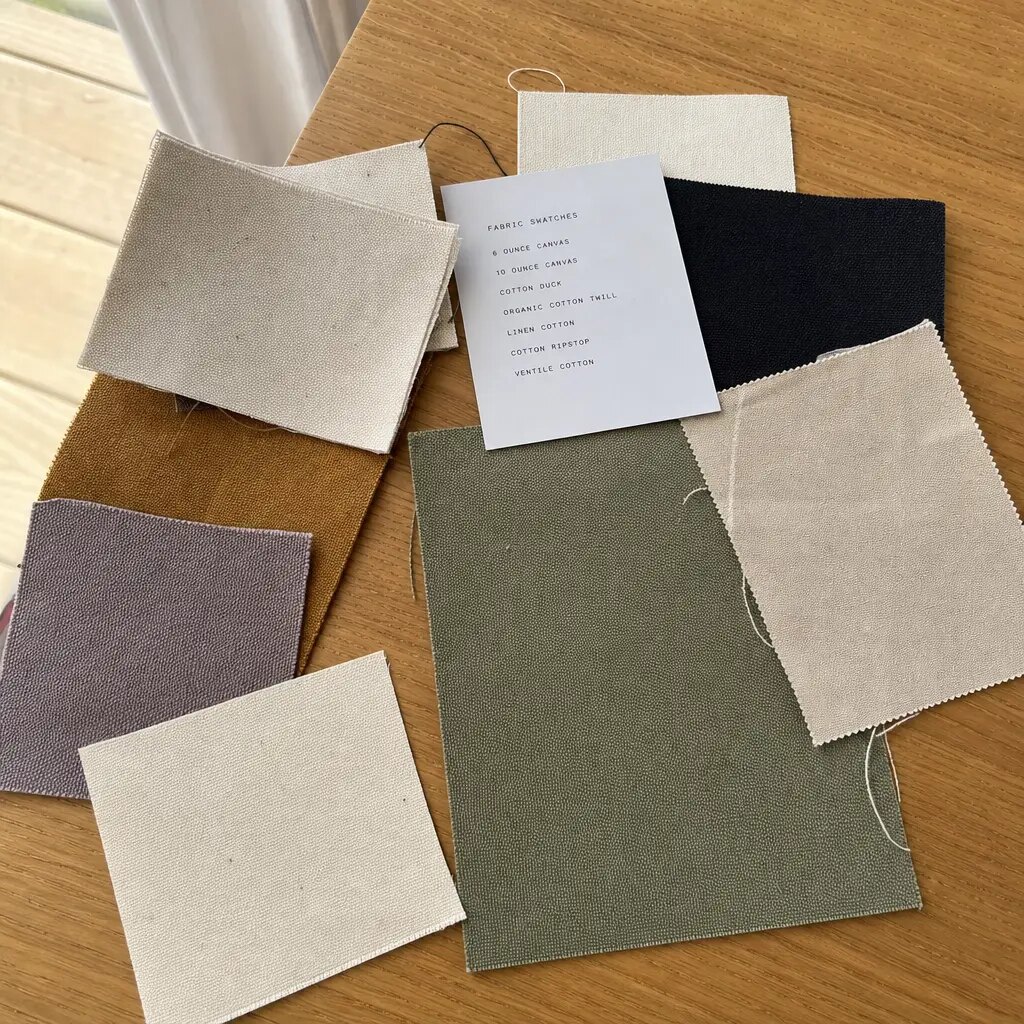
Most apparel packaging programs sit comfortably in 140-180 GSM cotton. This range usually gives enough body for retail presentation and reuse while still folding efficiently. Lighter 120-140 GSM cotton can work for low-cost inserts or short-life protective sleeves. Heavier canvas can be right for premium reusable positioning, but it should be chosen deliberately because it raises fabric cost, carton volume, and sometimes print risk.
Fabric color deserves more precision than the word natural. Natural cotton can vary between lots, and bleached or dyed cotton needs a shade reference. If the brand wants an undyed look, ask how the supplier controls shade variation and whether the approved sample uses the same fabric as bulk production. For reorders, keep a retained sample from the previous shipment, but allow realistic tolerance unless you are paying for a tighter color standard.
- Specify finished sewn dimensions and tolerance for length, width, opening, and cord-channel height.
- Confirm weave, GSM, fabric finish, shrinkage allowance, and whether the fabric is natural, bleached, dyed, washed, or pre-shrunk.
- Use actual products, tags, cards, inserts, and tissue during fit testing.
- Avoid oversizing unless the pouch is intentionally part of a gift experience; extra fabric becomes extra carton cube.
- Approve fabric hand feel and thickness together with the carton plan because folding density changes by material.
Make artwork approval physical, not only digital
Print risk rises when artwork created for paper or web is moved directly onto cotton. Fine legal text, thin lines, gradients, soft shadows, and small QR codes can lose clarity on a woven surface. A PDF proof confirms layout, but it does not prove ink coverage, edge sharpness, opacity, or hand feel.
For recurring B2B pouch orders, 1-2 color screen printing is usually the cleanest baseline. It is predictable at scale and easy to inspect with a ruler and color reference. Heat transfer can work for short runs, complex color, or campaign artwork, but buyers should check whether the finish feels too synthetic for an eco apparel brand and whether edges lift after handling.
Placement needs numbers. Instead of approving a centered logo by eye, define the print size, distance from the top seam or cord channel, horizontal centerline, and tolerance window. This matters when pouches are bundled for retail kits, photographed, or packed in visible unboxing sets. A few millimeters of drift may be acceptable for bulk packaging but not for a premium presentation pouch.
- Request a physical strike-off on the approved fabric before bulk printing.
- Define Pantone or brand color reference, while recognizing cotton texture may affect perceived color.
- Check dry rub resistance, opacity, edge sharpness, and legibility of the smallest text.
- Avoid QR codes or fine reversed text unless the supplier proves scanability and readability on actual fabric.
- Ask whether repeat orders use the same screen, same ink formula, and same placement guide.
Normalize supplier quotes before comparing price
A low unit price is not useful if the packing assumptions are different. One supplier may quote loose bulk packing in a light carton. Another may include fixed inner bundles, stronger export cartons, printed ship marks, sealed carton photos, and a pre-shipment count check. The second quote may look higher until the first order reaches the warehouse and creates sorting or repacking labor.
To compare quotes fairly, force the same inputs: finished pouch size, GSM, fabric type, fabric color, cord material, print method, number of print colors, inner bundle count, master carton count, carton grade, carton dimensions, sample stages, and inspection support. Ask suppliers to separate setup charges from unit price where possible. Screen charges, sample fees, custom cord minimums, carton labels, and documentation fees can change the landed cost.
Freight mode changes the decision. Air and courier shipments punish volume and weight quickly, while ocean freight still requires cartons that stack and survive handling. Buyers should calculate cost per usable pouch after freight, duty, inspection, repacking risk, and defect allowance. A slightly higher ex-factory price can be the better buy if carton counts are accurate and receiving is clean.
- Use one RFQ sheet for every supplier instead of comparing loose email replies.
- Request price breaks at realistic order quantities, not only the supplier's preferred MOQ.
- Ask for estimated carton dimensions and gross weight before PO placement, then confirm after packing trial.
- Clarify whether the quote is EXW, FOB, FCA, CIF, DDP, or another Incoterm.
- Include carton relabeling, recounting, and repacking labor in landed cost when supplier packing control is weak.
Choose factory, trading company, or stock route deliberately
Direct factory sourcing usually fits repeat pouch SKUs with stable artwork, predictable forecasts, and specific carton requirements. The buyer can discuss fabric purchasing, cutting, sewing, printing, and packing closer to the production floor. This does not automatically guarantee better quality, but it often makes it easier to trace defects and lock a repeat carton configuration.
A trading company can be useful when the order includes several packaging items: drawstring pouches, hang tags, tissue, printed inserts, stickers, and care cards. Consolidation can reduce coordination work, but procurement must confirm who owns inspection and packing accuracy. If different subcontractors produce different components, the final carton plan can become unclear unless one party is accountable.
Local distributors and stock suppliers are best for urgent, small, or low-risk programs. They may help with unprinted pouches or market tests, but they usually offer less control over GSM tolerance, shade matching, custom bundle counts, and export carton labels. For a brand building a repeat eco packaging system, stock supply is often a bridge rather than the long-term sourcing model.
- Use a direct factory when carton count accuracy, repeat shade, and stable reorder control matter.
- Use a trading company when consolidation across packaging items saves enough work to justify the extra layer.
- Use a stockist for rush orders or low-risk quantities where custom packing is not critical.
- Ask who physically performs sewing, printing, packing, carton marking, and final inspection.
- Request documents that prove control: final spec sheet, packing list, carton label proof, inspection report, sealed carton photos, and retained sample record.
Set carton counts with trial packing, not guesswork
The right carton count depends on pouch size, GSM, cord bulk, folding method, print curing, inserts, and warehouse handling limits. Many apparel pouch programs use master cartons in the 200-600 piece range, but that range is only a starting point. A small 120 GSM pouch may pack efficiently at high counts. A larger 200 GSM canvas pouch with thick cotton cord may need a lower count to prevent bulging.
Fixed inner bundles make receiving faster and reduce count disputes. Common bundle counts are 25, 50, or 100 pieces depending on pouch size and order quantity. For example, a medium apparel pouch might be packed as 10 bundles of 50 pieces in one master carton. A smaller accessory pouch might use 20 bundles of 50 pieces. The best format is the one your warehouse can count quickly without damaging the goods.
Ask for carton dimensions in length x width x height, gross weight, net weight, and carton grade. For planning, many buyers prefer cartons that stay below about 15-20 kg gross weight and avoid severe bulging after sealing. If cartons will be palletized, check pallet pattern, stack height, and whether the carton can handle normal compression during storage. For ocean freight or long storage, a 5-layer export carton is often safer than a light 3-layer carton.
- Require a packing trial once fabric, cord, print, and folding method are approved.
- Reject cartons that need force to close or show visible bulging beyond the approved sample.
- Keep carton dimensions realistic; excessive empty headspace increases freight cube and carton crushing risk.
- Use carton labels that match the packing list exactly, including SKU, artwork version, color, and quantity.
- For mixed-SKU shipments, use separate cartons by SKU unless the 3PL has approved mixed cartons with clear inner labels.
Control MOQ by the real setup drivers
MOQ is rarely one simple number. It can be driven by fabric purchase, dye lot, cutting efficiency, print screen setup, cord color, sewing-line scheduling, and carton configuration. A supplier may advertise a low MOQ that applies only to natural cotton, one size, one artwork, one print color, and loose packing. Once the buyer adds dyed fabric, custom cord, three sizes, and separate carton labels, the practical minimum changes.
Procurement should ask for MOQ by layer: fabric color MOQ, pouch size MOQ, print version MOQ, cord color MOQ, and packing format MOQ. This is especially important for eco apparel brands with several product families. If each product needs a separate pouch size and artwork, setup cost can spread poorly across the program.
Standardization often protects cost without weakening the brand. One pouch size may cover multiple soft goods. One brand print may work across several SKUs when product-specific information sits on a paper insert or hang tag. For pilot orders, avoid custom dyeing, unusual cord, or complex print unless there is a credible repeat plan.
- Ask suppliers to quote MOQ separately by fabric, size, artwork, print color count, cord color, and carton format.
- Compare total program cost across all pouch versions, not only the largest SKU.
- Use shared pouch sizes where product fit allows.
- Check whether repeat orders have reduced setup charges or require new screens and approvals.
- For one-time campaigns, keep the spec simpler so launch cost does not overwhelm the pouch value.
Tie sample approval to shipment reality
A good sample is not just a nice pouch on a desk. It should prove the sewn dimensions, fabric feel, print execution, cord function, product fit, bundle method, and proposed carton behavior. A pouch can look acceptable as a single piece but fail when stacked, compressed, bundled, and shipped.
Review samples with tools. Measure finished length and width after sewing and pressing. Measure opening width and cord-channel height. Confirm print placement from fixed reference points. Open and close the cord several times, then check for snagging, uneven tension, loose knots, and shedding. Inspect bottom corners and cord-channel stress points for secure stitching.
For first orders, ask for a packing sample, packing diagram, or sealed carton photos before shipment. If a physical carton sample is practical, it can reveal weak corners, insufficient tape, overfilling, or unstable bundle layout. A basic drop and compression reference does not need to become a laboratory project for every order, but the supplier should know whether cartons are expected to survive normal export handling, stacking, and warehouse storage.
- Approve fabric, print, sewing, cord, and packing as one connected production version.
- Use the actual apparel item and inserts during fit approval.
- Check multiple samples, not only the best sample selected for photos.
- Record measured sample dimensions and print placement for inspection comparison.
- Require buyer signoff when any approved item changes, including fabric lot, print method, cord, folding method, or carton count.
Inspect cartons as part of product quality
For B2B pouch orders, carton quality is part of the product because it affects receiving accuracy and usable quantity. AQL or another agreed sampling method is useful for larger orders, but even smaller orders should include random checks from multiple cartons. Inspection should cover fabric, dimensions, sewing, cord, print, bundle count, master carton count, label accuracy, and carton condition.
Define defect severity before production. Critical defects include wrong artwork, wrong size, missing cord, unusable closure, severe stains, incorrect carton count, mixed SKU labels, or unsafe carton condition. Major defects may include visible print shift, weak seams, noticeable fabric flaws, wrong bundle count, or carton bulging. Minor defects may include slight loose threads or mild creasing when function and presentation are not affected.
Shipment release should require more than finished-pouch photos. Ask for inspection photos showing measured dimensions, print placement, cord function, inner bundle layout, opened-carton count checks, carton labels, and sealed cartons. Final documents should include the packing list, commercial invoice if applicable, carton mark confirmation, inspection report, and any freight handoff details required by the forwarder.
- Open random cartons and verify inner bundle counts against the packing list.
- Spot-check carton gross weight against the approved range.
- Reject or hold cartons with wet marks, crushed edges, broken tape, missing labels, or severe bulging.
- Confirm ship marks before cartons leave the factory, especially for multi-SKU or multi-destination orders.
- State whether defects trigger rework, replacement, credit, shipment hold, or buyer disposition.
Specification comparison for buyers
| Spec decision | Recommended option | When it fits | Buyer risk to check |
|---|---|---|---|
| Fabric weight | 140-180 GSM cotton for most apparel pouch programs | Works for socks, underwear, accessories, gift sets, sample kits, and reusable retail pouches that need a better hand feel without excessive carton weight | Below 120 GSM can look transparent and crease heavily; above 200 GSM can raise unit cost, carton cube, and gross weight without adding enough customer value |
| Fabric construction | Plain-weave cotton for everyday packaging; canvas only for heavier reuse positioning | Plain weave folds flatter and prints more predictably; canvas fits premium reusable pouches where stiffness is intentional | Canvas can increase carton volume and reduce print sharpness on fine artwork; approve finished thickness and carton dimensions before bulk |
| Print method | 1-2 color screen print for stable logos; transfer for short runs or complex artwork | Screen print fits recurring SKUs and gives a repeatable cost model; transfer can help with low MOQ or campaign artwork | Fine text, gradients, QR codes, and edge-to-edge art may fail on textured cotton; require a physical print strike-off on the approved fabric |
| Supplier route | Direct factory for repeat pouch SKUs; trading company for consolidated packaging programs | Direct sourcing fits stable forecasts and tight carton control; trading routes help when the PO combines pouches, labels, hang tags, and inserts | Extra layers can hide who controls fabric, printing, carton count, and final inspection; ask who physically packs and labels export cartons |
| Bag size | Finished pouch size based on product footprint plus 10-20 mm side clearance | Useful for apparel accessories, socks, jewelry, belts, scarves, sample sets, and gift inserts that must slide in cleanly | Oversizing wastes fabric and carton cube; undersizing creates wrinkling, seam stress, poor closure, and higher rejection risk |
| Draw cord | Cotton cord for natural positioning; polyester cord where strength, color, or abrasion matters more | Cotton cord supports eco apparel presentation; polyester can provide brighter color matching and higher resistance to repeated pulling | Natural cord can twist, shed, or shrink if finishing is weak; check diameter, pull strength, knot security, and closure cycling |
| Carton pack count | Fixed inner bundles with master cartons usually in the 200-600 pc range | Best for ecommerce fulfillment, import warehouses, and retail kit assembly where count accuracy and quick receiving matter | Overfilled cartons may bulge and crush lower layers; underfilled cartons increase freight cube, carton waste, and warehouse handling |
| Outer carton strength | 5-layer export carton for ocean freight, heavy counts, or long storage; 3-layer only for small light shipments | Useful when pouches are heavy GSM, packed with inserts, or moving through long freight routes and warehouse stacking | Weak cartons can fail under compression, humidity, poor tape, or mixed freight; request carton grade, sealed carton photos, and gross weight |
| MOQ approach | Build MOQ around fabric color, print setup, cord color, size, and carton configuration | Important when one program includes multiple pouch sizes, artwork versions, colors, or separate warehouse pack formats | A low headline MOQ can hide per-version minimums, screen charges, inefficient carton counts, and higher landed cost per usable pouch |
Buyer checklist before sampling
- Finished pouch size with seam allowance, opening width, cord-channel height, and length/width tolerance
- Target GSM, weave type, cotton color, shrinkage allowance, and whether fabric is natural, bleached, dyed, washed, or pre-shrunk
- Cord material, diameter, color reference, knot method, exposed cord length, and pull-strength expectation
- Artwork file, Pantone or brand color reference, print method, print size, placement measurements, and acceptable position tolerance
- Inner bundle quantity, bundle material, bundle label requirement, and whether individual polybags are allowed or prohibited
- Master carton piece count, estimated carton dimensions, gross weight target, carton grade, tape method, and maximum acceptable carton bulge
- Outer carton ship marks including PO number, SKU, color, size, artwork version, quantity, carton number, gross weight, and destination code
- Sample stages required before bulk approval: proto sample, print strike-off, pre-production sample, packing sample, and sealed carton photo
- Inspection plan covering AQL level, measurement checks, print checks, cord checks, carton count checks, and shipment-release documents
- Target ship window, latest acceptable ex-factory date, Incoterms, freight handoff point, palletization need, and forwarder booking responsibility
Factory quote questions to send
- What GSM, weave, shrinkage allowance, and fabric color standard are included in this quote?
- Is the quoted size the finished sewn size or cut-panel size, and what tolerance do you hold on length, width, and cord-channel height?
- Which print method is included, how many colors are covered, what is the setup charge per artwork, and what is the repeat-order setup cost?
- Can you print on the exact approved fabric and provide a physical strike-off showing ink coverage, placement, and rub resistance?
- What cord material, diameter, color standard, knot method, and exposed draw length are included in the price?
- What is the MOQ by size, fabric color, cord color, and print version, not only by total order quantity?
- How many pieces are packed per inner bundle and per master carton, and what carton dimensions and gross weight do you propose?
- What carton grade, flute type, tape method, moisture protection, and palletization option do you use for export orders?
- Can you provide a packing sample, packing diagram, or sealed sample carton photo before bulk packing starts?
- Which Incoterms are quoted, where does freight handoff occur, and who provides the final packing list, carton marks, and export documents?
Quality-control points to confirm
- Fabric GSM must match the approved range within agreed tolerance, with no obvious thin panels, oil marks, holes, severe slubs, or unacceptable shade variation between bundles
- Finished pouch dimensions must be measured after sewing, pressing, and final handling, not only on cut panels; length, width, opening, and cord-channel height should all be checked
- Draw cord length, diameter, knot finish, and pull action must let the pouch close fully without snagging, uneven tension, loose knots, or cord shedding
- Print registration must stay within the approved placement window, with no obvious pinholes, ghosting, ink bleeding, poor opacity, or illegible small text
- Print durability should pass the agreed dry rub and handling check on the approved cotton fabric before bulk shipment is released
- Seam density must be consistent at side seams, bottom corners, and cord-channel stress points, with back-tacking or secure finishing where required
- Cord channel must be clean enough for repeated opening and closing, with no trapped threads, skipped stitches, sharp seam ends, or twisted cord insertion
- Carton count must be verified against the packing list by random carton opening, with inner bundle counts matching the approved packing specification
- Outer cartons must pass visual compression, corner, tape, seal, and moisture checks, with no severe bulging, wet marks, crushed edges, or label loss
- Bundle packing must prevent dye transfer, cord tangling, panel creasing, dust exposure, and mixed-SKU errors during transit and warehouse receiving