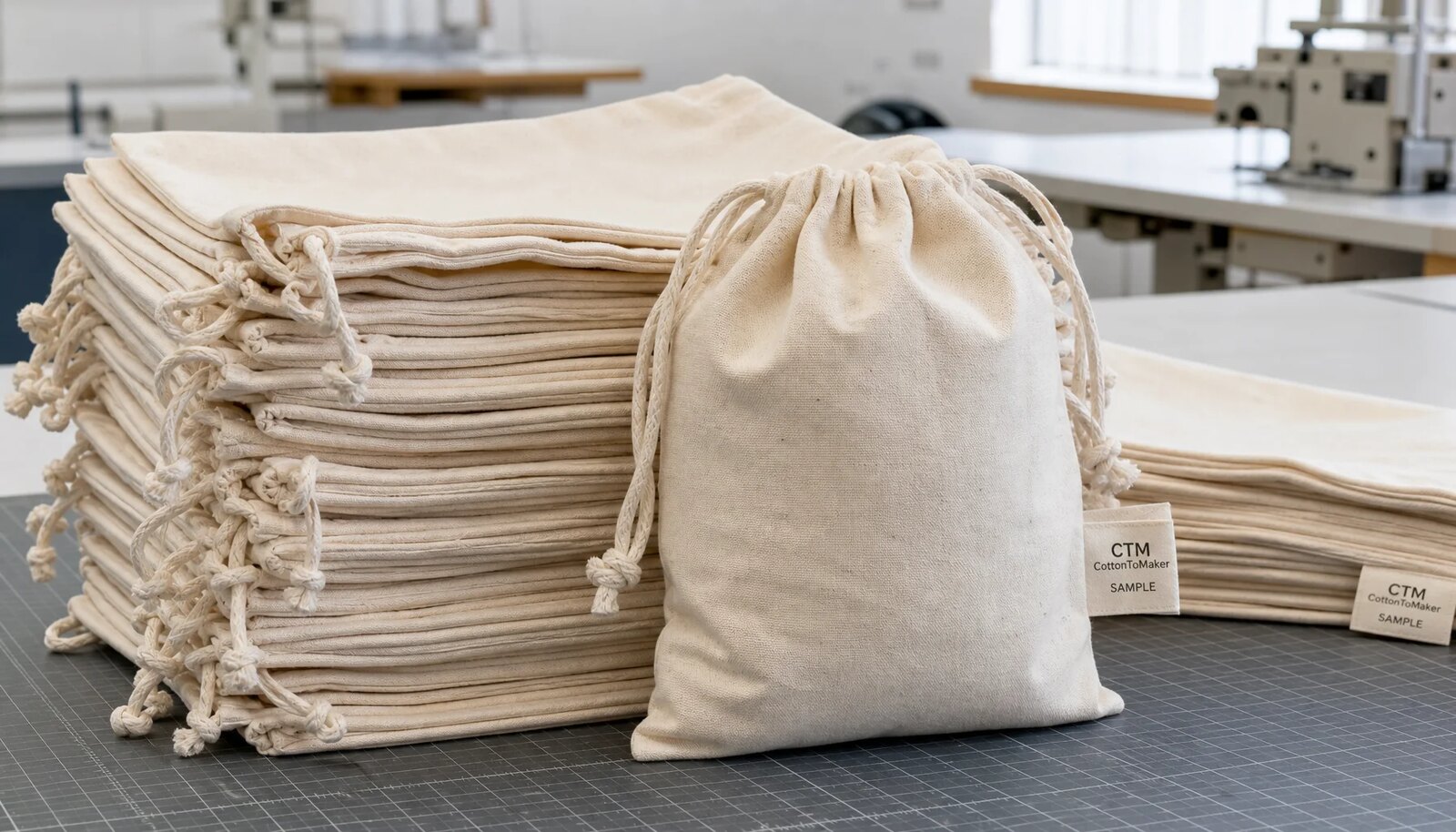
Make Carton Planning Part of the Product
For custom cotton drawstring pouches shipping carton planning for farmers market vendors is not a back-office detail to settle after the artwork is approved. It belongs inside the purchasing specification. A pouch can look right, feel right, and still cause trouble if the cartons are too heavy, the labels are vague, the inner counts do not match replenishment habits, or the packed quantity changes from one order to the next.
Farmers market programs are often more operational than they look from the outside. A vendor may need pouches for soap displays, CSA add-ons, candle sets, spice samplers, coffee promotions, seed packets, jewelry packaging, harvest bundles, and holiday gift kits. Those pouches may be stored in a garage, retail backroom, shared kitchen, market trailer, co-packer facility, or distributor warehouse. The carton plan has to serve that real movement, not just the factory floor.
The first useful sourcing question is simple: what happens to the pouches after production? A 2,000-piece order shipping to one vendor can use a different pack-out than a 20,000-piece order split across multiple SKUs, a distributor, and several seasonal destinations. If staff pull 50 pouches at a time for weekend markets, loose 1,000-piece cartons may save a little packing material while slowing every count and refill. If a warehouse needs carton numbers, item codes, routing labels, or gross weight limits, those requirements should appear in the RFQ before pricing is finalized.
Start with packing targets, then let the supplier confirm the count. Define maximum carton gross weight, preferred carton dimensions, inner bundle count, label fields, and pallet or parcel constraints. Ask for confirmation using production-like fabric, cord, print, folding, and inner packing. That one step prevents a familiar B2B problem: the lowest unit price is approved, then the buyer later discovers the quote assumed weak cartons, unclear labels, loose packing, or unrealistic carton compression.
- Include carton count, carton weight, carton dimensions, inner pack format, and label fields in the RFQ.
- Decide whether the destination needs market-ready bundles, warehouse-ready cartons, or low-cost bulk storage.
- Ask suppliers to price the pouch and packing method together so carton assumptions are visible.
- Keep the approved packing instruction with the purchase order and reuse it for repeat production.
Turn Market Use Into Measurable Specs
A useful pouch specification starts with the item going into the bag. Farmers market vendors use cotton drawstring pouches for flat seed packets, square soap bars, small candle tins, spice jars, lavender sachets, beeswax wraps, coffee samplers, small jewelry boxes, produce portions, and mixed gift kits. Each fill type behaves differently. A flat pouch that is perfect for seed packets may feel tight around a tin because rigid corners consume internal space and stress the side seams.
Procurement buyers should specify both finished outside dimensions and usable internal dimensions. The difference matters. The drawcord channel can take roughly 20-30 mm of vertical space on many small and mid-size pouches, depending on cord diameter and channel construction. Side seams may reduce usable width by about 5-10 mm per side. A gusset can improve fill capacity, but it also changes folding thickness and carton count. If the pouch has to close over a jar, box, tin, or dense bar, ask the supplier to test the filled product, not only the flat pouch.
Construction choices also affect packing. A single-draw pouch is usually flatter in the carton and can be faster to produce. A double-draw pouch may feel more balanced when customers open and close it, but the extra cord adds bulk. Cotton cord, braided polyester cord, jute-style cord, ribbon, knots, metal tips, and sewn cord stops all behave differently in bundles. A small change to cord diameter can reduce pieces per carton or create uneven stacks.
Treat these details as purchase lines rather than style notes. Send product dimensions and approximate fill weight. If a physical sample cannot be sent, provide a dimensional substitute or drawing. For seasonal programs, test the exact kit combination that will be sold at the market. A pouch that fits one jar may not fit that same jar plus a folded insert card, hang tag, or extra sampler.
- State the intended fill item, dimensions, and approximate fill weight.
- Specify finished outside size, usable internal size, channel height, seam allowance, and gusset depth if used.
- Confirm cord material, diameter, length, knot or tip finish, and single-draw or double-draw construction.
- Ask for a filled fit test when the pouch holds a rigid jar, tin, box, bar, or dense product.
Choose GSM for Handling, Not Habit
Fabric GSM influences handfeel, opacity, seam behavior, unit cost, carton weight, and freight density. Lightweight cotton around 120-140 GSM can work for small inserts, simple promotional pouches, or low-load event packaging. It folds compactly and may allow higher carton counts. The tradeoff is lower structure, more show-through, and a less substantial feel. For a vendor selling handmade soap, candles, botanicals, spices, or premium gift sets, a very light pouch can make the finished pack feel weaker than the product inside.
The 140-180 GSM range is often more practical for reusable farmers market packaging. It generally gives better opacity, better handfeel, and stronger shelf or table presence without moving into heavy tote-bag territory. It can tolerate repeated handling in crates, bins, storage shelves, checkout areas, and customer bags. Still, the carton plan has to be recalculated when GSM changes. Moving from 120 GSM to 160 GSM can alter both net weight and packed volume, especially for larger pouches or double-draw designs.
Higher GSM is not automatically an upgrade. Heavy cotton can make small pouches stiff, thicken seams, reduce mouth opening flexibility, and lower pieces per carton. It may call for stronger cartons or lower carton counts to stay within a manual handling limit. For produce reuse or heavier gift sets, that extra structure may be worth it. For one-time sampler inserts, it may add cost and freight without improving the customer experience.
Do not rely only on fabric names such as muslin, canvas, calico, or natural cotton. Those terms are used loosely across suppliers. Ask for target GSM, practical tolerance, weave appearance, color standard, and whether natural slubs or seed specks are acceptable. For unbleached cotton, some variation may be normal, but the approved sample should define what normal means for your order.
- Use 120-140 GSM for light inserts, simple giveaways, or low-load packaging where cost and carton cube matter.
- Use 140-180 GSM for reusable farmers market pouches where opacity, handfeel, and display quality matter.
- Ask for actual production GSM verification, with tolerance such as +/-5% unless a tighter range is agreed.
- Reconfirm carton count whenever GSM, cord, gusset, lining, or print coverage changes.
Build Carton Count From Real Limits
Carton count should be engineered from finished pouch weight, packed volume, and maximum acceptable gross weight. Buyers often ask for 500 or 1,000 pieces per carton because those numbers are tidy. Sometimes they work. Sometimes they create cartons that are too heavy, too compressed, or too bulky for the receiving location. Size, GSM, cord type, gusset depth, print coverage, and inner pack materials can all change the answer.
Manual handling deserves serious attention. Many farmers market vendors are not receiving into a dock with forklifts and long aisles. Cartons may be moved into a storage unit, shared kitchen, retail backroom, garage, basement, van, or event trailer. A carton that looks efficient on a freight estimate can be miserable to handle every week. In many consumer-goods workflows, keeping master cartons under about 15-20 kg gross weight is a practical target unless the consignee has a stricter published limit. Put the actual limit in the RFQ and PO.
Volume can become the constraint before weight. Cotton pouches trap air when folded loosely. Gussets and thick cords make uneven stacks. Printed panels may need cure or cooling time before tight bundling. Inner packs reduce counting problems but add thickness. A supplier should not finalize carton size from a blank lightweight sample if production will use heavier cotton, double cords, a large logo, or separator sheets.
The cleanest approach is to approve a packed trial. Ask for carton L x W x H, net weight, gross weight, pieces per carton, pieces per inner pack, and photos of the open carton, inner bundles, closed carton, label, and scale reading. If the flaps only close under forced compression, the carton plan is not stable. Compression may save cube for a moment, but it can distort folded pouches, stress tape, and create carton damage before receiving count is verified.
- Set maximum carton gross weight before approving final pieces per carton.
- Ask for carton L x W x H, net weight, gross weight, and count per carton by SKU.
- Reject pack-outs that require forced compression to close the carton flaps.
- Use lower carton counts when the destination values easy handling and clean receiving over minimum freight cube.
Use Inner Packs to Speed Receiving
Inner packing should match how the pouches will be counted, stored, and used. For farmers market vendors, counted bundles of 25, 50, or 100 pieces are often easier than loose cartons. Staff can move one bundle to a market bin, hold another for gift assembly, and keep the rest sealed. For distributors, co-packers, subscription box teams, and wholesale programs, consistent inner counts reduce receiving time and make partial carton picking more accurate.
Loose packing still has a place. If the pouch is blank, low value, and going straight to a team that will immediately re-sort or re-pack it, loose bulk packing may reduce material cost and waste. The risk is operational. Drawcords can knot. Printed faces can rub. Cotton can crease in uneven directions. Counts are harder to verify, and shortage claims are harder to investigate because there is no intermediate count unit between a single pouch and the whole carton.
Choose inner materials based on cleanliness, print risk, visibility, and downstream rules. Clear polybags make SKU identification easy and protect against dust or moisture, but some buyers prefer paper bands or sleeves to reduce plastic use. Paper bands can work when the pouch finish is not delicate and the bundle will not scatter during handling. Separator sheets may help with heavy ink coverage or transfers, although they add cost and carton volume.
For mixed-SKU orders, inner packing is also a control tool. Bundle by size, fabric color, artwork version, and quantity. If the supplier uses inner labels, make sure they match the carton label and packing list. A small label mismatch at bundle level can become a mispick later, especially during market-season replenishment when teams are moving quickly.
- Use bundle counts that match replenishment habits, commonly 25, 50, or 100 pieces.
- Bundle by SKU, size, color, and print version when the order has multiple variants.
- Avoid loose packing when cords tangle, print faces rub, or receiving must verify counts quickly.
- Specify whether inner packs need clear bags, paper bands, sleeves, labels, or barcodes.
Control Print Before It Controls Packing
Print method affects appearance, durability, cost, lead time, and packed behavior. Screen printing is usually the strongest default for simple one-color or two-color farm logos and repeat orders. It is efficient at practical quantities and can be controlled with measurable placement tolerances. Digital print or heat transfer may be the better fit for multicolor artwork, gradients, short runs, or personalization. The right choice depends on artwork complexity, order quantity, durability expectations, and how the print behaves after folding.
Placement needs numbers. Instead of saying the logo should be centered, specify print size, print area, distance from the bottom seam or pouch opening, and acceptable shift. Cotton is flexible, so very tight tolerances can raise cost or rejection risk. For many cotton pouch orders, a placement tolerance such as +/-3-5 mm is more realistic than rigid-product precision, but the buyer and supplier should agree before production. If artwork sits near a seam, gusset, or drawcord channel, review it on a filled pouch as well as a flat one.
Cure and rub resistance are logistics issues, not just print-shop concerns. Ink can look acceptable on a table and still transfer when stacked under carton pressure. Heat transfers may need cooling time before tight packing. Heavy print coverage can stiffen the pouch face and change the fold. Ask the supplier to check first-off printed pieces by folding, rubbing, stacking, and packing them in the intended inner pack format.
Artwork version control matters in B2B orders. Farmers market vendors often order seasonal versions, flavor-specific marks, event logos, or wholesale variants. Each version should have a file name, print size, print location, and SKU reference. The carton label should identify the print version clearly enough that receiving staff do not have to open multiple cartons to find the right design.
- Define print method, artwork size, color count, color reference, and print location from fixed edges.
- Agree on print placement tolerance and registration tolerance before production.
- Check rub resistance and fold behavior after curing, not only immediately after printing.
- Confirm printed pouches will not be bundled while ink or transfer film is still vulnerable.
Make Supplier Quotes Truly Comparable
Two pouch quotes are not comparable until the packing assumptions are visible. One supplier may include inner bundles, export cartons, labels, inspection, and carton markings in the unit price. Another may quote only the sewn pouch and add packing or setup later. A third may use fewer pieces per carton, changing the freight cost. The lowest factory unit price can become the higher landed cost once carton dimensions, gross weight, inspection scope, rework risk, and receiving labor are included.
Use one RFQ sheet for every supplier. Include finished pouch size, usable size, fabric GSM, fabric color, cord type, print method, artwork size, quantity by SKU, inner pack count, master carton target, maximum gross weight, carton label requirement, destination, and Incoterm. Ask suppliers to state every assumption that differs from the request. If they recommend a different GSM, carton count, or inner pack, have them show the effect on unit price, carton count, and freight basis separately.
Supplier route matters, but visibility matters more. A direct factory may offer closer control over cutting, sewing, printing, and pack-out. A managed sourcing partner can be useful for consolidation, communication, and multi-product programs. Either way, the buyer needs proof that someone owns final packing control. That party should be able to answer carton dimensions, count, label data, gross weight, sample approval status, and inspection scope without guessing.
Quote review should end with a landed-cost view. Compare the cost per acceptable pouch delivered into the intended receiving workflow, not just the FOB or ex-works unit price. If one quote includes stronger cartons and counted bundles while another relies on loose packing and vague labels, they are not the same offer.
- Compare quotes on the same pouch spec, inner pack, carton count, carton quality, and label requirement.
- Separate unit price, setup charge, packing cost, carton cost, inspection cost, and freight basis where possible.
- Ask for carton data before treating a freight estimate as reliable.
- Evaluate landed cost per acceptable pouch, not only the factory unit price.
Approve Samples and Packed Cartons
A pre-production sample should prove more than appearance. It should confirm fabric handfeel, actual GSM range, finished size, usable capacity, cord function, stitch quality, print placement, and print finish. A blank size sample is useful early in development, but it cannot confirm production print cure, final packed thickness, or carton behavior. For first orders or important seasonal launches, request a sample made from production fabric, production cord, approved stitching, and the intended print process.
The next approval layer is packed carton evidence. At minimum, ask for a photo set showing the inner bundle format, pouch orientation, open carton, closed carton, carton label, measured carton dimensions, and scale reading for gross weight. A physical sample carton may be worthwhile for larger orders, multi-SKU programs, heavier GSM, large print areas, double-draw cords, or shipments going into strict warehouse receiving.
Document the approval in measurable terms. Record finished size, usable size, GSM result, cord length, print placement, bundle count, carton count, carton dimensions, gross weight, and label content. Keep that record with the purchase file for reorders. Without it, the second order can drift because a different operator folds the pouch, a new carton is substituted, the cord supplier changes, or the packing team uses a convenient count instead of the approved one.
Do not let photo approval replace measurement approval. Photos are useful for checking general appearance and carton layout, but they cannot prove size tolerance, GSM, gross weight, or count. Ask for the numbers, then decide whether the evidence is enough or whether a physical sample needs to be reviewed.
- Approve a pre-production pouch sample before bulk cutting or mass printing.
- Approve packed carton evidence before mass packing starts.
- Measure samples instead of relying only on photos or visual approval.
- Keep approved product and carton data for reorder comparison.
Define QC Around Likely Failures
Quality control should follow the points where the pouch can fail in real use and logistics. Incoming fabric should be checked for GSM, shade, weave appearance, handfeel, and contamination before cutting. Cutting should be checked against the approved pattern. Sewing inspection should cover stitch density, skipped stitches, loose threads, seam allowance, channel width, and stress points near the drawcord opening. Drawcords should pull smoothly, close evenly, and avoid tearing or binding inside the channel.
Print QC needs both visual and functional checks. Inspect color density, edge sharpness, registration, placement from a fixed edge, cure, rub resistance, and condition after folding. If a pouch has multiple artwork versions, inspect each version separately. First-off pieces catch setup errors. Last-run pieces catch drift in ink viscosity, fabric tension, heat settings, and operator handling. Cotton texture variation may be normal; smudging, uncured ink, obvious misplacement, and transfer marks should not be waved through as texture.
Packed carton QC is the final checkpoint before mistakes become expensive. Verify inner bundle count, master carton count, carton label accuracy, carton dimensions, gross weight, tape closure, and carton condition. For mixed-SKU orders, check separation by size, color, artwork version, and carton number before shipment release. Compare labels against the purchase order and packing instruction, not only against the factory's internal packing list.
Count errors deserve special attention because they often appear after receipt. By then, cartons may be opened, bundles may be moved, and evidence may be incomplete. The supplier should verify counts before cartons are sealed and again during final pack-out. Any count change, carton substitution, relabeling, or rework should be documented and approved before shipment.
- Inspect fabric, sewing, drawcord function, print, inner pack, and master carton as separate stages.
- Set practical tolerances for GSM, size, print placement, and carton count before production.
- Check first-run and final-run pieces, not only a convenient middle sample.
- Require documented approval for count changes, carton substitutions, label corrections, or rework.
Plan Lead Time Around Bottlenecks
Lead time for custom cotton drawstring pouches is controlled by dependent steps, not only sewing capacity. Fabric booking, fabric dye or availability, artwork proofing, screen or transfer setup, cutting, sewing, printing, curing, carton printing, inner packing, final inspection, and freight handoff can each affect the ship date. A broad production estimate is useful, but procurement needs the step-by-step version to manage risk.
Buyer approvals are common bottlenecks. Low-resolution artwork, unclear print colors, changing carton label data, late SKU quantities, or missing destination references can hold production even when the supplier is ready. Multi-SKU orders carry extra risk because each size, fabric color, print version, and label may require separate setup and final packing control. A farmers market vendor planning for opening weekend, harvest season, subscription boxes, or holiday gifting should reserve time for sample review, artwork proofing, and packed carton approval.
Cartons and labels can delay shipment too. Custom carton markings, warehouse routing labels, barcodes, PO-specific carton sequences, or destination references may need approval before cartons are printed or labels are prepared. If destination data changes after packing begins, cartons may need relabeling or repacking. That delay is avoidable when the pouch spec, artwork, carton count, label content, and destination instructions are frozen before final packing.
For repeat orders, review the previous packing record before issuing the new PO. Confirm that the same GSM, cord, print method, inner pack count, master carton count, carton size, and label fields still apply. If any one of those inputs changes, ask the supplier to reconfirm carton data instead of assuming the old count still works.
- Ask for lead time by stage: sample, material, proofing, setup, cutting, sewing, printing, curing, packing, QC, and freight handoff.
- Freeze artwork, carton labels, PO references, and destination data before packing starts.
- Treat multi-SKU orders as higher schedule risk than single-SKU repeat orders.
- Build calendar buffer for market season launches, harvest promotions, subscription boxes, and holiday gift programs.
Specification comparison for buyers
| Spec decision | Recommended option | When it fits | Buyer risk to check |
|---|---|---|---|
| Supplier route | Direct factory or managed sourcing partner with documented pack-out control | Best when you need repeatable pouch specs, print control, carton counts, mixed-SKU separation, and accountable final packing | Confirm who owns fabric approval, print approval, packed-carton approval, carton markings, final inspection, and correction if carton count changes |
| Fabric GSM | 120-140 GSM for light inserts; 140-180 GSM for reusable retail and market handling; higher GSM only when the product weight or reuse expectation justifies it | Most farmers market soap, candle, spice, seed, coffee, and gift-set pouches sit in the 140-180 GSM range for better handfeel and opacity | Ask for actual production GSM and tolerance, often +/-5% unless tighter terms are agreed; do not rely only on catalog fabric names |
| Finished and usable size | Specify outside dimensions plus usable internal dimensions after seam allowance and drawcord channel | Needed for jars, tins, soap bars, produce quantities, jewelry boxes, sampler kits, and seed packet bundles | A nominal flat size can be misleading because the channel may consume 20-30 mm of height and seams may consume 5-10 mm per side |
| Drawcord construction | Single draw for flatter packing; double draw for more balanced opening and higher perceived finish | Single draw can reduce cord bulk in cartons; double draw can suit gift packaging or repeated retail handling | Confirm cord material, cord diameter, cord length, knot or tip finish, pull function, and whether cord bulk changes pieces per bundle |
| Print method | Screen print for simple one- or two-color logos; digital print or transfer when artwork complexity requires it | Screen printing usually suits farm logos, market brands, seasonal marks, and repeat orders | Check artwork size, ink color standard, placement tolerance, rub resistance, cure time, and whether heavy ink areas stick or mark when bundled |
| Inner pack format | Counted bundles of 25, 50, or 100 pieces using paper bands, clear bags, or labeled sleeves | Useful for farmers market vendors, co-packers, subscription box teams, distributors, and wholesale restocking | Loose packing can reduce material cost but may tangle cords, crease printed panels, slow receiving, and make count disputes harder to resolve |
| Carton pack count | Set maximum gross weight and handling size first, then confirm piece count by packed trial | Works better than copying a generic 500-piece or 1000-piece count across different GSM, pouch sizes, and cord types | Require actual carton L x W x H, net weight, gross weight, photos of the open and closed carton, and confirmation that flaps close without forced compression |
| Carton style | 5-ply export carton for most bulk pouch shipments; stronger board, strapping, or corner protection when cartons are heavy or handled many times | Appropriate for parcel, LTL, warehouse receiving, freight forwarding, and export shipments | Weak cartons can crush corners, deform folded pouches, split tape, lose labels, or fail before receiving count is verified |
| Carton labels | Item code, pouch size, fabric color, print version, quantity, carton number, PO, destination reference, gross weight, net weight, and country-of-origin wording if required | Needed for mixed SKUs, market-season replenishment, wholesale programs, storage units, and third-party warehouses | Missing label fields force receiving teams to open cartons, create mispicks, and make shortage claims difficult to investigate |
Buyer checklist before sampling
- Define finished outside size, usable internal size, fabric GSM, fabric color, seam allowance, drawcord channel height, cord material, cord diameter, cord length, and single-draw or double-draw construction.
- List the intended product fit with dimensions and approximate fill weight, such as a 90 g soap bar, 60 ml candle tin, 4 oz spice jar, seed packet set, coffee sampler, jewelry box, produce quantity, or holiday kit component.
- Specify fabric tolerance requirements, including practical GSM tolerance, shade tolerance against an approved swatch, shrinkage expectation if washed or steamed, and whether unbleached cotton slubs are acceptable.
- Specify print method, artwork file format, print color count, ink color standard or reference, maximum print area, placement from fixed edges, acceptable registration shift, and whether one side or both sides are printed.
- State target pieces per inner bundle, inner pack material, pieces per master carton, maximum carton gross weight, acceptable carton dimensions, and whether cartons must stay within a warehouse or manual-handling limit.
- Require carton labels to show item code, pouch size, fabric color, print version, PO number, carton number, total carton count, quantity, gross weight, net weight, destination reference, and any warehouse routing label required by the consignee.
- Ask whether the quoted price includes fabric sourcing, cutting, sewing, drawcord insertion, printing, print setup, inner packing, master cartons, carton labels, export packing, inspection, and export documents.
- Request a pre-production sample made from production fabric, production cord, approved stitch construction, and the final print process, not only a blank size sample or digital mockup.
- Request packed carton evidence before mass packing begins, including open carton, inner bundle view, closed carton, carton label, measured carton dimensions, and scale reading for gross weight.
- Confirm QC acceptance criteria for GSM tolerance, finished size tolerance, stitch density, seam strength, drawcord function, print placement, print cure, rub resistance, carton count, carton condition, and label accuracy.
Factory quote questions to send
- What exact fabric construction and target GSM are quoted, and what GSM tolerance will be inspected against during incoming fabric inspection?
- What are the finished outside dimensions, usable internal dimensions, drawcord channel height, seam allowance, and expected size tolerance after sewing and finishing?
- What cord material, diameter, length, knot or tip finish, and single-draw or double-draw construction are included in the price?
- How many pieces per inner bundle and per master carton are assumed, and what are the expected carton length, width, height, net weight, and gross weight?
- Does the price include inner bags or paper bands, master cartons, carton printing, carton labels, export packing, warehouse-specific markings, and any inspection labor?
- Which print method is quoted, what is the setup charge, what is the maximum print area, what color standard will be used, and what placement tolerance will be inspected?
- Can you provide a pre-production sample using production fabric, production cord, approved stitching, and the same print method before bulk production starts?
- Can you provide a packed carton photo set or sample carton before mass packing, including open carton, inner bundles, closed carton, carton label, carton dimensions, and measured gross weight?
- What stitch density, seam-strength check, drawcord pull check, print rub test, print cure check, and carton drop or compression review are included in your normal QC process?
- How do you prevent mixed SKUs, sizes, fabric colors, print versions, or carton quantities from being mixed during final packing?
Quality-control points to confirm
- Incoming cotton fabric should be checked against the approved GSM, color shade, weave appearance, handfeel, and contamination standard before cutting starts; a practical GSM tolerance is often +/-5% unless a tighter range is agreed in writing.
- Finished pouch dimensions should be measured after sewing and after any finishing step that could change size; buyers should define outside size and usable internal space because the cord channel and seams reduce capacity.
- Stitching should be inspected for skipped stitches, loose threads, uneven seam allowance, twisted drawcord channels, weak bar-tack or stress areas, and seam distortion near the drawcord opening.
- Drawcords should be checked for material, diameter, length, knot or tip finish, smooth pull function, balanced closure, and no tearing or binding in the channel.
- Print inspection should include placement from a fixed edge, color density, edge sharpness, registration, cure quality, rub resistance, fold behavior, and whether ink marks adjacent pouches during stacking.
- First-off production pieces and final-run pieces should both be inspected because fabric shade, sewing tension, print viscosity, heat settings, and operator setup can drift during production.
- Inner bundle counts should be verified before cartons are closed, and master carton counts should be checked after final pack-out rather than inferred from cutting or sewing output.
- Mixed-SKU orders should be separated by size, color, artwork version, and carton number, with line checks before cartons are sealed and before the packing list is issued.
- Carton dimensions, board strength, tape quality, closure method, label placement, and gross weight should match the approved packing instruction before shipment release.
- Carton labels should match item code, pouch size, color, print version, quantity, carton number, PO, destination reference, gross weight, and net weight exactly.