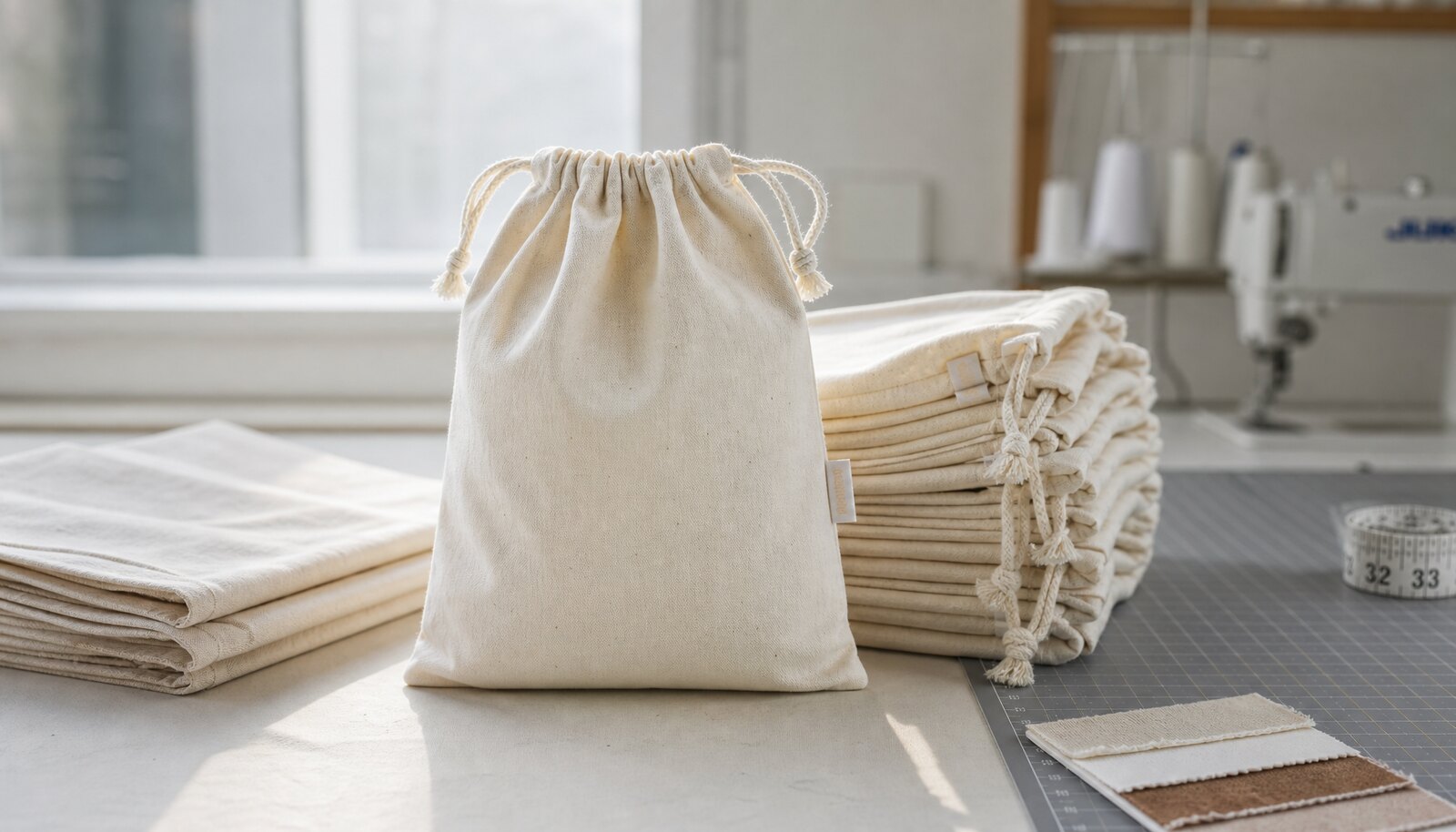
Start carton planning before the pouch price is final
For corporate gifting, a custom cotton drawstring pouch is rarely just a pouch. It may be one component in an employee welcome kit, a holiday gift box, a conference handout, a cosmetics bundle, a sales sample pack, or a client appreciation set. By the time the recipient sees it, the pouch has already passed through production, printing, folding, packing, export handling, receiving, storage, and often a separate kitting line. If the carton plan is vague, even a well-made pouch can become slow and expensive to handle.
Carton planning affects more than freight. It controls how quickly a warehouse can verify quantity, whether a kitting team can open one clean bundle at a time, whether the print arrives scuffed, and whether the cartons stay within a receiving team's weight limit. A low pouch unit price can lose its advantage if cartons are oversized, poorly labeled, underfilled, or packed so tightly that cords and printed panels are crushed.
Procurement teams should treat packing as part of the product specification from the first RFQ. Ask what the carton needs to enable after arrival: bulk replenishment, regional office distribution, retail-ready storage, direct-mail insertion, or immediate kit assembly. The answer shapes the fold method, inner pack quantity, carton count, gross weight, carton label, and inspection checklist.
A useful supplier conversation starts with one practical question: what happens to the pouch after the master carton is opened? Once that is clear, fabric, logo method, MOQ, and carton data can be priced on the same basis.
- Include carton planning in the first RFQ, not only in the shipping instruction after PO approval.
- Define the next step after arrival: kit assembly, warehouse storage, branch distribution, retail sale, or direct-mail insertion.
- Ask suppliers to quote by proposed pack ratio, carton size, and gross weight so prices are comparable.
- Treat carton label format, inner pack count, and export marks as controlled specifications.
Size the pouch around the gift contents
A flat pouch drawing is a starting point, not a fit guarantee. Cotton drawstring pouches lose usable space to side seams, bottom seams, the top hem, the cord channel, fabric thickness, and the gathered closure. A pouch specified as 150 mm wide does not provide 150 mm of clean internal space. If the pouch will hold a rigid box, tumbler, candle, bottle, notebook, cable set, or cosmetics pack, the buyer should test with the real item or a dimensionally accurate block before approving the size.
The pouch also has to look intentional. Too tight, and the seams pull, the logo distorts, and the closure may not gather cleanly. Too large, and the pouch collapses around the contents, looks cheaper, and consumes more carton cube than needed. For gifting, the target is usually a balanced fit: enough clearance for easy packing, enough structure for presentation, and enough top space for the drawstring to close without straining.
Ask the supplier to state both finished flat size and usable internal size. Measurement points should be named: top width, bottom width, full height, height below cord channel, top hem depth, and tolerance after sewing. Cotton moves during cutting and stitching, so a realistic tolerance in millimeters is better than a perfect dimension that cannot be held in bulk.
The filled pouch can also change the outer packaging plan. A few millimeters of extra width may reduce pieces per carton or force a larger gift box. Confirm the pouch size before locking carton quantity, divider spacing, or mailer dimensions.
- Request a fit test using the actual gift item or a size block, not only a flat sample photo.
- Define finished flat size, usable internal size, and tolerance separately.
- Confirm whether the quoted height includes the drawcord channel and top ruffle.
- Check whether the filled pouch still fits the outer gift box, mailer, or kitting tray.
- Avoid a size that leaves no clearance after seam allowance and fabric movement.
Choose GSM and finish for the handling journey
For most custom cotton drawstring pouches used in corporate gifting, 140-180 GSM is the practical range. Around 140 GSM, the pouch folds compactly and helps control carton weight in high-volume programs. It can work well for stationery, lightweight accessories, event inserts, and simple promotional kits where the pouch is a branded touchpoint rather than the premium item itself. The tradeoff is lower opacity, more visible creasing, and a lighter hand-feel.
Around 160 GSM is often the balanced specification. It gives more substance without becoming difficult to fold or pack. At 180 GSM, the pouch has better body, stronger opacity, and a more premium feel, which may suit cosmetics, jewelry-style gifting, tech accessories, or executive packs. Heavier fabric is not automatically better. It can increase sewing bulk, drawcord friction, master carton weight, and freight cube.
Finish changes both appearance and risk. Natural cotton has a warmer, organic look, but buyers should expect flecks and shade variation. Bleached cotton provides a cleaner ground for some logos. Dyed cotton can support brand color or seasonal themes, but it may require tighter shade control and, where relevant, a colorfastness or rub-transfer check. If pouches will sit beside light-colored goods, this deserves attention before bulk packing.
Construction details complete the GSM decision. Seam allowance, stitch density, top hem depth, channel width, and reinforcement at stress points affect how the pouch survives repeated opening, closing, packing, and re-packing. Gift pouches are handled by more people than the final recipient; the specification should reflect that journey.
- Use 140 GSM for lightweight, high-volume promotional programs where compact packing matters.
- Use 160 GSM when the order needs balanced hand-feel, opacity, and carton efficiency.
- Use 180 GSM when premium feel and shape retention matter more than minimum freight weight.
- Specify natural, bleached, or dyed cotton with shade tolerance and a physical reference.
- Define seam allowance, stitch density, top hem depth, and drawcord channel width in the tech pack.
Match the logo method to real fabric, not a PDF proof
Screen printing is usually the first benchmark for custom cotton drawstring pouches. It is cost-effective, repeatable, and suitable for simple one- or two-color corporate logos. Still, cotton is textured. Thin strokes, small type, tight registration, gradients, and photographic effects can lose sharpness on the woven surface. A logo that looks clean in a digital proof may look soft once printed on actual fabric.
For fine detail or premium presentation, a woven label, sewn patch, or transfer may be the better choice. A woven side label can be subtle and durable. A front patch can add structure and perceived value. Heat transfer can help with complex artwork or short runs, but it should be tested on the selected cotton and reviewed after folding. The decision should come from artwork detail, order quantity, color count, budget, and handling risk.
Placement needs the same discipline as print method. Specify logo width and height, distance from bottom seam, distance from side seam, and whether one or both sides are decorated. Also ask whether the pouch will be folded across the logo. If printed faces are pressed together in tight cartons, curing time and rub resistance become important, especially on urgent orders.
Approve the logo in the condition the recipient will experience it. That means printed, cured, folded, packed, opened, and inspected again. This simple check can reveal ink transfer, cracking, fold marks, and placement distortion before production moves too far.
- Use screen print for simple one- or two-color logos with clear shapes and moderate line weight.
- Consider woven labels, patches, or transfers for fine text, small marks, or premium positioning.
- Require artwork proof at actual size, not only a scaled mockup on a large pouch image.
- Specify print placement in millimeters from seams and hem, with an allowed tolerance.
- Approve the logo after the pouch has been folded and handled in the proposed packing style.
Separate MOQ by the real cost drivers
MOQ for cotton drawstring pouches is often shown as one tidy number. In practice, the minimum may be driven by several separate inputs: fabric purchase, dyeing, cutting efficiency, print setup, cord color, label production, inner packing, and destination separation. A buyer who only asks for the lowest MOQ may miss the actual cost structure of the order.
This is why two quotations can look inconsistent even when the pouch drawing is the same. One supplier may price one size, one fabric shade, one artwork, bulk packing, and standard cartons. Another may include inner bundles, barcode labels, export marks, carton numbering, and SKU separation. The second quote may look higher, but it may reflect the real requirements of a corporate gifting program more accurately.
Multiple logo versions should be discussed early. Employee, VIP client, and channel partner pouches may share the same fabric, size, and cord, allowing a common cutting lot. But printing, setup fees, artwork MOQ, and carton separation may still apply by version. Clarify this before marketing approves a family of designs.
Ask for a quote that separates blank pouch cost, decoration, setup, special labels, packing, master cartons, and SKU separation. With that structure, negotiation becomes more precise. The buyer can decide whether to simplify the logo, reduce versions, change inner pack size, or standardize carton counts instead of pushing only on the final unit price.
- Ask whether MOQ applies per size, fabric shade, print design, cord color, or shipping SKU.
- Separate fabric MOQ from print MOQ and packing MOQ in quote comparison.
- Check whether different logo versions can share one fabric cutting lot.
- Request setup charges per screen, per color, per side, and per artwork version.
- Normalize packing assumptions before comparing supplier prices.
Pick a supplier route that can control packing
The sourcing route changes how reliably the carton plan will be executed. A direct factory that controls cutting, sewing, decoration coordination, QC, and final packing can usually respond faster when buyers need fixed carton counts, special labels, or destination-specific cartons. Fewer handoffs also reduce the chance that packing instructions are lost.
A trading company or sourcing agent can still be useful, especially when the gift program includes multiple product categories. The buyer simply needs to know who physically controls final packing and who signs off the packing list. When there are several destinations, event deadlines, or strict receiving rules, accountability matters as much as convenience.
Bulk-packed sourcing can be the right choice when local printing, rework, or domestic kitting is planned. It may reduce overseas labor and packaging cost. But bulk packing also increases the need for clean handling, accurate counting, and dust protection after arrival. Loose pouches can wrinkle or become hard to count when cartons are opened repeatedly.
Factory-packed sourcing is stronger when pouches need to arrive ready for the next operation. That may mean bundles of 50 or 100, individual polybags, divider sheets, barcode stickers, carton labels, SKU separation, or destination marks. Decide early whether the factory should provide that precision or whether the receiving team will absorb the sorting work later.
- Use direct factory packing when carton accuracy, export labels, and repeatable presentation are critical.
- Use a trading route only when packing responsibility and inspection authority are documented.
- Use bulk packing when local rework or local kitting is planned and presentation risk is acceptable.
- Ask who owns final carton count, carton labeling, packing list accuracy, and corrective action.
- For multi-destination orders, require carton-level separation by SKU or destination code.
Build the carton plan with numbers
A good carton plan begins with the receiving process. If the warehouse requires cartons below a certain weight, put that limit in the RFQ. Many buyers prefer master cartons that are practical for manual handling, for example under 15 kg gross when that matches internal receiving rules. The right quantity depends on pouch size, GSM, fold method, cord bulk, inner packing, and carton strength.
Pack ratio should be tested. Pouches look flat one by one, but drawcords, knots, seams, labels, and folded edges create bulk. Overstuffed cartons can crush cords, create hard creases, press ink against fabric, and deform cartons. Underfilled cartons waste freight cube and can allow goods to shift. Ask the supplier for pieces per inner pack, pieces per master carton, carton dimensions, net weight, gross weight, and photos of a packed carton before approval.
Inner packing should match the next operation. Individual polybags keep pouches clean and simple to distribute, but they add cost, labor, plastic use, and volume. Bundles of 25, 50, or 100 may be better for kitting lines. Divider sheets can reduce friction or ink transfer without bagging every pouch. Choose the least packaging that protects presentation and supports counting.
Carton labels need to be specific. A strong label includes PO number, SKU, pouch size, color, logo version, quantity, carton number, total carton count, gross weight, net weight, destination, and barcode if required. If the order has multiple versions, the label should make mix-ups easy to spot.
For palletized shipments, check whether the carton dimensions support stable pallet loading. For air freight, volumetric weight may drive cost. For sea freight or LCL, cube utilization and carton strength under stacking matter more. These freight assumptions should be visible before final price approval.
- Request carton dimensions, pieces per carton, net weight, gross weight, and inner pack method in every quote.
- Avoid overstuffed cartons that compress cords, distort folds, or transfer ink between pieces.
- Avoid underfilled cartons that waste freight cube and increase landed cost per pouch.
- Define carton labels with PO, SKU, quantity, carton number, destination, and barcode if needed.
- Check pallet fit, air freight volumetric weight, and sea freight cube before approving bulk packing.
Approve samples as the warehouse will receive them
A loose sample is useful, but it is not enough for a corporate gifting order. The pre-production sample should reflect the bulk standard: actual fabric, actual GSM, actual cord, actual stitching, actual logo method, actual fold, actual inner pack, and proposed carton label. If the order includes a woven label, barcode sticker, care insert, desiccant, or special bundle format, include it in the approval package.
The approval record should be concrete. Keep photos, dimensions, logo placement measurements, fabric reference, cord diameter, print color references, fold method, and agreed tolerances together. The supplier should identify the approved sample version and keep a matching reference for production and QC. If version two is approved after version one is rejected, the PO should say so.
For packing approval, ask for photos or a short report showing how pouches are folded, bundled, inserted, counted, and sealed. On a large or deadline-sensitive order, a small packed-carton trial can be worth the time. It confirms whether the planned carton count is realistic and whether cartons remain square, sealed, and easy to handle.
Build sample timing into the calendar. Artwork proofing, sample making, sample transit, review, revision, and final approval can take longer than expected. Do not issue an urgent PO while artwork, carton labels, destination splits, or packing instructions are still undecided.
- Approve a production-style sample, not only a print strike-off or digital mockup.
- Record fabric shade, GSM, logo placement, cord size, stitch detail, and fold method.
- Include inner pack, carton label, barcode sticker, and special packaging in sample approval if required.
- Ask for a carton trial or packed carton photos before full packing starts.
- Use one approved sample reference for brand approval, factory QC, and receiving inspection.
Inspect quality, function, and count accuracy
Quality control for custom cotton drawstring pouches should cover more than appearance. The pouch must match the approved specification, function correctly, and arrive in cartons the receiving team can verify. A pouch can look fine at first glance and still fail if the drawcord sticks, the seams skew, the print rubs off, or the carton label does not match the packing list.
Size inspection needs defined measurement points. Inspectors should measure top width, bottom width, total height, and height below the cord channel where relevant. If the pouch is made for a specific box, bottle, notebook, or gift component, a fit test is more useful than measurement alone. Samples should come from different cartons or production lots, not only from pieces prepared for review.
Print inspection should cover color, placement, sharpness, registration, curing, and rub resistance. Cotton texture creates natural variation, but smudges, heavy ink buildup, misaligned colors, and illegible small text should be controlled. If the logo crosses a fold line, inspect the folded appearance too. Printed pouches should not be packed before curing is adequate.
Functional inspection focuses on the drawstring and seams. The cord should move smoothly. Knots should hold. The channel should not tear. Seam stitching should be consistent around the top hem and side seams. Loose threads should be trimmed because they hurt presentation and can catch during kitting.
Packing inspection is the final safeguard. Open random cartons to verify inner pack count, master carton count, SKU separation, carton labels, odor, moisture, dust, mold, and ink transfer. Carton sealing and board strength should also be checked for export shipment. A mislabeled carton can create receiving delays that cost more than the pouch.
- Measure finished size against the written spec and tolerance, not only against the approved sample from memory.
- Check fit with the real gift item when the pouch has a strict contents requirement.
- Inspect print after folding and light rubbing to catch curing, scuffing, or transfer issues.
- Pull-test cords and inspect channel stitching to confirm repeated opening and closing.
- Open random cartons to confirm count, labels, odor, moisture condition, and packing consistency.
Compare quotes by delivered, gift-ready cost
A strong B2B quote makes the cost stack visible. The buyer should be able to see the blank pouch cost, fabric or dye surcharge, decoration cost, setup charge, label cost, inner packing cost, master carton cost, export handling, and any documentation or testing fees. When everything is hidden inside one unit price, comparison becomes guesswork.
The quote should also state all operating assumptions. Size, GSM, fabric color, logo size, print colors, one-side or two-side decoration, cord type, inner pack quantity, master carton quantity, carton dimensions, gross weight, lead time, and delivery term should appear in writing. If carton details are missing before PO approval, the buyer cannot compare freight cube or warehouse handling cost accurately.
Freight may be purchased separately, but carton data still affects landed cost. Air freight may be charged by volumetric weight. Sea freight and LCL depend on cube, carton count, and handling. Warehouses may charge for repacking, relabeling, or sorting when cartons arrive in the wrong format. A cheap pouch can become expensive after the purchase order if the carton plan is weak.
Use one quote template for every supplier. Give each factory the same pouch size, GSM, artwork, pack ratio, carton weight limit, label requirement, destination split, and delivery term. If a supplier proposes a different pack ratio, ask why. Sometimes the alternative is better. Sometimes it is only easier for production. Clear quote structure helps procurement see the difference.
- Request separate pricing for blank pouch, logo, setup, labels, inner packing, master cartons, and export handling.
- Require carton dimensions, pieces per carton, and gross weight in the commercial quote.
- Compare cost per delivered, gift-ready pouch rather than pouch sewing cost alone.
- Ask suppliers to identify exclusions such as barcode labels, desiccant, testing, pallets, or special marks.
- Use one quote template so all suppliers price the same specification and packing basis.
Specification comparison for buyers
| Spec decision | Recommended option | When it fits | Buyer risk to check |
|---|---|---|---|
| Fabric weight | 140-180 GSM cotton, confirmed after finishing | Corporate gift sets, cosmetics, stationery, accessories, tech items, employee welcome kits, and client appreciation packs where hand-feel and presentation matter | Too light can show contents and wrinkle badly; too heavy can raise carton weight, freight cube, and sewing bulk |
| Fabric finish | Natural, bleached, or dyed cotton with a physical shade reference | Programs where pouch color needs to support a brand palette, seasonal theme, or premium gift presentation | Natural cotton has normal flecks and shade variation; dyed cotton can vary by lot and may need colorfastness checks |
| Closure style | Single or double cotton drawcord with defined cord diameter and length | Giveaways, retail insert packs, hotel amenities, employee kits, and repeated-use gift pouches | Weak knots, narrow cord channels, or poor top stitching can fail during kit assembly or re-packing |
| Print method | 1-2 color screen print, woven label, patch, or transfer chosen by artwork detail | High-volume branding, simple logos, small brand marks, and repeat logo placement across gift programs | Fine gradients, thin lines, and small type may blur on textured cotton; approve the logo at actual size |
| Supplier route | Direct factory or factory-managed packing line | Orders needing fixed carton counts, inner packs, barcode labels, export marks, destination splits, and mixed SKU pack-outs | If packing is outsourced, carton accuracy, label traceability, and change control can weaken |
| MOQ logic | MOQ separated by fabric, size, artwork, cord color, and packing format | Orders with multiple logo versions, event markets, regional languages, or gift-set assortments | A low headline MOQ may hide setup fees, artwork minimums, dye-lot minimums, or packing surcharges |
| Carton fill plan | Pack by folded dimensions, net weight, cord protection, and target gross weight | Sea freight, air freight, warehouse replenishment, branch-office drops, and gift assembly programs | Overstuffed cartons crush cords and crease print; underfilled cartons waste freight and pallet space |
| Sample approval | Pre-production sample with actual fabric, print, cord, fold, inner pack, and carton label | Orders with strict brand color, retail presentation, direct-mail insertion, or event deadlines | Flat artwork approval is not enough; the pouch may look different after folding and compression |
| Packing format | Individual polybag, inner bundle, divider sheet, or bulk pack selected by receiving process | Retail-ready kits, e-commerce inserts, warehouse kitting, branch-office drops, or distributor resale | Loose packing can scuff print and create count disputes; over-packaging can increase cost and sustainability concerns |
Buyer checklist before sampling
- Finished pouch size in flat condition and filled condition, with tolerance ranges in mm and the measurement method shown on a spec drawing
- Usable internal size after seams, top hem, cord channel, and drawstring closure are accounted for
- Fabric GSM, weave type, color finish, shrinkage allowance, and whether the cotton is natural, bleached, dyed, or washed
- Approved shade reference, Pantone reference if applicable, and allowed natural cotton shade variation for bulk production
- Print method, artwork file format, print color references, print size, placement from seams, and whether the logo appears on one or both sides
- Cord material, cord color, cord diameter, drawcord length, knot style, metal tip requirement, and pull-strength expectation
- Seam allowance, stitch density, top hem depth, corner reinforcement, and whether a woven side label or care label is included
- Packing ratio per inner pack, per master carton, and per destination SKU, including whether packs are bundled, polybagged, or separated by divider sheets
- Master carton dimensions, carton board strength, gross weight target, net weight estimate, export mark, barcode label, and palletization plan if required
- Pre-production sample standard: one or more pieces made with actual fabric, actual print, actual cord, actual fold method, and proposed packing materials
Factory quote questions to send
- What exact GSM, fabric width, weave, and finish are you quoting, and is shrinkage already included in the cutting allowance?
- Is the MOQ tied to one size, one fabric shade, one cord color, and one artwork, or can variants share the same fabric run?
- Which print method is included in the quote, and what is the setup cost per color, per side, per logo version, or per screen?
- Can you quote the blank pouch, decoration, packing, carton, and export handling as separate line items so we can compare landed cost?
- What finished size tolerance do you apply, and how do you measure the pouch: top width, bottom width, height below cord channel, or full height?
- What cord diameter and cord length are included, and do you perform any pull test or opening-and-closing test during QC?
- What carton size, inner pack count, master carton quantity, net weight, and gross weight are you using for this quotation?
- Can you keep master cartons under our receiving weight limit, for example under 15 kg gross, without increasing the risk of underfilled cartons?
- Will you supply a pre-production sample with actual fabric, print, stitching, cord, fold, inner pack, and carton label before bulk approval?
- What defect tolerance do you apply for print misalignment, loose threads, stains, odor, size variance, seam skew, and carton count errors?
Quality-control points to confirm
- Measure finished size on samples from the first completed production lot and from random cartons; compare against the approved spec sheet, not only against a loose sample piece
- Verify usable internal capacity by inserting the buyer's reference item or a size block when the pouch will hold a fixed box, bottle, notebook, or gift component
- Check GSM or fabric weight by supplier declaration and spot inspection against the agreed fabric roll reference; flag fabric that feels noticeably lighter, thinner, or more transparent
- Inspect cotton shade under consistent light, especially for natural and dyed cotton; confirm whether normal shade variation is acceptable before goods are packed
- Inspect print sharpness at normal reading distance and close range; small text, thin lines, logo edges, and registration should remain legible after one fold cycle
- Check print curing and rub resistance before packing by lightly rubbing printed areas with clean white cloth and reviewing whether ink transfer appears
- Test drawcord opening, closure, knot security, and channel stitching by pulling each side several times; reject broken stitches, stuck cords, or uneven drawstring lengths
- Verify seam allowance, stitch density, top hem depth, corner reinforcement, and side label placement; uneven hems can cause friction, skew, or poor presentation
- Open random inner packs and master cartons to confirm no odor, moisture, mold, dust, insect contamination, oil marks, ink transfer, or deep compression creases
- Review packing accuracy by piece count, inner pack count, carton count, carton label, SKU code, destination code, and purchase order reference