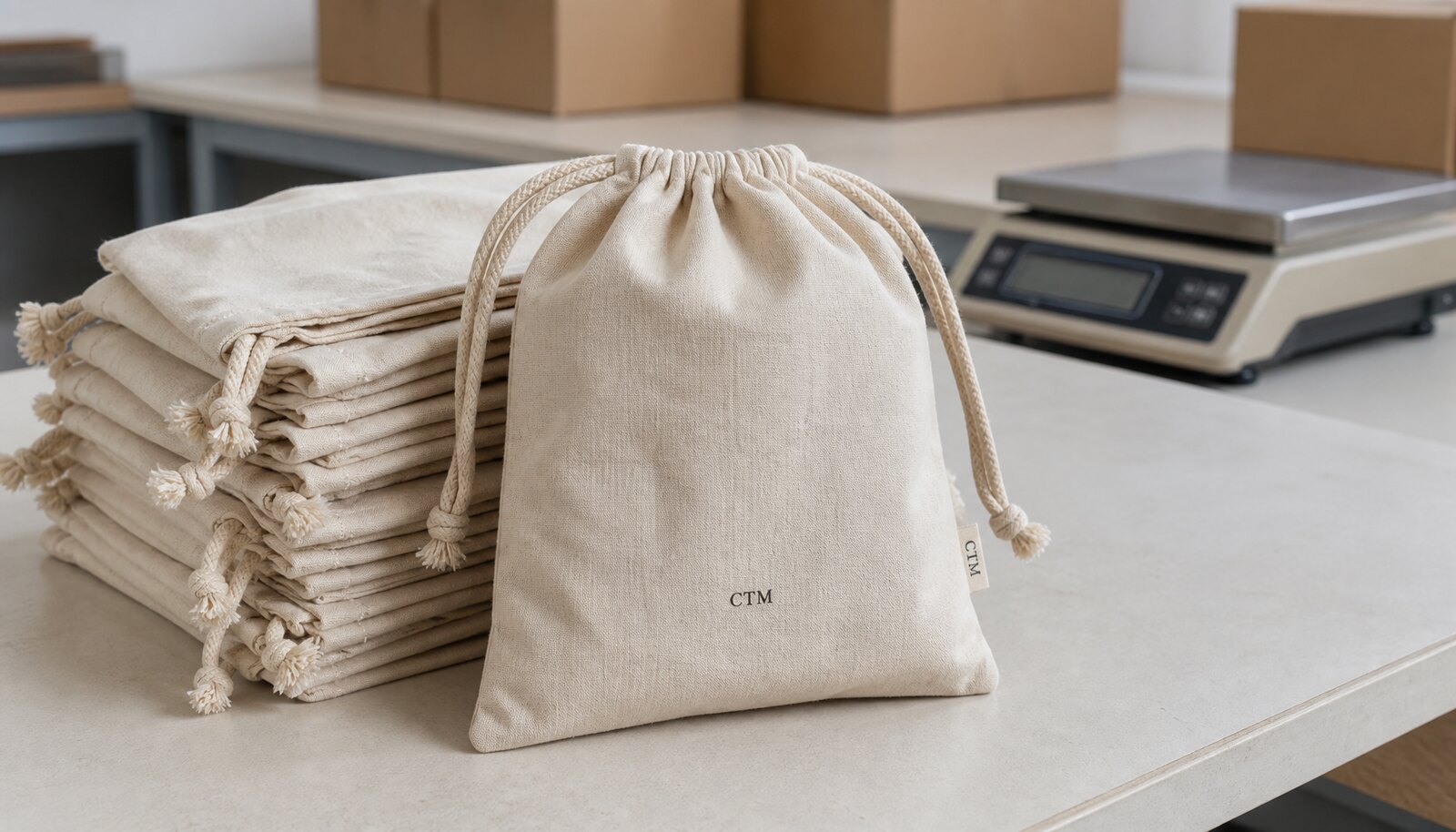
Why carton planning matters more than pouch price for gift shops
For custom cotton drawstring pouches, the quoted unit price only tells part of the story. Gift shops do not receive pouches as isolated pieces; they receive them through distribution centers, 3PLs, seasonal replenishment warehouses, or mixed-SKU inbound programs where carton size, pack count, label clarity, and receiving speed matter just as much as the bag itself. A low pouch price can still become an expensive order if the cartons are oversized, the pack count is inefficient, or the warehouse has to rework the shipment before it can be shelved or split into store replenishment.
That is why carton planning should be part of the product specification, not a warehouse afterthought. When buyers leave packing open, one factory may pack tightly and give a low freight cube while another uses more air and more cartons even though the pouch looks the same. The difference rarely appears in the first line of an RFQ. It shows up later in freight invoices, receiving labor, pallet efficiency, and seasonal stock availability. In gift shop programs, where many orders are smaller, seasonal, and margin-sensitive, those downstream costs can matter more than a small difference in piece price.
A focused carton plan also makes supplier comparison easier. If every quote includes the same pouch size, fabric spec, print method, inner pack, export carton count, and carton dimensions, procurement can compare landed cost on a like-for-like basis. Without that, one supplier may appear cheaper only because they quoted a looser pack format or assumed a smaller carton. The buyer ends up comparing incomplete offers instead of real options.
- Compare suppliers on packed carton dimensions, not only on pouch piece price.
- Ask for both net weight and gross weight before you lock the order.
- Use one packing logic across sizes when possible so receiving and replenishment stay simple.
Choose the cotton spec around retail use, shelf look, and packing behavior
The fabric choice should be driven by how the pouch will be sold, displayed, and handled. A very light cotton pouch may feel soft in hand, but in a retail environment it can collapse on shelf, show contents too easily, or wrinkle heavily once a logo is applied. For many gift shop applications, 140–180 gsm is a workable range because it gives enough body for branding, better seam durability, and a more premium presentation without making the carton unnecessarily heavy. That range is a practical starting point, not a universal rule; smaller pouches, minimal print, and low-fill gift items can work well at the lower end, while larger or more display-driven pouches may benefit from the upper end.
The finish matters as much as the gsm number. Natural unbleached cotton gives an eco-craft feel that fits artisan gift assortments, museum shops, and nature-themed product lines. Bleached or lightly processed cotton creates a cleaner background for logos and seasonal art. Brushed cotton softens the hand feel, but it also changes the visual texture and can alter how the print sits on the fabric. Because of that, the buyer should approve an actual sample, not just a fabric description. If the pouch family has multiple sizes, keep the look consistent across sizes so the assortment appears coordinated instead of mixed from different mills or different finishing processes.
Shrinkage is the quiet risk in cotton procurement. Cotton can move after washing, humid storage, pressing, or steaming during packing. If the pouch must fit a tray, a gift box, or a shelf-ready display pocket, ask whether the supplier is using pre-shrunk fabric or cutting with a shrinkage allowance. A supplier who cannot explain how shrinkage is handled is giving you a finished size that may be right only on the day the sample was made. That is a problem for retail buyers who need the pouch to hold a consistent shape through receipt, storage, and display.
- 140–180 gsm is a useful starting band, but size and use case should decide the final call.
- Request the actual finish: natural, bleached, brushed, or pre-shrunk.
- Ask how shrinkage is controlled, not only what size the finished pouch should be.
Print method decisions that affect MOQ, lead time, and shelf appearance
For gift shop pouch programs, the print method affects more than decoration. It changes setup cost, repeatability, minimum order quantity, lead time, and the retail look of the finished pouch. Screen print is usually the most practical option for simple logos, one- or two-color seasonal graphics, and branding that needs to stay stable across reorder cycles. It is also easier to quote because the setup is straightforward and the color output is more predictable than many short-run alternatives. If the design is simple and the order may repeat, screen print is often the most commercially stable choice.
Heat transfer can make sense for short runs or artwork with more detail, but procurement should ask how it will wear under handling. Some transfers look sharp at first but become less forgiving if the pouch is folded tightly, rubbed repeatedly, or stored in hot conditions. Embroidery gives a premium feel, yet it raises unit cost and can distort a light pouch body unless the construction is reinforced. In most gift shop programs, embroidery is a presentation choice rather than a default procurement choice. It should be used when the added value on shelf justifies the extra cost and slower output.
The more colors and placement changes you add, the more likely MOQ rises. A one-side, one-color logo is simple to repeat. Add a second-side print, metallic ink, or very fine artwork and the supplier may need more setup, more test prints, and more allowance for rejection. A useful RFQ question is not simply 'what is your MOQ?' It is 'what is the MOQ by print method, color count, and artwork area?' That breaks the pricing logic into pieces the buyer can actually compare.
- Screen print is the safest default for simple branding and repeat orders.
- Heat transfer needs a durability discussion before you approve it for retail handling.
- Multi-color artwork usually raises setup cost and can slow the schedule.
How to read MOQ logic without getting trapped by a low quote
MOQ for custom cotton drawstring pouches is rarely a single number. A supplier may have one minimum for the pouch body, another for print color count, and another for a carton-friendly pack configuration. That means a quote that looks low can still be hard to execute if your size range, artwork, or packing plan does not fit the factory’s standard workflow. The procurement task is not to chase the smallest MOQ; it is to understand what the MOQ is actually protecting on the production side.
The cleanest MOQ structure is one tied to production efficiency and receiving reality. If one SKU can be packed in a stable carton count and another requires a partial carton, the second SKU often costs more per unit once labor and volume are included. That is why mixed-size gift shop programs need a tighter plan than a single-SKU reorder. If the factory can consolidate sizes, keep the same fabric, and share print setup across variants, the order becomes easier to price. If not, the buyer should expect separate line items and potentially separate minimums.
For seasonal gift shop replenishment, it is often smarter to order fewer SKUs at a more efficient pack count than to chase a broad assortment with poor packing density. The inventory risk of a low MOQ is not only leftover units. It can also be partial cartons, poor pallet build, and more time spent receiving and reconciling goods at the destination. If the MOQ cannot be packed cleanly, ask the factory to quote a different pack plan rather than forcing the same MOQ through an inefficient carton structure.
- Separate MOQ by size, print color, and packing format.
- Prefer carton-friendly pack counts over arbitrary piece counts.
- If you need mixed sizes, ask whether material, cutting, and print setup can be shared.
Supplier route comparison table: direct factory, trading company, or consolidator
Gift shop buyers usually source through three routes: direct factory, trading company, or a consolidator that bundles multiple gift items. Each route can work, but each one changes who controls the details that drive landed cost and receiving quality. The right route depends on how much control you need over carton engineering, how much time you have to manage the order, and whether the pouch is a standalone item or part of a larger gift set or seasonal assortment.
A direct factory gives the most control over fabric choice, sewing, print approval, carton engineering, and change control. That matters when packed carton size, label format, and repeat order consistency are important. A trading company can be faster if you need a sourcing bridge or do not have bandwidth to manage production detail, but transparency on where cost changes happen may be weaker. A consolidator is useful when the pouch is one item in a broader program, but the convenience can reduce control over carton standardization and item traceability.
Use the comparison below as a procurement screen rather than a generic sourcing ranking. The route is only 'better' if it supports your packing rules, receiving process, and re-order rhythm.
- Direct factory works best when carton engineering and repeat orders matter.
- Trading companies can help speed quoting, but ask where packing decisions are made.
- Do not proceed until one named owner signs off the final spec version.
Supplier route comparison table
This table focuses on the route choices procurement buyers actually use for custom cotton drawstring pouches shipping carton planning for gift shops. It is designed to make the trade-offs visible before you ask for samples or spend time comparing prices.
The most useful comparison points are not generic. They are carton control, specification visibility, speed of quoting, and the buyer’s ability to force consistent packing rules across reorders.
- Write decisions in measurable language, not only descriptive wording.
- Ask for sample photos plus one physical approval sample for important orders.
- Keep quotation, sample approval, and inspection notes tied to the same spec version.
Carton planning method: how to calculate piece count, carton size, and freight impact
Carton planning should start from the destination constraint, not from the pouch dimension alone. Before you ask the factory to pack, define the handling limits: the maximum carton weight for manual receiving, the preferred carton size range, whether the warehouse uses palletized inbound, and whether cartons need to fit a shelf-ready or DC receiving standard. Once those constraints are known, the carton count can be chosen around them. The goal is a carton that protects the pouch, is easy to lift, and does not waste cube.
A practical carton planning method has four steps. First, measure the finished pouch size after folding or stacking as it will actually be packed. Second, decide the inner pack format: loose, polybagged per dozen, or grouped in a master inner. Third, calculate the carton count by testing several layouts on paper to see which one gives a stable stack without crushing the pouches. Fourth, convert the result into carton dimensions and gross weight so you can compare freight impact across suppliers. If the pouch is light and compressible, the cube may matter more than the weight. If the pouch is heavier or has inserts, gross weight may become the controlling factor.
A simple formula helps. Carton volume in cubic centimeters is L × W × H. To estimate carton efficiency, compare the actual packed volume against the theoretical space needed by the folded pouch count. For example, if a carton measures 50 cm × 40 cm × 30 cm, the gross volume is 60,000 cubic cm, or 0.06 cubic meters. If you pack 240 pouches in that carton, then the cube per pouch is 0.00025 cubic meters. If another supplier uses a 55 cm × 45 cm × 35 cm carton for the same count, the volume rises to 86,625 cubic cm, or 0.0866 cubic meters. That is a real freight difference even if the bag price is identical.
Worked example: assume a natural cotton pouch measures 20 cm × 15 cm finished size and folds to about 10 cm × 7.5 cm × 0.5 cm when packed flat with a thin insert. A carton sized at 50 cm × 40 cm × 30 cm might hold roughly 200–240 pieces depending on whether the pouch is polybagged, how tightly it is folded, and how much clearance is needed at the carton wall. If each pouch weighs 18 g, then 240 pieces net about 4.32 kg before polybags and carton weight. Add 0.45–0.70 kg for the carton and packing materials, and the gross weight may sit around 4.8–5.0 kg. That is useful because it tells you whether the carton stays within a manual handling limit and whether the pallet will be weight-limited or cube-limited.
If your destination warehouse prefers pallet efficiency, ask for cartons per pallet and the pallet pattern. Even a small change in carton footprint can improve pallet utilization across a full seasonal purchase. For example, reducing the carton base from 50 × 40 cm to 48 × 38 cm may let you fit more cartons per layer and reduce wasted edge space. The right carton is not always the smallest box; it is the box that gives the best balance of protection, handleability, and transport efficiency.
- Start carton design from warehouse handling and freight limits.
- Ask for L × W × H, gross weight, and carton count per pallet before PO release.
- Compare carton volume per pouch, not only carton count.
- Use a simple test layout before you approve the final pack count.
Mixed-SKU carton strategies for gift shop replenishment
Gift shops often reorder in mixed assortments: different sizes, different colors, or different seasonal art running through the same inbound shipment. That makes carton strategy more important than it is for a single-SKU wholesale order. If you force mixed styles into one carton without clear labeling, receiving teams may spend time separating them, which slows inbound processing and increases mispick risk. Mixed-SKU cartons can work, but only when the buyer and supplier agree on the structure upfront.
There are three practical approaches. The first is single-SKU cartons with a master shipment made up of multiple cartons per SKU; this is the cleanest for receiving. The second is inner assortments inside a master carton, where each inner pack is clearly labeled by size or color; this can be efficient for small gift shops or store-ready replenishment. The third is a mixed master carton with multiple SKUs in one outer box; this should only be used when the receiving site has explicitly asked for it and the labeling is very clear. The more mixed the carton, the more important it is to define counts, labels, and carton map in writing.
For seasonal replenishment, a good compromise is to keep the export carton single-SKU but allow mixed purchase orders by line item. That way the shipper and receiver do not have to sort a carton at the dock. If the gift shop chain uses a DC, ask whether they require vendor case pack compliance, barcode labels, or specific carton dimensions. A carton that is perfect for factory shipping may still be rejected if it does not match DC receiving rules. The safest procurement habit is to ask about those rules before the sample stage, not after booking.
- Prefer single-SKU cartons when receiving speed matters.
- Use mixed cartons only if the destination has asked for them.
- Get DC label, barcode, and case-pack rules before final packing is approved.
Sample approval should include pouch construction and carton math
A pre-production sample should prove more than color and logo placement. For custom cotton drawstring pouches, it needs to show construction quality, cord function, and the real packing result. A good sample arrives in the intended fabric, with the intended print method, and packed the way the bulk order will be packed. If the sample looks fine loose on a table but deforms badly in the carton, that is not a successful approval. Gift shop buyers should insist that the sample review includes one physically packed carton, not just a loose pouch or a flat sewn sample.
During sample approval, check the measurement points that matter later in receiving. Measure finished pouch length and width, confirm the draw opening, inspect stitch symmetry, and verify the print placement against the approved artwork file. Then open the carton and check the count, carton marking, and closure method. If the buyer plans to ship directly to a gift shop DC, the carton label should already resemble the final production label. That prevents the common failure where the pouch sample is approved but the actual shipping carton fails a receiving requirement that was never tested.
If the order is large enough to matter commercially, ask for a carton sample or at least a carton specification sheet with actual packing photos. A carton photo should show the product in the packed state, not just an empty box. For remote procurement teams, that is the easiest way to catch mismatch early. The goal is to avoid approving a pouch that cannot be packed efficiently or a carton that will create receiving headaches later.
- Approve a sewn sample and a packed carton sample before bulk.
- Measure the pouch, then measure it again in the packed state.
- Record the exact sample version so bulk tolerances are tied to one reference.
QC thresholds that prevent avoidable claims
QC for cotton drawstring pouches should focus on the defects that create actual buyer complaints: loose seams, inconsistent size, print drift, cord failure, and carton damage. The inspection plan should be written so a third party can use it without guessing what good means. Cosmetic language like 'nice finish' is not enough. You need measurable checkpoints. For many buyer teams, that means defining an acceptable size band, a print placement window, a seam quality standard, and a packaging requirement before mass production starts.
AQL should be used as a practical screening tool, not as a magic number. For general appearance checks on a simple textile accessory, many buyers use a normal inspection level around AQL 2.5 for major and minor defects, with tighter handling for critical issues such as open seams, missing cords, incorrect print, or wrong SKU labeling. If the pouch is being sold as a branded retail item, a critical defect should usually be zero tolerance because one wrong logo or one open channel can turn into a customer complaint. If your supplier uses a different AQL table, ask them to state it clearly in the inspection plan so both sides are speaking the same language.
Useful tolerances are specific. If the approved sample is 20 cm wide, define an acceptable finished width band instead of allowing any variation. If the logo is centered, the inspection should say how far it can move from centerline before rejection. Stitching should be checked at the side seams and cord channel for skipped stitches, broken thread tails, or visible puckering. The cord itself should be pulled by hand several times to make sure the channel does not tear and the opening does not distort. These are not glamorous checks, but they are the failures most likely to show up when a retail associate or end customer uses the pouch repeatedly.
Carton QC should be just as practical. Random cartons should be opened to confirm count, correct SKU, and label accuracy. Cartons should be checked for compression damage, bulging seams, tape failure, and wet spots. If cartons are likely to stack in a warehouse, ask the supplier to keep the top closure and board strength suitable for stacking, and reject any carton that collapses under normal handling. A good pouch with a bad carton still causes a receiving problem. For gift shop buyers, that is enough reason to inspect both product and pack, not just one or the other.
- Use AQL 2.5 as a common general-screening reference, then tighten critical defects to zero tolerance.
- Define separate rules for size, print placement, seam quality, and cord integrity.
- Check cartons for count accuracy, label correctness, and compression damage.
- Reject any lot where the pouch quality is fine but the carton cannot survive normal warehouse handling.
Specification comparison for buyers
| Supplier route | Best for gift shop buyers who need… | Main advantage | Main risk | What to verify before award |
|---|---|---|---|---|
| Direct factory | Control over carton size, pack count, print consistency, and repeat orders | Best visibility into fabric, sewing, packing, and carton engineering | Requires clearer spec writing and more active buyer coordination | Ask who owns final carton dimensions, who signs off the spec version, and whether pack changes require re-approval |
| Trading company | Faster quoting across several factories or a broader sourcing bridge | Useful when you need speed or multi-item sourcing support | Less transparency on where packing decisions and cost changes sit | Confirm the actual factory, sample source, carton owner, and whether the quote includes all packing materials |
| Consolidator / gift basket supplier | Mixed gift programs, bundled orders, or shelf-ready replenishment packs | Can simplify inbound handling when pouches are only one part of a larger program | Carton standardization may be weaker and item traceability can be harder | Request carton map, SKU segregation method, and receiving label format before approval |
| Material | 6-10 oz cotton canvas, 210D polyester, rPET, or blended cotton with shrinkage and colorfastness expectations set before sampling | Before price comparison | Different cloth weights, backing, or certification claims make quotes hard to compare | |
| Construction | cord diameter, eyelet or reinforced channel, bottom corner reinforcement, seam allowance, bar-tack position, and load target | Before sampling | Weak stress points create returns and failed inspections | |
| Decoration | screen print, transfer, embroidery, woven label, or drawstring tag tested against folding and abrasion | Before artwork approval | The wrong method can crack, bleed, pucker, or fail on the chosen fabric | |
| MOQ | Base MOQ plus change drivers | During quote review | Custom colors, trims, and packing can change minimums | |
| Sample | Physical sample with close-up photos | Before bulk cutting | Photo-only approval can miss hand feel and seam issues |
Buyer checklist before sampling
- Write the finished pouch size with tolerance, not just the nominal dimension; include usable internal height and draw opening width.
- Specify cotton gsm, weave type, finish, and whether shrinkage has been allowed for in cutting.
- State artwork size, print method, number of colors, and whether the print is one-side or two-side.
- Lock the inner pack count and export carton count early so the supplier can design carton dimensions around freight and warehouse handling.
- Ask for the packed carton dimensions, gross weight, net weight, and estimated cartons per pallet for your destination.
- Request sample approval that includes fabric, stitching, cord function, print placement, and at least one packed carton.
- Define acceptance criteria for visible defects, size drift, print misplacement, loose threads, and carton damage before production starts.
- If you buy mixed SKUs, ask how the factory will separate, label, and master-pack them for receiving at a distribution center.
- Confirm whether polybags, desiccants, carton marks, and pallet wrap are included in the quote or charged separately.
- Use one spec version across RFQ, sample approval, inspection, and packing list so nobody is quoting from a different document.
Factory quote questions to send
- What exact fabric gsm, weave type, and shrinkage allowance are you quoting, and do you have a tolerance band for incoming cloth?
- How many pouches per inner pack and per export carton are included in the quote, and what are the packed carton dimensions and gross weight?
- What print method is included, what is the setup fee by color count, and what minimum line thickness or font size do you require for artwork?
- Are there separate MOQs by pouch size, print color, or packing configuration? If so, please break them out line by line.
- Can you provide a sewn pre-production sample and one packed carton sample before bulk approval?
- What packaging materials are included in the unit price: polybag, insert card, desiccant, carton marks, corner protection, or pallet wrap?
- If the order includes mixed sizes or mixed artwork versions, how do you allocate setup cost, cutting cost, and packing labor?
- What is your standard lead time after sample approval, and what events usually extend it: print correction, fabric delay, carton delay, or booking congestion?
- Who signs off carton dimensions and packing count on your side, and will those values be fixed in the PO?
- If we need gift-shop replenishment packs or shelf-ready inner packs, can you quote that separately from the base pouch supply?
Quality-control points to confirm
- Check fabric gsm against the agreed target with a written tolerance band; do not accept cloth that is visibly thinner or less opaque than the approved sample even if the measured gsm is close.
- Inspect seam quality at the side seams, base seam, and draw channel. Look for skipped stitches, broken thread tails, loose ends, seam waviness, or puckering that affects shelf presentation.
- Set a size tolerance for finished pouch length and width, and measure at least three points per sample lot. Accept only when the finished size stays within the agreed nominal band.
- Measure print placement from the centerline and top edge. Reject logos that drift into the seam, sit too close to the draw channel, or vary beyond the approved placement window.
- For simple logo programs, define a rub test expectation: the print should not smear, flake, or transfer visibly under normal handling. If the ink has a cure requirement, state it in the inspection note.
- The drawcord should pull smoothly without tearing the channel. A practical acceptance rule is that the cord can be opened and closed repeatedly by hand without stitch failure or channel distortion.
- Use a carton handling check for compression and stacking. Cartons should retain shape, keep corners intact, and avoid top collapse under normal warehouse stacking conditions.
- Open random cartons to confirm count accuracy, label match, and SKU separation. Do not accept mixed SKU cartons unless they were ordered that way and labeled clearly.
- Carton labels should show SKU, size, color, piece count, carton number, and destination mark. Add barcodes or vendor item numbers if the receiving DC requires them.
- Reject any bulk lot that changes the hand feel so much that the pouch no longer matches the approved retail sample, even if the dimensions are technically within tolerance.