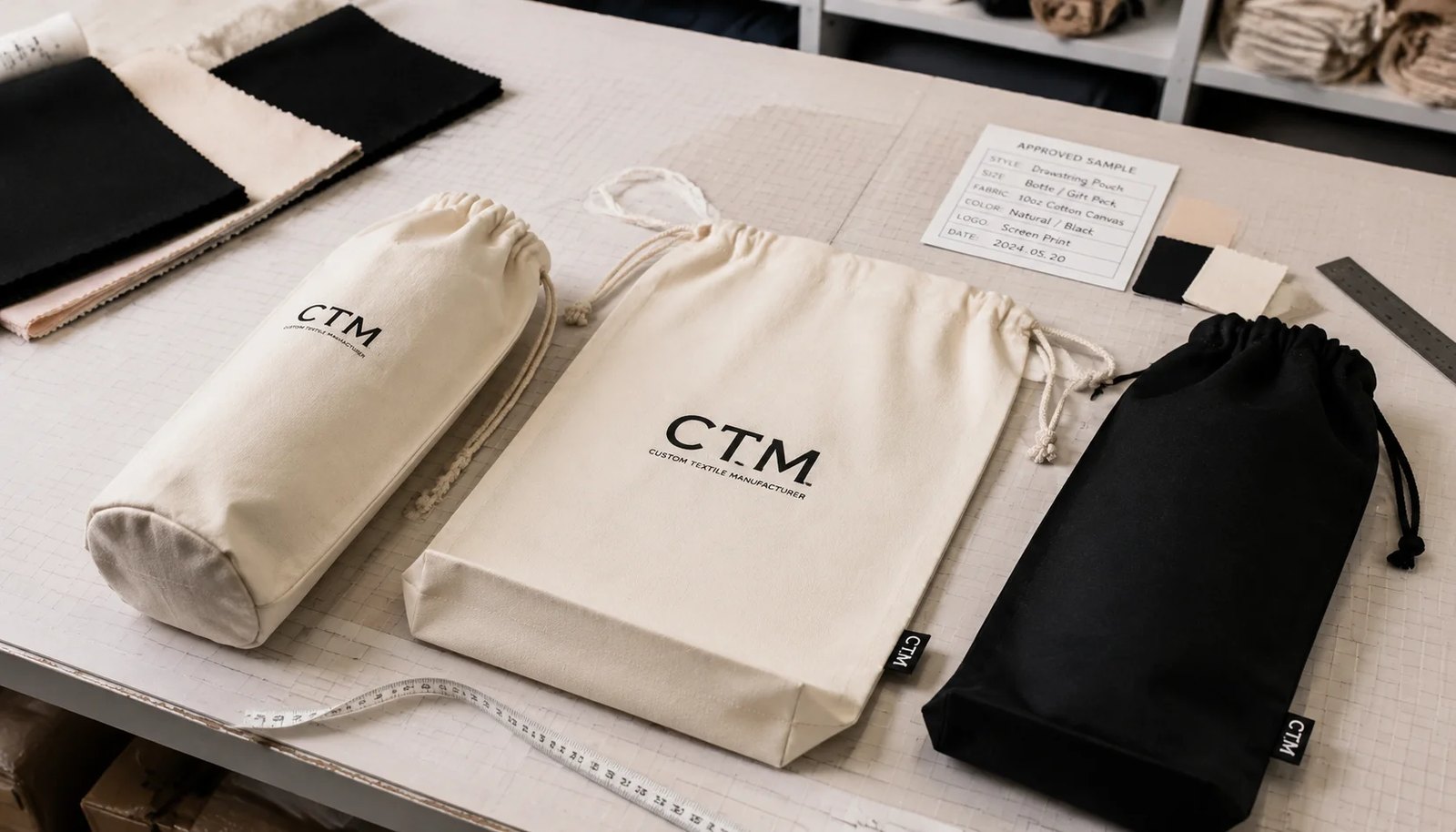
Why liquor retail buyers need a tighter RFQ for cotton drawstring pouches
Cotton drawstring pouches for liquor retail look simple, but quote gaps show up fast once bottle fit, logo quality, and shelf presentation matter. A pouch for a 750 ml wine bottle is not the same as a pouch for a squat whisky bottle, a tall gift tube, or a mini set. If the RFQ only says custom cotton pouch with logo, suppliers will fill in missing assumptions with their cheapest workable option. That usually means lighter fabric, flat construction, broad size tolerance, and a print method selected for factory convenience rather than retail appearance.
The main buying problem is not finding a factory that can sew a pouch. It is getting comparable quotes that reflect the same product, same packing basis, and same risk level. For liquor retail, small spec mistakes create real downstream costs: pouches that catch on foil necks, logos that crack after folding, cartons mixed by SKU, or drawcords that fray in stores. A stronger RFQ reduces sampling loops, makes supplier comparison cleaner, and keeps the landed cost closer to the original budget.
- Common failure point: pouch width quoted from cut panel instead of finished usable width
- Common cost creep: adding gusset, color-matched cord, or woven label after quote approval
- Common retail complaint: print placed too low, hidden by bottle body curve or shelf positioning
- Common warehouse problem: assorted cartons without size or artwork separation
Start with the real use case, not the pouch description
A workable RFQ begins with the bottle or pack that will go inside the pouch. Liquor retailers often buy by category label such as wine bag, spirit pouch, or gifting sleeve, but factories need physical dimensions and handling expectations. A single bottle pouch used only for holiday promotions can tolerate a simpler flat body. A year-round premium gift pouch handled by store teams and end consumers needs a heavier body, stronger top hem, and cleaner branding finish.
If you are sourcing for multiple bottle formats, split the RFQ by SKU instead of averaging one size. Suppliers can quote lower on one oversized universal pouch, but the result often looks loose on smaller bottles and too tight on broader bottles with neck capsules or swing tags. The most commercially useful RFQ shows bottle height, widest diameter, shoulder shape, and whether a paper tag, neck ribbon, or carton sleeve increases insertion friction.
- State bottle type: Bordeaux wine, Burgundy wine, spirits bottle, champagne-style, mini set, or gift assortment
- Include dimensions: total height, widest diameter, neck protrusions, and boxed or unboxed format
- State handling: in-store gifting, e-commerce add-on, distillery merchandise, or distributor promo use
- Note if the pouch must stand filled or only serve as a soft cover
Choose fabric weight by presentation and load, not by the lowest sample cost
Fabric weight is one of the biggest hidden variables in custom cotton drawstring pouches. For liquor retail, very light cotton can reduce cost on paper, but it often looks limp around the bottle, shows seam shadowing, and prints less cleanly. In practice, many buyers land in the 8 oz to 10 oz range, roughly 270-340 GSM, for a more stable hand feel and better premium presentation. A lighter option around 140-200 GSM can work for low-cost promotional sleeves where the pouch is secondary packaging rather than a branded retail item.
Fabric type matters as much as the GSM number. Tight, stable canvas is easier to cut and print consistently than open plain weave. Natural cotton can show seed specks and shade variation, which may be acceptable for rustic branding but should not surprise a premium spirits program expecting a cleaner base tone. If fabric hand feel, structure, or surface cleanliness matter to your brand, describe those points in plain language in addition to specifying GSM.
- 140-200 GSM: low-cost promo sleeve, less structure, lower print stability
- 200-270 GSM: middle range for simple branded pouches without heavy retail wear
- 270-340 GSM: stronger bottle presentation, better for premium gifting and repeated handling
- Ask for actual fabric swatch with GSM test result if price differences between suppliers are large
- For dyed fabrics, ask how shade consistency is controlled lot to lot
Construction details that change fit, appearance, and sewing cost
Construction is where many RFQs stay too vague. A flat pouch is cheaper and easier to make, but a gusseted bottom gives a fuller shape and can help a bottle sit better during display. The hem channel width affects both appearance and function: too narrow and the cord drags; too wide and the top looks bulky. Side seam type also matters. Overlock inside seams may be fine for standard programs, while bound or turned seams can improve appearance on premium items but add labor and cost.
Top opening dimensions deserve special attention. A pouch may technically fit a bottle body but still fail in real use if the neck catches during insertion. This is common on bottles with wax tops, foil capsules, medallions, or broad shoulders. In your RFQ, distinguish between finished body width and effective mouth opening after the drawstring channel is formed. That one detail prevents many fit disputes between buyer and factory.
- Flat pouch: lowest cost, suitable for simple bottle covers
- Bottom gusset: better shape retention and premium presentation
- Side gusset: useful for boxed bottle sets or wider gift contents
- Top hem channel should be specified, for example 20-30 mm finished width
- Drawcord thickness of 4-6 mm usually balances function and appearance for bottle pouches
- Specify whether inside loose threads must be trimmed before packing
Print method selection should follow artwork complexity and order volume
For most liquor retail pouch programs, screen printing is the standard starting point. It handles solid logos well, gives decent opacity on heavier cotton, and becomes cost efficient once volume rises beyond sample-scale orders. Heat transfer can work for short runs or multi-color artwork, but the finish may feel less integrated with the fabric and should be tested for cracking or edge lift after folding. Embroidery adds perceived value for premium merchandise, though it is slower, costlier, and not ideal for fine text or large filled areas.
Artwork scale must match fabric texture. Cotton canvas is not a smooth coated surface, so tiny text, thin serif lines, and very fine borders can lose definition. Instead of simply attaching artwork, include the intended print size and note any critical elements such as registration-sensitive icons or mandatory legal brand marks. If the factory offers a lower-cost print route than your request, get a sample strike-off before accepting the change.
- Screen print: best for 1-2 color logos and medium to high volume
- Heat transfer: useful for multi-color smaller runs, but test adhesion and hand feel
- Embroidery: premium look, higher cost, slower output, poor for small text
- Request print color reference by Pantone if exact brand color matters
- State minimum acceptable line clarity and maximum position deviation
MOQ logic and quote structure: how to make supplier prices comparable
MOQ on pouches is rarely one simple number. A factory may say 3,000 pieces MOQ, but that could mean one size, one fabric color, one print color, and one artwork. Once the order becomes 1,000 each across three sizes with two logo colors, the real unit price changes because cutting, screen setup, and packing complexity increase. To compare quotes properly, break your RFQ into quantity ladders by SKU and ask suppliers to state the MOQ trigger for each variable.
The quote itself should separate cost components instead of giving one blended unit price. When fabric, print setup, sample charge, label cost, and packaging are itemized, you can see whether a low quote is genuinely efficient or simply missing a requirement. This is especially important for liquor retail buyers managing seasonal launches where late changes to artwork or carton marking are common.
- Request quantity breaks such as 1,000, 3,000, 5,000, and 10,000 pieces per SKU
- Ask MOQ by fabric color and print color count, not only total order quantity
- Separate one-time charges: screen, sample, barcode sticker, carton mark plate, testing if any
- Request EXW and FOB quote lines using the same spec and packing basis
- Ask for carton count estimate per order volume to compare freight impact
Sample approval should test fit and production reality, not just appearance
A development sample can confirm general look, but it is not enough for final approval if it uses substitute fabric, temporary artwork, or a different cord. For liquor retail, the pre-production sample should be made in the intended bulk fabric, intended print method, and intended construction. Otherwise, the pouch may pass visual review but fail on bottle insertion, logo sharpness, or drawcord performance once production starts.
Buyers often focus on front appearance and miss functional points that drive claims later. During sample approval, test the actual bottle loading process several times. Pull the cord fully closed, reopen it, and reinsert the bottle. If stores will hand the pouch to consumers, evaluate whether the cord digs into the top edge, whether the bottle base distorts the seam, and whether print cracks after normal folding for packing.
- Approve against actual bottle or a bottle dummy with matching dimensions and shoulder shape
- Measure usable mouth opening after channel sewing
- Review print position from top edge and side seam, not only visual centering
- Fold sample to planned packing method and inspect print abrasion
- Retain approved sample with signed date and revision code
Packing details affect warehouse labor and damage risk more than many buyers expect
Packing is often treated as an afterthought because pouches are soft goods, but poor packing creates avoidable receiving errors and presentation issues. If units for different liquor SKUs are mixed in cartons, distributor warehouses may need to open and recount multiple cartons before allocation. If pouches are over-compressed, screen prints can offset or cords can tangle, slowing store prep. A clear carton plan can lower destination labor even if the per-piece factory packing cost is slightly higher.
For most pouch programs, it is practical to pack one SKU per carton with a fixed inner pack count such as 10, 20, or 25 pieces per polybag. Outer cartons should carry size, artwork code, color, quantity, and PO reference. If the goods are going into retail kits assembled at destination, mention whether polybags should be openable and resealable or whether individual units must remain loose for fast kitting.
- State units per polybag and whether each inner bag must be SKU-pure
- Set maximum carton dimensions or weight if warehouse handling limits apply
- Specify whether moisture protection is needed for sea freight storage
- Require shipping marks with PO, SKU, color, carton number, and country of origin
- If barcode labels are needed, state carton label size and placement
Lead time planning: where the schedule usually slips
Cotton drawstring pouches are not a long-cycle product compared with hard goods, but the schedule still slips in predictable places. The biggest delays usually come from artwork revisions, lab dip approval for dyed fabrics or cords, sample courier cycles, and waiting for final bottle dimensions while marketing has already fixed the launch date. If your pouch is linked to a holiday liquor program, that uncertainty should be reflected in a staged timeline rather than one optimistic ship date.
A realistic schedule separates sample development, pre-production approval, bulk sewing, inspection, and booking. Simple natural cotton with one-color screen print usually moves faster than dyed fabric with color-matched cords and multiple SKUs. Buyers should also leave room for packing corrections because carton count and SKU labeling errors are common on mixed retail programs.
- Development sample: often 5-10 working days depending on fabric availability
- Pre-production sample after artwork and material confirmation: often another 5-7 working days
- Bulk production for straightforward styles: commonly 20-35 days after approval, but varies by season and volume
- Add buffer for dyed fabric, woven labels, embroidery, or multi-SKU pack sorting
- Book inspection before final packing is fully sealed if carton assortment needs verification
Use acceptance criteria and landed-cost thinking before awarding the order
The best RFQ is not only a spec sheet; it is a decision tool. Before placing the order, define what will count as acceptable on dimensions, print position, seam quality, and packing accuracy. Without those thresholds, a supplier can technically ship goods that match the broad description but still create retail issues. For example, a plus or minus 10 mm width tolerance may be harmless on a cosmetic pouch but problematic on a liquor bottle pouch where insertion is already snug.
Landed cost comparison also needs more than unit price. A cheaper pouch can become more expensive after freight inefficiency, repacking, or quality claims. Compare total cost using the same carton plan, same incoterm, same sample requirement, and the same realistic rework risk. This is where a mid-priced supplier with stronger spec discipline often outperforms the cheapest quote.
- Example acceptance criteria: size tolerance within plus or minus 5 mm on width and height for fitted bottle pouches
- Example print criteria: position deviation not more than 5 mm from approved layout
- Example seam criteria: no skipped stitches on visible seams and no seam opening under normal bottle load
- Compare freight effect through carton dimensions and pieces per carton, not piece price alone
- Include destination relabeling or repacking labor when evaluating mixed-carton offers
Specification comparison for buyers
| Spec decision | Recommended option | When it fits | Buyer risk to check |
|---|---|---|---|
| Fabric weight | 8 oz to 10 oz cotton canvas, about 270-340 GSM | Best for wine bottle pouches, premium spirits gift bags, and repeat retail handling | Below 200 GSM often looks too soft for upright bottle presentation and may show print-through or seam stress |
| Fabric type | Combed cotton or cotton canvas with stable weave | Use when logo placement and size tolerance matter across multiple SKUs | Loose weave fabric can skew during cutting and printing, causing inconsistent dimensions and off-center artwork |
| Base construction | Flat pouch for low-cost gift cover; gusseted base for better bottle standing and cleaner shelf display | Flat works for simple bottle sleeves, gusset suits boxed minis, candles, or premium gift-with-purchase sets | If bottle diameter is not stated in RFQ, factory may quote a flat pouch that does not fit label-protected retail packs |
| Drawstring material | Cotton cord 4-6 mm with knotted ends or metal-free aglets | Preferred for retail gifting and markets where simple recyclable trims are valued | Thin cord can cut into the top hem after repeated pulls; dyed cords may bleed if washfastness is not specified |
| Print method | Screen print for solid logos; heat transfer for multi-color short runs; embroidery only for premium low-volume programs | Screen print gives the best cost on medium and large runs with simple branding | Small text under 2 mm line weight may fill in on textured canvas; request print size and artwork review before approval |
| MOQ route | Single size and single print color for first bulk order | Useful when testing store rollout or comparing factories on equal terms | Mixed sizes, mixed colors, and multiple artworks can push unit cost up sharply even if the total quantity sounds high |
| Packaging format | 10-25 pieces per polybag, export carton by one SKU only, size label on outer carton | Speeds inbound counting for distributors and lowers warehouse relabeling work | Assorted cartons save carton count but increase receiving errors and repacking labor at destination |
| Sampling path | Digital layout approval, then pre-production sample in actual fabric and print | Recommended for any pouch that must fit a specific bottle profile or premium launch date | Photo approval alone often misses cord thickness, opening width, and bottle insertion resistance |
| Supplier quote basis | FOB with tooling, sample charge, print setup, carton spec, and tolerance clearly separated | Makes supplier comparison cleaner across China, India, Pakistan, or local converters | A low all-in price can hide weak carton spec, lower GSM substitution, or missing testing and reprint liability |
Buyer checklist before sampling
- State exact end use: single wine bottle, spirits bottle, mini gift set, or promotional pouch without bottle load requirement.
- Provide finished pouch size in millimeters, plus the bottle diameter, bottle height, and whether a box or neck foil adds bulk.
- Specify fabric target as cotton or cotton canvas with acceptable GSM range, for example 270-340 GSM for bottle use.
- Define color standard for fabric and print, including Pantone references where brand color match matters.
- Attach logo artwork in vector format and note the maximum acceptable print deviation from centered position.
- List print method preference or allow alternatives with separate pricing lines for screen print, heat transfer, or embroidery.
- State if drawcord color must match body fabric or brand color, and whether metal parts are prohibited.
- Set size tolerance, print tolerance, and seam tolerance in the RFQ so suppliers do not assume broad factory standards.
- Describe packaging requirement: units per polybag, cartons by SKU, carton size limit, barcode labels, and shipping marks.
- Request pre-production sample made in bulk fabric and bulk print method, not only a development sample in substitute material.
Factory quote questions to send
- What fabric composition and actual tested GSM are included in this quote, and what GSM tolerance do you allow in bulk?
- Is the quoted pouch size based on finished inner usable space or cut panel size before sewing?
- What print method is quoted, and what line thickness or minimum text size can you reproduce cleanly on this fabric?
- How many pieces per size and color are required to meet MOQ without surcharge?
- Does the quoted price include drawcord insertion, knots, side label, care label, and any inside overlock finishing?
- What pre-production sample cost is charged, and is it refundable against bulk order?
- What lead time applies for lab dips, strike-off, pre-production sample, bulk production, and booking for export?
- What is your standard carton specification, and what pouch quantity per carton is used in this quote?
- How do you control shade variation between production lots for natural, black, and dyed cotton fabrics?
- What AQL level or in-house inspection standard do you use for dimensions, print position, seam strength, and packing accuracy?
Quality-control points to confirm
- Measure finished width, height, hem channel width, and gusset against approved tolerance before packing.
- Verify actual bottle insertion and withdrawal on approved bottle or bottle dummy, not only empty pouch dimensions.
- Check fabric GSM from bulk roll samples and compare with approved standard to avoid lighter-weight substitution.
- Inspect print position, color match, edge sharpness, and rubbing resistance after curing.
- Test drawcord pull and seam integrity at top channel because this is the highest stress point in use.
- Review stitch density and skipped stitches on side seams and bottom seam, especially on heavy canvas.
- Confirm no oil marks, weaving defects, needle holes, or dye streaks on visible front panels.
- Check odor, lint, and loose threads because premium liquor retail presentation is sensitive to surface finish.
- Audit packing by SKU, count per inner pack, carton marking accuracy, and carton drop resistance for export handling.
- Retain sealed approval sample and one production retention sample per SKU for any claim review after delivery.