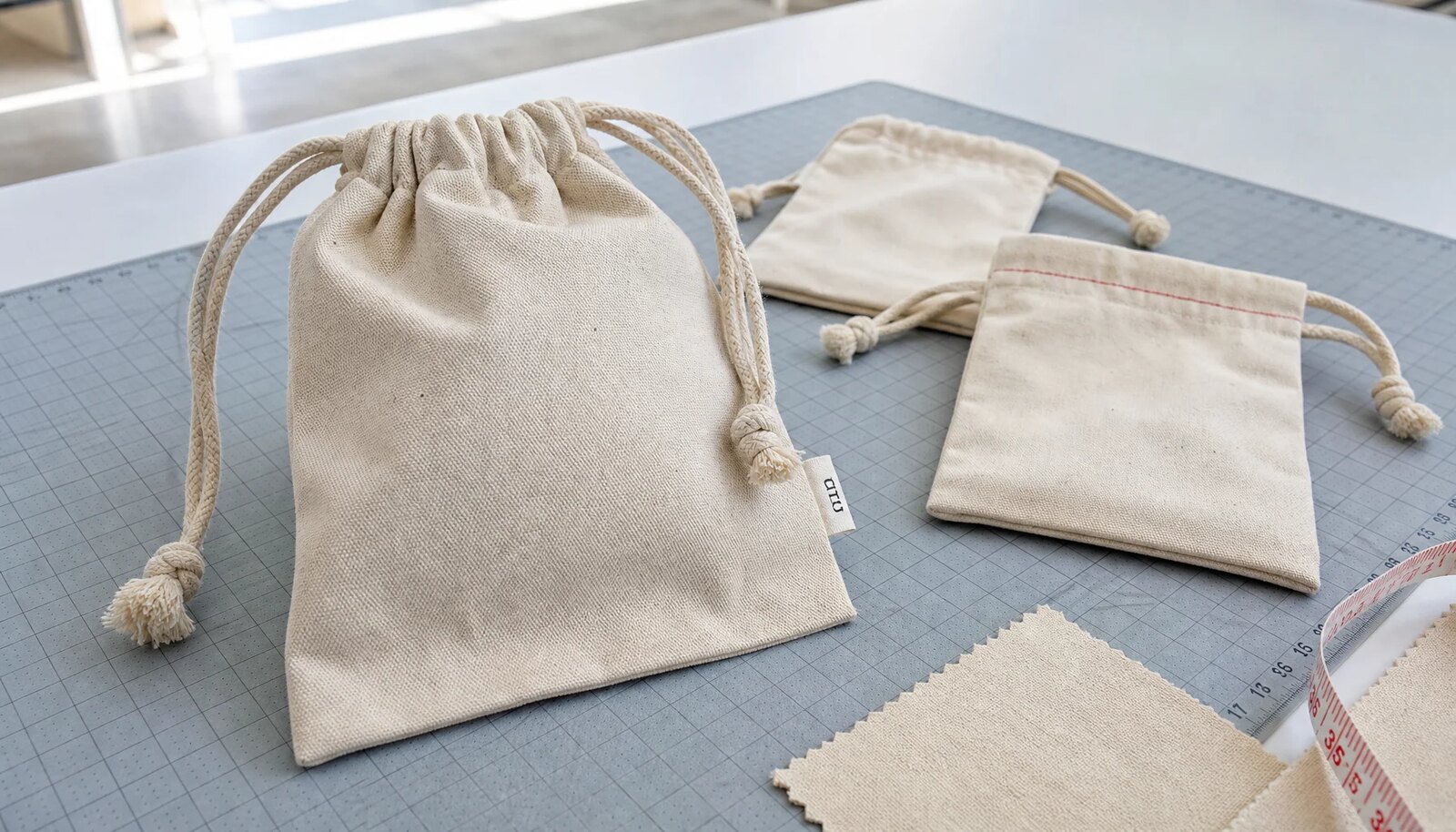
Start With The Pouch Job, Not The Logo
A custom cotton drawstring pouch quote goes wrong when the buyer opens with artwork and skips the use case. Event pouches are not all built the same. A pouch that holds a wristband, a lanyard, and a paper insert can be light and compact. A pouch that carries a candle, a small bottle, or a mixed gift kit needs more body, a stronger top hem, and a better carton plan. If the factory only sees a logo file, it will guess the rest, and those guesses usually show up later as price gaps or quality disputes.
Write the RFQ around how the pouch will be filled, handed out, and shipped. State whether the order is for one-off event giveaways, sponsor kits, retail add-ons, conference welcome packs, or reusable storage. Include the finished size, the item load the pouch must carry, where the branding should sit, and whether the buyer wants a soft promotional feel or a more premium reuse profile. Those details drive fabric weight, seam allowance, closure strength, and whether the supplier can quote with stock cloth or needs a custom dye lot.
- State the filled product weight, not only the empty pouch size.
- Define the event channel: conference desk handout, VIP kit, retail bundle, or mailer insert.
- Specify whether the pouch must look premium, neutral, or purely promotional.
- Add the destination market and shipping point so the factory can judge packing and lead time.
Select Fabric Weight For Hand Feel And Cost
For most custom cotton drawstring pouches, 140 to 160 GSM is the practical starting point. It gives enough structure for a clean logo print, holds shape better than very light cloth, and does not push freight weight as hard as heavy canvas. If the pouch is only for flat paper items or a light promo insert, 120 to 140 GSM can work. If the pouch will be reused, packed with glass, metal, or skincare, or sold as a retail accessory, 180 GSM and above is the safer direction. The right GSM is not about luxury language. It is about how the pouch behaves when it is filled, stacked, and handled by non-technical users at an event booth.
Fabric finish matters almost as much as GSM. Natural ecru cotton is easy to source and usually faster to quote, but some brands want a bleached or dyed base to support a tighter color story. If you need a dark pouch, ask about colorfastness and rub resistance, because low-grade dye work can mark hands, liners, or neighboring goods in transit. Ask for the actual cloth width, shrinkage expectation, and whether the factory cuts from pre-shrunk cloth or raw fabric. On small pouches, even a small shrinkage swing can change the opening, the cord channel, and the perceived quality after the first use.
- Use 120 to 140 GSM for light, short-life giveaways.
- Use 140 to 160 GSM for the best balance of cost and structure.
- Use 180 GSM or above when the pouch needs repeated reuse or heavier fill.
- Ask whether the cloth is natural, bleached, or dyed, and what shade tolerance applies.
Choose Construction That Survives Event Use
Most pouch complaints are not about the print. They come from weak construction that fails when the pouch is opened and closed repeatedly. A clean top hem with a proper drawcord channel, even side seams, and secure bartacks at the cord entry points is more important than decorative extras. For buyers comparing quotes, the key question is not whether the pouch has a drawstring. It is whether the cord can be pulled without distorting the mouth, and whether the seams can survive being stuffed quickly by event staff.
The cord itself deserves attention. Cotton cord gives a natural look, but polyester-core cord or a blended cord may hold tension better if the pouch carries more weight or is tied and untied many times. Cord length should be long enough for the intended hand use but not so long that it tangles in packing or clutters the event presentation. If the pouch is small, the cord channel should not swallow too much fabric at the top. That eats into the usable opening and makes the pouch harder to fill on a production line.
- Specify bartacks or another reinforcement method at the drawcord entry.
- State cord material, cord diameter, and target cord length in the RFQ.
- If the pouch carries heavier items, ask for a reinforced top hem and stronger side seams.
- Avoid overbuilt closures that add cost but do not improve use in a short event cycle.
Match Print Method To Artwork And Volume
Screen print is still the most practical method for custom cotton drawstring pouches when the art is simple and the order volume is meaningful. One or two spot colors usually quote cleanly, the print sits well on cotton, and the result is easy to repeat on reorder. If the logo uses fine type, small rules, gradients, or multiple color blends, a supplier may suggest heat transfer or another decoration method. That can work, but the buyer should treat it as a different product, not just another printing option, because the hand feel, durability, and quote structure change with it.
For higher-end event kits, a woven label or side label can solve a branding problem when the print area is tight or the design needs a quieter look. Embroidery is possible on some pouches, but it adds stiffness and can distort a light fabric. The key for the RFQ is to define artwork in a way that the factory can produce without reinterpretation: vector files, Pantone references where relevant, max print width, print position from seam, and whether the logo needs to read on both sides. A vague art brief forces the factory to price in risk.
- Use vector artwork and state the exact print size in millimeters or centimeters.
- Define whether the logo is one-side, two-side, or repeated pattern print.
- If gradients or tiny text are present, request a test print before bulk approval.
- If brand presentation matters, consider a sewn label rather than a dense print block.
Use MOQ To Separate Real Quotes From Noise
MOQ logic is where many buyers waste time. A supplier can give a low headline unit price and still be uncompetitive if the MOQ is inflated, the sample fee is high, or the setup charges are buried. For drawstring pouches, MOQ is usually driven by fabric width, cutting efficiency, color change, print screen setup, and cord sourcing. One color of natural cotton with a simple one-color logo is a very different job from a dyed cloth pouch with a multi-color brand mark and a woven label. Ask for the MOQ by size, color, and logo version, not only the total order quantity.
The cleanest way to compare suppliers is to request tiered pricing at the minimum order, the next price break, and a realistic reorder level. That shows how much the supplier relies on setup recovery versus true unit efficiency. It also reveals whether a factory is quoting from stock cloth or planning a custom production run. If a supplier will only quote one number, the comparison is weak. A useful quote should show the base pouch, print setup, sample cost, packing configuration, and what happens if the order is split across multiple colors or multiple delivery dates.
- Ask for pricing at MOQ, mid-tier volume, and a repeat-order quantity.
- Separate the cost of the pouch body from print setup and packaging.
- Confirm whether mixed colors or mixed logo versions are allowed in one run.
- Make the supplier state any minimum charge for a small reorder.
Approve A Physical Sample Before You Release Order
A digital mockup is not enough for a cotton drawstring pouch. The hand feel, opening size, cord action, and print position all need to be validated in physical form. The right sample sequence is usually a strike-off for artwork if the print is tricky, then a preproduction sample made with the same cloth, cord, and seam construction intended for bulk. That sample should be signed off against a written spec sheet so the buyer is not relying on memory later. If the pouch will sit beside other branded items in a kit, measure the fit with the actual contents, not a guessed carton photo.
When the sample arrives, the buyer should inspect more than appearance. Measure the finished size, opening width, seam straightness, print placement, and cord length. Pull the cord several times, fill the pouch with the real event item, and check whether the opening still closes cleanly. If the pouch is meant for reused retail carry, do a light handling test or wash test if that matters to the use case. Sample approval should end with a clear record: what passed, what was adjusted, and what becomes the golden sample for bulk production.
- Approve a physical sample, not only photos or renderings.
- Measure size, opening, print placement, and cord length against the spec.
- Test the pouch with the real fill item if the final load is known.
- Keep one signed golden sample for production reference.
Specify Packing For Fast Event Distribution
Event buyers often underestimate packing because the pouch itself looks simple. Packing can make or break the usefulness of the shipment at destination. If the team needs to hand out pouches quickly at a venue or repack them into kits, bulk packing in counted inner bundles is usually better than individual retail bags. If the pouches are going to end up in store shelves or need hygiene protection, individual polybags and barcodes may be necessary. The RFQ should state the intended unpacking flow, not just the carton count.
Master carton details matter because the pouches are light but bulky. Ask for carton dimensions, gross weight, inner bundle count, outer carton marks, and any specific labeling for size, color, and order reference. If the order will move through a warehouse, ask whether the cartons can be stacked safely and whether the factory can keep the net weight within your handling limit. Poor packing creates claims that look like quality issues but are really logistics mistakes: crushed cords, mixed counts, damp cartons, or missing size labels.
- Define inner bundle count, master carton count, and whether each pouch needs a polybag.
- State the carton marks, SKU labels, and any barcode or store-ready requirement.
- Set a carton weight target that your warehouse team can handle safely.
- If humidity is a risk, specify moisture protection and storage-safe outer packaging.
Protect The Schedule With The Right Sourcing Route
Lead time on custom cotton drawstring pouches is not one number. It is a stack of smaller steps: artwork confirmation, sample approval, cloth sourcing, cutting, sewing, printing, inspection, packing, and dispatch. Buyers who need a fixed event date should back-plan from the deadline and leave time for a reprint, sample correction, or fabric delay. The most common schedule failures are not dramatic factory problems. They are the small things that were not frozen early enough, such as a late logo change, a revised pouch size, or a last-minute packing request after production has started.
The sourcing route also affects schedule risk. A direct factory usually gives better control when the order is repeated or the spec is detailed. A trading route can be useful if the buyer wants faster communication or mixed product bundling, but it may add another layer of clarification before the factory receives the final spec. If the event is fixed and the product is simple, choose the route that can lock the spec fastest and prove it with a physical sample. Keep a buffer for shipping disruption, especially if the order lands near busy production periods or holiday shutdowns.
- Freeze size, artwork, and packing before sample approval starts.
- Build time for strike-offs, sample shipping, and any corrections.
- Treat holiday periods and plant shutdowns as schedule risks, not edge cases.
- Choose the sourcing route that can sign off the final spec without translation drift.
Compare Factory Quotes Line By Line
A usable quote for custom cotton drawstring pouches should be itemized. The buyer needs to see the fabric spec, the print setup, the unit sewing cost, the packing method, and any separate charge for labels, inserts, or special carton marks. If those items are blended into one number, comparison becomes guesswork. A low total price may be masking an expensive setup or a loose spec that the supplier can later reinterpret. The best quote is not the cheapest one on paper. It is the one that lets procurement compare the same scope across multiple factories.
The landed-cost view is more important than the ex-factory view. Add domestic handling, sample fee policy, freight assumptions, and any minimum charge for small changes. If one factory quotes bulk packed and another quotes retail bagged, the unit price cannot be compared directly. Buyers should also look for hidden constraints: a narrow valid-for period, an order split penalty, a color-change charge, or a quantity tolerance that forces overbuying. Quote comparison becomes reliable only when the scope is identical and the buyer has forced the factory to show where the money goes.
- Request line items for fabric, sewing, printing, packing, and labels.
- Compare quotes on the same carton count, pack count, and shipping assumption.
- Ask for the validity period and any surcharge trigger tied to raw material changes.
- Review both unit price and total landed cost before choosing a supplier.
Set QC Thresholds Before Production Starts
The simplest way to avoid disputes is to define defect thresholds before the first bulk meter of cloth is cut. For a cotton drawstring pouch, the usual problem list is predictable: off-center print, uneven opening, cord fray, loose seam ends, size drift, dirty fabric, and carton count mismatch. None of these issues should be debated after shipment if the RFQ and approved sample already defined acceptable limits. A buyer that sets inspection rules late ends up negotiating against the goods that have already been packed.
Use the sample to set the inspection reference, then write down what is acceptable and what is a reject. Small pouches need tighter size control than large ones because a few millimeters can change the fill behavior. Print placement needs a clear tolerance because a logo that looks fine on a mockup may sit too close to the seam in bulk. The important part is consistency: the factory should know which issues are cosmetic, which are functional, and which trigger rework or replacement. That is how a buyer protects both the event experience and the supplier relationship.
- Define size tolerance, print placement tolerance, and carton count tolerance in writing.
- Treat loose seams, frayed cords, and dirty cloth as functional defects, not minor blemishes.
- Use the approved golden sample as the visual reference for bulk inspection.
- Separate cosmetic variance from defects that affect use or brand presentation.
Specification comparison for buyers
| Spec decision | Recommended option | When it fits | Buyer risk to check |
|---|---|---|---|
| Fabric weight and weave | 140 to 160 GSM plain-weave cotton | Most event giveaways that need enough body without a premium freight penalty | Thin fabric may show contents; heavy fabric raises cost and carton weight |
| Fabric color strategy | Natural ecru or lightly bleached base cloth | Fast-turn branded orders with one-color print and simple event branding | Shade variation across rolls; lock the acceptable color range before bulk |
| Closure and reinforcement | Double drawcord through a reinforced top hem with bartacks | Reusable pouches and mixed gift contents that will be opened many times | Weak channel stitching, cord fray, or opening distortion after filling |
| Print method | 1 to 2 color screen print with vector artwork | High-volume event branding and repeat reorder programs | Fine text, gradients, and tight registration can fail on rough cotton |
| Branding add-on | Small sewn woven label or side label | Premium presentation or when the main print area is limited | Loose stitching, edge irritation, or extra lead time if the label is custom made |
| Sourcing route | Direct factory with itemized quote and preproduction sample | Buyers managing MOQ, lead time, and repeat orders | Hidden setup fees or vague specs from intermediaries can distort quote comparison |
| Sample route | Physical approved sample plus signed spec sheet | Any order with a fixed event date or strict brand standard | Approving from photos only creates size, color, and feel surprises |
| Packing route | Bulk packed in counted inner bundles with clear carton marks | Event distribution, venue handout, or warehouse forwarding | Overfilled cartons, count drift, and damaged cord ends during transit |
Buyer checklist before sampling
- Final pouch size with seam allowance and usable opening size
- Target fabric GSM, weave type, and acceptable shade range
- Logo method, number of print colors, and artwork file format
- Order quantity by size, color, and logo version
- Required sample type: strike-off, preproduction sample, or size sample
- Packing method, bundle count, carton marks, and any barcode needs
- Target ship window, destination port or door point, and Incoterm
- Accepted tolerance for size, print placement, and carton quantity
- Whether the pouches need retail presentation or only event distribution
- Who signs off the golden sample before bulk production starts
Factory quote questions to send
- What is the quote breakdown for fabric, cutting, sewing, drawcord, print setup, packing, and carton marks?
- What GSM will you cut and sew against, and what tolerance do you allow on incoming fabric?
- How many print colors are included in the price, and what is the add-on for a second location or second side?
- What is the MOQ per size, per color, and per logo version, not just the total order quantity?
- Will you provide a physical preproduction sample, and is the sample fee refundable against bulk?
- What is the expected production lead time after sample approval, and what parts of the schedule are outside your control?
- How will the pouches be packed per inner bundle and per master carton, and what outer marks will appear on the carton?
- What tolerance do you allow for finished dimensions, print placement, and carton count at shipment?
Quality-control points to confirm
- Finished dimensions should match the approved spec sheet within a clearly stated tolerance, especially on small pouch sizes.
- Fabric GSM should match the approved target closely enough that the pouch body does not become translucent or overly stiff.
- Top hem and drawcord channel must be even, with no twisting, skipped stitches, or weak points at the cord entry.
- Drawcords should slide smoothly and be cut to equal length, with sealed or finished ends that do not fray during handling.
- Print must sit in the approved location, with acceptable registration, no pinholes, no smears, and no unwanted color shift.
- Stitching should be clean and consistent, with no broken threads, loose knots, or raw seam edges exposed on the inside.
- Cartons should match the agreed pack count, bundle count, and carton mark details before booking outbound freight.
- The bulk lot should match the approved golden sample for color, hand feel, logo placement, and overall build quality.