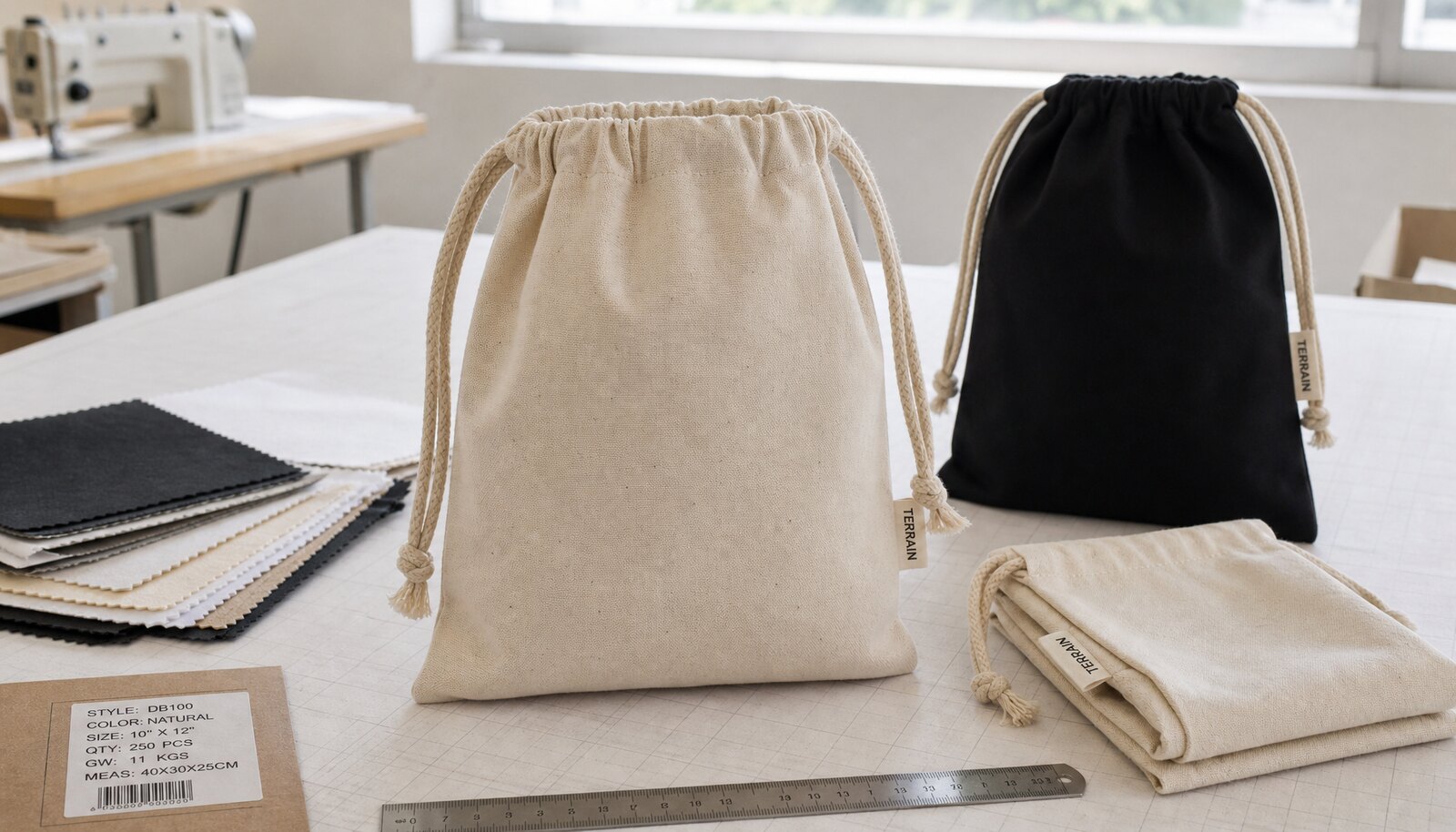
Start With the Gift Use Case, Not the Logo File
A useful RFQ for custom cotton drawstring pouches starts with the job the pouch has to do. Corporate gifting teams often begin with the artwork because the logo is visible, politically important, and usually urgent. The factory, however, needs to understand the contents first. A pouch for jewelry samples, tea sachets, employee onboarding pins, cables, power banks, desk objects, drinkware parts, gift cards, or event badges will not use the same finished size, fabric weight, opening width, seam strength, or closure style. If the supplier has to guess, the quote usually drifts toward a generic pouch that looks fine while empty but becomes awkward during packing or delivery.
Be clear about the role of the pouch in the gift set. Is it the main presentation piece, a reusable branded item, or simply a protective sleeve inside another box? A reusable pouch for executive gifting usually deserves cleaner stitching, better fabric hand, and more restrained branding than a short-term event giveaway. A pouch holding a rigid or sharp-edged item may need extra clearance, stronger seams, or heavier cotton so the contents do not stress the corners. A pouch going into a rigid gift box needs to arrive flat and consistent. A pouch handed out at an event may need a fast one-pull closure and simple counted bundles.
Give suppliers enough context to recommend construction without changing the buying intent. Include maximum item dimensions, approximate weight, whether the item is rigid or soft, how the pouch will be filled, how it will be shipped, and whether the recipient is expected to reuse it. This context does not replace the technical specification. It keeps the specification tied to the real gifting workflow and helps procurement compare quotes on fit, handling, and risk instead of unit price alone.
- Name the exact item or item category going inside the pouch, including maximum length, width, thickness, and approximate fill weight.
- State whether the pouch is a premium reusable gift component, protective sleeve, retail-style presentation piece, or short-term giveaway.
- Explain the downstream route: factory to warehouse, warehouse to kit assembly, direct shipment to event, or delivery to multiple office locations.
- Define the top priority before quoting: presentation, durability, speed, lowest unit cost, repeat consistency, or fulfillment simplicity.
- Ask suppliers to flag fit, opening, closure, or seam risks instead of silently quoting the cheapest pouch that appears workable.
Translate the Use Case Into Finished Dimensions
Cotton drawstring pouch dimensions should be quoted as finished flat size. Not cut fabric size. Not a rough guess based on the item. Finished width and height are measured after cutting, sewing, hemming, channel formation, and decoration. This distinction matters because seam allowance, bottom seam, side seams, drawcord channel depth, and shrinkage all reduce usable space. A pouch that appears large enough on a drawing can become tight once the top channel is sewn or once a three-dimensional item is inserted.
Separate outside finished dimensions from usable internal dimensions in the RFQ. For example, a pouch listed as 120 mm wide by 180 mm high may have much less usable height below the drawcord channel. If the gift item needs to be fully covered and the pouch must close neatly, ask the supplier to confirm usable internal height and opening width. For thicker objects, flat pouch width alone is not enough; the fabric must wrap around the object, which reduces the apparent opening. When fit is critical, send the actual item or a size- and weight-equivalent dummy for testing.
Tolerances should be realistic and written before sample approval. For many simple sewn cotton pouches, a finished-dimension tolerance around plus or minus 5 mm is more practical than an extremely tight tolerance, especially on small orders or lighter fabric. Larger pouches, washed cotton, dyed cotton, or hand-fed sewing may need a different tolerance. The goal is not to force one universal number. The goal is to agree on the tolerance, measurement method, and pass/fail rule before production starts.
- State finished flat size as width by height, such as 120 mm W x 180 mm H, and avoid quoting only the item size.
- Ask for usable internal height below the drawcord channel and minimum opening width after sewing.
- Use the actual contents or a size-equivalent dummy to confirm fit, insertion speed, and closure.
- Define how to measure: flat, empty, smoothed by hand, not stretched, after sewing and decoration.
- Set a practical dimensional tolerance, commonly around plus or minus 5 mm for simple small pouches unless the supplier recommends otherwise.
Specify Cotton Fabric With Enough Detail to Quote
Fabric is one of the biggest drivers of price, lead time, and perceived quality. The RFQ should identify cotton content, GSM target, color, weave feel, and finishing expectations. Natural cotton is not a single standard. One supplier may quote a loose, lightweight plain weave, while another quotes a denser cloth with better opacity. Both may describe the fabric as cotton. Without GSM, fabric route, and a physical sample reference, procurement cannot compare quotes fairly.
For lightweight giveaways, sample packaging, or soft low-value contents, 105 to 120 gsm cotton can be acceptable when the buyer expects a relaxed, economical pouch. For corporate gifting where the pouch contributes to perceived value, 140 to 170 gsm usually gives better structure, better opacity, and a cleaner print surface. Cotton at 180 gsm or higher may be appropriate for heavier items, repeat use, or a more premium hand feel. It can also increase cost, carton volume, sewing bulk, and lead time. Treat GSM as a target range, then verify it by sample, because finishing and weave density affect how the fabric actually feels.
Color needs the same procurement discipline. Stock natural cotton is often the fastest option because it avoids dye development, color approval, and extra dye-lot risk. Dyed cotton can be worth it for black, navy, red, seasonal palettes, or a brand-color pouch body, but the RFQ should request a lab dip or approved swatch, color tolerance, shrinkage expectation, and rubbing or crocking check. If the pouch may touch light-colored gifts, printed cards, or apparel, discuss color transfer risk before issuing the PO.
- Specify cotton content, target GSM, weave or hand description, color, finishing, and whether the cloth is stock, dyed, washed, or pre-shrunk.
- Use 105 to 120 gsm for light cost-sensitive use, 140 to 170 gsm for stronger corporate gifting presentation, and 180 gsm or higher for heavier or reusable applications.
- Request a physical fabric swatch or reference pouch before final supplier comparison.
- For dyed fabric, require lab dip or swatch approval, shrinkage expectation, and dry/wet rubbing or crocking guidance where relevant.
- Ask whether one fabric lot can be reserved for bulk production, especially for repeat programs or multi-location rollouts.
Lock the Cord, Channel, and Sewing Construction
The drawstring system is easy to ignore until the fulfillment team starts filling bags. Cord type, cord diameter, cord length, channel depth, and knot security all affect speed and user experience. A thin cord can feel cheap or cut into the fabric. An oversized cord can jam in a narrow channel. Cotton cord gives a natural look but may fray or vary more than synthetic cord. Polyester cord can be smoother and more consistent, although it may look less aligned with an all-cotton sustainability message. Ribbon or flat tape can feel gift-like, but it may twist in the channel if the construction is not tested.
Quote single-draw and double-draw closures separately when both are possible. A single draw is economical and simple. A double draw often closes more evenly and can feel more finished. Cord length should be specified after knotting, not guessed from an image. The supplier should confirm that the cord cannot pull back into the channel during normal handling. If the pouch is used by a fulfillment team, test opening and closure repeatedly with the real contents. A closure that takes only a few extra seconds can add meaningful labor across hundreds or thousands of gift sets.
Sewing construction should be documented in the approved sample and inspection checklist. Look for straight seams, balanced stitch tension, a clean top channel fold, secure corner stitching, and no open seams. Stitch density does not need to be over-specified in every RFQ, but buyers can ask the supplier to state the normal stitches per inch or centimeter used for the approved sample. Loose threads, skipped stitches, twisted panels, and weak side seams are common visible defects. Classify them before shipment, not after cartons arrive.
- Specify cord material, diameter, color, finished length, knot style, and whether the pouch is single draw or double draw.
- Confirm channel depth and cord movement so the closure pulls smoothly without catching or tearing.
- Ask the supplier to test cord pull and knot security on the approved sample.
- Record seam allowance, stitch quality, corner shape, and top-channel construction in the pre-production approval.
- Treat open seams, unusable closure, missing cord, and incorrect cord color as serious defects in the QC plan.
Choose Decoration That Works on Cotton Fabric
Decoration is a frequent failure point because artwork approved on a screen behaves differently on cotton. Cotton has texture, slubs, absorbency, seam movement, and slight panel variation. Thin lines, small reversed text, gradients, and detailed marks may lose sharpness on a loose weave. The RFQ should include artwork file type, print size, number of colors, placement, Pantone or brand references, and minimum acceptable legibility. It should also state whether the brand can accept a simplified production version of a complex logo.
Screen printing is often the most practical method for custom cotton drawstring pouches when the design uses one or two solid colors and the order quantity can absorb setup. It can offer good opacity and predictable repeat cost, but ink cure and rub resistance matter. On dark fabric, clarify whether an underbase is needed for opacity. For multi-color or photographic artwork, transfer printing or digital methods may be considered, but they need physical testing on the exact cotton. Some transfers feel stiff, glossy, or plasticky on soft cotton, which may conflict with a premium corporate gifting brief.
For understated branding, a woven label, side tab, or sewn brand label may be stronger than a large front print. Labels can feel more retail-ready and avoid some print distortion risks. They also bring their own specifications: label material, fold type, size, orientation, stitching, and placement tolerance. Embroidery can look premium on heavier cotton, but it may pucker light fabric or distort fine details. Whatever method is chosen, placement must be dimensional: distance from bottom edge, distance from side seam, relationship to the drawcord channel, and acceptable placement tolerance.
- Ask for the maximum recommended decoration area based on finished pouch size and sewing constraints.
- Use screen print for simple logos, solid colors, and medium to larger quantities where setup cost is acceptable.
- Test transfer, digital print, or embroidery on the exact fabric before approving bulk production.
- Consider woven labels or side tabs when the pouch should feel reusable, subtle, or retail-like.
- Define logo placement with measurements and a tolerance, such as centered within plus or minus 3 to 5 mm if suitable for the design.
Build the RFQ Around Real MOQ and Cost Drivers
MOQ is shaped by production setup, not by a generic supplier preference. For cotton drawstring pouches, minimums may be driven by fabric purchasing, dyeing, cutting efficiency, thread or cord changes, print screens, label production, packing labor, and carton configuration. One natural cotton pouch size with one logo and bulk packing is much easier to quote at a low MOQ than a program with three sizes, two dyed colors, six department logos, custom labels, individual polybags, and mixed destination cartons.
Ask for MOQ by variable. Procurement should request minimums by finished size, fabric color, cord color, artwork version, label version, and packing method. This exposes the real source of cost. If the MOQ is caused by dyed fabric, the buyer may switch to stock natural cotton. If it is caused by a woven label, a printed logo may be more practical. If it is caused by carton assortment or SKU separation, a fulfillment partner may handle sorting after receipt. The tradeoff becomes visible before price negotiation starts.
Quote sheets should separate unit price from charges around the unit price. Sample fees, screen charges, label setup, digitizing, artwork adjustment, special packing, barcode labels, export cartons, inspection, inland freight, and international freight assumptions should not be buried. Quantity ladders are also valuable because corporate gifting programs often repeat or expand. Ask for realistic levels such as 500, 1,000, 2,500, 5,000, and 10,000 pieces only if those quantities match possible demand.
- Request MOQ by size, fabric color, cord color, artwork, label, packing method, and shipment split.
- Ask for a price ladder at realistic volumes instead of only the first planned order quantity.
- Separate unit price, sample fee, setup charge, screen charge, label charge, packing charge, inspection, export, and freight assumptions.
- Confirm quote validity, payment terms, overage policy, underrun policy, and change-order pricing after sample approval.
- Ask whether the quote assumes stock materials or custom-purchased materials, because this can change both MOQ and lead time.
Use Samples as Physical Production Controls
Samples should function as production controls, not presentation props. A photo of a nice pouch is not enough for a corporate gifting order because the real risk appears in the hand: fabric feel, closure action, seam strength, print placement, and filled appearance. Identify which sample stage is required. A reference sample shows supplier capability. A blank size sample validates construction and fit. A decorated sample checks artwork. A pre-production sample should represent the exact bulk materials, construction, decoration, and packing method.
Sample approval should be practical and repeatable. Measure the pouch flat and empty. Insert the actual gift item or a size-equivalent dummy. Check whether the item slides in smoothly, whether the opening is wide enough for assembly workers, whether the logo remains visible after filling, and whether the top closes without strain. Pull the cord repeatedly to check channel stitching and knot security. Inspect seam tension, loose threads, corner shape, fabric opacity, and whether the pouch twists when filled. If the pouch goes inside a gift box, test the approved fold and thickness in the actual box.
Approval comments need measurable language. A note such as "approved" or "looks good" is weaker than a signed sample form that records finished size, GSM reference, cord type, logo placement, label placement, packing fold, and approved deviations. Keep one sealed reference sample for incoming inspection and ask the factory to keep a matching reference at the production site. If material or construction changes after approval, require written confirmation and, for higher-risk orders, a revised physical sample.
- Define whether you need a reference sample, blank size sample, decorated sample, pre-production sample, or packing sample.
- Test the sample with real contents or an equivalent dummy, including insertion speed and closure.
- Measure finished width, height, usable height, opening width, channel depth, logo placement, and label position.
- Check cord pull, seam strength, print cure, rub behavior, loose threads, stains, and filled appearance.
- Keep a sealed reference sample and require the factory to use the same standard for bulk production and final inspection.
Specify Packing for Receiving and Fulfillment
Packing is a procurement control point, not an afterthought. The same cotton pouch may need different packing depending on whether it ships to a warehouse, fulfillment center, retail partner, event venue, or multiple office locations. Bulk packing can be efficient when another party will insert gifts later. Counted bundles speed receiving and kit assembly. Individual polybags can keep pouches clean during storage, though they add material and labor. Inner cartons help when the order is split by SKU, destination, or artwork version.
Natural cotton can crease, collect dust, or arrive inconsistently counted if packing is left open. Overpacked cartons can compress the fabric and bend labels. Loose packing can create count errors and handling marks. If the pouch must sit flat in a gift box, specify the fold method, bundle quantity, and maximum bundle height. If warehouse intake depends on scanning, include barcode content, SKU name, carton mark format, destination label, and packing list requirements in the RFQ rather than adding them after the quote is issued.
Carton data affects landed cost. Ask suppliers for estimated carton dimensions, gross weight, net weight, and pieces per carton before the PO is finalized. A low unit price can become less attractive if inefficient packing increases freight volume or requires downstream repacking. For international orders, confirm export carton quality, moisture protection where needed, country-of-origin marking if required, and whether carton labels match the receiving system. For kit programs, request a packing sample or packing photos before shipment.
- Choose loose bulk, counted bundles, individual polybags, inner cartons, or kit packing based on the receiving workflow.
- Define pieces per bundle, bundles per carton, assortment rules, fold method, and carton count tolerance.
- Provide barcode, SKU, carton mark, destination label, and packing list requirements before final pricing.
- Request estimated carton dimensions, gross weight, net weight, and pieces per carton for freight planning.
- Approve packing photos or a packing sample when downstream assembly, warehouse intake, or multi-destination shipping is strict.
Plan Lead Time Backward From the Need-By Date
Corporate gifting deadlines are often fixed because the pouch is tied to an event, onboarding wave, sales kickoff, launch, or warehouse kit build. The quote should do more than state "production 20 days." Procurement needs to know when that clock starts and what happens before and after it. Artwork preparation, supplier clarification, sample production, sample transit, internal review, fabric purchase, dyeing, sewing, decoration, packing, inspection, export, transit, customs, receiving, and kit assembly all compete for calendar time.
The fastest lower-risk specification is usually stock natural cotton, one finished size, standard cord, one-color print, and simple bulk packing. Each customization can add time. Dyed cotton requires color approval and dyeing capacity. Custom woven labels require label artwork, sampling, and production. Multi-color printing may require more setup and registration checks. Individual polybagging, carton labeling, destination sorting, or kit packing adds labor and final QC time. If the event date cannot move, the buyer may need to simplify the pouch instead of compressing every production step.
Ask suppliers to provide a milestone schedule. The RFQ should request expected timing for artwork proof, sample production, sample transit, sample approval deadline, material purchase, bulk sewing, decoration, packing, final inspection, and shipment. This also creates buyer-side accountability. Late artwork files or slow sample comments can consume the same buffer as a factory delay. A clear RFQ makes both sides responsible for the schedule they control.
- Start with the fixed need-by date and work backward through receiving, kitting, transit, inspection, packing, production, and sampling.
- Ask what starts production lead time: PO, deposit, artwork approval, sample approval, or material arrival.
- Add buffer for dyed fabric, custom labels, multi-color decoration, individual packing, peak season, and split shipments.
- Simplify the pouch specification when the remaining calendar cannot support full customization.
- Put buyer approval deadlines in the project plan so late internal decisions are visible.
Define QC Standards Before the Purchase Order
Quality control is strongest when it is defined before production. A custom cotton drawstring pouch order should have agreed checks for dimensions, fabric, seams, cord, decoration, labels, cleanliness, packing, and carton count. The buyer does not need an overly complex inspection system for every order, but the RFQ should state what will be checked and what counts as unacceptable. Critical defects may include wrong artwork, wrong size that prevents use, unsafe contamination, open seams, missing cord, unusable closure, wrong SKU label, or missing cartons.
Major defects can include visible print misplacement, weak stitching, stains, severe loose threads, wrong cord length, inconsistent fabric color, crooked labels, poor ink cure, or carton count errors. Minor defects may include small loose threads or slight cosmetic variation within the approved standard. The supplier and buyer should agree how defects are classified, whether rework is allowed, and what happens if inspection fails. If the buyer uses an external inspection company, say so early so the supplier can include timing and access in the plan.
Inspection should use the approved pre-production sample as the reference. Inspectors should measure a representative set of pouches, compare fabric color and hand feel, pull the cord, check seam security, confirm logo placement, verify ink cure, and count cartons. For print, simple agreed checks such as dry rub, tape pull, scratch observation, or supplier-recommended cure verification can catch obvious problems. For dyed cotton, rubbing or crocking risk should be discussed before approval, especially when the pouch will touch light-colored items.
- Define critical, major, and minor defects before production begins.
- Use the approved pre-production sample as the reference for fabric, size, cord, label, print, and packing.
- Measure finished dimensions, usable opening, logo placement, label placement, and carton counts during inspection.
- Check seam security, cord pull, knot security, print cure, rub behavior, stains, loose threads, and packing accuracy.
- Request supplier QC records, production photos, packing photos, and permission for third-party inspection when order risk justifies it.
Specification comparison for buyers
| Spec decision | Recommended option | When it fits | Buyer risk to check |
|---|---|---|---|
| Supplier route: direct sewing factory | Best for custom finished size, controlled fabric, repeat orders, and one accountable production reference sample | You need the same party responsible for cutting, sewing, cord assembly, decoration coordination, packing, and factory QC | Verify actual sewing capacity, decoration partners, approved-sample custody, in-line inspection, and who signs off corrective action |
| Supplier route: trading company | Useful for multi-component corporate gift sets with pouches, cards, boxes, inserts, tissue, or accessories | You need one commercial coordinator and consolidated timing across several purchased items | Confirm the named pouch factory, inspection location, subcontracted processes, and whether the trader can enforce dimensional and packing tolerances |
| Supplier route: local decorator using imported blanks | Good for rush orders, domestic fulfillment, low quantities, and simple one-color logos on standard pouch sizes | Speed and low development effort matter more than exact fabric control or custom sizing | Check blank pouch GSM, lot-to-lot color variation, shrinkage, reorder availability, print cure, and finished-size variation across lots |
| Supplier route: packaging or kitting specialist | Fits programs where carton labels, barcode control, SKU separation, or ship-ready kit assembly matter more than unusual pouch construction | The pouch is one part of a fulfillment workflow and warehouse intake accuracy is critical | Make sure pouch specs are not loosely translated through multiple vendors; require a physical pouch and packing approval |
| Fabric route: stock natural cotton | Often the fastest and lowest-risk starting point for corporate gifting RFQs | The brand can accept a natural off-white cotton tone and decoration carries the brand identity | Ask for actual GSM, weave description, shrinkage expectation, fabric availability, and whether one lot will be reserved for bulk |
| Fabric route: dyed cotton | Appropriate for black, navy, red, seasonal palettes, or brand-color pouch bodies | The pouch fabric itself is part of the presentation standard | Require lab dip or swatch approval, color tolerance, rubbing/crocking check, shrinkage allowance, and dyeing time in the production schedule |
| Fabric route: heavier cotton canvas | Useful when the pouch carries dense items, is expected to be reused, or needs a more structured hand | Premium executive gifts, tech accessories, drinkware parts, desk objects, or retail-style presentation | Confirm seam bulk, drawcord closure performance, print hand feel, carton volume, and whether heavier fabric changes MOQ |
| Decoration route: screen print | Best for crisp one- or two-color logos on medium to larger runs | You want repeatable placement and predictable cost on cotton fabric | Check ink opacity, cure temperature/time, dry-rub behavior, registration tolerance, and whether print area avoids seams and channel |
| Decoration route: woven label or side tab | Strong for premium corporate gifting, understated branding, and reusable pouches | The brand should feel integrated rather than promotional | Confirm label size, fold type, material, orientation, placement tolerance, stitching, and whether the label affects side seam strength |
Buyer checklist before sampling
- Finished pouch size is stated as width by height in finished flat dimensions, with tolerance and measurement method included
- Usable internal height and opening width are checked against the contents, not assumed from total pouch height
- Intended contents, maximum item dimensions, approximate fill weight, rigidity, and insertion direction are listed in the RFQ
- Fabric is specified by fiber content, GSM target, weave or hand feel, color process, shrinkage expectation, and whether the cloth is stock, dyed, washed, or pre-shrunk
- Cord type, cord color, cord diameter, finished cord length, knot style, single- or double-draw closure, and channel depth are defined
- Seam construction, stitch density expectation, drawcord channel fold, seam allowance, and reinforcement expectations are confirmed in the pre-production sample
- Decoration method, artwork file type, print size, number of colors, Pantone or brand references, placement from edges, and placement tolerance are stated
- MOQ is requested separately by finished size, fabric color, cord color, artwork version, label version, and packing configuration
- Sample stages are named: available reference sample, blank size sample, decorated sample, pre-production sample, and sealed production reference
- Quote format separates unit price, sample fee, setup or screen charge, label charge, packing charge, export cost, inspection cost, freight term, and quote validity
Factory quote questions to send
- What exact fabric are you quoting: fiber content, GSM range, weave, color process, shrinkage expectation, fabric width, and whether it is stock or custom sourced?
- Is the quoted size based on finished flat pouch dimensions or cut fabric dimensions, and what tolerance applies after sewing, washing, dyeing, and decoration?
- What usable internal height remains below the drawcord channel, and what opening width do you recommend for the contents described?
- What is the MOQ per finished size, fabric color, cord color, logo version, label version, and packing configuration?
- Which decoration method is included in the unit price, how many colors are covered, and what setup, screen, label, digitizing, or artwork charges are excluded?
- What is the maximum recommended artwork area for this pouch size after allowing for side seams, bottom seam, drawcord channel, and normal placement tolerance?
- Can you provide a blank sample, decorated pre-production sample, sealed reference sample, and packing sample before bulk production, and what are the costs and timing?
- Will the same fabric, cord, thread, label, ink, and packing materials used for the approved sample be used in bulk production?
- What lead time applies after artwork approval, sample approval, deposit, and material availability, and which milestone starts the production clock?
- What packing is included: loose bulk pack, counted bundles, individual polybag, inner carton, master carton, barcode label, carton marks, or kit packing?
Quality-control points to confirm
- Finished width, finished height, usable internal height, drawcord channel depth, and opening width match the approved spec within the agreed tolerance band
- Measurement method is consistent: pouch is flat, empty, smoothed without stretching, and measured after sewing and decoration
- Fabric weight, weave feel, opacity, color tone, shrinkage behavior, and hand feel match the approved sample or reference swatch
- Cutting is consistent across front and back panels so the pouch sits square, closes evenly, and does not twist when filled
- Seams are straight, secure, evenly tensioned, and free of skipped stitches, open seams, loose tension, needle holes, weak stress points, or excessive loose threads
- Drawcord channel is cleanly folded and stitched so the cord pulls smoothly without catching, tearing, twisting, or bunching
- Cord length, cord diameter, knot security, color, and pull action are consistent across the order
- Logo placement is centered or positioned according to the spec, with repeatable distance from seams, bottom edge, and drawcord channel
- Print opacity, edge sharpness, color match, registration, hand feel, and coverage match the approved production sample
- Ink is fully cured and passes the agreed dry rub, tape, or scratch check without flaking, transfer, tackiness, or obvious cracking