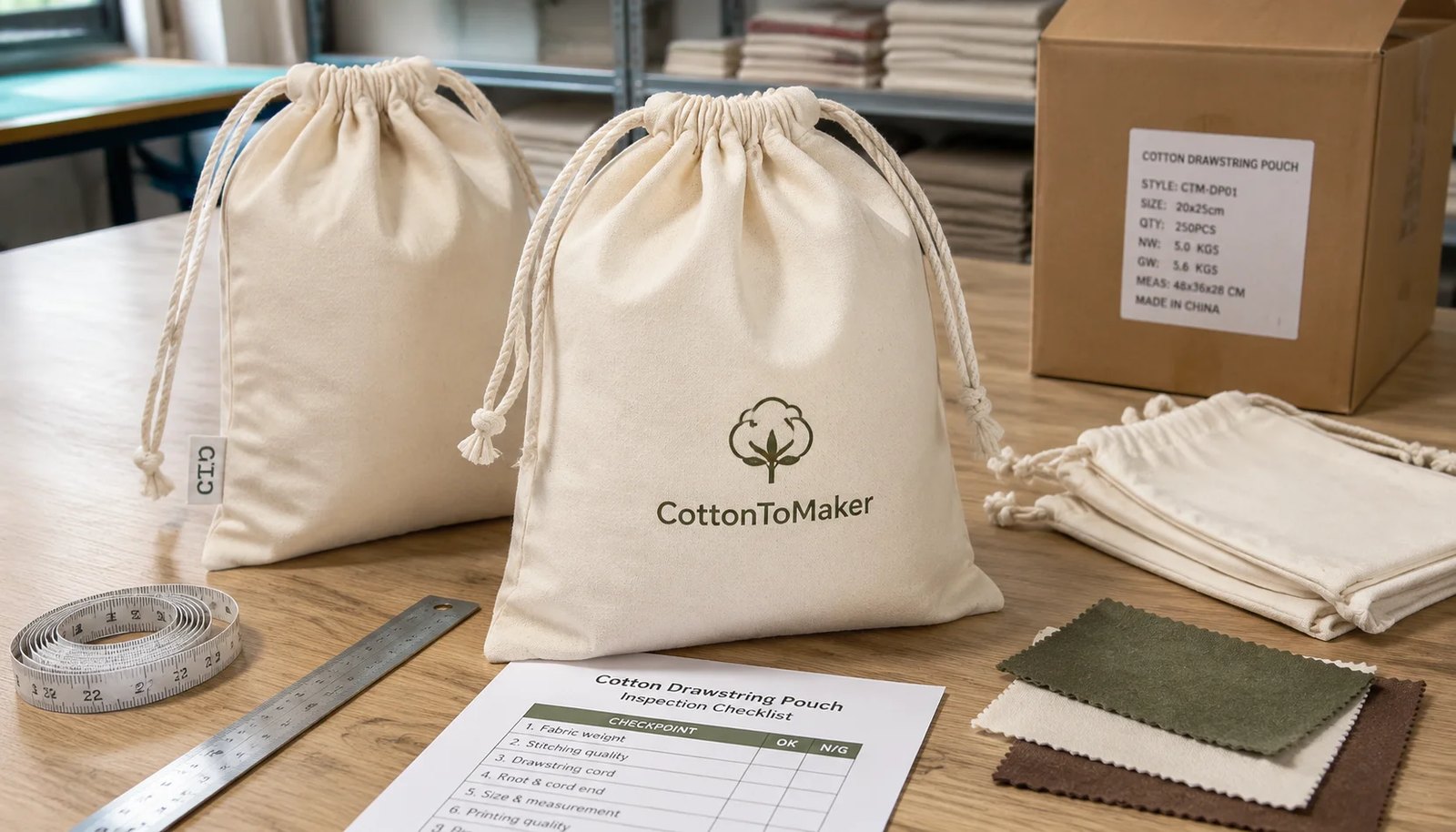
Why natural grocers need a different pouch inspection standard
Custom cotton drawstring pouches sold through natural grocers are usually judged more like a retail product than a simple packaging accessory. Buyers care about natural-looking fabric, but they also need clean sewing, readable branding, and pack consistency across store deliveries. That creates a specific sourcing problem: many factories quote these pouches as a low-spec commodity, while the actual retail expectation is closer to a branded soft-goods item.
The main quality risk is not one dramatic failure. It is a cluster of small defects that make the program look cheap in-store: mixed natural fabric shades, off-center logo prints, cords cut to uneven lengths, seam puckering, and cartons packed without SKU separation. A usable inspection checklist has to translate those store-level concerns into production tolerances that a factory and third-party inspector can actually measure.
- Retail use usually requires tighter appearance control than free giveaway use
- Natural fabric aesthetics do not mean unlimited variation is acceptable
- Most disputes happen over print placement, size tolerance, and mixed packing rather than catastrophic seam failure
- The RFQ should define what is acceptable before sampling starts
Set the base specification before requesting quotes
Many quote comparisons fail because the buyer sends only pouch dimensions and logo artwork. One supplier prices 110 GSM cotton with a synthetic cord, another prices 160 GSM cotton with cotton cord and overlocked seams, and both appear to be quoting the same item. For natural grocers, a sensible baseline is 140 to 170 GSM plain weave cotton for small and medium pouches. This range feels substantial enough for retail, prints reasonably well, and still closes cleanly with a drawstring.
If the pouch will carry heavier refill items, glass accessories, or multiple small products, move upward toward 180 to 200 GSM. Below that range, the pouch can become too transparent and can wrinkle badly around the logo. Above 200 GSM, the pouch may look premium, but the top channel becomes bulkier, drawstring closure can feel stiff, and freight cost climbs faster than most buyers expect.
- Useful baseline for RFQ: natural cotton, 150 GSM, plain weave, single drawstring, one-color screen print
- Add finished size in mm and note whether tolerance applies before or after packing
- Specify usable internal area if the top channel reduces filling height
- State if inside seams must be overlocked or if plain seam is acceptable for budget programs
Natural cotton fabric: GSM, shade, and surface expectations
Natural grocer buyers often prefer unbleached cotton because it fits an earthy shelf presentation. That choice brings a sourcing consequence: the fabric can show slight seed specks, slubs, and shade shifts between lots. If you do not write an approved appearance standard, the supplier may consider broad variation acceptable. The right approach is to approve a fabric cutting or swatch card that shows the expected shade band and surface character, then reference it in the PO and inspection plan.
GSM should also be handled carefully. A quoted GSM number on a sales sheet is not enough because cotton weight can vary by yarn count, weave density, and finishing. If your pouch dimensions are small, even a 15 to 20 GSM drop is visible and can change hand feel. Buyers should request both quoted GSM and practical tolerance, then compare sample weight with bulk. This matters especially if two suppliers are close in price and one may be quietly reducing fabric substance to win the order.
- Natural cotton can include minor specks, but define what retail will accept
- Approve shade under standard lighting, not mobile phone photos only
- Write GSM tolerance into the PO, such as plus or minus 7 percent unless your internal standard differs
- If the pouch will be washed after sewing, specify pre-washed or post-wash measurement expectations
Print method choices and the defects buyers should expect
For most natural grocer pouch programs, one-color or two-color screen printing is the most commercial option. It balances cost, acceptable ink coverage on textured cotton, and straightforward repeatability for volume orders. Water-based inks usually fit the product aesthetic better than heavy plastisol-like deposits, but the print result depends on fabric texture, pretreatment, and artwork detail. Thin lines and tiny text that look sharp on a digital mockup often spread or break on woven cotton.
The quality problem is not simply whether the logo is present. Retail buyers should inspect edge definition, ink penetration, print placement, and rubbing resistance. A pouch can pass a casual visual review and still fail in store handling if the print is weak on high-fiber areas or the logo sits too close to the drawstring channel and wrinkles when pulled closed. That is why print strike-offs matter: they validate art suitability on the actual fabric before bulk screens are locked.
- Best commercial choice: 1-2 color screen print for simple branding
- Request minimum readable text size and minimum line thickness from the factory before approving artwork
- Set print placement tolerance from side seam and top edge, not by eye only
- Review print on a filled pouch as well as a flat pouch because distortion changes logo appearance
Construction details that separate a retail pouch from a low-grade promo pouch
The difference between a usable retail pouch and a budget promotional pouch often comes from sewing details that are easy to overlook in the sample stage. The folded top channel should be even, the side and bottom seams should be secure, and inside seam finishing should match the expected end use. For standard natural grocer items, a lockstitch construction with overlock finishing inside is a reasonable default because it reduces fraying and improves appearance when customers inspect the pouch interior.
Drawstring quality also matters more than some buyers assume. Uneven cord lengths, fuzzy cord braiding, and poorly sealed ends make the whole item look inconsistent even when the body sewing is acceptable. If the pouch is part of a branded shelf program, cord symmetry and pull function deserve their own inspection line. A smooth pull action with no snagging at the channel is a practical sign that pattern, channel depth, and seam handling were controlled properly.
- Top channel depth should be consistent across the lot to keep logo placement and fill height stable
- Side seam and bottom seam should be checked for skipped stitches and seam grin under light tension
- Cord ends can be knotted, folded, or heat cut depending on material; specify the finish
- If double drawstring is required, state it explicitly because many standard quotes assume single drawstring
How MOQ logic changes the best sourcing route
Buyers often treat MOQ as one number, but pouch programs usually have several MOQ layers: fabric color MOQ, print design MOQ, size MOQ, and packaging MOQ. For first runs with natural grocers, the most efficient route is usually stock natural fabric in standard widths, with custom print and perhaps a custom side label. This keeps the MOQ practical and removes the dye-lot approval cycle that can slow launch dates.
Once volume is proven, custom dyed fabric, matching cords, woven labels, or multiple pouch sizes can be introduced. That sequencing matters because many factories can quote a very attractive unit price on paper, then add hidden MOQ constraints by artwork version or custom trim. Buyers comparing quotes should normalize the sourcing route before selecting a supplier. A cheap unit price with a split MOQ that forces excess inventory is usually not the cheapest landed option.
- Lower MOQ route: stock natural cotton, standard size, 1-color print, standard packing
- Higher MOQ route: custom dyed fabric, custom cord color, woven label, multiple size assortment
- Ask whether MOQ is per artwork or can be combined across sizes using same print screens
- Quote comparison should include inventory exposure, not only ex-works unit cost
Sample approval should test failure points, not just appearance
Too many pouch approvals happen from a courier sample that is only checked for general look. For a retail-ready custom pouch, the sample stage should validate size, fabric hand feel, print behavior, and drawstring function under realistic use. If the pouch is meant to hold soap bars, refill packs, produce accessories, tea bundles, or wellness gift kits, the buyer should physically load the sample. This reveals if the print cracks visually around folds, whether the opening is too narrow, and whether the bottom seam distorts when filled.
A good sample package usually includes one pre-production sample in actual fabric and trim, one print strike-off, and where needed a small fabric swatch or cutting reference. That creates a documented approval chain. If the buyer approves only artwork placement on a digital file and never signs off the physical sample standard, final inspection arguments become difficult because the supplier can say the bulk matches a verbal understanding rather than a fixed benchmark.
- Measure sample width, height, and top channel depth separately
- Weigh or otherwise verify sample fabric substance against quoted GSM
- Load the pouch with the intended product to evaluate shape and print distortion
- Retain one sealed approval sample for inspection reference and one for merchandising
Packing standards that prevent warehouse and store-level problems
Packing is a major hidden cost driver for distributors and retail buyers. A pouch can be manufactured correctly and still create receiving problems if sizes, logo versions, or language variants are mixed in one carton. For natural grocer programs with multiple SKUs, flat packing by exact SKU into labeled inner bags is usually the cleanest method. Carton markings should identify PO number, style, print version, quantity, carton sequence, and country of origin if required by your compliance team.
Carton density matters too. If export cartons are overfilled to reduce freight, pouches can arrive deeply creased, and printed faces may rub against each other during transit. That often leads to avoidable appearance claims. Buyers should cap carton weight according to their own warehouse handling standards and ask for carton dimensions in the quote stage, because carton cube affects landed cost and pallet efficiency.
- Set inner pack quantity by SKU, such as 25 or 50 pieces per polybag if that suits receiving flow
- Require a count map if one PO contains several sizes or artwork versions
- Limit carton gross weight to your warehouse standard rather than leaving it open
- Avoid mixed-SKU cartons unless there is a clear store allocation reason
Lead time planning and where pouch schedules usually slip
Cotton drawstring pouch lead time is not only sewing time. The schedule often stretches because artwork is not production-ready, fabric shade approval takes longer than expected, or sample comments are consolidated too late. For a standard stock-fabric pouch with simple print, production may be relatively quick once approvals are complete. But if the pouch uses custom dyed fabric, several artwork versions, or tight pack assortments, approval time can equal or exceed the cutting-and-sewing window.
The practical fix is to split the timeline into approval gates. Buyers should separately track artwork release, fabric or shade approval, print strike-off approval, pre-production sample signoff, and bulk ex-factory date. This structure makes delay ownership visible. It also helps when comparing suppliers: a shorter quoted lead time is only meaningful if both factories are assuming the same approval sequence and the same production complexity.
- Typical risk points: late art release, unclear shade approval, revised size after sample, and mixed-SKU packing changes
- Custom dyed natural-looking shades add approval days even if sewing capacity is open
- Request a stage-by-stage timeline, not one total lead time figure only
- If launch timing is tight, keep first order on stock fabric and standard size
Use final inspection criteria that match the commercial risk
Final random inspection should focus on the defects that create real commercial loss: visible appearance failures, count shortages, unusable closure function, and mismatched packing. Measurement and workmanship standards should be written in a way that a third-party inspector or internal QC can execute without interpretation drift. If the pouch is a retail item, the acceptable level for stains, print smudges, and severe misalignment should be tighter than for promotional overrun stock.
A strong checklist distinguishes critical, major, and minor defects in plain language. Critical issues may include wrong artwork, wrong size family, or severe contamination. Major defects can include open seams, obvious print placement failure, or mixed carton SKUs against the packing list. Minor defects may include manageable loose thread tails or slight natural slubs within approved appearance standards. This classification keeps the inspection decision tied to business impact rather than personal preference.
- Use approved sample and signed spec sheet as on-site inspection reference
- Count verification matters on custom pouch orders with many carton lines
- Inspect random cartons from early, middle, and late packed batches where possible
- Record defect photos by category to support fast corrective action before shipment release
Specification comparison for buyers
| Spec decision | Recommended option | When it fits | Buyer risk to check |
|---|---|---|---|
| Fabric weight | 140-170 GSM plain weave cotton | Best balance for dry grocery items, gift-with-purchase packs, tea, grains, soap, and refill accessories | Below 130 GSM can look thin and distort after printing; above 200 GSM raises cost and can bunch at the drawstring channel |
| Cotton type | Natural unbleached cotton with toleranced shade range approved by swatch | Suitable when the brand accepts slight seed specks and a natural grocery aesthetic | If no shade band is signed off, bulk can vary carton to carton and trigger store-level appearance complaints |
| Pouch construction | Single drawstring with folded top channel and bottom seam lockstitch plus overlock inside | Works for standard retail pouches under about 30 x 40 cm and medium fill weight | Top channel seam skipping or raw seam allowance can fray during store handling |
| Print method | 1-2 color water-based screen print | Best for simple logos, ingredient kits, produce accessory sets, and natural look branding | Fine lines, halftones, and edge registration can fail on textured cotton; request print line minimums |
| Logo placement | Centered print with 15-20 mm placement tolerance and approved strike-off | Good for high-volume retail replenishment where visual consistency matters | Without a written tolerance, suppliers may reject buyer claims for visibly off-center logos |
| Cord material | Cotton cord or herringbone tape drawstring matched to pouch tone | Preferred for natural grocers avoiding synthetic trim appearance | Loose braid, fraying cut ends, and uneven cord length create poor shelf presentation |
| MOQ route | Use stock fabric color and standard pouch sizes for first order; customize print and label only | Best for trial programs, seasonal launches, and distributor testing | Custom dyed fabric or custom cord colors can push MOQ sharply and delay shade approval |
| Packing method | Flat packed in PE inner bags by size and print version, then export carton with count map | Fits importer receiving, distributor allocation, and retail store replenishment | Mixed SKUs in one carton or no outer carton markings create receiving errors and higher warehouse labor |
| Inspection level | Pre-shipment AQL with appearance, measurement, print rub, seam, and carton verification | Needed when pouches will be sold in branded retail channels rather than used only as internal packaging | Skipping final random inspection can turn minor sewing drift into a full shipment dispute after arrival |
Buyer checklist before sampling
- Approve the exact finished size with tolerance in millimeters, not only a nominal size name such as small or medium.
- State fabric weight target and tolerance, for example 150 GSM cotton with acceptable range of plus or minus 7 percent.
- Define whether natural cotton shade variation and seed specks are acceptable, and attach a signed shade swatch if appearance is retail critical.
- Specify drawstring style, cord diameter, cord color, knot finish, and whether both cord ends must be equal length within tolerance.
- List print method, ink type, logo size, placement tolerance, minimum line thickness, and whether print strike-off approval is mandatory before bulk.
- Require seam construction details for side seam, bottom seam, and top channel, including whether overlock finishing is required inside.
- Set workmanship limits for loose threads, skipped stitches, puckering, oil marks, print smudges, and needle damage.
- Approve packing ratio by SKU, inner pack quantity, carton dimensions, carton gross weight limit, and barcode or carton mark format.
- Lock the inspection plan before production starts: sample approval, inline review if needed, and final random inspection standard.
- Put replacement or claim handling in writing for shortages, print defects, fabric weight failure, or mixed packing.
Factory quote questions to send
- What is the actual fabric construction behind your quoted GSM: plain weave, yarn count, and whether GSM is before or after washing?
- Is your price based on natural unbleached cotton stock fabric or a custom color lot, and what MOQ changes if shade matching is required?
- What size tolerance do you control in bulk after cutting and sewing, especially for pouches wider than 25 cm?
- Which print method is included in the quote, how many colors, and what print area is priced as standard?
- What are the practical limitations for small text, thin lines, or edge registration on your screen print line?
- Does the quote include print strike-off, pre-production sample, and courier cost, or are these billed separately?
- What drawstring material and diameter are included, and is there any surcharge for cotton cord, herringbone tape, or dyed cord?
- How do you calculate MOQ: per size, per print design, per fabric color, or combined across one order?
- What is the standard inner packing method, carton count, carton size, and maximum carton weight in your quotation?
- At what production stage do you test print adhesion, seam strength, and measurement compliance, and can you share your factory checklist format?
Quality-control points to confirm
- Fabric GSM must match approved standard within agreed tolerance; random inspection should compare measured fabric weight from bulk cut panels to approved sample reference.
- Finished pouch size must stay within agreed tolerance for width and height after sewing, with special attention to top channel depth affecting usable fill area.
- Natural cotton shade must remain within approved visual range under daylight or standard light box conditions; excessive yellowing, bleaching difference, or mixed shade lots should be segregated.
- Print must show clean edges, correct color density, no ghosting, no major pinholes in solid areas, and placement within approved tolerance from side and top seams.
- Ink rub resistance should be verified on dry cloth rub for simple screen prints, especially on natural cotton where loose surface fibers can affect coverage.
- Seams should have no skipped stitches, open seams, or severe puckering; back-tack and seam reinforcement at stress points should match approved construction.
- Drawstring channel must allow smooth pull action without trapping cord; cords should be equal in visible length within the approved range and ends properly finished.
- Loose threads, oil stains, needle marks, and fabric holes must be controlled to retail-acceptable standards, not just promotional giveaway standards.
- Packing count by SKU and print version must match packing list exactly; carton markings should identify PO, style, color, quantity, and carton number range.
- Cartons must survive normal export handling, with no overfilled cartons that compress pouches and create deep creasing on printed faces.