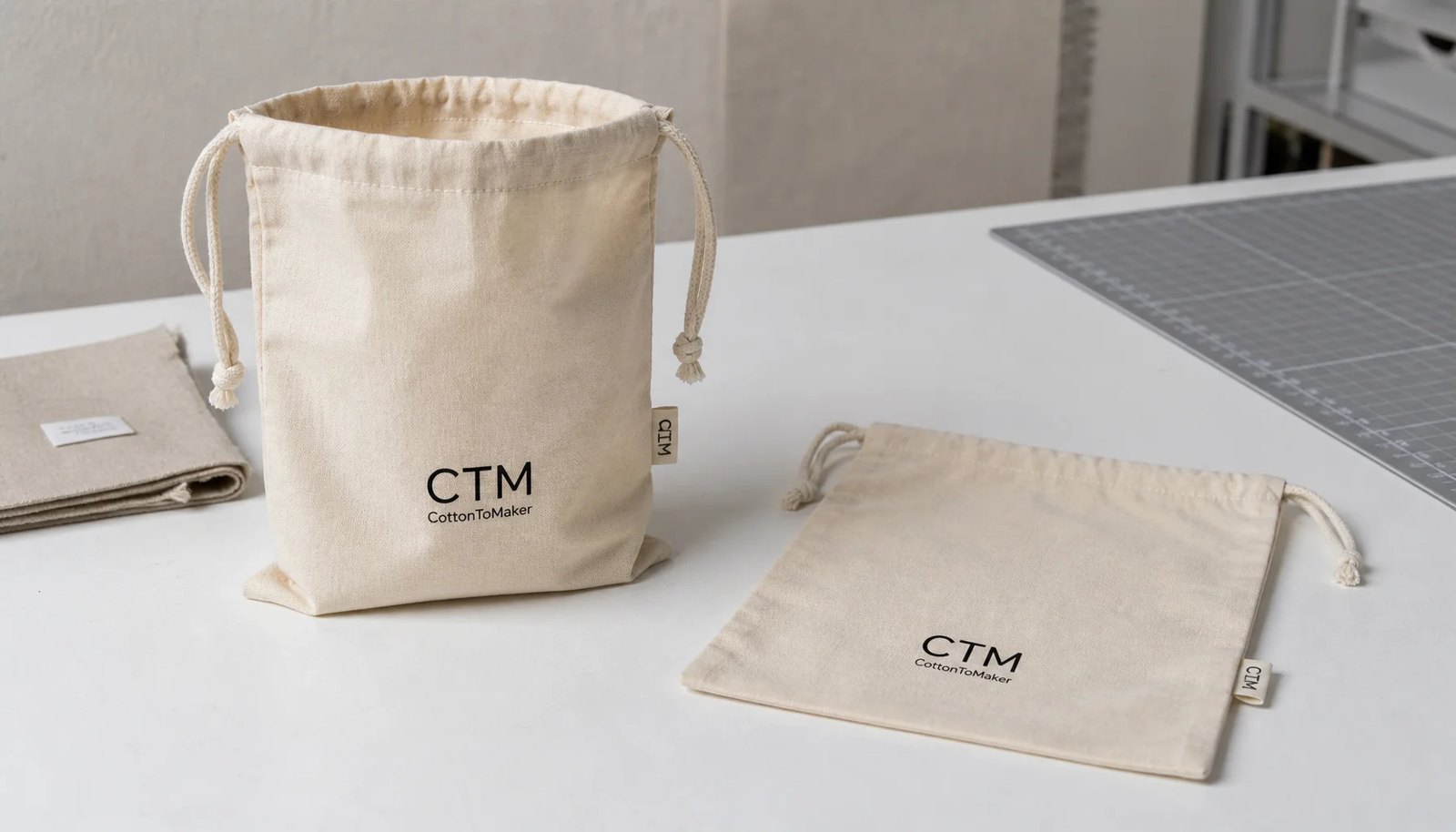
Start With the Bookstore Use Case
A custom cotton drawstring pouch for a university bookstore is not one product. It may be retail packaging for a campus-branded pin, a reusable bag for graduation jewelry, a department giveaway for orientation, or a gift pouch for alumni merchandise. Each use case changes the fabric weight, print size, closure, packing, and inspection standard. If the RFQ only says "cotton drawstring pouch with logo," factories will quote different assumptions and the lowest price may not match the item that the bookstore needs to sell or distribute.
Procurement teams should define the pouch around the object going inside it. A pouch for a lightweight enamel pin can use lower GSM cotton and a simple single drawcord. A pouch holding a ceramic ornament, tech accessory, or bundled bookstore gift needs stronger seams, a more stable fabric, and a closure that does not loosen in handling. The proofing checklist should therefore begin with product fit, shelf presentation, and reuse expectation before artwork approval.
- For small merchandise packaging, size the pouch to the item plus space for easy insertion by store staff.
- For orientation or welcome kits, prioritize quick packing, consistent closure, and low carton weight.
- For premium alumni or graduation items, use heavier cotton, cleaner drawcord finishing, and tighter print placement control.
- For multi-campus bookstore programs, separate SKUs by campus, department, logo, and packing destination in the RFQ.
Choose Cotton GSM Before Pricing
Fabric weight is one of the first cost drivers in custom cotton drawstring pouches. It affects hand feel, opacity, print stability, seam strength, and freight weight. For university bookstore applications, common cotton options usually fall between 100 and 200 GSM. A 100-120 GSM pouch is economical for light giveaways and small items, but it can feel thin if the bookstore wants a retail-quality product. A 160-180 GSM pouch gives a better balance for campus merchandise because it supports a cleaner print surface without becoming too bulky.
Heavier fabric is not automatically better. At 200 GSM and above, the pouch may feel premium, but the drawstring channel becomes thicker, the closure may not gather smoothly on small sizes, and cartons become heavier. Importers comparing quotes should look at both unit price and packing data. A supplier quoting 120 GSM may appear cheaper than one quoting 180 GSM, but the two prices are not comparable unless the bookstore has already decided the required hand feel and durability.
- Use 100-120 GSM for economy gift packaging where the pouch is not the main retail item.
- Use 140-160 GSM for balanced bookstore merchandise and better print opacity.
- Use 180-200 GSM for premium campus programs, heavier contents, or higher perceived value.
- Request fabric swatches when natural cotton color, bleaching level, or dyed fabric shade matters.
Match Print Method to Campus Artwork
University bookstore graphics often include official seals, mascots, department names, alumni marks, and licensed color standards. Screen printing is usually the best method for solid one-color or two-color logos because it gives a strong ink deposit and predictable cost at volume. It is also easier to inspect on cotton fabric than many low-cost transfer options. However, screen printing has limits with tiny type, fine outlines, gradients, and artwork that crosses seams or sits near the drawstring channel.
Heat transfer or digital printing can work when the artwork includes gradients, many colors, or short-run personalization. The tradeoff is hand feel, edge durability, and color behavior on textured cotton. A digital PDF proof cannot show how ink sinks into natural cotton or how a transfer film feels on a small pouch. For bookstore orders, a real print strike-off on the correct fabric is more valuable than a perfect on-screen color layout.
- Screen print is practical for bold logos, mascot marks, and standard bookstore graphics.
- Heat transfer can help with complex color art, but buyers should inspect edge lift and hand feel.
- Digital print can support short runs, but color consistency on cotton needs physical approval.
- Embroidery is possible for premium pouches, but it increases cost and can distort small lightweight fabric.
Build a Proofing Sequence That Prevents Rework
A strong print proofing checklist separates artwork approval from production approval. The digital proof should confirm logo size, placement, colors, and spelling, but it should not be treated as a final product approval. The next step is a print strike-off on the correct cotton, followed by a size and construction sample if the pouch is new. When the bookstore is buying several designs, approve one base construction sample and separate print strike-offs for each artwork.
The pre-production sample should be the control sample for bulk production. It should show the final fabric GSM, finished size, drawcord material, print method, print position, stitching, label position if any, and packing direction. Sign and date the sample, or issue a written approval sheet with photos and measurements. This reduces disputes later because the factory, importer, and bookstore are all working against the same physical standard.
- Digital proof: confirms layout, spelling, logo scale, and print position on the pouch template.
- Fabric swatch: confirms cotton weight, color, texture, and opacity before printing.
- Print strike-off: confirms ink color, edge sharpness, hand feel, and small detail performance.
- Pre-production sample: confirms complete pouch construction and becomes the bulk reference.
Set Logo Placement With Real Sewing Tolerances
Logo placement is a common failure point on drawstring pouches because the bag changes shape when filled or pulled closed. A mark placed too close to the drawstring channel may crease or disappear when the cord is tightened. A mark placed too close to the side seam may look off-center after sewing tolerance. The artwork area should be defined from stable reference points, usually the finished top edge, side seam, and bottom edge, rather than only from the digital flat drawing.
For most bookstore pouches, keep the printed logo at least 20-25 mm away from side seams and 30-40 mm below the drawstring channel. On very small pouches, the safe print zone may need to shrink, so artwork should be simplified. If a university seal contains fine rings or small Latin text, the buyer should request a minimum readable line size from the factory. A clean simplified mark often sells better than a full seal that becomes muddy on cotton.
- State finished-size print placement, not only artwork placement on a cutting panel.
- Use a print position tolerance such as plus or minus 3 mm for standard production, if realistic for the method.
- Avoid printing across fold lines, bottom corners, cord channels, or heavy seam areas.
- Approve a filled-pouch photo when the final product will be displayed with merchandise inside.
Understand MOQ Logic and Cost Drivers
MOQ for custom cotton drawstring pouches is not controlled by one number. The body fabric, dyed fabric color, drawcord color, print setup, screen count, label, and packing requirements may each create a different minimum. Natural cotton pouches with a one-color logo usually have more flexible MOQ than custom-dyed fabric with a special cord color and multiple printed designs. Buyers should ask which part of the specification drives the MOQ instead of accepting a single unexplained minimum.
Cost also changes with print area, number of ink colors, pouch size, fabric weight, finishing labor, carton packing, and sample rounds. A bookstore may save more by standardizing pouch size across departments than by pushing for a lower unit price on each design. If the order includes several logos, suppliers may combine fabric purchasing while charging separate print setup for each design. This should be visible in the quote so procurement can compare suppliers fairly.
- Separate MOQ for blank pouch body, fabric dyeing, cord color, print design, and packing variation.
- Request screen or setup charges as separate lines when multiple bookstore logos are included.
- Compare cost by usable pouch, not only unit price, because weak fabric or poor print may create retail rejects.
- Ask whether overrun or underrun tolerance applies, especially for small custom print batches.
Write Acceptance Criteria for Samples
Sample approval should use measurable criteria. A buyer can approve a pouch faster when the factory knows the target finished size, GSM, print dimensions, color standard, seam construction, drawcord length, and packing style. Without these details, the sample review becomes subjective and slow. The result is repeated sampling, missed bookstore launch windows, and uncertain accountability if bulk production differs from expectation.
Acceptance criteria do not need to be complicated, but they must be written. For example, the finished pouch may need to be 150 x 200 mm with a tolerance of plus or minus 5 mm, 160 GSM cotton with an agreed GSM tolerance, one-color screen print at 70 x 55 mm, centered with plus or minus 3 mm placement tolerance, and cotton cord long enough to close smoothly without slipping into the channel. These values should be adjusted by pouch size and factory capability, but the principle is the same: define what passes before mass production starts.
- Measure finished pouch size after sewing, pressing, and cord insertion.
- Compare print color to the approved strike-off under consistent lighting.
- Test closure by opening and closing the pouch several times with the intended product inside.
- Reject samples with twisted channels, loose knots, skipped stitches, heavy print bleeding, or visible logo distortion.
Plan Packing for Store Receiving
Packing is often treated as an afterthought, but university bookstores may receive goods during busy seasonal windows. If pouches arrive mixed by design, loose in cartons, or heavily creased through the printed panel, store teams lose time sorting and preparing inventory. Retail buyers should define inner pack quantity, carton quantity, carton markings, SKU separation, and whether pouches need to be flat, folded, banded, or individually polybagged.
For most cotton drawstring pouches, flat packing in inner polybags of 50 or 100 pieces works well. Small pouches may be packed at higher carton counts, but very heavy cartons create handling problems and can compress prints. If the bookstore needs retail-ready units, add barcode labels, hang tags, or department labels to the RFQ before pricing. Adding these after production starts can delay packing and create unplanned labor cost.
- Use separate inner bags for each logo, SKU, campus, or department.
- Specify carton marks with purchase order number, SKU, quantity, destination, and country of origin where required.
- Request carton dimensions and gross weight early for freight planning and warehouse receiving.
- Avoid over-compression if the print uses thick ink, transfer film, or dark ink on light cotton.
Control Lead Time Around Bookstore Dates
University bookstore orders often connect to fixed dates: orientation, homecoming, graduation, alumni events, semester launch, or licensing review deadlines. The production schedule should include artwork preparation, proof review, fabric sourcing, sampling, sample transit, buyer approval, bulk production, final inspection, export packing, and shipping. A factory lead time that begins only after sample approval is useful, but procurement also needs to budget the time before approval.
A realistic schedule protects both sides. If the artwork is not final, the factory cannot lock screen making or strike-off approval. If fabric is custom dyed, the timeline may increase and shade approval becomes critical. If the bookstore needs delivery before a campus event, build in a buffer for re-sampling or inspection. The RFQ should state the required in-store date and the preferred ship date, not only the purchase order date.
- Allow time for brand office or licensing approval if official university marks are used.
- Add several days for sample freight and internal review, especially across time zones.
- Do not approve bulk production until the print strike-off and construction sample are aligned.
- Plan final inspection before carton sealing when multiple designs or destinations are involved.
Compare Quotes by Landed Value
The cheapest pouch quote may not be the lowest-cost order once freight, defects, repacking, and missed delivery risk are included. A fair comparison includes fabric GSM, pouch size, print method, number of colors, sample charges, setup charges, packing, carton data, inspection plan, and lead time. Importers should put these data points into one comparison sheet before selecting a supplier. If one supplier quotes without carton dimensions or GSM tolerance, the price is incomplete.
Landed value is especially important for bookstore distributors handling multiple campus accounts. A supplier that can pack by SKU, maintain print placement, and provide clear carton data may reduce warehouse labor even if the unit price is slightly higher. Conversely, a low price with vague fabric weight and no strike-off process can create rejected merchandise that cannot be sold during the intended season.
- Compare unit price together with GSM, print method, setup cost, and packing labor.
- Use carton dimensions and gross weight to estimate freight impact before approving the supplier.
- Include inspection cost and sample freight when comparing small custom programs.
- Value supplier responsiveness on proof corrections because slow proofing can be more expensive than a small unit-price difference.
Specification comparison for buyers
| Spec decision | Recommended option | When it fits | Buyer risk to check |
|---|---|---|---|
| Fabric weight | 120-180 GSM cotton for small bookstore merchandise pouches; 200 GSM only when the pouch must feel premium | 120 GSM works for pins, keychains, cords, and small gifts; 160-180 GSM gives better opacity and print stability | Very light fabric can wrinkle under print pressure; heavy cotton increases unit cost, carton weight, and drawstring bulk |
| Pouch size | Set size by product plus 10-15 mm handling allowance on each side | Useful for bookstore bundles such as pen sets, graduation gifts, alumni pins, earbuds, or orientation kits | A pouch that only fits the item on paper may fail after seam allowance, shrinkage, or bulky drawcord closure |
| Print method | Screen print for solid university marks; heat transfer or digital print for gradients and multi-color artwork | Screen print is usually the cleanest for one- to three-color school logos and department graphics | Fine type, metallic inks, and halftones need a real strike-off, not only a digital proof |
| Logo placement | Keep artwork at least 20-25 mm from side seams and 30-40 mm below the drawstring channel | Protects the mark from distortion when the pouch is pulled closed | Designs placed too high will crease into the channel and look rejected even if the print itself is accurate |
| Drawcord material | Cotton cord for natural look; polyester cord when brighter color matching and durability matter | Cotton cord suits eco-positioned bookstore programs; polyester cord suits high-color school branding | Cord color may not match fabric or ink exactly; specify acceptable shade tolerance before bulk |
| Closure construction | Single drawstring for lower cost; double drawstring when students will reuse the pouch often | Double drawstring improves user experience for orientation, alumni, and gift packaging programs | Single-cord pouches can look cheaper in retail bins and may not close evenly on heavier contents |
| Packing unit | Flat pack in 50 or 100 pieces per inner polybag, with carton count matched to store receiving limits | Helps bookstores count stock, distribute to departments, and avoid repacking before retail launch | Random bulk packing can crease printed panels and slow receiving during peak semester setup |
| Proof approval standard | Approve fabric swatch, print strike-off, size sample, and final pre-production sample before mass production | Best for licensed bookstore graphics or orders tied to orientation, graduation, or campaign dates | Approving only a PDF can miss fabric shrinkage, ink hand feel, drawcord performance, and carton packing issues |
Buyer checklist before sampling
- Define the pouch use case first: retail packaging, orientation giveaway, graduation gift, alumni kit, or department merchandise.
- List the exact product dimensions and weight going inside the pouch, then add closure and handling allowance.
- Specify cotton fabric weight in GSM, color, weave expectation, and whether the fabric must be bleached, natural, dyed, or organic.
- Provide vector artwork, Pantone references, print size, print position, and whether the logo is licensed or requires brand office approval.
- Choose the print method based on artwork, not only price: screen print for solid marks, transfer or digital for gradients and small color runs.
- Set proof stages in the purchase schedule: digital artwork proof, fabric swatch, print strike-off, size sample, and pre-production sample.
- Write measurable tolerances for pouch size, print position, color, GSM, seam strength, drawcord length, and carton quantity.
- Confirm whether unit barcode labels, department labels, country of origin marking, or retail-ready packing are required.
- Request carton dimensions, gross weight, net weight, pieces per carton, and packing method before comparing freight quotes.
- Tie mass production approval to a signed sample or written approval sheet, not to informal email comments only.
Factory quote questions to send
- What cotton fabric weights can you offer for this pouch size, and what is the GSM tolerance in bulk production?
- Which print method do you recommend for our artwork, and what line thickness or small text limit should we avoid?
- Can you provide a printed strike-off on the correct fabric before making the full pre-production sample?
- What is the MOQ for the pouch body, drawcord color, fabric dyeing, and each print color?
- How do you control print position when the pouch body is sewn after printing or printed after sewing?
- What is the estimated sample lead time, bulk production lead time, and shipping-ready date after sample approval?
- What carton size, pieces per carton, net weight, and gross weight do you recommend for this order?
- Can you pack by design, department, campus location, or purchase order line if the bookstore has multiple SKUs?
- What defects are included in your internal inspection standard, and what AQL level can be used for final inspection?
- What quote items are excluded, such as sample freight, artwork setup, mold or screen charges, labeling, or destination charges?
Quality-control points to confirm
- Fabric GSM measured against the approved sample with an agreed tolerance, typically plus or minus 5-8 percent depending on fabric availability.
- Finished pouch size measured after sewing and pressing, not only before sewing, with clear tolerance for width, height, and drawstring channel.
- Print color compared under consistent lighting against approved Pantone target or signed strike-off, allowing realistic cotton absorption variation.
- Print position measured from top edge, side seam, and bottom edge to prevent logo drift across bulk cartons.
- Ink adhesion checked by rub test, tape test where suitable, and light hand-wash simulation if the pouch is marketed as reusable.
- Seam strength checked at side seams, bottom corners, and drawstring channel because these points fail first under product weight.
- Drawcord length and pull balance checked after closure so the pouch opens and closes smoothly without loose knots slipping through.
- Packing checked for correct SKU separation, count per inner bag, carton markings, carton strength, and protection from moisture during transit.