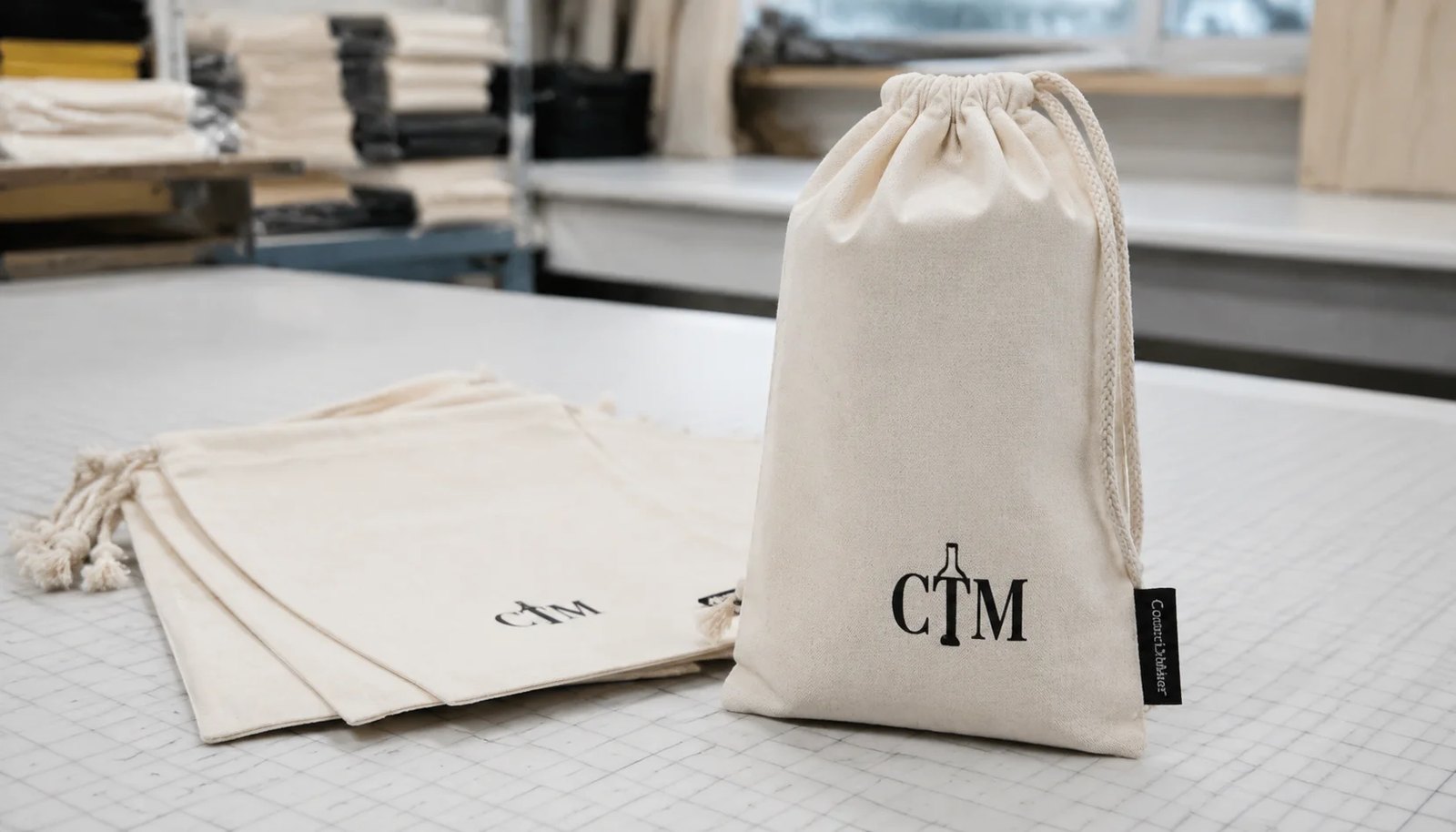
Start With the Retail Use Case
A print proofing checklist for custom cotton drawstring pouches should begin with how the liquor retailer will use the pouch, not with the logo file. A pouch used as a single-bottle gift bag has different requirements from a small cotton pouch for miniature bottles, tasting tokens, bottle openers, or loyalty gifts. If the pouch must sit on a shelf beside premium spirits, the fabric body, drawcord finish, and print position matter more than they would for a giveaway bag packed behind the counter.
The buying problem is usually simple: procurement receives several pouch quotes that look similar on unit price, but the samples and bulk goods can differ sharply. One supplier may quote 5 oz cotton with a small one-color print, another may quote 8 oz cotton with a larger print area, and a third may include individual packing. Without a shared proofing standard, the lowest price is often just the thinnest fabric, smallest decoration, or least controlled packing.
- Define whether the pouch is for a 50 ml miniature, 187 ml, 375 ml, 500 ml, 700 ml, 750 ml, or accessory kit.
- Record the maximum bottle diameter and the height from base to shoulder and base to cap.
- Decide whether the pouch must close fully, partially gather at the neck, or leave the bottle top visible.
- State whether retail staff will hand-pack bottles in store or whether pouches will be supplied to a bottler, distributor, or gift-pack assembly line.
Fabric GSM Changes Both Look and Cost
For cotton drawstring pouches, fabric weight is one of the first specifications to lock. Many quotes use ounces, while some factories use GSM. As a practical guide, 5 oz cotton is often around 150-170 gsm, 6 oz around 190-220 gsm, 8 oz around 240-270 gsm, and 10 oz around 300-340 gsm. Exact conversion varies by weave and finishing, so buyers should request the mill or factory GSM rather than rely on a rough conversion table.
Liquor retailers often prefer 6 oz or 8 oz cotton because it gives a better hand feel than thin promotional fabric while still closing properly around a bottle. A 10 oz pouch can look more structured, but it may bulk up around the drawcord channel and increase shipping weight. Natural cotton also has seed flecks and shade variation. That can be attractive for craft spirits, but it affects how white, metallic, and pastel print colors appear.
- Use 5 oz only when the pouch is low-cost, lightweight, and not expected to hide a bottle label or dark glass shape.
- Use 6 oz for general retail gift pouches where cost, foldability, and print result need to balance.
- Use 8 oz when the pouch needs a more substantial feel, better opacity, or stronger shelf presentation.
- Use 10 oz only after testing closure, carton weight, and print cracking on bends around the bottle.
- Request fabric swatches from current stock or current dye lot before approving print color.
Build the Proof Around the Print Method
Screen print is normally the most efficient print method for cotton liquor pouches when the artwork uses solid colors, store names, simple crests, event marks, or seasonal labels. It gives a clean retail result at bulk quantity, but it needs screens, ink setup, and correct curing. Fine serif text, reversed lines, and small legal-style copy may fill in on cotton texture. The proof should therefore show the actual logo size on actual cotton, not just a digital file.
Heat transfer and digital print can be useful for full-color artwork, gradients, small test orders, or multiple low-volume designs. The tradeoff is hand feel, edge appearance, wash or rub performance, and sometimes higher unit cost. Embroidery can look premium, but on a small drawstring pouch it may pucker the fabric and adds cost and setup time. A woven side label is a good secondary branding option when the front print must stay clean.
- For screen print, specify print color count, Pantone reference, print size, print side, and whether ink should be standard, water-based, puff, metallic, or high-opacity.
- For heat transfer, request a flex and rub check around the bottle curve and confirm whether the transfer edge is visible.
- For digital print, approve the color range on cotton fabric, not on coated paper.
- For embroidery, check fabric puckering, backing material, stitch density, and whether the pouch can still close smoothly.
- For woven labels, define label size, fold type, position, stitch color, and whether it is included in MOQ.
Place Artwork for a Sewn Product
A common proofing error is approving logo placement on a flat rectangle without considering seams, bottom gusset, side fold, and drawcord gathering. On a finished pouch, the front panel is affected by sewing tolerance and fabric movement. The artwork should be positioned from finished edges after sewing. For a liquor bottle pouch, the safest front print area is normally centered and kept away from the drawcord channel, side seams, and bottom seam.
A practical starting point is at least 25 mm clearance from the bottom seam and drawcord channel for small to medium pouches, with more clearance on large bottle pouches or thick fabrics. If the pouch has a round bottom, boxed bottom, or gusset, the print area should not extend into the fold line unless distortion is acceptable. Brand owners should also consider how the bottle shape pushes the fabric forward. A logo that looks centered flat may ride higher once a bottle is inside.
- Mark logo position from finished pouch top edge, side edge, and bottom seam.
- Include a pouch drawing with finished size, cord channel height, seam allowance, and printable area.
- Avoid placing small text where the pouch gathers after the drawcord closes.
- Test the printed sample with the actual bottle or a dummy bottle of the same diameter.
- Photograph the sample flat, filled, closed, and shelf-facing before final approval.
Control MOQ by Grouping the Right Variables
MOQ for custom cotton drawstring pouches is not one number. It can be controlled by fabric purchase, dyeing lot, cutting efficiency, print setup, sewing line changeover, label production, and packing method. A supplier quoting a low MOQ may still add charges for screens, dyeing, sampling, and packing labels. Another supplier may require a higher MOQ but include setup charges in the unit price. Buyers should compare the total order cost, not only the pouch unit cost.
Liquor retailers with several store locations or seasonal campaigns can often reduce cost by standardizing the pouch body and changing only the print. For example, one natural 8 oz cotton pouch size can support several one-color store logos, as long as each print design meets the factory's minimum for screen setup and production handling. Dyed fabric is less flexible because color lots usually need higher minimums and longer preparation time.
- Lowest MOQ usually comes from stock natural cotton, standard cord, one size, one-color print, and bulk packing.
- Higher MOQ often comes from custom dyed cotton, custom cord color, embroidery, woven labels, or individual retail packaging.
- Multiple artworks can share fabric MOQ, but screen setup and print scheduling may still apply to each design.
- Store-sorted cartons may reduce distribution labor but can add packing time and label control risk.
- For quote comparison, request the price at two or three quantity breaks, such as 500, 1,000, and 3,000 pieces.
Approve Samples in the Right Sequence
The safest sampling route is not always the fastest. When the pouch size is new, approve a plain size sample before spending time on print. This confirms bottle fit, drawcord function, seam construction, and fabric hand feel. After that, approve a printed pre-production sample using the actual fabric, cord, ink, logo size, and sewing construction intended for bulk. For repeat orders, a printed sample may be enough if all dimensions and materials match a previous approved production.
A digital proof is useful for layout, but it is not a production approval. It cannot show cotton shade, print absorption, ink thickness, fabric shrinkage, seam distortion, or how the pouch gathers around the bottle. The approval record should include photos, measurements, and written tolerances. If procurement approves only a pretty screen image, the factory has too much freedom to interpret print size, position, and color.
- Measure the sample before and after inserting the bottle.
- Check whether the bottle can be inserted quickly by store staff without forcing the side seams.
- Pull the drawcord several times to confirm smooth closing and no tearing at the channel opening.
- Rub the printed logo with a dry white cloth to look for obvious ink transfer after curing.
- Keep one signed approval sample at the factory and one with the buyer or importer.
Set Acceptance Criteria Before Bulk Production
Print proofing becomes useful only when the buyer defines what will pass and what will fail. For cotton pouches, reasonable bulk tolerances should cover finished size, logo position, print color, print defects, seam strength, cord length, stains, and packing quantity. Cotton is a fabric product, so tolerances cannot be the same as rigid packaging. The goal is to define a commercial retail standard that protects the brand without creating unrealistic rejection risk.
For most liquor retail pouch orders, buyers can use a size tolerance of plus or minus 5 mm for smaller pouches and plus or minus 10 mm for larger pouches, unless the bottle fit is tight. Print placement tolerance is often plus or minus 3 mm to 5 mm, depending on the artwork and sewing process. Color should be compared to a physical approved sample or Pantone target under consistent light, with the base fabric effect documented.
- Major defects: wrong artwork, wrong fabric color, wrong pouch size that prevents intended use, uncured ink, broken seams, heavy stains, or mixed SKUs without labels.
- Minor defects: small loose threads, slight shade variation, small print specks outside the main logo area, or minor sewing waviness within approved tolerance.
- Inspection quantity should follow the buyer's AQL plan or agreed sampling method, not a casual carton-top review.
- For retail-facing liquor promotions, inspect filled appearance as well as flat appearance.
- Do not approve bulk shipment until carton quantity, carton marks, and SKU separation match the purchase order.
Packing Affects Creasing and Store Handling
Packing looks like a back-end detail, but it can damage the presentation of printed cotton pouches. If pouches are compressed too tightly, hard creases can run across the logo. If different store logos are mixed inside the same carton without inner labels, the buyer's warehouse may spend hours sorting. If the pouch is individually polybagged when stores expected loose bulk packing, unpacking time increases and sustainability messaging can become awkward.
A practical export packing plan for cotton drawstring pouches is flat packing in inner bags of 50 or 100 pieces, then export cartons with clear carton marks. Retail programs that allocate pouches by store should use store codes, SKU labels, and carton-level quantity control. If the pouch includes a hangtag, barcode sticker, or insert card, the buyer should define exact placement and orientation. These small packing choices affect labor cost after arrival.
- Specify bulk pack, inner polybag, individual polybag, paper band, hangtag, barcode label, or store allocation carton.
- Require printed faces to be stacked in a way that reduces ink rubbing and logo creasing.
- Confirm carton dimensions, gross weight, net weight, and CBM for freight planning.
- Avoid oversized cartons that collapse during transit or overfilled cartons that crush the printed face.
- Use carton marks that include PO number, SKU, artwork code, quantity, carton number, and country of origin where required.
Compare Quotes by Landed Cost
Two pouch quotes can look close until freight and receiving labor are added. Heavier cotton increases carton weight. Individual packing increases CBM and handling. Dyed fabric may add lead time and minimums. A large print area can add ink cost, screen cost, and slower production speed. Procurement teams should build a quote comparison sheet that separates unit price from setup charges, sample charges, packing charges, freight data, and payment terms.
For liquor retailers importing directly, Incoterm matters. An EXW quote may look low but leave local transport, export handling, documents, and freight coordination to the buyer. FOB is often easier for import comparison because the goods are delivered to the named port after export handling. DDP can be convenient for smaller buyers, but the buyer should still request carton data and understand what duties, taxes, and delivery services are included.
- Compare fabric GSM, finished size, print method, print area, and packing method before comparing unit price.
- Separate one-time charges such as screens, sample fees, tooling, artwork adjustment, and label setup.
- Use carton CBM and gross weight to estimate freight, not only piece count.
- Check whether the quote includes export cartons, carton marks, barcode labels, and inspection support.
- Record quote validity because cotton fabric, dyeing, and freight costs can move between RFQ and PO.
Protect the Launch Schedule
Liquor retail programs are often tied to holidays, tastings, store openings, limited releases, or supplier-funded promotions. A pouch that arrives after the campaign date has little value even if the unit price was good. The production schedule should include artwork review, swatch approval, sample making, sample shipping, buyer approval time, fabric preparation, printing, sewing, packing, inspection, export booking, and transit. The biggest schedule losses usually come from late artwork approval or a sample that reveals preventable placement and fabric issues.
A realistic RFQ should ask for sample lead time and bulk lead time separately. Natural stock cotton with one-color screen print can move faster than dyed cotton with custom cord and retail packing. Buyers should also ask when the factory needs final approval to meet the ship date. This gives procurement a decision deadline instead of a vague promise. If the launch cannot move, reduce variables: use stock fabric, standard cord, simpler print, and bulk packing.
- Reserve time for artwork correction before sample making, especially when logos include small text or fine lines.
- Build in courier time for physical samples if the buyer must approve fabric and print by hand.
- Do not start bulk production from an unapproved sample unless the buyer accepts the risk in writing.
- Schedule inspection after packing but before final payment or shipment release where payment terms allow.
- For seasonal liquor retail programs, set a latest approval date and a latest vessel or courier handover date.
Specification comparison for buyers
| Spec decision | Recommended option | When it fits | Buyer risk to check |
|---|---|---|---|
| Fabric weight for bottle gifting pouches | 6 oz to 8 oz cotton for most 375 ml to 750 ml presentation pouches; 10 oz only when the pouch must stand firmer or carry heavier accessories | Liquor retailers needing a soft reusable bag with enough body to protect the label and feel retail-ready at checkout | Too light can look transparent and wrinkle heavily; too heavy can reduce drawcord closure and increase carton weight |
| Fabric color for proofing | Natural or dyed cotton approved from a physical swatch before logo proofing | Natural cotton works for craft spirits, limited releases, and sustainability-positioned gift packs; dyed cotton works when brand color control matters | Screen colors shift on unbleached natural cotton; dyed lots may vary unless lab dip or previous bulk fabric is referenced |
| Print method | Screen print for solid logos and larger repeated retail orders; heat transfer only for fine gradients or small trial runs | Screen print is the practical default for liquor retail logos, store names, event marks, and limited seasonal runs | Fine lines may fill on cotton texture; metallic inks and light ink on dark cotton need stronger proofing and rub testing |
| Logo placement | Keep main logo centered with minimum 25 mm clearance from bottom seam and drawcord channel | Fits front-facing retail displays, bottle insert cards, and gift shelves where the pouch is seen upright | Artwork too close to seam can distort after stitching; artwork too high may be hidden by cord gathers |
| Drawcord choice | Cotton cord for natural look; polyester cord when stronger color matching or smoother sliding is needed | Cotton cord suits premium and natural positioning; polyester cord helps high-volume retail handling | Cord thickness can affect closure around bottle neck; dyed cotton cord may bleed if not tested |
| MOQ logic | Separate MOQ for fabric color, pouch size, and print color count; negotiate by shared fabric and changing only print artwork where possible | Works for regional liquor chains needing several store logos or seasonal designs without rebuilding the whole spec | Combining SKUs may not reduce setup charges if artwork, ink, or packing labels differ |
| Sample approval route | Plain size sample first, then printed pre-production sample using actual fabric, cord, and logo file | Best for retailers ordering a new pouch size or a new print method before bulk launch | Approving only a digital proof misses shrinkage, drawcord gathering, ink hand feel, and logo distortion |
| Packing format | Flat packed 50 or 100 pcs per inner polybag, export carton sized to avoid hard creases across the printed face | Good for warehouse receiving, store allocation, and display kit packing | Over-compression can crease ink; mixed artwork cartons need clear carton marks and SKU separation |
| QC acceptance criteria | Define tolerances for pouch size, print position, print color, seam strength, cord pull, and carton quantity before production | Useful for importers and distributors who need consistent receipts across several purchase orders | Without written tolerances, disputes become subjective and factory inspection teams may use only general appearance checks |
Buyer checklist before sampling
- Define bottle size, pouch usable height, finished width, drawcord channel height, and whether the bottle must be inserted with tissue, neck tag, or gift card.
- Specify cotton fabric weight in oz or GSM, not only the word cotton. Common references are about 150-170 gsm for 5 oz, 190-220 gsm for 6 oz, 240-270 gsm for 8 oz, and 300-340 gsm for 10 oz.
- State fabric color as natural, bleached, dyed Pantone target, or approved swatch reference. Do not rely only on a screen image for natural cotton.
- Provide vector artwork with final print size, Pantone or ink reference, logo placement from finished edges, and whether the print is one side or two sides.
- Choose the print method before quote comparison: screen print, heat transfer, digital print, embroidery, woven label, or a combined decoration plan.
- Require a printed pre-production sample when the artwork has fine lines, reversed text, metallic ink, light ink on dark fabric, or tight placement near seams.
- Set acceptance tolerances for size, print position, color deviation, print defects, seam strength, and drawcord function before paying the bulk deposit.
- Confirm MOQ by pouch size, fabric color, print design, and packing method. A low unit MOQ may still carry separate setup, screen, dyeing, or packing charges.
- Define retail packing, inner bag quantity, carton marks, barcode labels, and whether cartons are store-sorted or bulk packed.
- Request quote data in a comparable format: unit price, sample cost, screen cost, packing cost, carton size, gross weight, production lead time, sample lead time, payment terms, Incoterm, and validity period.
Factory quote questions to send
- What cotton fabric weight and GSM will be used for this pouch, and can you provide a swatch from current stock before sample making?
- Is the quoted size the cut size or finished size after sewing and shrinkage? What size tolerance will apply in bulk?
- Which print method is included in the price, how many print colors are included, and are screen charges or setup charges listed separately?
- What is the minimum printable line width and minimum text height you recommend on this cotton weight?
- Can the pre-production sample be made with the same fabric, cord, print ink, and sewing construction as bulk production?
- What is the MOQ for each size, fabric color, print artwork, and packing style? Can multiple logos share one fabric lot?
- What packing is included in the quote: individual polybag, bulk inner bag, carton quantity, carton marks, barcode label, or store allocation label?
- What inspection standard do you use for print defects, color difference, seam strength, cord pull, stains, loose threads, and carton quantity?
- What is the sample lead time, bulk lead time after sample approval, and latest artwork approval date needed to meet the requested ship date?
- What are the carton dimensions, gross weight, estimated CBM, and HS code for freight and landed-cost comparison?
Quality-control points to confirm
- Finished pouch width and height within agreed tolerance, usually plus or minus 5 mm for small pouches and plus or minus 10 mm for larger bottle pouches unless tighter tolerance is approved.
- Print placement measured from finished pouch edges, not from cut fabric panels. A practical tolerance is plus or minus 3 mm to 5 mm for screen print on sewn cotton pouches.
- Print color compared against approved physical sample or Pantone target under consistent lighting, allowing for cotton base color effect when documented.
- Logo edges clean enough for retail presentation: no heavy bleeding, pinholes, missing strokes, double imaging, or ink smears visible at normal viewing distance.
- Ink adhesion passes a basic dry rub test and does not crack excessively when the pouch is flexed around a bottle.
- Drawcord slides smoothly and closes around the intended bottle neck without tearing the channel or pulling out of the side opening.
- Seams have no open stitches, skipped stitches, broken threads, or loose cord channel stitching; stress points should be reinforced where the pouch carries weight.
- Fabric surface is free from oil stains, heavy slubs in the logo area, dirt marks, mildew odor, and major color shade variation within the same carton.
- Packing quantity matches carton marks, SKU labels, and purchase order allocation. Mixed artworks should be separated or clearly identified.
- Cartons are strong enough for export handling and not over-compressed in a way that creates permanent creases through the printed logo.