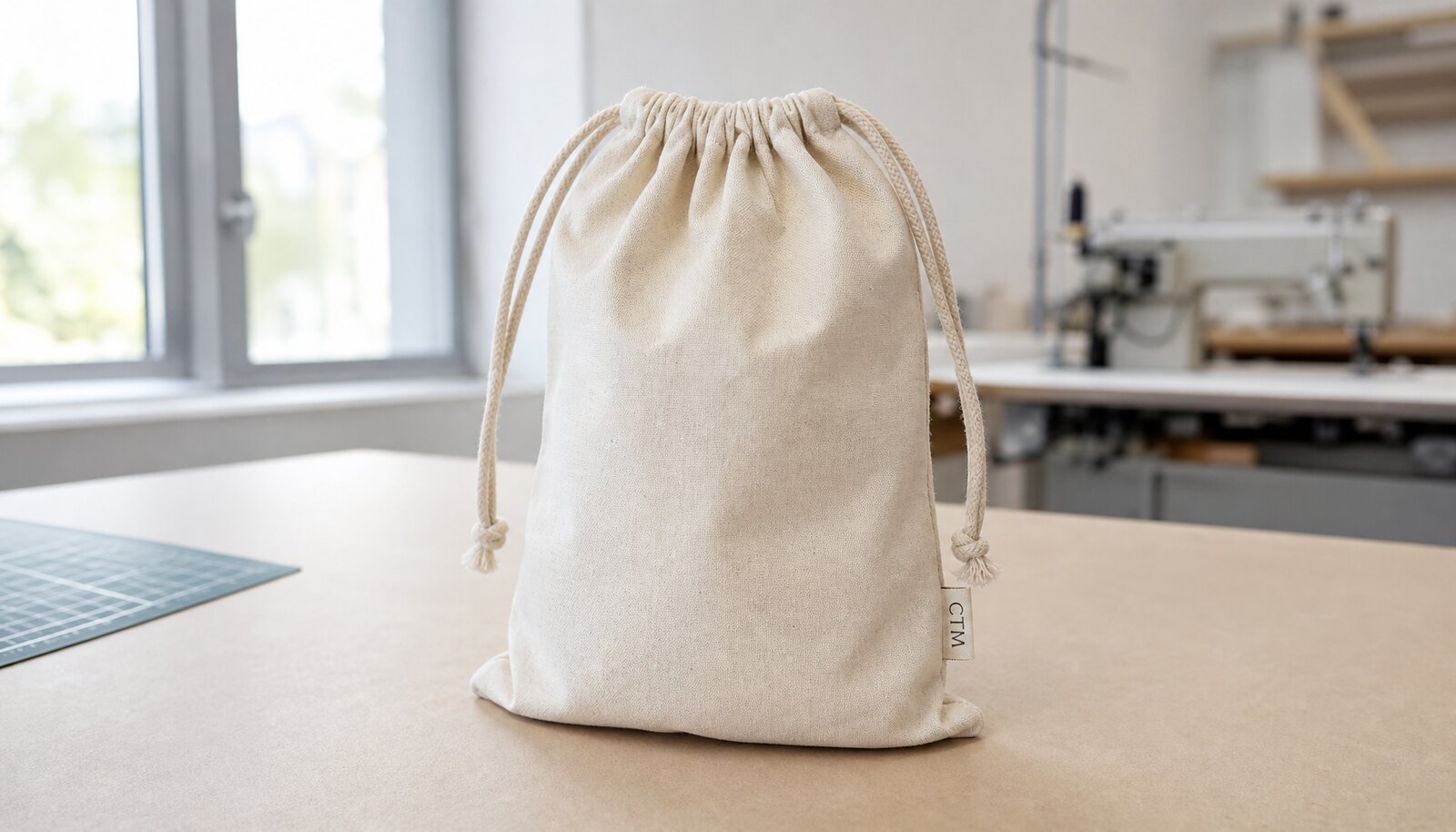
Start With the Retail Job, Not the Logo
A custom cotton drawstring pouch for a gift shop is not just a small bag with branding on it. It is retail packaging, a price signal, and often the first tactile item a customer handles before the actual gift. For procurement buyers, that means the proofing standard should reflect shelf handling, counter use, reordering, and carton flow—not just how the art looks in a PDF. If you only review a digital mockup, you miss the issues that drive rework later: print opacity on textured cotton, cord twist, seam distortion, and how the pouch sits when filled.
The practical starting point is to define the pouch’s retail job in one sentence. Is it a lightweight souvenir pouch for small keepsakes, a premium presentation bag for jewelry or cosmetics, or a reusable gift pouch that replaces disposable wrap? Each use case changes the right fabric weight, the print area, the closure feel, and how much visual variation you can accept in bulk. Gift shops often need a pouch that photographs well, stacks cleanly, and still looks neat after customers handle it. That is a different target than a general-purpose drawstring bag bought only for storage.
A buyer should also decide where the pouch sits in the commercial mix. If it is sold as an add-on at checkout, unit price matters most. If it is bundled with a gift set, visual consistency and packaging speed may matter more than saving a few cents. If it is used as a reusable branded tote alternative, durability and print life become part of the commercial spec. That business decision belongs in the RFQ before a factory starts sampling.
Choose the Cotton Base That Matches the Print and the Shelf Price
Fabric choice drives most of the print result, but it also drives the unit economics. On custom cotton drawstring pouches, the difference between lightweight muslin, standard plain weave, and a denser canvas-style cloth is not cosmetic. A loose weave can absorb ink quickly, but it also lets the design sink between threads, making thin lines disappear and solid fills look patchy. A tighter weave gives a cleaner edge and more premium shelf presence, but it usually costs more and may reduce softness.
GSM alone is not enough. Two pouches with the same weight can behave differently if one is an open weave and the other is a dense weave. For procurement, the safer approach is to request both GSM and a description of the weave structure, then compare the approved sample under the same lighting used for sign-off. If the pouch is for a seasonal retail program, ask about shrinkage allowance and whether the bulk fabric has been pre-shrunk or only estimated. Even a small change in finished size can alter how the pouch folds, packs, and displays.
Regional sourcing matters here too. If you are buying from factories in China, India, or Southeast Asia, cotton availability, loom density, and finishing methods can vary by region and even by mill. A supplier may quote “cotton” while sourcing from different mills across seasons. For repeat gift shop programs, ask where the cloth is sourced, whether the mill can be locked for reorder, and whether the factory can hold a confirmed fabric lot for replenishment. That reduces the risk of a second order looking slightly different even when the artwork file has not changed.
- Specify both GSM and weave type in the RFQ, not just fabric weight.
- Ask for the sample under the same lighting and the same fabric family planned for bulk.
- Check shrinkage allowance if the pouch will be washed, pressed, or stored for a long period.
- Ask where the cotton is sourced and whether the supplier can repeat the same mill or fabric lot for reorders.
Lock the Construction Spec Before Sampling
Print proofing only works when the base pouch is already controlled. The biggest source of confusion is when the buyer approves a logo on a screen but never locks the finished size, seam allowance, hem depth, cord channel, or gusset style. A 1 cm error on a small pouch can change usable capacity enough to make the pouch wrong for its intended retail item. If the buyer and factory do not agree on the physical spec before proofing, the sample can look approved while the bulk product still fails the job.
The spec sheet should read like a production document, not a marketing note. It should state finished size, cut size if needed, seam allowance, cord material, cord length, top hem depth, and whether the pouch is flat or gusseted. It should also say where the artwork begins relative to the top seam and side seam. That placement detail matters because cotton drawstring pouches are small surfaces, and decoration that looks centered in a mockup can drift once the bag is sewn and gathered. For buyers sourcing across regions, this is also where metric conversion errors happen; keep one unit system in the RFQ and repeat it on the approval sample card.
If you are comparing factories, ask them to quote the same construction language. One supplier may include a deeper hem or thicker cord in the base price, while another quotes a lighter build and then adds cost for the stronger version. That is why procurement should compare the pouch by function, not just by the headline price. The right question is not “What is your cheapest pouch?” but “Which pouch can you repeat at the approved shelf quality with the lowest landed cost and the least change risk?”
- Fix finished size and seam allowance before artwork approval.
- State cord type and cord length because both affect the final look and closure function.
- Write artwork placement as measured distances from the pouch edges, not as a visual guess.
- Keep all dimensions in one unit system and mirror them on the approval sample card.
Match Print Method to Weave, Artwork, and Lead Time
The best print method is the one that matches the artwork, the cloth, and the order pattern. For simple one-color logos on natural cotton, screen print is usually the most stable option. It gives consistent color, lower unit cost at volume, and a familiar retail look. The tradeoff is setup time: once screens are made, revisions are slower and a design change can add another round of charges. Buyers should therefore treat screen print as a strong choice when the art is stable and the reorder program is likely to continue.
For detailed seasonal artwork, licensing graphics, or low-volume launch runs, digital transfer or DTF can be a better proofing route. It shows the buyer how the art behaves before they commit to bulk screens or larger setup fees. The tradeoff is handfeel and durability. Transfers can look sharp but still fail if the adhesive edges lift, if the film feels stiff, or if the print cracks after flexing. If the gift shop item is meant to feel soft and natural, this difference can matter more than a slight gain in image detail.
A useful buyer comparison is unit economics by print method. Screen print usually has higher setup but lower unit cost as quantity rises; DTF or transfer often has lower setup but a higher per-piece cost and a greater chance of a tactile penalty. Woven labels or sewn brand tabs may be more expensive per unit than a flat print, but they can add premium value and avoid the detail loss that happens on open-weave cotton. In procurement terms, the real decision is often not “Which decoration is best?” but “Which decoration preserves margin and shelf quality at the expected order volume?”
- Use screen print for simple retail branding and repeatable bulk orders.
- Use transfer or digital proofing for detailed art or short-run launch programs.
- Do not approve a print method until you have seen its behavior on the actual cotton weave.
- Compare setup cost, unit cost, and tactile impact together rather than in isolation.
Use the Sample as a Production Gate, Not a Nice-to-Have
The first sample is not just a color approval. It is a proof of the full manufacturing path: fabric selection, sewing quality, cord motion, artwork placement, and print behavior. A good strike-off shows whether the logo fits the grain of the cloth, whether the text remains clear near the seam, and whether the pouch closes cleanly after being filled. If the sample looks good but is made from a different fabric lot, the approval has limited value.
A useful sample review should mirror how the pouch will be handled in the real program. Fill it with a small item, pull the cords, flatten it, fold it back into the expected pack format, and inspect it again. That catches problems that a flat image hides, including seam puckering, artwork distortion, and print placement that drifts toward the bottom fold once the pouch is packed. For seasonal retail programs, the sample should also be checked in the same fold direction that the bulk cartons will use.
Ask the supplier to send a blank proto before the decorated sample when the style is high risk or the first order is large. A blank proto is useful for checking stitch line, cord flow, seam tension, and actual capacity before the art is locked. Then require a printed strike-off on the same construction. That two-step proof process reduces the chance that the decoration gets approved on a pouch body that later turns out to be wrong.
For procurement files, keep more than a yes/no note. Save front, back, and detail photos of the approved sample, the date, the fabric reference, the ink or transfer reference, and the exact measurement card used during approval. That record becomes the control baseline when the factory asks for a reorder six months later.
- Approve the sample only if it uses the same fabric family planned for bulk.
- Test cord motion, seam tension, and print visibility when the pouch is filled and refolded.
- Save front, back, and detail photos of the approved sample as the production reference.
- Use a blank proto first when the construction or capacity is still uncertain.
Set QC Thresholds That the Factory Can Actually Inspect Against
Operational buyers need pass or fail criteria, not just a feeling that the bag looks acceptable. A good QC standard separates critical, major, and minor defects. Critical defects are the ones that break the order: wrong size, wrong artwork, open seams, broken cords, unreadable labels, or the wrong pouch color. Major defects are the ones that hurt retail value: visible print drift, heavy ink cracking, obvious staining, or a pouch that no longer closes correctly. Minor defects are cosmetic and should be limited in count: small loose threads, light fold marks outside the print zone, or tiny variations that do not affect shelf presentation.
The acceptance criteria should be specific enough for the factory to inspect against them. On small pouches, print position tolerance should be measured from the seam or edge, not judged by eye alone. Color should be checked against a physical reference in daylight-equivalent light whenever possible. If the artwork includes small text or fine outlines, define a minimum legibility standard at normal viewing distance and reject any sample where the weave swallows the details. For commercial credibility, the key is to tie each threshold to a clear inspection basis: measuring tape, visual comparison under standard light, or a rub/flex test done the same way each time.
If you are working with an offshore factory, ask what test standard or internal method they follow. Many factories use an internal AQL-style inspection or a buyer-specific checklist rather than a formal laboratory standard, and that is acceptable if the method is documented. What matters is consistency. A tolerance without a stated measuring method is hard to enforce and easy to dispute. For gift shops with strict branding, make the basis of every tolerance visible in the RFQ and on the approved sample card.
- Classify defects before production starts: critical, major, and minor.
- Set measurable tolerances for size, print position, and cord length.
- Require a physical color reference when brand consistency matters.
- State the inspection method next to each tolerance so the factory knows how to measure it.
Use Method-Specific Acceptance Criteria for Print Quality and Durability
Different print methods fail in different ways, so the acceptance test should match the method. Screen print usually fails by filling the weave, bleeding at the edge, or leaving gaps in solid areas. The buyer should reject samples where the logo becomes unreadable from normal viewing distance or where the ink puddles around the edges of letters. A water-based print can be acceptable on natural cotton, but only if the coverage is even and the design still reads cleanly across the cloth texture.
Transfer and DTF have a different failure profile. They can preserve detail very well, but they can feel stiff, lift at the edge, or crack after repeated flexing. Buyers should open and close the pouch multiple times, then inspect the corners and edge line of the graphic. If the pouch is intended for premium gift packaging, the handfeel matters as much as the image. A good proof should not just look correct on a table; it should still look good after the pouch has been handled like a retail item.
A practical buyer test for print durability is to combine visual inspection with a simple rub check and a flex check. Dry rub shows whether the ink transfers to a white cloth after repeated passes. Flexing shows whether a transfer edge starts to lift when the pouch is repeatedly opened and closed. These tests are not a replacement for a full lab program, but they are enough to catch obvious failures before bulk production. If the supplier offers an internal abrasion test or wash test, ask for the method and compare it with your intended use. A pouch that will never be washed does not need the same test as one sold as a reusable accessory.
- Reject screen prints that lose legibility, show heavy fill-in, or puddle at the edges.
- Reject transfer prints that lift, curl, or crack after repeated flexing.
- Judge the proof in the way the pouch will actually be handled at retail.
- Ask the supplier which rub or flex test method they use and keep it consistent for reorder control.
Build a Real Cost and Lead-Time View Before You Quote to Buyers
A quote for custom cotton drawstring pouches should be a production document, not a headline price. The same unit price can hide very different assumptions about fabric weight, print area, setup fees, packing format, and whether the factory is quoting blank stock or a full custom cut-and-sew order. Procurement teams need line-by-line clarity so they do not compare one supplier’s raw bag price with another supplier’s fully printed and packed landed cost.
The fastest way to expose hidden cost is to ask for the details that create rework. Ask who owns screens or plates, whether sample charges are refundable, whether overrun units are billed, whether the factory can store the print setup for reorder, and whether the proof uses production fabric. If the supplier cannot answer those questions clearly, the quote is not ready for a retail program. It may still work for a one-off project, but it is risky for a gift shop assortment that needs repeatable replenishment.
Lead time needs the same breakdown. A useful quote should separate sample lead time, bulk production lead time, quality inspection time, and freight time. For seasonal gift shops, a one-week delay in sample approval can cost more than a small unit price difference because it can push shipping into a more expensive window. Ask the factory for real lead-time examples by print method: screen print normally needs more setup time up front, while digital transfer may start faster but can slow if the order is large and labor-intensive. If the supplier is in another region, add customs clearance and inland trucking to the timeline so the estimate reflects reality, not just the factory floor.
A good buyer file should show a range, not a single number. For example, a simple one-color screen-printed pouch might have a shorter production path once the screen is approved, while a multi-color or transfer-based order may begin faster but cost more per unit and require more manual handling. The objective is not to chase the cheapest quote; it is to choose the quote that can be delivered on time, to spec, at a margin that fits the gift shop program.
- Compare landed cost, not only ex-works unit price.
- Separate unit price from setup, sample, packing, and freight assumptions.
- Ask whether screens, plates, or files are stored for reorder and for how long.
- Require a lead-time split for sample, bulk, inspection, and shipping.
Choose Packing That Protects the Print and Fits Retail Receiving
Packing is not a clerical detail. It affects print damage, carton counts, and how fast the receiving team can merchandise the order. For gift shop programs, the buyer should decide whether the pouches need individual polybags, paper wraps, hang tags, or barcode stickers. A pouch packed too tightly can crease the print. A pouch packed too loosely can arrive wrinkled or dusty. If the product will be sold from the inner pack, the fold direction should be fixed early and used consistently from sample to bulk.
Labeling matters just as much. Many gift shop buyers need fast counting, clean shelf replenishment, and straightforward size separation across stores. That means the carton mark, inner pack count, and barcode location should be specified before the order starts. Ask the factory for pre-shipment photos that show the fold direction, the inner pack, the carton label, and a finished unit. Those photos are the fastest way to catch a packing mistake before the truck leaves.
If you are sourcing across regions or routing through a distribution center, check carton durability too. A softer cotton pouch can shift inside a carton, so the outer box should be strong enough to hold the internal pack count without crushing the edges. For export shipments, ask for carton dimensions, gross weight, and whether the carton is optimized for pallet loading or for hand-carry receiving. A small change in carton efficiency can change freight cost enough to matter on a low-margin pouch program.
- Specify inner pack count, carton count, and carton dimensions in the quote.
- Keep one fold method fixed from sample to bulk to prevent new crease lines.
- Require barcode placement and carton mark format if the pouch goes directly to retail shelves.
- Ask for pre-shipment photos showing the exact pack method, not just the decorated pouch.
Supplier Selection Criteria for Gift Shop Buyers by Region and Order Profile
The right supplier is not always the closest one. For gift shop procurement, regional sourcing should be judged by order size, artwork complexity, and how much control the buyer needs over repeatability. A domestic or nearshore supplier can reduce communication friction, improve sample speed, and make short-run replenishment easier. An offshore factory may offer better unit economics on larger quantities, especially when the design is simple and the pack-out is standardized. The best choice depends on whether your program is a fast seasonal test or a long-running SKU.
Ask every potential supplier to explain three things: how they source cotton, how they manage print setup for reorder, and how they control consistent sizing across lots. In China, India, and Southeast Asia, a supplier’s strength may differ by print method or fabric family. Some factories are stronger in screen print and cut-and-sew control, while others are better at short-run decoration or fast sampling. Instead of asking who is “best,” ask who is best for your pouch type, your reorder rhythm, and your target margin.
There are also practical regional trade-offs. Nearshore suppliers often support smaller minimums and faster corrective action if the proof needs revision. Offshore suppliers may give a better landed price for larger cartons but require tighter upfront documentation because once the bulk order starts, changes are expensive. For gift shops, where the same pouch might be sold in multiple seasonally timed windows, the supplier should be evaluated on reorder reliability as much as on first-order cost. A cheaper first quote is not a win if the second order drifts in fabric tone, print placement, or pack method.
A useful supplier scorecard should include sample speed, communication clarity, proof accuracy, packing discipline, and willingness to document the exact production spec. If a factory treats your RFQ as a one-off art job instead of a repeatable retail component, the relationship is likely to stay expensive. If they can quote the same construction twice and reproduce the same sample card, they are closer to what gift shop buyers need.
- Match supplier region to order size, lead time, and reorder frequency.
- Ask how the supplier sources cotton and locks the same fabric for repeat orders.
- Score factories on proof accuracy and packing control, not only on unit price.
- Choose nearshore for speed and correction, offshore for scale and lower landed cost when documentation is tight.
Specification comparison for buyers
| Spec decision | Recommended option | When it fits | Buyer risk to check |
|---|---|---|---|
| Single-color logo on natural cotton | Factory screen print with one matched ink and a fixed print area | Best for retail branding, souvenir packaging, and repeat seasonal reorders | Confirm fabric weave, ink opacity, and print placement or the logo can sink into the cloth |
| Fine illustration or licensed artwork | Digital transfer or DTF on the proof sample, then compare against screen print for volume | Useful for gradients, detailed line art, and launch programs with uncertain demand | Check edge sharpness, handfeel, rub resistance, and whether the method adds visible stiffness |
| Low MOQ test run | Blank pouch from the factory plus local or digital decoration | Works for pop-up shops, new store tests, and short seasonal programs | Watch landed cost because local finishing, freight, and split sourcing can erase the savings |
| Rustic natural look | Unbleached cotton with water-based screen print | Fits eco-positioned retail programs and heritage-style gift packaging | Check show-through on open weave cloth, ink coverage, and whether the print is too translucent for shelf display |
| Premium boutique presentation | Small logo plus woven side label or sewn brand tab | Good for jewelry, candles, specialty souvenirs, and higher-margin gift sets | Inspect label placement, scratch points, and seam tension near the drawcord channel |
| Many SKUs on one pouch body | One construction spec with multiple artwork versions | Works well for museum shops, tourist stores, and chain retail assortments | Separate setup, screen, and artwork fees can make the quote look cheaper than it is |
| Fastest launch | Direct factory printing on approved stock fabric | Useful when timing matters more than advanced decoration | Make sure the sample and bulk use the same fabric lot and ink system |
| Tight retail control | Single factory with pre-shipment photo approval and carton-count verification | Best for multi-store rollouts and reorder-heavy programs | Ask who owns final inspection or small packing errors will slip through |
| Lowest unit cost at scale | Screen print on a stable, repeatable pouch spec | Best when the same design will reorder across several gift shop cycles | Check setup amortization, minimums, and whether the factory charges again for revised artwork |
Buyer checklist before sampling
- Finished size, seam allowance, gusset depth if any, and drawcord length are written into the RFQ.
- Fabric content, weave type, GSM, and shrinkage allowance are fixed before art approval.
- Artwork files include final dimensions, placement from the top edge and side seam, and Pantone or physical color references.
- The factory confirms print method, mesh count or plate use, ink type, and whether the proof uses production fabric.
- A blank proto and a printed strike-off are approved before bulk cutting starts when the style is high risk.
- Tolerance targets are set for bag size, cord length, print position, and multi-color registration.
- The quote states whether the pouch is folded flat, rolled, or packed loose, plus inner pack count and carton count.
- Barcode label format, carton mark text, and retail-ready packing requirements are defined in writing.
- Lead time is split into sample, bulk, inspection, and shipping days so delays are visible early.
- The quote states overrun and underrun limits, how extras are handled, and whether screens are stored for reorder.
Factory quote questions to send
- Which cotton weave are you quoting for the pouch body: plain weave, muslin, or canvas-style cloth?
- What GSM and shrinkage allowance are included in the quoted fabric specification?
- Is the print done in-house, and which method will you use for the proof and for bulk production?
- If the artwork uses more than one color, what is your registration tolerance and do you use a jig or fixture?
- What is the exact print area, and how far is the artwork placed from the top seam and side seam?
- What is the MOQ by size, artwork version, and number of print colors?
- Are setup costs, screens, plates, sampling, and packing added separately from unit price?
- Will you make the sample on the same fabric lot, ink system, and construction as the bulk order?
- What is your allowed overrun or underrun percentage, and how are extras billed or packed?
- How many units go into one inner pack and one export carton, and can you provide the carton dimensions?
Quality-control points to confirm
- Fabric GSM should match the approved spec within plus or minus 5 percent, and the weave should match the approved sample in openness, handfeel, and visual density.
- Finished size should stay within plus or minus 3 mm for small pouches under 200 mm and plus or minus 5 mm for larger pouches unless the buyer sets a tighter spec.
- Cord lengths should match within 5 mm on each side, slide freely through the channel, and show no fraying, twisting, or snagging.
- Seams should have no open sections, skipped stitches, or broken stitch runs longer than 5 mm, and seam lines should stay straight after filling the pouch.
- Print placement should stay within plus or minus 2 mm on small pouches and plus or minus 3 mm on larger pouches, measured from the approved reference points.
- Single-color prints should stay legible at normal viewing distance with no obvious fill-in across the weave, no pinholes larger than 1 mm in solid areas, and no ink pooling at the edges.
- Multi-color prints should show clean registration with no visible ghosting or color shift greater than 1 mm at the text edge or outline unless the art is intentionally distressed.
- Dry rub testing on a visible area should show no obvious color transfer after 10 back-and-forth passes with a white cotton cloth.
- If the print is a transfer or DTF, it should not crack, curl, or lift at the edges after 20 full open-and-close flexes of the pouch.
- Carton count, inner pack count, barcode label, and carton marks should match the packing list exactly, and barcode labels should scan on first pass.