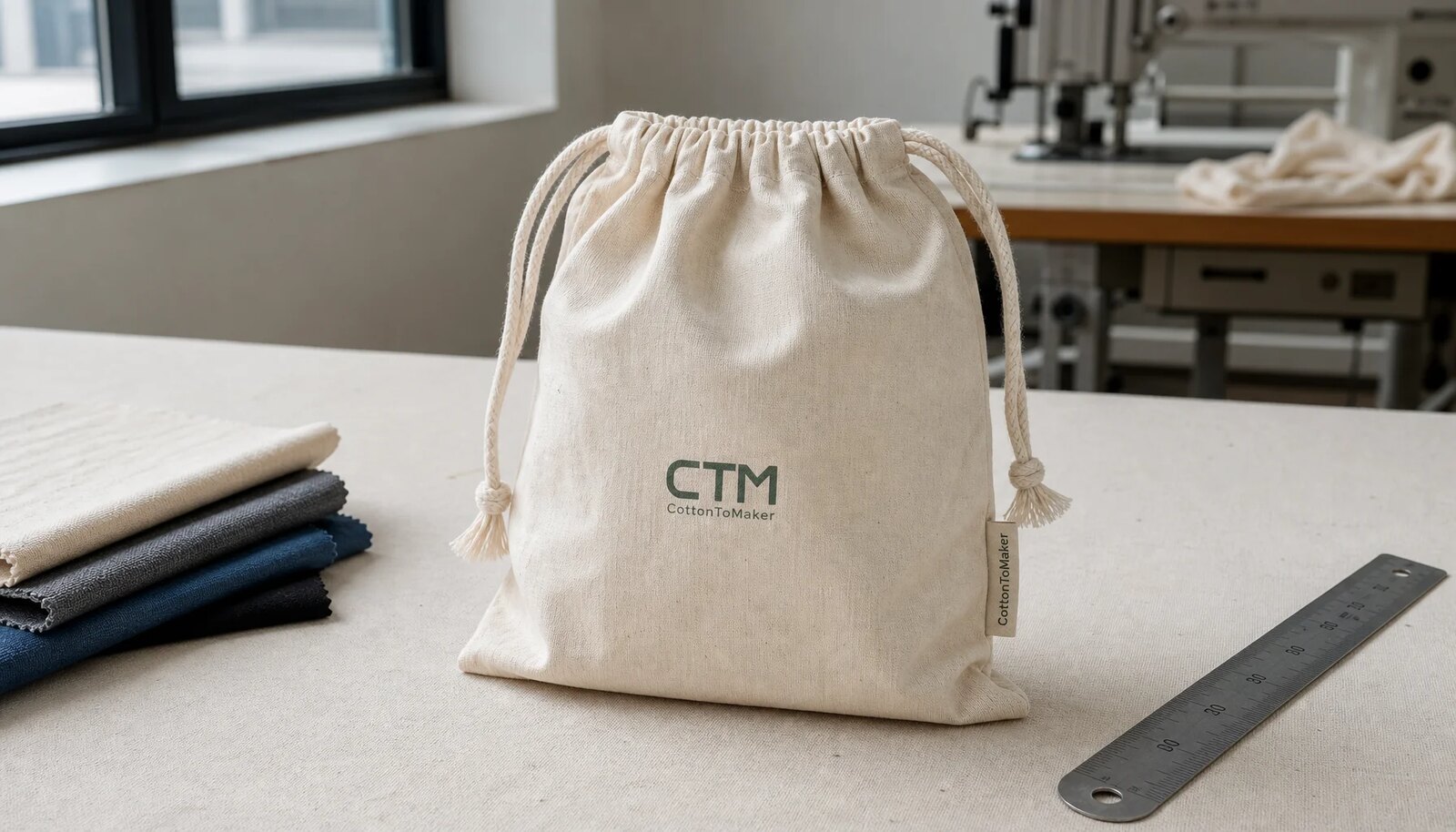
Why proofing belongs in procurement
Custom cotton drawstring pouches look uncomplicated at first glance. That is exactly why they can slip through sourcing too casually. A small pouch may have one logo, one cord, and two side seams, but the finished result depends on fabric weight, weave texture, cutting accuracy, sewing allowance, drawcord channel depth, print pressure, curing, trimming, folding, and carton packing. A digital artwork proof can confirm the logo on a drawing. It cannot show how ink sits on natural cotton, whether the logo shifts after sewing, or whether the export fold will run through the printed mark.
For eco apparel brands, the pouch is rarely just a low-cost giveaway. It may replace a polybag, protect a folded garment, present a retail set, support a gifting program, or stay with the customer as reusable storage. That makes print proofing an operational control step, not a decorative approval. Procurement needs to know whether the pouch fits the real product, whether the drawcord closes without strain, whether the print survives normal handling, and whether the packing format supports the brand's reduced-plastic brief.
Most pouch problems are not dramatic production failures. They are small mismatches repeated across thousands of units: fabric that feels thinner than the approved sample, a logo printed from the cut panel instead of the finished seam, cord lengths that vary by carton, ink that offsets because packing started too early, or mixed cartons that slow receiving. A useful custom cotton drawstring pouches print proofing checklist for eco apparel brands turns those details into measurable approval points before the supplier starts bulk work.
- Treat proofing as part of sourcing, sampling, production approval, and final inspection.
- Approve the complete pouch: fabric, finished size, print, cord, sewing, finishing, packing, and carton labeling.
- Keep written tolerances and retained samples so inspection follows the same standard procurement approved.
Lock the pouch spec before the logo
Artwork approval should start after the physical pouch specification is stable. Cotton drawstring pouches are often quoted by GSM, but GSM alone does not define performance. A loose 140 GSM cotton can look more transparent and print less sharply than a tighter cloth at the same weight. Natural unbleached cotton may include seed specks, slubs, and shade movement that fit an eco look. Bleached or dyed cotton may give cleaner contrast for a more retail-facing presentation. The RFQ should state GSM range, color, weave or hand-feel description, shrinkage expectation, and whether natural variation is acceptable.
Finished dimensions matter more than catalog size labels. A 20 x 30 cm pouch from one supplier may not have the same usable internal space as another if the channel depth, seam allowance, bottom fold, or gusset is different. State whether width and height are measured flat after sewing and pressing, and whether tolerance applies before or after normal cotton relaxation. If the pouch will hold a folded T-shirt, scarf, lingerie set, socks bundle, or accessory kit, test the sample with the real product or a size-accurate dummy.
The print area should be drawn around finished construction features. Measure the safe zone from the lower edge of the top channel, cord exits, side seams, bottom seam, gusset folds, woven labels, and barcode labels. A logo centered on a rectangle in a PDF may look high once the channel is sewn. A logo placed too low may sit on a fold or disappear when the pouch is filled. The proof should show the artwork dimensions and the exact distance from finished pouch landmarks.
- State fabric GSM, weave, color, finish, shrinkage expectation, and acceptable natural cotton variation.
- Define finished size, usable internal size, channel depth, gusset details, and measurement method.
- Approve print placement from finished seams and channels, not from a generic flat artwork box.
Choose the print method by risk
Screen printing is often the practical choice for bold one-color or two-color pouch logos, especially for repeat programs and medium-to-large quantities. It can give stable color, efficient cost after setup, and a familiar cotton hand feel. Still, the buyer should confirm minimum printable line thickness, minimum readable text height, registration tolerance for multi-color work, ink type, curing method, and opacity on natural fabric. Thin strokes, small serif text, tight negative space, and distressed logos can close up or break on woven cotton.
DTF and heat transfer are useful when artwork has gradients, many colors, smaller MOQs, or detail that would require several screens. The tradeoff is usually touch and edge behavior. A transfer can feel like a film on top of the cotton, and a large solid area may crack or show pressure marks if folded through the logo. The proof should test the exact transfer size on the actual pouch fabric, then check fold lines, dry rub, edge lift, adhesive residue, and any visible heat-press box around the design.
Embroidery can work well for premium reusable pouches when the artwork is simple and the fabric is heavy enough to hold stitches without puckering. It should not be the default for fine text, dense filled artwork, thin cotton, or placements close to seams and drawcord channels. If embroidery is quoted, request stitch count, thread color standard, backing method, reverse-side appearance, and pucker tolerance. For apparel packaging, the inside of the pouch matters because thread tails or rough backing can touch the product.
- Use screen print for simple spot-color marks after checking line detail, opacity, registration, and curing.
- Use transfer or DTF for multi-color and low-MOQ work after checking feel, edge lift, fold behavior, and rub resistance.
- Use embroidery only on suitable fabric weights with simple artwork and an inside finish the packed product can tolerate.
Build proofing gates that mean something
A reliable approval path has more than one gate because each gate answers a different question. The digital artwork proof confirms file version, logo size, placement, color reference, print side, orientation, and production readiness. The strike-off shows how ink, transfer, or thread performs on the specified fabric. The pre-production sample confirms the whole item: fabric, cutting, sewing, cord, print, finishing, and packing fold. The sealed approval sample becomes the reference for bulk inspection.
Approval language should be exact. An email that says "approved" without a sample number, artwork file name, measurement sheet, or correction list can create trouble later. A stronger record lists the artwork version, pouch size, fabric spec, print method, printed logo dimensions, measured placement, cord spec, packing method, date, and approver. If the sample is approved with comments, those comments should become a written correction list or a revised sample. Otherwise the factory may reasonably treat the physical sample as approved exactly as received.
For first orders, new suppliers, or launch-critical packaging, the pre-production sample should use intended bulk fabric and intended production settings. If substitute fabric is used because bulk material is not ready, procurement should record that limitation and require a second confirmation before mass printing. Keep one sealed approval sample for inspection and one working sample for garment fit and handling checks. The sealed sample is a commercial reference, not a showroom piece.
- Separate the digital artwork proof, fabric strike-off, pre-production sample, and sealed approval sample.
- Tie every approval to a version number, measurement sheet, photo set, fabric spec, and correction status.
- Do not release bulk production from substitute material unless the risk and next approval step are written.
Put tolerances in plain numbers
Cotton pouches need tolerance because cotton moves during cutting, sewing, pressing, packing, and normal relaxation. Zero tolerance is not realistic. Missing tolerance is worse because it leaves the supplier and buyer using different standards. The PO should include finished size tolerance, print placement tolerance, color acceptance method, multi-color registration tolerance, cord length tolerance, stitch quality standard, carton count rules, and defect classification. The exact numbers should fit the pouch size and brand requirement, but the decision must be made before bulk production.
Placement tolerance should be measured from finished pouch features. For example, a front logo may be horizontally centered and positioned a specific distance below the lower edge of the drawcord channel. If a gusset changes the visible front panel, the proof should show the measurement start point. If the buyer wants the logo visually centered when the pouch is filled, the sample should be approved while filled with the intended product. Written measurement logic prevents arguments about whether a logo is centered on the fabric panel, the sewn pouch, or the filled presentation.
Color tolerance also needs a practical standard. Pantone references are helpful, but cotton color, ink absorption, weave texture, and natural fabric shade can affect the final appearance. A physical approved print reference is often more useful than a number by itself. For repeat orders, define whether the supplier must match the previous bulk shipment, the latest approval sample, or a fresh strike-off. If the pouch is part of a wider apparel packaging system, compare it beside hangtags, labels, tissue, and cartons under normal viewing light.
- Write tolerances for finished size, print placement, color, registration, cord length, sewing, and packing count.
- Measure logo placement from sewn seams, channel edges, cord exits, and other finished features.
- Use a physical approved print reference where color accuracy is commercially important.
Inspect print at production scale
Print QC should go deeper than deciding whether the logo looks attractive. On screen print, check solid areas for weak opacity, pinholes, uneven pressure, ink buildup, bleeding, smudges, rough edges, and filled-in small details. On fine artwork, counters in letters should stay open, thin strokes should remain visible, and small text should be readable at actual pouch viewing distance. For multi-color print, registration should be checked across cartons, not only on the first good sample.
For DTF or heat transfer, inspect the edge of the transfer, surface feel, color consistency, heat press marks, adhesive residue, cracking, and whether the design lifts when bent at likely fold points. For embroidery, inspect thread color, stitch density, skipped stitches, thread nests, pucker, backing, and reverse-side comfort. The accepted defect level should reflect the pouch's use. A reusable retail pouch has a different customer visibility standard than a short-life internal packing pouch, but both need a clear pass/fail rule.
Durability checks should match the handling path. A dry rub check can reveal pigment transfer during packing and customer handling. A fold check can show cracking or pressure marks if the logo lies on a fold line. A tape pull may be useful for transfer edge adhesion. A light wash-handling check only makes sense if the brand will market the pouch as washable or expects repeated consumer washing. Test the failure modes that would create real customer complaints.
- Check opacity, edge quality, pinholes, bleeding, filled letters, broken lines, registration, and surface marks.
- Match rub, fold, tape, or wash-handling checks to the pouch's real use and any brand claims.
- Compare first, middle, and late bulk units with the sealed approval sample to catch print drift.
Do not separate print from sewing
A perfect logo cannot rescue poor construction. Uneven side seams can make a centered print look crooked. A tight or inconsistent drawcord channel can cause the cord to jam. Puckered corners, skipped stitches, loose threads, and frayed cord exits make the pouch look unfinished even when the print is correct. Procurement teams should keep sewing checks in the same proofing file as artwork because the customer receives a complete item, not a separate printed panel.
Cord specification deserves its own line in the RFQ. Cotton cord, polyester cord, braided cord, flat tape, dyed cord, and natural cord all behave differently. Cotton may align better with an eco positioning but can vary in shade and fray if ends are not controlled. Polyester may slide smoothly but may not fit the material story. Specify cord material, diameter or tape width, color, length, single-draw or double-draw construction, knotting, end finish, and whether the pouch must close fully around the packed product.
Inside finish matters for apparel. Loose threads can transfer to garments, rough seams can snag delicate fabrics, and odor or dust can create receiving issues. Natural cotton pouches can pick up lint, cutting dust, oil marks, or handling stains in production. The inspection should include inside and outside surfaces, cord channel, seam ends, and bottom corners. If the pouch replaces a polybag, cleanliness becomes part of the product protection standard, not just an aesthetic preference.
- Inspect seam straightness, stitch density, skipped stitches, backstitching, puckering, loose threads, and corner strength.
- Specify cord material, diameter or width, length, color, draw style, knotting, and fray control.
- Check inside surfaces for lint, loose threads, stains, odor, rough seams, and transfer risk to apparel.
Make quotes comparable before choosing
Pouch quotations often look comparable while hiding different assumptions. One supplier may quote 120 GSM natural cotton and another 160 GSM. One may include screen setup while another lists it separately. One may quote one-side printing, while another assumes two sides. One may include individual polybags even though the brand wants reduced plastic. Unit price alone is not useful until fabric, size, print, sampling, packing, MOQ, inspection, lead time, and incoterm are normalized.
A strong RFQ asks all suppliers to quote the same base specification and show optional items separately. Request line items for heavier GSM, second print color, second-side print, paper band, barcode label, individual packing, lower MOQ, sample shipping, and third-party inspection support. Ask for two or three quantity tiers so procurement can see whether the next practical volume meaningfully changes price. For repeat programs, ask whether screens, print files, or embroidery programs are kept for future orders and whether repeat setup fees apply.
Clarify the production route before supplier award. A direct factory with in-house sewing and printing can reduce handoff risk, but only if the sample and bulk production use the same process path. A trading company can be valuable for multi-SKU apparel packaging, but the named factory and inspection responsibility should be visible. Ask who buys fabric, who cuts, who prints, who sews, who trims, who packs, and who signs off before shipment. Accountability is part of the quote.
- Normalize quotes by GSM, finished size, print method, print sides, setup, MOQ, packing, incoterm, and lead time.
- Ask for optional line items and volume tiers instead of relying on one blended unit price.
- Confirm sample origin, bulk origin, production facility, and inspection responsibility before supplier award.
Protect the print in packing
Packing can create print defects after production appears complete. If ink or transfer decoration is folded, stacked, banded, or carton-packed before proper curing or cooling, the logo can offset, stick, crack, or show pressure marks. A flat-fold bulk pack is efficient, but the fold should not pass through sensitive artwork unless the proof has tested that exact condition. The supplier should confirm cure time, cooling time where relevant, print-face direction, stacking method, and whether interleaving is needed for the selected decoration.
Eco apparel brands should also make the packing method match the sustainability brief. If the pouch is intended to reduce plastic, the quote should not quietly include one polybag per pouch. Alternatives such as bulk packing, paper bands, grouped paper wraps, carton liners, or retail-ready paper sleeves can work, but each affects labor, cleanliness, moisture control, carton cube, and presentation. Plastic-free packing may require cleaner cartons, better humidity management, and stricter handling to prevent dust and stains.
Carton control reduces receiving problems. Specify inner count, master carton count, carton dimensions if warehouse limits exist, gross and net weight needs, shipping marks, SKU labels, mixed-carton rules, and barcode placement. For multi-size or multi-logo programs, carton labels should prevent receiving teams from opening every carton to identify contents. Before shipment, request photos of packed pouches, inner packing, carton marks, and carton count. The approved pouch is only successful if it arrives in the approved condition.
- Control folding method, cure time, print-face direction, stacking, inner count, carton count, and carton marks.
- Align reduced-plastic packing with cleanliness, moisture protection, labor cost, and retail presentation needs.
- Require packed-carton confirmation for multi-SKU, barcode, warehouse-sensitive, or retail-ready orders.
Use final signoff before shipment
Final signoff should connect the RFQ, quotation, PO, approved sample, production photos, inspection result, and packing list. Before shipment, confirm that bulk goods use the approved fabric specification, print method, artwork version, finished size, cord, sewing construction, packing format, and carton labeling. This is the last practical point to separate defects, rework units, repack cartons, or document approved deviations before export.
Inspection depth should match risk. A first order, new factory, tight launch date, high-visibility retail program, or changed pouch specification deserves more scrutiny than an unchanged replenishment order from a proven supplier. For higher-risk orders, schedule buyer or third-party inspection after production is complete and before final payment or shipment release. For lower-risk replenishment, factory inspection photos and retained samples may be sufficient if past performance supports that approach.
Any deviation should be written clearly. If the buyer accepts a small shade variation, alternate cord length, changed carton count, or revised fold method, record the affected quantity, photos, measurements, and approval date. Avoid burying commercial decisions in informal chat threads. A disciplined signoff file protects the buyer, gives the factory a clear standard, and makes future reorders faster because the pouch specification is already controlled.
- Match bulk goods against the RFQ, PO, approval sample, tolerance sheet, and packing specification.
- Choose inspection depth based on supplier history, order value, launch risk, and customer visibility.
- Record approved deviations with affected quantity, measurements, photos, and written buyer approval.
Specification comparison for buyers
| Decision area | B2B specification to request | Procurement use case | Quote or QC risk to control |
|---|---|---|---|
| Supplier route | Direct factory with confirmed in-house cutting, sewing, and printing | Repeat pouch programs, tighter print placement control, faster sample correction, and fewer production handoffs | Ask whether bulk goods will be cut, sewn, printed, finished, and packed in the same facility that made the approved sample |
| Supplier route | Trading company or sourcing office with named factory and written inspection responsibility | Multi-SKU apparel packaging programs, export coordination, bilingual project management, or mixed cotton packaging categories | Require factory name, sample origin, bulk origin, inspection owner, and responsibility for defects in writing before price comparison |
| Fabric weight | 120-140 GSM cotton, plain weave or similar light woven quality | Cost-sensitive garment accessories, socks, lingerie, lightweight apparel kits, event pouches, and low-bulk ecommerce packaging | Check opacity, seam strength, stitch tear-out risk, logo show-through, and whether dark ink distorts on a loose weave |
| Fabric weight | 160-200 GSM cotton, tighter weave or heavier reusable quality | Premium apparel packaging, retail gift sets, reusable storage pouches, heavier accessories, and brand-facing presentation | Expect higher unit cost, slower sewing, thicker carton cube, higher freight impact, and possible embroidery suitability |
| Construction | Flat pouch with side seams and top drawcord channel | Common apparel and accessory packaging where the packed product has moderate thickness | Confirm usable internal size, channel depth, cord exit position, seam allowance, and finished-size tolerance after sewing and pressing |
| Construction | Bottom gusset or boxed bottom, if required | Bulky folded garments, footwear accessories, gift sets, or kits that need expanded capacity or a standing shape | Ask for gusset measurement method, finished capacity, additional sewing cost, and print placement impact when filled |
| Print method | Screen print with 1-2 spot colors | Bold logos, repeat programs, medium to high quantities, stable brand colors, and efficient per-unit cost after setup | Confirm screen charge by color and side, ink type, opacity on natural cotton, minimum line width, registration tolerance, and curing process |
| Print method | DTF or heat transfer | Multi-color artwork, gradients, smaller MOQs, detailed graphics, or orders where screen setup is inefficient | Check hand feel, transfer edge visibility, heat press marks, edge lift, cracking on fold lines, and dry-rub performance |
| Print method | Embroidery on heavier cotton | Premium reusable pouches with simple logos, initials, small icons, or limited edition packaging | Avoid light fabric, small type, dense fills, large stitch areas, and placements close to seams or drawcord channels |
Buyer checklist before sampling
- Final vector artwork in AI, EPS, PDF, or SVG format with fonts outlined, strokes expanded where needed, Pantone or approved visual color references, minimum line thickness, and minimum text height confirmed for the chosen print method
- Finished pouch width and height measured flat after sewing, plus any bottom gusset, side gusset, boxed bottom, seam allowance, drawcord channel depth, and internal usable size requirement for the packed garment
- Usable print area measured from finished pouch features, including top channel edge, cord exits, side seams, bottom seam, gusset folds, woven labels, barcode labels, and required logo clear space
- Fabric specification including GSM range, weave or hand-feel description, natural, bleached, or dyed color, shade tolerance, shrinkage expectation, pre-wash or non-pre-wash status, and whether slubs or cotton seed specks are acceptable
- Decoration specification including print method, print side, print size in millimeters, number of colors per side, ink, transfer, or thread type, setup charges, repeat order screen policy, and whether back-side printing has a separate charge
- Proofing package including digital artwork proof, printed strike-off, pre-production sample, sealed approval sample, approval photos, measurement sheet, sample version number, and written corrections before bulk start
- Tolerance sheet covering finished size, logo placement, color acceptance method, registration tolerance for multi-color print, cord length, stitch density, carton count, and defect classification for inspection
- Cord specification including material, diameter or tape width, color, length, single-draw or double-draw construction, knot or end finish, fray control, and smooth closure when the real product is inside
- Sewing and finishing requirements including seam type, stitch density target, backstitching, loose thread trimming, pressing, lint removal, odor control, stain prevention, and inside-pouch cleanliness
- Packing format including folding method, print-face direction, cure time before packing, inner pack count, paper band or polybag decision, carton count, carton markings, SKU labels, barcode labels, and plastic-free requirement if applicable
Factory quote questions to send
- What exact cotton fabric are you quoting, including GSM range, weave type, color, finish, shrinkage expectation, and whether natural cotton specks, slubs, or shade variation are considered acceptable?
- Is the bulk fabric from the same lot as the approved sample, the same mill specification, or a substitute equivalent, and how will you notify us if the fabric source, shade, or GSM changes?
- What are the finished pouch dimensions after sewing and pressing, and what tolerance do you apply for width, height, gusset, drawcord channel depth, and internal usable size?
- Which print method are you quoting for this artwork, and what setup charges apply by color, side, screen, transfer, embroidery program, or repeat order?
- What minimum printable line thickness, minimum readable text height, and minimum gap between design elements do you recommend on this cotton fabric using the quoted decoration method?
- Is the price based on one-side or two-side printing, and how does the cost or defect risk change if the logo is close to the top channel, side seam, bottom seam, cord exit, gusset, or side label?
- Can you provide a digital proof, strike-off on actual fabric, and pre-production sample, and can you separate the cost and lead time for each approval step?
- What is included in the unit price for cord material, cord color, cord length, knotting, end finish, side labels, paper bands, barcodes, carton marks, and export cartons?
- What MOQ applies by fabric color, pouch size, print version, cord color, and packing method, and what are the next two practical price break quantities?
- What lead time applies after artwork approval, after physical sample approval, and after deposit, and which approval step officially releases bulk material cutting or bulk printing?
Quality-control points to confirm
- Fabric GSM matches the agreed range using a practical GSM check method, and the approved hand feel, opacity, color tone, weave texture, and natural cotton character are maintained across bulk cartons
- Finished pouch dimensions are measured flat after sewing and normal relaxation, with width, height, gusset, and channel depth within the approved tolerance rather than estimated from cut panels
- Usable print area is respected, with no logo element too close to the top channel, side seam, bottom seam, cord exit, gusset fold, woven label, barcode label, or planned fold line
- Print placement is measured from finished pouch features and stays within the approved millimeter tolerance for horizontal centering, vertical drop from the channel, and side-to-side alignment
- Print color matches the approved physical reference or agreed Pantone target within the accepted visual tolerance, allowing for documented natural cotton shade influence where applicable
- Screen print coverage is even, with no heavy ink buildup, weak opacity, pinholes, bleeding, smudging, rough edges, filled counters, broken fine lines, scorch marks, or visible registration drift
- Transfer or DTF decoration shows no edge lift, adhesive residue, heat box mark, excessive plastic hand feel, cracking at fold points, or color transfer after agreed handling checks
- Embroidery decoration has consistent thread color, clean edges, controlled tension, no puckering, no loose thread nests, and an acceptable reverse side for the product being packed
- Seams are straight and secure, stitch density is consistent, backstitching is present at stress points, and there are no skipped stitches, open seams, puckered corners, needle cuts, or loose threads
- Cord channel width is consistent, cord exits are clean, cord length is uniform, knots or ends are secure, and the pouch closes smoothly with the intended garment or accessory inside