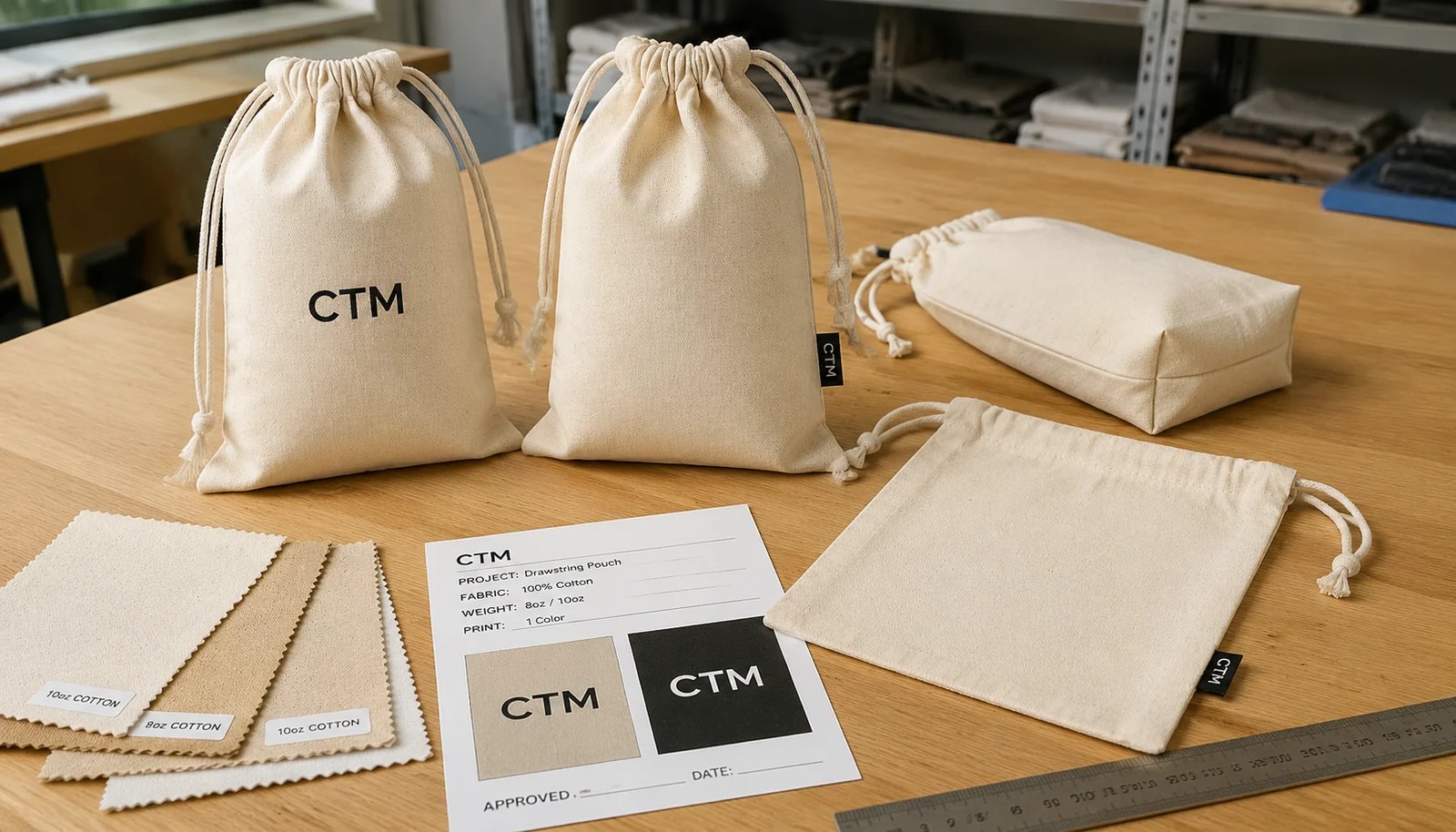
Why MOQ gets difficult on liquor retail pouch programs
MOQ discussions on custom cotton drawstring pouches usually go wrong because the buyer is negotiating the total order number while the factory is calculating several different minimums underneath it. A pouch for liquor retail can trigger separate cost thresholds for greige fabric purchase, dye lot, screen setup, sewing line efficiency, woven label run, and carton packing format. If the buyer only says they need 2,000 pieces, that number may still be uneconomic when split across four bottle sizes, two logo versions, and a premium dyed fabric.
Liquor retail also has a packaging behavior that drives complexity faster than many non-alcohol categories. One retailer may want the pouch to fit a standard 750ml bottle, a taller sparkling bottle, and a seasonal gift pack, all under one buying program. That sounds like one product family, but it often acts like multiple SKUs in production. The practical route is to identify which parts of the pouch can stay common across the range, then negotiate MOQ around those common elements instead of pushing every variable at once.
- MOQ may apply separately to fabric color, print artwork, size, and label.
- Flat natural cotton usually gives more flexibility than dyed custom-color canvas.
- A low initial quantity is easier if the first order uses one fabric, one print color, and one packing method.
- Retail assortment programs often fail at quote stage because buyers request mixed small runs without understanding where the factory loses efficiency.
Start with the bottle fit, not the pouch look
The biggest hidden cost in pouch sourcing is redesign after the first fit sample. Buyers often begin from a visual reference and add dimensions later, but for bottle pouches the fit drives everything: cut size, seam stress, drawcord placement, bottom shape, and how much fabric is actually consumed. A pouch that looks neat on a flat drawing may not close properly over a long-neck bottle, and a bag that fits a broad bottle base may need more gusset depth than expected.
For RFQ purposes, give the supplier the actual bottle dimensions and describe how the pouch will be used in store. A pouch that only covers the bottle body needs less fabric than one that must close fully over the cork or cap. If the pouch will be used as a premium gift wrap, the top allowance above the bottle matters because a short neck reveal can look cheap even if the bag technically fits.
- Provide bottle height, maximum body diameter, neck width, and cap or closure height.
- State whether the pouch must close fully, partially, or remain open for presentation.
- Clarify if the pouch holds bottle only or bottle plus neck tag, leaflet, or mini accessory.
- If multiple bottle formats are in scope, identify the one pouch size that covers the largest shared requirement.
Fabric weight choices that affect MOQ and quote comparability
For custom cotton drawstring pouches in liquor retail, 8oz canvas at about 270 GSM is usually the commercial starting point. It gives enough body for a decent retail presentation without pushing fabric cost too high, and it is commonly available in natural stock fabric. That matters during MOQ negotiation because a factory holding regular natural cotton inventory can offer a lower cut-and-sew minimum than if it needs to buy a special fabric run from a mill.
Moving to 10oz canvas, around 340 GSM, often makes sense for premium spirits or when the retailer wants a more substantial reusable feel. But the buyer should treat it as both a quality upgrade and a negotiation trigger. Heavier canvas can reduce cutting yield, increase sewing time slightly, and make print handling different due to thicker texture. If two suppliers quote the same pouch style at very different prices, the first thing to verify is whether their GSM basis and fabric composition are truly comparable.
- Typical commercial range: 6oz to 10oz cotton canvas, roughly 200 to 340 GSM.
- Natural cotton stock fabric generally supports lower MOQ than custom dyed fabric.
- Ask for actual tested GSM or fabric spec sheet, not just a sales description.
- Heavier fabric may improve premium feel but can raise both unit cost and sample revision risk.
Print method and branding route: where small orders become expensive
For most liquor retail pouch programs, one-color screen printing remains the most economical custom branding method. The setup cost is manageable, the result is durable on cotton, and print speed works well for medium and large runs. The issue is not that screen print is expensive by itself. The issue is that buyers often combine small quantity, multi-color artwork, and multiple size variants, which multiplies setup and handling without enough volume to absorb it.
If the first order is a market test, a sewn label can be the smarter branding route. One woven or printed label can sometimes be applied across several pouch sizes using the same body fabric, helping the buyer avoid repeated screen setups by size or artwork placement changes. This does not mean labels are always cheaper. It means labels can be a better MOQ negotiation tool when the program includes mixed dimensions or future artwork changes. The buyer should compare both routes based on total setup burden, not unit price alone.
- Screen print is usually best for simple 1-color logos on natural fabric.
- Detailed art, metallic effects, and very small text may need a different branding route.
- Sewn labels can reduce repeated print setup across multiple pouch sizes.
- If using print, define artwork width, print side, Pantone target if needed, and minimum line thickness.
How factories actually calculate MOQ on drawstring pouches
A realistic MOQ conversation starts when the buyer breaks the pouch into cost blocks. The factory is looking at material procurement, cutting efficiency, sewing line loading, print or label setup, and final packing. Material and decoration usually create the first hard minimum. Sewing minimums can be more flexible, especially if the style is simple and the factory can slot the order into existing production flow. That is why a flat natural-canvas pouch with one-color print often has more negotiable MOQ than a dyed gusset pouch with custom cords and store-ready pack assortments.
When procurement teams understand this logic, they can make targeted concessions instead of asking for a blanket lower MOQ. For example, keeping one body fabric across two pouch sizes can help. Using stock natural canvas instead of dyed black can help. Accepting bulk carton packing for the first order can help. Each of those choices removes a separate source of minimum quantity pressure. The key is to negotiate around shared components and fixed setup cost, not only around the final piece count.
- MOQ pressure usually comes first from fabric source, color, and decoration setup.
- Simple sewing styles are easier to run below standard MOQ than complex gusseted styles.
- Mixed SKUs may be possible if they share fabric, print method, and packing format.
- A trial order below normal MOQ often requires reduced customization somewhere else.
A workable negotiation strategy for trial orders and rollouts
If the retailer is testing a new gift-with-purchase or seasonal bottle packaging concept, the best negotiation approach is phased customization. Start with the lowest-risk specification set that still looks on-brand, then lock in upgrade points for the second order. For example, phase one might use stock natural 8oz canvas, one-color print, a flat pouch body, and bulk export packing. Phase two might add dyed fabric, gusset base, woven label, or store-specific barcode placement once sales velocity is proven.
This matters because factories are more likely to support a lower initial MOQ when they can see a practical repeat-order path. Procurement teams should not promise volume they cannot justify, but they can present a rollout logic tied to shared components. A supplier will take a test order more seriously if the sample and quote package already shows the likely repeat size, seasonal reorder window, and which specs will remain unchanged.
- Use one fabric across the trial order to preserve leverage.
- Reduce artwork variation in the first run; keep one logo version where possible.
- Postpone luxury add-ons such as custom dyed cord or special inner retail packs until reorder.
- Show estimated annual usage range as a forecast example, not as an unsupported promise.
Sample approvals that prevent expensive production misunderstandings
Sample approval on cotton drawstring pouches should happen in stages, because one sample cannot validate everything. A fit sample confirms dimensions and bottle insertion. A print strike-off or logo sample confirms artwork readability on the chosen fabric texture. A pre-production sample confirms the combined effect of fabric, sewing, drawcord, and branding. Skipping those stages is where buyers end up approving a pouch that technically matches the art file but fails on shelf due to weak structure, poor print visibility, or awkward closure.
For liquor retail, sample review should include real merchandising behavior. Put the actual bottle in the pouch, close it the way store staff would, and assess whether it bunches unattractively at the neck, exposes too much glass, or stresses the side seams during insertion. The sample also needs a practical handling review: can staff insert bottles quickly, and does the cord knot stay secure after repeated open-close cycles? These are not luxury tests. They are basic acceptance criteria that protect labor efficiency and presentation at retail level.
- Fit sample: approve dimensions using the real bottle, not only a drawing.
- Print strike-off: review logo opacity, edge clarity, and readable text size on actual fabric.
- Pre-production sample: approve final combination of material, sewing, label, and drawcord.
- Record sample comments with measurable revisions, not broad words like nicer, tighter, or more premium.
Packing and carton planning can erase the savings from a low MOQ
Many buyers negotiate hard on MOQ and unit price, then accept vague packing terms that create freight waste or inbound handling cost. Cotton pouches are soft goods, but they still need a packing plan that matches how the importer or retailer receives them. Bulk export packing is usually the lowest-cost route and often the best for MOQ discussions because it avoids extra labor. However, if the retailer needs size assortments by store, barcode stickers per unit, or kitted bottle-and-pouch sets, those operations can add more cost than the original MOQ concession saved.
The quote stage should therefore include a simple carton math review. Ask for pieces per carton, carton dimensions, gross weight, bundle method inside the carton, and whether pouches are packed flat or folded in a way that can mark the print. This allows a realistic landed-cost estimate and helps compare supplier quotes that may otherwise look similar on unit price but differ in freight efficiency and warehouse labor impact.
- Bulk packed by size and print version is usually the most MOQ-friendly option.
- Inner bundles can help receiving teams count faster without requiring individual polybags.
- Store-ready assortment packs add handling cost and should be priced separately.
- Carton labeling should include SKU, size, quantity, and PO reference to avoid inbound confusion.
Lead time risk: what changes once MOQ is pushed down
Lower MOQ is rarely free from a scheduling perspective. Small custom runs can be slotted between larger jobs, which may sound efficient but can also make timing less predictable if materials are not already in stock. Natural stock fabric gives better lead time flexibility than custom dye lots, and simple one-color print is easier to fit into production than multi-step decoration. Buyers pushing for reduced MOQ should understand that they may also be accepting less scheduling priority than a standard-volume order.
A good quote review separates sample lead time, material preparation time, production time, and booking window for shipment. That detail matters more than a single headline lead time number. If one supplier says 25 days and another says 35 days, the shorter figure is not automatically safer. The more reliable supplier is the one that explains which steps depend on approval timing, fabric availability, and print setup completion. For seasonal liquor promotions, missing the retail launch matters more than saving a small amount on unit cost.
- Natural stock canvas usually shortens material lead time versus dyed fabric.
- Printed approvals can delay start if art and placement comments are unresolved.
- Smaller orders may face line-slotting delays during peak season.
- Request a stage-by-stage timeline tied to final sample approval, not only PO date.
How to compare quotes without being misled by the lowest unit price
A useful quote comparison for cotton drawstring pouches should separate fixed setup cost from variable unit cost. One supplier may show a slightly higher unit price but include screen setup, standard carton labeling, and sample revisions. Another may show a lower unit price while charging separately for print screens, label attachment, export carton upgrades, and extra QC checks. Procurement teams should normalize these factors before judging which quote is actually better.
It also helps to compare landed-use value, not just ex-works piece price. A pouch that is too light, too small, or packed inefficiently can cost more once warehouse handling, repacking, and retail complaints are included. If the buyer intends to reorder, the first order should also be evaluated for repeatability. A supplier using standard stock fabric and a stable print method may be commercially stronger than one offering a low introductory quote on a fabric source that is not dependable for repeat production.
- Break quotes into fabric, sewing, print or label, packing, and setup categories.
- Identify which charges are one-time and which repeat on every PO.
- Normalize carton pack assumptions when comparing freight impact.
- Review reorder practicality, not just first-order attractiveness.
Specification comparison for buyers
| Spec decision | Recommended option | When it fits | Buyer risk to check |
|---|---|---|---|
| Fabric weight | 8oz cotton canvas, roughly 270 GSM | Good for standard single-bottle accessory packs, gift items, and mid-volume retail programs where cost matters more than premium hand feel | May look too light for heavy glass bottles or dark print coverage if buyers expect a structured luxury bag |
| Premium fabric upgrade | 10oz cotton canvas, roughly 340 GSM | Better for premium spirits, reusable gift pouch positioning, and retail programs needing stronger drape and richer print base | Higher fabric cost increases MOQ pressure if factory must buy a special lot-dyed or tight-width fabric run |
| Construction style | Flat pouch with bottom seam only | Best starting point for MOQ negotiation because cutting yield is simpler and sewing minutes are lower | Bottle fit can be tight if buyer does not specify bottle height, closure clearance, and neck width |
| Bottle presentation upgrade | Bottom gusset pouch | Works when the pouch must stand better on shelf or fit wider bottle bases in gift sets | Adds cutting waste and sewing time; very small runs often get weaker price breaks than buyers expect |
| Logo method | 1-color screen print | Most economical custom option for MOQ deals, especially on natural cotton with simple brand marks | Fine lines, metallic effects, and exact Pantone matching may not hold if artwork is too detailed for the fabric texture |
| Branding label route | Sewn side label or neck label | Useful when retailers need a low-MOQ branding solution across multiple pouch sizes using the same body fabric | Label attachment location must be approved early or it may interfere with side seam strength or shelf appearance |
| Drawstring type | Cotton cord with single-side pull | Lower cost and faster sewing for straightforward bottle pouch programs | If cord diameter is not defined, supplier substitutions can change look, knot security, and closure feel |
| Packing method | Bulk packed by size and print version in export cartons with inner poly by bundle | Best for importers focused on freight efficiency and store-level relabeling after arrival | Retailers needing store-ready assortment packs can face hidden repacking labor if this is not settled at quote stage |
| MOQ route | Shared greige fabric plus size-specific sewing run | Strong option when negotiating lower MOQ because factory can use stock natural fabric and only customize print, label, and size | Savings disappear if buyer adds special dye color, custom cord, custom barcode sticker, and mixed pack-out in the same trial order |
Buyer checklist before sampling
- Define the exact bottle or gift item dimensions, including maximum body diameter, neck height, and closure clearance needed above the bottle.
- State fabric target in GSM or oz canvas instead of using only words such as lightweight, premium, or thick.
- Specify whether the pouch is flat-bottom or gusseted and whether it must stand, hang, or sit inside a box.
- Submit logo artwork with print size, print color count, Pantone references if needed, and minimum readable line thickness.
- Clarify whether branding can shift to a woven label or side label to lower print-related MOQ and setup cost.
- List assortment needs by size, color, and artwork version so the supplier can explain where MOQ applies per SKU versus per order.
- Define acceptable seam tolerance, print placement tolerance, and drawstring function standard before sample approval.
- State required packing method: bulk carton, store pack, barcode labeling, inner bundles, or gift-set collation.
- Request standard production lead time from sample approval, plus the effect of material shortages or peak-season congestion.
- Ask whether fabric is stock greige, mill-made to order, or dyed to order, because this changes MOQ leverage.
Factory quote questions to send
- Is your MOQ based on total order quantity, per size, per print color, or per SKU?
- If we use natural stock cotton canvas, what lower MOQ can you support versus dyed fabric?
- What fabric options do you stock regularly in 8oz and 10oz, and what are the actual GSM tolerances?
- For our artwork, is screen print or sewn label more economical at our target quantity?
- What is the print setup charge and does it repeat if we split deliveries or repeat the order?
- Can one logo be used across multiple pouch sizes without creating separate MOQ by size?
- What sewing construction changes would reduce cost without weakening bottle presentation or drawstring performance?
- What is included in the sample stage: blank fit sample, printed pre-production sample, and print strike-off approval?
- What are your standard carton dimensions, pieces per carton, and estimated carton gross weight?
- What QC standard do you use for print alignment, seam quality, fabric flaws, and cord function?
Quality-control points to confirm
- Fabric weight should stay within the agreed tolerance range, for example within about plus or minus 5 percent of the approved base fabric, and the hand feel should match the approved sample.
- Cut size and finished pouch dimensions should meet agreed tolerances, especially height, usable width, and bottom gusset depth where applicable.
- Bottle fit must be tested with the actual bottle or a dimensionally identical dummy to confirm insertion, drawstring closure, and removal without seam stress.
- Screen print position should remain within the approved placement tolerance and should show no major smudging, pinholes, ghosting, or color contamination.
- Logo readability should be verified on textured cotton fabric, especially small serif text, thin lines, and reversed-out shapes.
- Side seams and bottom seams should be secure, with no skipped stitches, broken threads, loose bartacks, or seam puckering visible from normal retail distance.
- Drawcord length, diameter, and knot security should match the approved sample so closure tension feels consistent across the batch.
- Any woven or sewn label should be attached straight, not caught in the seam incorrectly, and not fray at edges after normal handling.
- Packing count per bundle and per carton must match the packing list exactly to prevent import receiving shortages.
- Cartons should be dry, correctly labeled, and strong enough for export stacking without crushing the pouches or distorting printed areas.