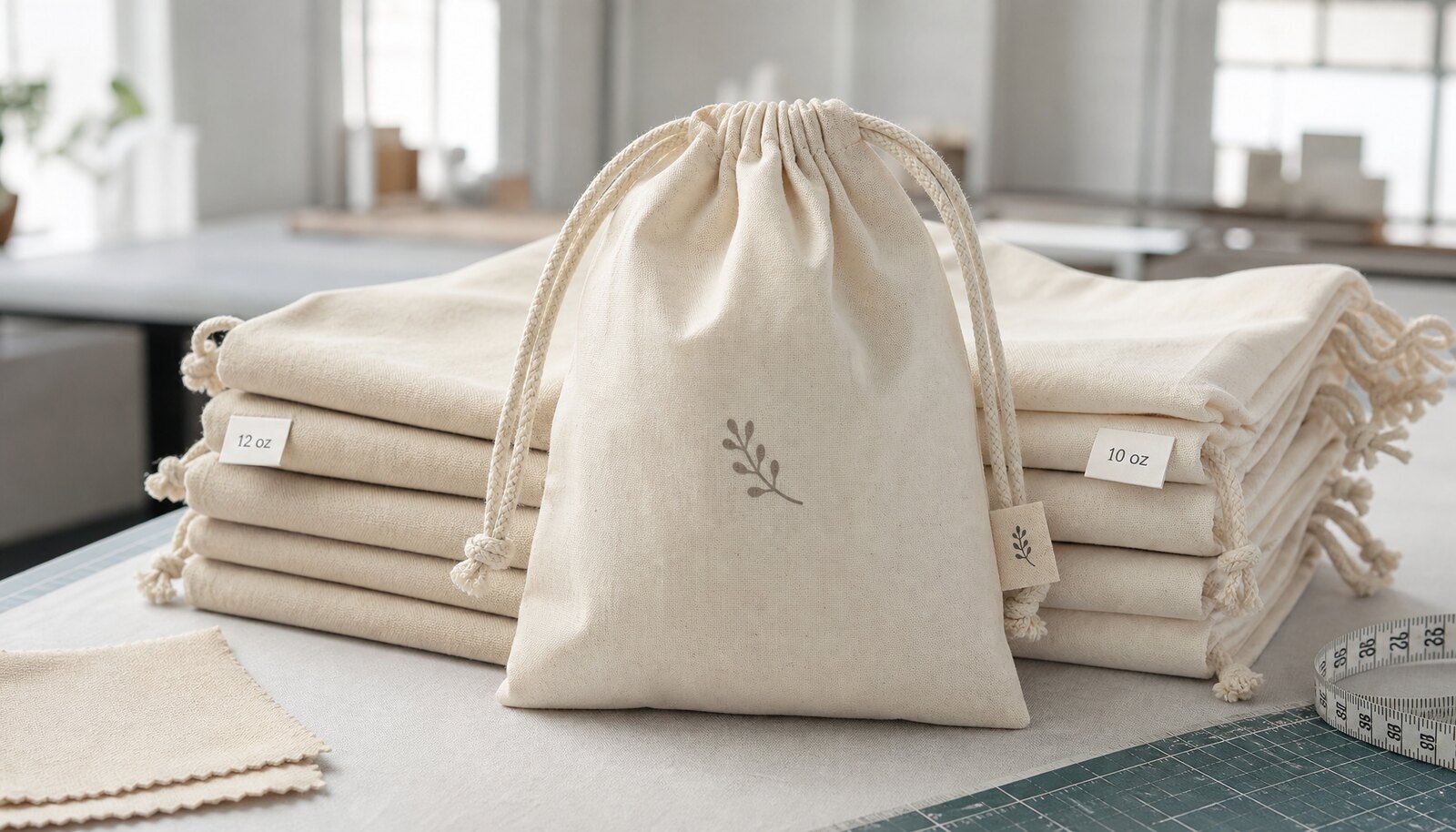
Why MOQ Matters So Much for Gift-Shop Pouches
Custom cotton drawstring pouches are simple on the shelf and surprisingly complex in procurement. For a gift shop, the pouch is rarely just a pouch. It may replace a box, support a seasonal bundle, protect fragile merchandise, and carry the brand impression that helps the sale feel finished. That means MOQ is not just a supplier threshold. It is a business decision that affects margin, cash flow, shelf presentation, and reorder flexibility.
The mistake many buyers make is treating MOQ as a single number to negotiate down. In practice, MOQ is built from several parts: fabric preparation, cutting yield, sewing labor, print setup, packing labor, and any special handling such as barcoding or retail labeling. If your order has multiple sizes, several artwork versions, special cords, or shelf-ready packing, the factory sees a much more complicated run than a plain one-color pouch. Two buyers can ask for the same product and receive very different minimums because the actual production burden is not the same.
For procurement buyers, the better goal is not the lowest possible quantity at any cost. The better goal is the lowest workable MOQ that still produces a stable, repeatable, sellable pouch. A too-small run with too many custom details often creates hidden charges, inconsistent quality, or a reorder that cannot be matched later. A good MOQ negotiation starts with understanding which parts of the spec are fixed, which are flexible, and which changes truly move the minimum.
Gift-shop buying makes this especially important because demand is often seasonal. Holiday sets, spring refreshes, tourist-shop assortments, and limited-edition gift bundles all have different turnover patterns. You may only need one smaller launch order to test a line, but you still need enough control to reorder the winner without redesigning it. That is why MOQ negotiation should be tied to the retail plan, not just the supplier’s first answer.
Build a Quote-Ready Spec Before You Ask for Pricing
If the buyer starts with a mood board, the factory starts with guesswork. A photo reference can be useful for style direction, but it is not enough for quotation. A workable RFQ needs measurable inputs: finished dimensions, target fabric weight, color, closure type, logo method, artwork placement, packing format, and whether the pouch is intended for display packaging or for holding a product directly. Without those details, the quote may look fast and friendly while still being unusable in production.
For cotton pouches, fabric weight is one of the first commercial decisions. A lighter cloth can be adequate for jewelry tags, soaps, or accessories, but it may look too soft or too transparent for a premium retail display. Heavier cloth usually gives better structure and shelf presence, but it can raise cost and sometimes reduce the factory’s willingness to accept a low order quantity if the build becomes less efficient. The right weight depends on the pouch’s job, not just the target price.
Size should always be stated as a finished measurement. Do not describe only the item you want to fit. State the pouch width and height after sewing, then specify whether the product inside should fit loosely, snugly, or with room for a small insert card. If the pouch is narrow or highly filled, the factory also needs to know whether the bottom should stand flat, whether the opening should draw evenly, and whether the seam allowance can vary slightly without affecting the look.
It also helps to replace vague style language with commercial terms. Instead of saying “soft but premium,” specify whether the cloth should be supple, structured, opaque, dense, or lightly draped. Instead of saying “nice logo,” state the placement, size, color count, and acceptable shift tolerance. The more measurable the spec, the easier it is to compare suppliers and the less likely the first sample will need to be rebuilt from scratch.
What Actually Drives MOQ on Cotton Drawstring Pouches
Factories do not calculate MOQ from sewing time alone. They calculate it from the full setup needed to produce your order cleanly. That includes opening the right fabric, organizing cuts, setting the machines, printing or labeling, inserting cords, packing in the right format, and separating the goods in a way that supports shipping and receiving. Every added variation creates friction. That is why MOQ rises faster than buyers expect when the order has several artwork versions or size combinations.
The most common MOQ drivers are straightforward once you know what to ask about. Fabric color changes can require special sourcing or dye-lot control. Print color changes may need extra screens or plates. A thicker drawstring, metal tip, waxed cord, or custom stopper adds material and assembly steps. Retail packing adds more labor if the factory must fold each pouch, place it in an individual polybag, apply a barcode, and pack by style or SKU. A quote that ignores these steps is not a complete quote.
The simplest way to lower MOQ is usually to standardize the pouch body and customize only the branding. A common natural cotton body, one logo print, and a standard cord are much easier for a factory to schedule than a custom-dyed cloth, multiple logo locations, and special retail packaging. In real purchasing terms, simplicity often matters more than buyers think. A factory can absorb a smaller quantity more readily when the run is operationally clean.
It also helps to distinguish between actual MOQ and setup minimums. Sometimes the supplier will accept a lower total order but still charge fixed fees for printing, labels, or special packing. That is not a problem if it is transparent. It becomes a problem when the buyer thinks the quantity was negotiated down but later discovers the fixed charges have simply been shifted elsewhere. Separate the minimum volume from the one-time setup cost before you compare offers.
How to Compare Quotes Without Getting Misled
When buyers compare quotes for custom cotton drawstring pouches, the problem is rarely that there are too few numbers. The problem is that the numbers may not describe the same build. A lower unit price may reflect a lighter fabric, smaller print area, simpler packing, or a missing service you still need. A meaningful comparison only works when the commercial variables are aligned first.
A strong quote should identify the fabric in practical terms: GSM or ounce weight, color basis, and whether the material is natural, bleached, dyed, or pre-shrunk. It should state the size, print method, color count, and whether the price includes sewing, cord insertion, and standard packing. If the supplier only gives a unit price with a vague description, ask for a revised quotation. Buyers lose the most money when they compare an incomplete quote against a complete one.
This is especially important for gift-shop buyers because retail presentation often depends on details that are invisible in a headline price. For example, one quote may include loose bulk packing and another may include pre-sorted barcode packs that save warehouse labor. One may use a standard cotton body while another uses heavier cloth that improves shelf appearance. If you do not compare the same packing and finish level, the cheaper quote may be more expensive once the goods are received.
A useful procurement rule is to ask the supplier to break out the non-recurring costs separately from the unit cost. That means setup, sample, label, and packing charges should be visible on their own line. Once those are exposed, you can see whether the MOQ is genuinely being lowered or whether the supplier is simply changing where the cost lands.
Sourcing Routes: Which One Fits the Order You Actually Need?
The right sourcing route depends on more than price. It depends on how much control you need, how much coordination your team can handle, and whether the order is a one-off seasonal buy or a repeatable retail program. For custom cotton drawstring pouches, there are four commercial routes buyers usually consider: factory direct, trading company, hybrid sourcing, and stock body plus custom branding. Each route has a different relationship between MOQ, visibility, and cost.
Factory direct usually gives the cleanest access to the actual production cost structure. That makes it the strongest choice when the buyer already knows the spec and wants to hold the factory to a repeatable standard. Trading companies or sourcing offices can be helpful when the order is small, communication is difficult, or the buyer wants help combining multiple items into one shipment. Hybrid models can work well when the buyer wants the factory price but needs a local or bilingual coordinator to keep revisions organized. Stock bodies with custom branding are often the best fit for testing demand or launching a seasonal line quickly.
For gift shops, the decision is often a trade-off between cash risk and spec control. A fully custom sewn pouch gives the brand more control over look and feel, but it requires a stronger commitment to forecasted demand. A stock body with a logo may cost more per unit, but it can keep the first buy small enough to test whether the line actually sells. That is often the right choice for a new holiday assortment or a retailer with uneven seasonal traffic.
The biggest sourcing mistake is choosing a route only because the unit price is lower. If the supplier cannot prove who is making the pouches, cannot show the real factory, or cannot explain the QC process, a cheaper quote can become the most expensive one after delays, defects, or rework. The right route is the one that supports your reorder plan, your inspection needs, and your retail timing.
- Ask whether the supplier can provide factory photos, machine photos, or a recent production video that shows the actual sewing and packing line.
- Request the name and role of the person who will own revisions, sample approval, and complaint handling.
- For short-run seasonal orders, check whether the supplier can reserve material for a reorder window without requiring a second full setup.
Questions That Reveal Whether a Supplier Is Credible
A professional quote is not enough. You also need evidence that the supplier can actually produce the order at the claimed standard. For a pouch order, credibility should be checked through documentation, sample consistency, and production proof. If the supplier says they are a factory, ask for more than a business card. If they claim a certification, ask for the certificate number, scope, and issue date. If they say they can test to a standard, ask who does the testing and for what product scope.
A useful supplier review starts with the production site. Ask for the factory name, address, and the role of the company you are dealing with. If you are not buying directly from the maker, ask whether the intermediary is adding value through QC, scheduling, or consolidation. Then verify that the sample you received came from the same production route, not from a different workshop. The goal is to know who is accountable if the bulk order drifts from the approved sample.
Request evidence that is tied to your exact product, not a generic marketing deck. For example, ask for photos of similar pouches in production, the actual stitch style used, and sample images of print placement. If the supplier claims textile testing, ask for the latest report and make sure the report covers the same fabric type and finish you are buying. A certificate on its own is not enough if it is unrelated to your item or out of scope.
It is also smart to ask how the supplier handles changes after approval. If the print size, cord color, or label position changes during production, who signs off? How are revisions recorded? If the answer is vague, the supplier may be relying on verbal approvals instead of controlled documentation. That is a risk for any buyer, but especially for gift-shop orders where the same pouch may be reordered across seasons and must stay visually consistent.
- Ask for the factory name, not only the salesperson’s company name.
- Request a certificate copy with scope, issue date, and validity, and make sure it matches the product type or process claimed.
- Ask for a recent product-specific test report if the supplier claims compliance, and confirm the report covers the correct fabric and finish.
- Ask who approves production changes after sample sign-off and how those changes are documented.
- Request production photos or a short video of the actual sewing and packing line for similar pouches.
Price Drivers You Should Ask the Supplier to Break Out
The easiest way to lose negotiating power is to ask only for a unit price. A useful commercial quote should show the levers that move cost and MOQ: fabric weight, pouch size, number of print colors, decoration method, packing format, label requirements, and whether any setup fees are one-time or recurring. Once these are visible, you can decide which changes are worth paying for and which are only adding complexity.
Fabric weight is one of the clearest drivers. A lighter pouch is not automatically cheaper in the real sense if it looks too flimsy for your retail presentation or if it fails to hold a product securely. Heavier cotton generally improves structure and shelf impression, but it can increase cost and sometimes limit the supplier’s ability to accept a very small order. Ask for the actual GSM or ounce weight instead of accepting a broad description like “thick cotton.”
Decoration method also matters. A one-color screen print is often cost-effective for simple branding, but once the logo becomes more detailed or uses multiple tones, the setup effort can rise quickly. Embroidery, woven labels, and transfer applications each have their own strengths, but they are not interchangeable. A good supplier should explain which method is best for your target quantity, not simply push the most profitable option for them.
Packing is another hidden cost center. A quote that includes retail-ready packing may be more expensive on paper, but cheaper overall if it saves labor in your warehouse. That is why you should ask for carton count, inner pack count, gross weight, and label format before approval. For a gift shop buyer, the lowest unit price is not helpful if the receiving team must re-sort or relabel every carton by hand.
Sample Approval Rules That Prevent Expensive Mistakes
A sample is the moment where the pouch becomes a controlled product instead of an idea. Artwork can show the layout, but it cannot prove the cloth handle, the drawstring movement, the stitch behavior, or the way the pouch looks after folding and packing. For gift shop use, that matters because the product has to look finished on a shelf and still work after customers handle it repeatedly.
The sample should use the final fabric, final print method, final cord, final seam structure, and final packing style whenever possible. If the sample is built with substitute material or a temporary decoration method, it should be treated as a development sample only. Do not approve bulk production from a sample that is “close enough” in only one or two variables. A pouch can look acceptable in isolation and still fail once the actual production cloth or print process is applied.
A good approval routine is straightforward. Measure the finished size. Check whether the logo sits in the agreed position and whether the print edge is clean. Open and close the drawstring several times and make sure the channel does not twist. Rub the logo with a clean white cloth to check for visible transfer. Place a sample gift item inside the pouch and inspect seam tension, bottom corner stress, and the way the pouch drapes when filled.
Sample control also means recordkeeping. Keep one signed reference sample, label it with the version date, and tie it to the approved spec sheet. If a reorder later looks different, you will need that reference to prove whether the change came from the factory, the artwork revision, or a packing difference. That is especially useful for gift-shop programs where repeat customers may notice small changes in color, size, or print placement.
- Measure finished dimensions on the sample, not just the flat-cut piece.
- Approve only the actual production method, not a temporary substitute method.
- Use a clean white cloth rub test on the printed area after folding the sample several times.
- Keep one signed reference sample and one signed spec sheet together for every approved version.
QC Standards That Should Be in the PO, Not Just in the Factory Note
QC works best when it is written before production starts. If the purchase order does not define the acceptance criteria, the factory and the buyer may each believe the product is acceptable for different reasons. For custom cotton drawstring pouches, the most useful standards are the ones that affect retail appearance, functionality, and receiving efficiency. Those include fabric weight, seam quality, size tolerance, print quality, cord performance, labeling, and carton condition.
Start with fabric. Ask the factory to confirm the actual GSM or ounce weight on the first production lot and verify that it matches the agreed range. If the weight is critical to shelf appearance or opacity, set a tolerance band instead of a single descriptive term. For stitching, specify that there should be no open seams, visible skipped stitches, excessive loose threads, or broken channel areas on a randomly checked sample from the batch. For the drawstring, require smooth pull action and no snagging at the channel end.
Print quality deserves its own rule set. Define acceptable placement tolerance, color tolerance, and whether the logo must remain legible after folding and handling. If the pouch uses a one-color logo, the print should be checked for opacity, edge sharpness, and rub resistance. If the pouch is decorated with a label instead of print, check that the label is aligned, secure, and free from curling or fraying. A sample that passes visually may still fail if the decoration is positioned too close to a seam or draw channel.
Do not forget sample-to-bulk matching rules. The factory should be required to match the approved sample on fabric shade, cord type, print method, stitching style, and pack format. If the bulk lot needs to deviate for any reason, the supplier should ask for written approval before proceeding. That one rule prevents a large share of surprise disputes. For gift-shop buyers, it is especially important because the pouch often sits on a display table where any mismatch is immediately visible.
- Set a fabric weight tolerance band in the PO, not only a description.
- Define acceptable seam defects: open seam, skipped stitch, loose thread, or twisted channel should each be listed as rejectable if they affect function or appearance.
- Require a rub test on printed areas and a visual check after folding the pouch twice.
- State that bulk goods must match the approved sample on fabric shade, cord type, print method, and pack format.
- Require carton marks, SKU labels, and pack count to match the PO before release.
Packing and Labeling Choices That Change Warehouse Cost
Packing has a direct impact on receiving labor, yet it is often treated as an afterthought. For gift-shop buyers, that is a mistake because many orders are time-sensitive and often processed in small warehouse teams. If cartons arrive with poor labeling, mixed assortment packs, or unclear SKU markings, the product may still be usable but it will cost more to receive, sort, and store.
The simplest receiving structure is the safest one: one size, one color, one pack count, one barcode, one carton mark. If you need mixed packs, define the handling sequence in advance and confirm that the factory can maintain separation from packing through outer carton labeling. This matters most for buyers who allocate one shipment across several stores or multiple seasonal assortments. A single packing error can create downstream merchandising issues that cost more than the pouch itself.
Ask for carton dimensions and gross weight before you book freight. Those details affect shipping cost, pallet planning, and warehouse handling. Also confirm whether the cartons are single-wall or double-wall, whether inner packs are sealed, and whether the outer marks include the exact style, quantity, and destination code you need. If your receiving team scans barcodes, make sure the barcode position and label size are agreed in the sample stage rather than corrected after arrival.
A low unit price can quickly disappear if your team has to relabel cartons or re-sort inner packs by hand. That is why packing deserves the same treatment as the product spec. For many gift-shop programs, packing is not a secondary detail; it is part of the landed cost.
- Confirm carton dimensions and gross weight before freight booking.
- Ask whether the carton is single-wall or double-wall and whether the pack format is sealed or loose.
- Define barcode position, label size, and carton mark format before bulk production.
- If mixed packs are required, ask how the factory prevents SKU mixing during sewing, packing, and cartonizing.
Specification comparison for buyers
| Commercial route | Best use case | MOQ and cost implications | Buyer watch-outs |
|---|---|---|---|
| Factory direct | Repeatable programs, standardized artwork, and buyers who want the clearest control over fabric, stitching, and packing | Typically the lowest landed cost once the spec is stable. For a simple pouch, entry MOQs are often more workable than buyers expect, but each added option—size, color, print, label, special pack—raises the minimum fast. Setup fees are usually itemized clearly. | Verify the manufacturer is real, not a broker. Ask who owns the pattern, print file, and sample record. Confirm whether the same fabric lot or shade standard can be held for reorders. |
| Trading company or sourcing office | Smaller buyers, mixed-category orders, multilingual coordination, or programs that need faster back-and-forth | MOQ can look flexible because the intermediary may consolidate orders across factories. Unit price is usually higher, and the real factory minimum may still sit behind the scenes. | Request the factory name, audit proof, and the exact production site. Ask which charges are retained as margin and who is liable for defects, rework, or missed specs. |
| Hybrid model | Buyers who want factory pricing plus local coordination or technical support | Can speed sampling and reduce communication friction. MOQ is often close to factory-direct on simple builds, but coordination or project fees may appear in the quote. | Make sure no one changes spec details without written approval. Track revisions by version number so sample, PO, and bulk order remain aligned. |
| Stock body with custom branding | Gift shops testing demand, seasonal launches, and short-run assortments | Usually the easiest route for the smallest practical MOQ because the pouch body is already made. Cost per unit is higher than a fully custom sew job, but inventory risk is lower. | Check stock shade consistency, label placement tolerance, and whether the stock body will still be available for a reorder window. |
| Fully custom sewn pouch | Private-label packaging, premium retail lines, and size-specific kits | MOQ is usually higher because cutting, sewing, and branding are dedicated to your order. Best value appears when the design repeats across seasons or channels. | Ask if MOQ is per size, per color, per artwork, or per total order. One unclear line can make the quote impossible to compare. |
| Material-driven quote change | When comparing cotton weights, dyed vs. natural cloth, or special finishes | Fabric weight, weave density, and color treatment can move cost without changing the pouch look dramatically. Heavier cloth usually improves structure and shelf presentation, but increases cost and sometimes MOQs. | Request the fabric spec in GSM or oz, plus whether the cloth is bleached, natural, dyed, or pre-shrunk. Vague terms like “good cotton” are not enough. |
| Decoration-driven quote change | When the logo is the main variable and the pouch body stays standard | Screen setup, print colors, embroidery, woven labels, or transfer application can drive MOQ more than sewing itself. A one-color print is usually much easier to scale than a multi-color graphic. | Ask how many colors are included, what the setup fee covers, and whether the chosen method can survive folding, abrasion, and retail handling. |
| Packing-driven quote change | When the store needs barcode labels, size sorting, or shelf-ready delivery | Individual polybagging, inner packs, barcode labels, and carton marks raise labor and often create a real minimum even when sewing is simple. | Confirm the packing format line by line. A quote that ignores packing may look cheap but create receiving labor or rework at your warehouse. |
Buyer checklist before sampling
- Confirm pouch size in finished dimensions, not just artwork area, and state whether the gift item must fit loosely or snugly.
- Choose a fabric weight target in GSM or oz and decide whether you care more about softness, structure, opacity, or shelf shape.
- Specify whether the quote includes sewing, cord insertion, printing, label attachment, individual polybagging, and carton packing.
- Send vector artwork and define print color count, placement, and acceptable color tolerance using a reference sample if possible.
- Ask whether MOQ is per design, per size, per color, or per combined order, and request that answer appear in the quotation.
- Request a pre-production sample made with final fabric, final print method, final cord, and final packing format.
- Ask for carton count, inner pack count, gross weight, carton size, and label format before approving shipment.
- Define who owns the approved sample and whether reorder samples will match the same construction spec.
- Ask the supplier to identify any variable charges such as screen setup, plate making, label fees, testing fees, or packing labor.
- Build in calendar time for sample review, correction, and bulk approval before seasonal buying deadlines.
Factory quote questions to send
- Is the MOQ calculated per size, per artwork, per color, or per total order volume?
- Please state the fabric weight in GSM or oz and whether the quoted fabric is bleached, natural, dyed, or pre-shrunk.
- Does the unit price include cutting, sewing, cord insertion, printing, and standard polybag packing?
- What are the setup charges for screen printing, plate making, labels, or special packing?
- How many colors are included in the quoted print, and what is the surcharge for additional colors?
- Can one print setup be shared across multiple sizes, and if so, does MOQ change?
- What is the sample cost, what does the sample include, and is the sample charge deductible after bulk order confirmation?
- What is the expected production lead time after artwork sign-off, deposit, and sample approval?
- Can you confirm carton count, inner pack count, carton dimensions, and gross weight for freight planning?
- Who will sign off on the pre-production sample, and how do you handle changes after approval?
Quality-control points to confirm
- Fabric weight: verify the actual GSM or oz against the agreed spec using the same measurement method on the first production lot and again on a random sample from the finished batch.
- Stitching: check seam alignment, stitch density, skipped stitches, loose threads, and whether the side seams open under normal handling or when the pouch is lightly loaded.
- Seam tolerance: confirm finished dimensions remain within the agreed commercial tolerance after sewing and light pressing; small pouches need tighter dimensional control because a few millimeters can affect fit.
- Cord performance: pull the drawstring several times to confirm smooth movement, no snagging, no channel twisting, and no premature fraying at the exit points.
- Cord pull strength: ensure the cord is secured at the channel ends and does not slip through with normal manual force or repeated opening and closing.
- Print quality: inspect placement, registration, ink opacity, edge sharpness, and rub resistance after folding and handling.
- Print rub test: rub the printed area with a clean white cloth under moderate pressure to check for obvious transfer, smearing, or peeling.
- Sample-to-bulk matching: compare the approved sample against the first production lot for fabric shade, hand feel, logo placement, cord type, seam finish, and packaging method.
- Label and carton control: verify that size labels, style labels, barcode labels, and outer carton marks match the PO exactly.
- Packing integrity: check polybag count, carton count, carton sealing, and whether carton drop handling creates seam or print damage.