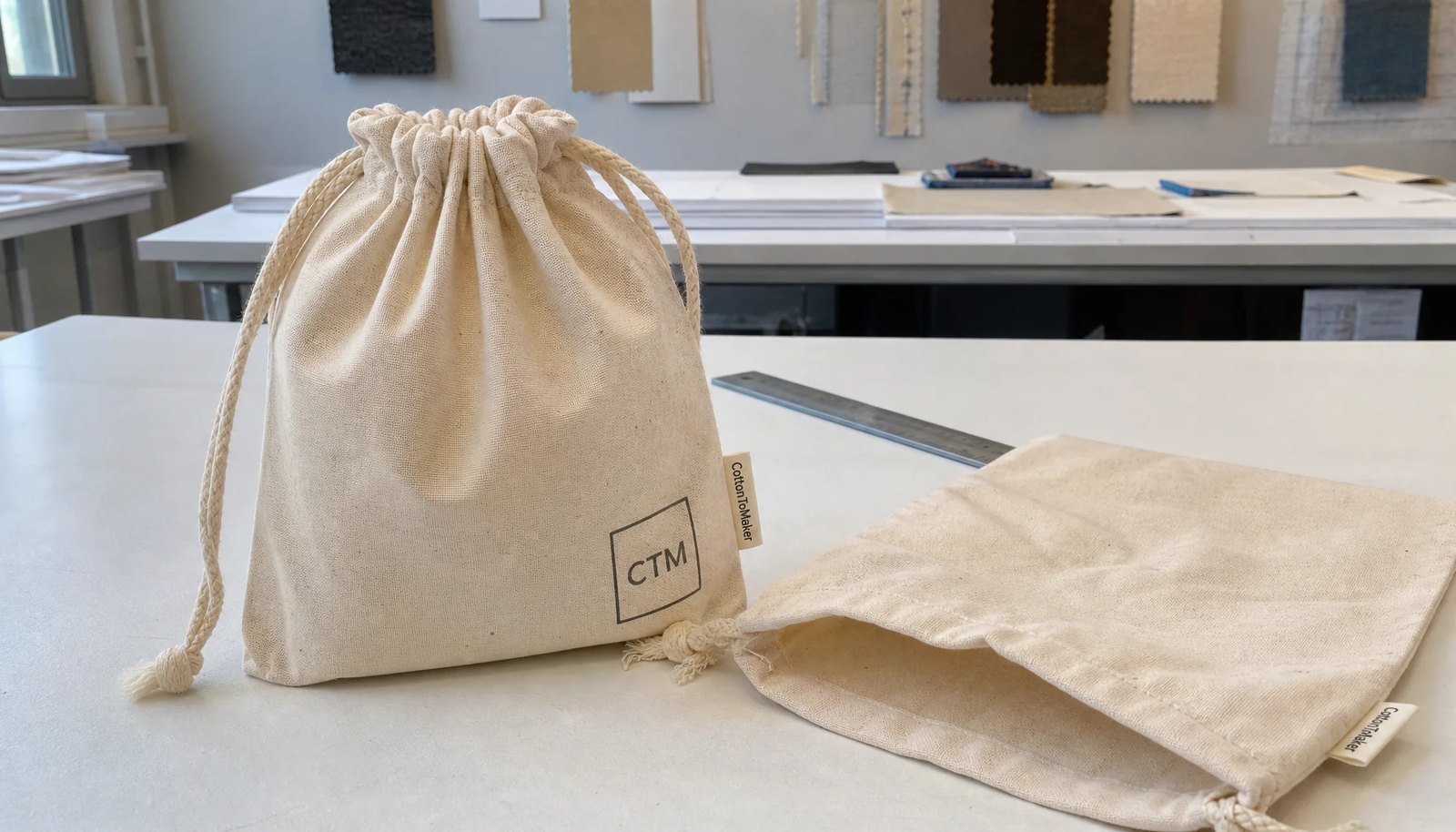
The MOQ problem campus stores actually face
For university bookstores, the hard part is rarely finding a factory willing to make custom cotton drawstring pouches. The problem is matching a practical minimum order quantity to a seasonal buying calendar, several campus logo versions, and uncertain sell-through. A bookstore may need 300 pouches for a graduation gift set, 500 for orientation, and 200 for a department bundle, while a factory may quote MOQ from a production standpoint: fabric roll use, cutting efficiency, print setup, sewing line loading, and packing labor.
A useful MOQ negotiation starts by separating the pouch specification from the artwork program. If every department wants a different pouch size, cord color, print method, and retail pack, the factory has to treat each version as a separate production item. If the buyer standardizes the base pouch and only changes the print, the factory has more room to combine material purchase, cutting, sewing, and inspection.
- Weak RFQ wording: “Please quote custom cotton pouches, low MOQ, university logo.”
- Stronger RFQ wording: “Quote 20 x 30 cm natural cotton pouch, 5 oz cotton, cotton cord, 1-color screen print, bulk packed, with three artwork versions under one shipment.”
- Negotiation target: reduce separate MOQs by standardizing fabric, size, cord, and packing before discussing artwork splits.
- Commercial reality: a lower MOQ may carry higher unit cost, but it can still be better if it prevents dead stock after the campus season.
Build the pouch spec before asking for a minimum
MOQ is not a fixed number sitting in a supplier catalog. It changes when the buyer changes fabric weight, size, print method, cord type, label, and packing. A 10 x 15 cm natural cotton pouch with a one-color logo can often run more flexibly than a dyed 30 x 40 cm pouch with full-color transfer, individual barcode labeling, and four artwork versions. The RFQ should therefore define the physical product before asking the factory to negotiate quantity.
For bookstore use, 5 oz to 6 oz cotton is often a practical starting point. It feels more substantial than very light promotional cotton but does not create the heavy, stiff hand feel or high freight volume of 8 oz canvas. Natural cotton works well for eco-positioned campus merchandise, but it has shade variation. Bleached white gives a cleaner background for colored logos, while dyed cotton adds dye MOQ, shade control, and sometimes longer lead time.
- Small accessory pouch: 10 x 15 cm or 12 x 18 cm, commonly used for pins, jewelry, keychains, and small gift items.
- Medium bookstore pouch: 20 x 30 cm or 25 x 35 cm, suitable for notebooks, small apparel accessories, and bundled merchandise.
- Large pouch: 30 x 40 cm and above, useful for apparel kits but more sensitive to fabric consumption and carton volume.
- Fabric note: natural cotton may show seed flecks and shade differences; approve this intentionally instead of treating it as a defect later.
How factories calculate MOQ on cotton drawstring pouches
A factory looks at MOQ through production efficiency, not only through order value. Cotton fabric is bought in rolls, cut in layers, printed in batches, sewn through operators, inspected, packed, and cartonized. If the order is too small, setup time and material handling become a larger part of the unit cost. This is why a supplier may accept a low MOQ for a standard natural cotton pouch but resist low quantities for dyed fabric, special cord, custom woven labels, or multiple print colors.
The buyer can negotiate more effectively by asking which cost component is driving the MOQ. If fabric roll consumption is the issue, a smaller pouch size or standard fabric may help. If print setup is the issue, combining artwork with the same ink color may help. If sewing line setup is the issue, using one size and one cord construction across all versions may help. The negotiation becomes practical when both sides can see which decision creates the minimum.
- Fabric-driven MOQ: caused by roll length, dyed color minimums, organic cotton sourcing, or nonstandard GSM.
- Print-driven MOQ: caused by screen setup, ink changeover, transfer sheet preparation, or multiple logo placements.
- Sewing-driven MOQ: caused by low line efficiency, special channel construction, custom trims, or many size versions.
- Packing-driven MOQ: caused by individual polybags, barcode stickers, hangtags, carton sorting, or department-level packing splits.
- Shipment-driven MOQ: caused by export carton handling, freight minimums, documentation, or consolidation with other goods.
Use artwork grouping to lower separate minimums
University bookstore orders often involve many stakeholders: athletics, alumni, admissions, student clubs, and academic departments. Each group may want its own logo. If the buyer sends these as separate pouch projects, the supplier will likely quote separate MOQs and separate setup charges. A better buying method is to create one base pouch program and define artwork splits inside it.
For example, the RFQ can state that the buyer wants 2000 total pouches in the same natural cotton fabric, same 20 x 30 cm size, same cotton cord, and same bulk packing, divided into four one-color screen print designs. The supplier can then evaluate whether the same screen size, same ink color, and same print position allow a combined production run. The MOQ may not disappear, but the factory has a real reason to quote a lower split quantity.
- Best split condition: same pouch size, same fabric, same cord, same print location, same ink color, same packing.
- Moderate split condition: same pouch but different ink colors; expect extra setup or washout cost.
- Difficult split condition: different pouch sizes, different logo placements, different packing instructions, or full-color art.
- RFQ phrase to use: “Please quote total production quantity with artwork split options, and list any extra charge per artwork.”
Print method choices that affect MOQ and quality
For cotton drawstring pouches, one-color screen printing is usually the most stable and economical method for bookstore logos. It works well on natural or white cotton, gives a clean retail look, and keeps setup understandable. The buyer should provide vector artwork, print size, print position, and Pantone color. If the logo includes fine lines, small registration marks, distressed textures, or a detailed school seal, the factory should review print feasibility before committing to bulk production.
Heat transfer can be useful for gradients, full-color graphics, and small-batch artwork variation, but it changes the acceptance criteria. Transfers may feel different on cotton, can affect the flexibility of the pouch surface, and require adhesion testing. Embroidery is usually less common for low-cost pouches because it can pucker lighter cotton and slow production. Woven labels can create a premium look but add label MOQ and sewing alignment requirements.
- Screen print: best for simple logos, one to three colors, repeat orders, and stable cost control.
- Heat transfer: useful for full-color logos but should be tested for edge adhesion, hand feel, and cracking.
- Embroidery: better on heavier fabric; risky on 4 oz to 5 oz cotton if the logo is dense.
- Woven side label: useful for private-label branding but requires label MOQ, placement tolerance, and seam approval.
- Acceptance target: printed logo should be readable at retail distance, centered within agreed tolerance, and free from bleeding or heavy ink blockage.
Sample approval should test the production risk
A sample is not only a photo for internal approval. It is the buyer’s chance to test the actual decisions that can fail in bulk production. For custom cotton drawstring pouches, the sample should show the real fabric weight, drawcord, channel construction, print method, print size, and packing direction if retail presentation matters. A sample made from substitute fabric is useful only for size reference, not for final approval.
The approval notes should be specific enough for the factory to reproduce. Instead of writing “sample approved,” record the accepted measurements, fabric feel, print color, logo position, cord behavior, and any changes required before mass production. If a university licensing office must approve the logo, build that review into the schedule before bulk fabric is cut or printed.
- Measure finished size after sewing, not only cut panel size.
- Pull the drawcord several times to see whether both sides close evenly.
- Check the logo after the pouch is cinched, because the upper area can distort near the channel.
- Rub the print with a dry white cloth and a lightly damp cloth to catch weak adhesion or color transfer.
- Place the intended product inside the pouch to confirm fit, shape, opacity, and drawstring closure.
- Photograph the approved sample with a ruler and keep it as the inspection reference.
Quote data needed to compare suppliers fairly
Many pouch quotes look similar at the unit-price line and very different after setup, packing, freight volume, and rejected goods are considered. A factory that quotes a slightly higher unit price but includes clear fabric GSM, sample terms, carton data, and quality tolerance may be easier to manage than a cheaper quote with missing details. For university bookstore buyers, the comparison should focus on total usable cost and delivery reliability, not only the lowest MOQ.
The quote should show price breaks and explain what changes at each break. If 500 pieces, 1000 pieces, and 3000 pieces have different prices, the supplier should clarify whether the saving comes from fabric usage, print setup allocation, sewing efficiency, or packing labor. This helps the buyer decide whether to buy a little more for cost efficiency or keep the order smaller to reduce inventory risk.
- Required unit data: pouch size, fabric GSM or ounce weight, fabric color, cord type, print method, print colors, and packing method.
- Required cost data: unit price, setup cost, sample cost, artwork charge, label charge, packing charge, and bank or documentation charges if applicable.
- Required logistics data: units per carton, carton dimensions, gross weight, net weight, total cartons, and estimated CBM.
- Required schedule data: sample days, approval cutoff, bulk production days, inspection date, packing completion date, and shipment readiness date.
- Required risk data: tolerances, defect classification, overrun or underrun policy, and remake responsibility for confirmed factory defects.
Packing decisions can change both MOQ and landed cost
Small cotton pouches seem simple to pack, but packing choices can quietly change cost and lead time. Bulk packing is usually best for event distribution, campus kit assembly, and backroom use. Individual polybags are helpful when the pouch is sold as a retail unit, but they add material, labor, barcode control, and more inspection points. If the bookstore has sustainability targets, bulk packing with carton dividers or paper bands may be more appropriate than automatic individual polybagging.
Carton data matters because cotton pouches compress differently depending on fabric weight, cord thickness, and whether they are folded. A quote without carton dimensions is incomplete for importers and distributors. Freight cost may be minor for very small pouches, but large drawstring bags or retail-packed units can create unexpected CBM. For landed-cost comparison, the buyer needs carton count before issuing a purchase order.
- Bulk pack: lower cost, lower material use, good for in-store kitting and event handout programs.
- Individual polybag: better for shelf-ready retail, but higher labor and more packaging waste.
- Barcode sticker: necessary for retail receiving, but must be placed consistently and not cover the logo.
- Inner bag count: useful for warehouse receiving, department allocation, and miscount prevention.
- Master carton mark: should include item number, PO number, quantity, gross weight, carton number, and destination if required.
Lead time planning for bookstore seasonality
University bookstore demand is calendar-driven. Orientation, move-in, homecoming, graduation, alumni weekends, and holiday promotions create fixed windows. The MOQ negotiation should not ignore timing. A very low MOQ that requires special fabric sourcing or several sample revisions may miss the selling window, while a slightly higher quantity using standard natural cotton may ship faster and protect the event date.
The schedule should be broken into approval gates. Artwork approval, sample approval, fabric booking, printing, sewing, inspection, packing, and export handover are different steps. If a licensed school logo requires internal approval, that time belongs in the buyer’s calendar, not only the factory’s production schedule. The safest RFQ asks the supplier to show the last approval date needed to meet the requested shipment date.
- Artwork review: allow time for vector cleanup, Pantone confirmation, and licensing approval if required.
- Sample stage: plan for one original sample and one possible revision before bulk production.
- Material stage: standard natural cotton is usually more flexible than dyed or specialty cotton.
- Printing stage: multiple artwork versions need print scheduling and drying or curing time.
- Inspection stage: leave time to correct packing labels, carton marks, or minor sorting issues before shipment.
- Shipping stage: compare readiness date with the bookstore’s receiving deadline, not only the promotion date.
Negotiation tactics that do not damage production quality
The best MOQ negotiation gives the factory efficiency while giving the buyer inventory control. Pushing for a very low quantity without simplifying the spec often forces the supplier to recover cost through higher unit price, reduced inspection time, substitute materials, or vague tolerances. A better approach is to trade flexibility: accept one standard fabric, one size, and bulk packing in exchange for lower artwork split quantities or better price breaks.
Buyers should also avoid negotiating only on the first order. If a bookstore expects repeat campus programs, the RFQ can include a reorder forecast without presenting it as a guaranteed commitment. A supplier may be more willing to absorb setup work if the base pouch spec is likely to repeat. However, the purchase order should still separate confirmed quantity from forecast quantity to avoid confusion.
- Offer standardization: one fabric, one size, one cord, one packing method.
- Request split flexibility: several logo versions under one production batch.
- Accept realistic tolerances: natural cotton shade and GSM will vary within agreed limits.
- Negotiate setup allocation: ask whether screen charges can be reduced on repeat orders using the same artwork.
- Use price breaks: compare 500, 1000, 2000, and 5000 pieces to find the true efficiency point.
- Protect quality: do not accept unspecified fabric weight or substitute print methods just to lower MOQ.
Specification comparison for buyers
| Spec decision | Recommended option | When it fits | Buyer risk to check |
|---|---|---|---|
| Fabric weight | 5 oz to 6 oz cotton, about 140-170 GSM | Good balance for university bookstore gift pouches, spirit items, stationery bundles, and low-bulk shipping | Very light 3 oz cotton may look translucent, wrinkle heavily, and make dark logo prints less crisp |
| Size range | Small 10 x 15 cm for accessories; medium 20 x 30 cm for apparel add-ons; large 30 x 40 cm only when contents require it | Keeps MOQ negotiation realistic because factories can nest cutting sizes and reduce fabric waste | Oversized pouches increase fabric consumption and carton volume even when unit price looks close |
| Print method | 1-color screen print for normal bookstore logos; heat transfer only for gradients or full-color crests | Screen print supports lower setup cost and stable repeat orders when art is simple | Full-color transfers can raise MOQ or unit cost and may need wash/rub testing before approval |
| Cord and closure | Cotton cord or flat cotton tape matched to pouch weight | Best for retail-friendly, natural-positioned campus merchandise | Thin polyester cord on natural cotton can feel mismatched and may cut into the channel after repeated pulling |
| MOQ negotiation route | Consolidate several artwork versions under one fabric, size, and cord spec | Useful for campus departments, alumni events, and bookstore private-label assortments | Each logo color, print position, or packing style can create separate setup cost even if the pouch is the same |
| Sample approval | Pre-production sample with actual fabric, actual cord, and actual print ink before bulk cutting | Needed when the pouch will be sold retail or used in branded gift kits | Approving a digital proof only leaves fabric shrinkage, drawcord pull, and print opacity unresolved |
| Packing format | Bulk pack 50-100 pcs per inner polybag, or retail pack only for shelf-ready selling | Bulk pack reduces cost for in-store kitting and event distribution | Individual polybags increase labor, material use, carton count, barcode management, and sometimes inspection time |
| Lead time control | Separate sample lead time, material booking, printing, sewing, QC, and export packing in the quote | Helps bookstore buyers plan around orientation, homecoming, holiday, and graduation seasons | A single quoted lead time can hide delays from print approval, fabric dyeing, or carton label changes |
Buyer checklist before sampling
- Define the pouch use case first: retail sale, gift-with-purchase, orientation kit, alumni event, or department giveaway.
- Specify size in centimeters or inches with tolerance, not only as small, medium, or large.
- Choose fabric weight by function: 4 oz for lightweight inserts, 5-6 oz for retail bookstore use, 8 oz only when a heavier hand feel is required.
- State whether cotton must be natural, bleached white, dyed color, or organic cotton, because each choice changes MOQ and lead time.
- Provide artwork size, print position, color count, and Pantone references before comparing supplier quotes.
- Separate MOQ for blank pouches, printed pouches, and each artwork version in the RFQ.
- Request actual fabric and print samples, not only photos, when the pouch will carry a licensed school logo.
- Confirm cord material, cord diameter, draw channel width, seam type, and whether the pouch closes smoothly after printing.
- List packing needs: bulk pack, individual polybag, barcode sticker, carton mark, carton size target, and pallet requirement if any.
- Compare quotes using total landed cost per usable pouch, including setup, sampling, packing, freight volume, and expected rejection allowance.
Factory quote questions to send
- What is your MOQ for this exact pouch size, fabric weight, cotton color, cord type, print method, and packing method?
- Can multiple campus logos share one MOQ if the fabric, size, cord, and print color remain the same?
- What are the price breaks at 500, 1000, 3000, and 5000 pieces, and which cost element changes at each break?
- Is the quoted fabric greige, natural unbleached, bleached, dyed, or organic cotton, and what GSM tolerance do you allow?
- Which print method are you quoting, and what is the maximum printable area before the pouch draw channel or side seam affects placement?
- Are screen setup, artwork separation, sample cost, and pre-production sample freight included or listed separately?
- What size tolerance, GSM tolerance, print position tolerance, and color tolerance will you use for inspection?
- How many days are needed for sample making, sample revision, bulk fabric preparation, printing, sewing, final inspection, and export packing?
- What is the estimated carton quantity, carton dimensions, gross weight, and CBM for the quoted order size?
- What happens if the approved sample passes but bulk production has fabric shade variation, print bleeding, or drawcord failure?
Quality-control points to confirm
- Fabric GSM should be checked against the approved sample with a practical tolerance agreed in writing, commonly within about plus or minus 5-8 percent depending on cotton source.
- Finished pouch size should be measured after sewing and pressing, with separate tolerances for length, width, and draw channel height.
- Print position should be measured from the top edge or draw channel, not judged only by visual centering.
- Logo color should be compared under consistent light against Pantone or an approved physical sample, especially on natural cotton.
- Print adhesion should pass a basic rub test and, when relevant, a light hand-wash or damp cloth test before mass packing.
- Drawcords should pull evenly without breaking stitches, twisting inside the channel, or causing the mouth to jam.
- Side seams and bottom seams should be checked for skipped stitches, loose threads, seam opening, and raw edge exposure.
- Packing count should be verified by inner bag and master carton, because small pouches are easy to miscount in bulk packing.
- Retail labels, barcode stickers, carton marks, and country-of-origin markings should match the buyer's routing guide before shipment.