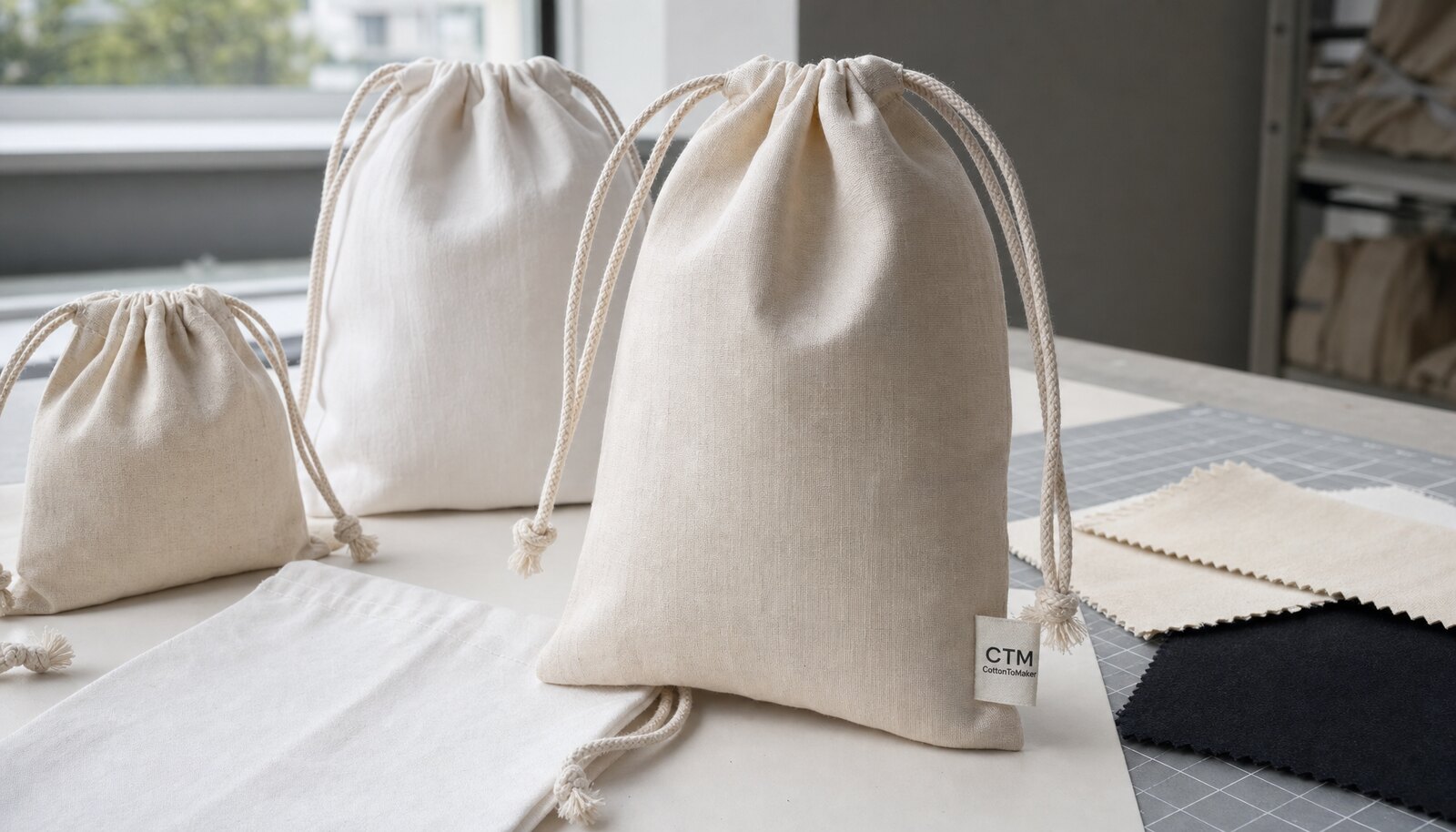
Why material selection matters more than the logo
For corporate gifting, the pouch itself carries more of the buying risk than the artwork. A logo can be reprinted; a poor fabric choice cannot be fixed after shipment. If the pouch feels flimsy, closes badly, or arrives with inconsistent shrinkage, the entire program looks low value even when the brand print is correct. That is why the first buying decision should be the cotton construction, not the decoration method.
The most common mistake is to source by photos and price only. Two pouches can look similar in a quote sheet but behave very differently in hand. One may use 100 GSM loose weave cotton with soft drape; another may use 140 GSM cotton drill with tighter body. Those differences affect print sharpness, contents protection, packing volume, and how premium the gift feels when the recipient opens it.
- Start with contents: light items, sample kits, cosmetics, or small accessories.
- Define the gifting event: premium executive gift versus mass conference giveaway.
- Match fabric body to use case; soft drape is not always a good thing.
- Require the supplier to state GSM, weave, and shrinkage assumption in the quote.
Choose the cotton fabric by use case, not by habit
Most cotton drawstring pouches for gifting sit in the 120–160 GSM range. Below 120 GSM, the pouch can look economical, but it may wrinkle heavily, show stitching tension, and lose shape once packed. Above 160 GSM, the pouch starts to feel more substantial, but bulk, sewing difficulty, and cost rise fast. For many corporate programs, 130–140 GSM is the practical middle ground because it balances print clarity, hand feel, and shipping weight.
Weave matters as much as GSM. Plain weave is common and economical, but the surface can show fiber texture more clearly under fine logos. Cotton drill offers better body and a stronger premium feel, though it can be slightly bulkier and a bit more expensive. If the pouch will carry rigid objects or be reused many times, the extra structure of drill is usually worth the cost.
- 100–120 GSM: use only for light inserts, short-life giveaways, or very price-sensitive orders.
- 130–140 GSM: best all-around choice for most corporate gifting pouches.
- 150–160 GSM: better for premium kits, heavier contents, or higher perceived value.
- Plain weave: lower cost, softer drape, more economical for large runs.
- Drill: stronger body, more premium hand feel, slightly higher material and sewing cost.
Natural, white, or dyed cotton: the color decision changes cost
Natural cotton is the easiest route for buyers who want a clean, eco-leaning look with fewer process steps. It avoids fabric dye cost and usually shortens lead time. The tradeoff is color inconsistency from lot to lot, and the raw shade may vary from off-white to beige depending on fiber source and finishing. If your brand guidelines require a stable background for a precise logo, natural cotton is not always the safest option.
Bleached white cotton gives the sharpest print contrast and is usually the easiest backdrop for dark logos, fine text, and detailed artwork. Dyed cotton is best when the pouch itself must match a brand color, but dyed lots require tighter shade approval and can extend scheduling. Buyers should compare quotes for the same construction in all three fabric colors because the lowest fabric price may not be the lowest landed cost once dyeing, rejects, and delayed sampling are counted.
- Natural cotton: lower processing cost, less exact shade control, good for eco positioning.
- Bleached white: best for crisp logo reproduction and retail-like finish.
- Dyed cotton: best for strict brand identity, but check shade tolerance and repeatability.
- Ask whether the fabric is pre-shrunk or whether final size allowance is built into cutting.
Print method should follow artwork complexity and order volume
For most custom cotton drawstring pouches, the first choice is still screen print. It is cost-effective, durable, and suitable for one- or two-color logos with solid shapes. If the artwork is simple and the order volume is mid to high, screen print usually gives the cleanest unit economics. But it depends on good screen separation and the right mesh count; a poor setup can make thin strokes or small lettering fill in.
Heat transfer can work when the logo has more colors or the buyer needs flexible artwork changes between SKUs, but it usually feels less integrated than ink on fabric. Embroidery is sometimes requested for premium pouches, yet it adds labor, puckering risk, and MOQ complexity, especially on lighter cotton. If the customer cares most about a crisp brand message at controlled cost, the print method should be matched to the logo, not to a sales pitch from the supplier.
- Single-color screen print: best value for most corporate gifting orders.
- Two-color screen print: acceptable if registration tolerance is clearly defined.
- Heat transfer: useful for multicolor logos, but test rub resistance.
- Embroidery: premium look, but confirm fabric density and stitch distortion before approval.
Compare sourcing routes before you compare unit prices
A factory-direct quote and a trading company quote can look similar on paper but differ in real manufacturing control. Direct factories usually offer better visibility on GSM, sewing method, print setup, and packing, which helps when you need repeat orders or a long-term program. Trading routes may be easier when the order is small or the spec is not yet final, but they can add another layer of margin and another layer of risk when a problem appears during production.
The right sourcing route depends on how stable your spec is. If you have a fixed pouch size, a fixed logo, and a predictable annual volume, direct factory sourcing usually gives better quote control. If you are still testing marketing response, you may accept a slightly higher unit price in exchange for lower MOQ and more flexible sampling. What matters is that the route matches the stage of your buying program.
- Direct manufacturer: stronger for repeat business and spec control.
- Trading company: more flexible for mixed categories or small trial orders.
- Local converter: useful for urgent runs, but often with higher unit cost.
- Compare route, not just unit price; hidden handling can change landed cost.
A practical quote comparison for corporate gifting buyers
When buyers compare quotes for cotton drawstring pouches, the biggest errors come from hidden spec mismatches. One supplier may quote 120 GSM natural cotton with simple one-color print and bulk packing. Another may quietly use 100 GSM fabric, thinner cord, and no inner carton separation. The second quote looks cheaper, but the buyer may lose quality, add receiving work, or trigger repacking costs after arrival.
Use a quote comparison that turns vague marketing terms into measurable inputs. Ask every supplier to state fabric GSM, weave type, print method, cord diameter, finished size tolerance, sample fee, lead time, and carton pack-out. Without those fields, you are not comparing suppliers; you are comparing assumptions.
- Compare by same fabric weight, same print method, same packing format.
- Separate sample fee from mass production price.
- Ask for MOQ by color and logo version, not only total quantity.
- Request carton data so you can calculate freight and warehouse handling.
What to inspect on the sample before you release bulk
A flat artwork proof is not enough for a pouch program. The pre-production sample should be made with the actual fabric, actual cord, actual closure stitch, and actual print method. If the supplier changes any of those elements later, the bulk goods can differ in hand feel or appearance even when the logo file is unchanged. For corporate gifting, that is a preventable mistake because the pouch usually sits close to the recipient’s hand and eye.
During sample approval, inspect the pouch as a working object, not just as a printed item. Open and close it several times, check the symmetry of the drawstring, make sure the channel does not twist, and confirm the print stays centered when the pouch is filled. A sample that looks good flat but collapses badly when loaded will fail in the field.
- Check finished size after sewing and pressing, not only cut size.
- Pull the cord several times to see whether stitching loosens.
- Rub the print lightly to check immediate transfer or cracking risk.
- Confirm logo placement while the pouch contains a typical gift item.
Packing decisions affect damage rates and receiving cost
Packing sounds secondary until the buyer receives a mixed carton or a box that crushes the print. For pouches, the right packing method depends on how the goods move after arrival. If the buyer will immediately kit or relabel at a local warehouse, bulk packing by size and color in clear master cartons is usually the cleanest option. If the pouches go direct to stores or event kits, inner polybags or unit labels may be necessary.
Do not let packing be defined late in the process. Packaging can change carton volume, shipping weight, and even the print condition by the time goods reach the destination. A pouch stuffed into a small carton may arrive with hard crease lines. A loose pack with no size sorting can create receiving delays, inventory errors, and repacking labor that erodes the apparent savings of a lower factory quote.
- Bulk pack by size and color to simplify warehouse count checks.
- Request carton marks showing SKU, quantity, and country of origin data if needed.
- Confirm whether the supplier uses polybags, bundle ties, or paper bands.
- Avoid over-compressed carton packing that marks the print surface.
Lead time risk comes from fabric, not sewing alone
Many buyers assume the sewing stage drives lead time, but fabric preparation is often the real bottleneck. If the order requires dyed fabric, special width fabric, or a new weave, the cloth lead time may exceed the sewing time by a wide margin. Add logo sampling and packing approvals, and a simple pouch order can slip by weeks if the schedule is not staged correctly.
A realistic production timeline should separate sample approval, fabric booking, printing setup, bulk sewing, finishing, and final carton packing. The supplier should also state what happens if the artwork changes after sample approval. Even small design revisions can reset print plates or screens, and that is where many corporate gifting deadlines get missed.
- Blank stock on hand: fastest route for urgent programs.
- Custom dyed fabric: add buffer for shade approval and fabric booking.
- Printed bulk orders: allow time for screen setup and first-output inspection.
- Ask whether rush service changes MOQ, packing, or QC inspection steps.
Build landed cost around the real spec, not just FOB
For importers and distributors, FOB price is only one line in the total cost. Cotton GSM, print method, packing format, carton count, and supplier route all affect the landed number. A slightly cheaper pouch can become more expensive once cartons are larger, the printing rejects are higher, or the receiving team spends extra hours sorting mixed SKUs. That is why comparing the same pouch on a true like-for-like basis matters more than chasing the lowest headline quote.
A useful way to evaluate is to break the quote into material, sewing, printing, packing, and export carton costs. If a supplier refuses to separate these items, it is harder to see where price changes come from on repeat orders. For buyers managing annual gifting programs, transparent cost structure is often more valuable than a one-time discount because it protects future reorders.
- Material cost changes with GSM, weave, and dyeing requirements.
- Printing cost depends on color count, coverage area, and setup volume.
- Packing cost rises with unit polybags, inserts, and carton sorting.
- Freight cost is affected by carton volume more than by pouch count alone.
Specification comparison for buyers
| Spec decision | Recommended option | When it fits | Buyer risk to check |
|---|---|---|---|
| Fabric weight | 120–160 GSM cotton for most gifting programs | Best balance of hand feel, print clarity, and cost for apparel, wellness, and event kits | Too light can look thin after printing; too heavy can raise cost and reduce closure capacity |
| Fabric type | Plain weave cotton or cotton drill for better body | When the pouch must hold premium items, cosmetic sets, or boxed samples without collapsing | Drill is sturdier but can feel bulkier; plain weave may show weave lines under fine prints |
| Color choice | Natural, bleached white, or dyed Pantone-matched cotton | Natural for eco positioning and lower dye cost; white for sharper branding; dyed for strict brand identity | Dyed lots need shade tolerance control and may add lead time, especially for repeat orders |
| Print method | 1–2 color screen print or single-color heat transfer for sharp logos | Best for medium-volume corporate gifting where unit cost matters and artwork is simple | Fine gradients, small text, or full-color photos may blur, crack, or shift on textured cotton |
| Closure spec | Cotton rope drawcord with reinforced eyelets or stitched channel | For reusable gift pouches that will be opened and closed multiple times | Weak channel stitching causes cord pull-out; thin cord feels cheap and can fray in transit |
| MOQ route | Factory-direct with one fabric and one print setup | When the buyer can consolidate sizes, colors, and logo variants into one production run | Multiple SKUs fragment MOQ and can drive each variant above the quoted target price |
| Sample approval | Pre-production sample with actual fabric, cord, print, and label | For brand launches, agency-controlled programs, and high-visibility events | Flat artwork approval is not enough; final sample must match construction, placement, and color tolerance |
| Packing format | Bulk packed by master carton with size/color separation and carton marking | For distributors, importers, and fulfillment teams that relabel or kit on arrival | Loose mixing creates receiving errors; overpacking can crease print and increase carton weight |
| Supplier route | Direct manufacturer with in-house cutting, sewing, printing, and packing | Best for buyers needing quote control and fewer handoffs | Trading routes may be easier on small orders but can hide factory capability gaps and longer issue resolution |
Buyer checklist before sampling
- Lock the pouch use case first: sample kit, event giveaway, premium gift wrap, or retail accessory.
- Choose fabric weight by contents, not by appearance alone; confirm GSM and finished hand feel.
- Approve one physical pre-production sample with the actual print method and closure construction.
- Specify logo size, placement tolerance, and ink or heat-transfer color reference.
- Confirm cord length, cord diameter, and whether the ends are knotted, heat-sealed, or tipped.
- State packaging requirements: bulk pack, polybag, barcode label, insert card, or master-carton split by size.
- Ask for carton dimensions, gross weight, and carton quantity per size before quote acceptance.
- Request production lead time separately for blank fabric, printed sample, bulk sewing, and final packing.
- Compare quotes on the same spec sheet to avoid hidden differences in GSM, cord quality, and packing.
Factory quote questions to send
- What exact cotton GSM, weave type, and shrinkage allowance are you quoting?
- Is the print included in the price, and which method is assumed for this artwork?
- What is the MOQ by size, color, and logo version, not just the total order quantity?
- Can you quote the same pouch in natural cotton, bleached white cotton, and dyed cotton with the same construction?
- What is included in the sample fee, and is it refundable after order placement?
- What are the carton size, units per carton, and gross weight for export packing?
- Which defects do you treat as rejection: seam opening, logo misplacement, print smudge, or cord failure?
- What is the normal production lead time after sample approval, and what causes schedule extension?
Quality-control points to confirm
- Fabric GSM within agreed tolerance, typically ±5% unless the buyer accepts wider variance.
- No visible holes, thin spots, oil stains, or uneven dye marks on the body fabric.
- Seam strength at side seams and channel area strong enough to resist cord pull under normal hand use.
- Print placement within the agreed tolerance window, with no major shift, ghosting, or cracking after light rub.
- Cord length and symmetry consistent across the batch, with secure knots or fixed ends.
- Drawstring channel wide enough for smooth opening and closing without fabric bunching.
- Finished size within tolerance after sewing and pressing; confirm tolerance before bulk approval.
- Carton packing clean and count-accurate, with no mixed SKUs unless the carton label clearly identifies them.