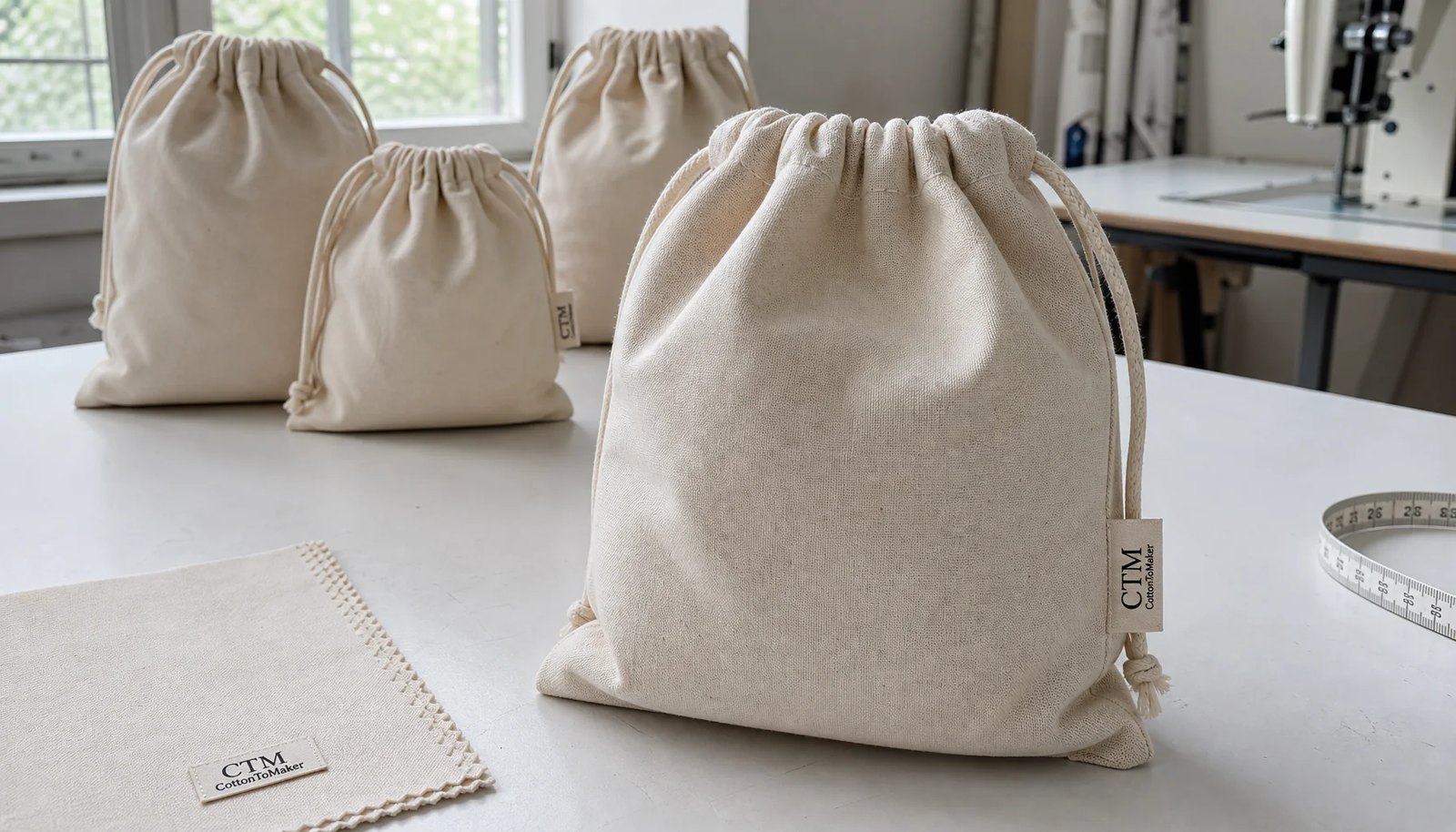
Start With the Subscription Box Use Case
Material selection for custom cotton drawstring pouches changes once the pouch becomes part of a subscription box program rather than a one-off giveaway. In a subscription box, the pouch often has three jobs at once: it protects the contents, supports the brand story, and survives enough handling to arrive looking intentional. That means the right fabric is not just about price per piece. It is about whether the pouch holds shape in transit, prints cleanly, and lands at a cost that still leaves margin in the box.
The first sourcing mistake is treating every pouch as a generic cotton bag. A pouch for jewelry, beauty samples, tea sachets, apparel inserts, or wellness kits does not need the same GSM, weave density, seam construction, or cord strength. Buyers should start with what goes inside the pouch, then work backward to the material and build. If the pouch will be seen before the subscription box is opened, the look and hand-feel matter more than the lowest possible fabric cost.
Procurement teams should also separate the pouch’s functional job from its marketing job. Some pouches only need to keep a product from scuffing inside a mailer. Others act as the visible unboxing layer and may be reused by the customer. Those two cases can call for very different material selections, even if the external dimensions look the same. A pouch that looks fine in a sample tray can still fail once it is packed, shipped, and handled by the end customer.
A practical way to scope the pouch is to define four inputs before requesting quotes: what it carries, how often it will be handled, how visible it is in the box, and whether the customer is expected to keep it. Those answers determine whether the spec should favor softness, body, print sharpness, or durability. If the answers are not fixed, supplier quotes will be inconsistent and hard to compare. That is where buyer time gets wasted, because every supplier ends up quoting a slightly different version of the same pouch.
For buyers managing multiple subscription tiers, it helps to build a simple pouch family instead of one universal spec. A premium tier may justify heavier cotton canvas with a cleaner print route, while a standard tier may need a lighter fabric and smaller print area to preserve margin. The key is to match the pouch to the product and the commercial model, not to force every program into the same construction. In practice, that usually means one spec for display-heavy boxes and another for internal protection or sample kits.
- Define what the pouch must do: protect, present, organize, or be reused.
- Match material choice to contents weight, print area, and customer touchpoints.
- Treat the pouch as part of the unboxing experience, not only as packaging.
- Separate functional requirements from branding requirements before RFQ.
- Build different pouch specs for different subscription tiers when needed.
Choose Fabric Weight by Contents, Not by Habit
For most custom cotton drawstring pouches used in subscription boxes, 120–140 GSM is the practical starting range. It usually gives enough body for logo visibility, decent sewing efficiency, and controlled freight cost. If the contents are very light, like sample sachets, cards, stickers, or small accessories, this range is often enough. If the pouch needs to look premium on shelf or handle a heavier insert, then 180–220 GSM cotton canvas may be the better fit.
Heavier fabric does not automatically mean better. It can improve structure and perceived quality, but it also changes stitch behavior, increases sewing time, and can raise unit and carton weight. If a buyer is comparing quotes, the same pouch size in 140 GSM and 220 GSM should not be treated as interchangeable. The quote should clearly state fabric weight, weave type, and whether the fabric is bleached, natural, dyed, pre-shrunk, or finished before cutting.
The right GSM also depends on how full the pouch will be. A pouch that is only half filled may need more fabric body to avoid looking limp in the box. A pouch that is tightly filled may need stronger seams and a weave that can tolerate stress at the corners. If the product has sharp edges, heavier cotton can reduce the risk of visible stress points or seam pull. A thin fabric might still pass a flat swatch review, but it can look tired once it is stuffed and drawn closed.
Buyers should also ask how the fabric behaves after cutting and sewing. Some fabrics look acceptable in a swatch but behave differently once stitched, pressed, and packed. Ask whether the supplier pre-shrinks, steams, or otherwise finishes the fabric, because finishing can affect finished dimensions, hand-feel, and the final appearance of the drawstring channel. In cotton sourcing, finishing is not a small detail; it can change how well the pouch keeps its size after a production run and after any customer handling.
The safest approach is to compare at least two GSM options against the real contents, not against a generic sample. Put the actual inserts into each prototype pouch, close the cord, place the pouch into the carton, and check the result under handling conditions that resemble your shipping lane. That process quickly shows whether the lighter option looks too thin or the heavier option adds unnecessary cost. Buyers usually get the answer faster when they test a real bundle than when they debate fabric specs on paper.
- 120–140 GSM: good general-purpose option for light to medium contents.
- 180–220 GSM: better for premium reuse, heavier fills, and a more structured appearance.
- Ask for finished fabric spec and finished pouch weight, not only raw fabric weight.
- Confirm whether the fabric is pre-shrunk, steamed, or finished before sewing.
- Test the pouch with actual contents before choosing the final GSM.
Compare Fabric Types for Print, Hand-Feel, and Cost
Plain cotton sheeting, twill, and canvas each behave differently in production. Sheeting usually prints smoothly and keeps costs low, but it can feel softer and less structured. Twill can improve drape and visual texture, while canvas gives the most body and durability. If your brand values a cleaner premium look, a tighter weave with less surface fuzz will usually print better than a loose, highly textured cloth. That matters because the fabric surface affects everything the buyer cares about: logo clarity, pouch shape, and the way the material reads in a customer’s hands.
For subscription boxes, the best material is often the one that keeps the pouch acceptable across the full chain: sewing, printing, packing, and the customer’s first touch. A rough surface can make fine logos look uneven. A very soft or open weave can show seams, reduce opacity, and lead to more visible size variation. If the pouch is natural cotton, color variation and fiber speckling may be acceptable—but only if the brand has approved that look in advance. Otherwise, a buyer can end up with a product that is technically cotton but visually inconsistent from batch to batch.
Tight weave matters because it improves repeatability. A tighter construction can hold print edges more cleanly and reduce distortion at the seam line. That does not mean every brand should choose the stiffest fabric available. Beauty, spa, and wellness brands often want a softer hand-feel; fashion or premium gift boxes may prioritize structure and a more refined silhouette. The buyer should decide which visual cue matters most before asking for samples. If the pouch is meant to feel luxurious, the hand-feel matters. If the pouch is meant to frame a logo, print clarity may win.
There is also a cost tradeoff between stock fabric and custom material. Stock natural cotton often gives faster lead times and lower risk. Custom-dyed or specially finished fabric can help the pouch better align with brand colors, but it adds lead time, minimums, and shade-control risk. If the pouch color must match a box system, confirm whether the factory can match against a Pantone target or whether it will work from existing stock shades only. A buyer should not assume a color match is simple just because the sample looked close under office lighting.
Request both an unprinted swatch and a printed strike-off on the actual chosen fabric. A print that looks clean on one cloth may spread, feather, or lose opacity on another. The buyer should compare the swatch in natural light, check the weave under magnification if possible, and confirm whether the fabric surface supports the line thickness in the artwork. The swatch should be retained as part of the approval record. That sample becomes important later if the supplier changes lots or a reorder needs to match the first run.
- Tighter weave improves logo clarity and reduces visible distortion.
- Soft hand-feel can be good for beauty or wellness brands but may reduce structure.
- Request both unprinted and printed swatches before approving bulk fabric.
- Treat custom dyeing as a lead-time and shade-control decision, not only a branding decision.
- Keep the approved swatch with the purchase order file for future reorders.
Specify Size and Tolerance Before You Ask for Quotes
A pouch quote is only comparable if the size definition is exact. Buyers should specify finished width, finished height, bottom gusset if any, top channel height, and the exact drawstring exit position. A loose description such as “small cotton pouch” leaves room for hidden differences in material use and sewing cost. For a subscription box, the pouch should be sized to the actual product plus any protective insert or tissue, not simply to a marketing concept. The more precisely the size is written, the less room there is for quiet substitution later.
The critical point is tolerancing. Cotton can shift during cutting, sewing, finishing, and packing, so the buyer needs acceptable variation stated in writing. For small pouches, a practical finished size tolerance is often ±0.5 cm. For larger pouches, ±1.0 cm is usually acceptable unless the box fit is tight. If the contents are rigid or the pouch is used as a set piece inside a retail tray, a tighter tolerance may be needed. Buyers should not guess on this point; they should define it before the factory starts cutting fabric.
Drawstring channel measurements matter too. If the channel is too short, the cord pull will feel stiff and the closure may not sit evenly. If it is too long, the pouch can look sloppy or waste fabric. The same is true for seam allowance. The supplier should tell you the target seam allowance, typically stated in millimeters, and the buyer should confirm whether that allowance is held consistently across all four sides. Without those numbers, you cannot compare production samples accurately, and you cannot judge whether a reorder is actually the same product.
Because subscription boxes often use multiple pouch sizes, ask the supplier to quote each size separately. A 10 x 15 cm pouch and a 15 x 20 cm pouch may use the same fabric, but the sewing setup, cord length, and packaging cost can differ enough to change the economics. If the pouch will be kitted with a specific product, require a fit check with the actual insert. That prevents surprises such as a pouch that technically matches the size but is too tight once the item is inside. Fit problems are one of the most common reasons a pouch spec needs a second round of samples.
A good spec sheet should read like a production instruction, not a marketing brief. Include dimensions, tolerance, target fabric GSM, closure style, print placement, and pack method. If the supplier cannot quote against those details, the quote is not reliable enough for procurement comparison. Buyers who standardize the spec sheet usually spend less time reconciling sample differences and more time comparing real commercial tradeoffs.
- State finished width, finished height, and any gusset or channel dimensions.
- Use ±0.5 cm tolerance for small pouches and ±1.0 cm for larger pouches unless the fit requires tighter control.
- Specify seam allowance and cord exit position in millimeters.
- Quote each size separately instead of pooling multiple pouch sizes.
- Test the actual product fit before approving the final dimensions.
Select the Print Method Around Artwork Complexity
Screen print remains the most cost-efficient route for recurring subscription programs with one to two logo colors. It is usually the best choice when the same pouch runs repeatedly and the artwork is stable. The key is to keep line thickness, negative space, and print placement realistic for cotton fabric. Small text and hairline details can disappear, especially on textured fabric or unbleached cotton. If the logo relies on tiny details, a buyer should expect some simplification before production starts.
Heat transfer and digital print are more flexible for short runs or artwork changes, especially when the brand uses seasonal subscription themes. They help when the design needs more color variation or fine detail. The tradeoff is durability and unit cost. Buyers should ask how the print will age under rubbing in a box, whether the ink sits on the surface or bonds through the fiber, and whether the finish remains stable after folding and handling. A print that looks sharp on day one still has to survive packing, shipping, and the first customer touch.
The correct print route also depends on the role of the pouch. If the pouch is primarily an internal organizer and will not be reused, a simpler print spec may be acceptable. If the pouch is visible at unboxing or intended for repeated customer use, the quality threshold should be higher. In that case, ask whether the print can withstand light laundering, repeated hand contact, or abrasion from small hard goods inside the pouch. Reuse changes the bar, and the print method should reflect that from the start.
Do not let artwork files determine the method by default. A design may look beautiful in a brand deck and still be impractical on cotton fabric. Thin outlines, tiny type, gradient fades, and heavy solid blocks all carry risk. Ask the supplier to flag any elements that may fill in, blur, or misregister. A good factory should suggest line-weight changes, simplified artwork, or print-size adjustments before production starts. That kind of feedback is a sign that the supplier understands fabric behavior, not just artwork submission.
For best results, require a strike-off on the actual pouch fabric and a simple durability check. Fold the pouch, rub the print, and inspect whether the design cracks at the fold line or transfers onto adjacent material. If the pouch will be packed tight inside a box, the print should tolerate repeated compression without obvious damage. This is especially important for subscription programs where the pouch may arrive compressed and then be reused by the customer. The print has to look presentable both in the box and after the box is gone.
- Use screen print for stable, repeatable artwork and simpler branding.
- Use transfer or digital print for short runs, detailed graphics, or frequent design changes.
- Approve a rub test and fold test before release if the pouch is reused by customers.
- Check line thickness and type size against the real fabric surface, not only the artwork file.
- Ask the supplier to identify any print risks before the final proof is approved.
Use a Sourcing Route That Matches Your Risk Tolerance
The factory route matters as much as the fabric itself. A direct manufacturer with in-house sewing and printing can usually control fabric consistency, print alignment, and packing more tightly. That is helpful when the pouch must match a larger subscription box schedule or when the brand needs repeatability across seasons. The buyer should still confirm which steps are truly in-house and which are outsourced, because that determines how much control the supplier really has. A clear process map is often more useful than a sales pitch.
A trading company or multi-factory sourcing route can be useful when the buyer needs more quote options, mixed materials, or bundled sourcing across several packaging items. The risk is spec drift. One factory may quote a similar-looking cotton pouch that differs in fabric density, cord quality, or carton pack. Another may substitute a more convenient stock fabric unless the specification is tightly written and acknowledged in the PO. That is why the buyer needs an exact written spec, not just a sample photo and a price.
Procurement teams should ask for a process map. Who buys the fabric? Who cuts it? Who sews it? Who prints it? Who inspects it? Who packs the goods? Those questions sound basic, but they reveal where variation can enter the order. If printing is subcontracted, for example, the buyer may need extra time for strike-off approval and more careful QC on color alignment and cure quality. A supplier that cannot answer these questions clearly may not be ready for repeat business.
A good RFQ should force every supplier to quote against the same fabric weight, color family, print method, closure style, pack count, and tolerance sheet. Without that discipline, one supplier can appear cheaper simply because it quoted a thinner or simpler product. If your team uses multiple suppliers, create one master spec sheet and do not allow separate interpretations unless the differences are explicitly marked. That is the easiest way to avoid buying a pouch that looks fine in the quote but arrives with a different feel or different performance.
The supplier route should also reflect the importance of communication. If the project has repeated reorders, multiple SKU sizes, or strict launch dates, a direct factory or a very controlled trading partner is often easier to manage. If the brand is still testing the pouch concept and needs multiple samples quickly, a trading route can be useful—but only if the sample stages and acceptance criteria are documented clearly. Fast sourcing is helpful; vague sourcing is not.
- Direct factory works best when repeatability and process control matter.
- Trading route can help when you need faster quote comparison across multiple options.
- Lock the spec sheet so suppliers are quoting the same product, not a similar one.
- Ask who buys, cuts, prints, sews, inspects, and packs the goods.
- Require explicit acknowledgement of any spec changes before award.
Read MOQ Logic Before You Compare Unit Prices
MOQ is rarely just a number. For cotton drawstring pouches, MOQ often changes with fabric color, print colors, pouch size, and whether the fabric needs to be woven, dyed, or finished specially. A supplier may quote a low MOQ on stock natural cotton but require a much higher run for custom dyed fabric or a multi-color logo. Buyers should ask whether the MOQ applies per size, per color, per artwork, or per total order. Those details matter because they change how much inventory risk the buyer is actually taking on.
When comparing quotes, the lowest unit price is not always the best route if it forces oversupply in the wrong color or size. A subscription brand with frequent seasonal changes may benefit from a slightly higher unit price but a lower MOQ, especially for first-order testing. On the other hand, a stable monthly insert program can justify higher volume and a lower price if the pouch spec stays unchanged for several cycles. Procurement has to weigh cash flow, storage, and launch flexibility together rather than chasing the smallest line item.
It also helps to understand what causes the MOQ. Some factories set a minimum because of fabric roll yield, cutting setup, or print screen preparation. Others tie MOQ to dye lots or the minimum batch size of outsourced finishing. Ask for the reason behind the number, because that tells you whether the factory can negotiate a more flexible order through stock fabric, simpler print, or standard colors. A supplier that explains the driver clearly is usually easier to work with when you need a repeat order later.
For subscription-box buying, flexibility is often worth money. If a brand runs several box variants, it may be better to place smaller but more frequent orders than to lock into one large MOQ. That reduces the risk of dead inventory if the box theme changes or the pouch size is updated. However, if the pouch is a long-running program, the buyer should calculate total annual demand and compare it against the supplier’s price breaks to understand the real saving potential. The best answer is usually commercial, not emotional: whatever keeps the program stable without overbuying.
The right procurement decision is not simply to choose the lowest MOQ or the lowest unit price. It is to choose the best balance between inventory risk, launch speed, and repeat-order economics. Ask suppliers whether they can hold stock fabric for repeat runs, whether the quoted MOQ includes a tolerable overage, and whether a first order can be structured differently from a reorder once the spec is proven. That gives the buyer room to test the pouch first, then scale only after the spec is validated.
- Ask whether MOQ is tied to fabric stock, custom dyeing, print setup, or sewing line time.
- Compare total committed inventory risk, not only the quoted unit price.
- For seasonal programs, flexibility can be more valuable than the lowest production cost.
- Ask the supplier to explain what drives the MOQ.
- Model annual demand if the pouch is likely to become a repeat item.
Use Quote Data That Lets You Compare Apples to Apples
A useful factory quote should separate the cost drivers instead of hiding them in one blended price. For a cotton drawstring pouch, the key quote data usually includes fabric weight, pouch size, print method, cord type, sample charges, carton packing, and production lead time. If the supplier only gives a single unit price, the buyer has no way to see whether the quote assumes thinner fabric, simpler print, weaker packing, or a lower-quality finish. That makes procurement comparison slow and risky.
The best way to compare is to request the same data from every supplier and build a simple landed-cost view. That means checking unit cost, sample cost, domestic packing, export carton pack, and freight impact from gross weight. In many cases, the difference between two quotes is not the sewing price; it is the fabric weight and pack density that change shipping cost and quality risk. A pouch that is slightly cheaper on paper can cost more after freight, rework, or inspection rejects. Buyers should look at the whole picture, not only the purchase price.
Ask suppliers to state exactly what is included and excluded. Does the price include cutting, sewing, cord insertion, trimming, printing, inspection, folding, polybagging, and carton labeling? Does it include any color matching or strike-off work? Are sample charges deductible from the bulk order? If these details are missing, the quote is not ready for comparison. A line that looks small in the price table can turn into a real cost once the order is in production.
It is also useful to request the expected gross carton weight and carton dimensions. For subscription box programs, pallet density and distribution center handling matter. A quote that looks favorable per piece may be less attractive if carton weight is too high for efficient shipping or if the carton count creates more handling labor. The unit price should be evaluated with freight and warehouse handling in mind. In some cases, the best supplier is the one whose packaging spec reduces repacking work downstream.
A disciplined buyer can use a one-page comparison matrix to keep sourcing honest. Put each supplier across the top and the spec elements down the side: fabric, color, weave, print method, cord, packing, MOQ, lead time, and sample stage. If the matrix shows any mismatch, pause and ask for a revised quote before award. That avoids buying a pouch that is cheaper only because it is not the same product. The quote should make differences obvious, not hide them.
- Require separate line items for fabric, print, sewing, packing, and sample charges.
- Compare gross carton weight and carton count because freight can change the real cost.
- Ask for a quote revision if the supplier changes fabric grade without flagging it.
- Confirm exactly what is included and excluded in the quoted price.
- Use a single comparison matrix so every supplier is judged against the same spec.
Set Sample Approval Rules Before Bulk Starts
Sample approval should include more than appearance. For subscription box pouches, the pre-production sample needs to prove that the fabric weight, print placement, cord function, and packing method all work together. If the sample feels too limp, shrinks too much, or shows print bleeding, that is the time to correct it. Once bulk starts, small issues become expensive across a large run. A sample that looks acceptable in isolation can still create problems once it is packed, shipped, and handled by the customer.
A strong sample process usually has three checkpoints: fabric swatch, printed strike-off, and sewn sample. Buyers should sign off against a reference sample and a written spec sheet. If the pouch will be used with a specific insert size, the sample should be tested with actual contents inside the pouch and placed inside the shipping carton. That reveals bulk issues that a flat sample cannot show. It also helps the buyer see whether the pouch closes cleanly when full, not just when empty.
When reviewing the sample, do not just inspect it visually. Open and close the pouch several times. Check whether the drawcord slips, whether the channel collapses, whether the seam twists after filling, and whether the pouch still looks neat once packed. If the pouch has a printed logo, check placement against the center line and the top edge, because inconsistent placement is one of the most common reasons buyers reject pouches even when the fabric is acceptable. The sample should prove both appearance and function.
For first orders, it is wise to require a signed golden sample or sealed reference sample. That sample should be retained by both buyer and supplier as the acceptance standard for production. If the brand has multiple stakeholders—marketing, operations, and procurement—make sure they all agree before release. Late design changes after sample approval can trigger rework, lost time, and shipment delays. It is better to settle the details once than to debate them during bulk production.
If possible, add a small production pilot before full bulk. A pilot run of a limited quantity can show whether the fabric behaves well on the sewing line, whether print registration stays consistent, and whether packing instructions are practical. This is especially useful when the pouch is going into a subscription box program with a fixed launch date. A small pilot is often cheaper than discovering a repeatable defect after the full order is already underway.
- Approve fabric, print, and sewn sample separately when the order is not standard.
- Test the pouch with real contents and actual carton packing before bulk release.
- Keep the signed sample and spec sheet attached to the PO file.
- Use a sealed reference sample for production comparisons.
- Consider a small pilot run for first-time pouch programs.
Control Packing and Carton Load to Protect Margin
Packing can shift both damage risk and landed cost. Flat-packed pouches save carton volume, but if the fabric wrinkles badly or the drawcord tangles, rework time can rise at fulfillment. Stuffed or nested packing can improve appearance but increases carton size and freight. For subscription boxes, the buyer should define whether each pouch needs individual polybags, bundle ties, tissue inserts, or carton dividers. Those decisions affect both labor and moisture protection, so they belong in the spec rather than in a later email.
The carton pack count should be chosen with the shipping lane in mind. A high pack count may reduce carton cost but create heavier cartons that are harder to handle and more vulnerable to crush damage. A lower pack count may improve handling but raise freight per piece. The right choice depends on whether the shipment is air, ocean, or domestic distribution. Ask for the factory’s standard carton dimensions and gross weight before approving the shipping plan. That data helps you estimate freight and warehouse load more accurately.
If the pouch is sold or presented in retail-facing packaging, presentation standards become more important. A clean fold, consistent cord position, and dust protection can matter more than saving a small amount of carton volume. If the pouch is only inserted inside another box, a simpler packing method may be acceptable as long as the goods remain clean and undamaged during transit. The same pouch can justify two different pack methods depending on where the customer sees it.
Moisture control is also easy to overlook. Cotton can absorb moisture and develop odor or wrinkling if cartons sit in humid storage. Ask whether the factory uses desiccants, liner bags, or moisture barriers when needed. This is especially relevant for long ocean transit or warehouse dwell time before kitting. The packing spec should be written so the buyer does not have to guess what condition the pouch will be in on arrival. If the product will sit in a warehouse for weeks, that detail becomes a quality issue, not a packaging preference.
The packaging instructions should be precise enough that a new operator can follow them. Specify folding orientation, cord tuck method, bundle size, polybag type, label placement, and carton mark format. If the pouch ships in multiple sizes or colors, ask how the factory separates cartons to prevent mix-ups. Good packing instructions reduce repacking work at the destination and help the receiving team confirm counts quickly. They also make it easier to reject a shipment if the factory packs against the wrong spec.
- Specify flat-packed, folded, or stuffed condition in the PO.
- Balance carton count against handling weight and freight efficiency.
- Confirm whether polybags are needed for dust, moisture, or retail presentation.
- Define folding, cord tuck, bundle size, and carton mark rules clearly.
- Ask about moisture control for humid storage or long transit lanes.
Specification comparison for buyers
| Spec decision | Recommended option | When it fits | Buyer risk to check |
|---|---|---|---|
| Fabric weight | 120–140 GSM cotton | Most subscription boxes that need a balance of hand-feel, print clarity, and controlled cost | Too light can look thin once filled; too heavy raises sewing time, freight, and unit cost |
| Fabric weight | 180–220 GSM cotton canvas | Premium kits, heavier contents, or reuse-focused pouches | Higher GSM changes seam bulk, closure performance, pack volume, and lead time |
| Fiber choice | Combed cotton or fine cotton sheeting | When softer hand-feel and sharper print edges matter more than rugged texture | Confirm shrinkage behavior, shade variation, and whether the fabric is pre-shrunk or finished |
| Weave choice | Tight plain weave or light canvas weave | When the pouch must hold shape and keep small logos legible | Loose weave can show seam distortion and reduce print definition |
| Print route | 1–2 color screen print | Stable artwork, recurring subscription programs, and simple logos | Fine lines may fill in; solid areas need proper ink deposit and cure control |
| Print route | Heat transfer or digital print | Short runs, gradient artwork, or many SKUs with frequent design changes | Some transfers crack or peel under friction if the pouch is reused often |
| Closure build | Self-fabric drawcord with reinforced stitching | Standard inserts and gift sets | Cord length, knot security, and cord fray control must be verified |
| Supplier route | Direct factory with in-house sewing and printing | When you need tighter control of fabric, print, and packing | Confirm whether print and finishing are truly in-house or subcontracted |
| Supplier route | Trading company with multi-factory sourcing | When you need broader quote options or mixed product programs | Risk of spec drift if fabric and trim are not locked in writing |
Buyer checklist before sampling
- Define the pouch role: insert pouch, reusable gift pouch, or retail-ready packaging layer.
- Lock finished size, fill weight, content dimensions, and acceptable shrinkage before RFQ.
- Select fabric GSM, weave type, and color family based on contents, print area, and reuse expectations.
- Provide artwork in vector format and specify print placement, ink limits, Pantone targets, and minimum line thickness.
- State whether the pouch must meet reusable retail presentation, promo-grade, or shipping-protection expectations.
- Request a fabric swatch, printed strike-off, and sewn pre-production sample before bulk approval.
- Confirm overage percentage, carton pack count, polybag requirement, palletization, and outer carton marks.
- Align lead time with fabric availability, print method, sample approval, and any third-party inspection window.
- Ask the supplier to confirm seam allowance, drawcord construction, stitch density, and thread trimming in writing.
- Verify whether the quoted price includes packaging, trimming, tagging, and export carton labeling.
Factory quote questions to send
- What fabric weight do you propose, and what is the finished GSM after finishing or washing allowance?
- Is the fabric woven in-house, sourced greige, or purchased as finished stock?
- What weave type do you recommend, and why is it suitable for the pouch contents and print method?
- What print method is included in the quote, and how many colors are priced?
- What is the MOQ per size, per color, per print design, and per fabric type?
- What is the sample cost, sample lead time, and what sample stages are available?
- What tolerances do you control for size, cord length, stitch density, seam allowance, and print placement?
- How are pouches packed inside the carton, and what is the standard master carton quantity?
- What production lead time applies to repeat orders versus first orders?
- Which steps are done in-house, and which are outsourced to subcontractors?
Quality-control points to confirm
- Finished size tolerance: keep within ±0.5 cm for small pouches up to 20 cm and ±1.0 cm for larger pouches unless the product fit requires tighter control.
- Fabric defects: reject visible slubs, holes, oil marks, loose yarns, broken warp/weft threads, and strong shade variation within the same lot.
- Fabric consistency: confirm the same weave, hand-feel, and opacity across bulk fabric lots; inspect random cartons for lot mixing.
- Shrinkage control: verify dimensional change after any washing, steaming, or finishing allowance; record acceptable shrinkage in the spec sheet.
- Stitching: check seam straightness, seam allowance consistency, bar-tack strength, stitch density, and loose thread trimming.
- Recommended stitch density: verify a consistent 8–10 stitches per inch for standard pouches unless the structure requires a different target.
- Corner and seam performance: inspect the pouch when filled to confirm no seam gaping, twisting, or stress distortion at the base.
- Drawcord: verify smooth pull, equal cord length, secure knotting or end finishing, and no fraying at the cut ends.
- Cord exits: make sure eyelet openings or stitched channels are clean, aligned, and not tearing under normal use.
- Print quality: confirm placement, opacity, registration, cure, and rub resistance with dry and damp rub tests.