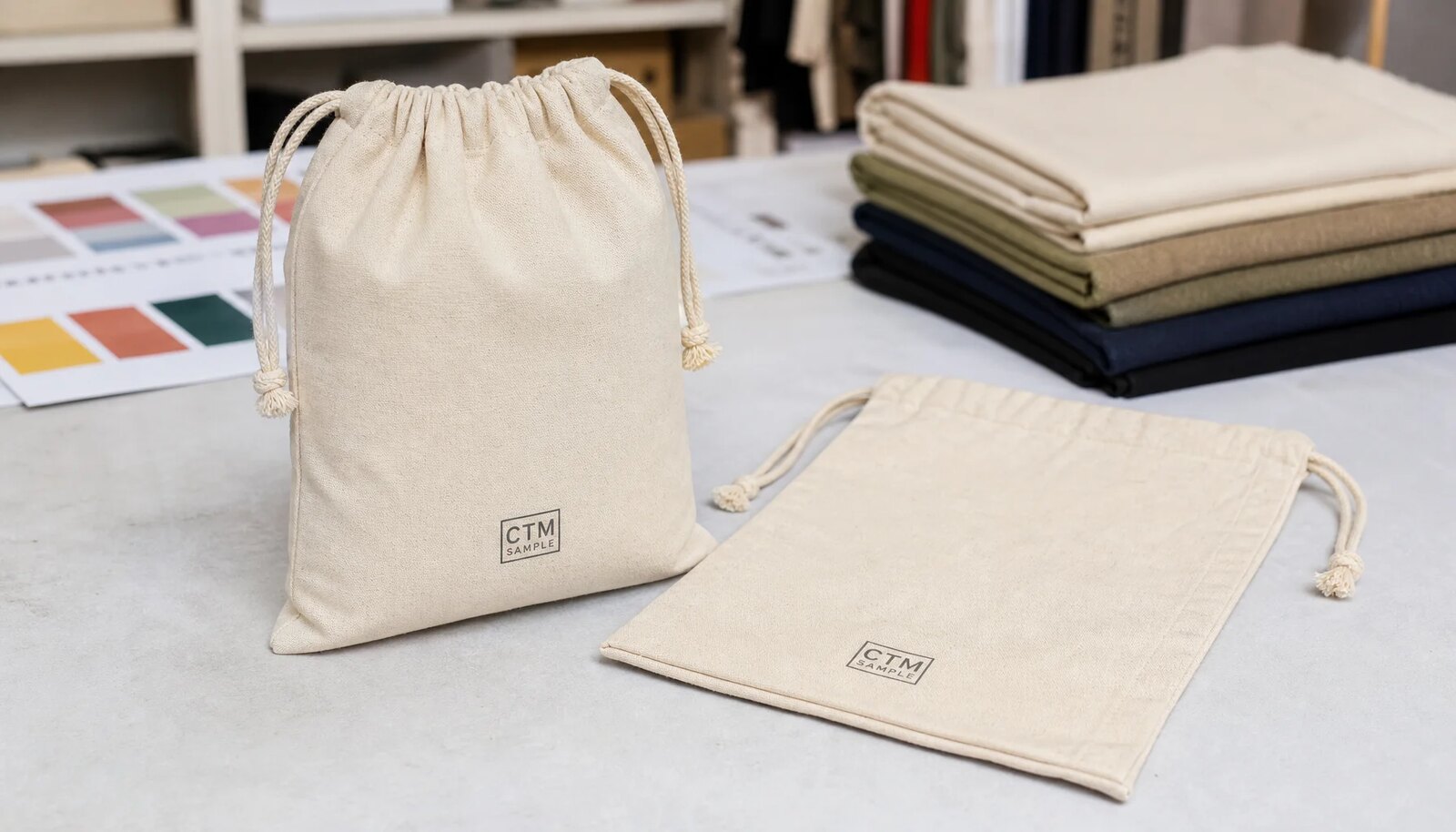
Why Logo Placement Matters
For hotel retail, a cotton drawstring pouch is often judged before the guest touches the product inside. The pouch may sit in a spa boutique, gift shop, minibar display, welcome amenity tray, or online hotel shop photo. If the logo is too high, too low, crooked, or printed across a seam curve, the product looks like packaging instead of merchandise.
The main buying problem is not choosing a pretty logo position on a flat artwork file. The problem is controlling where that logo lands after fabric cutting, sewing, drawstring channel folding, closing, filling, pressing, and carton packing. A good RFQ should describe the placement from real pouch construction points, not from a generic image centered on a rectangle.
- Use finished pouch dimensions as the basis for placement, not cut panel dimensions.
- Measure logo location from the top edge after the drawstring channel is sewn.
- Keep artwork away from the drawcord fold, side seam allowance, and bottom bulge area.
- Approve placement on a filled sample if the pouch will be sold with a product inside.
- For hotel retail, prioritize a clean front view when the pouch is hanging, lying flat, or standing with contents.
Start With Pouch Function
A hotel retail pouch may be used for candles, bath salts, slippers, skincare bottles, tea, jewelry, small textiles, travel kits, or wine accessories. Each use changes the best logo position. A flat jewelry pouch can carry a centered logo quite low. A pouch for a round jar needs the mark higher because the lower panel will curve around the product.
Before discussing logo artwork, send the factory the product dimensions, product weight, display method, and whether the pouch is sold empty or filled. A buyer who only sends finished pouch size may receive a technically correct sample that fails on the shelf because the logo disappears once the pouch is loaded.
- For empty gift pouches: front center placement normally gives the cleanest presentation.
- For filled pouches with bulky contents: move the logo slightly above the pouch midpoint.
- For hanging displays: keep the logo below the drawstring channel but high enough to remain visible when gathered.
- For premium hotel boutiques: consider a small side label or lower corner print if quiet branding fits the collection.
- For amenity kits packed in rooms: choose durable placement that tolerates stacking and housekeeping handling.
Choose Cotton Weight Before Artwork
Logo placement cannot be separated from fabric weight. Light 3 oz to 4 oz cotton is soft and economical, but it wrinkles easily and may show product edges. It is often acceptable for simple amenity packaging or low-cost gift wrap. For hotel retail, 5 oz to 8 oz cotton or cotton canvas usually gives a better panel surface and a more stable print zone.
Heavier cotton improves perceived value, but it also changes sewing behavior. A thick channel can make the top area bulky, so artwork needs more clearance from the drawstring fold. If the pouch must close tightly around a product, very heavy canvas may resist gathering and make the top look stiff.
- 3-4 oz cotton: suitable for lightweight amenity bags, simple drawstring sleeves, and cost-sensitive programs.
- 5 oz cotton: common balance for small hotel retail pouches with screen printed logos.
- 6-8 oz cotton canvas: better for premium gift shop goods, spa sets, and heavier contents.
- 10 oz or above: use carefully for small pouches because the drawstring channel may become bulky.
- Natural cotton color can vary by batch; dyed or bleached cotton gives tighter visual control but adds lead time and MOQ pressure.
Map the Logo Placement
A practical logo placement spec uses three measurements: distance from the top finished edge or drawstring channel, distance from left and right side seams, and distance from the bottom seam. The factory should mark these points on a pre-production sample and keep the approved sample as the production reference.
For many small and medium cotton drawstring pouches, a safe front logo area begins about 45-70 mm below the top edge and ends at least 35-60 mm above the bottom seam, depending on pouch size. This is not a universal rule; it is a starting range for avoiding the two most common failures: hidden logos near the gathered top and distorted logos near the filled base.
- Small pouch around 10 x 15 cm: keep logo compact, usually no wider than 55-70 mm.
- Medium pouch around 15 x 20 cm: center logo in a 80-110 mm wide print zone.
- Large pouch around 20 x 30 cm: allow a wider mark, but keep clear of bottom contents curve.
- For horizontal hotel logos, check that fine text remains readable after cotton texture absorbs ink.
- For crest or emblem logos, avoid placing the top detail near the drawstring channel where gathering can break the visual line.
Match Print Method to Logo
Screen printing is usually the most reliable method for cotton drawstring pouches when the logo uses one to three solid colors. It gives good color density, stable cost, and repeatable output in bulk. For hotel logos with thin serif letters, small taglines, or fine line crests, the artwork may need minor adjustment so the print holds on cotton fabric.
Heat transfer can handle gradients, photographic details, or very small multicolor artwork, but it may feel less natural on cotton and can create a film-like surface. Embroidery can look premium on heavier canvas, but it adds cost, can pucker light fabric, and is not suitable for tiny text. Woven side labels are a strong option when the retail design needs a clean front panel.
- Use screen print for solid CTM-style marks, hotel names, simple emblems, and one-color branding.
- Use heat transfer only when artwork detail cannot be separated into clean spot colors.
- Use embroidery on 6 oz to 10 oz cotton canvas, not on very light cotton.
- Use a sewn label when the logo must stay subtle or when the same pouch body serves multiple hotel brands.
- Always approve the print strike-off on the actual fabric, because ink behavior changes between natural cotton, dyed cotton, and canvas.
Understand Cost Drivers
The pouch body cost is driven by fabric weight, size, cotton type, cutting yield, sewing complexity, cord type, and packing. Logo cost is driven by print method, color count, artwork size, setup charge, and production quantity. A low unit price may hide extra screen charges, sample charges, or packing costs that appear later on the proforma invoice.
For quote comparison, do not only compare unit price. A supplier quoting 4 oz cotton with one-color print and bulk carton packing is not quoting the same product as a supplier quoting 6 oz cotton canvas, custom dyed cord, woven side label, and individual retail packing. The RFQ should force all suppliers to show the same cost assumptions.
- Fabric upgrade from light cotton to canvas raises material cost and carton weight.
- Custom dyed fabric or cord often adds MOQ, lab dip time, and color approval risk.
- Two-sided printing adds handling time and reject risk because both panels must stay clean.
- Large ink coverage can slow drying and may require more careful packing.
- Individual polybagging, barcode labels, belly bands, or hang tags should be quoted separately.
Set MOQ and Color Logic
MOQ is usually easier to manage when the buyer groups several pouch sizes under the same fabric color, same cord color, and same print color. Hotel groups often need related pouches for spa, room amenities, gift shop items, and seasonal retail sets. If every pouch has a different fabric, cord, and logo color, the factory may treat them as separate small orders.
For logo placement, MOQ also matters because every artwork size can require a different screen or transfer setup. A brand buyer can reduce setup cost by using one logo width across several pouch sizes where the visual result still works. For example, a 70 mm wide logo may suit both a small skincare pouch and a medium bath salt pouch, while a large tote-style mark would not.
- Combine SKUs by shared fabric and print color when possible.
- Use one approved logo width for multiple pouch sizes if the design remains balanced.
- Avoid unnecessary cord color changes unless the retail story needs them.
- Separate true retail pouches from disposable amenity pouches in the RFQ.
- Clarify whether the MOQ is per size, per color, per logo, or per total order.
Approve Samples Correctly
A digital proof can show general layout, but it cannot prove print quality, cotton texture, seam behavior, or the way the pouch closes. The first useful sample is a physical sample using the intended fabric weight, cord, print method, and logo size. If custom dyed fabric is not ready, the factory can make a construction sample in available fabric and a separate print strike-off on the closest approved material.
Sample approval should not be a simple yes or no based on appearance. Mark the sample with measured comments: logo is 60 mm below top edge, centered within 2 mm, print color approved, cord length approved, channel stitching acceptable, size within tolerance. This gives the factory a real standard to follow during bulk production.
- Approve artwork placement on a flat empty pouch and, when relevant, on a filled pouch.
- Rub the printed logo lightly with a white cloth after curing to detect transfer risk.
- Open and close the drawstring several times to check channel friction.
- Fold the pouch as planned for packing and inspect whether the print creases badly.
- Keep one signed or photographed approved sample for factory production and one for buyer receiving inspection.
Define QC Acceptance
Cotton pouches are sewn goods, so small variation is normal. The buyer's job is to define which variation is acceptable before production. For logo placement, many retail programs can work with plus or minus 3 mm on small pouches and plus or minus 5 mm on larger pouches. Tighter tolerance may be possible, but it should be discussed because fabric cutting, sewing, and manual printing all add variation.
QC should also cover defects that affect shelf presentation: crooked channel seams, loose threads near the logo, ink smears, stains on natural cotton, panel twisting, and uneven drawcord length. A pouch can pass size measurement and still fail retail inspection if the front panel looks careless.
- Logo off-center beyond agreed tolerance: classify as major defect for retail-facing items.
- Ink smudge, pinhole in key logo area, or color contamination: classify based on visibility at normal viewing distance.
- Open seam, broken stitch, or blocked drawstring channel: reject as functional defect.
- Visible stain on light cotton front panel: reject for hotel retail unless within an approved fabric standard.
- Cord length difference should be controlled so paired drawstrings close evenly and do not look mismatched.
Plan Packing and Lead Time
Packing affects logo presentation more than many buyers expect. If cotton pouches are compressed too tightly, the logo panel may arrive with strong folds, especially when screen print ink coverage is large. For retail use, flat packing with controlled stack height is usually better than heavy compression. If individual packing is required, choose clear polybags, paper belly bands, or recyclable paper sleeves according to the hotel brand standard and destination rules.
Lead time depends on fabric availability, dyeing, print setup, sampling, production quantity, and packing labor. A simple natural cotton pouch with one-color print can move faster than a custom dyed canvas pouch with woven label, barcode sticker, and individual retail packing. Build the schedule around approval points: artwork proof, fabric approval, print strike-off, pre-production sample, bulk production, QC, and final packing.
- Allow extra time for custom dyed fabric, custom cord color, or organic cotton sourcing.
- Do not release bulk cutting until finished size and logo placement are approved.
- Confirm whether the factory can finish curing and packing without ink blocking.
- Request carton dimensions and gross weight before shipment booking.
- For hotel launch dates, reserve time for buyer-side receiving inspection, labeling, and internal distribution.
Specification comparison for buyers
| Spec decision | Recommended option | When it fits | Buyer risk to check |
|---|---|---|---|
| Front center logo placement | Place artwork 45-70 mm below the drawstring channel and centered between side seams | Best for hotel retail shelves, amenity kits, spa sets, and gift packaging where the pouch is viewed flat or hanging | If the logo sits too high, the drawcord fold can distort the print and hide the top of the artwork after packing |
| Lower front logo placement | Keep the logo above the bottom seam by at least 35-45 mm on small pouches and 50-60 mm on larger pouches | Useful when the pouch is displayed upright with product weight filling the base | Heavy contents can create bottom bulging; artwork printed too low may curve and look off-center on shelf |
| Side label branding | Use a woven or printed cotton side label of about 20-35 mm exposed length | Good for quiet luxury hotel retail, organic collections, or designs where the main panel should stay clean | Side labels need sewing tolerance control; labels can twist, hide inside the seam, or scratch retail packaging if too stiff |
| Fabric weight | Use 5 oz to 8 oz cotton canvas for retail pouches; use lighter 3-4 oz cotton only for low-weight amenity packing | 5 oz is common for small retail pouches; 6-8 oz gives better structure for premium hotel shop products | Thin fabric may show product edges and print ink bleed; heavy fabric raises unit cost and carton weight |
| Print method | Screen print for solid hotel logos; heat transfer for fine gradients; embroidery only for heavier canvas and simple marks | Screen print gives good cost control on bulk orders with 1-3 spot colors | Fine serif text below 1.5 mm stroke width, metallic inks, and heavy ink coverage need strike-off approval before PO |
| Drawstring position | Round cotton cord or flat cotton tape, color matched or natural, with channel seam kept parallel | Cotton cord fits spa and wellness goods; flat tape gives a more gift-ready retail finish | Uneven channel stitching makes the logo look crooked even when the print is centered correctly |
| MOQ logic | Group sizes by same fabric, same logo color, and same print setup to reduce setup charges | Works for hotel groups ordering multiple pouch sizes for minibar, bath, spa, and gift shop SKUs | Different logo sizes, fabric colors, or cord colors can split the order into several production lots |
| Packing plan | Flat pack in inner polybags or paper bands with carton size set to avoid hard fold lines across logo | Needed for retail buyers who will barcode, sticker, or kit the pouches after import | Tight vacuum packing can crease screen print and make front panels look wrinkled at receiving inspection |
Buyer checklist before sampling
- Define the pouch use: hotel retail resale item, amenity packaging, spa gift pouch, minibar kit, or guest-room merchandise sleeve.
- Choose finished size after testing the actual product insert, not only by measuring the product width and height.
- Specify cotton fabric by GSM or ounce weight, color, weave, shrinkage expectation, and whether the fabric is natural, bleached, dyed, or organic cotton.
- Place the logo using measurements from finished pouch edges: distance from top channel, side seams, and bottom seam.
- State logo size in millimeters, print colors by Pantone or approved standard, and whether slight ink texture on cotton is acceptable.
- Request a digital artwork layout plus physical print strike-off on the approved fabric before bulk cutting.
- Confirm drawstring type, cord diameter or tape width, cord color, knot style, and whether cord ends need metal tips, knots, or heat sealing.
- Set acceptance limits for logo position tolerance, color deviation, print smudging, fabric stains, sewing defects, and size variation.
- Plan packing by retail handling route: flat bulk pack, individual polybag, paper belly band, barcode sticker, or master carton only.
- Collect quote data in the same format from each supplier: fabric GSM, print method, setup cost, MOQ by color, sample fee, lead time, carton details, and incoterm.
Factory quote questions to send
- What cotton fabric weight are you quoting, in GSM or ounces, and is it stock fabric or custom dyed fabric?
- What is the finished pouch size tolerance after sewing, and does the quote include shrinkage allowance?
- What is the maximum recommended logo size for this pouch size without printing into the drawstring channel or bottom curve?
- Which print method are you using for our artwork, and what is the minimum line thickness you can hold on this fabric?
- Is the quoted unit price based on one print color, two print colors, heat transfer, embroidery, or a sewn label?
- Are screen charges, artwork setup, pre-production sample, courier cost, and bulk packing included or separate?
- What MOQ applies by pouch size, fabric color, cord color, and logo design?
- Can you provide a print strike-off on the same cotton fabric before bulk production starts?
- What carton quantity, carton size, gross weight, and packing method are assumed in the quote?
- What production lead time starts after sample approval, and how many days should be allowed for fabric dyeing or custom cord sourcing?
Quality-control points to confirm
- Logo position tolerance should normally be controlled within plus or minus 3 mm for small pouches and plus or minus 5 mm for larger retail pouches.
- Finished size tolerance should be agreed before production; many cotton drawstring pouches can be controlled within plus or minus 5 mm depending on size and fabric weight.
- Print color should be compared under consistent light against the approved strike-off, allowing for cotton texture and absorption.
- Ink should not crack, peel, transfer, or block after normal folding, rubbing, and carton pressure.
- The drawstring channel must open smoothly and close without catching on seam allowance or loose threads.
- Side seams and bottom seams should be straight, secure, and free from skipped stitches, open seams, or puckering that distorts the logo panel.
- Fabric should be free from oil marks, weaving slubs beyond the approved fabric standard, color streaks, and visible contamination.
- Carton packing should avoid hard creases across printed logos and should protect light-colored cotton from dust during transit.