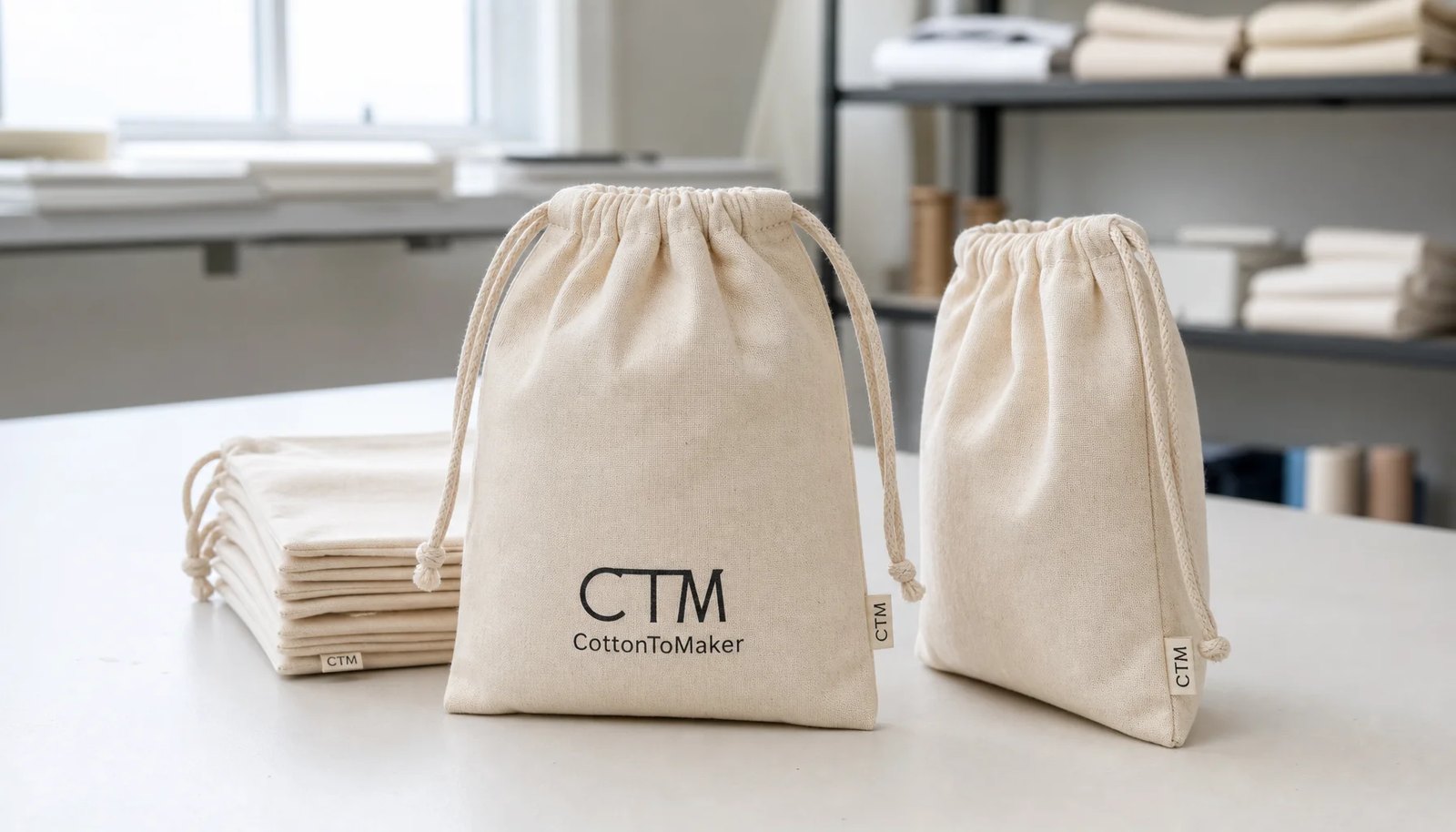
Why logo placement is a sourcing specification
A cotton drawstring pouch at a trade show does more than hold samples. It sits on the booth counter, moves through the aisle in an attendee's hand, and may later become a small organizer for cables, cosmetics, stationery, or product literature. That means the logo is judged on the sewn, filled, cinched pouch — not on the clean artwork file your brand team approved.
Small placement choices create real purchasing consequences. A logo that appears centered on a flat mockup can slide into the gathered top once the cords are pulled. A mark printed too close to the bottom seam may crease when the pouch is folded for cartons. Artwork that crosses a thick seam can print unevenly. None of these problems are dramatic in a PDF proof, but they matter when thousands of pouches arrive days before an exhibition.
For B2B procurement, logo placement belongs in the RFQ, purchase order, sample approval, and inspection plan. The supplier needs the finished pouch size, printable panel, seam clearances, logo dimensions, decoration method, packing method, and placement tolerance before quoting accurately. If those details are missing, the first price may not include larger screens, second-side printing, extra sample rounds, special folding, or added QC work.
The practical target is simple: the brand should stay readable at arm's length in the real booth environment. For most custom cotton drawstring pouches, that means keeping the main logo below the drawcord channel, leaving breathing room from seams, and choosing a decoration method that suits the cotton surface. A good placement guide is not a design mood board. It is a production control document.
- Specify placement in millimeters from seams and the cord channel, not with words like lower, centered, or approximate.
- Approve the pouch in realistic conditions: flat, filled, cinched, carried, and folded for packing.
- Separate brand preference from production constraints such as seam allowance, fabric movement, drawcord gathers, and print table access.
- Include placement requirements in the RFQ so every supplier prices the same decoration work.
- Keep the approved sample and measured proof as references for bulk production and reorders.
Map the event use case before choosing the logo zone
Start with the way the pouch will be used at the show. A flat pouch for brochures behaves differently from a pouch filled with skincare samples, charging cables, tools, jewelry, badge materials, or premium gifts. If pouches are displayed in trays on a counter, the lower front panel often gives the strongest first read. If booth staff will hand them out already closed, the logo must sit below the gathered fabric at the top.
Ask the event team a few concrete questions before the RFQ goes out. Will the pouch be handed out open or cinched? Will it be filled by the factory, a kitting partner, a hotel team, or booth staff? Will attendees carry it by the cords, put it inside a tote, or keep it as retail-style packaging? Does the pouch need only one brand mark, or also an event date, sponsor logo, QR code, recycling note, multilingual copy, or product claim? Those answers influence the finished size, logo zone, decoration method, and carton plan.
For many exhibitors, the safest primary logo position is the lower front panel or the middle third of the front face. The upper third is less reliable because the drawstring closure creates folds, shadows, and uneven tension. Back-panel printing can work well for campaign details, QR codes, usage instructions, or sponsor information, but it should not be the only visible branding if the pouch is expected to advertise your booth as attendees walk the hall.
- Counter display: use lower front placement so the mark remains visible when pouches are stacked, fanned, or laid in trays.
- Handout while closed: keep artwork below drawcord gathers and test the cinched sample before approval.
- Prefilled kit: check the logo after actual contents or equivalent weight are inserted, not only on an empty pouch.
- Reusable giveaway: choose a middle or lower placement that still looks intentional after the event.
- Sponsor or QR content: place secondary information on the back panel when the front brand must stay clean.
Confirm finished size, GSM, and construction limits
A placement drawing is only useful when it is based on the finished pouch, not a generic blank. Cotton drawstring pouches lose usable space to side seams, bottom stitching, top hems, and the drawcord channel. A pouch quoted as 150 x 200 mm may have a much smaller clean print face once those construction areas are excluded. Ask suppliers to separate finished dimensions, cut-panel dimensions, usable interior size, and usable print panel.
Fabric GSM affects both appearance and decoration performance. Lighter cotton around 100-110 GSM can be suitable for paper inserts, small samples, or cost-sensitive giveaways, but it wrinkles more easily and may distort when filled. Cotton around 120-140 GSM is often a practical range for general trade show pouches because it provides a steadier print surface and better perceived value. Heavier cotton, such as 160 GSM or above, can feel more premium and support embroidery better, though it may increase unit cost, folding bulk, and freight weight.
Construction sequence also matters. If panels are printed before sewing, the factory must align the printed panel accurately during stitching. If pouches are printed after sewing, the operator needs enough flat surface for the screen table or heat press. Thick seams, knots, and uneven cotton texture can interfere with pressure. These are ordinary production constraints, but they become schedule risks when buyers discover them only after the first sample misses the desired placement.
- Request finished width and height separately from cut-panel size.
- Ask for usable print panel dimensions after seams, bottom stitch, and cord channel are considered.
- Confirm whether GSM is measured before dyeing, after washing, or after finishing.
- Use 100-110 GSM for light, short-cycle giveaways where lowest cost matters.
- Use 120-140 GSM for general trade show kits needing better print stability and hand-feel.
- Use heavier cotton when the pouch carries more weight, needs premium feel, or uses embroidery.
Use measured clearances for the logo zone
The lower front panel is the dependable starting point for many custom cotton drawstring pouches. It sits below the drawcord gathers, remains visible when the pouch is held by the cords, and photographs cleanly on a booth counter. For small and medium pouch sizes, ask the supplier to mark the top seam, cord channel, side seams, bottom seam, and logo bounding box on the proof. Then approve actual millimeter distances, not a visual impression.
The middle third of the front panel gives a more balanced, retail-style presentation. It suits beauty samples, wellness products, accessories, stationery, and higher-value gift packs. Still, it needs clearance from the planned fold line if the pouch will be folded in cartons. If the artwork combines an icon and wordmark, state whether the complete artwork should be centered as one group or whether the icon and text require separate alignment. Tiny interpretation differences are easy to miss in sampling and obvious in bulk goods.
Upper placement is where many avoidable logo problems start. The top of a drawstring pouch is not a stable billboard. It gathers, compresses, folds, and casts shadows when closed. If artwork sits too close to the channel, part of the logo may disappear. If the print crosses a seam, pressure may become uneven. The cleanest specification defines a top no-print zone and clearly states whether decoration is front only, back only, both sides, or front plus side label.
- Lower front: best default for closed-bag visibility, counter displays, and simple exhibitor branding.
- Middle front: best for balanced product presentation and reusable gift pouches.
- Upper front: use only for small secondary graphics; keep primary logos away from drawcord gathers.
- Back panel: useful for QR codes, event dates, sponsor copy, or secondary brand information.
- Side seam: suitable for woven labels or small identity tags, not the main trade show message.
- No-print zones: define clearance around the cord channel, seams, knots, and planned fold lines.
Match decoration method to artwork and quantity
Screen printing remains the common choice for many cotton drawstring pouch programs because it works well for simple one-color or two-color logos, scales efficiently, and gives a clean matte finish. It is especially practical for exhibitors ordering repeat branding in meaningful quantities. The quote should name the print size, number of colors, setup charge, ink type, screen count, and whether a white underbase is needed. On natural cotton, light inks can look softer than they do on a digital proof, so do not skip the physical sample when color matters.
Heat transfer can make sense for short runs, full-color graphics, gradients, detailed icons, or event artwork that changes late. It may reduce screen setup complexity, but it brings different inspection points. Transfers can feel stiffer than the cotton, show a film edge, lift at corners, or crack if the pouch is folded through the artwork. A flat photo is not enough. Rub it, fold it, cinch it, and compare the hand-feel against the approved sample.
Embroidery works best with simple marks and more stable fabric. It gives a tactile, premium finish, but lightweight cotton can pucker, and cost can rise with stitch count, thread changes, and slower production. Woven labels are useful for subtle identity across several pouch sizes, especially on side seams, but they rarely provide the same aisle visibility as a front print. The best method is the one that meets visibility, budget, timeline, and inspection needs with the least avoidable risk.
- Use screen print for flat logos, one to two colors, larger quantities, and repeat programs.
- Use heat transfer for full color, short runs, detailed artwork, or late-stage event changes.
- Use embroidery for premium gifts, heavier fabric, and simple logos with enough stitch area.
- Use woven labels for subtle branding, side seam identity, or multi-size consistency.
- Request method-specific QC: cure and rub for screen print, edge adhesion for transfer, puckering for embroidery.
- Avoid choosing decoration before the supplier confirms fabric weight, print panel, MOQ, and setup charges.
Build MOQ and price breaks around the real spec
MOQ is often misunderstood because buyers ask for a general factory minimum. The useful question is narrower: what is the MOQ for this pouch size, this GSM, this fabric color, this logo method, this artwork size, and this packing style? A standard natural cotton pouch with a one-color screen print may have a lower or more flexible MOQ than a dyed custom-color pouch with embroidery, a woven label, and individual packing.
Request price breaks in a structured matrix. Keep the pouch size, GSM, logo size, decoration method, and packing style constant, then ask for several quantities. After that, isolate the add-ons: blank pouch cost, decoration setup, extra print color, second-side print, larger print area, upgraded cord, individual polybag, paper belly band, barcode label, carton mark, and inspection support. This prevents a common procurement trap: the base quote looks attractive, but the final order rises once real event requirements are added.
Timeline belongs in the cost conversation. A low-MOQ order with complex artwork can still take longer than expected if sampling requires several rounds. A larger one-color screen print order may be more predictable if the factory runs similar cotton pouches regularly. If the program may repeat across regional shows, standardize the pouch size, logo placement, proof format, and packing plan now. Reorders are easier when the screen, artwork file, inspection criteria, and carton instructions can be reused.
- Ask for MOQ by size, GSM, fabric color, decoration method, and number of colors.
- Request price breaks at realistic event quantities, not only the lowest order quantity.
- Separate blank pouch cost, decoration setup, sample fee, packing cost, and freight assumptions.
- Confirm whether screens, embroidery programs, or label setups can be reused for reorders.
- Treat second-side printing, larger artwork, and individual packing as separate cost drivers.
- Compare suppliers on landed cost, sample control, and placement repeatability, not only unit price.
Specify artwork files and placement proofs
A complete artwork package gives the factory more than a logo attachment. Send vector artwork where possible, final logo dimensions, Pantone or brand color targets, placement measurements, and a note on visual versus mathematical centering. If the logo includes small text, fine lines, gradients, or QR codes, review those details against the selected decoration method. Cotton texture softens edges. What looks sharp on screen may not stay sharp on fabric.
The placement proof should be technical enough for production. It should show the finished pouch outline, side seams, bottom seam, top hem, drawcord channel, and logo bounding box. A plain line drawing is often more useful than a polished lifestyle mockup because it tells the operator where the decoration belongs. Mark the print side clearly: front, back, both sides, or side label. If the order includes multiple pouch sizes, create a separate proof for each one. A single scaled logo can crowd a small pouch and look weak on a large pouch.
QR codes need a stricter review. If the pouch drives lead capture, post-show content, or campaign tracking, place the code on a flat, high-contrast area and keep it away from folds and gathers. Scan the physical sample with several phones before approval. Treat small sponsor names and compliance copy the same way. If it must be readable, it must be tested on the actual cotton pouch, not only viewed in a design file.
- Send vector artwork when available, plus approved color references and final logo dimensions.
- Provide a placement proof showing seams, cord channel, bottom seam, top hem, and print bounding box.
- Create separate proofs for each pouch size instead of assuming one scaled layout works everywhere.
- State whether front and back artwork must align or can be positioned independently.
- Test QR codes, small text, and fine lines on a physical sample before mass production.
- Record the final proof file name, artwork revision, and approval date in the purchase order.
Approve samples as production checkpoints
The sample stage should prove the production setup, not just the design idea. A useful pre-production sample uses the actual cotton fabric, actual GSM, actual cord, actual stitching construction, and actual decoration method. A digital proof or sample printed on a different blank can help early review, but it should not release bulk production when placement matters. Trade show dates rarely move, so a weak sample approval can become an expensive rush problem later.
Handle the sample the way the attendee will handle it. Lay it flat and measure the logo. Fill it with the intended contents, or a close weight and shape, and check whether the mark tilts or distorts. Pull the cords closed and confirm the top gathers do not cover the artwork. Fold the pouch exactly as planned for packing and see whether the crease crosses the logo. Rub the print with a clean white cloth and look for transfer, tackiness, cracking, or abrasion.
Sample comments should be measurable. Instead of writing that the logo looks too high, say to move the top edge of the logo 15 mm lower from the top seam while keeping the same artwork size and horizontal center. Instead of saying the color feels dull, reference the approved physical sample, Pantone target, or agreed visual range. Label the approved control sample with date, supplier, pouch size, GSM, print method, artwork revision, and approval status.
- Approve a physical pre-production sample before bulk production whenever timing allows.
- Measure logo placement on the sample and record distances in the approval notes.
- Review the pouch flat, filled, cinched, folded, and under daylight-equivalent lighting.
- Convert subjective sample feedback into measurable factory instructions.
- Label and retain the approved sample as the control sample for inspection.
- Do not release bulk production from a mockup if logo placement is critical to the event.
Set practical QC tolerances before production
Quality control should be agreed before the run starts. The core checks are finished pouch size, logo position, print clarity, color appearance, seam quality, drawcord function, and packing accuracy. Cotton is flexible, so minor variation is normal. The point is to define what variation is acceptable. For many sewn cotton pouches, a practical finished size tolerance may be around ±5 mm, while logo placement may be around ±3 mm to ±5 mm depending on pouch size, fabric weight, and decoration method.
Start inspection early, not after cartons are sealed. A first-article check or first-carton photo with ruler measurements can confirm the print is in the approved zone before the full run is packed. Measurements should come from fixed points: top seam, left side seam, right side seam, and bottom seam. Do not measure from a loose fold or from the drawcord itself. If the order has multiple carton lots, continue random checks because print position can drift after setup changes, operator shifts, or fabric handling changes.
Each decoration method needs its own QC focus. Screen print should be checked for registration, cure, rub resistance, ink coverage, and edge sharpness. Heat transfer should be checked for adhesion, film edge, cracking, stiffness, and corner lift. Embroidery should be checked for puckering, thread trimming, backing visibility, and stitch density. Natural cotton shade variation should also be reviewed against the approved sample because the same ink can look different on different cloth lots. The goal is not perfection; it is predictable acceptance against a written standard.
- Use fixed measurement points: top seam, side seams, bottom seam, and logo bounding box.
- Agree size and placement tolerances before production, commonly around ±5 mm for sewn size and ±3-5 mm for logo position.
- Check first production units before allowing the full run to be packed.
- Measure units across multiple cartons, not only the best-looking sample from the line.
- Inspect decoration quality according to the method used, not with one generic checklist.
- Photograph ruler measurements and keep them with the inspection record.
Plan packing, cartons, and event handling early
Packing can protect the logo, or it can ruin an otherwise acceptable print. A pouch may pass decoration inspection and still arrive with a hard crease through the brand mark if it is folded tightly across the artwork and compressed for weeks. Specify the folding method, inner pack count, moisture protection, and whether printed faces need separation from abrasion. Natural cotton can pick up wrinkles or odor during long transit and humid storage, so packing belongs in the RFQ, not in a last-minute email.
Carton structure should match the event workflow. If a kitting team packs one pouch into each attendee set and works in batches of 50, inner packs of 50 or 100 can reduce counting errors. If several pouch sizes, colors, or artwork versions ship together, carton marks should identify size, artwork version, quantity, purchase order, and destination requirement. Clear labeling matters most when delivery is close to show date and the receiving team has little time to sort cartons.
Retail-style or VIP packaging should be priced separately. Individual polybags, paper belly bands, hangtags, barcode stickers, and event labels add labor and can affect lead time. Some buyers avoid individual plastic for sustainability reasons; others need it to prevent print transfer or keep kits organized. Either choice can work. The risk is assuming the supplier will choose the event-ready option without written instructions.
- Specify whether pouches are bulk packed, inner packed, individually packed, or kit-ready.
- Avoid fold lines that run directly across the main printed logo.
- Align inner pack counts with event kit assembly counts to reduce handling errors.
- Mark cartons by pouch size, artwork version, quantity, purchase order, and destination requirement.
- Confirm moisture protection for long transit or warehouse storage.
- Quote barcodes, hangtags, belly bands, and event labels separately from the base pouch.
Specification comparison for buyers
| Spec decision | Recommended option | When it fits | Buyer risk to check |
|---|---|---|---|
| Primary front logo zone | Lower front panel, centered horizontally, with the top of artwork typically 50-70 mm below the top seam on small to medium pouches | Best for trade show giveaways handed out closed, stacked on counters, or carried through exhibition halls | Confirm the logo is not hidden by drawcord gathers and does not land on the fold used for carton packing |
| Balanced retail look | Middle third of the front panel with at least 15-25 mm clearance from side seams and bottom seam | Works for VIP kits, beauty samples, stationery, wellness products, and reusable attendee pouches | Check actual contents do not bulge through the logo and make the mark appear tilted or too high |
| No-print top zone | Keep main artwork below the top hem and drawcord channel; avoid printing across seams or gathered fabric | Important for all pouches that will be cinched before handout | Ask the factory to mark the cord channel height and top no-print zone on the placement proof |
| Back-panel branding | Secondary logo, campaign copy, QR code, recycling note, or multilingual event detail on reverse side | Useful when the front needs a clean brand presentation or sponsor information is required | Visibility drops when attendees carry the branded side inward; define front/back clearly in the PO |
| Side seam woven label | Small flag label sewn into side seam, usually 10-25 mm visible length depending on pouch size | Good for subtle repeat branding across multiple pouch sizes or premium gift sets | Confirm label placement does not weaken the seam, catch the cord, or create uneven folding |
| Screen print route | One to two solid colors on a flat cotton panel, with print size and setup charges stated separately | Best balance of cost, sharpness, and repeatability for many B2B trade show pouch orders | Confirm ink type, cure, hand-feel, registration tolerance, rub resistance, and whether a white underbase is required |
| Heat transfer route | Full-color or detailed artwork on short runs, late artwork changes, or complex gradients | Useful for small batches, variable event branding, and designs that do not suit screens | Check film edge, stiffness, corner lift, cracking on folds, and whether the transfer changes the cotton feel |
| Embroidery route | Simple logo on 140 GSM or heavier cotton, with stitch count and backing confirmed | Fits premium giveaways where tactile finish matters more than lowest unit cost | Check puckering, backing visibility, thread trimming, stitch density, and distortion around the embroidered area |
| Placement tolerance | Set a written logo position tolerance, commonly ±3 mm for print on stable panels and ±5 mm for more flexible sewn pouches | Useful for inspection, supplier comparison, and future reorders | Agree tolerance before production; do not judge bulk goods against an unmeasured mockup |
Buyer checklist before sampling
- Define the use case: leaflet sleeve, sample pouch, VIP gift pack, badge kit, retail-style giveaway, hotel welcome pouch, or reusable attendee organizer.
- Confirm finished pouch width and height, usable interior size, fabric GSM, cotton type, color, shrinkage or washing status, cord type, and drawcord channel height.
- Specify the logo position in millimeters from the top seam, left side seam, right side seam, bottom seam, and drawcord channel; do not approve placement from a lifestyle mockup alone.
- State decoration method, number of colors, Pantone or brand color targets, maximum print area, artwork size, minimum line thickness, and whether white ink or an underbase is required.
- Ask for MOQ and price breaks by pouch size, GSM, fabric color, print method, print colors, second-side printing, packing style, and delivery term.
- Request a pre-production sample made with actual fabric, actual cord, actual stitching, actual decoration method, and the same logo size planned for bulk production.
- Approve the sample in at least four conditions: flat, lightly filled, fully cinched, and folded according to the proposed packing method; photograph each condition for the record.
- Set measurable tolerances for finished size, logo position, print color, print clarity, seam strength, drawcord function, carton count, and packing direction before mass production starts.
- Ask for first-article production photos or a first-carton inspection with ruler measurements before the full order is packed and sealed.
- Define folding method, inner pack count, carton marks, moisture protection, barcode or event labels, and whether carton quantities must match kit assembly counts.
Factory quote questions to send
- What finished pouch dimensions are you quoting, and what is the usable interior size after seams, bottom stitching, and the drawcord channel?
- What fabric GSM are you quoting, and is that GSM measured on greige fabric, after bleaching or dyeing, or after final finishing?
- Is the cotton natural, bleached, dyed, organic, recycled blend, prewashed, or unwashed, and what shade variation should we expect between lots?
- What cord material, cord diameter or width, knot style, and drawcord channel height are included in the price?
- Where exactly will you place the logo in millimeters from the top seam, side seams, bottom seam, and cord channel, and what print area are you pricing?
- Which decoration method is included: screen print, heat transfer, embroidery, woven label, digital print, or another method?
- How many colors are included, what setup charge applies, and what is the cost for each extra color, screen, label mold, embroidery thread change, or stitch count increase?
- What is your MOQ by pouch size, fabric color, GSM, logo method, and color count, not just the general factory MOQ?
- Does the unit price include a digital proof, physical pre-production sample, sample freight, carton marks, or inspection support, or are these charged separately?
- What sampling lead time, bulk production lead time after approval, packing time, and artwork change cut-off date should we plan around?
Quality-control points to confirm
- Measure finished pouch width, height, drawcord channel height, side seam allowance, bottom seam allowance, and usable print panel before judging logo position.
- Measure logo position from fixed points: top seam to top of artwork, left seam to left edge, right seam to right edge, and bottom seam to bottom of artwork.
- Check at least five units from the first carton and additional random units across later cartons or production lots; increase sampling if print position drifts.
- Confirm the logo remains readable when the pouch is flat, lightly filled, fully cinched, and folded for packing; reject placements that disappear into top gathers.
- Check screen print registration for double image, blur, edge bleed, pinholes, missing ink, uneven pressure, clogged details, or ink buildup on cotton texture.
- Compare printed color against the approved physical sample under daylight-equivalent lighting; record how natural cotton shade affects perceived color.
- For screen print, check cure, rub resistance, blocking, tackiness, cracking, and transfer to adjacent pouches after stacked packing.
- For heat transfer, check edge adhesion, stiffness, film outline, corner lift, cracking on folds, and whether the transfer hand-feel matches the approved sample.
- For embroidery, check puckering, thread trimming, backing visibility, stitch density, thread color, and distortion around the drawstring pouch panel.
- Inspect side seams, bottom seam, top hem, cord channel, loose threads, skipped stitches, broken stitches, and whether cords pull smoothly without catching.