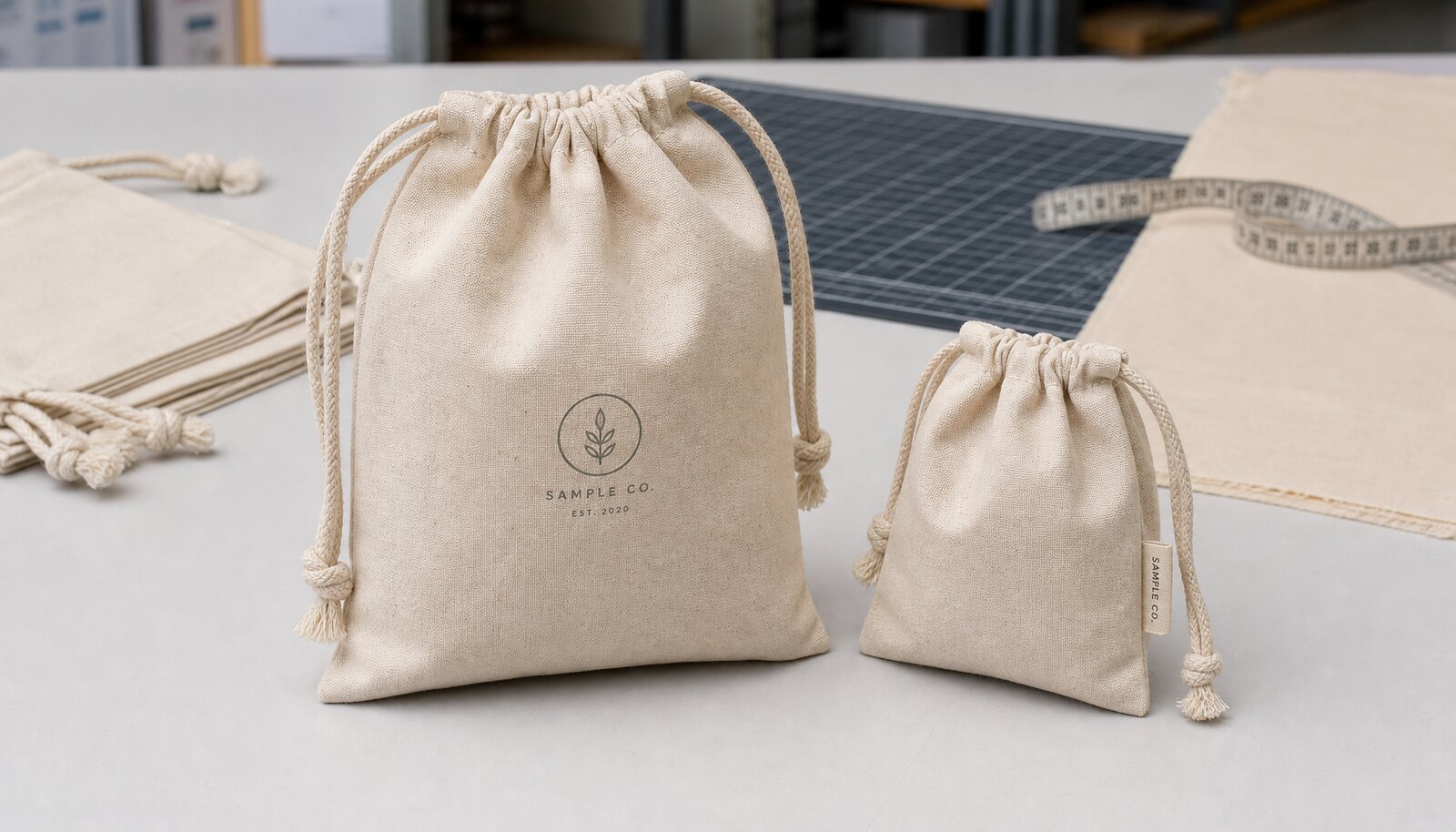
Start with the selling scenario, not the artwork file
For gift shops, a cotton drawstring pouch can do three different jobs: it can be a protective insert inside a gift set, a standalone retail item customers buy for reuse, or a branded wrap that supports a higher-margin product such as candles, skincare, tea, or jewelry. Those use cases do not need the same construction, decoration, or packing. The wrong spec usually comes from treating every pouch as if it were the same commodity bag.
Logo placement should follow the sales scenario. If the pouch is mainly packaging, the brand can be smaller and more understated. If it sits on a shelf as part of the product story, the logo must stay visible when the pouch is tied, partly filled, and viewed from a few feet away. That is why procurement teams should lock the finished size and display condition before they approve artwork. A supplier can only place the logo correctly if they know how the pouch will actually be used, sold, and handled.
- Gift set insert: optimize for cost, clean stitching, and reliable bulk packing.
- Standalone retail item: optimize for visible branding, stronger hand feel, and cleaner finishing.
- Shelf display pouch: optimize for logo visibility when tied and filled.
- Ask the supplier to quote by use case, not only by size.
Logo placement rules that survive folding, filling, and tying
The safest default for most gift-shop pouches is the front panel, centered horizontally, with the top edge of the logo positioned roughly 20–35 mm below the casing seam. That zone usually keeps the branding away from the drawstring channel, which is the first area to fold when the pouch is closed. It also leaves enough blank space above the logo so the bag still reads as a pouch rather than a printed poster.
That said, placement is not just a number. Small pouches for jewelry or tea sachets need a tighter logo so the art does not crowd the side seams. Larger pouches for candles or multi-item gift sets may need the logo moved slightly upward so it remains visible when the top is pulled shut. If you are sourcing more than one size, ask the factory for a placement chart by size instead of approving one universal artwork file. That reduces the chance of a good-looking proof turning into an off-center production run.
- Keep the logo clear of the casing seam and the side seams.
- Check the pouch while tied and filled, not only flat on a table.
- Use separate placement rules for each finished size if the range is wide.
- If the design includes a tagline, confirm that the full line stays legible at shelf distance.
Fabric weight, weave, and hand feel: why GSM is not a standalone answer
Buyers often ask for a GSM number as if it were the whole fabric spec. It is not. GSM helps compare weight, but it does not tell you everything about weave tightness, opacity, shrinkage, or how the cloth behaves after stitching. A 110–130 GSM cotton can be perfectly acceptable for light-use packing, promotional gift wraps, or lower-priced retail programs, but it can also look thin under bright store lighting if the weave is open or the dye is pale.
For premium gift presentation, many buyers move toward 140–170 GSM, but that should be treated as a working range, not a universal default. Heavier cloth usually improves structure and reduces see-through risk, yet it also raises cost and can make small pouches feel stiff if the weave is too dense. The better buying question is: what fabric weight produces the right shelf appearance for the item being sold, after sewing and fill? For destination markets with longer transit lanes, humidity, or premium retail expectations, the buyer should also ask about shrinkage after cutting, because a cloth that looks correct on a roll can change once it is made into a pouch.
- Use lighter cloth for low-cost packing, samples, and short-life promotions.
- Use heavier cloth when the pouch needs to look retail-ready or be reused.
- Do not approve GSM alone without checking weave, opacity, and shrink behavior.
- Ask the factory whether the quoted weight reflects raw fabric or finished pouch behavior.
Decoration methods: pick the one that fits the artwork and the order profile
Screen printing is usually the most practical route for simple logos, one-color marks, and repeat orders. It gives a clean, solid appearance and keeps the unit cost more predictable when the design is stable. The tradeoff is detail. Small type, thin strokes, and gradients can fail if the screen mesh or ink control is not appropriate for cotton. If the artwork looks fine on a screen but will be printed close to the seam or casing, ask for a physical sample rather than trusting the file preview.
Heat transfer is more flexible for short runs, mixed artwork, or designs with finer detail, but it changes the look and hand feel. Buyers should treat it as a separate decoration style, not an equivalent substitute for screen print. Embroidery is usually the premium option when the pouch is part of a higher-priced retail presentation, but it needs enough logo area to stay readable and can create more bulk on thinner cotton. A woven side label is often the best answer when the buyer wants the front panel kept clean and minimal. The real procurement choice is not which method is 'best' in general, but which method fits the logo, the order size, and the price point of the gift shop program.
- Screen print: best for bold logos, repeat orders, and tighter unit costs.
- Heat transfer: useful for short runs and more detailed artwork, but verify durability and look.
- Embroidery: premium presentation, but confirm size, legibility, and fabric thickness.
- Woven label: useful when the front panel should stay visually quiet.
How to compare suppliers without getting trapped by the lowest quote
The comparison should not stop at unit price. A lower number can hide a weaker pouch construction, a different packing assumption, or a sample process that is too loose to control the final result. For procurement buyers, the more useful question is whether the supplier can reproduce the same placement, same fabric feel, and same cord finish across the full order. That is why a pouch specialist often outperforms a general bag maker even when the quote is slightly higher: the specialist usually understands casing height, logo clearance, and the way a tied pouch reads on a shelf.
Direct factory sourcing tends to give the best control when the design is stable and the order will repeat. A trading company can help if the buyer needs mixed packaging, multiple SKUs, or coordination across different mills and decorators, but the buyer should still verify the actual factory and inspect a real sample. The commercial tradeoff is straightforward: more layers in the supply chain may simplify communication, but they often add margin and increase the risk that placement details get diluted before production starts. The right route depends on how much control the buyer needs over the finished pouch, not just how quickly a quote arrives.
- Compare like-for-like specs before judging price.
- Ask for a sample from the actual producer, not only a sales photo.
- Favor pouch specialists when placement and finishing matter.
- Use intermediaries only when they can prove factory control and clear accountability.
Comparison table: the tradeoffs procurement teams should actually track
This is the part that matters in a buying meeting. A comparison table should show how each decision affects landed cost, rework risk, and speed to approval, not just what each option is called. Ask every supplier to quote the same pouch size, the same decoration method, the same packing format, and the same destination assumptions. Once those variables are aligned, you can compare the true commercial effect of each route instead of comparing incomplete offers.
The table below is designed for that purpose. It helps buyers decide whether they should pay a little more for a tighter process or use a lower-cost route where the risk is acceptable. For gift-shop programs, the cheapest option is only cheap if it ships on time, matches the approved sample, and arrives in a condition that is ready for shelf or set assembly.
- Normalize the specs before comparing quotes.
- Make the supplier show how the quote changes with quantity and packing.
- Treat extra sample cycles as part of the real cost.
- Use the same destination and freight assumptions for every offer.
MOQ and price breaks: where the real cost is hidden
MOQ is not just a number; it is a way of spreading setup cost across the order. A supplier may offer a low minimum but still need to recover screen setup, label setup, cutting time, color matching, or packing labor. That is why a small order can look inexpensive at first and then become less attractive after the extras are added. Buyers should ask for a price ladder at several quantities so they can see how the unit price changes as the order scales.
For standard cotton drawstring pouches, many factories can work within a planning range around 1,000 to 3,000 pieces per color or print version, but that should never be treated as a universal default. The actual floor depends on fabric availability, whether the cloth is stock or custom-dyed, the number of decoration colors, and whether the order includes retail packing. Embroidery, custom labels, or destination-specific packaging often push the practical MOQ higher than a simple one-color screen print. If the order is a seasonal trial, it is usually smarter to keep the first run simple than to chase a low MOQ that comes with unstable quality or hidden charges.
- Ask for pricing at multiple quantities, not only one target.
- Separate setup fees from the base unit price.
- Keep the first order simple if you are testing the market.
- Treat unusually low MOQ offers as a cue to inspect hidden assumptions.
Sample approval: the lowest-cost place to catch the expensive problems
A PDF proof is useful, but it is not enough. Cotton changes when it is cut, stitched, and closed. The pre-production sample should use the actual fabric, actual thread, actual drawcord, and the actual decoration method. If the pouch includes a woven label, retail tag, or special insert, those should be present on the sample too. Otherwise the buyer is approving an image, not a product.
The sample should be checked the way the customer will see it. Put something inside it, pull the cord, and inspect the front panel at shelf distance. Measure the logo position from a fixed reference point, check whether the stitching pulls the panel off center, and confirm that the pouch still looks balanced when tied. If the sample misses the placement by even a few millimeters, do not assume production will correct itself. A small adjustment at sample stage is cheap; a correction after production starts is usually where delays and waste begin.
- Require a physical sample, not only a digital proof.
- Test the pouch tied and filled, then inspect the logo alignment.
- Measure from the same reference points that will be used in production.
- Do not approve until the sample reflects the real decoration and packing plan.
Packing and retail handling: choose for the channel, not for the factory default
Packing should match the sales channel. If the pouch is part of a gift set, bulk packing usually makes the most sense because the buyer is opening cartons for assembly anyway. If the pouch will be sold as a standalone accessory or sent through e-commerce, individual polybags, barcode stickers, or hang tags may be necessary. Those choices are not cosmetic. They affect labor, carton count, carton size, and the time needed for warehouse receiving.
Gift-shop buyers also need to think about presentation after arrival. Cotton can pick up dust and smell if cartons are overfilled, sealed while damp, or moved through a humid lane without enough protection. For dark or printed pouches, compression scuffing can become visible on the front panel, so cartons should be filled to a sensible level rather than packed to the edge. Ask the supplier to quote the same pouch with bulk pack and retail pack so you can see the real cost delta. That keeps packing decisions tied to channel economics instead of guesswork.
- Bulk pack for gift sets and kit assembly.
- Use individual packing only when the sales channel needs it.
- Approve barcode and carton marks before shipment.
- Ask how packing changes carton size and freight weight.
Lead time and landed cost: use a buyer's calendar, not a factory promise
Lead time depends on more than sewing time. It is affected by fabric availability, print queue, packing complexity, inspection, and the route the goods take after they leave the factory. For stock fabric and a simple one-color print, some suppliers can quote a relatively short production window after sample approval, but that is only useful if every upstream step is already frozen. Once the order involves custom dyeing, woven labels, or retail packing, the schedule usually stretches, and the buyer should plan around that longer path rather than hoping the shortest estimate wins.
Landed cost is the figure that matters to procurement. A cheap ex-factory quote can turn into a less competitive landed price if print setup, packing, inner bags, carton marks, or destination freight are added later. The buyer should normalize every offer to the same assumptions: same pouch specification, same packing format, same destination, and same service level. That allows a true comparison between suppliers and reduces the risk of signing a purchase order that looks good on paper but misses the launch window. For seasonal gift-shop assortments, the schedule risk can be more expensive than a small difference in unit price.
- Build the calendar around sample approval and freight, not only sewing time.
- Ask which step is on the critical path: fabric, print, packing, or inspection.
- Compare landed cost on the same destination and packing assumptions.
- Treat rushed schedules as a risk premium, not a free advantage.
Specification comparison for buyers
| Spec decision | Recommended starting point | Cost impact | Defect risk | Sample cycle time |
|---|---|---|---|---|
| Logo placement | Front panel, centered, with the top of the logo about 20–35 mm below the casing seam | Usually neutral if the artwork fits one screen or one transfer panel; moving the artwork after approval can trigger a new sample | Low when clear of the drawstring channel and side seams; high if the print area crosses a fold line | One sample round if the position is locked early; longer if the factory needs to remake artwork |
| Fabric weight | 110–130 GSM for light-use packing; 140–170 GSM for a more premium retail feel, subject to weave and shrinkage | Heavier cloth raises material cost and often increases sewing time; dyed fabric can add more cost than GSM alone suggests | Too light can look thin, show contents, and distort print; too heavy can feel overbuilt for small accessories | Usually one round, but heavier or dyed cloth may need a second physical sample if shrinkage changes the fit |
| Print method | Screen print for simple logos, heat transfer for short runs or fine detail, embroidery for premium presentation, woven label for minimal branding | Screen print is often the lowest-cost repeat route; embroidery and label work usually add setup or labor cost | Fine type can blur on screen print, transfer can crack if badly applied, embroidery can lose small detail | Screen print is usually fastest to approve; embroidery and label placement often need more visual checking |
| Supplier route | Pouch-specialized factory when placement control matters; trading company only if it can show the actual producer and sample | Direct factory often reduces hidden handling cost; trading routes can add margin but sometimes simplify mixed orders | General bag suppliers may miss pouch-specific details like casing height or cord alignment | Direct factory can shorten feedback loops; intermediaries can lengthen revision cycles |
| MOQ structure | Ask for pricing at 1,000 / 3,000 / 5,000 pieces when possible, but treat thresholds as method- and fabric-dependent | Low MOQ often pushes up setup cost per unit or hides fees in print, packing, or labels | Artificially low MOQ can produce unstable color, mixed lots, or uneven finishing | Shorter if the factory already has stock fabric and one color of thread or print |
| Packing format | Bulk pack for gift sets; individual polybag, barcode, and retail insert only if the pouch is sold standalone | Retail packing increases labor, carton volume, and sometimes freight cost | Missing barcode or label placement can delay launch; loose packing can scuff print | Usually one extra approval step if retail packaging or carton marks are custom |
Buyer checklist before sampling
- Confirm finished pouch size, gusset depth if any, casing height, seam allowance, and shrinkage allowance before sampling.
- Specify logo placement in millimeters from the top seam and side seam, not just 'front center' or 'front print'.
- Approve the artwork against the exact print method, color count, line thickness, and minimum text size.
- Request a physical pre-production sample made with production fabric, production thread, and the actual drawcord.
- Ask the factory to show the pouch tied and filled, not only laid flat, so fold behavior is visible.
- Define packing format, carton quantity, barcode location, and whether the pouch needs a hang tag or retail insert.
- Set acceptable tolerances for seam straightness, print registration, cord length symmetry, and carton count.
- Ask for landed-cost pricing that separates product price, print setup, packing, cartonization, and destination freight assumptions.
- Confirm whether the destination market requires fiber content, care labeling, country-of-origin marking, or other retail compliance details.
Factory quote questions to send
- What is the exact finished size, seam allowance, casing height, and drawcord specification included in your quote?
- Where exactly will the logo sit relative to the top seam and side seams, and what printable area do you guarantee?
- Which decoration method are you quoting, and what setup charges apply if the artwork changes after sample approval?
- What is your MOQ by color, by print version, and by packing format, and how does the price change across 1,000 / 3,000 / 5,000 pieces?
- Will the sample use production fabric, production thread, and the actual drawcord, or only a visual artwork proof?
- Can you quote the same pouch with bulk packing and with retail packing so we can compare the real cost impact?
- What is your standard lead time after sample approval, and which steps usually extend it: fabric, print, packing, or inspection?
- What inspection standard do you use for print placement, seam strength, odor, cord movement, and carton count?
- Can you show a previous pouch sample or photo that proves you have handled this construction, not just general bag work?
- If we need a second sample round, what changes will trigger a new setup charge or a new production slot?
Quality-control points to confirm
- Logo is centered within the approved tolerance and does not cross the casing seam, side seam, or fold line.
- Printed edges are sharp, with no smearing, ghosting, pinholes, or visible color shift against the signed-off sample.
- Fabric weight, weave density, and hand feel match the approved reference and do not feel noticeably thinner than the swatch.
- Drawcord runs smoothly, exits the casing evenly, and closes without twisting, binding, or one-sided tension.
- Knot stops or cord ends are secure and do not loosen during a simple pull check.
- Side seams are straight, with no puckering, skipped stitches, or uneven seam allowance after filling and light handling.
- Finished pouch size is within the agreed tolerance after stitching and, if relevant, after a shrinkage check.
- No broken stitches, loose threads, oil marks, odor, or dust contamination that would affect shelf presentation.
- Carton count, pack ratio, style label, and barcode information match the purchase order and packing list.
- Retail inserts, hang tags, and outer carton marks are in the agreed position and readable without opening every box.