Start With The Event Use
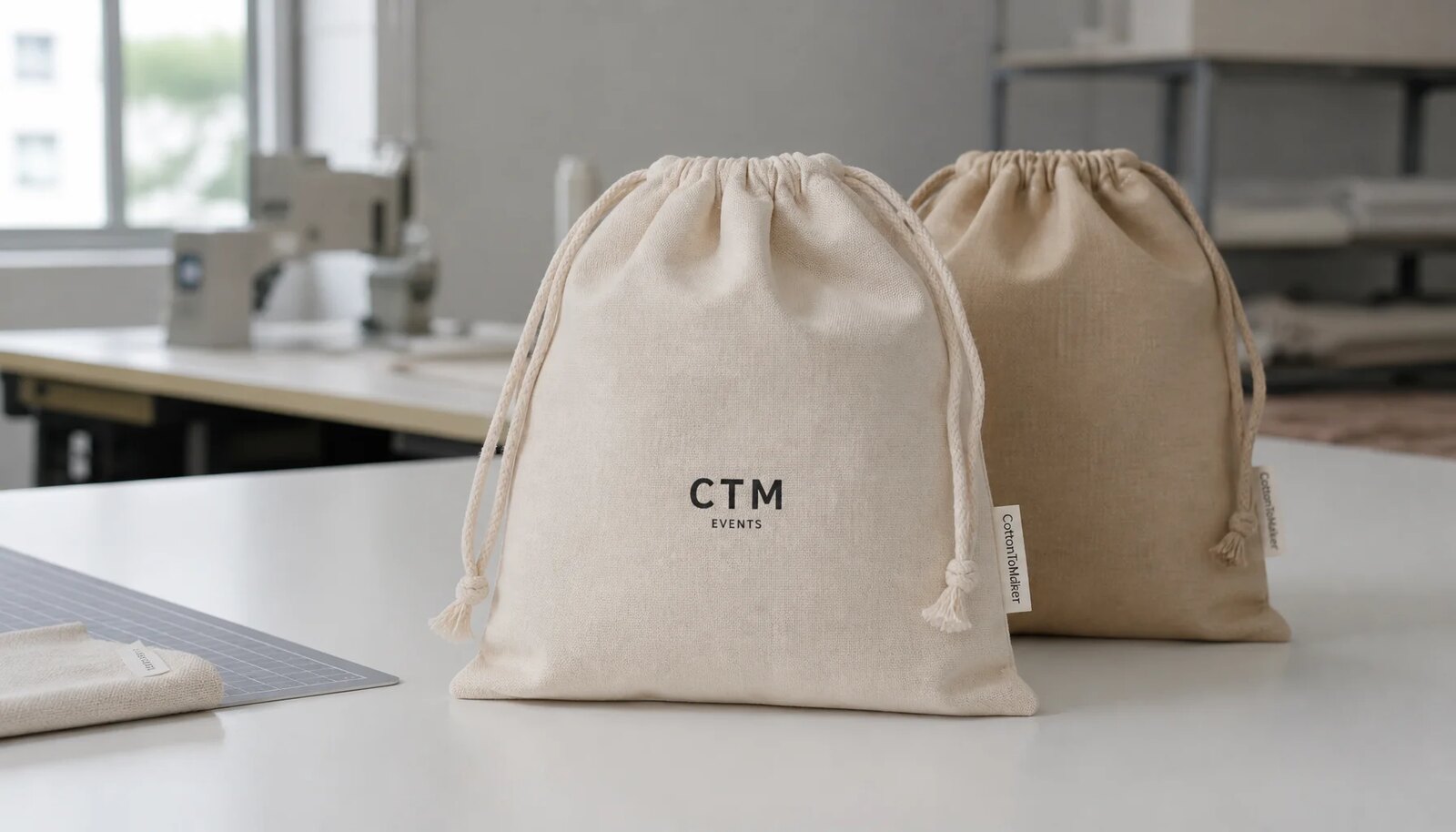
The right logo placement starts with how the pouch will move through the event, not with a flat mockup. A pouch handed out empty at registration behaves differently from one filled with samples, tied around a bottle, packed in a hotel welcome kit, mailed to remote attendees, or arranged for sponsor photos. Cotton folds, gathers, and changes shape when the drawstring is pulled, so the visible brand area is smaller than the artwork board suggests.
For event planners buying custom cotton drawstring pouches, the first placement decision is visibility versus subtlety. If the pouch must be clear in registration-table photos or recap content, a centered front logo below the tunnel is normally the lowest-risk choice. If the pouch is part of a premium gift or wellness kit, a smaller lower-corner mark, tone-on-tone print, or woven side label may feel less promotional.
Write the viewing condition into the brief. Say whether the pouch ships empty or filled, whether it will be displayed open or closed, and whether contents are flat, round, rigid, or irregular. Fine text near the drawstring channel can distort when the tunnel gathers. A low logo may curve around bulky contents. These are production details, not just design preferences.
A measurable placement note is stronger than a style direction. For example: front side only, one-color screen print, logo 85 mm wide by 32 mm high, horizontally centered, top of logo 45 mm below finished top edge, no critical text within 20 mm of side seams or tunnel stitching. That gives design, factory, and inspection teams the same reference point.
- Define the use case: empty giveaway, filled sample kit, hotel amenity, sponsor pack, VIP gift, or retail-style wrap.
- State whether the logo must be visible when closed, filled, photographed, mailed, or packed inside another bag.
- Give final logo width and height in millimeters, plus the approved artwork version name.
- Keep text, QR-adjacent details, and fine lines away from tunnel gathering, seams, and likely fold lines.
- Ask for a measured placement proof before sample production.
Map The Usable Print Area
The usable print area is smaller than the finished pouch size. A 150 x 200 mm drawstring pouch does not provide a clean 150 x 200 mm decoration field. Side seams, bottom seam, tunnel height, stitch variation, cord bulk, and cotton movement all reduce the area where a logo can be printed consistently.
Ask the supplier for a placement drawing that shows the finished pouch outline, seam allowance, tunnel height, stitch lines, and proposed logo box. For small and medium cotton pouches, many inspection teams use safe margins around 15 to 25 mm from side and bottom seams as a working range, then adjust based on pouch size, decoration method, and contents. The top margin depends on the tunnel construction, but critical elements should sit below the drawstring channel.
Reference points must be stated. One supplier may measure from the finished top edge; another may measure from the tunnel stitch line. A decorator working on stock blanks may visually center the art after loading the pouch on a print board. Those approaches can produce different results while still sounding like centered front print.
Two-sided decoration needs additional control. Front and back panels may not align perfectly after sewing, and cord knots can affect visibility. If both sides carry sponsor logos, define the primary side and confirm whether the back logo uses identical placement. For woven labels and side tabs, define left or right from the viewer's perspective while looking at the front of the pouch.
- Request a measured proof with pouch outline, tunnel height, seam allowance, stitch lines, and logo box.
- Use millimeter measurements instead of middle, high, low, or near the top.
- Keep critical artwork out of gathered zones and away from seams that curve when filled.
- Define left and right from the viewer's perspective for labels, tabs, and patches.
- Require a revised proof if pouch size, fabric weight, cord type, or decoration method changes.
Specify Size, GSM, And Construction Together
Pouch pricing changes quickly when size, GSM, and construction are not locked together. A supplier can lower a quote by assuming lighter fabric, smaller seam allowance, thinner cord, simpler tunnel construction, or a slightly smaller finished size. For procurement comparison, those details should travel as one spec package.
Finished size should be measured after sewing, flat and unstretched. If the pouch holds a product, confirm fit with the actual contents. A 200 mm wide pouch does not mean a rigid 200 mm item will slide in comfortably, because seams and tunnel construction reduce the opening and usable internal space.
GSM affects feel, opacity, decoration quality, carton weight, and cost. A 100 to 120 GSM cotton pouch can work for lightweight inserts, short-term giveaways, and modest one-color marks. A 140 to 180 GSM pouch is often a balanced event-kit range because it improves structure and opacity without excessive freight. A 200 to 240 GSM pouch feels more substantial for premium gifting but raises material cost, shipping weight, and sometimes sewing time.
Do not specify only natural cotton. Ask for target GSM, tolerance, weave if known, base color, dyed or undyed status, washing or pre-shrinking, and expected shade variation. Natural unbleached cotton can show seed flecks, slubs, and lot-to-lot shade movement. That may be acceptable, but it should be approved against a sample instead of debated at receiving.
- State finished width and height in millimeters, measured flat after sewing.
- Use 100 to 120 GSM only for light contents and simple print coverage.
- Use 140 to 180 GSM for many event kits balancing cost, feel, opacity, and decoration.
- Use 200 to 240 GSM for premium or heavier-use pouches after checking freight impact.
- Record acceptable shade, slub level, construction notes, and GSM tolerance in the PO.
Choose Decoration By Artwork Risk
Screen printing is often the most efficient decoration choice for cotton drawstring pouches at event volume. It works well for one-color or two-color logos, solid shapes, clean line work, and moderate coverage. Buyers still need to specify ink color, logo size, placement, opacity expectation, and final fabric color.
Multi-color screen printing adds registration risk. Soft cotton panels can shift slightly during loading and printing, especially on small or lightweight pouches. If the artwork has tight outlines, small reversed text, or several sponsor marks, ask the supplier to confirm registration tolerance and minimum line weight before sample approval.
Heat transfer or digital transfer can be better for full-color artwork, gradients, sponsor graphics, and short versioned runs. The tradeoff is hand feel and edge behavior. Some transfers sit on top of the cotton and may show a film edge, particularly on natural fabric. Test opening, closing, folding, and carton packing before approving bulk production.
Woven labels, side tabs, patches, and embroidery are more construction-sensitive. A woven side label can make the pouch feel less promotional, but it must be sewn straight and secured in the seam. Embroidery can look premium on heavier cotton, yet dense stitches may pucker light fabric and tiny lettering can fill in. Choose the decoration method by artwork complexity, brand risk, budget, timeline, and pouch construction.
- Use screen print for bold one- or two-color event logos and efficient volume production.
- Use transfers for full-color art or short sponsor versions after checking hand feel and edge visibility.
- Use woven labels or side tabs for subtle branding, with placement and stitch checks included.
- Use embroidery on heavier cotton with simple artwork and controlled stitch density.
- Approve decoration on final fabric color because cotton shade changes perceived ink color.
Control Logo Size And Legibility
Logo size should match pouch size, viewing distance, and artwork detail. A large logo can be strong on a flat medium-weight pouch, but it can feel crowded if it approaches the tunnel or seams. A small logo can look premium but may disappear in event photography or on a busy registration table.
Review artwork at actual size. Cotton texture softens edges, thin lines can break, small reversed text can close up, and solid areas can show fabric texture. For screen print, ask the supplier to confirm minimum line weight and minimum text size for the selected fabric and ink. For woven labels, review the woven artwork at actual size because fine lettering and sponsor marks may not translate cleanly.
QR codes need special caution. Cotton texture, ink spread, wrinkles, curved filling, and drawstring gathering can all affect scanning. If a code is required, test it on the final fabric, final print method, and final size. A flat insert card is often more reliable than printing the code directly on a soft pouch panel.
Sponsor lockups should have a hierarchy. One event logo centered on the front is straightforward. Multiple partner marks require spacing rules, size limits, and proofing at actual scale. If sponsor details are too fine, use the pouch for the main event mark and an insert card for detailed sponsor recognition.
- Review artwork at actual size before approving the sample.
- Keep small text, QR codes, and thin lines away from tunnel, side seams, and bottom seam.
- Ask for minimum line weight and text-size guidance for the chosen decoration method.
- Scan-test QR codes on a physical pouch sample under normal lighting.
- Move detailed sponsor recognition to an insert card when pouch printing would be unreliable.
Build A Clean RFQ
A production-ready RFQ reduces quote gaps and protects the event timeline. Include finished pouch size, target GSM, fabric color, drawstring spec, decoration method, logo size, logo placement, quantity, version breakdown, packing method, destination, delivery date, and freight basis. When those details are missing, suppliers fill the gaps with assumptions.
Version control matters for event programs. City versions, language versions, sponsor versions, VIP kits, and general attendee kits should each appear as separate RFQ lines. Include quantity, artwork file name, pouch body color, print colors, packing method, and destination for each line. This helps the supplier estimate setup time and lowers the risk of mixed cartons arriving at the venue.
Ask for line-item pricing. Separate blank pouch, decoration, setup, woven label or patch, sewing attachment, packing labor, inner packaging, master carton, sample, and freight. Line items make quote comparison easier and help with reorders, where some setup costs may not repeat.
The RFQ should include the approval schedule. Ask for digital proof timing, physical sample timing, sample transit, production time after approval, inspection date, and freight transit. Work backward from the required in-hand date, not only the event date. Venues, warehouses, and kit teams often need receiving time before attendee distribution.
- Include size, GSM, fabric color, cord spec, logo placement, decoration method, quantity, packing, destination, and freight basis.
- List each artwork or sponsor version as its own RFQ line.
- Request separate pricing for product, decoration, setup, labels, patches, packing, samples, cartons, and freight.
- Attach vector artwork and identify the exact file name approved for quotation.
- Ask for a schedule showing proofing, sampling, production, inspection, and freight separately.
Approve Samples With Measurable Notes
Sampling should match order risk. A digital proof can confirm layout, spelling, approximate placement, and logo scale, but it cannot prove cotton hand feel, ink opacity, drawstring function, fabric shade, or print behavior. The pre-production sample should use final size, fabric, cord, decoration method, logo position, and packing method when packing can affect the surface.
Separate sample types when needed. A blank construction sample checks finished size, GSM, stitching, tunnel, cord movement, opening, and hand feel. A print strike-off checks ink color, opacity, line sharpness, and registration on final fabric. A complete pre-production sample confirms all parts together before mass production.
Approval comments should be measurable. Instead of move the logo up a little, write move logo top edge 8 mm higher while keeping horizontal center unchanged. Instead of print looks light, write increase ink opacity to reduce fabric show-through in solid areas. If the sample is approved with exceptions, list those exceptions and request updated production proof or corrected sample photos before bulk work starts.
Keep a golden sample. Label it with supplier name, PO number, artwork version, pouch size, GSM, fabric color, cord spec, decoration method, and approval date. One sample can remain sealed, and one can be used during receiving inspection. For repeat events, the golden sample is often more useful than a digital file because it captures shade, hand feel, placement, and workmanship.
- Use a blank sample to approve construction, size, fabric, stitching, cord, and opening.
- Use a strike-off to approve ink, opacity, color, edge quality, and detail on final fabric.
- Use a pre-production sample to approve the complete pouch before bulk production.
- Record finished-size tolerance, logo-position tolerance, color standard, and defect limits.
- Keep a labeled golden sample for inspection, disputes, and reorders.
Write QC Standards Inspectors Can Use
Quality control should convert brand expectations into checks a factory, third-party inspector, or receiving team can apply. Cotton pouches are soft sewn goods, so hard-goods precision is unrealistic. Still, useful tolerances can be written for finished size, logo position, print quality, stitching, cord function, fabric appearance, and packing accuracy.
Logo placement should be measured from fixed references. For example, the top of the logo may be set 45 mm below the finished top edge with an agreed tolerance, and the logo centerline may be checked against the front panel centerline. The exact tolerance depends on pouch size, fabric movement, and decoration method. The important point is that the standard is agreed before production.
Print QC should include opacity, color, edge quality, smudges, pinholes, missing ink, registration, cracking, and transfer lift. Transfers should be flexed lightly and checked after the pouch is opened, closed, and folded. If the pouch will be filled before delivery, inspect filled samples too, because contents can stretch the panel and change defect visibility.
Sewing QC should cover side seams, bottom seam, tunnel stitch, label or patch attachment, loose threads, skipped stitches, and cord function. The drawstring should pull smoothly and close evenly. Cord knots should stay secure under normal handling. If dyed cord is used with light cotton, check for rub-off that could stain the pouch.
- Measure finished size flat and unstretched against written tolerance.
- Measure logo placement from seams, stitch lines, or finished edges.
- Inspect opacity, registration, smudging, pinholes, cracking, and transfer lift.
- Check drawstring movement, knot security, tunnel stitching, seams, and loose threads.
- Compare shade, odor, stains, slubs, and visible defects against the approved sample.
Plan Packing For Venue Reality
Packing is part of the product specification for event buyers. A correct pouch can still create operational problems if versions are mixed, cartons are mislabeled, fresh prints rub during transport, or venue staff cannot identify which cartons go where. Define packing during the RFQ stage because it affects labor cost, carton dimensions, freight weight, receiving time, and inspection.
Start with unit packing. Loose bulk packing is lower cost and uses less material, but it can increase rubbing and counting time. Individual bags protect the pouch and make distribution easier, but they add labor and material. Paper bands or tissue can work for some premium kits, though they do not protect the product in the same way. If the event has sustainability requirements, state the specific packing rule rather than using broad language.
For kitting, write the sequence exactly. A useful instruction might say: fold welcome card with front facing pouch logo, insert card and sample sachet, close drawstring halfway, place 25 pouches per inner carton, place four inner cartons per master carton, label by city and sponsor version. That level of detail keeps production efficiency from overriding event usability.
Carton labels should serve the receiving team. Include item name, SKU, artwork version, event name, destination, quantity, carton number, and PO number. If the shipment goes directly to a venue, add attention line, delivery window, and neutral-carton requirement. For split shipments, request separate packing lists by destination and photo proof of carton labels before dispatch.
- Choose loose bulk, individual bag, paper band, tissue wrap, or pre-kitted pouch packing.
- Specify inner-pack quantity, master-carton quantity, and whether versions may be mixed.
- Write the kit sequence for cards, samples, badges, inserts, or sponsor materials.
- Confirm who supplies inserts and how shortages or damaged inserts will be handled.
- Use carton labels with SKU, version, event name, destination, PO number, carton number, and quantity.
Compare Suppliers By Total Risk
Supplier selection should compare total landed risk, not unit price alone. A domestic decorator using stock blanks may be the best route for a rush event when delivery certainty matters more than custom GSM or exact cord color. The tradeoff is limited blank availability, fewer size choices, and less control over construction. Confirm actual stock quantity, physical blank dimensions, fabric weight if available, printable area, and production slot.
A direct factory can be stronger for custom sizes, controlled GSM, woven labels, special packing, and repeat programs. This route gives more control over cutting, sewing, decoration, and inspection, but it requires a clearer RFQ and more time for sampling. Freight, duty, payment terms, inspection, and schedule risk should be counted before calling it cheaper.
A promotional distributor or trading company can add value when the program has many moving parts: sponsor versions, kitting, split shipments, account service, or venue coordination. Procurement should ask who physically sews the pouch, who decorates it, where packing happens, who inspects it, and who is responsible if a defect appears after delivery.
Evidence should be specific. Ask for photos of recent cotton pouches made with similar GSM, decoration method, and packing requirements. If the supplier claims in-house screen printing, ask whether printing happens before or after sewing and how placement is controlled. If the supplier handles venue pack-out, request sample carton labels and packing photos. Generic catalog images do not prove execution capability.
- Use domestic stock decoration for rush orders with simple specs and fixed deadlines.
- Use direct factory production for custom sizes, repeat specs, controlled GSM, and price transparency.
- Use distributors or full-service suppliers when kitting, split shipments, and coordination reduce event risk.
- Ask who sews, prints, labels, packs, inspects, and ships the order.
- Compare landed cost, sampling time, freight mode, inspection plan, communication speed, and reorder control.
Specification comparison for buyers
| Procurement situation | Best sourcing route or spec choice | Technical notes to confirm | Buyer risk to control |
|---|---|---|---|
| Rush event under 1,000 pcs | Domestic decorator using confirmed stock cotton blanks | Stock blanks limit size, GSM, cord color, and print area; decoration is often screen print or transfer | Confirm physical stock, blank dimensions, printable area, setup timing, and ship date before PO release |
| 1,000 to 10,000 pcs with one-color logo | Factory with sewing and screen print control | Natural cotton in 140 to 180 GSM is a common event-kit range when contents are moderate | Write GSM tolerance, finished-size tolerance, logo-position tolerance, ink color, and carton packing into the order |
| Multiple sponsor or city versions | Supplier with version control and packing discipline | Each version needs a separate artwork file name, quantity, carton mark, and inspection record | Do not allow mixed cartons unless approved; require version photos and carton-label proof |
| Brand-sensitive logo color | Supplier able to produce a strike-off on final pouch fabric | Natural cotton can warm or dull light ink colors compared with white proofing stock | Approve a physical strike-off on the final fabric color, not only a digital proof |
| Premium gift or VIP kit | Heavier cotton, woven label, patch, or controlled kitting | 200 to 240 GSM gives more structure; labels and patches add sewing and placement checks | Inspect label straightness, stitch security, patch position, loose threads, and lead time |
| Full-color artwork or gradients | Heat transfer or digital transfer tested on cotton | Useful for short runs, sponsor art, and fine detail; hand feel varies by transfer system | Check film edge, cracking, lifting, stiffness, and appearance after folding and carton packing |
| Subtle reusable pouch look | Small screen print, tone-on-tone mark, woven side tab, or lower-corner logo | Best when the pouch should feel like packaging rather than a giveaway item | Set shade variation limits and confirm the small mark remains legible at actual size |
| Lowest landed cost repeat order | Offshore factory direct with stable spec and planned freight | Works when size, GSM, artwork, packing, and forecast are known early | Compare freight, duty, inspection, payment terms, carton cube, and reorder fabric consistency |
| Split shipment to venues | Supplier with documented pack-out and carton labeling | Requires destination labels, SKU separation, carton numbering, and delivery windows | Request packing lists by destination, carton photos, and neutral cartons when venue rules require them |
Buyer checklist before sampling
- Finished pouch width and height in millimeters, measured flat after sewing, with drawstring tunnel included or excluded from height measurement.
- Target cotton GSM, GSM tolerance, fabric color, and whether the cotton is natural, bleached, dyed, washed, or pre-shrunk.
- Fabric construction if available, such as plain weave, muslin-style cotton, or canvas, plus shrinkage expectations if the pouch may be washed or steamed.
- Drawstring material, cord color, cord diameter, pull direction, knot style, and cord-end finish.
- Vector artwork file, final print width and height, PMS or ink reference, color count, and artwork approval version number.
- Measured logo placement from finished top edge, side seam, bottom seam, or drawstring tunnel stitch line, with safe margins for small text and QR-adjacent details.
- Decoration instruction by SKU, including one side, two sides, woven label, side tab, patch, transfer, embroidery, or sponsor-version artwork.
- Decoration method, ink or thread color standard, opacity requirement, registration tolerance, and acceptable color variation on final pouch fabric.
- Sample approval owner, deadline, revision allowance, sample freight method, and whether sample cost is credited against bulk order.
- QC tolerances for finished size, logo position, print registration, stitch quality, cord function, fabric defects, carton count, and version separation.
Factory quote questions to send
- What exact cotton fabric are you pricing: target GSM, GSM tolerance, weave if known, fabric color, and shrinkage assumption?
- Will the pre-production sample use the same fabric, cord, construction, and decoration method as bulk production?
- What are the cord material, diameter, color, pull direction, knot style, and cord-end finish included in the price?
- What finished-size tolerance do you apply after sewing, and is measurement taken flat and unstretched?
- What placement reference will production use: finished top edge, tunnel stitch line, side seam, bottom seam, or visual centering?
- Can you provide a measured proof in millimeters showing pouch outline, tunnel height, seam allowance, stitch lines, and logo box?
- What decoration method, ink, thread, or transfer system are you quoting, and how do you control opacity on natural or dyed cotton?
- For multi-color print, what registration tolerance and minimum line weight do you recommend for this fabric?
- Can pricing be separated for blank pouch, decoration, setup, label or patch, sewing attachment, packing labor, cartons, sample, and freight?
- What is the MOQ by pouch size, fabric color, GSM, print color count, label type, packaging method, and shipment split?
Quality-control points to confirm
- Finished dimensions checked flat and unstretched against the approved spec; for soft sewn pouches, agree practical tolerances before PO release rather than applying hard-goods standards.
- Fabric GSM checked against the quoted target and tolerance using supplier records, incoming fabric checks, or lab measurement for higher-volume or brand-controlled orders.
- Logo position measured from fixed references such as finished top edge, side seam, bottom seam, or drawstring tunnel stitch line.
- Logo centered to the usable front panel after tunnel height, seam allowances, and expected filling shape are considered.
- Ink opacity checked for patchy fill, pinholes, fabric show-through, excessive buildup, smudging, and inconsistent solid areas.
- Print edges checked for sharpness, small-text legibility at approved size, and multi-color registration within agreed tolerance.
- Transfer decoration checked for visible film edge, lifting, cracking, peeling, or stiffness after opening, closing, folding, and packing.
- Drawstring checked for smooth movement, even pull, secure knots, clean trimming, and no obvious cord staining or rub-off.
- Stitching checked for skipped stitches, broken thread, loose thread ends, seam twisting, needle damage, fraying, and stress-point weakness.
- Fabric checked against the approved sample for stains, oil marks, odor, unacceptable slubs, dye streaks, yarn contamination, and shade variation beyond the agreed range.