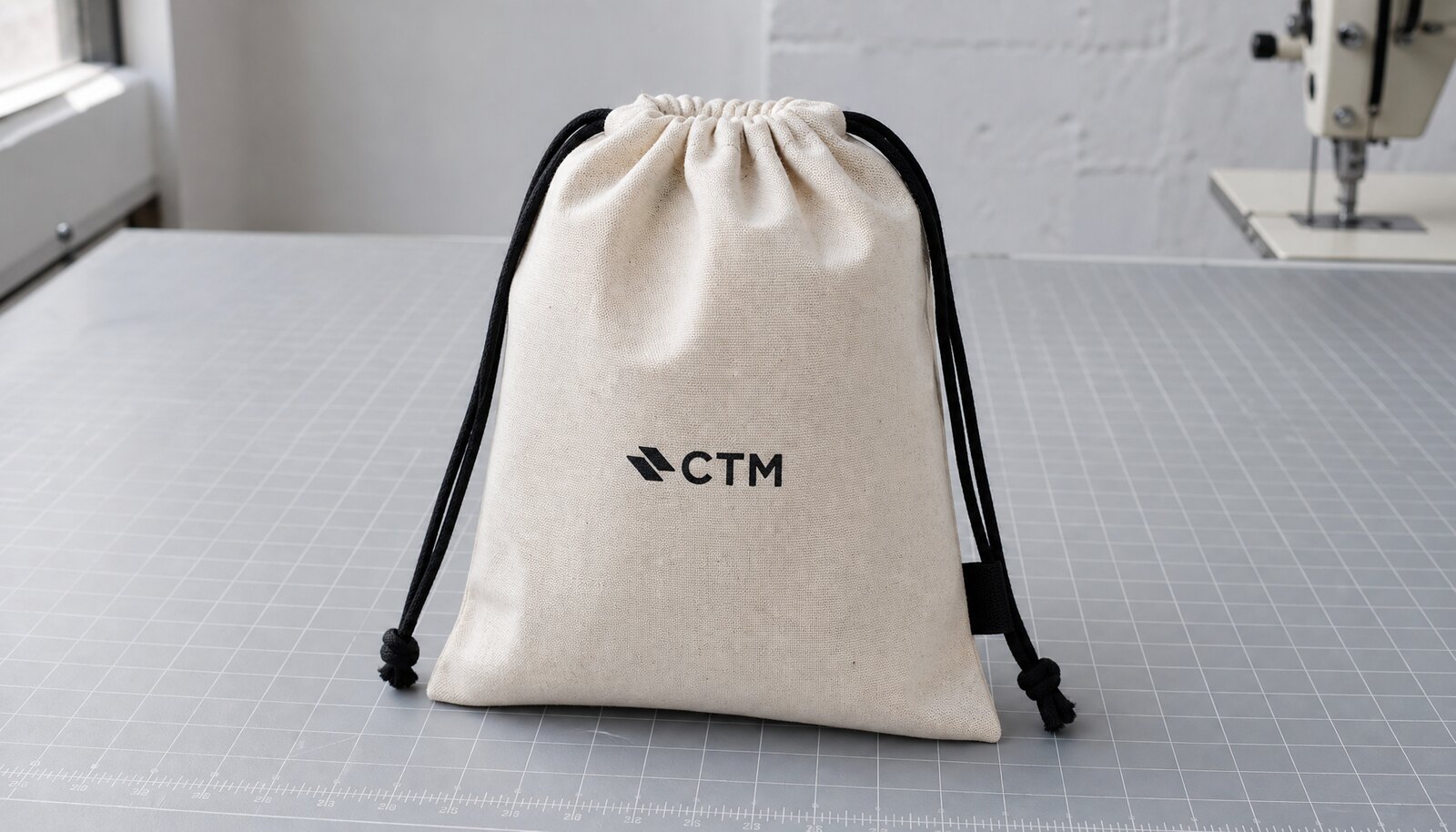
1. Why Logo Placement Belongs in the Procurement Spec
On custom cotton drawstring pouches for corporate gifting, logo placement is not a small design note to settle after the quote. It affects brand visibility, print durability, sample approval, packing presentation, inspection criteria, and sometimes landed cost. A mark placed too close to the drawcord channel may vanish into the gathers once the pouch is tied. Move it too low, and it can sit on seam bulk where ink pressure is uneven or transfers may crack. A logo that feels perfectly balanced on a flat PDF can look oversized or off-center once real cotton folds around a gift item.
The pouch’s role after unboxing matters too. If the recipient is expected to reuse it for cables, travel items, cosmetics, desk storage, sample kits, or event materials, a loud front logo can reduce reuse. If the logo is too small or hidden on the back, the gifting campaign may not deliver the visibility the brand team expects. A trade show giveaway, employee onboarding kit, executive appreciation gift, hotel welcome pack, loyalty mailing, and retail-style gift box do not need the same branding treatment.
The safest way to avoid confusion is to turn the visual idea into a measured production instruction. Instead of writing only “logo centered on front,” include the logo width and height, distance from the drawcord stitch line or top edge, distance from both side seams, bottom clearance, and the intended tolerance. Those numbers help the supplier build a print jig, help the buyer inspect fairly, and reduce arguments once cartons arrive. For many standard pouch orders, plus/minus 5 mm placement tolerance is realistic. For small premium marks or very small pouches, plus/minus 2-3 mm may be needed, but the supplier must confirm that before sampling and purchase order release.
- Evaluate the pouch empty, filled, tied, folded, and packed before approving logo placement.
- Use millimeter measurements on a placement drawing, not only a PDF mockup or “visual center” instruction.
- Define the main priority: brand visibility, premium restraint, reuse, photography, table display, or kit presentation.
- Keep logo elements away from drawcord gathers, side seams, bottom seam bulk, and heavy fold lines.
- Agree on inspection tolerance before mass production, not after the first carton is opened.
2. Lock the Pouch Body Before Locking the Artwork
Logo placement cannot be finalized until the pouch construction is clear. A 100 x 150 mm pouch, a 150 x 200 mm pouch, and a 200 x 300 mm pouch may all be called cotton drawstring pouches, but their usable branding areas are completely different. The top area near the drawcord channel is unstable because the fabric folds when the cord is pulled. Side seams and the bottom seam reduce the flat print zone. If there is a gusset, the front panel may curve forward after filling. Ask for total height, usable height below the drawcord channel, opening width, gusset depth if any, and the approximate shape of the contents before approving artwork position.
Fabric weight changes the result. Lightweight cotton around 120-140 GSM can work for low-cost event giveaways, jewelry bags, small accessories, or mailer inserts, but it may show more puckering and large ink blocks can feel stiff. A 150-180 GSM cotton is often a practical middle choice for corporate gifting because it gives better print stability while staying soft and packable. Heavier 200 GSM and above cotton or canvas gives more structure for premium kits and heavier items. It also changes drawcord behavior, carton volume, freight weight, and sometimes sewing requirements.
Natural cotton is not bright white. Its shade can vary by yarn lot, bleaching level, and finishing. Dark marks such as black, charcoal, navy, or forest green usually contrast well on natural cotton. Pale inks, white ink, and metallic-looking effects need opacity checks. Dyed cotton adds another layer of risk: shade variation and possible crocking, especially if the pouch touches light-colored tissue paper, apparel, insert cards, or product boxes. If a buyer approves a print on a showroom blank but bulk fabric comes from a different lot, the same logo may look warmer, duller, or less opaque. Sample approval should tie the pouch body and the decoration method together.
- Confirm width, total height, usable branding height, channel height, seam allowance, and gusset before artwork approval.
- State fabric composition, target GSM, acceptable GSM tolerance, shade standard, and whether natural slubs are acceptable.
- Choose GSM based on gift weight, hand feel, print stability, and reuse expectations, not unit price alone.
- Test the largest gift item inside the pouch before approving logo size and placement.
- For dyed cotton, ask about shade control and color transfer risk before approving light-colored packing materials.
3. Map the Stable Branding Zones
For most corporate gifting programs, the center-front panel is the safest logo zone. It gives strong visibility, works well with one-color screen printing, and is straightforward for factory QC to measure. Still, the best center-front logo is not always the largest logo that fits. Open cotton around the mark often makes the pouch feel more considered, and it gives the logo room to survive filling, tying, and folding. On small pouches, the usable center panel can be much smaller than the front face shown in a mockup because the channel, seams, and bottom hem all create caution areas.
Lower-front placement gives a quieter, more premium look. It works well for executive gifts, retail-style gift sets, or pouches placed inside a larger box where the insert card or product should remain visually dominant. The risk is bottom clearance. Printing too close to the bottom seam can create skipped ink, uneven transfer pressure, edge lift, or a crooked appearance after filling. A lower logo should sit on a smooth single-layer fabric area, not on seam bulk.
Upper-front placement is more difficult than it looks. It can work for a small mark, but only if the factory keeps it clearly below the drawcord channel and outside the gather zone. When the pouch closes, the upper fabric pulls into folds. Those folds can cover small text or distort round icons. Back-panel printing is useful when the front needs to stay clean, but the buyer should accept that the logo may not appear in unboxing photos, table displays, or kit presentation. Side seam woven labels are another route. They feel more retail-like and reusable, but they add label lead time, orientation checks, seam strength checks, and another point of possible variation.
- Use center-front for repeatable bulk production and broad corporate visibility.
- Use lower-front for premium restraint, but keep the mark above seam bulk and fold lines.
- Avoid upper placement unless the logo stays below the gather zone after the pouch is closed.
- Use back-panel branding only when reduced visibility is intentional and accepted by the brand team.
- Use side seam labels for small marks, fine details, or a reusable retail-style appearance.
- Ask the supplier to mark the proposed logo zone on a physical blank pouch before making the branded sample.
4. Turn the Mockup Into Measurements a Factory Can Follow
A factory cannot reliably control “slightly higher,” “more premium,” or “centered like the mockup” across thousands of pieces. The artwork package should include a flat pouch drawing with front and back orientation, logo width and height, logo centerline, distance from the top edge or drawcord stitch line, distance from side seams, and distance from the bottom seam. If the pouch has a gusset, clarify whether measurements refer to the front panel only or to the full flat width including side folds. Scale matters. A 5 mm shift on a small pouch may look obvious; on a large laundry-size pouch, it may be acceptable.
Reference points need to be written down. Measuring from the top cut edge can produce a different result from measuring from the lower stitch line of the drawcord channel. Measuring to the soft edge of a fabric pouch can also vary if the operator stretches or smooths the pouch differently. A stronger instruction might read: “Logo centerline aligned to pouch centerline within plus/minus 3 mm; top of logo 45 mm below bottom stitch of drawcord channel within plus/minus 4 mm.” That gives the printing operator and inspector the same target.
Clear space should cover both brand and production needs. Brand guidelines may specify clear space around the mark, but the pouch also needs functional clear space. Keep the logo away from seams, cord exits, stitch lines, side labels, bulky folds, and carton compression creases. If the pouch will be folded for packing, the fold should not cross thin outlines, QR codes, small sponsor names, or legal text. A simple physical folding test tells you more than a polished mockup because cord thickness, cotton hand feel, and carton pressure can change where the crease lands.
- State logo width and height in millimeters; do not rely on scaling percentages.
- Identify measurement references: top edge, channel stitch line, side seam, bottom seam, or logo centerline.
- Set placement tolerance by pouch size and logo sensitivity, commonly around plus/minus 5 mm unless otherwise approved.
- Specify skew tolerance so a logo is not accepted if it is technically in position but visibly tilted.
- Include folding direction and no-crease zones if the pouch will be individually packed or carton compressed.
- Revise the placement sheet whenever pouch size, channel height, gusset, artwork size, or print method changes.
5. Match Decoration Method to Artwork, Cotton, and Quantity
Screen printing is usually the first method to review for B2B cotton drawstring pouch orders with simple logos. It is efficient at volume, handles bold spot colors well, and works on natural or dyed cotton when the artwork is suitable. That does not mean every logo will print cleanly. Buyers should confirm minimum line weight, minimum text height, ink opacity, and curing conditions. On textured cotton, very thin lines can break, small reversed text can fill in, and large solid ink blocks may feel stiff. With two-color screen print, registration tolerance should be discussed before the strike-off; thin outlines make even small shifts visible.
Transfer, DTF, and similar film-based methods are useful for gradients, detailed sponsor grids, campaign graphics, multi-color marks, or shorter runs where multiple screens are inefficient. The tradeoff is hand feel and edge behavior. A transfer may look crisp in a photo but feel too plastic on soft cotton. It may also lift at the edge when the pouch is folded tightly or compressed in cartons. Approve transfers only after checking dry rub, folding, light scratch, edge adhesion, and packing abrasion on the actual pouch fabric.
Embroidery, woven labels, and patches create a different brand feel. Embroidery can look premium on heavier cotton or canvas, but large stitch areas can pucker lightweight cotton and create thread bulk on the inside. Woven labels often work better for small corporate marks, fine lettering, or understated branding because the detail sits in the label rather than in ink on textured fabric. Patches can suit premium kits, but they add cost, thickness, sewing time, and inspection points. Decide the decoration method together with placement and logo size, not after the pouch has already been costed.
- Use screen print for bold one-color or two-color logos and repeat quantities where setup can be amortized.
- Use transfer or DTF for complex multi-color artwork only after edge, fold, rub, and hand-feel checks.
- Use embroidery on heavier cotton with smaller designs placed away from seams and drawcord channels.
- Use woven labels for small marks, fine type, durable reuse, and understated retail-style branding.
- Ask whether decoration happens before sewing or after sewing because this changes placement control and seam clearance.
- Request a strike-off or pre-production sample on the actual cotton fabric, not only on a separate fabric swatch.
6. Set Artwork and Color Standards That Can Be Held in Production
Many buyers send a logo file and assume the supplier will adapt it. On cotton, that is risky. The artwork package should include vector files such as AI, EPS, or production-ready PDF, approved colors, clear-space rules, minimum line weights, minimum text size, and any allowed simplification. If the artwork includes a tagline, legal copy, sponsor names, QR code, or thin icon, check it at the final physical print size. A mark that reads well on a monitor may not be legible when printed 25 mm wide on open-weave cotton.
Color control needs to be practical rather than theoretical. Pantone references help, but cotton absorbency, fabric shade, ink system, curing temperature, and print thickness all affect the final look. Natural cotton can make colors appear warmer or less saturated than they do on coated paper. Dyed cotton changes contrast, especially when light ink sits on dark fabric. Approve a physical strike-off or pre-production sample under an agreed light condition. If brand color is sensitive, state whether the target is Pantone coated, Pantone uncoated, a fabric swatch, or the approved sample itself. A screen-rendered mockup should never be the only color standard.
Two-color artwork needs early review for registration and trapping. Fine outlines, small overlaps, and reversed text are common failure points. A supplier may recommend thickening lines, opening gaps, enlarging text, or converting a full-color mark to a one-color version for better production stability. Those edits should be approved by the brand owner before the factory changes the file. Controlled simplification is better than a technically faithful logo that looks poor on real fabric.
- Send vector artwork and lock the production version number before sampling.
- Define minimum line weight and text height for the chosen method and pouch fabric.
- Approve color on the actual cotton pouch or bulk-intended fabric, not only on screen.
- Clarify whether the supplier may simplify gradients, small text, or delicate details.
- For two-color printing, confirm registration tolerance and whether trapping is needed.
- Keep one approved artwork file and one approved placement sheet attached to the purchase order.
7. Quote the Order Like a Manufactured Item, Not a Promo Mockup
MOQ and unit price for custom cotton drawstring pouches depend on the full specification, not just the pouch size. A natural cotton pouch with one-color front print is usually simpler because it may use standard fabric, standard cord, and one decoration setup. Cost and MOQ can rise when the buyer requests custom dyed fabric, heavier GSM, custom cord color, double drawstrings, multiple print positions, woven labels, embroidery, individual packaging, insert cards, barcode labels, or kit assembly. Each feature adds sourcing, setup, line handling, and inspection work.
Price comparisons often fail because suppliers quote different assumptions. One quote may be based on 120 GSM cotton while another uses 180 GSM. One may include screen charges; another may exclude them. One may quote bulk packing; another may include individual polybags, carton labels, and insert cards. A useful RFQ defines the base spec and asks suppliers to itemize options. That makes it possible to compare real value and decide where to adjust cost without damaging the gift presentation.
Logo placement can also affect feasibility and price. A simple center-front print on a smooth panel is efficient. A logo near a seam, two-sided decoration, side label, embroidery, or unusually tight tolerance can slow production and increase reject risk. These are legitimate cost drivers, but they should be visible in the quote. If a supplier gives a very low price without asking about GSM, logo size, placement, print method, packing, or inspection requirements, treat it as an estimate rather than a production-ready quotation.
- Request tier pricing at 1,000, 3,000, 5,000, and 10,000 pieces using the exact same base specification.
- Separate blank pouch, print, extra locations, labels, screens, digitizing, samples, packing, inspection, and freight assumptions.
- Compare GSM, fabric color, cord construction, seam quality, print area, and packing before comparing unit price.
- Ask whether setup fees are one-time, reusable for repeat orders, or charged again for artwork changes.
- Confirm whether custom dyeing, woven labels, or custom cords trigger higher MOQ or longer lead time.
- Require suppliers to state quotation validity, lead time assumptions, and excluded costs.
8. Approve Samples as Production Controls
A sample is not just something to show the marketing team. It becomes the control reference for bulk production. The strongest pre-production sample uses the bulk-intended fabric, target GSM, final cord, final sewing construction, final decoration method, final label or tag, and final folding or packing method. A generic sample is useful for checking general workmanship, but it should not approve final color, placement, hand feel, or print durability. Ask one plain question before signing off: if bulk production matches this sample within the agreed tolerance, will we accept it?
Review the sample under real use conditions. Lay it flat and measure the logo from the agreed reference points. Fill it with the intended gift item, or with an item of similar size and weight. Pull the drawcord closed and check whether folds hide the logo. Fold the pouch as it will be packed and inspect whether the decoration creases, cracks, transfers, or disappears from view. If the pouch will appear in event photos or unboxing content, photograph the sample under realistic lighting, not only under factory lighting.
Written approval should record the exact details: pouch dimensions, fabric approval, logo size, logo placement, color approval, cord specification, sewing construction, label details, packing method, approved deviations, and version date. Keep one sealed approved sample with the supplier, one with the buyer, and ideally one with the inspection team. Final inspection weeks later should compare goods against the sealed sample and written specification, not against memory, chat screenshots, or an old mockup.
- Approve a pre-production sample made with final decoration and bulk-intended materials.
- Measure logo placement and record actual numbers in the approval email or PO.
- Check empty, filled, tied, folded, and packed conditions before releasing bulk.
- Inspect color under an agreed light source and keep the approved physical reference.
- Seal and label approved samples with PO number, version, date, and approval notes.
- Do not approve bulk production while comments such as “move slightly lower” or “make more premium” remain unresolved.
9. Write QC Limits and Defect Rules Into the PO
Quality control improves when the buyer defines limits before production begins. For logo placement, many standard programs can accept around plus/minus 5 mm, but that is not universal. A large bold logo may tolerate small movement. A small luxury-style mark may look wrong with a 3 mm shift. Small pouches usually need tighter control than large pouches because every millimeter is visible. The purchase order should state placement tolerance, skew tolerance, registration tolerance, pouch size tolerance, and exactly which points are used for measurement.
Defect definitions should separate critical, major, and minor issues. Critical defects may include safety concerns, contamination, mold, sharp components, or material unsuitable for the intended use. Major defects may include wrong artwork, wrong color, upside-down print, logo outside tolerance, severe cracking, missing drawcord, non-functioning closure, broken seam, visible stain on the front panel, incorrect label, or wrong packing version. Minor defects may include small loose threads, slight natural cotton slubs within approved limits, or small shade variation that does not affect presentation. For executive gifting or high-profile events, buyers may choose stricter appearance standards than they would for a basic giveaway.
In-line QC is especially valuable for logo placement. If the first 100-200 printed pieces are checked and the jig is corrected, the supplier can avoid a full batch of misaligned pouches. Final inspection should include carton checks, count verification, random piece measurement, print durability checks, sewing inspection, drawcord function, fabric cleanliness, and packing review. If using AQL inspection, still define which pouch-specific issues count as major or minor. Generic inspection lists often miss the practical risks around logo position, drawcord closure, and presentation.
- State placement tolerance, skew tolerance, registration tolerance, pouch size tolerance, and acceptable shade variation in the PO.
- Define critical, major, and minor defects before final inspection.
- Require first-article or first-batch photos showing several pieces, not one carefully selected sample.
- Use dry rub, wet rub where relevant, fold, scratch, and carton abrasion checks for decorated areas.
- Check drawcord closure after filling because a pouch can pass flat inspection and fail in actual use.
- Make final inspection reference the sealed sample, placement drawing, artwork file, and packing instruction together.
10. Plan Packing, Lead Time, and Supplier Route Around the Gift Program
Packing is part of the product when cotton drawstring pouches are used for corporate gifting. A well-made pouch can arrive looking low value if it is crushed, dusty, overfolded, or packed with the logo hidden. Bulk packing may be fine when pouches will be filled by an internal assembly team. Client-facing programs may need individual polybags, paper belly bands, insert cards, hangtags, barcode labels, or a consistent fold direction. If the pouch is pre-filled, the factory or packing partner must understand how the gift item affects logo presentation and carton compression.
Lead time should be quoted by stage. Artwork review and sample making can be quick for a simple pouch, but custom dyeing, woven labels, embroidery digitizing, transfer film preparation, or multi-component kit packing may add time. Peak corporate gifting periods and major holidays can affect capacity. Avoid approving samples so late that the supplier must compress printing, curing, packing, and inspection. Rushed schedules are where placement errors, color issues, and poor packing decisions become more likely.
The best supplier route depends on risk level. A direct pouch factory is often suitable for repeat orders, larger quantities, and projects where fabric, sewing, and logo placement require close control. A trading company can help when one program includes many gift products, but the technical pouch details must still reach the actual factory clearly. A local decorator can be practical for very small or urgent orders using stock blanks, although control over size, GSM, and seam consistency may be limited. Whichever route you choose, the supplier should be able to explain fabric, channel construction, print workflow, tolerances, QC process, and packing method in specific terms.
- Decide whether pouches ship bulk-packed, individually packed, pre-filled, or inserted into a larger gift kit.
- Specify fold direction, logo-facing direction, inner pack count, master carton quantity, carton marks, and destination labels.
- Avoid carton compression that creates permanent creases across printed logos or transfer edges.
- Request lead time by stage: sample, approval, materials, bulk production, inspection, packing, and delivery.
- Choose direct factory, trading company, or local decorator based on volume, complexity, timeline, and control needed.
- Do not place the PO until the supplier confirms the same pouch spec, logo placement, QC limits, and packing plan in writing.
Specification comparison for buyers
| Spec decision | Recommended option | When it fits | Buyer risk to check |
|---|---|---|---|
| Center-front print | One-color or two-color logo centered on the stable front panel; keep practical clearance from drawcord channel, side seams, and bottom hem | Most corporate gift pouches, onboarding kits, event giveaways, hospitality gifts, sample packs, and branded packaging | A logo that looks centered on a flat mockup can look too high, too low, or visually distorted once the pouch is filled and tied |
| Lower-front print | Small to medium logo placed above the bottom hem with measured quiet space around the mark | Premium client gifts, executive kits, retail-style gifting, and understated reusable pouches | Too little bottom clearance can cause uneven print pressure, cracking over the hem, or a crooked appearance on a filled pouch |
| Upper-front print | Small logo below the drawcord channel, kept outside the gather and fold area | Small pouches, tag-like branding, or layouts where the lower panel is covered by the gift item | High placement is easily hidden by fabric gathers after closing, especially on lighter 120-140 GSM cotton |
| Back-panel print | Clean front panel with branding printed on the reverse side; orientation clearly marked on artwork | Minimalist corporate gifts, dual-use storage pouches, or programs where overt front branding is not desired | Logo may be invisible in photos, table displays, kit presentation, or unboxing if the pouch is shown from one side only |
| Side seam woven label | Small folded woven label sewn into the side seam or lower side seam; confirm label width, fold, and seam allowance | Reusable pouches, retail-style gifts, logos with small type, or branding that should feel less promotional | Poorly controlled labels can twist, be sewn upside down, weaken the seam, or create inconsistent left/right placement |
| One-color screen print | Flat spot-color ink on one panel, usually the most efficient method for bold logos at volume | Large orders with simple artwork, tight unit-cost targets, and repeat corporate programs | Fine lines can fill in, natural cotton changes perceived color, and ink opacity must be approved on the actual fabric |
| Two-color screen print | Two spot colors with simplified artwork and clear registration tolerance, commonly plus/minus 1-2 mm depending on artwork and setup | Simple brand marks requiring more recognition than one color while keeping cost controlled | Registration shifts show on outlines, small text, and reversed areas; approve a strike-off before bulk production |
| Multi-color transfer or DTF | Transfer-based decoration for gradients, detailed sponsor marks, or small multi-color artwork | Shorter runs, campaign graphics, co-branded gifts, or complex logos not suitable for screen print | Check edge adhesion, hand feel, dry/wet rub, folding, packing abrasion, and whether the transfer feels too plastic on cotton |
| Embroidery | Small embroidered logo on heavier cotton or canvas, placed away from seams and drawcord channel | Premium pouches where texture matters more than a flat printed look | Large embroidery can pucker lightweight cotton, add reverse-side thread bulk, and reduce pouch flexibility |
Buyer checklist before sampling
- Confirm the final usable pouch size, not only the flat cut size: width, total height, usable height below the drawcord channel, gusset depth if any, seam allowance, and the largest gift item that must fit without warping the logo.
- Specify fabric composition and construction: cotton or cotton blend, natural or dyed, target GSM with an acceptable range such as 150 GSM plus/minus 5-8%, weave appearance, shrinkage target, and whether bulk fabric must match a sealed swatch.
- Define drawcord details: cotton cord, polyester cord, braided cord, ribbon, or twisted rope; diameter in millimeters; cord color reference; single or double draw; knot style; finished cord length; and whether cord ends are knotted, heat sealed, tipped, or left cut.
- Provide artwork in vector format with Pantone, CMYK, or an approved physical color reference; include minimum line weight, minimum text height, negative-space limits, and whether small text or gradients may be simplified for production.
- Attach a placement drawing with measurements in millimeters from fixed references: top edge, drawcord stitch line or channel bottom, side seams, bottom seam, and logo centerline; do not rely only on a percentage mockup.
- Choose the primary branding method and a backup method if the supplier cannot hold the requested detail, opacity, registration, or durability on the first strike-off.
- State acceptance tolerances for logo placement, print skew, print color, print clarity, registration, fabric shade, pouch size, seam strength, stitch density, loose threads, stains, drawcord function, and packing presentation.
- Require a pre-production sample made from bulk-intended fabric using the final print method, final cord, final sewing construction, final label or tag, and final folding or packing direction.
- Confirm whether pouches ship empty, flat-packed, folded, individually polybagged, bulk-packed, pre-filled, or inserted into a larger kit because packing affects logo visibility, crease risk, carton size, and freight cost.
- Request itemized pricing for blank pouch, printing, extra print locations, woven labels, screens, transfer setup, artwork adjustment, sample fee, packing, carton, inspection, certificates if required, and freight assumption so quotations are comparable.
Factory quote questions to send
- What is your unit price at 1,000, 3,000, 5,000, and 10,000 pieces for the same pouch size and GSM with blank pouch, one-color front print, two-color front print, front plus back print, transfer print, embroidery, and front print plus side woven label?
- What setup fees apply for screens, transfer films, embroidery digitizing, woven labels, sample making, color matching, cutting dies, insert cards, or special packing, and are those fees reusable or charged again for repeat orders?
- What exact fabric will you use for bulk production: composition, target GSM and tolerance, fabric width, natural or dyed shade, shrinkage expectation, and whether the sample and bulk will use the same material source?
- What pouch size tolerance can you hold after sewing, for example plus/minus 5 mm on width and height for standard cotton pouches, and what tighter tolerance is realistic if the gift item fit is critical?
- Can you make a pre-production sample from bulk-intended fabric with the exact logo size, placement, drawcord, channel construction, seam type, label or tag, and packing direction before bulk cutting or printing starts?
- Will the logo be printed before sewing, printed after sewing on the finished pouch, transferred after sewing, embroidered before assembly, or label-sewn during assembly, and how does that workflow affect placement tolerance and seam clearance?
- What placement tolerance can you hold for this exact pouch size and logo size? Please confirm whether your QC will measure from the top edge, drawcord stitch line, side seam, bottom seam, or logo centerline shown on our drawing.
- For screen print, what minimum line weight and minimum text height do you recommend on this cotton weave, and what registration tolerance do you normally control for two-color artwork?
- For transfer or DTF, what tests do you run for edge lifting, dry rub, wet rub, folding, heat exposure, and carton abrasion, and can those tests be done on the approved pouch fabric?
- For dyed cotton pouches, what colorfastness or crocking checks do you perform, especially if the pouch will touch light-colored gift items, tissue paper, apparel, or printed insert cards?
Quality-control points to confirm
- Logo position matches the approved sample and placement drawing. For many standard drawstring pouch orders, plus/minus 5 mm may be practical; small premium marks or tight layouts may need plus/minus 2-3 mm if the supplier confirms it before PO release.
- Logo is straight to the pouch body, not only to a cut edge. Check print skew against the side seams and bottom seam after the pouch is laid flat and the drawcord channel is smoothed by hand.
- Logo is outside the unstable gather zone. When the pouch is pulled closed with the intended item inside, the drawstring folds should not cover key text, icons, QR codes, or legal marks.
- Ink, thread, label, or transfer color matches the approved reference under the agreed light source, with no visible pooling, pinholes, ghosting, banding, dye migration, inconsistent opacity, or unacceptable shade shift on natural cotton.
- Fine lines, small text, negative spaces, and sponsor marks remain legible. Reject fill-in, broken strokes, fuzzy transfer edges, excessive ink spread, misregistration beyond agreed tolerance, or text that cannot be read at normal viewing distance.
- Printed or transferred areas pass agreed durability checks such as dry rub, wet rub if relevant, fold test, tape check, light scratch check, and carton abrasion simulation without cracking, peeling, powdering, smearing, or transfer edge lift.
- Pouch dimensions meet the approved size tolerance after sewing. Measure width, total height, usable height below the drawcord channel, gusset if applicable, and opening width; confirm the intended gift fits without stress.
- Side seams, bottom seams, drawcord channel, and any gusset are straight, secure, and free of skipped stitches, burst seams, exposed raw edges, loose threads, needle holes inside the logo area, or stitch density outside the approved range.
- Drawcord length, diameter, color, knotting, pull action, and closure behavior are consistent. The cord should not jam, fray excessively, pull out of the channel, or make the approved logo placement disappear when tied.
- Fabric weight, hand feel, shade, weave appearance, and shrinkage behavior match the sealed reference. Reject visible stains, oil marks, holes, severe creases, odor, major weaving defects, or slubs beyond the agreed natural-fabric tolerance.