Why logo placement belongs in the sourcing spec
A cotton drawstring pouch looks uncomplicated on a desk. In bakery use, it rarely stays flat. Cookies push against the front panel, a mini loaf creates a curved face, granola packs add thickness, and the drawcord gathers the top. That movement is exactly why logo placement should sit in the sourcing specification, not only in the artwork email.
For custom cotton drawstring pouches used by artisan bakeries, the logo is both a brand element and a production control point. Buyers need it to land in the same visual zone across samples, bulk cartons, and reorders. Suppliers need enough detail to build print jigs, set sewing references, and train operators. If the instruction is only “logo centered on front,” two factories can quote the same pouch and still place the mark differently.
A useful purchase order names the finished pouch size, fabric weight, cord construction, gusset type, print method, artwork size, logo position, measurement points, and inspection tolerance. That may sound detailed, but it prevents a common sourcing problem: the flat sample is approved, the filled pouch looks wrong, and no one can prove whether bulk goods are out of spec. Cotton is flexible, so the target is not rigid-box precision. The target is a realistic, measurable range that both buyer and factory can control.
- Write logo placement in millimeters from finished construction points, not vague terms such as upper center, small logo, or standard position.
- Approve the logo on a filled and closed pouch, not only on a digital mockup or flat sample.
- Separate artwork size approval from placement approval because the logo can be the right size in the wrong zone.
- Put placement tolerance in the quote, sample approval form, purchase order, and final inspection checklist.
- Keep approved reference samples with the buyer, factory, and inspection team for production and reorders.
Start with the bakery item, not the pouch catalog
The pouch should be built around the product that will go inside it. A pouch for two biscuits, a pastry favor, a 250 g granola inner pack, a small bread mix, or a mini loaf gift set will not behave the same way. Shape matters as much as nominal size. A rigid box creates clean edges; a wrapped roll set bulges; a soft pastry pack may settle toward the base.
Procurement teams should measure the real product or inner pack before choosing pouch dimensions. Record width, height, depth, weight, and closure allowance. Also note whether the product is wrapped, boxed, loose inside food-safe primary packaging, or combined with other items in a gift set. A tight pouch can stretch the print zone and distort the logo. An oversized pouch can create loose folds, heavy top gathering, and an unstable-looking front panel.
Common starting sizes for smaller bakery programs include 10 x 15 cm, 12 x 17 cm, and 15 x 20 cm for biscuits, favors, small pastries, and counter add-ons. Larger gift packs may move toward 18 x 24 cm, 20 x 30 cm, or bigger, often with a bottom gusset. These are starting points, not final engineering. Ask the supplier to confirm loading fit after reviewing the intended product dimensions.
Measurement language is another frequent source of confusion. Some suppliers quote finished external flat size. Others mention cut-panel size or approximate usable internal size. These are not interchangeable on a sewn textile pouch. Your RFQ should state the required finished external size and the bakery product dimensions, then ask the supplier to confirm the practical loading allowance before sampling.
- Measure the real bakery item or inner pack before locking pouch dimensions, especially for thick cookies, boxed pastries, and mini loaves.
- State whether the product will be wrapped, boxed, loose inside a primary pack, or assembled as part of a gift set.
- Confirm whether the quoted dimension is finished external flat size, cut-panel size, or usable internal loading size.
- Allow space for product bulge, hand loading, drawcord closure, bottom fold, and any hangtag or label added later.
- Request a sample tested with the same product shape and weight bakery staff will handle in packing.
Define a usable print zone the factory can measure
“Center front” is convenient language, but it is not a reliable manufacturing instruction. It can mean the center of the total flat pouch, the center of the visible filled face, or the center of the supplier’s print board. Those positions can separate once the pouch is sewn, filled, closed, and displayed.
A stronger specification defines the usable front print zone. This zone excludes the drawcord channel, side seam risk area, bottom fold, and any gusset section that curves away from the main front face. For many small and medium bakery pouches, a practical starting point is to place the top of the main logo about 25-35 mm below the drawcord channel seam, with at least 20 mm clearance from both side seams. Larger pouches, thicker cords, heavy contents, and deeper gussets often need more space.
Different artwork shapes need different controls. For a round bakery seal, measure the circle center against the pouch centerline and check the edge clearance on both sides. For a horizontal wordmark, measure the left and right artwork edges because small shifts are easy to see on plain natural cotton. For a tall emblem, check bottom clearance after the pouch is filled; the lower part of the logo can drop toward the standing base.
Ask the supplier for a marked flat layout before the strike-off or PP sample. The drawing should show finished dimensions, channel seam, side seams, bottom fold, gusset fold lines, front centerline, logo size, and logo top distance. The drawing does not replace the physical sample, but it helps everyone inspect the same target.
- Deduct channel height, seam risk, bottom fold, and gusset expansion before calculating the logo area.
- Measure placement from finished top edge or channel seam, not from raw fabric before sewing.
- Use centerline measurements for seals and edge measurements for wordmarks to control visual balance.
- Keep at least 20 mm side clearance on many small pouches and increase clearance for larger or deeper filled pouches.
- Approve the logo when flat, filled, closed, and displayed in the intended retail orientation.
Set artwork limits before screens are made
Artisan bakery branding often includes wheat icons, bread sketches, pastry line drawings, circular seals, founding dates, and small taglines. These details can look excellent on cotton, but the file must be reviewed for the fabric and pouch size. Cotton is not coated label stock. Fine strokes can break, reversed-out letters can fill in, and small serif type can lose definition when ink meets weave texture.
Before quoting, send vector artwork and ask the supplier to confirm minimum line thickness, minimum gap, smallest readable text, print color count, and whether a simplified version is recommended. Do not wait until the PP sample to discover that the tagline cannot print cleanly. If a website URL, year mark, or slogan is not essential, label it as optional so the supplier can protect the main brand mark.
For small pouches, artwork width around 35-45% of finished pouch width is a useful starting range. It keeps the mark visible without crowding seams or the closure area. It is not a universal rule; a narrow wordmark, round seal, or tall illustration may need adjustment. The important point is to approve artwork size and placement together on the actual pouch.
Color approval should happen on fabric. Dark brown, black, charcoal, deep green, and burgundy often suit bakery packaging, but the final tone depends on cotton shade, ink deposit, and curing. A Pantone reference helps the conversation, yet ink on natural cotton will not match a coated-paper chip exactly. The approved strike-off should become the standard for color, coverage, edge sharpness, and acceptable fabric texture show-through.
- Provide vector artwork and mark which elements are mandatory, optional, or allowed to simplify for print clarity.
- Ask the supplier to confirm minimum line thickness, minimum gap, smallest readable text, and registration limits before sampling.
- Keep small pouch artwork simple and avoid long taglines, tiny serif text, and reversed-out details unless tested.
- Approve print color on the actual cotton, not only on a digital mockup or paper proof.
- Use the approved strike-off as the reference for ink coverage, edge sharpness, color tone, and fabric show-through.
Choose cotton weight with print and reuse in mind
Cotton drawstring pouches are often quoted by ounce weight and sometimes by GSM. A 4 oz to 5 oz cotton is light, economical, and easy to fold. It can work well for pastry favors, cookie packs, and promotional use, but it may show product shadow, wrinkle more easily, and feel less reusable. An 8 oz cotton usually gives stronger hand feel, better opacity, and a cleaner front print while still packing efficiently. A 10 oz or heavier cotton can support a premium gift-pack position, though it raises material cost, carton volume, and closure bulk.
Fabric weight also changes logo behavior. Lighter cotton may move on the print table if the operator does not use a good jig. Heavier cotton resists folding and can create stronger top gathering around the drawcord channel. A logo that looked balanced on 5 oz cotton may feel too close to the channel on a thicker fabric because the closure becomes bulkier.
Finishing matters as well. Natural, bleached, dyed, washed, pre-shrunk, pressed, and calendared cotton can differ in shade, shrinkage, surface smoothness, and final dimensions. If the quote changes from 5 oz to 8 oz after sampling, or from untreated natural cotton to washed cotton, do not assume the same pouch measurement and logo position will behave identically.
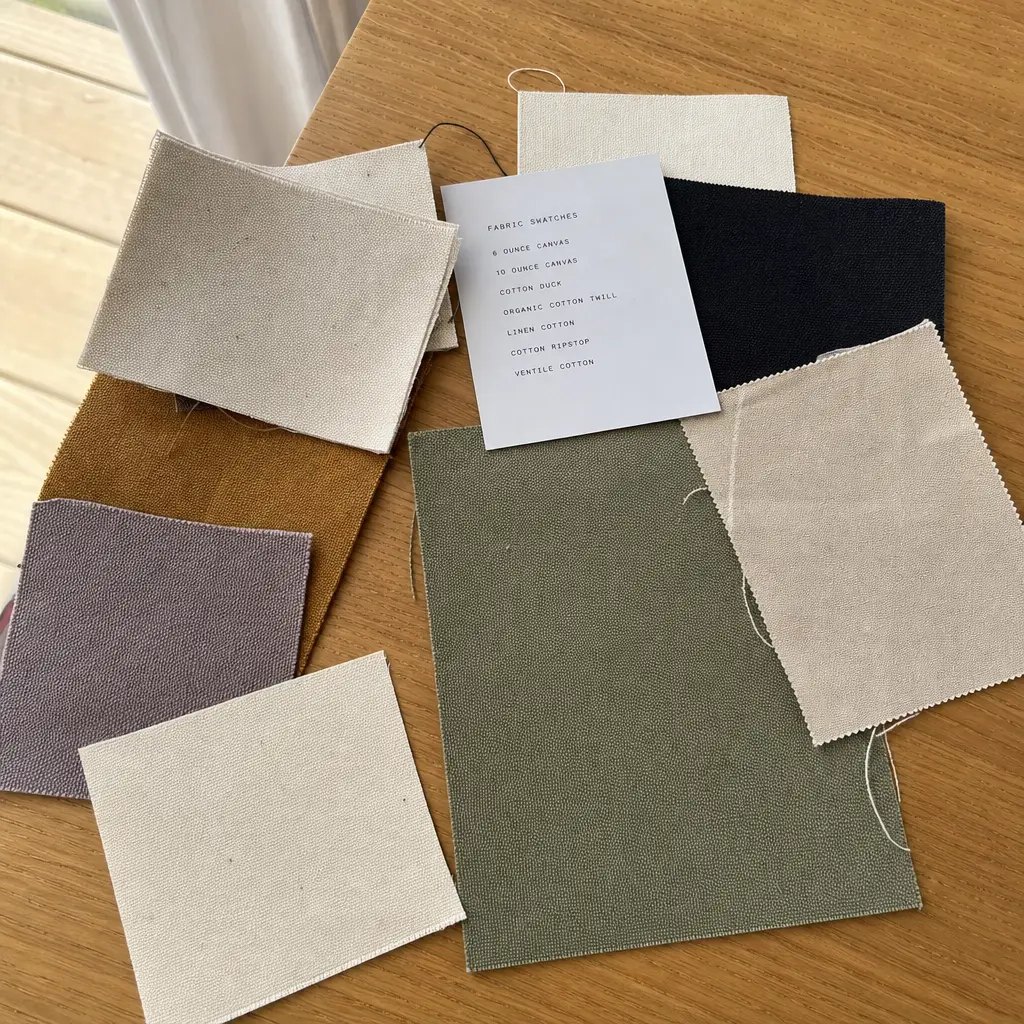
For bakery brands that rely on a warm natural look, approve a fabric swatch range. If the pouch will sit beside kraft boxes, printed sleeves, ribbons, or paper labels, compare those materials together. Natural cotton shade variation can be acceptable, but it should be agreed before bulk fabric is cut.
- Use 5 oz cotton for lightweight favors, low-cost promotional pouches, and short-use bakery packaging.
- Use 8 oz cotton for a more substantial reusable feel, better opacity, and cleaner logo presentation.
- Use 10 oz cotton for premium gift pouches when higher unit cost and freight volume are acceptable.
- Confirm whether fabric is natural, bleached, dyed, washed, pre-shrunk, pressed, or calendared before production.
- Request swatches from the intended bulk fabric lot or approve a shade range when color consistency matters.
Match decoration method to the bakery logo
Screen printing is usually the most practical choice for custom cotton drawstring pouches with artisan bakery logos. It suits one- to three-color wordmarks, monograms, circular seals, wheat icons, and simple illustrations. It is also manageable for repeat orders because the supplier can reference the same artwork, placement, ink color, and curing standard.
That does not mean every design belongs in screen print. Heat transfer can reproduce gradients, photographic detail, or complex multicolor artwork. The tradeoff is hand feel. A transfer may look smoother or more film-like than screen print, which can feel less aligned with a rustic cotton bakery presentation. Transfers should be tested for folding, rubbing, edge lifting, and creasing, especially when pouches will be folded tightly in cartons.
Embroidery can add a premium look on larger reusable pouches, but it brings different risks: thread thickness, stitch density, puckering, and higher cost. On small pouches, embroidery can distort the front panel or reduce flexibility. Woven labels and side tags are useful for subtle brand reinforcement or secondary information, but they usually do not replace a clear front logo when shelf visibility matters.
If the project combines methods, quote each process separately. A printed logo plus woven side label or hangtag can look polished, but it adds setup, handling, and inspection steps. Each extra process needs its own tolerance and approval sample.
- Choose screen print for solid bakery logos, repeat orders, one to three colors, and a natural cotton look.
- Choose heat transfer only when artwork complexity justifies the different hand feel and fold-performance risk.
- Choose embroidery mainly for larger premium gift pouches, not very small pouches with tight front panels.
- Use woven labels for secondary branding, batch identity, or side detail rather than the main shelf-facing logo.
- Request curing, rub, tape, odor, and fold checks before approving bulk decoration.
Control drawcord, channel, and gusset effects
The drawcord is not just a closure detail. It changes the whole top section of the pouch. When the cord is pulled, the fabric gathers inward and the front panel can rise, wrinkle, or tilt. A logo placed too close to the channel may look crowded or partly hidden after closing, even if it looked clean on the flat sample.
Cord diameter matters. A 3 mm cotton cord can suit smaller pouches and a softer closure. A 5 mm cord feels more substantial but can be bulky on narrow pouches. If the bakery wants a thick natural cord for a premium gift look, the logo often needs to sit lower so the brand mark has enough breathing room below the gathered top.
The RFQ should specify cord material, color, diameter, pull style, knot or tip finish, and finished exposed length. Single-side pull and double-side pull pouches do not behave the same way. Double drawcords can feel balanced and secure, but they create gathering from both sides. If the logo is wide, side bunching can make it look squeezed.
Gussets add capacity and help some pouches stand upright, but they change the geometry of the front panel. A flat pouch is often enough for biscuits, favors, or thin packs. A bottom gusset works better for mini loaves, roll sets, boxed treats, and mixed gift assortments. For gusseted pouches, logo placement should be approved on the visible filled front face, not the total flat fabric width.
- Specify cord material, diameter, color, pull style, knot or tip finish, and finished exposed length.
- Move the logo lower when using thicker cord, heavier contents, or a closure that creates strong gathering.
- Compare single-pull and double-pull samples because side bunching changes visual balance.
- Use flat pouches for thin bakery items and bottom gussets for products with depth or standing display needs.
- Measure gusseted logo placement from the visible filled front face, not from total flat cut fabric.
Build an RFQ suppliers can price cleanly
MOQ and unit price are shaped by more than pouch dimensions. Fabric sourcing, cutting yield, sewing setup, screen setup, color count, print position, trimming, pressing, packing, inspection, and export handling all affect cost. A supplier may accept 300 or 500 pieces with stock natural cotton and one-color printing, but setup costs are spread across fewer pieces. At 1,000 to 3,000 pieces, cutting and printing often become more efficient. At 5,000 pieces and above, material yield, scheduling, carton packing, and inspection planning become more important.
Ask for price breaks using the same specification at each quantity. If one quote assumes 5 oz cotton and another assumes 8 oz cotton, the lower unit price is not a true comparison. If one supplier lists screen charges separately and another hides them in the unit price, normalize the quote before choosing. Separate unit price, setup, sample cost, packing, testing, inland freight, export charges, and special labeling or allocation work.
Delivery and packing requirements belong in the RFQ too. A distributor shipping pouches to multiple bakery accounts may need inner bags by quantity, carton labels by SKU, or no mixed cartons. A bakery chain building seasonal gift sets may need store allocation, barcode labels, or carton marks that match its warehouse process. These instructions affect labor and carton count, so they should be quoted before the purchase order is issued.
A clean RFQ also helps the supplier flag risks early. If the artwork is too fine for the selected fabric, if the product is too bulky for the requested pouch size, or if the MOQ is too low for dyed cotton, the factory can respond before sampling money and calendar days are spent.
- Quote 500, 1,000, 3,000, and 5,000 pcs when testing a seasonal or multi-location bakery program.
- Keep size, fabric, print method, artwork, color count, packing, and delivery term identical across price breaks.
- Separate stock natural cotton, dyed cotton, organic cotton, and recycled-content options because MOQ and lead time can differ.
- Clarify whether screen charges are per color, per artwork, per size, one-time, or repeated on future orders.
- Request carton dimensions, gross weight, net weight, pieces per carton, and inner bag quantity for landed-cost planning.
Approve samples in a controlled sequence
A flat photo can start the conversation, but it should not release bulk production. Bakery pouch sampling works best in stages. First, approve fabric swatches for shade, weight, opacity, weave, and hand feel. Second, approve a print strike-off on the actual fabric for color, line clarity, coverage, curing, and ink hand feel. Third, approve a sewn pre-production sample for finished size, stitching, drawcord function, gusset shape, and logo position. Fourth, approve a filled and closed sample using the real product or a dummy insert with matching size, weight, and thickness.
Keep sample records measurable. Mark the approved sample with logo top distance from the channel seam, centerline position, artwork width, artwork height, side clearance, and bottom clearance. Photograph the pouch flat, filled, closed, from the side, from the bottom if it stands, and in the intended display setting. If the pouch will sit in a basket, hamper, bakery counter tray, or gift box, approve that viewing angle as well.
Timing is critical. If panels are bulk printed before the filled sample is approved, a placement error can become expensive or impossible to correct. This is especially risky for seasonal bakery packaging, where a missed sales window can matter more than a small unit-cost saving. The purchase order should state that bulk cutting or bulk printing cannot begin until the required sample stage is approved in writing.
Reference samples should not disappear after approval. Seal and label one for the buyer, one for the factory production line, and one for final inspection if third-party QC is involved. Reorders are much easier when everyone can compare against a physical pouch rather than a photo in an email thread.
- Approve fabric swatch before artwork if natural shade, opacity, or hand feel affects the bakery brand presentation.
- Approve print strike-off before sewn sampling when artwork has fine lines, small text, multiple colors, or strict color needs.
- Approve a sewn PP sample before mass cutting when finished size, channel height, or gusset shape is critical.
- Approve a filled and closed sample before bulk printing when logo visibility after packing is the main risk.
- Seal and retain reference samples for buyer QC, factory production control, and future reorder matching.
Set QC standards that inspectors can repeat
Final inspection should not rely on whether the pouch “looks nice.” For custom cotton drawstring pouches, measurable QC points include finished size, logo position, logo tilt, print color, ink coverage, ink adhesion, seam quality, cord length, channel function, fabric cleanliness, odor, loose threads, and packing condition. A clear standard helps the buyer reject true defects while allowing normal textile variation.
Practical tolerances should be agreed before production. Many cotton pouch programs use logo placement tolerance around ±3 mm to ±5 mm from the approved sample, depending on pouch size and print method. Finished size may be around ±5 mm for small pouches and ±8 mm to ±10 mm for larger or gusseted pouches unless a tighter retail standard is contracted. Logo tilt can often be limited to within about 2 degrees. These numbers are not automatic guarantees; the supplier must confirm them and the PO must record them.
Use a ruler template, printed overlay, or inspection guide to measure logo position. Check first-off print panels, in-line sewn pieces, and finished cartons from different layers. For multicolor artwork, inspect registration at the edges of letters, seals, and icons. Missing ink on the main logo, clogged small text, sticky ink, strong odor, severe tilt, dirty fabric, open seams, and broken channels should be treated as major defects.
Packing deserves its own standard. Cotton pouches are often packed flat in inner polybags of 50 or 100 pieces, then loaded into export cartons. The logo area should not be sharply folded unless a fold test proves the print can recover. Cartons should not be over-compressed, damp, dirty, or mixed without approval. Request packing photos, carton marks, carton dimensions, gross weight, net weight, and moisture-control method before shipment.
- Use a ruler template, printed overlay, or inspection guide to measure logo placement instead of checking by eye.
- Inspect first-off print panels, in-line sewn pieces, and final cartons from multiple carton layers and production batches.
- Classify missing ink on the main logo, sticky ink, strong odor, severe tilt, open seams, and dirty fabric as major defects.
- Check drawcord pull on filled samples because tight channels slow bakery packing and can tear at side openings.
- Control packing count, carton marks, moisture condition, logo creasing, ink transfer, odor, and mixed-carton rules before shipment.
Specification comparison for buyers
| Spec decision | Recommended option | When it fits | Buyer risk to check |
|---|---|---|---|
| Logo reference point | Measure from finished top edge, drawcord channel seam, side seams, bottom fold, gusset fold lines, and front centerline | Any custom cotton drawstring pouch where bulk production must match an approved sample | Raw cut panels change after sewing, pressing, cord insertion, and filling; inspect the finished pouch, not the cut fabric |
| Front logo position | Center on the usable front panel; for many small and medium pouches, start 25-35 mm below the drawcord channel seam with at least 20 mm side clearance | Cookie pouches, pastry favors, granola packs, roll sets, mini loaf gifts, and bakery retail add-ons | A flat pouch may look correct while the filled pouch pulls the logo upward, curves it around the side, or hides the lower edge |
| Logo size for small pouches | Keep artwork width around 35-45% of finished pouch width; avoid text below about 4-5 mm cap height unless proven by strike-off | 10 x 15 cm, 12 x 17 cm, and 15 x 20 cm pouches for biscuits, small treats, counter gifts, and tasting packs | Thin strokes, flourishes, reversed-out letters, and small serif text can fill in or blur on cotton weave |
| Logo size for larger gift pouches | Deduct channel height, seams, bottom fold, and gusset before sizing artwork; confirm on a filled standing sample | 20 x 30 cm and larger pouches for mini loaves, bundled rolls, seasonal bakery gifts, and premium kits | Oversized logos may bend over the curved front panel, drop onto the base, or look off-center when displayed upright |
| Fabric weight | Quote 5 oz, 8 oz, and 10 oz cotton separately, with GSM if available, and approve the actual swatch | 5 oz for light promotional use, 8 oz for most reusable bakery pouches, 10 oz for premium gift packaging | Changing fabric weight affects opacity, print sharpness, closure bulk, carton volume, freight cost, and final unit price |
| Print method | Use screen printing for solid one- to three-color bakery logos; consider transfer only for gradients or complex multicolor artwork | Most artisan bakery wordmarks, seals, wheat icons, monograms, establishment marks, and simple illustrations | Screen print needs curing, registration, rub resistance, odor control, and line-thickness limits; transfers may feel less natural and crease across folds |
| Drawcord specification | Specify cord material, diameter, color, pull style, knot or tip finish, and finished exposed length | Cotton cord around 3-5 mm for a natural bakery look and reusable gift-pack positioning | Thick cord creates more top gathering and can visually crowd artwork placed too close to the channel |
| Gusset choice | Use a flat pouch for thin items; use a bottom gusset for products with depth or standing display needs | Flat for biscuits and favors; gusseted for mini loaves, boxed treats, roll sets, or mixed gift packs | Logo placement must be based on the visible filled front face, not the total flat fabric width |
| MOQ and price breaks | Quote 500, 1,000, 3,000, and 5,000 pcs using the same construction, fabric, print colors, packing, and delivery term | Importers, bakery groups, distributors, promotional buyers, and seasonal gift-pack programs | Low MOQ quotes may hide setup, sampling, screen, cutting loss, packing, inland freight, or export charges; separate non-unit costs |
Buyer checklist before sampling
- Confirm finished pouch size, flat measurement method, seam allowance, drawcord channel height, gusset depth if any, and the usable front print zone before artwork approval.
- Measure the actual bakery item or inner retail pack, including width, height, depth, weight, product bulge, closure space, and whether it will be wrapped, boxed, or loose inside food-safe primary packaging.
- Define logo placement from fixed finished construction points: top edge, drawcord channel seam, side seams, bottom fold, gusset fold lines, and front panel centerline.
- Specify artwork width, artwork height, color count, color references, minimum line thickness, smallest readable text, and required clear space around the logo.
- Select fabric weight by opacity, hand feel, expected reuse, print clarity, pouch size, product weight, carton volume, and target landed cost.
- Confirm whether cotton is natural, bleached, dyed, organic, recycled-content, washed, pre-shrunk, pressed, or calendared, and state how shade and shrinkage will be approved.
- Choose the decoration method in the RFQ: screen print, heat transfer, embroidery, woven label, or combined branding, with technical limits confirmed by the supplier.
- Approve a fabric swatch, print strike-off on actual fabric, sewn pre-production sample, and filled closed sample before bulk cutting or bulk printing.
- Test the sample with the real product or a dummy insert matching the bakery item’s size, weight, thickness, inner wrap, and closure behavior.
- Set measurable acceptance limits for finished size, logo shift, logo tilt, print color, ink coverage, ink adhesion, seam defects, cord length, channel function, odor, staining, and packing condition.
Factory quote questions to send
- What cotton weight do you recommend for this pouch size, product weight, and intended reuse level, and can you quote 5 oz, 8 oz, and 10 oz options separately with GSM if available?
- Is the quoted size the finished external flat size, the cut-panel size, or the usable internal loading size after sewing and drawcord closure?
- What is the exact usable front print area after excluding the drawcord channel, side seams, bottom fold, gusset expansion, and any area that will curve when filled?
- Can you provide a flat layout or marked technical drawing showing finished dimensions, channel seam, logo centerline, top distance, side clearance, bottom clearance, and gusset fold lines?
- Which print method gives the most stable result for our artwork on the selected cotton, and what minimum line thickness and minimum text height can you hold in bulk production?
- Can you provide a screen print strike-off on the actual cotton fabric before making the sewn pre-production sample?
- Can the PP sample be filled with our product or a dummy insert of the same dimensions and weight so we can approve logo position after closure?
- What logo placement tolerance can you control in production, measured in millimeters from the approved sample and centerline?
- What finished size tolerance do you normally apply for this pouch size, and does that tolerance change after washing, pressing, dyeing, or packing?
- Are screen charges quoted per color, per artwork, per size, or as a one-time setup, and will they repeat on reorders?
Quality-control points to confirm
- Finished pouch size tolerance should be agreed before production; common practical targets are around ±5 mm for small cotton pouches and ±8 mm to ±10 mm for larger or gusseted pouches unless a tighter retail standard is contracted.
- Logo placement should be measured against the approved sample with a ruler template, printed overlay, or inspection guide; define acceptable shift such as ±3 mm for small pouches and ±5 mm for larger pouches where textile movement is greater.
- Logo tilt should be limited, often within 2 degrees, because plain cotton front panels make rotation visible even when the logo is otherwise centered.
- Logo side clearance must be inspected after filling on gusseted pouches because the opened gusset can pull the front panel and make artwork appear closer to one edge.
- Screen print color should be compared under consistent light against the approved strike-off or Pantone reference, while allowing for natural cotton base shade variation agreed at swatch stage.
- Ink coverage should match the approved strike-off; missing ink on the main logo, clogged small text, blurred registration, sticky ink, or strong odor should be classified as major defects.
- Ink adhesion should pass an agreed dry rub check and tape check before shipment because pouches are folded, packed, opened, and handled repeatedly during bakery assembly and retail display.
- Print registration on multicolor artwork should be checked at the edges of letters, seals, and icons; visible misregistration on the main brand mark should be treated as a major defect.
- Drawcord length should be consistent by size, with no frayed ends, broken knots, missing cord, uneven pull, trapped cord, or cord ends that disappear into the channel.
- The drawcord channel and side openings should withstand repeated closure on a filled pouch without tearing, skipped stitches, loose seams, or excessive resistance.