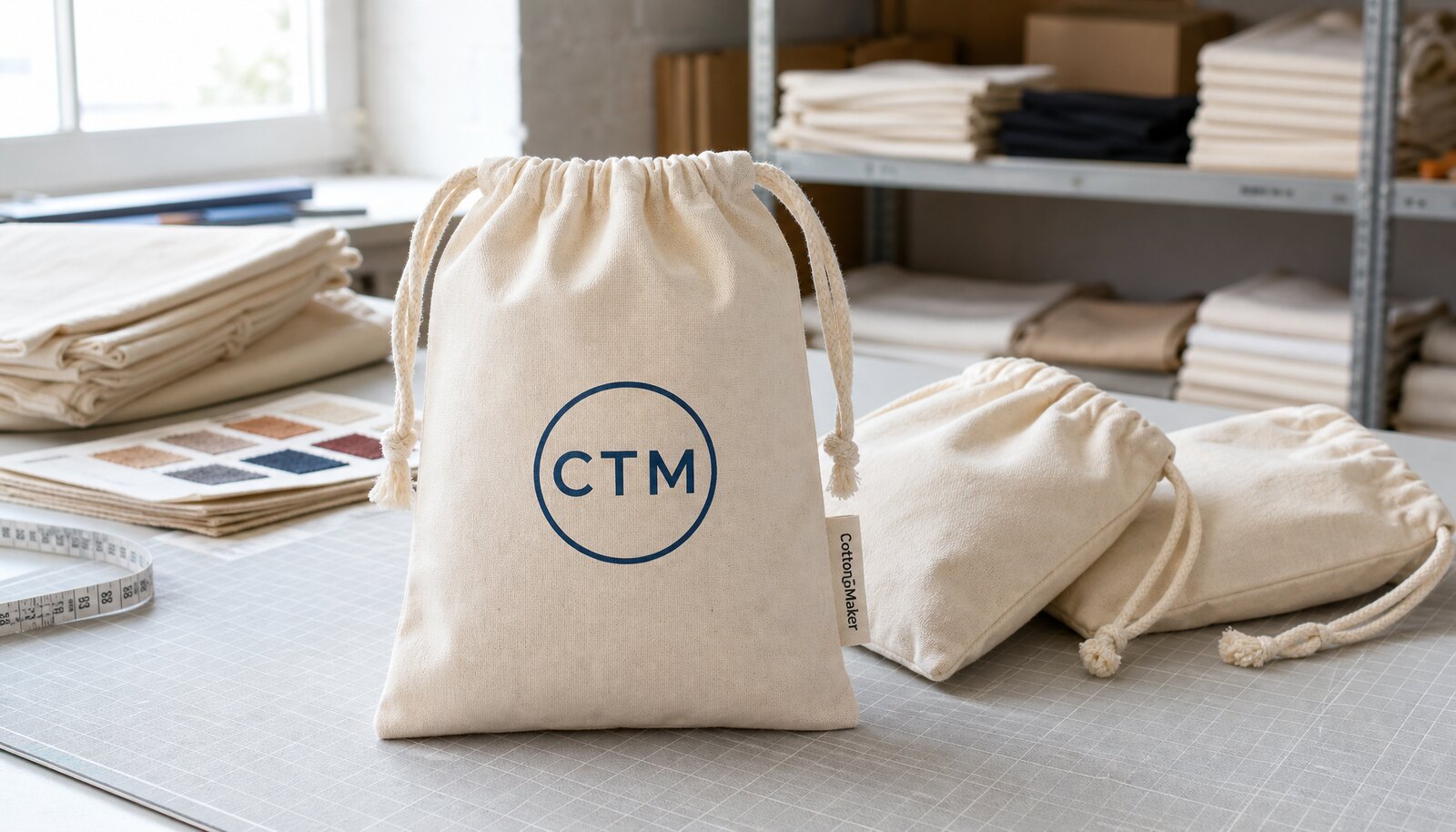
Start With The Winery Use Case, Not The Mockup
For boutique wineries, a cotton drawstring pouch is rarely just a small bag. It may hold a corkscrew, stopper, tasting token, gift card, candle, soap, chocolate, wine club insert, or seasonal merchandise item. Sometimes it supports a retail sale. Sometimes it helps a distributor sample feel organized. Sometimes it is the first thing a club member touches when opening a package. Logo placement should be decided around that job, not around a flat artwork mockup that looks tidy on screen.
A logo that looks centered on a PDF can fail once the pouch is filled. The cord may cover the estate name. A corkscrew may create a front-panel bulge through the crest. A lower fold may run across the vineyard wordmark. If the pouch sits upright near a tasting counter, the brand needs to read quickly at arm's length. If it goes into a wine club shipment, the hand feel and repeatable presentation may matter more than maximum logo size.
Procurement should also name the commercial priority before asking suppliers to quote. A giveaway pouch for a release event may accept lighter cotton and a wider placement tolerance if the logo is still readable. A retail-ready pouch beside higher-value accessories needs cleaner fabric, tighter print control, consistent folding, and better packing. Write that priority into the RFQ so suppliers price the pouch you actually intend to receive.
- Write the use case into the RFQ: tasting-room retail, wine club insert, corkscrew pouch, gift set, event giveaway, distributor sample, or merchandise add-on.
- State the viewing condition: flat, filled, cinched, upright, stacked, photographed, or inserted into another gift box.
- Tell the factory what goes inside the pouch, including dimensions, weight, sharp edges, and whether the item creates a front-panel bulge.
- Decide whether the main buying priority is premium hand feel, lowest unit cost, repeat placement accuracy, short lead time, or retail-ready packing.
Choose Size From The Product Inside
Logo placement starts with pouch size. The usable print area is what remains after the top hem, drawstring channel, side seams, bottom seam, seam allowance, cord movement, and product bulge are removed from the design area. A small pouch for a stopper or tasting token may have only a narrow clean branding zone. A larger accessory pouch gives more space, but the panel may wrinkle when the cord is pulled tight.
Begin with the item going inside the pouch. Add enough clearance for easy insertion and removal, then confirm the finished pouch size. A pouch that is too tight can stretch the logo and skew the panel. A pouch that is too loose can fold through the mark and look off-center in photos. For many winery accessory pouches, the safest logo zone is below the drawstring channel and above the widest part of the product inside.
Clarify whether the supplier is quoting cut size or finished size. Finished size is the practical purchasing dimension because sewing, pressing, washing, curing, and heat transfer can change the final measurement. If the quote is based on cut size while the purchase order assumes finished size, the same logo coordinates may land too high, too low, or too close to a seam in bulk production.
- Provide item dimensions and target clearance instead of asking the factory to guess the pouch size.
- Confirm finished pouch size after sewing and finishing; ask the supplier to disclose cut size separately if relevant.
- Keep the primary logo out of the top closure area when the pouch will be cinched tightly.
- Request a filled sample when the pouch is designed around a specific corkscrew, stopper, candle, gift card, sample accessory, or irregular item.
- Use separate placement drawings for each size; do not let the factory resize or reposition artwork by eye.
Specify Cotton GSM, Weave, And Finish
Cotton GSM affects print clarity, structure, hand feel, and cost, but it does not tell the whole story. Lightweight cotton around 100-120 GSM can work for budget event giveaways where reuse and retail polish are not the main goals. The tradeoff is more transparency, more panel movement, and less forgiveness for small type. For many boutique winery programs, 140-180 GSM is a practical middle range because it supports cleaner screen print, a better hand, and controlled unit cost.
For premium reusable pouches, 200 GSM or heavier cotton may be worth testing, especially for woven labels, patches, or embroidery. Heavier fabric can reduce show-through and support tactile branding. It can also change how tightly the pouch closes and increase carton weight. Weave matters as much as weight. A tight 150 GSM cotton can print cleaner than a loose 180 GSM fabric, while a slubby natural cotton may look beautiful but break up fine serif lettering.
Put tolerances in writing. For sourcing discussions, buyers often use ranges such as GSM ±5%, finished size ±5 mm or an agreed percentage for larger pouches, and logo placement around ±3-5 mm depending on pouch size, fabric stability, and loading method. These are not automatic guarantees. They are practical targets to confirm with the actual factory process and record on the purchase order.
- Use 100-120 GSM mainly for low-cost giveaways where premium structure is not the goal.
- Use 140-180 GSM for most tasting-room, club insert, and gift accessory programs that need clean branding at controlled cost.
- Use 200 GSM or heavier for sewn labels, patches, embroidery, or a more durable reusable pouch.
- Specify natural, bleached, dyed, washed, pre-shrunk, or heat-set cotton; shade variation is more visible on natural cotton than many buyers expect.
- Ask for weave type, fabric shade reference, GSM tolerance, shrinkage assumption, and whether bulk fabric will match the sample lot.
Match Decoration To Logo Detail
Winery logos often carry more detail than buyers realize: estate names, small crests, vineyard illustrations, appellation text, vintage references, and fine linework. The decoration method has to match that detail. Screen print is usually the strongest default for simple one-color or two-color pouch branding. It is repeatable, economical at volume, and clean when the artwork is simplified. A dark one-color mark on natural cotton can feel understated and premium.
Screen print becomes less forgiving when the artwork includes tiny serif letters, thin crest lines, reversed-out text, or tight circular type. Mesh, ink, fabric texture, squeegee pressure, and print timing all affect the result. Ask the supplier for minimum stroke width and minimum text height before sampling. On small pouches, a simplified estate mark often performs better than a full crest with every line preserved.
DTF and heat transfer can carry more colors and detail for short runs, seasonal artwork, or complex crests. They still need testing. A transfer may look sharp on a flat table but feel too plastic for a premium winery program, show an adhesive halo, or lift at the edge after folding. Embroidery works best for simple marks on heavier cotton. Woven labels and cotton patches are useful when subtle reusable branding matters more than a large front graphic.
- Use screen print for simple one-color or two-color logos, repeat programs, and predictable setup economics.
- Use DTF or heat transfer for short runs, fine crests, or multicolor seasonal artwork after testing fold, rub, and hand feel.
- Use embroidery only on heavier cotton with simplified artwork and limited small text.
- Use woven labels, patches, or side tabs when tactile branding and reuse matter more than large logo coverage.
- Ask the factory to flag risky artwork details before sample production, including thin lines, small reversed text, gradients, and tight registration areas.
Build A Millimeter-Based Placement Drawing
A useful custom cotton drawstring pouches logo placement guide for boutique wineries has to go beyond the phrase center front. Center front may be correct, but only after the print-safe area is defined. The top hem and drawstring channel are not stable decoration zones. Side seams and bottom seams create thickness. The lower panel may fold when the pouch is filled. The placement drawing should show exact measurements from fixed construction points.
For small and medium pouches, keep the logo below the drawstring channel and above the main product bulge. On a pouch around 5 x 7 inches or 6 x 9 inches, a 45-60 mm wide simplified logo may read better than a larger mark that crowds the closure. On a pouch around 8 x 12 inches, 60-90 mm may be suitable if the artwork is not too detailed. Final size should be approved on the actual pouch, not chosen only from a digital mockup.
Placement tolerance should be settled before the purchase order. A jigged print process on a stable flat panel may hold tighter placement than manual loading on soft cotton after sewing. For many cotton pouch programs, buyers and suppliers negotiate a practical range such as ±3 mm for small stable placements or ±5 mm for larger soft panels. The important part is shared measurement: same reference points, same tolerance, same defect classification.
- Show logo width, height, center line, and exact distance from the top finished edge, left/right seams, and bottom seam.
- Keep artwork clear of the drawstring channel, top hem, seam allowance, gussets, and expected fold zones.
- Specify whether placement is judged with the pouch flat, filled, cinched, or in retail display condition.
- Use a simplified logo on small pouches rather than forcing a full crest into a tight print-safe area.
- Set separate placement tolerances for front print, back print, woven label, patch, side tab, and embroidery.
Write An RFQ That Reduces Quote Drift
Quote drift happens when suppliers price different products under the same short description. One factory may quote 120 GSM cotton, another 160 GSM. One may assume screen print before sewing, another may decorate stocked blanks after sewing. One may include setup and packing, while another excludes them. The unit prices appear comparable, but the actual sourcing risk is different.
A strong RFQ identifies finished pouch size, fabric GSM, weave, shade, cord specification, construction, decoration method, artwork dimensions, logo coordinates, number of colors, print side, sample requirements, packing method, and quantity by SKU. If the winery needs several pouch sizes or seasonal artwork versions, ask for MOQ and setup fees by version. A low price may depend on combining quantities that actually require separate screens, labels, fixtures, or inspections.
Ask suppliers to list deviations directly. If a factory cannot hold the requested placement tolerance or believes the artwork is too detailed for the selected fabric, that feedback is valuable before sampling. The goal is not to make every supplier say yes. The goal is to reveal which supplier is quoting the pouch you intend to buy.
- Include finished size, top hem height, channel height, seam allowance, cotton GSM, weave, shade, cord material, cord color, and cord diameter.
- Include artwork file format, logo dimensions, print color reference, number of colors, print side, and placement coordinates.
- Ask for MOQ by pouch size, fabric color, cord color, artwork version, print side, label type, and packing method.
- Request line items for screen setup, transfer setup, label setup, sample, pre-production sample, packing, inserts, barcode labels, inspection, and freight basis.
- Require every supplier to state exceptions to the requested specification directly in the quotation.
Approve Samples Like An Inspector
Sampling protects the bulk order. A digital proof can confirm orientation, but it cannot show how ink behaves on natural cotton, whether a transfer feels too heavy, whether embroidery puckers, or whether the drawstring covers the logo after cinching. The first serious approval should use production fabric and the intended decoration method. Substitute material may be acceptable for early concept review, but it should not approve color, hand feel, shrinkage, or placement.
When the sample arrives, measure it the way an inspector will. Check finished pouch width and height, logo width and height, distance from the top edge, distance from both side seams, distance from the bottom seam, and alignment to the center line. Then fill the pouch with the intended item or a realistic substitute and close it. Watch what happens under cord tension. Does the fabric collapse through the wordmark? Does the knot cover the crest? Does the lower seam pull the artwork into a fold?
Color approval should happen on the actual cotton base. Natural cotton can warm or dull ink color, and shade variation between fabric lots can change how the same ink appears. If color is critical, provide a physical color reference or Pantone target and agree on a realistic visual tolerance for cotton. Retain one signed master sample with date, version number, fabric, cord, decoration, placement, and packing notes. Bulk should be judged against both the signed sample and the written specification.
- Approve production fabric, cord, stitching, decoration method, curing process, and packing fold before bulk production.
- Measure sample placement from the same reference points the factory will use during line setup and QC.
- Inspect the pouch flat, filled, cinched, folded, and under normal tasting-room or retail lighting.
- Take phone photos of the filled pouch because winery sales teams often use quick images for ecommerce, club emails, or internal approvals.
- Keep a signed master sample and do not approve bulk based only on a digital mockup or unmeasured sample photo.
Set QC Standards Before The PO
Quality control should be written before production starts. For logo placement, the central requirement is measurable tolerance. A logo that is 3 mm off center may be acceptable if the agreed tolerance allows it. The same logo may be a major defect if the approved limit is ±2 mm. A logo that crosses the drawstring channel, smears, or disappears when cinched can be a major defect even if its center measurement is close.
Use method-specific QC. For screen print, check cure, opacity, bleeding, pinholes, clogged detail, and registration. For DTF or heat transfer, check edge lift, adhesive halo, cracking, bubbling, scorching, and abrasion. For embroidery, check puckering, loose threads, backing exposure, needle damage, and legibility. For woven labels or patches, check straightness, stitch security, orientation, fraying, and whether the label remains visible when the pouch is filled.
If a third-party inspection is used, specify the sampling standard and acceptance levels instead of assuming the inspector knows the brand expectation. Many import programs reference ANSI/ASQ Z1.4 or ISO 2859-1 sampling with agreed AQL levels, such as critical 0, major 2.5, minor 4.0, but the correct plan depends on buyer risk, order size, and product use. Even with supplier internal QC, define the defect list, measurement tools, sample size, and photo reporting requirements.
- Define minor, major, and critical defects for placement, print, sewing, fabric, cord, packing, and wrong artwork.
- Set placement tolerance in millimeters and state exactly how it will be measured.
- Require rub, fold, cinch, and filled-product checks on decorated pouches, not only flat-table visual inspection.
- Inspect side seams, bottom seams, channel stitching, cord movement, cord length, knot security, cleanliness, odor, and stains.
- Confirm carton counts, SKU labels, artwork version labels, and inner pack quantities so receiving teams do not mix products.
Control Packing And Presentation
Cotton pouches can pass print inspection and still arrive poorly presented if packing is loose, rushed, or unspecified. Tight compression can create hard creases across the logo. Packing before ink is fully cured can cause offsetting, blocking, gloss marks, or sticking. Random bulk packing can force the winery or fulfillment partner to sort, count, and refold every pouch before use, adding labor and schedule risk.
The right packing method depends on the sales channel. Event giveaways may be acceptable in counted bulk inner bags if pouches stay clean and dry. Retail pouches may need a consistent flat fold, logo facing the same direction, inner pack quantity, barcode label, or insertion into a larger gift kit. Natural cotton should be protected from moisture, warehouse dust, and odor contamination. For ocean freight, humid storage, or long warehousing, discuss carton liners, desiccant, and stronger master cartons.
Packing affects logo appearance directly. If every pouch is folded through the printed mark, the first presentation may show a crease. If transfers are stacked face-to-face under pressure too soon, the print may mark the opposite panel. If labels or inserts press into the logo area, they can create dents or shine. When presentation matters, ask for packing photos, a packing sample, or a pilot carton before shipment.
- Specify inner pack quantity, folding method, logo orientation, master carton count, carton size, and carton marks.
- Avoid planned fold lines directly through the primary logo for retail-facing programs.
- Confirm full ink cure or transfer cooling time before tight packing.
- Request moisture protection for natural cotton if cartons will face ocean freight, humid storage, or long warehousing.
- Include barcode labels, hang tags, inserts, retail-ready folds, and special carton marks in the original quote rather than adding them late.
Compare Suppliers On Repeatable Results
The lowest unit price is not always the best procurement result. A low FOB quote may exclude setup, sample revisions, retail packing, inspection, inland freight, duty, warehouse labor, or realistic defect allowance. It may also assume lighter cotton, wider placement tolerance, or a decoration method that does not match the approved presentation. Compare suppliers on the cost to receive usable pouches that match the signed sample and can be reordered without rebuilding the program.
Direct factories can provide strong control when they manage cutting, sewing, decoration, packing, and inspection together, or when they disclose and supervise any subcontracted decoration. This route is useful for repeat winery programs because fabric references, screens, placement drawings, and approved samples can be retained. Traders can add value when a buyer needs several pouch formats or coordinated mixed SKUs, but procurement should ask where production happens and who owns defect resolution.
Local decoration on imported blanks can be the right solution for speed, small events, or emergency replenishment. It can also create variation because blank dimensions and fabric lots may change between orders. Artwork that fit one stocked blank may sit too close to the channel on the next. Include double freight, extra handling, blank rejects, local misprint allowance, and repacking cost when comparing against direct custom production.
Schedule is part of sourcing accuracy. Ask for the calendar by stage: artwork review, fabric strike-off, pre-production sample, sample approval, bulk cutting, decoration, sewing if applicable, final inspection, packing, and shipment. For repeat orders, confirm whether the supplier retains screens, placement fixtures, color references, fabric standards, and the signed master sample. Repeatable logo placement is not just a design preference; it is a procurement control.
- Compare landed cost, including setup, samples, packing, inspection, freight, duty, warehousing, repacking, and expected rejects.
- Ask who controls fabric sourcing, cutting, sewing, printing, label sewing, packing, and final inspection.
- Use direct factory sourcing for planned repeat programs with stable placement and fabric requirements.
- Use a trader when multi-SKU coordination and communication value justify the added layer.
- Use local decoration when speed matters more than lowest unit cost and blank variation is understood.
- For repeat orders, confirm retained samples, screens, placement drawings, fabric references, color targets, and reorder lead time.
Specification comparison for buyers
| Spec decision | Recommended B2B specification | When it fits | Buyer risk to check |
|---|---|---|---|
| One-color winery logo on natural cotton | Screen print on 140-180 GSM plain-weave or twill cotton; artwork supplied as vector; target placement tolerance agreed in writing, commonly around ±3-5 mm after sample approval | Repeat tasting-room, wine club insert, corkscrew, stopper, candle, soap, chocolate, or gift accessory programs where the logo needs to repeat cleanly across batches | Confirm minimum stroke width, minimum text height, ink type, cure temperature/time, setup charge per color/side, and whether print is done before or after sewing |
| Fine crest, gradients, or short seasonal artwork | DTF or heat transfer tested on the actual cotton base; specify transfer dimensions, edge boundary, press settings, cooling time, and adhesion test | Limited releases, distributor sample kits, short runs, or artwork too detailed for economical screen setup | Check plastic hand feel, adhesive halo, edge lift after folding, cracking after cinching, color shift on natural cotton, and the factory's plan for replacing defective transfers before packing |
| Premium reusable pouch with tactile branding | Woven label, cotton patch, or side tab sewn with defined label size, seam allowance, stitch count, thread color, and orientation | Higher-margin retail accessories, club gifts, merchandise add-ons, or reusable packaging where subtle branding matters | Verify the label faces outward when filled and cinched; check crooked sewing, needle damage, seam crowding, label fray, and colorfastness |
| Minimal monogram on heavy cotton | Embroidery on 200 GSM or heavier cotton; simplified logo; backing, stitch density, and thread color approved on sample | Small monograms, initials, or simple estate marks where texture matters more than small text detail | Check puckering, thread density, loose ends, backing visibility, needle holes, and whether serif letters or vineyard names close up |
| Budget event giveaway | 100-120 GSM cotton with one-color screen print and wider commercial tolerance agreed before PO | Large events where low unit cost matters more than long-term reuse or retail presentation | Confirm opacity, fabric skew, print bleed, logo distortion when filled, and whether the unit price includes rejected-print allowance |
| Multiple pouch sizes in one winery program | Separate dieline and placement drawing for each finished size; the same logo may be scaled only by written approval | Programs with small accessory pouches, tasting tokens, half-bottle accessories, and larger gift packs | Do not allow the supplier to scale by eye; require coordinates from top finished edge, side seams, and center line for every SKU |
| Direct factory sourcing | Factory controls cutting, sewing, decoration, packing, and final inspection, or discloses each subcontracted process | Repeat orders where consistent cotton, logo position, and landed cost matter | Ask where printing occurs, who approves line setup, how master samples are stored, and what happens if bulk fabric differs from sample fabric |
| Imported blank plus local decoration | Stock blank pouches decorated domestically; artwork positioned after verifying actual blank dimensions | Rush launches, last-minute events, very small regional programs, or emergency replenishment | Include blank size variation, double freight, extra handling, local setup fees, misprint allowance, and the risk that stocked blanks change between batches |
| Sample-first ocean bulk order | Production-fabric strike-off, pre-production sample, signed master sample, then bulk production with in-line and final inspection | Planned seasonal programs, tasting-room retail, and wine club packaging with enough calendar time | Protect the approval schedule; confirm sample lead time, bulk lead time, inspection date, packing method, and the exact acceptance standard used |
Buyer checklist before sampling
- Define the pouch use case before comparing prices: tasting-room retail, wine club insert, gift set, bottle accessory, event giveaway, distributor sample, or merchandise add-on.
- List the product going inside the pouch with dimensions and approximate weight; include photos if the item is irregular, sharp-edged, heavy, or bulky.
- Specify finished pouch size, not only cut size; if cut size is quoted, require the expected finished size after sewing, pressing, washing, curing, or heat transfer.
- Lock cotton GSM, weave, fabric shade, finishing method, shrinkage assumption, cord material, cord diameter, cord color, and closure style before artwork pricing.
- Provide vector artwork and state logo width and height in millimeters; do not rely on a scaled PDF screenshot as the only placement instruction.
- Define logo position in millimeters from the top finished edge, left/right side seams, bottom seam, and vertical center line for each pouch size.
- Keep the primary logo below the drawstring channel and outside seam allowances, gussets, fold lines, and areas that bulge when filled.
- State whether the logo must remain visible when flat, lightly filled, cinched, stacked, photographed, or displayed upright in a tasting room.
- Identify decoration method, number of colors, color reference, print side, label position, and whether setup charges apply per color, screen, side, and artwork version.
- Ask the supplier to confirm minimum printable stroke width, minimum text height, registration capability, and recommended artwork simplification before sampling.
Factory quote questions to send
- What finished pouch size, cut size, seam allowance, top hem height, and drawstring-channel height are included in this quote?
- What cotton GSM, weave, fabric shade, finishing process, and shrinkage assumption are included? What GSM tolerance can you hold, such as ±5% or another written range?
- Is the pouch cut and sewn in your facility, or are blank pouches sourced elsewhere and decorated separately? If subcontracted, who is responsible for final QC?
- What cord material, diameter, color, cord length, knot method, and cord-length tolerance are included?
- What decoration method is included, and what are the setup charges per color, screen, artwork, side, label, or embroidery program?
- What minimum printable stroke width and minimum text height do you recommend for screen print on this cotton?
- For multicolor print, what registration tolerance can you hold on a soft cotton pouch panel?
- Can you place the logo at the specified millimeter distances from the top edge, center line, side seams, and bottom seam? What placement tolerance can you guarantee in bulk?
- Will you print before sewing or after sewing? How does that affect placement accuracy, seam clearance, and inspection?
- What is the MOQ per pouch size, fabric color, cord color, artwork version, print side, label type, and packing method?
Quality-control points to confirm
- Finished pouch dimensions match the approved specification within the written tolerance, commonly expressed in millimeters or as a percentage by size; inspectors measure width and height flat without stretching.
- Logo position is measured from agreed reference points: top finished edge, vertical center line, side seam, bottom seam, and label seam where relevant.
- Logo placement falls within the approved tolerance, for example ±3 mm on stable small panels or ±5 mm where the buyer and supplier agree that soft cotton or manual loading requires more allowance.
- Logo remains readable when the pouch is flat, lightly filled, cinched, and photographed under normal retail lighting; drawstring knots do not cover key text or the brand mark.
- Print does not cross the drawstring channel, top hem, side seam, bottom seam, gusset, or planned fold line unless the approved artwork drawing specifically allows it.
- Ink or transfer color is checked against the approved production-fabric sample or stated color reference on the actual cotton base, not only against a digital proof.
- Screen print edges are clean, with no unacceptable bleeding, pinholes, clogged fine details, under-cured ink, ghosting, smearing, or visible registration shift beyond tolerance.
- Heat transfer or DTF decoration shows no edge lift, cracking, bubbling, adhesive halo, scorching, or excess film beyond the approved artwork boundary.
- Embroidery shows no panel puckering, skipped stitches, loose thread ends, thread-color mismatch, backing exposure outside the approved area, or unreadable small text.
- Woven labels, patches, and side tabs are straight, securely stitched, correctly oriented, and not crowded into seams or drawstring channels.