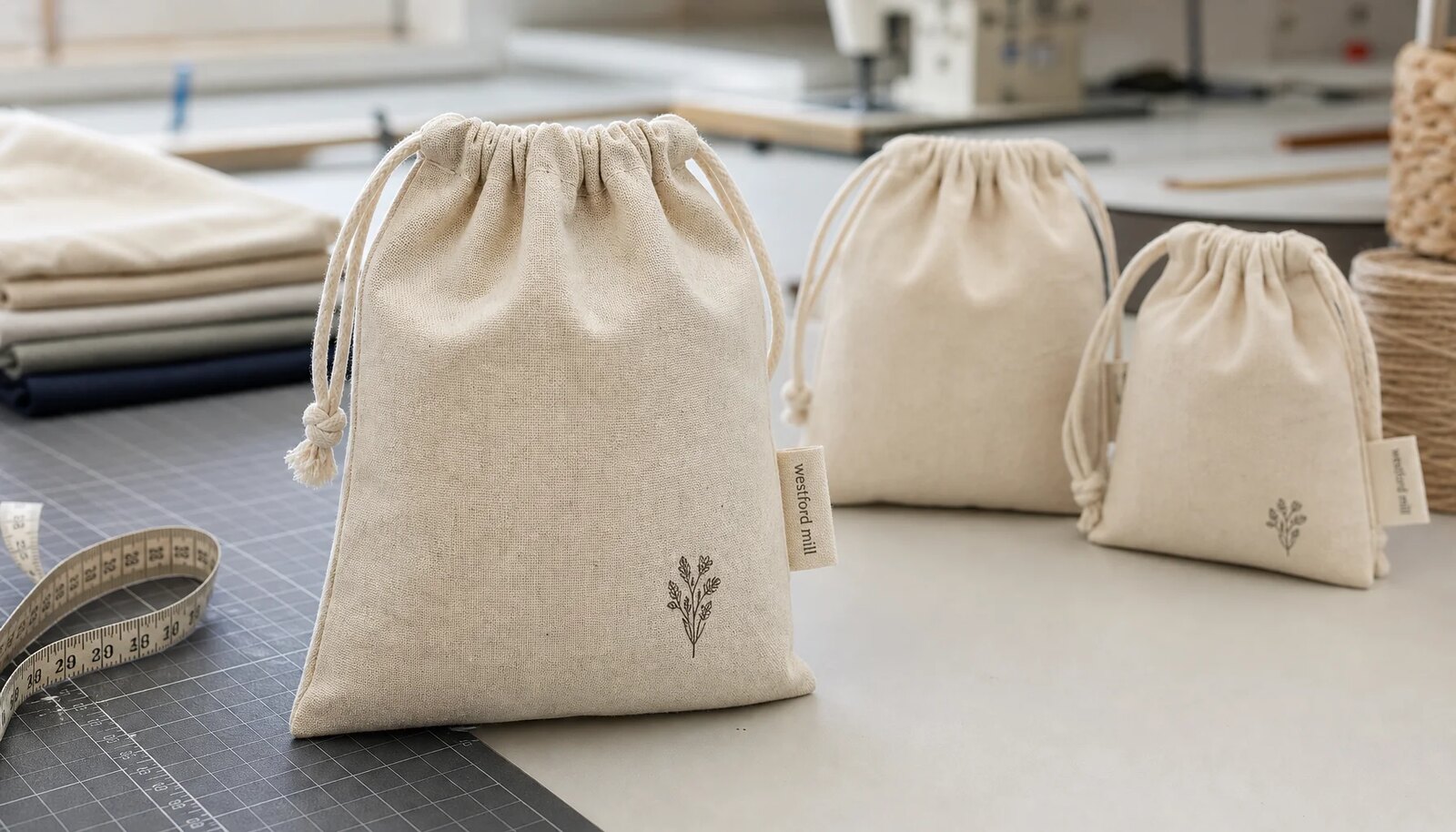
Start With the Date the Team Actually Needs Goods
For event planners, custom cotton drawstring pouches are not casual merchandise. They may be attendee registration packaging, sponsor gifts, VIP room-drop pieces, press kit bags, product sampling packs, or containers for a multi-city kit build. If the pouches arrive late, the packing line can stall even when every badge, insert, bottle, sample, and gift card is already sitting at the warehouse.
Plan from the working deadline, not the public event date. A practical custom cotton drawstring pouches lead time planning guide for event planners separates four dates: the event date, the internal in-hands date, the warehouse receiving deadline, and the latest acceptable supplier cargo handoff date. The event date is visible. The in-hands date is when your team needs usable goods. The warehouse receiving deadline is when cartons must arrive for check-in, counting, kitting, or redistribution. The supplier cargo handoff date is the last day inspected goods can leave without forcing a risky freight decision.
Quoted production time is only one line in that calendar. A pouch order can involve artwork proofing, sample making, courier transit, internal review, fabric procurement, cutting, sewing, decoration, curing, trimming, inspection, packing, export documents, freight, customs clearance, domestic delivery, and warehouse receiving. A supplier may quote 20 to 25 working days after sample approval. The real RFQ-to-receipt calendar can still land closer to six to ten weeks when sample rounds and freight are included.
The advantage of planning backward is that tradeoffs show up early. If the calendar is tight, you can choose stock natural cotton instead of custom dyeing, reduce two-sided artwork to one side, use a standard pouch size, approve a low-risk sample by photo, or decorate stock blanks domestically. Those moves are far cheaper before the PO is issued than after the brand team has approved a specification the schedule cannot support.
- Set the warehouse receiving date before requesting quotes, especially if pouches will be filled or routed to multiple venues.
- Ask for lead time after written sample approval and material confirmation, not after inquiry or deposit.
- Keep sample time, production time, inspection time, freight time, customs time, and warehouse handling time as separate calendar lines.
- Give internal stakeholders a latest approval date so late logo or sponsor feedback has a visible schedule cost.
Use Lead-Time Ranges as a Reality Check
Lead time changes with quantity, specification, supplier route, and freight lane. Procurement teams still need working ranges so they can spot a quote that looks too optimistic. For a simple stock-size cotton pouch with one-color screen print and available fabric, sample evidence may take 3 to 7 working days, with bulk production often around 12 to 25 working days after approval. For a cut-and-sew order with a custom size, two-color print, and confirmed stock fabric, 20 to 35 working days after pre-production sample approval is usually a more realistic production range.
The phrase after approval deserves attention. One supplier may mean after deposit. Another may mean after final artwork. A factory may mean after fabric arrival, after sample signoff, or after the production slot is confirmed. Those are not the same schedule. Ask the supplier to write the trigger clearly and to name the latest sample approval date required to meet your in-hands date.
Freight can move the deadline almost as much as sewing time. Domestic parcel or truck delivery may take days. International air freight can move quickly after cargo is ready, but it still needs carton dimensions, commercial invoice details, packing list, customs data, and receiving coordination. Ocean freight can reduce cost for large orders, but it needs a much longer calendar and is rarely the rescue option for a near-term event.
Build in a rework buffer when the event is important. Cotton pouches are straightforward products, yet print placement errors, fabric shade mismatch, missing carton labels, incomplete curing, or cord length problems can still happen. If there is no room for correction, simplify the spec and choose a supplier route with fast sample communication.
- Simple stock-size, one-color print: often 3 to 7 working days for sample evidence and 12 to 25 working days for bulk after approval.
- Custom cut-and-sew with stock fabric: often 20 to 35 working days for bulk after pre-production sample approval.
- Custom dyed fabric, washed finish, embroidery, labels, or special packing can add meaningful time and should be quoted separately.
- International freight, customs, and warehouse receiving must be calendar lines, not assumptions inside production lead time.
Specify the Pouch Like a Bought Product
A cotton drawstring pouch spec should be clear enough that two suppliers quote the same item. Finished size is the starting point, but it is not the whole product. State whether dimensions are measured flat, whether the height includes the drawcord channel, whether a gusset is required, and which tolerance applies. Small pouches for jewelry, cosmetics, badges, or tech accessories may need tighter control because a few millimeters can affect fit. Larger event kit pouches may tolerate more variation, but logo placement and fill capacity still need consistency.
Write fabric weight in GSM. Do not rely on words like light, medium, natural, or premium. A 120 to 140 gsm cotton pouch can work for low-cost favors, table giveaways, and short-use sampling. A 160 to 180 gsm pouch is often a practical middle range for event gifts because it improves hand feel and print appearance without becoming too heavy or bulky. A 220 to 260 gsm pouch can feel more substantial for VIP or retail-style programs, but it may increase carton weight, sewing effort, and unit cost.
Fabric color and finish need the same discipline. Natural cotton can show seed flecks and shade variation. Bleached cotton may look cleaner but requires availability checks. Dyed cotton introduces color matching, dye lot, crocking, and lead-time questions. Washed or pre-shrunk finishes can improve hand feel, but they may change size tolerance and schedule. If natural flecks are acceptable, say so. If the logo area must be especially clean and smooth, put that in the RFQ.
The drawcord is part of performance. Specify cotton, polyester, or blended cord; approximate diameter; color; cord length; knot style; and end finish. Cotton cord can pair well with natural fabric. Polyester cord may slide more easily and hold color consistently. Either can work. The problem is leaving the cord undefined, then discovering after bulk production that it feels thin, pulls unevenly, or does not close comfortably after the pouch is filled.
- Define finished size, flat measurement method, gusset, channel height, and dimensional tolerance.
- Use GSM ranges intentionally: 120-140 gsm for budget use, 160-180 gsm for many event programs, 220 gsm and above for premium presentation.
- State whether natural cotton flecks, shade variation, and minor slubs are acceptable outside the logo area.
- Specify cord material, diameter, color, length, knot style, and end finish before sampling.
- Test the approved size with the real fill item before releasing bulk production.
Choose Decoration for the Artwork and the Calendar
Decoration affects lead time, cost, sample risk, and inspection. One-color screen printing on natural or bleached cotton is often the simplest route when the artwork is bold and the deadline is firm. Two-color screen printing can also work well, but registration tolerance must be realistic on soft fabric. Fine type, thin sponsor marks, knockouts, gradients, distressed textures, and large solid ink areas all need extra proofing because cotton texture changes how artwork behaves.
Heat transfer can help with many colors, gradients, or artwork that cannot be separated cleanly for screen print. It still needs durability review because transfers can feel different from ink and may behave differently on textured cotton. Embroidery, patches, woven labels, foil, custom hangtags, and tipped cords can add a premium look, but each one adds setup, sampling, approval, and inspection points. For fixed-date events, complexity should earn its place.
Artwork should arrive production-ready. Ask for vector files, outlined fonts, Pantone or brand color references, approved print size, placement from pouch edges, print side, and version count. A logo that looks sharp in a presentation may be unusable if it is a low-resolution raster file. Artwork cleanup can add days. Sponsor logo changes can add another approval chain.
Decoration QC should be defined before the first strike-off. For many pouch orders, print placement tolerance of plus or minus 3 mm to 5 mm is a practical starting point, depending on pouch size and artwork. Color should be compared with the approved strike-off or pre-production sample rather than a monitor image. Curing needs attention too, especially for pouches that will be handled heavily during registration, kitting, or attendee pickup.
- Use one-color screen print when the deadline is tight and the artwork is clean.
- Ask for a strike-off on the actual fabric when color, opacity, or fine detail matters.
- Do not assume small legal text or sponsor marks will remain legible; confirm minimum type size with the printer.
- Write print size, side, placement, color count, and tolerance into the quote and sample approval.
- Keep a backup decoration route, such as one-color print or label branding, for compressed schedules.
Build the Timeline Around Approval Gates
A useful timeline is built around gates, not one production estimate. Each gate needs an owner, an input, and a due date. The RFQ gate confirms that procurement has supplied the information needed for a stable quote. The artwork gate confirms usable files and approved layout. The sample gate confirms construction and decoration. The production release gate confirms material availability and the approved bulk standard. The shipment gate confirms inspection, packing, documents, and freight booking.
This structure makes delay visible. If a sponsor logo version is still pending, the artwork gate is not complete. If fabric is not available, production has not truly started. If the sample is approved by photo but no one checked cord length, fill capacity, or print placement, the risk has only moved downstream. Late-stage problems are harder to fix because fabric may already be cut, screens may be made, and freight bookings may be tight.
For larger or high-visibility orders, ask the supplier to perform first-off checks when bulk begins. First-off pieces confirm size, print position, stitching, and cord function before the full run continues. Catching a logo printed 10 mm too low on the first 20 pieces is manageable. Finding the same issue after 20,000 pieces are packed is a very different conversation.
Put calendar realities in the timeline. Weekends, local holidays, production peak seasons, courier delays, customs exams, and warehouse appointment rules can all affect delivery. If the order overlaps a holiday period or seasonal rush, ask the supplier to state the approval date needed to hold the production slot. Include that date in the proforma or order confirmation so late decisions have a clear consequence.
- RFQ gate: size, GSM, quantity, art, packing, destination, incoterm, and event dates are complete.
- Artwork gate: vector file, Pantone reference, print size, print side, and placement proof are approved.
- Sample gate: counter sample, strike-off, or pre-production sample is checked against written criteria.
- Production gate: materials, factory slot, and approved sample standard are confirmed.
- Shipment gate: inspection, carton labels, packing list, freight booking, and receiving details are complete.
Normalize Quotes Before Comparing Prices
Pouch quotes need to be compared on the same basis. A quote for 160 gsm natural cotton with one-side screen print, bulk packing, and FOB terms is not the same as a quote for 180 gsm bleached cotton with two-sided print, individual packing, carton marks, and delivered pricing. The lowest unit cost may simply be pricing a lighter fabric, smaller print area, less packing labor, or a different freight responsibility.
A complete quote should read like a production summary. It should include finished size, GSM, fabric color and finish, drawcord material, decoration method, print size, print side, color count, setup charges, sample charges, MOQ rules, packing method, carton count, lead-time trigger, incoterm, payment terms, and freight assumption. If a spec is missing, treat it as a question, not a harmless blank.
Version control matters for events. A 20,000-piece program may include four sponsor logos, two pouch sizes, three destination splits, and different carton labels. The total quantity looks large, but the factory may need separate screens, separate setup, separate packing runs, and separate QC checks. Ask the supplier to quote by version and show whether each version has its own MOQ or setup charge.
The best quotes also say what changes reset the schedule. Switching from natural to dyed cotton, adding a second print side, increasing print size, changing cord color, adding individual polybags, or splitting cartons by destination can all affect production time. Written reset rules give procurement a factual way to manage internal change requests instead of absorbing every late revision as an emergency.
- Compare quotes using the same size, GSM, color, print method, packing, incoterm, and delivery assumption.
- Separate unit cost from setup, screens, sample fee, packing surcharge, inspection cost, and freight.
- Ask for MOQ and lead time by artwork version, size, fabric color, and destination split.
- Require the supplier to define when the production clock starts.
- Get a written list of changes that affect price, sample requirements, or lead time.
Use Sampling as Risk Control
Sampling is not a courtesy step. It is the main risk-control point before bulk production. A digital proof can confirm layout, but it cannot prove fabric hand feel, cord pull, seam strength, opacity, curing, or fill capacity. For new event pouches, a pre-production sample made with the intended fabric, cord, print method, size, and construction is the strongest approval standard.
Different samples answer different questions. A counter sample or fit sample proves general size and sewing construction. A print strike-off proves logo scale, color, ink opacity, edge clarity, and registration on the selected fabric. A pre-production sample should prove the final combination of fabric, drawcord, decoration, and construction. Repeat orders may combine stages, but the buyer should know exactly what evidence is being skipped.
Measure the sample instead of approving by appearance alone. Check flat width, flat height, gusset, opening width, drawcord channel height, cord length, logo distance from top and side edges, and print size. Then fill the pouch with the real item or a weight-equivalent substitute. Close the cord and look for seam stress, logo distortion, awkward proportions, and drawcord friction.
Photo approval can shorten the calendar when used carefully. Ask for front, back, inside, seam, channel, cord, logo close-up, measurement, and filled-use photos. For premium programs, unfamiliar materials, heavy fill items, or important sponsor logos, physical sample review is still stronger. Keep the approved sample as the master reference for inspection and any dispute.
- Approve samples against a written checklist, not only a product photo.
- Ask whether sample revisions change the final ship date before requesting changes.
- Do not release bulk from a sample made with substitute fabric, substitute cord, or a different decoration method unless that exception is written.
- Keep the approved sample or approved strike-off available for final inspection.
- Name one approval owner so supplier communication does not stall between departments.
Set QC Tolerances Before Sewing Starts
Quality control works best when acceptance rules are written before bulk production starts. A request for good quality is too vague for B2B sourcing. The supplier needs measurable expectations for size, fabric appearance, sewing, drawcord function, print quality, packing, and carton labeling. Procurement also needs defect classifications so the team can decide what fails inspection and what is acceptable for the event use.
Dimensional tolerance should fit the pouch size and the fill item. Many cotton pouch orders use plus or minus 5 mm for small pouches and plus or minus 10 mm for larger pouches. Tighter control may be needed for rigid products, cosmetics sets, jewelry boxes, or kits with exact pack-out dimensions. State whether dimensions are measured flat and whether tolerance applies before or after washing, if washing is part of the spec.
Sewing QC should focus on the drawcord channel, side seams, bottom seam, backstitching, and thread trimming. Trim-ready loose threads are usually minor. Open seams, skipped stitches through the channel, broken stitches at stress points, holes, or a bottom seam that fails under normal fill weight are more serious. If the pouch will hold a bottle, candle, jar, or dense product kit, ask for a simple fill or pull test during inspection.
Print QC should compare actual pieces with the approved strike-off or pre-production sample. Inspect color, opacity, curing, edge sharpness, registration, and placement. Natural cotton texture can create slight variation, but the logo should not be blurred, under-cured, patchy, severely off-center, or printed on the wrong side. Sponsor logos and fine text should be legible at normal handling distance.
Final inspection should pull pieces from multiple cartons. For higher-risk orders, use a formal sampling plan such as ANSI/ASQ Z1.4 with an AQL level agreed in advance, or hire a third-party inspection service. For many event orders, even a clear supplier pre-shipment photo set is better than no documented inspection. Define the evidence before the goods leave the factory.
- Critical defects: wrong logo, wrong fabric color, holes, mold odor, wet cartons, unusable drawcords, or open seams that make the pouch unusable.
- Major defects: obvious stains, poor print opacity, off-center print beyond tolerance, broken stitches, wrong carton quantity, or incorrect destination labels.
- Minor defects: trim-ready loose threads, slight natural flecks within the approved standard, or small shade variation away from the logo area.
- Inspect across cartons and production stages, not only top-layer pieces prepared for photos.
- Require current-run photos of measurements, logo close-ups, packed cartons, and carton marks before shipment release.
Design Packing for Event Operations
Packing is part of the product specification because it affects labor, receiving, and distribution. A factory may default to bulk packing because it is efficient, while the event team may need cartons organized by venue, sponsor, registration station, kit type, or VIP tier. If packing instructions arrive after production, the result can be repacking cost, incorrect carton marks, or delays at the warehouse dock.
For simple handouts, bulk inner bags and master cartons may be enough. Premium gifts may need individual polybags, tissue, paper bands, hangtags, or retail-style presentation. Sustainability-focused programs may prefer no individual polybags, recyclable paper bands, or larger inner packs. Each choice affects labor, moisture protection, carton dimensions, and lead time, so it should be quoted from the beginning.
Carton counts should match the downstream workflow. If a registration station needs 250 pouches, a 500-count master carton forces on-site splitting. If a multi-city event needs exact destination quantities, mixed cartons can create misrouting. Ask for inner pack count, master carton quantity, carton dimensions, net weight, gross weight, carton number format, PO number, item description, and destination label content.
Cotton pouches need protection from dirt, moisture, and abrasion. Natural cotton can show handling marks, and prints can rub if packed too tightly or before curing is complete. For long storage, humid seasons, or ocean freight, discuss carton strength, moisture control, and whether desiccants are appropriate. The packing method should protect the product without creating unnecessary waste or extra warehouse work.
- Specify individual packing, paper bands, bulk inner packs, or no individual packaging in the RFQ.
- Match carton quantities to kitting stations, venue counts, or sponsor allocation.
- Require carton marks with PO number, item name, quantity, destination, carton number, and total carton count.
- Ask for carton dimensions and gross weight before freight booking.
- Confirm whether palletization, routing labels, or warehouse appointments are required.
Write the RFQ and Backup Plan Together
A strong RFQ gives the supplier enough detail to price the real job and enough deadline context to flag risk. Include event date, in-hands date, delivery destination, quantity, finished pouch size, GSM, fabric color, drawcord type, decoration method, artwork file, print size, print placement, packing method, incoterm, sample expectations, inspection requirements, and freight assumptions. Also say which details are fixed and which can change if the calendar tightens.
Write the backup plan at the same time as the preferred specification. If the preferred pouch is 180 gsm natural cotton with two-color screen print and paper banding, the backup might be 160 gsm natural cotton with one-color print and bulk inner packs. If the preferred route uses custom dyed cord, the backup might use stock natural cord. If overseas cut-and-sew is too slow, the backup might be stock pouches decorated domestically.
This is not lowering standards. It is controlling risk. Event teams often lose time because the first specification is treated as the only acceptable version until it becomes impossible. A pre-priced fallback lets procurement switch with a clean approval trail instead of rebuilding the order under deadline pressure.
Be direct about the event deadline. A responsible supplier can recommend the safer production route only if they understand the real in-hands date and the work that happens after delivery. Ask the supplier to identify the latest approval date required to protect the schedule. If internal approval misses that date, procurement can show the tradeoff clearly: simplify the spec, change the sourcing route, increase freight cost, or accept higher risk.
- Include preferred and backup specs in the same RFQ so both are priced against the same deadline.
- List allowed substitutions for GSM, fabric shade, cord color, print method, packing, and freight mode.
- Ask suppliers to mark every assumption that affects MOQ, price, or lead time.
- Require written confirmation that bulk starts only after final artwork, sample approval, and material availability are complete.
- Use the latest sample approval date as the decision point for switching to the backup plan.
Specification comparison for buyers
| Sourcing route | Typical lead-time use case | What to specify in the RFQ | Procurement risk to control |
|---|---|---|---|
| Factory-direct cotton pouch maker | Best for repeat sizes, 3,000+ pieces, stable artwork, and buyers who want sewing, decoration, and packing managed under one production plan | Finished size, GSM, fabric color, cord type, print method, print size, tolerance, packing, inspection level, incoterm, destination, and sample approval date | Confirm which steps are truly in-house. If printing, dyeing, washing, or packing is outsourced, include transfer time and name who owns each handoff. |
| Trading company or promotional merchandise distributor | Best when an event program includes pouches plus totes, notebooks, lanyards, badges, or other merchandise categories | Full product spec for every item, routing labels, version count, final delivery date, and who approves each sample | Ask who owns QC and claims. One account contact is helpful, but inspection rules and rework responsibility still need to be written. |
| Domestic decorator using imported blanks | Best for urgent schedules, small quantities, and simple one- or two-color logos on stock pouch sizes | Blank size, blank inventory count, fabric weight if known, print area, print method, ink or transfer durability, and required in-hands date | Verify physical inventory before issuing the PO. Stock blank shade, size tolerance, and sewing quality can vary by lot. |
| Regional cut-and-sew converter | Best for shorter freight lanes, lower customs risk, and programs where buyer-side sample review speed matters | Fabric source, cutting location, sewing capacity, decoration method, carton packing, and domestic transit schedule | Unit cost may be higher, but schedule control can improve. Confirm bulk capacity before assuming a small sample shop can handle a large event order. |
| Stock pouch plus custom label, hangtag, or sticker | Best for very short calendars, internal meetings, and low-complexity handouts where full custom production is too risky | Stock pouch SKU, available quantity, label position, attachment method, carton count, and any sustainability requirements | Make sure the branding route is acceptable to the event sponsor or brand team before relying on it as the fallback. |
| Overseas factory with sourcing agent | Best for larger quantities where the buyer needs language support, supplier coordination, payment handling, or freight follow-up | Agent role, factory name or capability, production photos, sample stages, inspection party, payment terms, and freight booking responsibility | Clarify whether the agent or factory resolves defects if bulk goods fail inspection or arrive inconsistent with the approved sample. |
| Split production across two suppliers | Best for high-volume, multi-venue, or deadline-critical programs where one missed production slot would be too risky | Identical spec sheet, approved master sample, fabric shade standard, print placement tolerance, carton labels, and inspection checklist | Shade, size, and logo placement can drift between factories. Use one written standard and inspect both lots separately. |
| Air-freight emergency route | Best only when the event date is fixed and the production schedule has already compressed | Carton dimensions, gross weight, chargeable weight, airport destination, customs documents, and latest cargo handoff date | Air freight may save transit time, but it cannot fix late artwork, failed samples, poor curing, or missing packing instructions. Use it as a freight tool, not a production plan. |
Buyer checklist before sampling
- Event date, internal in-hands date, kitting date, warehouse receiving deadline, venue delivery window, and latest acceptable supplier ship date
- Finished pouch dimensions measured flat, gusset requirement, opening width, drawcord channel height, seam style, and agreed dimensional tolerance
- Cotton fabric GSM, weave, color, finish, shrinkage expectation, acceptable natural flecks, and whether the pouch must be washable
- Drawcord material, diameter, color, length, knot style, end finish, pull feel, and whether tipped ends or aglets are required
- Quantity by size, logo version, fabric color, print side, destination, kit type, and replenishment buffer
- Artwork in vector format, Pantone or brand reference, print size, print side, placement from edges, color count, and minimum legible type size
- Decoration method, backup decoration method, ink or transfer durability requirement, curing expectation, and abrasion or rub test requirement
- Sample plan covering counter sample, print strike-off, pre-production sample, photo approvals, physical approvals, approver name, and approval deadline
- MOQ and price breaks by size, fabric color, artwork version, packing method, and split shipment
- Packing method, inner pack count, master carton quantity, carton dimensions, gross weight, carton marks, routing labels, pallet rules, and destination split
Factory quote questions to send
- What finished size, flat measurement method, and dimensional tolerance are included in the quote?
- What cotton GSM, weave, fabric color, finish, and shrinkage expectation are included? Is the fabric stock, greige to be finished, dyed to order, or specially purchased?
- What drawcord material, diameter, color, length, knot style, and end finish are included?
- What decoration method, print size, print side, color count, ink or transfer type, setup cost, and curing process are included?
- Can you provide a counter sample, print strike-off, and pre-production sample? How many working days does each stage require after artwork and payment are complete?
- Does bulk lead time start after PO, deposit, final artwork, fabric arrival, or written pre-production sample approval?
- What MOQ applies by pouch size, fabric color, print version, print side, and packing configuration?
- Which steps are in-house, and which are outsourced to printers, dyers, washers, sewing workshops, label suppliers, or packers?
- What inspection standard will you use for fabric, sewing, dimensions, print placement, print curing, drawcord function, and carton packing?
- Can you quote both the preferred spec and a faster backup spec using stock fabric, stock cord, simpler print, or bulk packing?
Quality-control points to confirm
- Fabric GSM, weave, shade, hand feel, shrinkage expectation, and natural fleck level match the approved swatch or pre-production sample
- Finished pouch width, height, gusset, opening, and drawcord channel are measured flat and stay within the written tolerance
- Common dimensional tolerance is agreed before production; many event pouch orders use plus or minus 5 mm for small pouches and plus or minus 10 mm for larger pouches, unless the fill item requires tighter control
- Print placement tolerance is agreed in writing; a practical target is often plus or minus 3 mm to 5 mm from the approved position depending on pouch size and artwork
- Drawcord material, color, diameter, cord length, knot style, end finish, and left-right balance are consistent across inspected pieces
- Drawcord channel is straight, cleanly stitched, and free from twisting, skipped stitches, puckering, open ends, or excessive thread tails
- Side and bottom seams hold under the expected fill weight with no seam burst, loose backstitching, needle damage, or broken stitches near stress points
- Print color, opacity, edge sharpness, registration, curing, hand feel, and rub resistance match the approved strike-off or pre-production sample
- No wrong logo version, incorrect print side, severe off-center print, holes, stains, oil marks, mold odor, wet cartons, or unusable drawcords
- Inspection samples are pulled from multiple cartons and, when possible, from early, middle, and late production rather than only from top-layer pieces