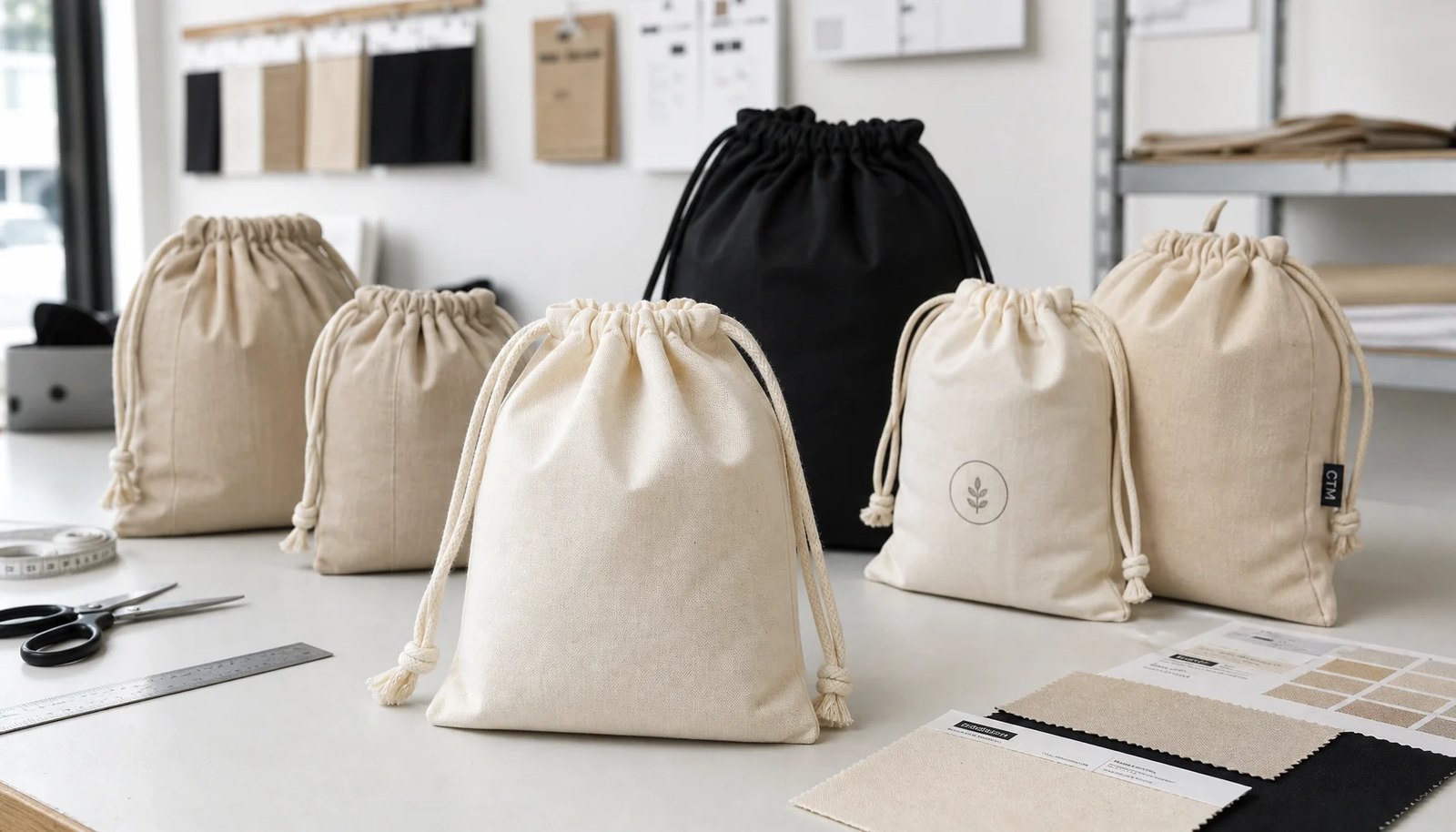
Start From the Box Calendar, Not the Pouch
A custom cotton drawstring pouch only matters if it reaches the kitting line before the box is built. The right planning sequence is not artwork first, then sourcing, then shipping. It is box ship date first, then pouch deadline, then the factory calendar, then freight mode. That order keeps procurement aligned with the real constraint, which is usually a fixed subscription drop or a retail launch window.
Work backward from the warehouse build week and set a hard latest-arrival date for the pouch at your 3PL or fulfillment center. A practical rule is to reserve 5-7 working days for sampling on simple stock-cotton orders, 15-25 working days for bulk production once the sample is approved, and then freight on top of that. If the box launch has no buffer, even a short artwork correction can turn into a missed ship date. Treat the pouch as a critical-path component, not a decorative add-on.
- Lock the box ship date before you ask for quotes.
- Reserve time for at least one sample review cycle.
- Add receiving time at the warehouse, not just transit time.
- Use a launch buffer if the pouch must arrive before a fixed campaign date.
Define the Spec Before You Ask for Price
Most quote noise comes from vague specs. If one supplier is quoting a 4 x 6 inch pouch in 120 gsm stock cotton and another is quoting a 4.5 x 6.5 inch pouch in 180 gsm dyed fabric with a woven label, the unit prices are not comparable. Lock the finished size, cutting size, seam allowance, cord channel width, cord length, fabric weight, print method, label type, and packing method before you send the RFQ.
This is especially important for subscription boxes because the pouch has to fit a defined pack-out. If the drawstring closure crowds the box lid, if the folded pouch hangs over a divider, or if the contents show through the cloth, the job fails even if the factory made the bag correctly. The useful spec is the one that tells the factory exactly what has to fit, how it has to look, and how it will be packed for the warehouse.
- State finished dimensions and cutting dimensions separately.
- Set a GSM target with a tolerance, not a vague hand-feel preference.
- Define whether the pouch must be opaque, shape-retaining, or purely protective.
- Describe the final pack-out: flat, folded, nested, or pre-filled.
Use a Real Decision Matrix for Route Selection
The table above is meant to be a decision matrix, not a list of options. A row passes only if the MOQ, lead time, and quality controls fit the program. If a route fails those checks, the answer is not to negotiate the unit price harder. The answer is to change the sourcing route or simplify the spec.
For subscription box buyers, the best route depends on launch stage. A stock-cotton pouch with one-color screen print is usually the lowest-risk route for repeat orders because the fabric is available and the branding setup is simple. A trading company can be useful when the program has many SKUs and the buyer values one point of contact over price transparency. A fully custom-dyed, woven-label pouch makes sense only when the pouch is visible enough in the box to justify the extra setup time and cost. The right decision is the one that preserves the box calendar and avoids unnecessary rework.
- Do not compare a stock-fabric quote against a dyed-fabric quote as if they are the same job.
- Treat any MOQ above your forecasted volume as a schedule risk, not just a volume problem.
- If the route adds more than 1 week without improving the user experience, question it.
- Ask which parts are in-house and which parts are outsourced before you trust the lead time.
Match Material and Construction to the Contents
Fabric weight changes more than cost. It changes sew speed, drape, opacity, shipping weight, and how the pouch feels when the customer opens the box. For light inserts, 120-140 gsm cotton is usually enough if the pouch only holds a sample card, a small accessory, or another soft item. For premium subscription boxes, 160-220 gsm is a better range when the pouch needs to keep its shape, hide the contents, or survive repeated reuse.
Construction details matter just as much as GSM. A top hem that is too loose can cause cord drag. A channel that is too narrow can twist the drawstring and slow the packing line. A stitch pattern that is too light can fail at the corners after a few opening cycles. If the pouch is reusable, ask for a pull test and a seam check that reflect actual use rather than only a visual inspection. The goal is not to overbuild the bag. The goal is to keep the construction aligned with the value of the contents and the brand standard of the box.
- Use 2.5-4 mm cotton cord for most pouches; thinner cord can feel weak, thicker cord can add friction in the channel.
- Keep the top hem and channel width consistent across sizes so the warehouse does not have to sort by feel.
- If the contents are heavy or angular, move up in GSM before you add more branding complexity.
- Ask whether the fabric is pre-shrunk or whether the final size can move after steam or moisture exposure.
Plan Lead Time by Route, Sample Cycle, and Freight Mode
The fastest way to build a schedule is to split the job into separate blocks instead of using one total lead-time number. For a direct factory order using stock cotton and one-color screen print, a realistic plan is 5-7 working days for the first sample, 3-5 working days for any revised sample, and 10-15 working days for bulk after approval. Air freight usually takes 3-7 days in transit once the cartons are ready, while sea freight often takes 20-35 days port-to-port depending on origin and destination.
If the job includes custom-dyed fabric, a woven label, or a custom cord color, add time. A common range is 7-10 working days for the first sample and 15-25 working days for bulk after approval, with an extra 7-14 days if the fabric or trim must be sourced from scratch. A trading company typically adds 2-5 working days to communication and approval loops because there is one more handoff between buyer and factory. Stock blank plus local print is the quickest route: 2-4 days for a sample if blanks are on hand, 3-6 days for printing, and 1-3 days for domestic transit. That route is useful for test runs, but only if the blank pouch already matches the target size and fabric standard.
- Use working days for factory time and calendar days for freight so the schedule is easy to audit.
- Add 3-5 working days for each true revision cycle, not just for the first sample.
- Treat custom fabric sourcing as a separate task; it can add 7-14 days before sewing starts.
- If your box date is fixed, move the freight decision earlier so the landed date is real, not assumed.
Build the Sampling Gate Before Mass Production
A sample has to prove fit, not just appearance. Approve the pouch with the actual contents, the actual box or mailer, and the final closure method in place. If the box has only a few millimeters of clearance, a photo approval is not enough. Measure the sample flat, loaded, and packed in the real insert tray so you can see whether the drawstring, folded corner, or label interferes with the kit layout.
The sample review should also catch the details that usually become production problems. Check cord length on both sides, seam straightness, label placement, print alignment, and thread color. If the supplier cannot make one clean pre-production sample, bulk output is unlikely to improve on its own. For repeat programs, keep one signed golden sample, one measurement sheet, one print reference, and one carton photo set. That archive becomes the fastest way to launch the reorder without reopening the whole spec.
- Approve a physical sample, not only photos.
- Use the final artwork file, final cord, and final packing format in the sample.
- Test the pouch inside the real box or mailer if the fit is tight.
- Mark the approved sample version so there is no confusion at bulk release.
Write the RFQ So the Factory Can Quote Cleanly
A useful RFQ removes guesswork before the supplier prices the job. Include the finished size, cut size, fabric GSM, weave, shrinkage allowance, print method, number of colors, label type, cord color, pack-out format, target ship date, and delivery terms. If the pouch has to match another branded item in the box, attach a reference image and say which attributes matter most: color match, stitch quality, opacity, or carton format.
The best RFQ also forces line-item clarity. Ask the factory to separate body fabric, sewing, print setup, labels, packing, and freight handling. That makes it easier to compare quotes and explain the delta internally. A low quote that hides setup, carton labeling, or sample charges is not a good quote. It is just a quote with missing information. For subscription-box buying, missing information is the expensive part because it turns into a schedule slip or a warehouse exception later.
- Attach a simple dimension sketch if the pouch has a tight fit requirement.
- State whether the order is a launch run, a test run, or a repeat order.
- Ask the supplier to identify every step that changes MOQ or lead time.
- Include a photo of the target box or insert if the pouch must fit a fixed pack-out.
Set QC Rules That Are Measurable, Not Generic
Generic quality language does not help procurement. What matters is a measurable acceptance standard that the factory can run against and the warehouse can verify at receiving. For subscription-box pouches, a practical baseline is AQL 2.5 for major defects and AQL 4.0 for minor defects, with a tighter major-defect target if the pouch is visible in the final unboxing. Then define the actual defect list: open seams, wrong size, print misregistration, visible stains, broken cords, mixed SKUs, and carton damage.
Size and performance checks should be written in numbers. Use a finished-size tolerance of +/-5 mm or +/-3% of the finished dimension, whichever is larger. Hold shrinkage to 3% or less if the pouch is prewashed or conditioned for testing. Keep fabric GSM within +/-5% of the approved target. For print color, set a delta E target, ideally 2.0 or better on the printed area. For seams, ask for 8-10 stitches per inch on the main joins and a simple pull test that reflects the expected use case. These limits are specific enough to prevent drift and broad enough to survive normal manufacturing variation.
- Write the AQL target into the PO or supplier agreement.
- State the exact defect types that count as rejectable.
- Use a pull test that matches the load the pouch will actually carry.
- Keep one in-house golden sample and one approved inspection photo set.
Plan Packing and Receiving So the Warehouse Does Not Rework the Order
Packing is part of the product, not an afterthought. If the pouch will be counted, kitted, and inserted into monthly subscription boxes, it should arrive in a format that the warehouse can handle without resorting or repacking. Flat-packed by SKU and size is usually the cleanest method because it reduces cubic volume and keeps the receiving team from sorting mixed bundles by hand. Inner packs should be consistent enough that the team can scan and count without opening every carton.
Ask for a carton plan before bulk ships. That plan should show inner-pack quantity, outer-carton quantity, carton dimensions, gross weight, carton numbering, SKU identification, and barcode placement. If the shipment will travel by sea or sit in storage, ask for moisture protection appropriate to the fabric and climate. Even undyed cotton can pick up odor, scuffing, or wrinkling if the cartons are weak or packed too tightly. When receiving is planned well, the pouch enters the kitting line as a known unit instead of becoming a manual sorting job.
- Use separate carton marks for each subscription SKU or variant.
- Write the inner-pack count into the packing instruction.
- Require carton photos before shipment so receiving can prepare.
- Specify whether the warehouse needs flat, nested, bundled, or individually bagged units.
Compare Quotes on Landed Cost and Reorder Value, Not Unit Price
Unit price is useful only after the spec is fixed. A pouch that costs less per piece but arrives late, ships in mixed cartons, or needs manual re-sorting is not actually cheaper. Compare quotes on landed cost: production, setup, packing, testing, freight, duties, and the internal time needed to receive and kit the order. If one supplier includes carton labeling, photos, and QC reports while another does not, the headline price alone will mislead you.
A practical way to compare offers is to look at cost deltas by feature. One-color screen print often adds a small setup cost and very little unit premium on moderate volume. A woven label or custom dye usually adds 8%-20% depending on order size and origin. Rush air freight can add 15%-40% to landed cost, which may still be worth it if the box calendar is fixed. The best quote is not the cheapest line item. It is the one that gets the correct pouch into the correct carton before the warehouse needs it and gives you a clean file to reorder from next cycle.
- Compare quotes only after the size, GSM, and branding method are identical.
- Separate production cost from freight and import charges.
- Flag any quote that omits setup, sample, packing labor, or carton labeling.
- Keep the approved spec, golden sample photos, and carton template for the reorder file.
Specification comparison for buyers
| Spec decision | Recommended option | When it fits | Buyer risk to check |
|---|---|---|---|
| Direct factory, stock cotton, one-color screen print | MOQ 1,000-3,000 pcs; sample in 5-7 working days; bulk in 10-15 working days after approval; lowest setup cost but still requires a clean spec | Repeat monthly boxes with simple artwork and a stable size | Pass only if the factory can confirm fabric reserve, a written size tolerance of +/-5 mm, and a production schedule with named milestones |
| Direct factory, custom-dyed fabric plus woven label | MOQ 3,000-5,000 pcs; sample in 7-10 working days; bulk in 15-25 working days after approval; cost usually runs 10%-20% above a stock-cotton build | Premium subscription programs where the pouch is part of the brand presentation | Fail if the supplier cannot show dye reference control, label placement control, and a clear answer on whether the dye lot is reserved before artwork approval |
| Trading company managing production | MOQ often 2,000-5,000 pcs; add 2-5 working days to quote and approval cycles; unit cost can be 5%-12% higher than a direct factory on the same spec | Multi-SKU launches where one contact is worth the markup | Pass only if the quote identifies the actual sewing factory, who owns QC, and who is responsible for rework if the bulk run drifts from the sample |
| Stock blank pouch plus local print | MOQ can be as low as 250-1,000 pcs; first samples in 2-4 days; total turnaround often 1-2 weeks if blanks are in stock; print adds 5%-10% to unit cost versus blank | Test launches, short promotions, or urgent restocks | Fail if the blank shade, fabric weight, or finished size does not match the subscription box standard |
| 120-140 gsm cotton body | Usually the cheapest cloth option; faster sewing; can hold lead time down when stock fabric is available | Light inserts, sample kits, or low-cost gift pouches | Fail if the contents show through, the pouch collapses in transit, or the customer can feel the box product through the fabric |
| 180-220 gsm cotton body | Typically adds 8%-18% to fabric cost and may add 1-3 days to sewing time | Retail-grade inserts, heavier products, or reusable pouches | Pass only if the supplier can still meet the finished size and pull-test requirement without over-tightening the seams |
| One-color screen print | Lowest cost branding method; adds little lead time after screens are made; best for repeat orders | Simple logos, short copy, and stable color targets | Pass if the supplier confirms screen count, print area, and delta E target before bulk starts |
| Woven side label or sewn patch | Usually adds 8%-15% to unit cost and 3-7 working days to sourcing or sewing | Premium branding where you want durability and a cleaner hand feel | Fail if the label size, stitch type, or placement is not frozen in the approved sample |
| Flat-packed by SKU and size | Often the best choice for fulfillment; can reduce warehouse handling errors and carton volume | Subscription programs that build boxes by theme or month | Pass only if the carton marks, inner-pack count, and barcode format are written into the packing instruction |
Buyer checklist before sampling
- Finished size, cut size, seam allowance, and cord channel width are fixed before RFQ comparison.
- Fabric GSM target, shrinkage tolerance, and acceptable weave range are written in the spec.
- Artwork is locked with print method, Pantone reference, placement, and the maximum number of colors.
- MOQ is confirmed separately for color, artwork version, label type, and any custom cord.
- The sample plan names the owner, the number of revision cycles allowed, and the deadline for each.
- A golden sample will be signed, photographed, and retained before bulk release.
- Lead time is split into fabric booking, sample, bulk sewing, inspection, freight, and receiving.
- The PO or supplier agreement includes AQL, size tolerance, shrinkage limit, and color variance limits.
- Carton quantity, inner-pack count, barcode format, and SKU segregation are defined for the warehouse.
- A buffer is built for freight delay, rework, and box-line changes before the launch date.
Factory quote questions to send
- Is your quote based on finished size or cutting size, and what tolerance do you allow on each dimension?
- What fabric weight, weave, finish, and shrinkage allowance are included in the price?
- What is the MOQ per color, per artwork version, and per label type?
- How many days do you need for the first sample, a revised sample, and the pre-production sample?
- Does the price include cord, label, hangtag, polybag, carton labeling, and inner-pack labor, or are those separate?
- What is the standard production lead time after sample approval and deposit, and which calendar week will the order start?
- Which QC standard do you use, what is your AQL target, and can you share a checklist or inspection report template?
- How are cartons packed, labeled, and palletized for subscription fulfillment, and what are the master carton dimensions?
- What extra charges apply for rush orders, split shipments, multiple delivery addresses, or artwork corrections after approval?
- If the bulk run differs from the sample, who pays for rework, replacement units, or reinspection?
Quality-control points to confirm
- Use AQL 2.5 for major defects and 4.0 for minor defects as a practical baseline for subscription-box pouches; tighten major defects to 1.5 for premium launches if the pouch is visible in the final unboxing.
- Measure finished size on a random sample and keep tolerance within +/-5 mm or +/-3% of finished size, whichever is larger.
- Set shrinkage tolerance at 3% or less after conditioning or any prewash test you require for your program.
- Require fabric GSM to stay within +/-5% of the approved spec so the hand feel does not drift between lots.
- Define a stitch density target of 8-10 stitches per inch on the main seams and reject skipped stitches, loose threads at stress points, or open seam starts.
- Test cord-channel and top-seam pull strength with a simple load test, such as 3 kg for 10 seconds on light pouches and 5 kg for heavier pack-outs, or your internal benchmark.
- Agree on a color variance limit before production, ideally delta E 2.0 or better against the approved swatch for printed areas.
- Check print placement, edge sharpness, and registration against the approved sample; misaligned logos are a common cause of avoidable rejects.
- Inspect for odor, oil spots, stains, broken needles, torn weave, and mixed SKU cartons before the shipment leaves the factory.
- Confirm that carton labels, carton counts, and barcode scans match the packing list so the warehouse does not have to re-sort inbound stock.