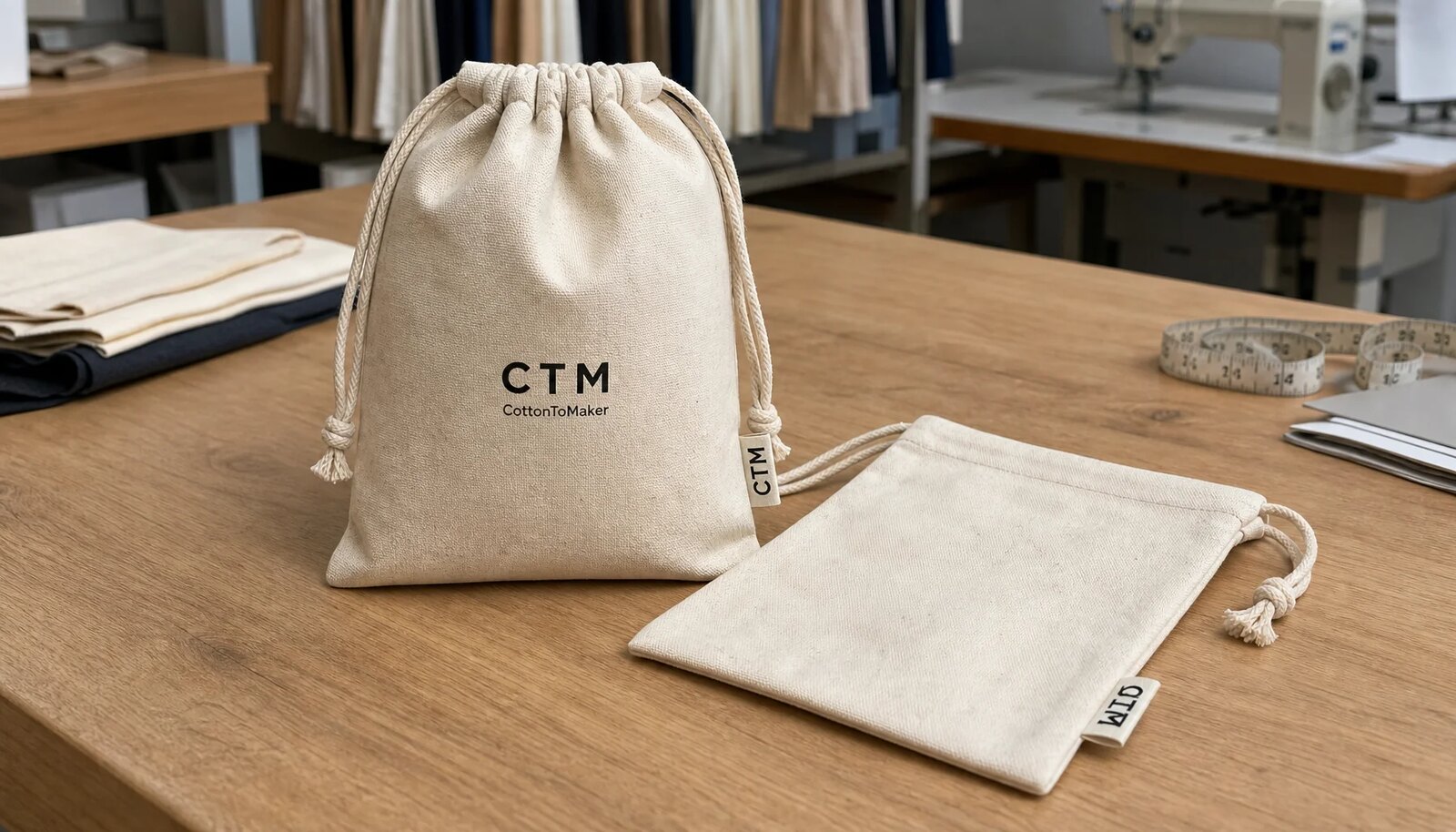
Plan Backward From the Hotel Retail Date
For hotel retail programs, the safest way to plan custom cotton drawstring pouches is to start from the launch date and work backward. Buyers often ask for lead times as if the factory controls the whole schedule, but the clock really starts when the specification is frozen. Until the pouch size, fabric, decoration, packing, payment terms, and destination are agreed, the factory is still quoting a concept rather than a production order.
A practical schedule for a standard custom pouch program often lands in the 45-60 day range from final approval to ex-factory readiness, but that number only describes the manufacturing lane. A real project also needs time for sampling, inspection, export booking, transit, customs, local distribution, and internal hotel merchandising. If the product launch date is fixed, reverse-plan every step and place buffer where the project has the most uncertainty, not where it is easiest to overlook.
- Treat the approved sample date as the real production start.
- Separate sample time, bulk time, and freight time in the RFQ.
- Add extra buffer before holiday closures, trade shows, and hotel opening dates.
- Do not assume the quote date equals the start date for cutting or printing.
What Actually Moves Lead Time
Lead time is not one number. It is the sum of several decisions that can each add or remove days. Fabric availability, whether the fabric must be dyed, the decoration method, the number of variants, the packing format, and the freight mode all change the timeline. If buyers only ask, "How long will it take?" they usually get a vague answer that is too optimistic to be useful.
For procurement teams, the goal is not just speed. It is schedule control. A supplier can often accelerate one part of the process, but the project only stays on track when the buyer knows which choices are fast, which choices need approval, and which choices create hidden delay. This is why the same cotton pouch can be a 3-week project for one order and a 10-week project for another, even when the quantity looks similar on paper.
- Stock natural fabric is generally faster than custom-dyed fabric.
- Simple one-color screen print is usually faster than embroidery or complex multicolor decoration.
- Retail-ready packing adds labor and review steps that bulk packing avoids.
- Multiple artwork versions or sizes often slow production more than buyers expect.
Choose the Right Fabric Spec for the Job
Cotton drawstring pouches used in hotel retail usually sit in a narrow but important band between appearance and efficiency. Lightweight fabric can reduce cost, yet it may look thin, crease heavily, or show the insert through the material. Heavy fabric gives a more premium feel, but it can raise material cost, increase freight volume, and create unnecessary stiffness for small amenities or gift cards. For many programs, 6 oz to 8 oz cotton, or roughly 200-270 GSM, is the practical middle ground.
The exact spec should match the product inside the pouch. A soap bar, a small candle, or a jewelry piece can live happily in a soft pouch. A bottle, ceramic item, or multi-item set needs more structure. If the buyer does not share the insert dimensions and weight, the factory is forced to guess, which usually produces either an overbuilt pouch or a costly redesign later. Natural cotton also deserves a clear decision: many hotel brands like the organic look of flecks and slubs, but if brand consistency matters more than the natural finish, bleached or dyed fabric may be worth the extra time.
- Quote fabric in GSM or oz, not only in marketing language like medium or premium cotton.
- State whether natural flecks, slubs, and minor shade differences are acceptable.
- Choose stock fabric when the date is tight and the brand color is not critical.
- Ask for a swatch from the same fabric source that will be used in bulk.
Decoration Method Changes More Than Just the Look
Decoration is one of the most underestimated lead-time drivers. Screen printing is usually the most efficient option for simple hotel logos, icons, and short text because setup is straightforward and the result is durable on cotton when the ink load is controlled. That said, print near seams or near the drawstring channel can distort, so the artwork placement must be reviewed against the finished pouch structure rather than just against the flat artwork file.
Embroidery creates a more tactile finish and can work well for some premium hotel or resort brands, but it adds digitizing time, machine time, and a higher risk of puckering on light fabric. Heat transfer can handle complex artwork or gradients, but it changes the feel of the pouch and may not fit the natural look many cotton programs want. The right choice is not the fanciest method. It is the one that matches the brand, the lead time, and the expected wear of the pouch in the field.
- Lock decoration method before the final quote if you want a reliable schedule.
- Use vector files for print and embroidery wherever possible.
- Keep artwork away from high-stress seams and the drawstring channel.
- Approve a physical strike-off when color matching or ink texture matters.
Use MOQ Strategy to Reduce Cost and Delay
MOQ is not only a factory number. It is the point where the supplier can source fabric efficiently, set up printing without wasting time, and keep the line running without frequent changeovers. A total order can look large but still behave like a small order if it is split across many sizes, cord colors, print versions, or retail pack formats. Every extra variant creates a separate planning queue and usually a separate QC burden.
The practical procurement move is to simplify. When hotel properties need localized branding, it is often cheaper and faster to keep the pouch body common and change only the label, belly band, or insert card. If multiple room categories or stores need different pouch sizes, ask whether the internal product assortment can be standardized around one or two dimensions. Fewer variants generally mean lower risk, less carton complexity, and less rework when the launch date is close.
- List quantity by variant, not just total units.
- Ask which changes trigger a separate MOQ: size, fabric color, cord color, or artwork.
- Standardize pouch dimensions across product lines when possible.
- Compare setup cost and process cost, not unit price alone.
Build a Sample Path That Tests Fit, Not Just Appearance
A good sample process is short but disciplined. Start with a plain size sample when the fit is unproven, then move to a decorated pre-production sample once the size and closure are confirmed. If the pouch is already a known size, a decorated sample may be enough. The key is to approve the right stage of the product, because each extra round of sampling adds time and can create false confidence if the buyer only reviews a digital image.
The sample should be tested in the same way the final pouch will be used. Insert the real product, close the cord fully, check the print at retail distance, and inspect the pouch after folding. This catches the issues that matter most: whether the item fits, whether the closure still works, whether the artwork distorts, and whether the pouch looks right when handled by hotel retail staff or end customers. A sample that only looks good empty is not a usable approval reference.
- Approve finished dimensions, not cut dimensions.
- Test with the actual insert and any retail label or tag that will ship with the pouch.
- Keep one approved physical sample as the production reference.
- Do not start bulk cutting from a digital mockup alone.
Break the Schedule Into Production Blocks
When a factory quotes a lead time, ask them to break it into blocks. This is where the real schedule becomes visible. A typical project may involve fabric confirmation, printing or embroidery setup, cutting, sewing, finishing, packing, inspection, and dispatch. If custom dyeing is required, add lab dip approval and possible shade correction before cutting begins. If the buyer wants retail-ready packing, add labeling, folding, or sleeve application time after sewing.
This breakdown matters because it shows where the schedule can be compressed and where it cannot. Sewing is often not the bottleneck. Waiting for artwork approval, fabric confirmation, or packing instructions is usually what pushes the date out. Buyers who see the lead time only as a single calendar number cannot tell whether a delay is caused by fabric sourcing, decoration, or their own internal review process. A factory that can explain the schedule in blocks is usually easier to manage than one that only promises a date.
- Ask for days by stage: material, decoration, sewing, packing, inspection, and dispatch.
- Distinguish between stock fabric and custom-dyed fabric in the timeline.
- Confirm whether sample approval is required before material cutting.
- Use the block breakdown to identify where acceleration is realistic and where it is not.
Packing Can Add Real Cost and Real Days
Packing is often the hidden driver in hotel retail orders. Bulk pack is efficient if the pouches will be re-kitted on arrival or used by an operations team behind the scenes. Retail-ready packouts, by contrast, can include polybags, sleeves, belly bands, hangtags, barcode stickers, or carton labeling, and each of those steps adds labor and inspection. If one supplier quotes bulk and another quotes finished retail packing, the price comparison is not meaningful until the packing scope is normalized.
The buyer should also think beyond unit price and into logistics. Different pack formats change carton count, carton dimensions, gross weight, and pallet utilization. That affects freight and warehouse handling. If moisture protection is needed for a humid shipping lane, say so before award rather than after the cartons are packed. Small details like fold direction or label placement can create avoidable rework if they are not written into the approved specification.
- State whether the pouch ships flat, folded, labeled, or individually packed.
- Confirm barcode placement, hangtag requirements, and carton marks before production starts.
- Check how packing changes carton volume and freight cost.
- Add moisture protection if the route is long or humid.
Plan Freight as Part of the Lead Time, Not After It
For hotel retail launches, freight should be planned alongside production, not after goods are finished. Ocean freight is usually the right economics for standard replenishment and planned rollouts, but it needs more calendar time and more coordination with export booking and local receiving. Air freight can rescue a launch date or cover a small urgent replenishment, but it does not remove production lead time and it can erase the cost advantage of the pouch program.
This is why buyers should always ask for the ready date and the delivery date separately. A factory can have cartons ready while the shipment still misses the launch because the freight booking, inspection, export paperwork, or local delivery is not arranged in time. If the hotel or distributor has a non-negotiable opening date, the procurement team should decide early whether to reduce variants, use stock fabric, simplify packout, or split the order into urgent and replenishment shipments.
- Get ex-factory ready date and destination arrival date as separate milestones.
- Use ocean freight for standard programs when the launch buffer allows it.
- Use air freight only when the schedule value is higher than the freight premium.
- Book inspection and pickup before the packed goods are sitting idle.
Compare Quotes as Total Landed Cost
A useful quote is specific enough to compare. It should show fabric weight, pouch size, print method, packing format, MOQ, sample cost, setup charges, payment terms, Incoterm, port, and estimated ready date. If two quotes differ in GSM, decoration method, or packing scope, they are not the same product. The buyer should normalize the specification before negotiating, otherwise the lowest quote may simply be the least complete one.
Procurement teams for hotel retail often need more than a unit price. They need predictability. A quote that omits screen charges, artwork adjustments, barcode labeling, or carton marks can create margin loss later. The goal is to compare landed cost and schedule risk, not just ex-works price. The best supplier is not always the cheapest. It is the supplier whose quote actually matches the order you intend to place.
- Normalize quotes to the same GSM, decoration, and packing standard.
- Compare FOB or EXW separately from freight, duty, and local delivery.
- Ask whether the quote includes setup, labels, and carton marks.
- Watch for low prices that quietly reduce fabric weight or cord quality.
Specification comparison for buyers
| Spec decision | Recommended option | Supplier cost drivers | Timing impact | Buyer risk to check |
|---|---|---|---|---|
| Fabric weight for hotel retail display | 6 oz to 8 oz cotton, roughly 200-270 GSM, with a pre-production swatch approved against the real insert | Higher GSM increases fabric cost, cutting resistance, and freight volume; lighter fabric can reduce cost but may require tighter QC on transparency and seam strength | Stock greige cotton is usually faster; custom dyeing or fabric sourcing adds days or weeks before cutting starts | Thin fabric may look acceptable empty but fail once the pouch is packed; confirm the actual inserted product fits and the closure still closes cleanly |
| Pouch construction | Flat pouch with double-fold top channel, reinforced side seams, and a seam allowance that matches the insert weight | More seam reinforcement and tighter stitch density increase labor time; larger sizes consume more fabric and carton space | Simple flat construction is fastest; gusseted or boxed-bottom builds add pattern, stitching, and inspection time | Weak channel stitching can tear when cords are pulled repeatedly; ask for stitch density, seam allowance, and a sewn sample photo |
| Drawstring material | Cotton cord matched to the pouch body, typically 3-5 mm diameter depending on size and product weight | Natural cotton cord costs more than generic synthetic cord, but it aligns better with hotel retail positioning; dyed cords add color-matching work | Stock cord color is fast; custom cord color or custom tipping adds sourcing and approval time | Cord shrinkage, twist, and surface finish can differ from the fabric; approve fabric and cord together, not separately |
| Logo decoration | Screen print for solid logos; embroidery only when the premium look justifies added cost and time; heat transfer only for special artwork | Screen print setup and color separations are usually cheaper and faster; embroidery increases machine time and may require digitizing; heat transfer may add material and finishing cost | Simple one-color screen print is usually the fastest decorated option; embroidery and multicolor work extend sample and bulk lead time | Heavy ink can stiffen lightweight cotton, while embroidery can pucker thin fabric; check the approved physical sample under real packing conditions |
| Packing format | Bulk pack for back-of-house kitting, or individual paper belly band / recyclable sleeve / labeled polybag for retail display | Individual packing adds labor, inserts, label application, and carton volume; barcode and retail label work also increase handling cost | Bulk-packed pouches are fastest; retail-ready packouts add one to several production days depending on count and labeling complexity | Comparing unit prices without the same packing spec creates false savings; confirm cartons, inner packs, labels, and barcode placement before award |
| MOQ strategy | Consolidate sizes, fabrics, and artwork versions whenever possible; plan 1,000-3,000 pieces per size/color/artwork as an efficiency starting point | Every split in size, color, or artwork creates separate setup work, screens, QC checks, and packing lines | A single size and print version is usually quickest; multiple variants can extend production because the factory has to batch and reset | A large total order can still behave like a small order if it is split too many ways; list quantities by variant so the factory can quote honestly |
| Sampling route | Plain size sample first if fit is unproven, then printed pre-production sample on confirmed fabric and cord | Plain samples are inexpensive; repeated color strike-offs, revised artwork, or new dies/tooling raise sample cost and add labor | One clean approval cycle is fastest; multiple sample rounds can push bulk production back by one to two weeks or more | Approving only a digital mockup misses closure behavior, print distortion near seams, and how the pouch looks when packed |
| Fabric availability | Use stock natural or stock-dyed fabric whenever the schedule is tight; reserve custom dye for projects with real buffer | Stock fabric minimizes sourcing risk and keeps the line moving; custom dye adds lab dips, shade approval, and potential rework if the color misses target | Stock fabric usually shortens the front end; custom dye often becomes the single largest schedule risk before sewing begins | Ask whether the supplier already has the exact fabric in-house or must buy it after PO; that difference changes the real start date |
| Freight mode | Ocean freight for standard programs, air freight only for urgent launch recovery or small replenishment runs | Air freight is materially more expensive; ocean freight adds transit time but usually protects unit economics better | Ocean freight adds transit time after ex-factory; air freight shortens transit but does not eliminate production lead time | Do not confuse production ready date with delivery date; book inspection, pickup, export paperwork, and local distribution in the schedule |
Buyer checklist before sampling
- Define the pouch use case first: retail sale, amenity kit, gift-with-purchase, spa packaging, in-room merchandising, or back-of-house kitting.
- State finished dimensions in width by height, and note whether the insert must fit while the drawstring is fully closed.
- Specify the product that will go inside the pouch, including approximate weight, shape, and any sharp edges or protrusions.
- Choose fabric weight in GSM or oz, and state whether natural flecks, slubs, or slight shade variation are acceptable.
- List fabric color, cord color, print color, logo position, maximum print size, and any required Pantone references.
- Provide artwork in vector format when possible, and identify which elements are non-negotiable for brand approval.
- Break quantity down by size, color, cord, artwork version, and packing type instead of giving only one total quantity.
- Ask for a plain sample and a decorated pre-production sample if fit and print both matter.
- Specify packing requirements: bulk, folded retail-ready, individual sleeve, belly band, barcode sticker, hangtag, or polybag.
- Confirm carton quantity, carton dimensions, gross weight target, pallet requirements, and moisture protection if needed.
Factory quote questions to send
- Is the quoted fabric already in stock, or do you need to source it after order confirmation?
- What is the fabric weight in GSM or oz, and what tolerance do you allow in bulk production?
- Does the price assume natural cotton, bleached cotton, dyed cotton, or custom-dyed cotton?
- What MOQ applies per size, per fabric color, per drawstring color, and per artwork version?
- Which decoration method do you recommend for our logo, and what setup or digitizing charges apply?
- How many days are required for a plain sample, a printed sample, and bulk production after written approval?
- Will you provide a production reference sample or sealed sample that the bulk run must match?
- What is included in the quoted packing: inner pack, labeling, barcode application, folding, and carton marks?
- What are the carton size, units per carton, gross weight, and estimated carton volume for shipping planning?
- What QC checks are done before shipment, and can you share sample photos of fabric, print, seams, and packed cartons?
Quality-control points to confirm
- Define finished size tolerance before production, typically plus or minus 5 mm for small pouches and plus or minus 10 mm for larger pouches.
- Check fabric weight against the approved swatch and the production roll record, especially when substitutions happen due to availability.
- Compare print color to an approved physical sample or Pantone reference under consistent lighting, not only through phone photos.
- Check print placement against the center line and seam clearance so the logo does not drift into the drawstring channel.
- Confirm the print does not crack, flake, or feel excessively stiff after the pouch is folded and reopened several times.
- Test drawstring movement for smooth pull, even closure, and no blocked channels, loose ends, or fraying at the exits.
- Inspect side seams, bottom seams, and channel stitching for backtacks, skipped stitches, and open corners.
- Reject oil marks, mildew smell, visible contamination, needle damage, heavy wrinkles, and loose threads beyond agreed tolerance.
- Verify that folding, bundling, stickers, belly bands, or polybags match the approved packing instructions exactly.
- Check carton count, carton marks, and gross weight before shipment, and confirm moisture protection if the route is humid or long transit is expected.