Plan From the Warehouse Date, Not the Fair Date
For custom cotton drawstring pouches used at craft fairs, timing is often the first real sourcing risk. Unit price matters, of course. But a pouch that arrives after the event has almost no commercial value, even if the quote looked excellent. Start with the required warehouse arrival date, then work backward through buyer-side receiving, counting, filling, labeling, vendor sorting, domestic delivery, customs clearance, international transit, export booking, final inspection, print curing, sewing, cutting, fabric confirmation, sample approval, and artwork approval.
Many delays begin with one vague question: “Can you deliver before the craft fair?” That sounds reasonable, but it hides too much. If the fair opens on Friday, a Thursday warehouse delivery may already be late. The pouches may still need to be opened, counted, filled with soap, jewelry, candles, tea, stationery, ornaments, accessories, or vendor welcome kits, then labeled and sorted by booth. If cartons are short, mislabeled, or mixed by design, the buyer needs time to fix the problem before the event floor opens.
A better RFQ gives the supplier four dates: craft fair opening date, internal kit completion date, required warehouse arrival date, and latest commercially useful delivery date. This gives the factory and forwarder a real deadline, not just a marketing date. It also keeps internal teams honest about the calendar. A quoted production lead time is only one section of the schedule. It normally does not include buyer artwork delays, sample courier time, inspection scheduling, customs clearance, or local trucking.
- Use the required warehouse arrival date as the planning anchor, not the public event date.
- Reserve buyer-side time for receiving, counting, filling, labeling, vendor sorting, and issue resolution.
- Ask the factory to state exactly when lead time starts and which approvals must be complete.
- Add separate buffers for sampling, inspection, export booking, transit, customs, and domestic delivery.
- Treat air freight as a contingency cost for fixed events, not as a substitute for late approvals.
Build a Lead Time Model You Can Actually Manage
A useful lead time plan separates the work into approval time, production time, inspection time, and logistics time. For a straightforward order using stock natural cotton, one simple logo, bulk packing, and no resampling, sampling may take about 5-10 working days after artwork and payment are complete. Mass production might be quoted around 15-30 working days depending on quantity, factory load, print method, material status, and packing complexity. These are planning ranges, not promises. Each supplier should confirm its own schedule in writing.
The calendar stretches quickly when the order is less standard. Multiple designs require artwork control, screen or print file management, and SKU separation. Dyed fabric may add time if the shade is not in stock. Retail packing, barcode labels, hangtags, or vendor-specific bundles add handling time at the end of production, when the schedule is usually tightest. Small pouches can also be slower to sew when the buyer specifies thick fabric, bulky seams, or a cord channel that leaves little room for smooth closure.
Approval gates keep the project from drifting. Artwork should be locked before sampling. Fabric GSM, fabric color, cord, size, and print location should be approved before mass production. Packing marks and carton labels should be approved before the factory reaches the packing stage. Final inspection should be booked before the goods are already at the shipping deadline. If the buyer changes pouch size, GSM, cord, artwork, print method, or packing after sample approval, part of the schedule may reset.
- Artwork and spec confirmation: allow time for file cleanup, PMS review, print size approval, and missing detail correction.
- Sampling: include sample making, courier transit, buyer review, comment consolidation, and possible resampling.
- Production: count from final approval and material readiness, not from the first inquiry or preliminary quote.
- Inspection: reserve time for booking, factory access, report review, and rework if major defects are found.
- Shipping: include export documents, freight booking, customs clearance, local delivery, and buyer receiving.
Specify the Pouch Around the Product
A drawstring pouch should be designed around the item it must hold, not around a generic catalog size. Cotton has limited stretch. Usable capacity is reduced by side seams, the bottom seam, drawcord channel height, fabric thickness, and the space needed for the top to gather cleanly. A soap bar, candle tin, jewelry card, ornament, cosmetic jar, or small apparel accessory may fit inside the flat dimensions but still look crowded once the cord is pulled.
Send the product dimensions, product weight, product shape, and product photos with the RFQ. Rigid corners push into seams and reduce the clean front area available for printing. Fragrant or oily products can transfer odor or marks to natural cotton. Dark products may show through lighter fabric. If the pouch will be displayed filled at the booth, the logo needs to remain visible after the pouch is gathered. If the pouch will be handed out flat, the buyer may care more about flat presentation, low carton volume, and easy counting.
Use finished dimensions, not cutting dimensions. The RFQ should state width by height measured flat after sewing, whether the measurement includes the drawcord channel, and how much top clearance is needed above the product. For tight packaging, request a filled sample photo or a full pre-production sample. A small size adjustment made before bulk production can prevent a shipment of pouches that technically meet the drawing but fail in real booth use.
- State finished flat size as width by height after sewing, with measurement points clearly defined.
- Confirm drawcord channel height and required clearance above the filled product.
- Provide product dimensions, weight, photos, and risk notes for sharp, oily, fragrant, rigid, or dark items.
- Keep logo artwork away from seams, bottom corners, the channel, and areas that wrinkle when filled.
- Request a filled sample or fit photo for bulky, heavy, fragile, or presentation-critical products.
Choose Cotton GSM With Use and Landed Cost in Mind
Cotton pouch fabric is often discussed by GSM, but GSM alone does not define quality. Weave, yarn count, finishing, natural shade, and shrinkage behavior can make two fabrics with the same GSM feel different in the hand. Still, GSM is a practical procurement control because it affects opacity, softness, durability, carton weight, packed volume, sewing behavior, and landed cost.
For economical craft fair packaging, 100-120 GSM cotton can work for very light goods, sachets, tea samples, small flat jewelry, or short-term giveaway use. It packs compactly and can reduce freight weight. The tradeoff is that dark contents may show through, wrinkles may be more visible, and the pouch may feel less premium. For many B2B buyers, 120-140 GSM plain cotton is the safer middle ground. It suits many soap bars, stationery items, small accessories, and general branded craft fair pouches where both cost and presentation matter.
For reusable positioning or premium handmade goods, 160-180 GSM cotton or light canvas gives stronger handfeel and better opacity. It can support gift sets, cosmetics, small apparel accessories, and products where the pouch is part of the perceived value. The tradeoff is higher fabric cost, higher carton gross weight, greater packed volume, and possible sewing bulk on small pouches. Compare landed cost using carton data, not only FOB unit price.
- 100-120 GSM: economical, compact, and suitable for lightweight or short-term use.
- 120-140 GSM: balanced choice for many branded craft fair pouches and small retail goods.
- 160-180 GSM: stronger handfeel and opacity for reusable or premium presentation.
- Above 180 GSM: usually better for larger pouches, heavier contents, or higher-value gift packaging.
- Approve a physical swatch and test opacity, wrinkle, and handfeel with the actual product.
Control Artwork, Print Method, and Placement
Screen printing is usually the practical choice for one to three solid logo colors, simple text, sponsor marks, and repeat orders. It can give reliable coverage on cotton when artwork, ink color, curing, and placement are controlled. Provide vector artwork, outlined fonts, PMS references, print size, print location, orientation, and safe distance from seams. PMS matching on natural or unbleached cotton should be treated as approximate because the fabric base color and texture influence the final result.
Digital printing and heat transfer can be useful for gradients, detailed seasonal artwork, multicolor illustrations, or low-volume vendor-specific designs. These methods may reduce some setup constraints, but they introduce other checks. Heat transfer can have a visible edge or a different handfeel. Digital print color may shift on natural cotton. Fine lines, small type, and heavy ink coverage need proofing before mass production. Choose the print method after artwork review, not from the pouch name alone.
Print placement needs numbers. Small pouches make small shifts visible, especially when a logo is centered. The RFQ should state print width and height, distance from top edge, distance from side edge, and whether the position is measured from the pouch edge, seam line, or center point. For small pouches, a print position tolerance of +/-0.3-0.5 cm may be a reasonable target if the factory confirms it can hold that control. Approve a strike-off or pre-production sample with a ruler in the reference photo.
- Use vector artwork for screen print, with fonts outlined and final print size stated in centimeters or millimeters.
- Accept realistic color tolerance on natural cotton unless a lab-dip or approved strike-off is used as the standard.
- Confirm minimum line thickness, small text risk, maximum print area, curing time, and expected handfeel.
- Define print placement from fixed reference points and agree the tolerance before production.
- Do not approve production until the artwork, print method, ink color, print size, and location are closed.
Clarify MOQ, SKU Splits, and Price Breaks
MOQ is a production planning issue, not just a sales rule. A factory’s MOQ can reflect fabric purchasing, cutting efficiency, sewing setup, print screens, artwork proofing, packing separation, and inspection workload. A supplier may accept 1,000 pieces for one natural cotton pouch with one logo, then quote differently if the same 1,000 pieces are split across five designs, two sizes, and individual barcode packing.
Craft fair orders often include multiple vendor logos, sponsor marks, product categories, seasonal graphics, or booth kits. Ask whether the factory can group the order under one base pouch size, one fabric color, and one GSM while charging separate setup fees by artwork. That structure may reduce fabric MOQ pressure while still recognizing the real cost of each design. It also helps procurement decide whether some designs should be consolidated to protect schedule and budget.
A SKU table is the cleanest RFQ format. Each line should list size, GSM, fabric color, cord type, artwork name, number of print colors, print method, quantity, packing method, inner bundle requirement, carton mark, and destination. This stops the supplier from assuming all units can be mixed freely. It also creates a better basis for inspection, warehouse receiving, and vendor sorting before the fair.
- Ask whether MOQ applies per total order, size, fabric color, GSM, artwork, or packing style.
- Expect separate screen or setup charges for each artwork, color set, and print size change.
- Use one shared blank pouch spec when multiple craft fair vendors can accept the same construction.
- Request price breaks by total quantity and by design split so tradeoffs are visible.
- Keep SKU codes consistent across PO, artwork files, packing list, carton marks, and inspection report.
Use Samples as a Technical Approval Gate
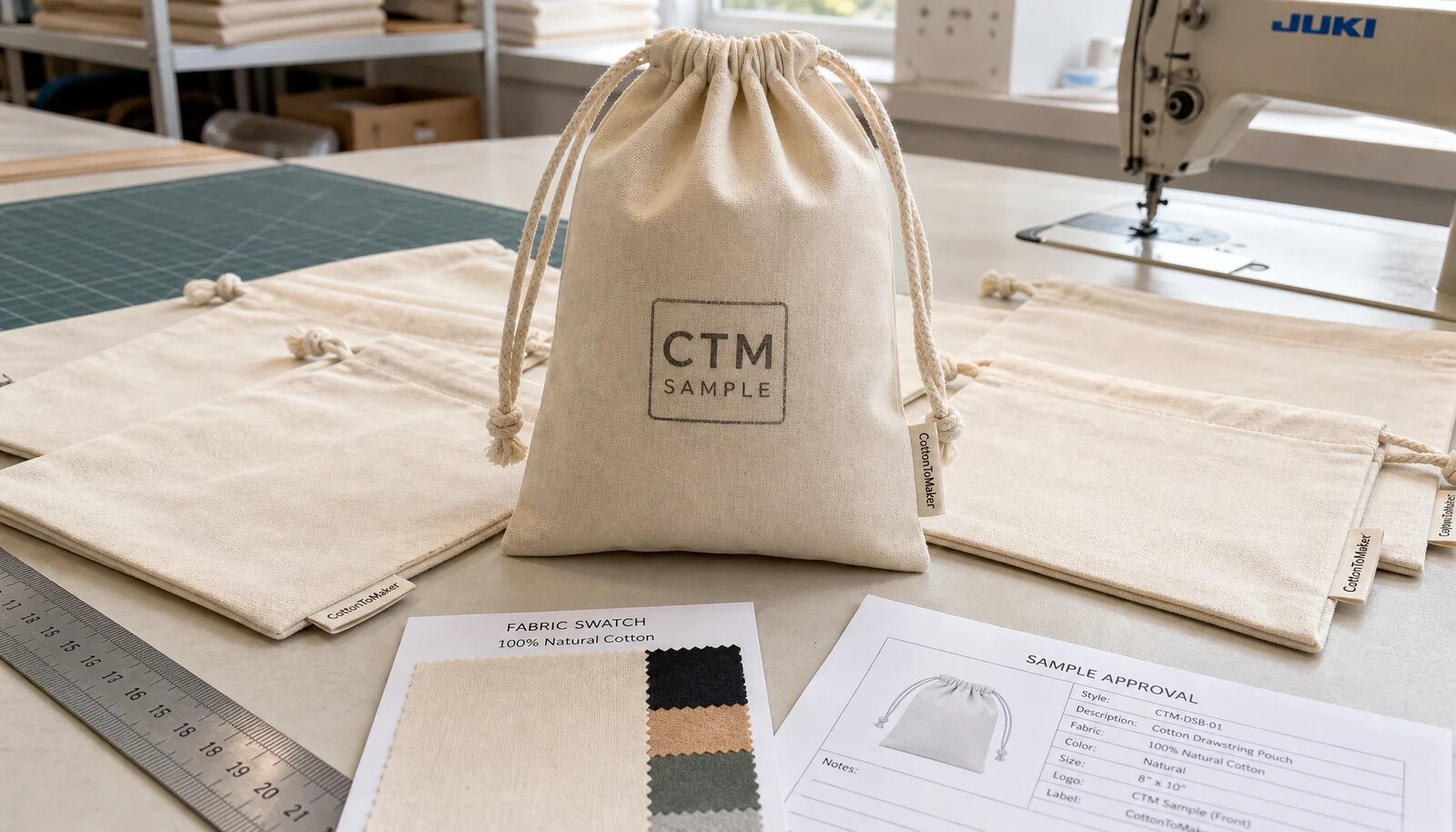
Sampling should remove production ambiguity, not simply produce a nice photo. For repeat orders with stable specifications, a fabric swatch and print strike-off may be enough. For first orders, tight fit, premium presentation, detailed artwork, multiple designs, or strict event deadlines, a full pre-production sample is usually safer. The sample should show actual or approved-equivalent fabric, GSM, finished size, seam construction, cord material, cord diameter, print method, print position, and closure appearance.
Sample approval should be written and measurable. Instead of saying the sample “looks good,” record the approved size, acceptable tolerance, print dimensions, print location, fabric swatch reference, cord details, and packing expectation. If the logo is 0.8 cm too high, the cord is thinner than expected, or the top clearance is tight, write that down before approval. Production teams need repeatable criteria, not subjective reactions.
Test the sample the way it will be used at the fair. Fill it with the real product, close and open it repeatedly, place it in the display tray, apply any sticker or hangtag, and check whether the logo remains visible. For soap, candles, cosmetics, oils, or fragranced items, test for marking and odor transfer. For jewelry, check whether the fabric or seams snag delicate chains or cards. For heavier items, test seam stress and cord comfort.
- Measure finished size flat after sewing and compare it with the RFQ tolerance.
- Check channel height, top closure clearance, cord length, knot security, and smooth opening.
- Review print position with a ruler and confirm placement against approved reference points.
- Test print adhesion only after the ink or transfer has cured according to the supplier’s process.
- Keep one approved sample with the buyer and one with the factory or inspector for reference.
Define Packing Before Freight Is Quoted
Packing affects cost, carton count, freight, inspection, and buyer-side labor. Bulk flat packing is usually the most efficient method when the buyer will fill pouches after arrival. Common B2B instructions include bundles of 50 or 100 pieces, inner master bags, paper bands, or SKU labels on each bundle. If the buyer wants to reduce individual plastic, paper bands or larger master bags may be suitable, but export cartons still need protection from dust and moisture.
Retail-ready packing changes the project. Individual polybags, glassine bags, paper sleeves, hangtags, barcodes, warning labels, vendor labels, and assortment packing all add material, labor, carton volume, and inspection time. Quote these requirements at the beginning. Otherwise, one supplier may price loose bulk pouches while another includes individual packing and barcode application, making the lower unit price misleading.
Request carton data before comparing freight options. Cotton pouches are not fragile, but cartons can still be crushed, damp, mislabeled, or mixed by SKU. Ask for pieces per carton, carton dimensions, gross weight, net weight, total carton count, and carton marks. Forwarders need this data to compare courier, air, sea, rail, or truck shipping. Warehouse teams need the same data to plan receiving and sorting before the craft fair.
- Specify inner bundle quantity, such as 50 or 100 pieces, and how each bundle is labeled.
- State whether pouches need individual bags, hangtags, barcodes, stickers, warning labels, or vendor labels.
- Require carton marks that match SKU, design, quantity, purchase order, and destination warehouse rules.
- Request carton dimensions, gross weight, net weight, and carton count before approving freight estimates.
- For mixed designs, require physical separation by inner bundle, inner carton, or master carton as appropriate.
Compare Quotes by Landed Cost and Risk
A complete quote for custom cotton drawstring pouches should let procurement compare landed cost and execution risk. Unit price alone is not enough. A lower price may reflect lighter fabric, smaller finished size, thinner cord, loose bulk packing, a different print method, no sample cost, no setup charge, incomplete carton data, or a lead time that starts only after conditions the buyer has not yet met.
A useful comparison sheet separates base unit price, setup charges, sample fees, artwork revision fees, packing charges, inspection cost, freight impact, and schedule. It should also show Incoterms. Under EXW, the buyer or forwarder typically handles pickup and export-related arrangements. Under FOB, the supplier’s responsibility usually extends to delivery to the named port under the agreed term, but the buyer still needs correct carton data, commercial invoice, packing list, and shipment timing.
For a craft fair order, schedule reliability can matter more than a small unit-price saving. A few cents per pouch may disappear quickly if the order then needs air freight, emergency local replacement packaging, manual carton sorting, or overtime kitting. Flag any quote that does not state fabric GSM, print method, MOQ basis, lead time start condition, packing method, or carton data.
- Compare fabric GSM, weave, finished size, cord type, print method, and packing before comparing price.
- Separate screen charges, sample fees, artwork changes, hangtags, labels, and individual packing from base unit cost.
- Use carton dimensions and gross weight to compare landed cost across suppliers and GSM options.
- Record production lead time and the exact start condition for that lead time.
- Identify exclusions such as duties, inland freight, inspection, bank fees, barcode labels, and rework.
Set Practical QC Tolerances and Defect Classes
Craft fair pouches do not need luxury handbag tolerances, but they do need consistent presentation and reliable function. Define acceptance criteria for finished size, print placement, seam security, cord operation, stains, shade, odor, and carton accuracy before production starts. Small pouches make small print shifts more visible. Heavier products make seam strength and cord function more important.
A practical size tolerance might be +/-0.5 cm for small pouches and +/-1.0 cm for larger pouches, measured flat after sewing. Print placement on small pouches may need a target tolerance of +/-0.3-0.5 cm from approved reference points if centered artwork is important. Cord length can be controlled against an approved sample or written range. Agree these tolerances with the supplier because cotton fabric, manual sewing, and drawcord construction have normal production variation.
Defect classification should separate critical, major, and minor issues. Critical defects may include wrong artwork, wrong SKU, unusable drawcord, open seams, severe stains, mildew odor, contamination, or mixed cartons that make the order unusable. Major defects may include obvious print misplacement, poor adhesion, size outside tolerance, large fabric flaws, repeated skipped stitches, or inconsistent cord length. Minor defects may include small natural slubs, tiny thread ends, or slight packing wrinkles within the approved fabric character. For general inspection, buyers often use an agreed sampling plan such as AQL 2.5 for major defects and 4.0 for minor defects, with critical defects set at zero tolerance when appropriate.
- Define measurement method, size tolerance, print tolerance, and cord tolerance before mass production.
- Classify wrong logo, unusable closure, open seam, severe stain, mildew odor, and mixed SKU carton as serious defects.
- Check both loose pouch appearance and filled pouch function when the product weight or shape creates stress.
- Verify carton labels, inner bundle counts, SKU separation, and packing list accuracy during final inspection.
- Require defect photos, measurement photos, carton mark photos, and packed carton photos for time-sensitive orders.
Specification comparison for buyers
| Procurement decision | Practical specification range | Best fit for craft fair orders | Quote or QC risk to control |
|---|---|---|---|
| Planning start point | Work backward from the required warehouse arrival date, then add buyer-side kitting time before the fair | Orders that must be received, counted, filled, labeled, sorted by vendor, or distributed to booths before a fixed event | Factory production lead time usually excludes artwork revisions, sampling transit, inspection, export booking, customs clearance, domestic delivery, and buyer-side filling work |
| Standard fabric weight | 120-140 GSM plain-weave cotton, subject to swatch approval | Light to medium products such as soap bars, jewelry cards, tea samples, stationery, candles in small tins, ornaments, and handmade accessories | The same GSM can feel different by weave and finishing; approve a swatch and test opacity with the actual product inside |
| Premium fabric weight | 160-180 GSM cotton or light cotton canvas | Reusable retail pouch positioning, premium gift sets, cosmetics, small apparel accessories, and heavier handmade goods | Higher GSM increases FOB cost, carton gross weight, packed volume, and sometimes sewing bulk at the drawcord channel |
| Finished size tolerance | Typically +/-0.5 cm for small pouches and +/-1.0 cm for larger pouches, unless the buyer requires a tighter written tolerance | Fitted packaging where the pouch must close cleanly above the product and look tidy at a booth | Tolerance must be measured flat after sewing; usable capacity is reduced by seams, channel height, fabric thickness, and product corners |
| Print position tolerance | Common working target: +/-0.3-0.5 cm from approved reference points for small-format pouches | Small logos, sponsor marks, centered artwork, and brand presentation where alignment matters | Small pouches exaggerate placement shift; require a pre-production sample or strike-off with measured print location |
| Simple logo printing | Spot-color screen print, usually strongest for 1-3 solid colors and repeat quantities | Brand logos, vendor marks, sponsor logos, and clear booth packaging where setup cost can be spread over volume | PMS matching on natural or unbleached cotton is approximate; require print size, ink color, curing, and rub-check expectations in writing |
| Detailed artwork printing | Digital print or heat transfer, depending on fabric, quantity, artwork, and durability target | Gradients, full-color art, seasonal designs, low-volume vendor versions, or artwork with fine detail | Check handfeel, transfer edge visibility, color shift, minimum line thickness, curing time, dry rub, and tape-pull performance |
| Drawcord construction | Cotton cord for natural handfeel; polyester cord for smoother repeat opening; cord diameter commonly 3-5 mm depending on pouch size | Cotton for handmade and eco-style branding; polyester when smoother pulling or lower fray risk is more important | Cord diameter must suit channel height; cord ends need knots, stitching, tipping, or heat sealing where compatible with the material |
| MOQ structure | Clarify MOQ per order, size, fabric color, GSM, print design, and packing style | Event organizers, distributors, brands, and subscription-kit buyers running multiple vendor or sponsor designs | One total quantity split across many artworks may trigger separate screens, setup fees, SKU counting, packing separation, and inspection time |
Buyer checklist before sampling
- Set four working dates before requesting pricing: craft fair opening date, internal kit completion date, required warehouse arrival date, and latest commercially useful delivery date.
- Specify finished pouch size as width by height measured flat after sewing, plus drawcord channel height, target top clearance above the product, and whether the pouch must close fully when filled.
- Provide product dimensions, weight, shape, corner sharpness, oil or fragrance risk, color show-through risk, and whether the pouch will be shipped flat, displayed filled, hung, or handed out at the booth.
- Choose fabric GSM with a clear sourcing reason: 100-120 GSM for economical lightweight use, 120-140 GSM for general craft fair packaging, or 160-180 GSM for reusable or more premium presentation.
- Send artwork in vector format where possible, with outlined fonts, PMS references, print dimensions, print position from edges, orientation, safe distance from seams, and approved background fabric color.
- State the order structure clearly: one design, multiple designs, multiple sizes, multiple fabric colors, vendor-specific assortments, or pre-packed booth kits.
- Ask whether MOQ and price breaks apply per total order, pouch size, fabric color, GSM, print design, packing style, or purchase order line.
- Request the right approval materials: fabric swatch for GSM and shade, print strike-off for artwork risk, and full pre-production sample for first orders, tight fit, or premium presentation.
- Set written deadlines for artwork approval, sample comments, resample decision, deposit, production start, packing marks, carton labels, inspection booking, and shipment release.
- Define packing before quote comparison, including bundle quantity, inner bag or paper band, pieces per carton, carton marks, SKU labels, barcode location, hangtags, and any individual packing.
Factory quote questions to send
- What exact cotton fabric options are available for this pouch size, including GSM, weave, natural or dyed shade, stock status, shrinkage risk, minimum fabric quantity, and whether the material is pre-washed or finished after weaving?
- Is the quoted MOQ based on total order quantity, per pouch size, per fabric color, per GSM, per print design, per packing style, or per purchase order line?
- What finished size tolerance can you hold for this pouch, and will measurements be taken flat after sewing from outer edge to outer edge, excluding cord loops?
- What drawcord diameter, material, color, and end treatment are included in the quote, and what channel height do you recommend so the pouch opens and closes smoothly?
- Which print method do you recommend for this artwork, and what are the setup charge, color limit, minimum line thickness, maximum print area, curing time, handfeel, and expected color tolerance on natural cotton?
- Can you provide a fabric swatch, print strike-off, or full pre-production sample, and how many working days are needed after artwork approval, sample payment, and material confirmation?
- When does your production lead time officially start: after deposit, artwork approval, sample approval, fabric arrival, print screen approval, packing confirmation, or only after all purchase order details are closed?
- What are the estimated carton dimensions, gross weight, net weight, pieces per inner bundle, pieces per export carton, total carton count, and carton material grade for the quoted packing method?
- How will multiple designs, sizes, or vendor assortments be separated during printing, sewing, counting, inner packing, carton packing, and final loading to avoid mixed cartons?
- What QC checks are performed for finished size, print position, print adhesion, seam security, cord function, fabric stains, broken yarns, shade mixing, loose threads, needle damage, odor, and carton label accuracy?
Quality-control points to confirm
- Finished pouch dimensions should be measured flat after sewing, with a written tolerance such as +/-0.5 cm for small pouches and +/-1.0 cm for larger pouches unless the buyer requires tighter fit control.
- Usable fill height should account for the drawcord channel and top closure space; a pouch can meet flat dimensions but still fail if it cannot close cleanly around the intended product.
- Drawcord channels should open and close smoothly without skipped stitches, trapped cords, twisted cords, loose channel seams, excessive friction, or seam bulk that prevents full closure.
- Cord length should be consistent within an agreed range, such as +/-1.0 cm for small pouches or a buyer-approved tolerance, with secure knots, tipping, stitching, or heat sealing where appropriate.
- Print position should be measured from agreed reference points, usually top edge and side edge, with a target tolerance such as +/-0.3-0.5 cm for small pouches when centered artwork is critical.
- Screen print, digital print, or heat transfer should be checked after curing for dry rub, light scratch resistance, tape-pull risk, cracking, transfer edge lift, color smear, and small-text legibility.
- Fabric should be free from visible oil marks, dark stains, mildew odor, damp packing, broken yarns, holes, severe slubs outside approved fabric character, obvious shade mixing, and heavy creasing from moisture.
- Seams should be straight enough for retail presentation, back-tacked at stress points where required, and should not open when filled to the buyer’s intended product weight and handled repeatedly.
- Needle holes, skipped stitches, loose threads, raw-edge exposure, uneven channel height, and bottom corner bunching should be classified before inspection so minor cosmetic issues do not become subjective disputes.
- Mixed-design orders should be counted and packed by SKU, with inner bundles, carton marks, purchase order numbers, barcode labels, and packing list data matching exactly.