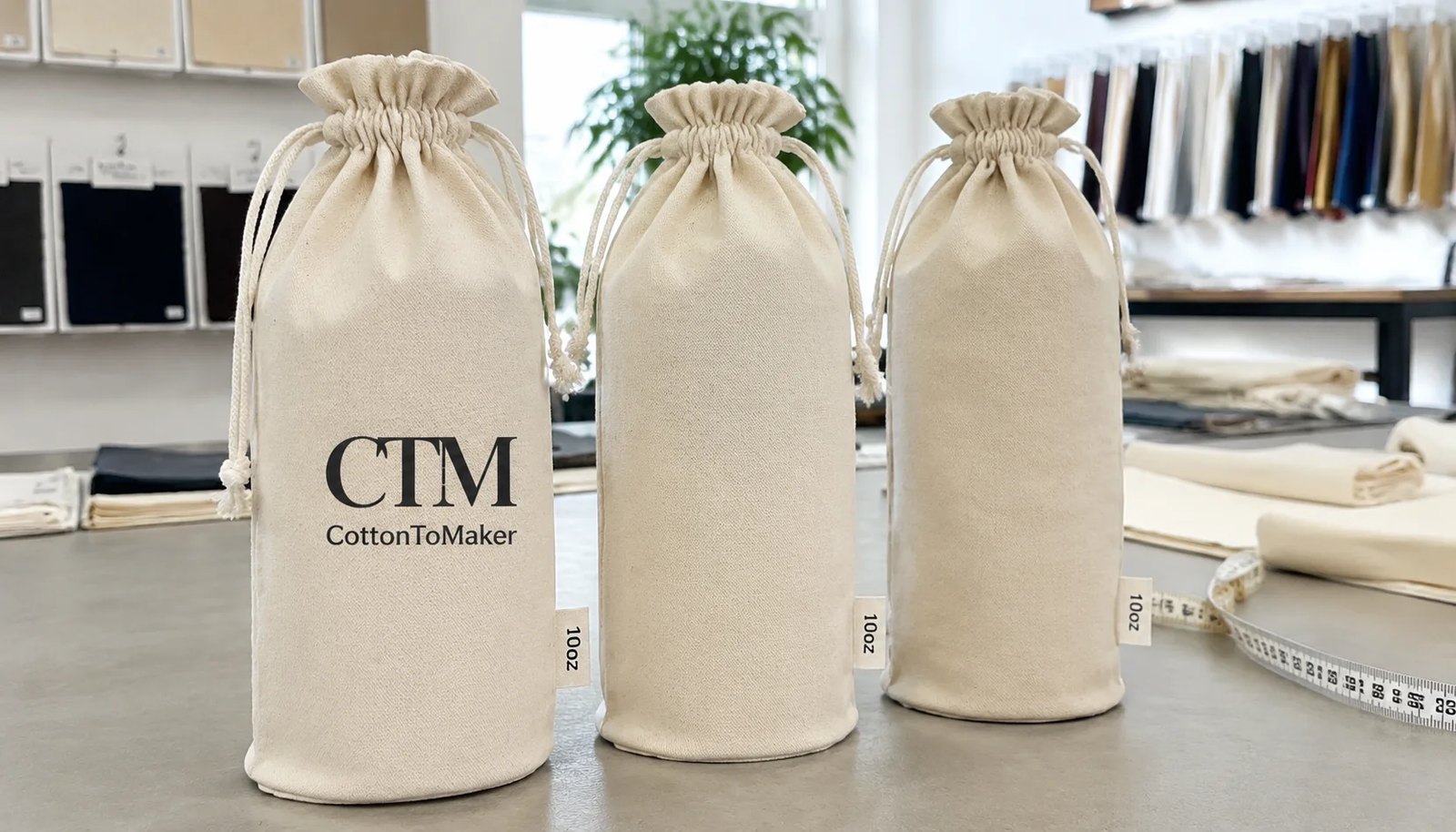
Why fabric weight matters more for liquor pouches than simple gift bags
A cotton drawstring pouch for liquor is not the same buying problem as a flat jewelry bag or a thin promotional giveaway. The product has to wrap a rigid glass bottle, hide or reveal the bottle shape in a controlled way, close cleanly around the neck, and survive handling by retail staff, distributors, gift packers, and end customers. Fabric weight is the first specification that changes all of those outcomes.
For liquor retailers, the wrong GSM creates visible commercial problems. A pouch that is too light can look cheap beside a premium bottle, show sharp bottle shoulders, and strain at the bottom seam. A pouch that is too heavy can become bulky, expensive to ship, difficult to cinch, and slower to sew. The practical target is not the highest GSM; it is the lowest fabric weight that gives the desired hand feel, print result, strength, and shelf presentation.
- Light cotton below about 170 GSM is usually a dust-cover or giveaway fabric, not a premium bottle pouch fabric.
- Midweight cotton around 200-240 GSM works for many standard liquor gift sleeves when the bottle is not carried by the pouch for long distances.
- Heavier canvas around 270-340 GSM gives a more structured premium feel but changes cord, seam, carton, and freight assumptions.
- The finished bottle fit should be approved before bulk fabric is ordered, because fabric weight changes drape and closure behavior.
Useful GSM ranges for liquor drawstring pouch RFQs
Many RFQs only say cotton pouch or canvas pouch, which leaves too much room for suppliers to quote different fabrics. One factory may quote 5 oz cotton to win the price comparison, while another quotes 8 oz canvas because the bottle is premium. Both may technically be correct, but the quotes are not comparable. Procurement teams should state GSM, construction, and usage together.
In cotton bags, ounce weight and GSM are both used. As a rough guide, 5 oz is around 170 GSM, 6 oz around 200 GSM, 7 oz around 230-240 GSM, 8 oz around 270 GSM, and 10 oz around 330-340 GSM. Actual conversion varies by mill and finishing, so the quote should show the supplier's fabric test range rather than only a marketing description.
- 5 oz / about 170 GSM: suitable for short-term promotions, mini bottles, or non-premium gift sleeves where low cost is the priority.
- 6 oz / about 200 GSM: a common entry point for standard bottle pouches with acceptable opacity and improved sewing stability.
- 7 oz / about 230-240 GSM: a strong all-round option for 750 ml liquor pouches needing better hand feel without excessive bulk.
- 8 oz / about 270 GSM: good for premium spirits, heavier branding, and pouches expected to feel like a reusable item.
- 10 oz / about 330-340 GSM: best for structured premium packaging, but requires careful cord, channel, and carton planning.
Match fabric weight to bottle type and retail use
The bottle decides more than the artwork. A slim wine bottle, a square whiskey bottle, a wide-shouldered tequila bottle, and a ceramic spirits bottle place stress on the pouch in different areas. If the buyer only provides volume, such as 750 ml, the factory still has to guess the diameter, shoulder angle, and height needed below the drawcord channel.
For liquor retail programs, define whether the pouch will be filled at the factory, at a distributor, in store, or by an end customer. A pouch filled at retail may need faster insertion and a wider mouth. A pouch sold as a gift wrap accessory may need stronger visual structure. A pouch packed with a bottle for ecommerce fulfillment may need better abrasion control and tighter dimensions so the bottle does not slide inside the pouch.
- Standard 750 ml bottle gift sleeve: often works in 6 oz to 7 oz cotton if the pouch is decorative and not load-bearing.
- Premium whiskey, rum, tequila, cognac, or limited edition bottle: usually benefits from 8 oz cotton canvas or heavier.
- Mini bottle or tasting set pouch: 5 oz to 6 oz may be enough, depending on the number of bottles and internal contact.
- Tall bottle with narrow neck: confirm usable height below drawcord so the channel does not sit awkwardly below the shoulder.
- Wide square bottle: increase finished width and consider heavier fabric to avoid sharp corner show-through.
Cost drivers behind fabric weight, not just unit price
Higher GSM increases the material cost, but that is only one part of the price change. Thick cotton can require slower sewing, larger needles, stronger thread tension control, more space in cartons, and sometimes a larger drawcord channel. If the quote only shows a unit price, procurement will miss why two suppliers are far apart.
The landed cost also changes with carton volume and weight. A 10 oz cotton pouch may look only slightly more expensive per piece, but the carton quantity may drop and the CBM per 1,000 pieces may rise. For distributors shipping to multiple retail branches, the freight and storage impact can be more important than the difference in sewing cost.
- Fabric consumption: larger pouch size and heavier GSM multiply cost together.
- Finishing: dyed, washed, bleached, or brushed cotton usually costs more than natural greige cotton.
- Sewing time: thick canvas and reinforced seams reduce daily output compared with light cotton.
- Print setup: screen count, color changes, and special ink affect cost independently of fabric weight.
- Packing volume: heavier and thicker pouches reduce pieces per carton and increase warehouse handling space.
- Waste allowance: custom dyed fabric and tight color control may require more fabric reserve.
Printing choices by cotton weight and liquor branding style
Most liquor pouch logos are not complicated, but they are highly visible. A one-color distillery logo on natural cotton is often best handled by screen printing. It is durable, cost-efficient at volume, and works well on 6 oz to 10 oz cotton when the mesh, ink deposit, and curing are set correctly. The risk is that coarse weave or heavy slubs can break fine lettering.
Heat transfer can be useful for gradients, small text, or multi-color artwork, but it changes the hand feel and may look less natural on premium cotton. Embroidery is possible on heavier pouches, but it is rarely the lowest-risk choice for thin lettering or large filled areas because it can pucker the fabric. For retail alcohol packaging, the safest artwork is usually bold, simplified, and positioned away from seam distortion.
- Screen print: best for 1-3 solid colors, logos, batch names, holiday marks, and clean brand icons.
- Heat transfer: useful for detailed artwork, but test edge adhesion on the selected fabric texture.
- Embroidery: better on 8 oz or heavier cotton, but avoid dense stitches over large panels.
- Woven label: good for a premium side detail, but less effective as the main front branding.
- Print placement: keep critical text at least 20-30 mm from side seams, bottom seam, and heavy drawcord wrinkles.
MOQ logic for custom cotton liquor pouches
MOQ is not only a factory policy; it depends on which components are custom. A natural cotton pouch in a stock fabric weight with one-color printing can often start at a lower MOQ than a dyed pouch with custom cord, woven label, and multiple print colors. Buyers comparing quotes should separate base pouch MOQ from special material MOQ.
For test campaigns, it is often better to use an available natural or black cotton fabric and invest in a correct sample, rather than force a custom dye color at a low quantity. Custom dyeing becomes more sensible when the program is large enough to absorb lab dip, bulk dye lot, and shade tolerance management. Liquor retailers planning seasonal promotions should also consider whether future reorders must match the first batch.
- Lower MOQ is most realistic with natural cotton, standard black cotton, standard cotton cord, and one-position screen print.
- Custom fabric color usually raises MOQ because the mill or dye house has minimum batch requirements.
- Custom cord color, metal cord tips, and special labels can each create their own MOQ.
- Multiple SKUs with the same pouch size but different prints may share fabric MOQ if scheduled together.
- Reorders should reference the approved fabric lot, print color standard, and finished sample, not only the old PO number.
Sample approval: what a liquor retailer should physically test
A photo approval is not enough for this product. The pouch must be tested with the actual bottle or a weighted dummy bottle that matches the diameter, height, and mass. The buyer should inspect how the fabric drapes around the shoulder, whether the bottom seam sits flat, and whether the drawstring closes without fighting the bottle neck.
The sample should also confirm the print result on the exact cotton weight. A logo that looks sharp on a flat lab print can lose definition on coarse 8 oz canvas. If the pouch will be used for premium gifting, the buyer should keep one signed approval sample and require bulk production to match it in fabric feel, dimensions, print color, and cord behavior.
- Fit test: bottle inserts smoothly without forcing side seams or distorting the print panel.
- Closure test: drawcord pulls evenly and closes around the neck with no channel blockage.
- Carry test: filled bottle held by cord for a defined short period if the pouch is expected to support weight.
- Print test: rub, fold, and scratch the printed area after curing, especially on textured canvas.
- Dimension test: measure finished width, finished height, channel height, and bottom seam allowance.
- Presentation test: stand the filled pouch upright and check whether the logo faces cleanly on shelf or gift table.
QC thresholds that make supplier inspections objective
Quality disputes often happen because the RFQ says good quality but not measurable quality. For cotton drawstring liquor pouches, the most useful QC thresholds are fabric weight tolerance, finished size tolerance, seam strength, print adhesion, and bottle fit. These are practical checks that an in-line inspector or third-party inspection team can repeat during production.
Fabric weight tolerance should be agreed before order placement because cotton mills have normal variation. A buyer may accept a small GSM range if hand feel and strength remain acceptable, but a large drop from quoted weight changes the product. For finished dimensions, tolerance should be tight enough for bottle fit but realistic for cotton sewing. Overly tight tolerances on soft fabric can create unnecessary rejection risk.
- Fabric weight: define an acceptable GSM range, for example quoted GSM with a reasonable mill tolerance agreed in writing.
- Finished size: use actual pouch measurements after sewing, not flat fabric cut size.
- Seam security: no skipped stitches, open seams, loose bottom corners, or broken threads under filled-bottle handling.
- Print adhesion: no obvious cracking, peeling, heavy ink bleed, or color transfer under normal rub testing.
- Cord performance: both sides pull evenly, knots or tips do not slip into the channel, and cord ends are controlled.
- Cleanliness: no oil marks, heavy lint, mildew odor, mixed shades, or dirty folding marks on retail-facing pieces.
Packing and export details that affect retail handling
Packing is easy to underestimate because a flat cotton pouch looks simple. In bulk export cartons, heavy compression can crease print areas, flatten drawcords, and create hard fold lines that remain visible when the pouch is used for gifting. Natural cotton can also pick up dust or moisture if packed loosely in a warehouse environment.
Liquor retailers and distributors should decide whether pouches arrive as bulk flat-packed pieces for local bottle filling, individually polybagged retail accessories, or grouped inner packs for store allocation. Each method changes labor, waste, carton size, and presentation. For sustainability-focused programs, buyers may choose paper banding or inner kraft bundles, but the print surface still needs protection during transit.
- Bulk flat pack: lowest packing material cost and efficient for local fulfillment, but needs clean carton lining and controlled compression.
- Individual polybag: protects each pouch but adds plastic waste, labor, and possible retail unpacking time.
- Inner bundle pack: useful for distributing 25, 50, or 100 pieces to retail branches or co-packers.
- Interleaving paper: helpful for dark ink or large print areas that may mark adjacent natural cotton surfaces.
- Carton labels: include SKU, pouch size, fabric weight, color, print version, quantity, PO number, and gross weight.
- Moisture control: avoid damp cartons and request dry storage before shipment, especially for natural cotton.
Lead time risks for seasonal liquor promotions
Liquor packaging often runs on seasonal calendars: holidays, tasting events, club releases, duty-free promotions, or distributor sell-in periods. The production risk is not only sewing time. Artwork approval, sample revision, fabric availability, dyeing, print curing, inspection, packing, and vessel booking all sit before the goods reach the retailer.
A realistic schedule separates development from production. If a buyer needs a custom dyed cotton pouch for a holiday gift set, the lab dip and bulk dye steps can become the longest lead-time items. If the buyer can accept natural cotton and one-color screen print, the process is simpler. Either way, the purchase order should state what event date the goods support, so the factory can flag risks before committing.
- Development stage: artwork file review, fabric swatch selection, pouch size confirmation, and sample making.
- Approval stage: buyer fit test with bottle, logo placement approval, print color approval, and written sample sign-off.
- Material stage: fabric booking, dyeing if required, cord and label preparation, and incoming material inspection.
- Production stage: cutting, printing, curing, sewing, trimming, final inspection, and packing.
- Shipping stage: carton measurement, booking, customs documents, export handling, and destination delivery planning.
- Schedule buffer: add time for one sample revision if bottle fit or print position is not yet proven.
Specification comparison for buyers
| Spec decision | Recommended option | When it fits | Buyer risk to check |
|---|---|---|---|
| Fabric weight for standard 750 ml bottle | 7 oz cotton canvas, about 230-240 GSM | Most liquor gift pouches where the bottle is boxed or handled gently in retail | Too light if the pouch carries a heavy glass bottle by the cord for long periods |
| Fabric weight for premium spirits gifting | 8 oz to 10 oz cotton canvas, about 270-340 GSM | Whiskey, tequila, cognac, limited edition promotions, club gifts, duty-free sets | Higher GSM increases carton weight, bulk, and unit cost; confirm shelf and carton dimensions |
| Fabric weight for cost-sensitive promotions | 5 oz to 6 oz cotton, about 170-200 GSM | Short campaign giveaways, mini bottle sets, lightweight sample kits | May show bottle shape, feel thin, and print less solid on coarse natural yarn |
| Fabric construction | Plain weave cotton canvas with stable shrinkage control | Reliable for screen print, transfer print, and simple sewing on cylindrical bottle pouches | Loose weave can twist after washing or steaming; measure grain alignment on samples |
| Drawcord material | Cotton cord 4-6 mm or braided cotton rope for heavier pouches | Natural brand positioning, good hand feel, compatible with cotton pouch story | Cord tips can fray; specify knotted, taped, metal aglet, or sewn finish |
| Print method | Screen print for 1-3 spot colors; heat transfer for detailed artwork | Liquor logos, tasting notes, holiday artwork, distributor marks | Ink cracking on heavy textured fabric or poor registration near side seams |
| MOQ logic | 300-500 pcs for plain or one-color print; higher for dyed fabric, custom cord, or complex labels | Buyers testing seasonal packs before rolling out to multiple retail locations | Small MOQ may use available greige fabric only; dye lot and cord color choices become limited |
| Packing format | Flat pack in export carton with bottle-size insert sample approved | Retailers or distributors filling bottles locally after import | Over-compressed packing can crease printed panels and deform thick drawcord channels |
Buyer checklist before sampling
- Define the exact bottle type before fabric selection: 750 ml Bordeaux, Burgundy, spirits bottle, mini bottle, boxed bottle, or irregular premium shape.
- State whether the pouch is decorative packaging only or must safely carry a full glass bottle by the drawcord.
- Specify fabric weight in both ounces and GSM, and request the supplier's acceptable tolerance range.
- Request fabric swatches in the intended natural, bleached, black, dyed, or custom color before approving print colors.
- Confirm pouch finished size after sewing, not just cutting size, including usable height below the drawcord channel.
- Approve one filled-bottle sample test using the real bottle or a bottle with matching diameter and weight.
- Define print position measured from the bottom seam and side seam, not only centered visually.
- Check drawcord diameter, color, knotting, fray control, and ease of closing around the bottle neck.
- Set carton packing quantity according to pouch thickness and destination warehouse handling limits.
- Require quote data for fabric weight, fabric color, print method, MOQ, sample charge, production lead time, carton dimensions, and gross weight.
Factory quote questions to send
- What cotton fabric weight are you quoting in GSM and ounces, and what tolerance do you apply during bulk production?
- Is the quoted fabric greige, bleached, dyed, or washed, and will the final pouch shrink after sewing or steaming?
- What finished pouch size do you recommend for our bottle diameter, bottle height, shoulder shape, and closure style?
- Can the pouch carry a filled bottle by the drawcord, or is it intended only as a dust bag and gift sleeve?
- Which print method is included in the quote, and what is the maximum printable area before distortion from seams or wrinkles?
- What MOQ applies to this exact fabric weight, color, cord type, label, and print design?
- How many pre-production samples are included, and are courier cost, sample revision cost, and fabric swatch cost separate?
- What packing method will protect the print surface: flat pack, interleaving paper, inner polybag, or bulk carton only?
- What are the estimated carton dimensions, gross weight, and CBM per 1,000 pieces for the quoted fabric weight?
- What production lead time starts after sample approval, deposit, artwork confirmation, or fabric arrival?
Quality-control points to confirm
- Fabric weight tested by cutting and weighing a known area, with tolerance agreed before production.
- Finished pouch width, height, bottom gusset if any, and drawcord channel height measured against approved sample.
- Seam strength tested at side seams, bottom seam, and drawcord channel using a filled-bottle pull test.
- Print adhesion checked by dry rub, light scratch, tape pull, and folding test on the actual fabric weight.
- Drawcord closure tested for smooth pulling, no channel blockage, no loose stitching, and controlled fraying.
- Bottle fit test performed with the real bottle or a weighted dummy bottle in every inspection lot.
- Color consistency checked between approved lab dip or swatch and bulk pouches under neutral light.
- Packing inspected for print transfer, heavy creasing, carton compression, moisture protection, and correct labeling.