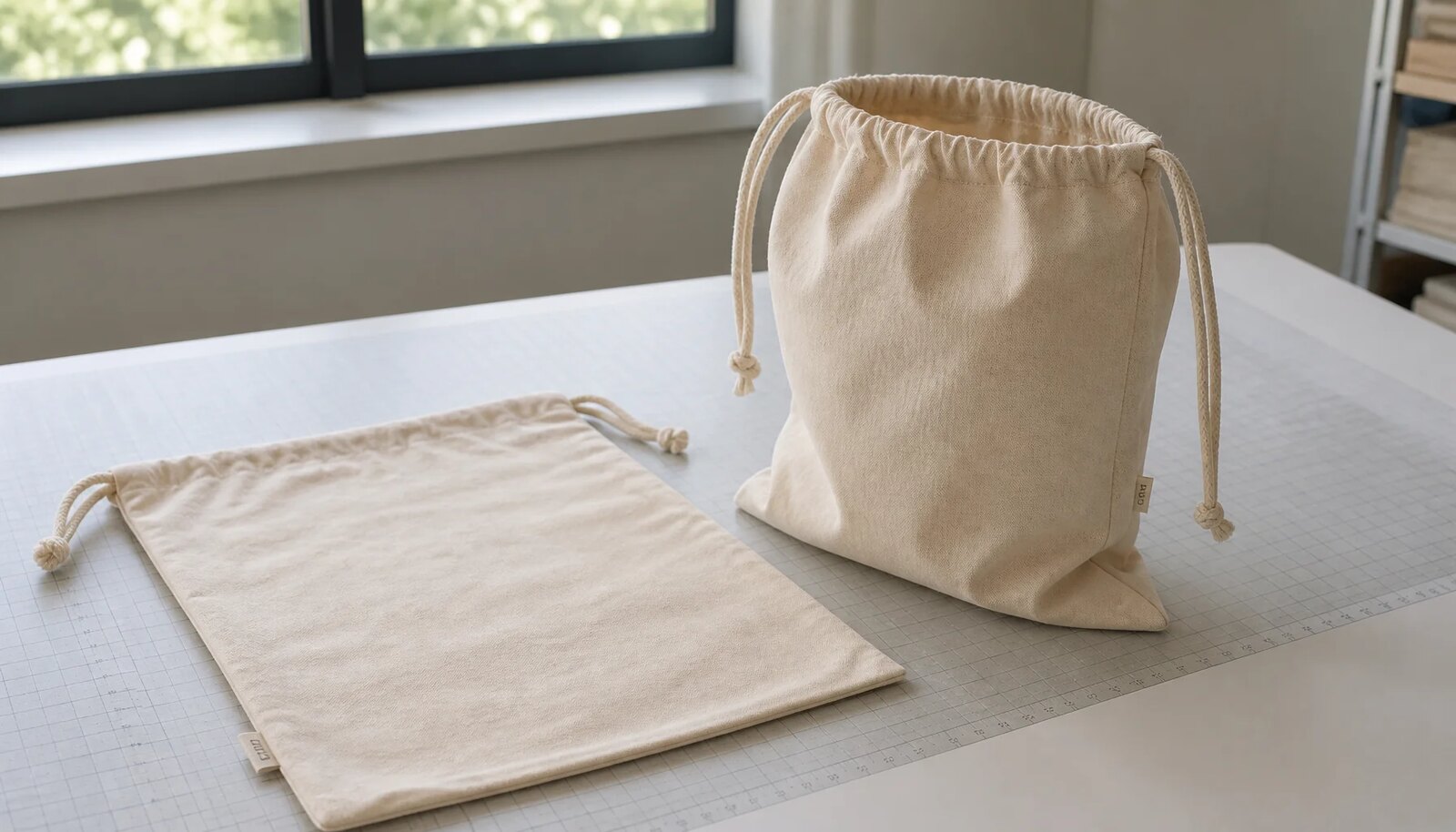
Start With The Event Job To Be Done
For custom cotton drawstring pouches, the fabric weight decision should start with the event use case, not with a generic fabric preference. A pouch that holds a folded brochure and a pen can be much lighter than one that carries a sample bottle, USB drive, or small retail gift. If the pouch is only a handout container, buyers often overspend by specifying heavier fabric than the product needs. If it is meant to be reused after the event, a light, loose weave can fail the first impression test and create complaints about cheap feel.
The cleaner way to brief suppliers is to describe the actual kit load, the expected reuse level, and how the pouch will be handed out. A conference welcome kit, a press kit, and a retail insert may all use the same logo, but they do not need the same GSM, closure strength, or print method. Once the use case is clear, the factory can quote a pouch that meets the function without loading unnecessary cost into the order.
- State what goes inside the pouch and the total packed weight.
- Define whether the pouch is a one-time giveaway or a reuse item.
- Tell the supplier if the pouch will be inserted into a larger kit or handed out loose.
- Flag any premium expectation, such as retail-style presentation or a more structured hand feel.
What GSM Actually Controls
GSM means grams per square meter, but for buyers it is more useful to think of it as a proxy for opacity, hand feel, durability, and freight weight. Two pouches can both be labeled 140 GSM and still behave differently if one is plain weave, one is twill, or one is finished differently. That is why a quote that only says cotton pouch is not enough. Ask for finished GSM and the construction behind it, because those two details explain most of the difference you will feel in a sample room.
Finished GSM matters more than greige fabric weight because washing, scouring, bleaching, and printing can change the final behavior of the bag. A supplier may present a nice looking sample that shrinks or softens after the first wash if the fabric was not stabilized properly. For procurement teams, this is where a cheap quote can become expensive after complaints, replacements, or a failed event handout. The point is not to buy the heaviest fabric available. The point is to buy the lightest fabric that still protects the contents and supports the brand image.
- Request finished GSM, not only raw fabric weight.
- Compare the sample by opacity, drape, and seam stability, not by numbers alone.
- Ask whether washing, scouring, or bleaching changed the final hand feel.
- Tie GSM to actual load and reuse expectations so you do not over-spec the pouch.
The GSM Range Buyers Use In Practice
In event sourcing, 110-120 GSM is usually the low-cost bracket for light inserts and short-use giveaways. It can work when the pouch carries paper goods or very light merchandise, but it is easy to overprint or see through on natural cotton. The middle range, roughly 140-160 GSM, is where many buyers land for conference kits, brand activations, and welcome packs because it balances feel, cost, and print reliability. Once you move into 180-220 GSM, the pouch starts to read as a more durable, premium item and can handle heavier contents better, but freight and unit cost rise with every step up.
If the pouch has to do more than hold a leaflet, the middle range is usually the safer starting point. Event planners often underestimate how much stress the cord channel, top seam, and bottom seam see when people stuff the bag in transit. A pouch that looks fine on the table can fail once it is filled with a hard object or a stack of collateral. When you use heavier GSM, you are paying for more fabric and a more premium look, so that choice should be deliberate rather than automatic.
- 110-120 GSM suits very light contents and the lowest cost target.
- 140-160 GSM is the most flexible range for standard event kits.
- 180-220 GSM fits premium programs, repeated reuse, and heavier inserts.
- Above 220 GSM should be reserved for structured, premium use cases where stiffness matters.
Fabric Construction Changes The Result
Fabric weight is only one part of the story. Plain weave, twill, and canvas all feel different at the same GSM, and they print differently too. Plain weave usually gives a clean, even surface and is common for basic drawstring pouches. Twill can feel a little richer and may hide minor surface issues better, while canvas is often chosen when the buyer wants a more substantial retail look. If the factory does not state the weave, you can end up comparing two samples that are not truly equivalent.
Finish also changes how the pouch behaves. Bleached cotton generally gives a cleaner print surface and more consistent color for logos, while natural unbleached cotton can show seed specks, tone variation, and a more rustic look. Pre-shrunk or stabilized fabric reduces surprises after production, especially when the pouch will be packed with tight cords or printed close to the seam. If the brand wants an organic or natural look, make sure the acceptable shade variation is written into the approval standard instead of left open to interpretation.
- Ask the supplier to name the weave and finish, not just the fiber content.
- Specify whether natural cotton tone variation is acceptable or not.
- Check shrinkage risk if the pouch will be washed or handled in humid conditions.
- Confirm seam allowance because heavier fabric and thicker weave can change the final size.
Print Method Should Follow Fabric Weight
Print choice should follow the fabric, not the other way around. Screen printing is usually the best fit for simple logos, solid colors, and medium to larger runs because it is efficient and gives strong color on cotton. Heat transfer or digital transfer is more useful when the artwork has many colors, gradients, or very small quantities, but the buyer should inspect the surface feel and edge durability. Embroidery and patches can add value on premium pouches, but they are not the first choice for light fabric because the needle load can pull the weave or create puckering.
The practical rule is that fine detail and very small type need more fabric stability than buyers expect. If the logo has thin lines, tiny text, or complex edges, ask the factory for its minimum line thickness and whether the artwork should be simplified. For screen print, request a strike-off on the actual fabric weight you plan to buy. For transfer or embroidery, ask for a pre-production sample that includes final placement, because a logo that looks fine on paper can sit very differently once the pouch is sewn and cinched.
- Use screen print for simple logos on 140 GSM and above whenever possible.
- Use transfer methods when the artwork complexity matters more than long-term softness.
- Use embroidery only when the fabric weight and brand position justify the extra cost.
- Ask for the minimum line width and minimum text size the supplier can hold cleanly.
- Approve the decoration on sewn pouch samples, not on loose fabric alone.
How MOQ And Price Breaks Really Move
MOQ for cotton drawstring pouches is driven by more than fabric weight. The biggest levers are whether the factory holds stock fabric, whether the pouch needs custom dyeing, how many print colors are involved, and whether labels or special packing are included. A 140 GSM stock natural pouch with a single-color print can often be quoted at a much lower MOQ than a custom dyed or embroidered pouch. Once you ask for a custom color, a woven label, or special folding and kitting, the factory usually needs more pieces to cover setup cost and material risk.
The quote should separate the pieces that actually move the price. Ask for the body, cord, print setup, label, packing, and carton work as separate lines if possible. This helps you see whether a higher price is coming from the fabric itself or from finishing work. For comparison shopping, request price tiers at 500, 1000, 3000, and 5000 pieces, or at the breakpoints the supplier actually uses. That is the fastest way to tell whether the supplier is truly competitive or just hiding setup cost inside the unit price.
- Ask whether MOQ is tied to fabric color, print color count, or total order quantity.
- Request separate lines for bag body, cord, decoration, and packing.
- Compare price breaks at multiple quantities instead of one headline price.
- Ask if sample fees or screen fees are refundable against mass production.
- Confirm whether custom dyeing or custom labels change the MOQ.
Sample Approval Should Lock More Than The Logo
A proper sample process for event pouches should lock the product, not just the artwork. Start with an artwork proof, then a strike-off or decoration sample, then a sewn pre-production sample made from the final fabric and final cord. The last sample should be the reference for bulk production and packing. If procurement signs off only on a flat print proof, the factory can still change size, cord thickness, seam allowance, or carton packing without technically violating approval. That is where many disputes start.
The acceptance standard should be measurable. Size tolerance, logo placement, print color, seam quality, and drawstring function all need a numeric or visual target. For a typical pouch, a size tolerance of about plus or minus 0.5 to 1 cm is often enough, but the exact window should match the bag size and how tight the contents fit. If the pouch is meant to protect a polished item, inspect for surface marks, loose threads, and uneven top hems because those flaws are obvious once the pouch is on a table in front of customers.
- Approve a sewn pre-production sample as the final reference, not just an artwork proof.
- Define size tolerance, print location, and cord length before bulk production starts.
- Check logo registration on the actual pouch, not on loose fabric.
- Set a clear rule for acceptable shrinkage and surface variation.
- Keep one signed golden sample with procurement and one with the factory.
Packing And Kit Assembly Can Change The Quote
Packing is often treated as a small detail, but for event orders it can create real cost and schedule risk. A pouch that is flat folded and bulk packed is inexpensive to produce and ship, while a pouch that must be individually polybagged, tagged, barcoded, or inserted into a kit takes more labor and more carton space. If the event team wants the pouches delivered as part of a multi-item welcome kit, the labor to assemble that kit should be quoted separately. Otherwise the supplier may present a good unit price on the pouch and then add assembly charges later.
The carton plan matters because cotton pouches compress differently depending on GSM and finish. A lighter pouch can be packed tightly, but a thicker pouch may hold more air and reduce carton efficiency. That changes freight cost and can affect how many cartons you need on site. Ask for inner pack quantity, master carton dimensions, gross weight, and carton marks. If the shipment is heading into a venue warehouse or a distribution center, the outer label format should be written down before production begins, not after cartons are already sealed.
- Decide whether the pouch ships flat, folded, bagged, or pre-kitted.
- Ask for carton dimensions and gross weight because they affect freight and warehouse handling.
- Confirm whether barcode labels, hang tags, or event labels are included in the price.
- Write down the exact pack count per inner pack and per master carton.
Lead Time Risks And What To Freeze First
A realistic planning baseline for a stock-fabric cotton pouch with a simple print is often a few weeks after sample approval, but the actual schedule depends on how fast the buyer freezes the spec. Custom dyeing, embroidery, multi-step packing, or fabric sourcing from a new mill can extend the schedule quickly. The biggest delay usually is not sewing. It is late changes to artwork, size, packing, or color after the factory has already started buying material. Once the event date is fixed, the buyer should lock the spec before the sample goes into production.
The safest way to protect the schedule is to simplify the order when time is tight. Use stock fabric instead of custom dyed fabric, reduce print colors, and avoid extra labels unless they are absolutely necessary. If the pouch has to arrive at a venue on a fixed date, build in time for approval, production, inspection, and transit, not just sewing. A sample that is approved late can push the whole order into a worse freight option or force the buyer into a compromise on packing. In event sourcing, a clean specification is often worth more than a small unit price reduction.
- Freeze size, fabric, print method, and packing before the factory starts bulk material booking.
- Use stock cotton and fewer decoration steps when the event date is close.
- Leave time for inspection and transit, not only for sewing.
- Treat late artwork revisions as schedule risk, not as a minor edit.
Compare Quotes On A Landed Basis
When you compare supplier quotes, do not stop at the ex-factory unit price. A heavier GSM pouch can look expensive on paper but still win on landed cost if it reduces failures, replacements, or venue complaints. At the same time, a low-price quote can become the most expensive option if the carton count is inefficient, the print fails inspection, or the factory needs expensive rework. The right comparison is landed cost per usable pouch, including packing, freight, duty, and any assembly charge tied to the event workflow.
To make quotes comparable, every supplier should respond to the same line items. The RFQ should include the finished GSM range, weave, color, size, print method, artwork files, sample requirements, packing format, carton count, inspection level, and shipping terms. If one supplier gives you all-in pricing and another breaks out the add-ons, normalize the numbers before deciding. This is especially important for event planners, because the cheapest unit price can still create the most expensive execution if the pouches arrive looking thin, inconsistent, or poorly packed.
- Compare ex-factory, FOB, and landed cost separately so the numbers are not mixed together.
- Include freight, duty, and kit assembly when the pouch is part of a larger event package.
- Normalize the quote by usable pouch quality, not by headline unit price alone.
- Ask every supplier to quote against the same GSM, packing, and approval standard.
- Treat print setup and sample cost as part of the decision, not as an afterthought.
Specification comparison for buyers
| Spec decision | Recommended option | When it fits | Buyer risk to check |
|---|---|---|---|
| 110-120 GSM stock natural cotton | Use for light inserts and price-sensitive giveaways | Brochure kits, flat mailers, short-use event handouts | Can be see-through, feel thin, and show logo ghosting |
| 140-160 GSM bleached or well-scoured cotton | Best default for most event orders | Conference kits, welcome packs, reusable branded pouches | Confirm pre-shrink, opacity, and print registration |
| 180-220 GSM plain weave or light canvas | Choose for premium kits and repeated reuse | Retail-style gifts, heavier inserts, stronger brand presentation | Higher freight, stiffer handfeel, and larger MOQ pressure |
| Screen print 1-2 spot colors | Use for clean logos on stable fabric | Simple branding, large runs, strong unit economics | Minimum line width, cure quality, and color alignment |
| Heat transfer or digital transfer | Use for gradients or small runs | Artwork with many colors, short lead-time orders, small quantities | Edge lift, surface feel, and wash or rub durability |
| Embroidery or patch | Use for premium branding | Heavier pouches and retail programs | Puckering, backing cost, and slower production speed |
| Factory-direct with in-house print | Best for standard specs and moderate volumes | One-stop sourcing when sewing and printing must match | Confirm who owns QC if print and sewing are in the same plant |
| Split sourcing: bag factory plus local decorator | Use only when speed or special decoration matters more than simplicity | Rush jobs, unusual artwork, or buyers with local finishing control | Shade mismatch, handoff errors, and inconsistent packing standards |
Buyer checklist before sampling
- Lock the finished pouch size, flat or gusseted construction, and target fill weight before requesting quotes.
- State the finished GSM range you will accept, not only the base fabric description.
- Specify fabric color: natural, bleached, or dyed, and define the shade tolerance you can live with.
- Provide artwork in vector format and note the exact print method, logo size, and number of colors.
- Define sample approval steps: artwork proof, strike-off, pre-production sample, and golden sample ownership.
- Write the packing spec clearly: fold method, inner polybag or not, carton quantity, and carton marks.
- Set the event date and shipping window early so the factory can plan fabric booking and production slots.
- Ask for separate pricing on sample fee, screen setup, printing, packing, and any extra label or tag work.
Factory quote questions to send
- What is the finished GSM of the fabric after finishing, and is that measured before or after washing?
- Which fabric construction are you quoting: plain weave, twill, or canvas, and what is the yarn count?
- What MOQ applies to this size, this GSM, and this print method, and does MOQ change by color count?
- What are the price breaks at 500, 1000, 3000, and 5000 pieces, including packing?
- What sample stages do you provide before bulk production, and which sample is the final approval reference?
- What are the size tolerance, print registration tolerance, and acceptable shrinkage range?
- What packing format is included in the quote, including inner packs, carton count, and carton dimensions?
- What extra charges apply for custom dyeing, embroidery, woven labels, hang tags, or carton artwork?
- What lead time do you need after artwork approval, deposit, and final sample sign-off?
- Which inspection standard or AQL level do you work to, and can the buyer send a third-party inspector?
Quality-control points to confirm
- Finished GSM matches the agreed range on a production sample, not just the fabric specification sheet.
- Overall pouch size stays within the agreed tolerance, and both sides are consistent after sewing.
- Logo placement, color, and registration match the approved strike-off or golden sample.
- Cord length, knot security, and closure function are consistent across the full order.
- No visible holes, broken stitches, oil stains, or excessive loose threads are accepted on packed goods.
- Carton count, inner pack count, and carton labels match the packing list and purchase order.
- Fabric shade, weave density, and surface finish stay within the agreed lot-to-lot variation.
- Printed areas do not crack, flake, or transfer in a light rub test during final inspection.