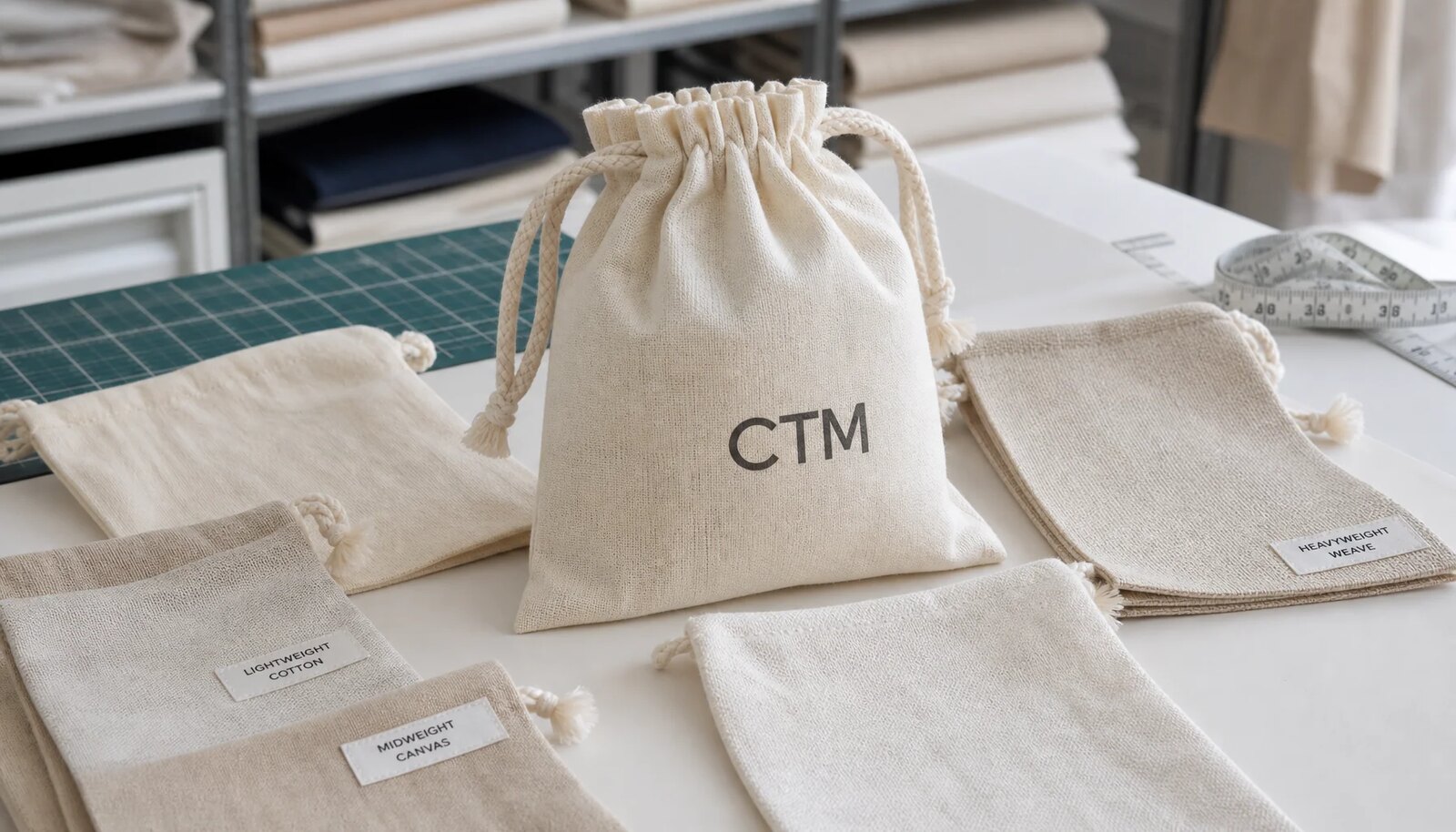
Why GSM belongs in the first RFQ, not the final sample comment
For custom cotton drawstring pouches, fabric weight is a commercial specification, not a cosmetic afterthought. GSM, or grams per square meter, influences how the pouch feels in the hand, how well the front panel presents a logo, how easily the warehouse team loads the gift, how many units fit in a carton, and whether the recipient sees the pouch as reusable packaging or disposable wrapping. In a corporate gifting program, that first touch can affect the perceived value of the entire kit.
Many B2B requests still say only "cotton drawstring pouch with logo" and include a size and artwork file. That leaves the supplier to choose the weave, GSM, drawcord, seam allowance, decoration process, packing style, and sometimes even the cotton finish. Three suppliers can quote the same nominal size while pricing three different products: a 110 GSM light muslin pouch, a 150 GSM plain-weave pouch, and a 220 GSM canvas pouch. The spreadsheet may show a large price spread, but the buyer is not comparing like with like.
A stronger procurement approach is to define the working specification before the quote is issued. That does not mean overcomplicating a simple pouch. It means controlling the variables that change the appearance, function, and landed cost. At minimum, buyers should specify target GSM, fabric construction, finished size, drawcord, decoration method, logo placement, packing method, and inspection expectations. If the correct GSM is uncertain, ask suppliers to quote two controlled alternatives instead of leaving the material open.
Fabric weight also affects downstream cost. A heavier pouch can raise fabric cost, slow sewing, increase carton volume, and change air freight economics. A lighter pouch can reduce unit cost but increase the risk of transparency, wrinkles, weak presentation, and print show-through. The right answer is not always the heaviest pouch. It is the pouch weight that matches the gift tier, contents, recipient expectation, and logistics plan.
- Include GSM, weave, cord, decoration, and packing in the first RFQ.
- Compare supplier pricing only after the same specification is confirmed.
- Use two controlled GSM options when cost-performance tradeoff is unclear.
- Treat the approved sample as the physical standard for bulk production, not as a styling suggestion.
Practical GSM ranges for corporate gifting
The most useful fabric weight range depends on the pouch role. A low-cost event insert does not need the same structure as an executive gift pouch holding a glass candle. For most corporate gifting buyers, the practical decision sits in three bands: 100-120 GSM for light promotional use, 140-160 GSM for standard gifting, and 180-240 GSM for premium reusable presentation.
A 100-120 GSM cotton pouch can work when the pouch is secondary to the product. It is common for flat cards, small samples, sachets, lightweight accessories, or high-volume events where budget pressure is strong. The buyer should understand the tradeoff: the fabric may be more transparent, less structured, and more likely to wrinkle. Large logos can look uneven if the weave is open or if the fabric moves during printing. This range is not wrong, but it should be purchased knowingly.
A 140-160 GSM pouch is often the safest starting point for corporate gifting. It gives better hand feel than low-cost sheeting while staying efficient to sew, fold, pack, and ship. It is usually appropriate for onboarding kits, employee appreciation gifts, stationery, cosmetics, small tech accessories, cable sets, wellness items, and distributor promo kits. For a simple one-color logo, this range normally gives a practical balance between branding quality and unit cost.
At 180-240 GSM, the pouch begins to feel more substantial and reusable. The front panel holds shape better, seams feel more robust, and the pouch can support a more premium unboxing moment. This range is worth considering for jewelry, candles, metal accessories, glass jars, travel kits, higher-value cosmetics, and executive programs. Buyers should check seam bulk, drawcord tunnel performance, carton dimensions, and gross weight before approving the heavier option.
Above 260 GSM, the pouch becomes a more specialized product. Heavy canvas can be excellent when structure and durability are central to the brief, but it may be too stiff or bulky for small pouches. It can require a wider tunnel, thicker cord, stronger seam construction, and different packing. For most corporate gift packaging, heavy fabric should be justified by the contents and reuse expectation rather than selected automatically as a premium signal.
- 100-120 GSM: use for light contents, high-volume budgets, and secondary packaging.
- 140-160 GSM: start here for most standard corporate gifting programs.
- 180-240 GSM: use for premium presentation, heavier contents, and higher reuse expectations.
- 260 GSM and above: use only when structure, durability, or retail-style packaging justifies extra bulk and cost.
Weave and finish can change the result as much as weight
GSM tells you how much the fabric weighs, but it does not tell the whole sourcing story. Two pouches can both be 160 GSM cotton and feel different if one is a tight twill and the other is a loose plain weave. A dense fabric can feel smoother and print cleaner at the same weight. A loose fabric can feel softer but may show product edges, stretch more at the seam, or allow ink to bleed unevenly.
Plain weave is common because it is familiar and efficient. It can be a good choice for standard gift pouches, especially with simple logos and medium GSM. Twill usually gives a more refined surface and stronger perceived hand feel, though it may cost more. Canvas or duck canvas provides structure and durability, but it creates thicker seams and can interrupt fine artwork because of its more visible texture. Muslin and light sheeting are better understood as light-duty packaging fabrics, not premium corporate gift materials.
Finish matters too. Natural unbleached cotton has a warm tone with visible flecks. Many brands like this look because it feels less processed, but the buyer must approve the acceptable level of shade variation and flecking. Bleached or optical-white cotton gives stronger contrast for logos but can show dirt, handling marks, and carton dust more easily. Brushed cotton can feel soft and premium, but it may collect lint or show pressure marks.
Dyed cotton needs additional control. If the pouch color is tied to a brand palette, request a lab dip or color swatch before sampling bulk pouches. For repeat orders, expect some batch variation unless the supplier can reserve fabric or reproduce the shade closely. If the pouch may be handled heavily, ask about colorfastness to rubbing, especially for dark colors. Corporate gifting often involves warehouse kitting, so abrasion during packing and assembly is a real consideration.
Buyers should also clarify whether the fabric is washed, pre-shrunk, bleached, brushed, or untreated. These processes can change hand feel, shade, shrinkage, and print response. For a pouch that is not marketed as washable, the main concern is still repeatability: the bulk order should match the approved sample closely enough that recipients do not see obvious variation.
- Plain weave: efficient and versatile for simple logo pouches.
- Twill: better perceived hand feel and useful for mid-tier or premium programs.
- Canvas: structured and durable, but bulkier at seams and less forgiving for fine print.
- Natural cotton: attractive for a simple, less processed look, but approve shade and flecks.
- Dyed cotton: useful for brand color, but requires lab dip, shade tolerance, and rub review.
Fit the pouch to the contents before choosing the final GSM
Fabric weight should be selected after the buyer understands what will go inside the pouch. A 150 GSM pouch may be excellent for a notebook and pen but underpowered for a glass jar. A 220 GSM pouch may look premium around jewelry but feel unnecessarily bulky for flat cards. The purpose of the pouch is to present and contain the gift cleanly; GSM is only one part of that performance.
Finished size and usable size are not the same. A 150 x 200 mm flat pouch does not provide a full 150 x 200 mm internal loading area after side seams, bottom seam, drawcord tunnel, and seam allowance are considered. If the pouch has a gusset, the flat measurement may be even more confusing unless the supplier provides a drawing. Buyers should request measurement points and tolerances in writing, especially when the pouch must fit into a gift box cavity or hold a fixed retail pack.
Loading weight matters because drawstring pouches are usually not engineered like load-bearing bags. A pouch holding paper samples has different stress points than one holding a metal bottle opener, candle, jar, or power bank. Heavier or sharper contents may need heavier GSM, tighter weave, reinforced seams, larger seam allowance, or a gusset. For glass or fragile contents, the pouch improves presentation but should not be treated as protective packaging unless additional padding is designed in.
Shape also affects logo appearance. A flat pouch is economical and easy to pack, but bulky contents can cause the front panel to bulge and distort a large logo. A bottom gusset can improve standing shape and loading volume, but it may change how the pouch folds and where the logo should sit. If the logo must remain centered during unboxing, test it with the filled pouch, not an empty sample.
The best approval method is simple: load the sample with the real product or a dummy of the same size and weight. Close the cord, hold the pouch by the cord, place it in the final gift box, and let the assembly team try packing several units. If loading is slow, the pouch opening is too tight, or the tunnel wrinkles heavily, adjust the size or construction before bulk production.
- Confirm finished size, usable opening, gusset, tunnel height, and seam allowance.
- Test with real contents or an accurate dummy before sample approval.
- Use 140-160 GSM for many stationery, cosmetic, wellness, and small tech items.
- Move toward 180 GSM or higher for glass, metal, candles, or premium reusable presentation.
- Review logo visibility after filling, especially for bulky products and gusseted pouches.
Decoration choices should follow the fabric surface
A digital mockup can make any logo look clean. Bulk cotton fabric is less forgiving. Weave texture, absorbency, dye color, fabric movement, and seam placement all affect the final decoration. For corporate gifting, the decoration method should be chosen after the buyer understands the fabric construction and logo requirements.
Screen printing is often the most practical route for one-color or two-color corporate logos. It is efficient at volume, gives clear branding on natural and light cotton, and keeps setup predictable for repeat orders. The buyer should still approve a strike-off on the actual fabric weight and color. Fine text, small registration marks, and thin lines can break on coarse canvas or loose weave. Large ink blocks may feel heavy or show uneven coverage if the fabric is absorbent.
Heat transfer can be useful for detailed artwork, gradients, multi-color graphics, or smaller quantities where screen setup is inefficient. The risks are different: edge lifting, cracking, a plasticky hand feel, and changes after storage or folding. A large transfer on a soft cotton pouch can reduce the natural feel that made cotton attractive in the first place. Buyers should ask for adhesion checks and approve the feel, not only the color brightness.
Embroidery, woven labels, sewn labels, and cotton patches can create a more tactile brand impression. They are especially useful when the logo has small details that will not print well on textured cotton, or when the brand wants a retail-style finish. These options introduce sewing controls: placement, straightness, puckering, loose threads, backing, and distance from the tunnel or gusset. A patch placed too close to the drawcord tunnel can interfere with closing or make the top opening look uneven.
Logo placement should be specified by measurement, not by visual instruction alone. For example, define the logo centerline, logo size, and distance from the bottom seam. For multi-size programs, do not assume the same logo size works on every pouch. A mark that looks balanced on a 200 x 300 mm pouch may overpower a 100 x 140 mm pouch. Procurement should keep approved artwork files, placement drawings, and sample photos tied to the same specification revision.
- Use screen print for simple logos, controlled cost, and repeat corporate programs.
- Use heat transfer only after testing adhesion, edge quality, hand feel, and fold behavior.
- Use labels or patches for premium tactile branding and textured fabrics.
- Keep decoration away from seams, gussets, and drawcord tunnels unless the design is engineered for it.
- Approve decoration on the same fabric weight, color, and finish planned for bulk production.
RFQ details that prevent quote confusion
A good RFQ lets suppliers quote the same pouch instead of filling in missing details with their own assumptions. The basic specification should include finished pouch size, usable opening, gusset if any, fabric construction, target GSM, color, drawcord material and diameter, decoration method, logo size, quantity, packing method, carton requirements, and delivery terms. If the buyer is still deciding between standard and premium, ask for a controlled side-by-side quote: same pouch in 150 GSM and 200 GSM, with the same cord, same print, and same packing.
Measurement language deserves special care. Buyers should state that size refers to finished sewn dimensions unless otherwise noted. If the pouch must hold a product, include the product dimensions and target fit. If the pouch must fit inside a gift box, include the box cavity or packing constraint. If the supplier quotes from cut-panel dimensions, the finished pouch may arrive smaller than expected. A drawing with measurement points is often more useful than a paragraph of description.
The quote should separate cost drivers. Ask for blank pouch cost, decoration cost, setup charge, sample charge, label or hangtag cost, individual polybag cost if applicable, export carton cost, estimated units per carton, carton dimensions, and gross weight. This is especially important when comparing 140 GSM and 220 GSM options, because the heavier fabric can affect both factory price and freight cost. A low ex-works price is not always the lowest landed cost if packing is inefficient.
Version control is part of procurement quality. Artwork revisions, Pantone references, sample comments, approved photos, and packing instructions should refer to the same spec version. When the end client changes logo size or cord color after sample approval, the supplier should reconfirm price, lead time, and sample status. This keeps the importer, distributor, agency, factory, and assembly vendor working from the same facts.
The RFQ should also define what is included in approval. For a low-risk repeat order, a fabric swatch and production reference may be enough. For a first-time order with new artwork and new GSM, request a fabric swatch, blank sample, print strike-off, and finished pre-production sample. Sampling adds time, but it is cheaper than discovering after shipment that the pouch is too thin, too small, or poorly printed.
- Specify finished dimensions and measurement points.
- Ask for controlled GSM alternatives instead of open-ended material suggestions.
- Request carton dimensions and gross weight with the quote.
- Separate blank pouch, decoration, setup, sample, packing, and freight assumptions.
- Tie all artwork, comments, and approvals to one spec revision.
Tolerances and QC language buyers should put in writing
Cotton drawstring pouches are sewn textile products, so small variation is normal. The goal is not to demand impossible precision. The goal is to agree on practical tolerances for the details that affect fit, appearance, and usability. Without written tolerances, a buyer and supplier may both believe they are being reasonable while judging the bulk order by different standards.
GSM tolerance should be discussed before production. Depending on fabric source and finishing, a practical tolerance may be around plus or minus 5% to 8%, though buyers should confirm what the supplier can actually hold. What matters is that the approved bulk fabric does not shift into a different perceived quality tier. A pouch approved at 160 GSM but delivered near 125 GSM will feel like a different product even if the supplier still calls it cotton.
Finished size tolerance should be linked to pouch size and use. For many small and medium sewn pouches, plus or minus 5 mm may be workable, but tighter applications may need stricter control. If the pouch must fit a box insert or a specific product, the tolerance should reflect that constraint. The supplier should measure width, height, gusset, opening width, and tunnel depth at agreed points after sewing and finishing.
Decoration tolerances should cover placement and registration. A one-color logo may only need placement control, while multi-color artwork also needs registration review. Buyers should define acceptable distance variation from side seam and bottom seam. They should also state how defects will be judged: misprint, ink smudge, poor opacity, cracking, transfer lifting, crooked label, or embroidery thread issue. These categories help inspection teams make consistent decisions.
Quality inspection should include both appearance and function. The pouch must look clean, but it must also open, close, hold the contents, and arrive sorted correctly. Useful checks include fabric shade, GSM, dimensions, seam integrity, stitch density, cord movement, cord end finish, print adhesion, stains, loose threads, odor, carton count, SKU labels, and packing list accuracy. A pre-shipment inspection that only checks quantity and general appearance can miss the defects that cause problems during gift assembly.
- Agree on GSM tolerance and how GSM will be measured.
- Define finished size tolerance by measurement point, not only by overall dimensions.
- Set logo placement and registration tolerance before print production.
- Classify critical, major, and minor defects for inspection.
- Include functional checks for cord movement, loading fit, seam strength, and packing accuracy.
Sampling sequence for lower-risk approval
Sampling should prove the material, construction, decoration, and packing logic before bulk production. A digital layout is useful for alignment conversations, but it cannot confirm hand feel, opacity, seam strength, cord movement, print adhesion, or carton behavior. For first-time orders, the safest sequence is fabric swatch, blank pouch sample, decoration strike-off, and full pre-production sample.
A fabric swatch helps the buyer decide whether the proposed GSM and weave feel appropriate. It is especially useful when comparing 140 GSM and 180 GSM, or plain weave and twill. A blank sample then confirms finished size, seam construction, drawcord tunnel, gusset, and fit with the real product. This step prevents the buyer from spending time on logo approval before the pouch itself is correct.
A print strike-off should be made on the same fabric weight and color intended for production, or on a clearly identified equivalent if bulk fabric is not yet available. Review edge sharpness, opacity, color, hand feel, bleed-through, and rub resistance. For labels and patches, review placement, stitching, puckering, and whether the added component changes how the pouch closes.
The pre-production sample should represent the final approved product as closely as possible. It should use the approved fabric, cord, decoration, construction, and packing method where practical. The buyer should load it with the actual gift, close it, hold it by the cord, place it into the gift box, and check the presentation after normal handling. If the pouch is going to a kitting line, ask the assembly team to test several units and comment on loading speed.
Written sample comments are essential. Instead of saying "make it better," specify changes such as "increase pouch height by 10 mm," "move logo 15 mm lower," "use thicker cord," or "reduce print width to avoid side curvature." The approved sample and written comments become the production standard. Keep one physical sample with the buyer, one with the supplier, and one available for inspection reference when the order is high value or complex.
- Use swatches to decide GSM and fabric finish.
- Use blank samples to approve size, construction, cord, and fit.
- Use strike-offs to approve decoration on the right fabric.
- Use pre-production samples to approve the final pouch before bulk.
- Record sample comments in measurable language.
MOQ, setup cost, and landed cost tradeoffs
MOQ for custom cotton drawstring pouches is driven by more than sewing capacity. Fabric availability, dye lot, cutting efficiency, decoration setup, cord color, label minimums, and packing method can all affect the minimum order. A natural cotton pouch with one-color print is usually easier to source at lower quantities than a custom-dyed pouch with several logo versions and a special woven label.
Setup costs should be visible in the quote. Screen printing may require a screen charge per color and per artwork version. Woven labels may have artwork, sampling, and minimum label quantities. Custom-dyed fabric may require a minimum dye lot. Special cord colors can have separate minimums. If these costs are hidden inside a single unit price, reorder pricing can become confusing, especially when the reorder quantity is smaller or only one logo version is needed.
Landed cost matters more than factory unit price. Heavier GSM increases fabric cost but can also change carton quantity, carton dimensions, and gross weight. If pouches ship by air to meet an event date, volume can matter as much as weight. A 220 GSM pouch may be the right premium choice, but buyers should know how it changes freight, storage, and handling. Conversely, a 110 GSM pouch may save factory cost while creating a lower-value presentation that is unacceptable for the campaign.
Packing labor is another cost that buyers sometimes miss. Individual polybags can protect against dust and scuffing, but they add material cost and unpacking labor at the kitting site. Bulk bundles are efficient, but only if counts are reliable and cartons are clearly marked. If the receiving team must sort mixed sizes or logo versions manually, small factory savings can become expensive downstream work.
When supplier quotes differ sharply, procurement should verify assumptions before negotiating price. One supplier may have quoted polyester cord, lower GSM, no pre-production sample, loose bulk packing, or a different decoration method. Ask each supplier to confirm the same spec sheet and carton assumptions. Once the specification is normalized, price differences become meaningful.
- Ask how MOQ changes by fabric color, size, logo version, print color, and cord.
- Separate setup charges from unit pricing for clearer reorder planning.
- Compare ex-works price together with carton volume, gross weight, and packing labor.
- Review whether individual polybags solve a real handling problem or only add cost.
- Investigate large price gaps as possible specification gaps.
Packing and carton instructions for gift assembly
Packing is part of the product specification because it affects appearance, counting, receiving, and assembly. Cotton pouches can wrinkle, collect dust, absorb odors, or suffer print scuffing when packed poorly. Overfilled cartons may crush seams and create deep fold lines. Loose mixed cartons can force destination teams to spend hours sorting sizes or logo versions before kitting begins.
Common packing formats include bulk bundles, inner bags, individual polybags, inner cartons, and SKU-separated master cartons. Bulk bundles are usually efficient for corporate gift assembly, provided the bundle count is fixed and the carton label is clear. Individual polybags may be useful when the pouch goes directly to a recipient, needs dust protection, has a delicate print surface, or must support retail-style presentation. They may be unnecessary for a warehouse kitting line where every pouch will be unpacked immediately.
Carton data should be confirmed before bulk production, not after goods are packed. Ask for units per bundle, units per carton, carton dimensions, net weight, gross weight, and carton marks. For multi-destination orders, confirm whether cartons need market codes, SKU labels, barcodes, purchase order numbers, or sequential carton numbering. If mixed cartons are unavoidable, require a clear inner count and packing list format approved by the receiving team.
Print protection should be considered before cartons are sealed. Screen-printed pouches need adequate curing before stacking. Transfers need edge stability and cooling time. Dark or large prints may need a fold method that avoids heavy print-to-print pressure, or a separator if the decoration is sensitive. The supplier should confirm how printed pouches are stacked, folded, and held before final packing.
For time-sensitive corporate gifting, receiving accuracy can matter as much as pouch quality. A beautiful pouch that arrives with mixed SKUs, unclear carton labels, or wrong counts can delay assembly. The packing specification should make it easy for the destination team to verify quantity quickly and start kitting without rework.
- Define bundle count, carton count, carton marks, and SKU labels.
- Avoid overfilled cartons that crush seams or set deep creases.
- Use individual polybags only when protection or presentation justifies the labor and cost.
- Confirm print curing, stacking direction, and fold method before packing.
- Align packing instructions with the receiving and gift assembly workflow.
Specification comparison for buyers
| Specification decision | Typical B2B recommendation | Best-fit corporate gifting use | Procurement risk to verify |
|---|---|---|---|
| Lightweight pouch fabric | 100-120 GSM cotton sheeting, muslin, or light plain weave | High-volume giveaways, event inserts, flat cards, sachets, and low-weight sample packaging where the pouch is not the main gift presentation | May look translucent, wrinkle easily, show product edges, and distort under heavier contents; confirm logo opacity and seam strength before bulk |
| Standard gift pouch fabric | 140-160 GSM cotton plain weave, tight sheeting, or light twill | Most onboarding kits, employee gifts, cosmetic sets, stationery packs, small tech accessories, distributor kits, and general corporate gifting | If the weave is loose, the same GSM can still feel thin; approve actual fabric swatch and finished pouch sample, not only a GSM number |
| Premium reusable pouch fabric | 180-240 GSM cotton canvas, medium twill, duck canvas, or brushed cotton | Executive gifting, jewelry, candles, wellness kits, glass jars, heavier accessories, and unboxing programs where the pouch remains visible | Higher fabric cost, slower sewing, thicker seams, larger cartons, and possible drawcord tunnel stress; check freight volume and fit after filling |
| Heavy-duty route | 260 GSM and above only when justified by load, structure, or retail-style reuse | Special retail packaging, heavier product protection, or structured branded pouches that must hold shape | Can become bulky and stiff for small pouches; may require wider seam allowance, stronger cord, larger tunnel, and revised carton packing |
| GSM tolerance | Agree on practical tolerance, often about +/-5% to +/-8% depending on fabric source and finishing | Orders where multiple vendors quote, repeat orders, dyed fabric, or premium hand feel must be controlled | A pouch quoted at 160 GSM but produced near 135 GSM can change print quality, touch, opacity, and buyer perception |
| Finished size tolerance | Define finished measurement points and tolerance, commonly about +/-5 mm for small and medium sewn pouches unless the application requires tighter control | Gift assembly, product inserts, box cavity fit, and SKU programs where the pouch must load quickly | Cut size, finished size, and usable internal size are not the same; tight fit can slow assembly and stress seams |
| Decoration method | 1-2 color screen print for simple corporate logos; label, patch, or embroidery for textured premium branding | Repeat programs, distributor gifting, and corporate identity work where logo clarity and unit cost matter | Fine text, gradients, large ink areas, and coarse fabric need strike-off approval on the exact fabric lot or equivalent bulk fabric |
| Drawcord specification | Cotton or cotton-blend cord matched to tunnel width; confirm diameter, color, end finish, and pull smoothness | Pouches recipients will open and close repeatedly, or gift sets handled during warehouse assembly | Cord too thin can feel cheap or cut into light cotton; cord too thick can jam, pucker the tunnel, or break stitches |
| Packing route | Bulk packed by SKU with fixed bundle counts; individual polybag only when dust protection, retail presentation, or scuff control is needed | Most B2B import, distributor warehouse, kitting, and corporate gift assembly shipments | Mixed cartons, loose counting, overfilled cartons, or print-to-print rubbing can create receiving errors and visible decoration damage |
Buyer checklist before sampling
- Define the commercial role of the pouch: low-cost giveaway insert, standard corporate gift pouch, premium reusable packaging, retail-style presentation, or assembly-line component.
- List the actual contents with size, weight, corners, surface finish, and whether the item is glass, metal, paper, fabric, cosmetic packaging, or mixed kit contents.
- Specify finished pouch width and height, usable opening width, gusset style if any, drawcord tunnel height, seam allowance target, and loading direction.
- Choose target fabric construction, not only material name: plain weave, twill, canvas, duck canvas, muslin, brushed cotton, bleached cotton, unbleached natural cotton, or dyed cotton.
- State target GSM and acceptable tolerance, such as 160 GSM with an agreed production tolerance, and confirm whether GSM is measured before washing, after dyeing, or from bulk fabric before cutting.
- Confirm color standard: natural cotton approval sample, Pantone or lab dip for dyed fabric, acceptable shade range, and whether optical brighteners, bleaching, or garment washing are included.
- Define drawcord material, diameter, color, end treatment, number of cords, knot style, and whether the pouch closes with single-sided or double-sided pull.
- Send vector artwork and specify logo width, height, placement from bottom seam and side seam, print color references, maximum color count, and tolerance for placement and registration.
- Ask the supplier to quote controlled alternatives when needed, such as 140 GSM versus 180 GSM with the same size, cord, decoration, packing, and carton assumptions.
- Request line-item quote details for blank pouch, decoration, setup, sampling, label or hangtag, inner packing, export carton, carton dimensions, estimated gross weight, and shipment terms.
Factory quote questions to send
- What exact cotton construction are you quoting: muslin, plain weave, sheeting, twill, canvas, duck canvas, brushed cotton, or another fabric?
- What is the target GSM, and what production tolerance can you hold for this fabric and finish?
- Is GSM measured on greige fabric, after bleaching, after dyeing, after washing, or on bulk fabric before cutting?
- Is the quoted price based on finished pouch dimensions or cut-panel dimensions? Please confirm measurement points for width, height, gusset, opening, and tunnel.
- What drawcord material, diameter, color, and end finish are included in the price? Is it cotton, cotton-blend, polyester, or another cord?
- What stitch density, seam allowance, bottom-corner construction, and drawcord tunnel construction will be used for this fabric weight?
- Does the price include blank pouch, print, screen/setup charge, label or hangtag, trimming, pressing, folding, inner packing, export carton, and carton marking?
- What is the MOQ by pouch size, fabric color, logo version, print color count, cord color, and packing method?
- Can multiple pouch sizes share one fabric lot, and can you keep shade and GSM consistent across all sizes in the order?
- For natural cotton, is the fabric bleached, unbleached, optical white, washed, or untreated, and how should we approve acceptable flecks and shade variation?
Quality-control points to confirm
- Fabric GSM should be checked against the approved specification with an agreed tolerance and a defined measurement method. A 160 GSM approval sample should not become a noticeably lighter bulk fabric without written approval.
- Fabric construction should match the quote, including weave, finish, hand feel, and color. A supplier should not substitute light sheeting for twill or canvas because both are described broadly as cotton.
- Shade should be compared under consistent lighting against the approved swatch or sample. Natural cotton can have flecks and batch variation, but the acceptable range should be agreed before production.
- Finished dimensions should be measured after sewing and finishing, not from cut panels. Width, height, gusset, opening width, and tunnel depth should match the agreed measurement points and tolerances.
- Usable internal space should be checked with the actual product or approved dummy. A pouch can meet flat dimensions but still be difficult to load if the tunnel, gusset, or seam allowance reduces capacity.
- Seam construction should show even seam allowance, balanced tension, no skipped stitches, no open seams, no needle cuts, and no weak points at bottom corners, side seams, and drawcord tunnel ends.
- Stitch density should be consistent with the approved sample and fabric weight. Very low stitch density can reduce durability, while excessive stitch density on light fabric can perforate the seam line.
- Drawcord movement should be smooth through the channel. The cord should not jam, pull out easily, fray excessively, or cause heavy puckering when the pouch is closed.
- Cord thickness should match tunnel width and fabric weight. Thin cords can feel low value and cut into lightweight cotton; oversized cords can strain stitching and distort the top opening.
- Print placement should be measured from defined reference points such as bottom seam and side seam. Visual centering alone is not enough for multi-SKU corporate gift programs.