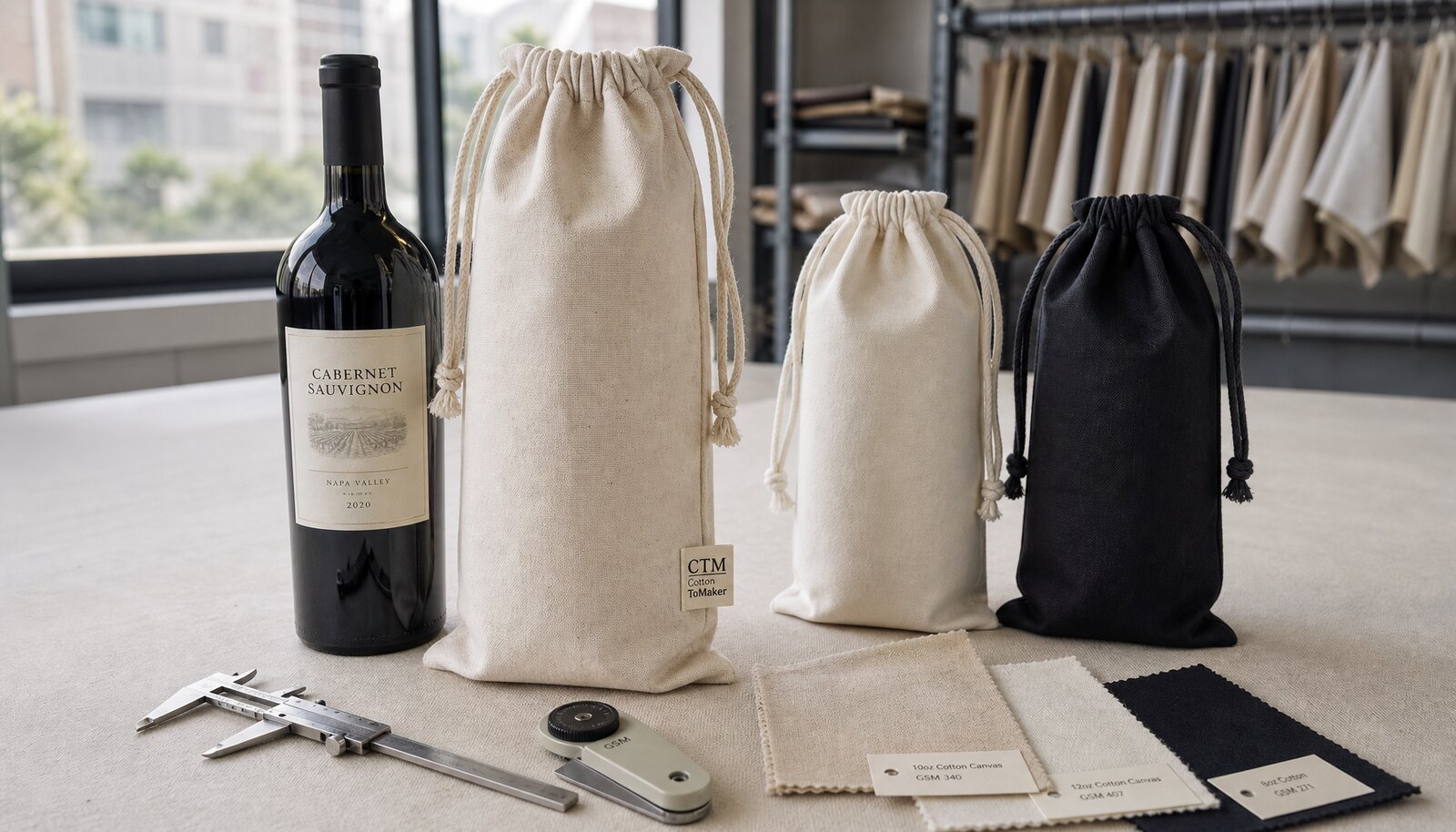
Start With The Bottle, Not The Fabric Shelf
A useful custom cotton drawstring pouches fabric weight guide for boutique wineries begins with the bottle in hand. GSM matters, but it cannot rescue a pouch that was patterned around the wrong glass. A 750 ml Bordeaux bottle, Burgundy bottle, tall Riesling or flute bottle, half bottle, and sparkling bottle can all push cotton in different places. Body diameter, shoulder slope, punt depth, capsule height, and label position decide how the pouch sits once it is filled. If the pouch is too narrow, the side seams pull and the front artwork rolls toward the edge. If it is too tall, the bottle drops into a soft column of fabric and the closed top looks unfinished.
Procurement should also name the job the pouch must do. A tasting-room giveaway can be lighter and simpler than a wine club insert that will be packed, shipped, stored, and opened by a paying member. Retail pouches need better face presentation because they sit beside labels, gift boxes, and other packaging. Corporate gift pouches may need a more substantial hand feel, cleaner folds, and tighter artwork placement. The same cotton bag can feel right in one channel and weak in another.
Before requesting samples, build a short fit brief. Include the bottle format, filled-bottle weight if relevant, closure type, neck tag, tasting card, insert, and any accessory. If one pouch must fit several SKUs, test the widest bottle, tallest bottle, heaviest bottle, and most difficult shoulder first. That awkward bottle will expose pattern problems quickly. Once fit and channel use are clear, fabric weight becomes a controlled purchasing decision instead of a guess.
- Measure bottle height, maximum body diameter, shoulder shape, closure height, label position, and any neck tag before setting the pouch pattern.
- Define whether the pouch is for tasting-room handoff, retail display, wine club packing, corporate gifting, event promotion, or reusable storage.
- Use the largest and most awkward bottle as the first fit test when one pouch must cover multiple bottle formats.
- Confirm whether the pouch must reduce label scuffing or only improve gift presentation.
- Approve logo visibility after the filled pouch is closed, not only on a flat sample.
Use GSM As A Specification, Not A Shortcut
GSM means grams per square meter. It is a useful measurement, but it is only one part of the fabric specification. Two cottons can both be described as 150 gsm and behave very differently. A loose muslin may feel relaxed and slightly open. A tight plain weave at the same weight can print more sharply and hide dark glass better. Brushing can make cotton feel fuller. Calendaring or other finishing can make a sample feel firmer than the bulk fabric later does. Buyers who ask only for medium cotton or premium cotton leave too much room for interpretation.
For winery sourcing, 120 to 135 gsm is usually a light promotional range. It can work for event handouts, wine trail promotions, release-day inserts, and pouches that are mainly a presentation layer. The 140 to 160 gsm range is the practical starting point for many single-bottle boutique winery programs because it balances opacity, print stability, sewing reliability, unit cost, and freight weight. The 180 to 220 gsm range fits premium gifts, reserve releases, embroidery, sewn patches, heavier bottle formats, and pouches expected to feel reusable.
Write the fabric requirement as a range or as a target with tolerance. A line such as 150 to 165 gsm natural cotton plain weave, finished fabric, is far clearer than 160 gsm cotton with no context. Also define where the measurement happens. Cotton weight can shift after dyeing, washing, steaming, pressing, brushing, or compacting. A supplier should state whether GSM is checked on greige fabric, finished fabric before cutting, or fabric sampled from finished production. That detail prevents arguments when bulk goods arrive slightly different from the first swatch.
- Use 120 to 135 gsm for light promotional programs and short-term presentation.
- Use 140 to 160 gsm for most single-bottle winery pouches balancing feel, cost, and print quality.
- Use 180 to 220 gsm for premium gift pouches, embroidery, heavier bottles, or reusable presentation.
- Define whether GSM is measured before finishing, after finishing, or from finished production fabric.
- Compare quotes only after GSM, weave, finish, size, decoration, packing, and inspection assumptions are aligned.
Choose The Weave Before Adding Weight
Heavier is not automatically better. Fabric construction often drives the customer impression as much as weight does. Muslin is soft, open, and economical. It suits relaxed tasting events, natural packaging language, and simple one-color branding. A tighter plain weave cotton gives better print control and usually better opacity at similar GSM, which is why it is a strong default for branded winery pouches. Twill has a diagonal rib and a more substantial feel, though the texture can soften fine print edges. Canvas gives structure, but it can look bulky if the pattern is not adjusted.
Unbleached cotton is popular with wineries because it feels tactile and low-intervention. It also varies. One lot may read warm cream, another gray-beige, and both may be sold as natural cotton. That variation becomes obvious when pouches from different cartons are used together at the tasting room. Dyed cotton offers more color control, but it adds approval steps, cost, and possible lead time. White cotton can look crisp, yet it shows warehouse dust, lint, and handling marks faster than natural cotton.
Ask for fabric swatches before full samples. Swatches let packaging, marketing, and operations teams compare shade, opacity, hand feel, weave texture, and print surface without waiting for a sewn pouch. For dark glass bottles, test opacity under the light where the pouch will actually be seen: tasting room, retail shelf, event tent, or fulfillment area. The best fabric is the one that supports the channel, the bottle, the decoration, and the landed cost target. Sometimes that is 145 gsm plain weave. Sometimes it is 200 gsm canvas. The point is to choose deliberately.
- Choose muslin when softness, low cost, and casual presentation matter more than opacity and structure.
- Choose tight plain weave cotton for balanced print clarity, opacity, and sewing reliability.
- Choose twill when the program needs a more substantial hand feel and visible textile texture.
- Choose canvas for premium gifts and shelf-facing packages where structure is part of the value signal.
- Approve natural cotton with a physical shade range because unbleached cotton varies by lot.
Size Around Usable Height
Finished pouch dimensions can be misleading when the RFQ lists only total width and total height. A drawstring pouch includes a top hem, cord channel, seam allowance, and gathered closure area. The usable height below the drawcord channel determines where the bottle sits and how much of the face remains clean for branding. If a logo is placed too high, the cord gathers through it. If it sits too low, it may curve under the bottle body or disappear when the pouch is carried. On a single-bottle pouch, a few millimeters can change the whole presentation.
Width needs the same care. Cotton has limited stretch, so a tight pouch may be slow to load during tasting-room service or fulfillment. It can distort the print, strain side seams, and make the closure feel forced. Too much width creates the opposite problem: the bottle shifts, the pouch looks baggy, and the front mark drifts off center. For small sewn pouches, plus or minus 5 mm on width and height is a common reference point, but the supplier should confirm what is workable for the selected fabric and sewing setup.
Accessories belong in the sizing test. A neck tag, tasting card, small opener, ribbon, hang card, or second item can change closure performance. If one pouch must support several bottle SKUs, create a simple fit matrix. List the smallest bottle, largest bottle, widest shoulder, tallest height, heaviest filled bottle, and accessory set. Then ask the supplier to sample against that matrix. Test insertion, drawcord closure, logo visibility, seam strain, and final presentation with real bottles, not substitutes.
- Specify total height and usable height below the drawcord channel as separate measurements.
- Set width for practical loading and clean presentation, not merely for the flat bottle diameter.
- Agree dimensional tolerance before bulk production; plus or minus 5 mm is a common reference point for small pouches but must be confirmed by supplier capability.
- Place artwork using a filled and closed pouch reference.
- Include neck tags, tasting cards, and gift accessories in sample approval if they will be used in production.
Match Decoration To The Cotton Surface
Decoration quality depends on the surface underneath it. Screen printing is often the safest choice for one-color and two-color winery logos because it is predictable, durable when properly cured, and cost-effective at volume. On light muslin, the fabric can shift during printing and fine edges may soften. On a tight 140 to 160 gsm plain weave, the surface is usually more stable. On heavier canvas, ink coverage can be strong, but the weave texture may still show through. That may be attractive for a rustic mark and unacceptable for tiny serif type.
Digital printing can help with multi-color artwork, gradients, or illustrations, but natural cotton can reduce contrast and shift color appearance. Heat transfer can deliver strong color on difficult fabrics, yet the film-like hand may clash with a natural winery aesthetic. Embroidery can feel premium, but it needs a stable base. On light cotton it may pucker, stiffen the mouth of the pouch, or distort the fabric. A woven side label or small sewn patch can be cleaner when the brand wants a restrained mark rather than a large face print.
A strike-off is a procurement control, not a nice-to-have. It should use the actual production fabric, actual artwork size, and intended ink or thread. Winery artwork often includes estate names, appellation text, vintage years, crest details, or fine rules. Those details can fill in on textured cotton. Ask the supplier to confirm minimum line width and minimum readable text height for the chosen method. For multi-color printing, define registration tolerance in millimeters. For all decoration, measure placement from fixed pouch edges after sewing, not from a rough visual center.
- Use screen printing for most one-color and two-color winery pouch designs.
- Require a strike-off on the actual production fabric before bulk printing.
- Avoid very small typography unless the supplier proves readability on the chosen fabric.
- Use embroidery on stable fabric, typically 180 gsm or heavier, or after a puckering test on the actual material.
- Consider woven side labels or sewn patches when a subtle premium mark is better than a large printed logo.
Write An RFQ Suppliers Can Price Cleanly
A strong RFQ turns a pouch idea into a manufacturing specification. Include finished size, usable height, bottle model, fabric composition, GSM range, weave, color, shade approval method, print method, artwork size, drawcord type, seam details, packing method, destination, and required delivery date. If the same pouch needs different packing for tasting room, retail, and wine club use, separate those lines. The sewn pouch may be identical, but folding, inner packs, carton labels, barcodes, and warehouse marks affect labor and cost.
MOQ should be discussed by SKU, not only by total order quantity. A winery may say it needs 6,000 pouches. The supplier may see three artwork versions, two cord colors, and two packing styles. Those splits affect cutting, print setup, line changeover, cartons, and QC. Ask for the exact split price and a consolidated alternative. Procurement can then decide whether each seasonal, varietal, or location version is worth the extra complexity.
Clarify what is included in the price. Some suppliers include pre-production samples, standard print screens, inner polybags, carton labels, and inspection photos. Others charge separately. Freight assumptions matter too. A 220 gsm canvas pouch packs and ships differently from a 140 gsm plain weave pouch. Unit price alone can hide setup charges, sample freight, inspection, defect risk, storage space, and receiving labor. The quote should make those assumptions visible before the purchase order is approved.
- Include size, usable height, fabric spec, color, decoration, cord, seam construction, packing, destination, and delivery date in the RFQ.
- Quote by SKU and by consolidated quantity so the cost of artwork, color, and packing splits is visible.
- State whether sample fees, print setup, proofing, inspection, polybags, carton labels, and barcode labels are included.
- Attach final-size artwork and define placement tolerance, commonly in millimeters from top or side reference points.
- Ask for carton dimensions, gross weight, and estimated pieces per carton before comparing landed cost.
Approve Samples Like Production Evidence
Sample approval should never stop at a flat pouch photo. Cotton changes when it wraps around glass and gathers at the drawcord. Insert the exact bottle, close the pouch, tie it if that is the intended use, and view it at normal handoff distance. Check whether the logo remains centered, whether side seams pull, whether the fabric looks too transparent over dark glass, and whether the cord moves smoothly. Repeat the action several times. A pouch can look good once and still be annoying in daily use.
The people who will handle the pouch should test it. Tasting-room staff can spot slow loading. Fulfillment teams can tell whether flat folds release cleanly or snag during packing. Retail teams can see whether carton compression leaves creases across the printed face. If pouches will be stored before a seasonal release, ask how packing protects them from odor, moisture, and crushing. Cotton can absorb warehouse smells, so clean storage and moisture control belong in the approval conversation.
Keep a physical reference set. At minimum, retain an approved fabric swatch, print strike-off, flat pouch, filled-pouch photo, and packing reference. The supplier should keep matching standards. If a future lot changes fabric shade, cord diameter, thread color, print ink, seam allowance, or folding method, the difference can be checked against the approved set. This matters for repeat winery programs, where the pouch may appear across several vintages and customers will notice drift even when no single piece is technically defective.
- Test the sample with the exact bottle and all accessories that will be used in production.
- Check fit, closure, logo visibility, side seam strain, opacity, and handling after the drawcord is closed.
- Have operational users test loading speed, cord feel, folding, and carton unpacking.
- Keep approved references for fabric, print, flat pouch, filled presentation, and packing.
- Require supplier notice and reapproval before changing fabric, cord, ink, stitching, or packing.
Set QC Standards Before Cutting Bulk
Quality control needs to be written before production starts. For boutique wineries, the common failures are wrong size, poor bottle fit, crooked print, weak seams, inconsistent shade, dirty fabric, bad odor, and drawcords that do not close cleanly. The pouch does not need an excessive inspection manual unless it is sold as premium retail packaging, but it does need objective acceptance criteria. Otherwise, receiving inspection becomes a subjective argument after cartons arrive.
A practical QC plan checks several stages. Fabric inspection should verify weight, width, shade, stains, holes, foreign fibers, and severe slubs before cutting. Cutting inspection should verify panel size and fabric orientation. Sewing inspection should check seam allowance, stitch density, channel width, thread trimming, skipped stitches, open seams, and blocked cord channels. Printing inspection should confirm artwork, color, registration, placement, cure, opacity, and rub resistance. Final inspection should check count, carton labels, folding, odor, and random bottle-in performance.
Define defect severity in plain procurement language. Critical defects make the pouch unusable, unsafe, or unacceptable for brand presentation: wrong artwork, mold odor, heavy stains, open seams, drawcord failure, or contamination. Major defects are visible and likely to affect customer perception: crooked logo, severe shade mismatch, poor fit, blocked cord channel, or dimensions outside tolerance. Minor defects might include a small loose thread or slight internal slub that does not show in normal use. Clear categories help the supplier inspect consistently and help the buyer make fair receiving decisions.
- Classify wrong artwork, mold odor, heavy stains, open seams, contamination, and drawcord failure as critical defects.
- Classify crooked print, visible shade mismatch, poor fit, blocked cord channels, and out-of-tolerance dimensions as major defects.
- Check fabric, cutting, sewing, printing, and final packing instead of relying only on end-of-line inspection.
- Run random bottle-in tests before shipment and again during receiving inspection.
- Require carton-level traceability when multiple fabric lots, print batches, or sewing lines are used.
Control Packing, Carton Labels, And Storage
Packing affects the pouch before a customer ever sees it. Cotton pouches should be folded consistently, and the fold should avoid hard creases across the logo whenever possible. Heavy compression can leave lasting marks, especially on canvas, brushed cotton, or heavily printed panels. Underfilled cartons can allow pouches to shift and wrinkle. The packing standard should balance freight efficiency with the condition required at the tasting room, retailer, or fulfillment center.
Inner packing should match the workflow. Bulk inner packs of 25, 50, or 100 pieces can be efficient for back-of-house use. Smaller inner packs with SKU labels may be better for retail distribution, multi-location winery groups, or mixed seasonal programs. Individual polybags add cost and packaging material, but they may be justified for light-colored cotton, retail-ready units, long storage, or humid shipping conditions. If the winery prefers reduced plastic, ask about paper bands, master poly liners, or recycled-content poly options, then confirm that the alternative still protects against moisture and dirt.
Carton marks are more than labels. They are a traceability tool. Each master carton should show PO number, SKU, pouch size, fabric color, print design, quantity, carton number, gross weight, net weight, and destination if needed. For multi-SKU programs, clear labels keep warehouse teams from opening cartons just to identify contents. They also help later if a shade issue, print issue, or odor concern appears in only part of the shipment.
- Specify fold direction and avoid hard creases across the main printed logo area.
- Set inner pack quantity based on receiving, storage, and daily issue workflow.
- Use individual polybags only when retail presentation, storage duration, light-color protection, or moisture risk justifies the cost.
- Require carton labels with PO, SKU, size, color, design, quantity, carton number, and destination.
- Confirm carton dimensions and gross weight before shipment for freight planning and warehouse handling.
Compare Landed Cost And Reorder Control
The lowest unit price is not always the lowest-cost decision. A 120 gsm pouch may save money but look too thin for a reserve bottle, force another sample round, or disappoint a corporate gift buyer. A 220 gsm canvas pouch may feel impressive but add freight weight, carton volume, sewing time, and storage needs beyond what the channel requires. Procurement should compare landed cost: unit price, setup, samples, artwork changes, inspection, packing, freight, duties where applicable, receiving labor, defect risk, and inventory carrying cost.
Lead time follows the slowest element in the specification. Stock natural cotton with a one-color screen print can usually move faster than custom-dyed fabric, special cord colors, embroidery, multi-color printing, retail barcoding, or complex kitting. Seasonal releases and wine club shipments leave little room for late corrections. Freeze artwork, bottle fit, fabric, and packing before production capacity is booked. If marketing expects vintage changes or seasonal art, give each version its own approval deadline.
Reorder control is a real procurement advantage for boutique wineries. Ask how the supplier records approved GSM, weave, shade range, pattern, cord, thread, print ink, artwork placement, packing, and inspection results. Natural cotton will not be perfectly identical from lot to lot, but a capable supplier can work within an approved range and document changes before they reach bulk production. For annual or semiannual pouch programs, a slightly higher price for repeatability may protect the brand better than a small one-time discount.
- Compare delivered landed cost, not unit price alone.
- Include setup, sample rounds, inspection, freight weight, carton density, duties, storage, and expected defect risk in the comparison.
- Freeze artwork, size, fabric, and packing before production slots are booked for seasonal programs.
- Ask how approved fabric, pattern, cord, print, thread, and packing details are recorded for future reorders.
- Treat repeatability as a sourcing requirement when the pouch will appear across multiple vintages, locations, or sales channels.
Specification comparison for buyers
| Spec decision | Recommended option | When it fits | Buyer risk to check |
|---|---|---|---|
| Fast tasting-room giveaway | 120 to 135 gsm natural cotton muslin or light plain weave | Event handouts, wine trail promotions, release-day inserts, and pouches used mainly for presentation rather than resale | Confirm opacity over dark glass, seam strength at the side seam and cord channel, and whether print edges look acceptable on the looser weave |
| Core single-bottle winery program | 140 to 160 gsm tight plain weave cotton, finished GSM specified with tolerance | Most boutique winery pouches for 750 ml bottles, wine club gifts, tasting-room sales, and seasonal reorder programs | Check bulk fabric weight within agreed range, shrinkage after finishing, logo position on filled pouch, and shade consistency between fabric lots |
| Premium retail or gift set pouch | 180 to 220 gsm cotton canvas, cotton twill, or brushed cotton with stable construction | Higher-value bottles, reserve releases, corporate gifts, two-piece presentation sets, and pouches expected to feel reusable | Expect higher material cost, heavier cartons, possible longer sewing time, and more visible defects if stitching or folding is uneven |
| Natural unbleached brand look | 140 to 160 gsm unbleached cotton with approved shade band and one-color screen print | Wineries wanting a tactile, low-ink presentation that complements kraft cartons, natural labels, or relaxed tasting-room packaging | Approve a physical shade range because unbleached cotton can vary from cream to gray-beige; do not rely on screen color approvals |
| Detailed logo or small typography | 160 to 180 gsm smoother plain weave or fine twill with strike-off approval | Artwork with estate names, appellation text, vintage years, fine linework, or more than one print color | Require a print strike-off on production fabric and define placement tolerance, registration tolerance, rub resistance, and minimum readable text size |
| Embroidery, woven patch, or sewn label | 180 gsm or heavier stable weave, or a sewn side label on midweight fabric | Premium club gifts, small crest marks, tactile branding, and programs where a subtle label is better than a large print | Check puckering, backing visibility, needle holes, label alignment, and whether the pouch still closes smoothly after decoration |
| Short domestic replenishment run | Stock 120 to 160 gsm blank pouch with local decoration | Late event needs, small tasting-room orders, emergency stock, small regional language versions, or limited release trials | Verify blank pouch dimensions and lot consistency; local decoration can change hand feel, scorch light cotton, or shift placement between runs |
| Direct factory repeat program | 150 to 180 gsm cotton with recorded weave, pattern, cord, print formula, and packing standard | Annual or semiannual winery packaging programs, multi-SKU purchasing, and brands that need reorder consistency across vintages | Ask how fabric lots, approved samples, inspection results, and production changes are documented for future reorders |
| Trading company bundle with other packaging | 150 to 180 gsm only if fabric source, factory ownership, and QC responsibility are clear | One purchase order covering pouches, wine boxes, tissue, ribbons, labels, and other gift packaging | Confirm who approves bulk, who owns claims, whether sewing is subcontracted, and whether inspection occurs at the pouch factory before consolidation |
Buyer checklist before sampling
- Measure the actual bottle height, widest diameter, shoulder shape, capsule or closure height, label thickness, neck tag, and any accessory before confirming pouch size.
- Define the pouch role: tasting-room handoff, retail package, wine club insert, corporate gift, event giveaway, reusable storage bag, or outer gift wrap.
- Specify finished pouch width and height, plus usable height below the drawcord channel; do not rely on total height alone.
- Write fabric as composition plus construction plus GSM range, such as 150 to 165 gsm natural cotton plain weave, finished fabric.
- Define acceptable dimensional tolerance, commonly plus or minus 5 mm for width and height on small pouches unless the supplier proposes a different workable standard.
- State whether GSM is measured on finished fabric before cutting or by testing fabric taken from finished production.
- Set shrinkage expectations after finishing, steaming, pressing, or washing; for cotton pouches, require the supplier to state expected shrinkage before sampling.
- Approve a physical shade range for natural or dyed cotton, especially if multiple lots or repeat orders are expected.
- Confirm print method, ink system where relevant, artwork size, color reference, placement tolerance, curing method, and strike-off approval process.
- Specify drawcord material, diameter, finished exposed length, knot style, color, and whether cotton, polyester, recycled polyester, or blended cord is acceptable.
Factory quote questions to send
- What exact fabric composition, weave construction, yarn style if known, finished GSM range, and finishing process are included in this price?
- Is the fabric stock, greige, custom dyed, custom woven, or purchased specifically for this order, and can the same mill or source support reorders?
- What finished pouch dimensions are you quoting, including total height, usable height below cord channel, width, hem depth, seam allowance, and drawcord length?
- What dimensional tolerance do you apply in bulk production, and is it measured flat before packing or after cartons are opened?
- How much shrinkage do you expect after fabric finishing, washing, steaming, or pressing, and at what production stage do you measure it?
- Which print method is included, what ink system will be used, and what setup charges apply per color, per design, per size, or per artwork revision?
- Can you provide a print strike-off on the exact production fabric before bulk printing, especially for natural cotton shade, fine typography, or multi-color artwork?
- What is the MOQ per pouch size, fabric color, print design, drawcord color, and packing style, and how does price change if SKUs are consolidated?
- What stitching details are included as standard, including stitch type, stitch density, seam allowance, hem width, reinforcement, thread composition, and thread color?
- What drawcord material, diameter, and color are included, and have you tested closure performance with the filled bottle weight and intended knot style?
Quality-control points to confirm
- Finished pouch width, total height, usable height, top hem depth, and drawcord length match the approved sample within the agreed tolerance.
- Fabric weight remains inside the contracted finished GSM range when checked from multiple fabric lots or cartons, not only from one pre-production swatch.
- Fabric weave, shade, opacity, and hand feel are consistent against the approved swatch range, with no unacceptable yellowing, gray cast, thin panels, or lot-to-lot mismatch.
- Bottle-in testing confirms the pouch fits the intended bottle, closes smoothly, does not strain side seams, and keeps the logo visible after the drawcord is pulled.
- Seams are straight and secure, with consistent stitch density, proper seam allowance, no skipped stitches, no broken needle marks, no loose seam ends, and no open seams.
- Cord channels are even, cleanly folded, reinforced where specified, and free from twisting, bunching, blocked openings, or tight spots that prevent easy closure.
- Drawcords match the approved material, color, diameter, exposed length, knot style, and pull performance without fraying, slipping out, or staining the fabric.
- Print color, opacity, registration, edge sharpness, placement, and cure match the approved strike-off and do not bleed, crack, transfer, or rub off under normal handling.
- Embroidery, woven labels, or sewn side tabs, if used, are aligned, secure, and free from puckering, backing show-through, loose threads, or sharp thread ends.
- No visible holes, stains, oil marks, mildew odor, foreign fibers, severe slubs, scorch marks, needle damage, or contamination appear on retail-facing surfaces.