Start with the coffee pack before choosing GSM
For coffee roasters, fabric weight is a procurement decision, not a cosmetic afterthought. The GSM affects how the pouch drapes around the inner coffee bag, how opaque the front panel looks, how cleanly a logo prints, how fast staff can fill the pouch, and how much weight is added to export cartons or parcel shipments. A custom cotton drawstring pouch for a 50 g tasting sachet does not need the same body as a gift pouch around a 250 g gusseted retail bag.
The first specification should describe the item going inside the pouch. Record the inner coffee bag width, height, gusset depth, sealed top shape, valve location, filled thickness, and whether the pack has stiff corners. If the pouch also holds brew guides, cards, filters, scoops, or accessories, include those in the sample test. Cotton pouches are flexible, but they are not magic; a hard foil bag can stress the lower corners and distort the print if the pouch is too light or too tight.
Buyers should also define the business use. A pouch inserted into a subscription box can be softer and flatter. A pouch used in a retail gift set needs better opacity and a cleaner filled shape. A pouch packed by a co-packer needs a consistent opening and closure so the line does not slow down. These differences change the correct GSM, seam construction, cord diameter, and packing method.
Cotton should normally be treated as outer packaging for coffee, not the primary coffee barrier. Roasted coffee needs appropriate protection for aroma, oil, moisture, and oxygen. Unless the supplier is specifically quoting a compliant food-contact material and construction, use a food-safe inner coffee bag and position the cotton drawstring pouch as the branded reusable or presentation layer.
A stable B2B program usually starts with one base pouch construction. Roasters can then vary the front print, hangtag, or label by blend or season. Standardizing the fabric, size, cord, and sewing construction makes repeat orders easier to match and gives procurement a clearer basis for comparing factories.
- For sample sachets and cards, 150 to 170 GSM may be enough when the load is light and reuse is not the main goal.
- For 100 g to 250 g inner coffee bags, 200 GSM cotton is often the practical starting point.
- For holiday gifts, retail displays, and premium bundles, 270 GSM canvas can improve structure and perceived value.
- For loose roasted coffee, specify a food-safe inner coffee bag; cotton alone is not a coffee barrier.
- For co-packing, test opening speed and drawstring closure, not only the empty sample appearance.
- For mailers, include compression, carton weight, and print creasing in the approval test.
Translate GSM and ounce weight correctly
Suppliers may quote cotton fabric in GSM, ounce weight, or both. GSM means grams per square meter. Ounce weight in bag production usually means ounces per square yard. A 4.5 oz cotton is roughly 150 GSM, 5 oz is roughly 170 GSM, 6 oz is roughly 200 GSM, 8 oz is roughly 270 GSM, and 10 oz is roughly 340 GSM. These conversions are approximate because finishing, moisture content, and mill standards can move the measured result.
Procurement teams should avoid quote language such as thick cotton, standard cotton, eco cotton, or premium canvas without measurable detail. Those phrases cannot be inspected. A stronger RFQ states the target fabric weight, acceptable tolerance, weave construction, color, finish, and whether the measurement is for finished fabric after processing. If the supplier measures greige fabric before washing, dyeing, or finishing, the final pouch may not match the buyer's expectation.
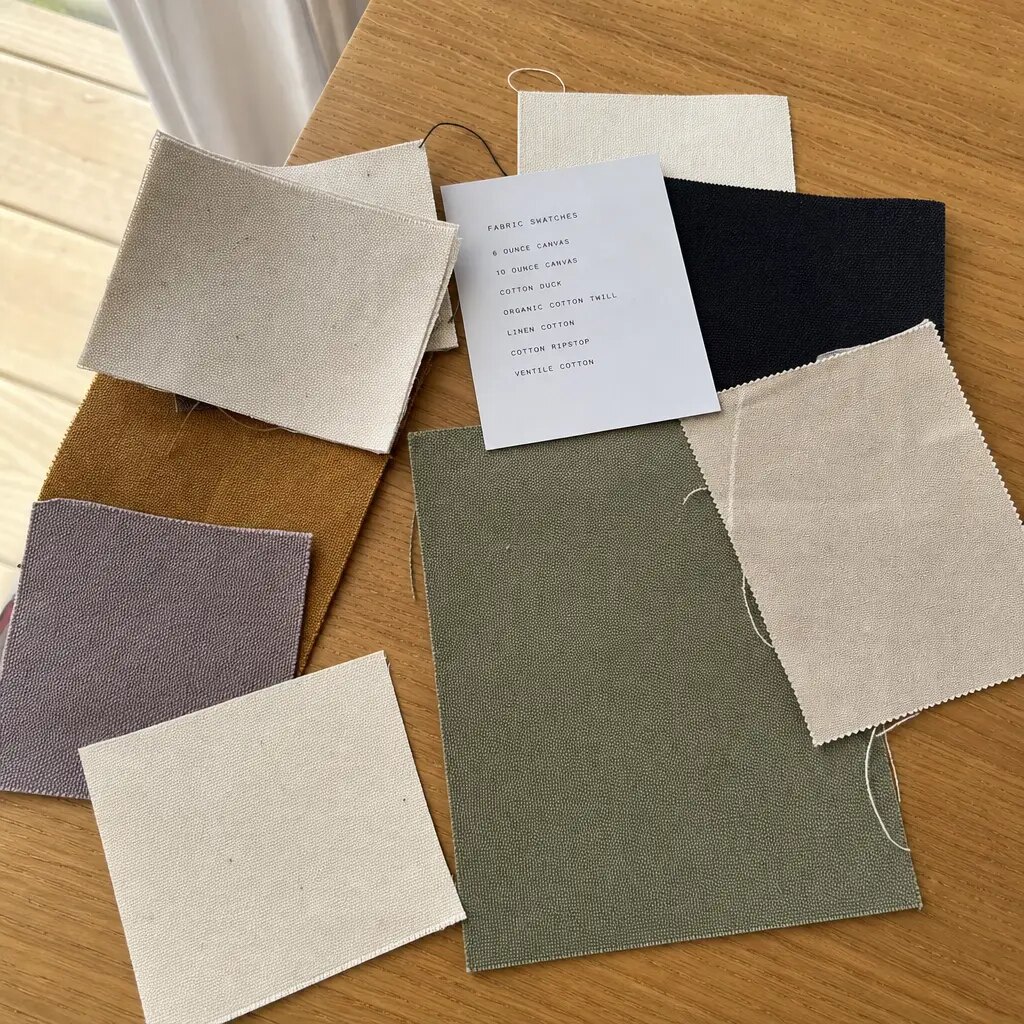
GSM is only one control point. Two fabrics can both be 200 GSM and behave differently. A loose plain weave may feel softer and more translucent, while a denser canvas may feel firmer and hide the inner bag better. The yarn thickness, weave density, fabric width, pre-shrinking, softening, and calendering all affect the final hand feel and print result. That is why a physical swatch is more useful than a number alone.
Natural cotton also needs a visual standard. Many roasters like the unbleached look, including small specks and fiber variation, but retail programs still need consistency. Ask the supplier to define the acceptable shade range and keep an approved swatch with the procurement file. For dyed cotton, request a lab dip or strike-off before bulk production, and confirm whether all cartons must match one dye lot.
For repeat orders, keep the approved sample, fabric swatch, GSM record, print strike-off, and carton label photo. That small archive prevents the next order from being treated as a new interpretation of the same pouch.
- 4.5 oz cotton: about 150 GSM, light, soft, lower opacity, lower load capacity.
- 5 oz cotton: about 170 GSM, suitable for small inserts, sachets, giveaways, and light sample packs.
- 6 oz cotton: about 200 GSM, common mid-weight choice for reusable coffee presentation pouches.
- 8 oz cotton canvas: about 270 GSM, firmer body for gift and retail use.
- 10 oz canvas: about 340 GSM, usually bulky for small drawstring pouches unless the design is intentionally heavy.
- Ask whether the quoted weight is finished fabric weight and what GSM tolerance will be accepted.
Match fabric weight to coffee use case
The right fabric weight is the lightest option that passes the real use test. Under-specifying cotton can lead to show-through, weak seams, poor print opacity, and a disposable feel. Over-specifying cotton can increase unit cost, freight weight, carton volume, and filling time. B2B buyers should choose by performance and total landed cost, not by the heaviest fabric available.
For dry sachets, flat cards, and low-load promotional inserts, 150 to 170 GSM can be economical. It folds easily, takes less carton space, and can still look clean with simple artwork. The limits appear when a dark or stiff inner pack is used. Lightweight cotton may reveal the shape and color of the item inside, and the front panel can wrinkle around sharp edges.
For most 100 g to 250 g inner coffee bags, 200 GSM is a better starting point. It has enough body for a reusable feel without making the drawstring channel too bulky. It also provides a more stable surface for one-color or two-color screen printing. This range is often suitable for subscription gifts, sampler kits, and retail coffee pouches where the cotton pouch supports brand presentation but does not need to stand rigidly by itself.
For holiday gift sets, event merchandise, and higher-value retail bundles, 270 GSM canvas can be worth the added cost. It improves structure and shelf presence, especially when the pouch will be handled repeatedly or displayed in baskets. The tradeoff is bulk. A heavy top hem with a thick cotton cord can make small pouches slow to close, so the supplier should adjust hem width and cord diameter to the pouch size.
The approval test should use the real product. Put the filled coffee pack inside the pouch, close it, leave it for 24 hours, and then check the front logo, seam stress, lower-corner abrasion, and closure smoothness. This simple test reveals problems that an empty sample will hide.
- Sampler pouch: 10 x 14 cm or 12 x 16 cm, 150 to 170 GSM, simple one-color print, light cord.
- 100 g coffee outer pouch: often 13 x 18 cm or 14 x 20 cm, around 200 GSM, tested with the real bag thickness.
- 250 g coffee gift pouch: often 16 x 24 cm or 18 x 26 cm, 200 to 270 GSM depending on gusset and shelf needs.
- Accessory pouch: 200 to 270 GSM if it holds scoops, filters, clips, or metal tools.
- Premium bundle pouch: 270 GSM canvas, wider opening, stronger cord, and clear carton packing rules.
- Sharp inner corners require abrasion checks on the lower front panel and side seams.
Control size, tolerance, and usable opening
Finished pouch dimensions are not the same as usable packing space. A pouch measured flat may seem large enough, but the top hem, cord channel, side seams, and filled thickness can reduce the opening and make insertion difficult. Coffee bags with gussets and valves need clearance beyond the flat product width. Procurement should ask suppliers to quote finished size and usable opening size separately.
A practical sizing method is to start with the real filled coffee bag and add handling clearance. The amount depends on fabric weight, pouch construction, and whether the pouch must close fully above the inner pack. If the pouch is too close to the coffee bag dimensions, workers may need to force the product inside, causing wrinkles, print distortion, and slower packing. If it is too large, the pouch may look loose and underfilled at retail.
Tolerances need to be written into the PO. For small pouches, plus or minus 5 mm on finished width or height is common. For larger pouches, plus or minus 10 mm may be more realistic. Tighter tolerances can increase cost and inspection rejects, especially with natural cotton that may shrink or relax during finishing. Logo placement should have its own tolerance, often plus or minus 3 to 5 mm depending on size and print method.
Buyers should specify measurement points. Measure body width below the drawstring channel, total height from top edge to bottom, usable height below the channel, hem channel width, and bottom fold if used. If the pouch must hold a retail bag upright, ask whether a box bottom, bottom fold, or simple flat seam is being quoted. Those constructions look different when filled.
For repeated orders, the approved sample should become the dimensional benchmark. Store a photo with a ruler and the measured values. That gives receiving teams a practical way to compare bulk goods without relying only on supplier paperwork.
- State finished width and finished height, plus usable opening width after sewing.
- Define top hem channel width and cord diameter together so closure remains smooth.
- Keep print placement away from seams and the drawstring channel, commonly at least 15 to 20 mm on small pouches.
- Use plus or minus 5 mm size tolerance for many small pouches and plus or minus 10 mm for larger pouches unless agreed otherwise.
- Specify whether the pouch is flat, has a bottom fold, or has a more structured base.
- Measure approval samples after pressing and again after the packed-product test.
Specify fabric construction and finishing
Fabric construction can matter as much as fabric weight. Plain weave cotton usually gives a softer, flatter, more flexible pouch. It is easier to fold into cartons and can work well for mailer inserts or subscription packaging. Cotton canvas has a denser body and stronger shelf presence. It is better when the pouch itself is part of the gift value, but it can become bulky on small sizes.
The buyer should ask for the weave construction, fabric width, and finishing process. Fabric width affects cutting yield and therefore cost. Finishing affects shrinkage, shade, surface feel, and print absorption. Pre-shrunk fabric can reduce size change after consumer washing, while softened fabric can feel better in hand but may absorb ink differently. Calendered or tightly finished fabric can print more sharply, but it may not have the natural texture some roasters want.
Natural cotton appearance should be controlled in plain language. Small specks, neps, and slubs may be acceptable if they support the brand look. Heavy oil stains, dark foreign fibers, holes, and inconsistent shade should not be accepted. The PO should define what is acceptable rather than leaving the factory to decide after production.
Dyed cotton introduces additional sourcing steps. The buyer may need lab dip approval, dye lot control, and a longer lead time. Dark fabric can also require a white underbase for screen printing, which affects cost and hand feel. If the roaster's brand color is strict, define the color reference and lighting condition for approval.
If sustainability positioning matters, be precise. Cotton, recycled cotton, organic cotton, and certified organic cotton are not the same claim. Any certification or chain-of-custody requirement must be named in the RFQ and supported by documents, not assumed from the word natural.
- Plain weave cotton: softer hand, lower bulk, easier folding, more casual appearance.
- Cotton canvas: firmer body, stronger shelf shape, more premium presentation, higher carton weight.
- Pre-shrunk fabric helps control later size change but should still be measured.
- Softening can improve hand feel and may change ink absorption.
- Dyed fabric may require lab dips, dye-lot control, and higher MOQ.
- Certification claims should be backed by named standards and supplier documents.
Choose print methods by artwork and fabric texture
Screen printing is usually the most practical print method for custom cotton drawstring pouches used by coffee roasters. It suits solid logos, roast names, simple icons, origin marks, and one to three color artwork. It is economical for repeat orders and can be durable when ink, mesh, curing, and fabric surface are matched properly. On coarse canvas, however, tiny text and hairline graphics may break across the weave.
Heat transfer can reproduce gradients, detailed multicolor graphics, and small color transitions, but it changes the hand feel. A transfer film may feel less natural than ink on cotton and must be tested for edge lifting, cracking, and adhesion. It can be a valid choice for complex artwork, but it should not be substituted without approval if the buyer expected screen print.
Embroidery can look premium, but it is not automatically better for coffee pouches. It adds cost, slows production, and can pucker small panels or distort lightweight fabrics. It is more suitable for simple badges, monograms, or reusable merchandise pouches than for detailed origin information or small text.
The RFQ should include print size, number of colors, artwork file format, Pantone or color reference if needed, and maximum printable area. Ask the supplier for minimum recommended line width and minimum text height on the selected fabric. As a rough procurement check, fine text below about 6 to 7 pt is risky on coarse canvas unless proven by a physical strike-off.
A printed strike-off is essential because the same ink looks different on natural cotton, bleached cotton, dyed cotton, 200 GSM plain weave, and 270 GSM canvas. Approve print color, opacity, edge sharpness, placement, and drying or curing quality on the actual production fabric. A digital mockup is useful for layout, but it is not a production approval sample.
- Use screen print for solid coffee logos, roast names, simple marks, and repeat bulk orders.
- Use transfer printing only when artwork complexity justifies it and adhesion is tested.
- Avoid fine legal text, QR codes, and thin lines on coarse fabric unless the supplier proves readability.
- For dark dyed cotton, confirm whether an underbase is needed for opacity.
- State print placement from fixed pouch references, not by eye.
- Check dry rub and light handling before approving bulk production.
Build RFQs that make supplier quotes comparable
Many custom pouch quotes look different because the products are different. One supplier may quote 170 GSM plain cotton with basic polyester cord and bulk carton packing. Another may quote 270 GSM canvas with cotton cord, printed strike-off, individual packing, and stronger cartons. Comparing only unit price hides the actual cost drivers and can lead to a poor buying decision.
A complete RFQ should give the factory the same information every time: finished size, target GSM, weave, fabric color, cord material, drawstring type, print method, artwork colors, print size, packing method, expected order quantity, destination, and required lead time. Ask the supplier to confirm assumptions back in writing. If a supplier changes the GSM or construction to meet a target price, that should be visible before sample approval.
Cost drivers include fabric consumption, fabric weight, cutting yield, labor time, print setup, number of print colors, cord quality, label or hangtag work, packing, carton strength, inspection, and freight. The small details matter. A wider hem channel, longer cord, or larger logo area can change cost when multiplied across thousands of pieces. Seasonal artwork can also add repeated screen setup charges.
Ask which charges are one-time and which are recurring. Screen fees, lab dips, strike-offs, courier sample freight, and artwork adjustments may be quoted separately. If the roaster plans to reorder the same pouch with different blend names, setup charges can affect the annual cost more than expected.
Landed cost matters more than ex-factory price. Heavier cotton can increase freight and warehouse handling, but it may reduce retail rejection risk and improve customer perception. A disciplined quote comparison should show unit cost, setup cost, sample cost, packing cost, carton data, estimated gross weight, freight terms, and lead time side by side.
- Require each quote to state GSM, oz weight, weave, fabric color, finished size, and tolerance.
- Separate one-time costs from recurring costs.
- Ask for screen charges by artwork and by color.
- Confirm whether sample freight, strike-offs, and lab dips are included.
- Request carton dimensions, quantity per carton, net weight, and gross weight.
- Do not compare quotes until cord, packing, print method, and inspection assumptions match.
Plan MOQ around blends, seasons, and repeat orders
Coffee roasters often want several pouch versions for espresso, decaf, single origin, subscriptions, and holiday gifts. MOQ can apply to different parts of the order: fabric color, pouch size, GSM, print artwork, cord color, or packing style. A supplier may allow several artworks in one order if the base pouch is identical, but each artwork may still need a separate screen and packing control.
The most efficient structure is one pouch size, one GSM, one fabric color, one cord, and several one-color front prints. The factory can cut and sew one base product, then separate artwork versions during printing and packing. This reduces cutting loss, shade variation, and inspection complexity. It also makes reorder matching easier because the construction does not change every season.
Complexity rises when the buyer changes fabric color, cord color, print method, and size by SKU. This may be justified for a major retail program, but it should be treated as multiple custom products, not one pouch order. Each variation needs a sample, inspection reference, carton label, and reorder record. Without that control, mixed cartons and mismatched shades become more likely.
For launch programs, a practical option is to use one natural cotton base pouch and differentiate blends with hangtags, paper labels, or small artwork changes. This keeps MOQ manageable while the roaster tests demand. Once annual volume is clearer, procurement can justify dyed fabric, heavier canvas, or more specialized sizes.
Ask suppliers what happens at reorder. If the first order uses stock fabric, will the next batch match it? If low MOQ depends on leftover fabric, is repeatability limited? A cheap launch quantity is only helpful if the packaging can be reproduced when demand increases.
- Best MOQ efficiency: same size, same GSM, same fabric color, same cord, different one-color prints.
- Moderate efficiency: same size and GSM, but different fabric or cord colors.
- Low efficiency: multiple sizes, multiple GSMs, multiple print methods, and SKU-specific packing.
- Ask MOQ per size, per color, per artwork, and per packing style.
- Use clear SKU labels and carton marks when multiple blends ship together.
- Forecast annual quantity when repeat shade consistency matters.
Approve samples with functional tests
A blank pouch sample checks approximate sewing quality, but it does not prove the full production result. Coffee buyers should approve fabric swatches, print strike-offs, and a finished pre-production sample made with the final materials. The best sample includes the selected GSM, selected fabric color, final cord, final print method, final logo placement, and final packing style.
Use the real inner coffee bag whenever possible. If coffee cannot be shipped for sampling, make a dummy with the same dimensions, thickness, stiffness, and weight. Insert it into the pouch, close the drawstring, stand the pouch upright, place it flat, and check whether the logo remains visible and centered. The pouch should look acceptable in the exact state the customer will see it, not only empty on a table.
Run a small handling test. Open and close the drawstring at least 20 cycles. Pull the seams with the filled pack inside. Rub the printed area lightly with a clean white cloth after the ink has cured. Place the packed pouch in the intended mailer or carton to check print creasing and closure pressure. These are simple checks, but they catch many practical failures before bulk production.
Measure the sample and keep records. Note total height, body width, usable opening, top hem, cord length, logo position, and pouch weight. Photograph the sample next to a ruler and keep the approved swatch. This helps receiving teams inspect bulk goods and helps the factory repeat the order later.
Approval should be written, not casual. State what is approved, what is still conditional, and what cannot change without buyer sign-off. If the supplier substitutes a different fabric lot, cord, print ink, or packing method after approval, procurement should be notified before bulk production continues.
- Approve a printed pre-production sample, not only a blank pouch.
- Test with the real coffee pack or a dimensionally accurate dummy.
- Measure top opening, body width, body height, hem channel, cord length, and print position.
- Open and close the drawstring at least 20 times on the approval sample.
- Check logo visibility when filled, tied, flat, upright, and packed in the mailer or carton.
- Store the approved sample, swatch, strike-off, and measurement record for reorders.
Put QC thresholds into the purchase order
Cotton drawstring pouches are simple, but bulk orders still need measurable quality thresholds. If the PO only says natural cotton pouch with logo, the buyer and supplier may disagree about size variation, shade difference, loose threads, print drift, and cord defects. A good technical sheet makes the product inspectable.
Defect classification should reflect business impact. Critical defects include safety or contamination issues, mold odor, wrong material, or any condition that makes the pouch unusable. Major defects include open seams, blocked drawstring channels, wrong print color, heavy print smearing, missing cord, incorrect size outside tolerance, wrong SKU packing, or severe stains. Minor defects may include small loose threads or natural cotton slubs within the approved standard.
Size and print tolerance should be written clearly. Common working ranges are plus or minus 5 mm for small pouches, plus or minus 10 mm for larger pouches, and plus or minus 3 to 5 mm for logo placement depending on pouch size. These are not universal rules; they are practical starting points to discuss with the factory. The tighter the tolerance, the more the buyer should expect careful sampling and possible cost impact.
AQL can be used as an inspection framework, but the defect list matters most. Agree on sample size, acceptable quality level, and what happens if inspection fails. Will the factory sort, rework, replace, discount, or hold shipment? Those answers should be clear before goods are packed for export.
QC should also include functional checks. Inspectors should open and close pouches, check cord security, verify carton counts, compare shade against the approved swatch, and check odor and moisture condition. For coffee packaging, cleanliness and odor control are especially important because cotton can absorb smells during storage and transport.
- Check GSM against approved swatch, commonly within plus or minus 5 percent unless otherwise agreed.
- Check finished size after sewing and pressing, not before sewing.
- Classify open seams, blocked channels, missing cords, wrong print, and heavy stains as major defects.
- Define acceptable natural specks and slubs before production.
- Measure logo placement from fixed reference points.
- Use the intended packed weight for seam and closure checks.
- Agree on inspection action if the shipment fails the sample plan.
Specification comparison for buyers
| Spec decision | Recommended option | When it fits | Buyer risk to check |
|---|---|---|---|
| Fabric weight for sampler pouch | 4.5 to 5 oz cotton, about 150 to 170 GSM | Dry sachets, tasting cards, light accessories, event giveaways, and low-load inserts | Can look translucent over dark inner packs; seams and print may distort if used for heavy or sharp coffee bags |
| Fabric weight for standard coffee gift pouch | 6 oz cotton, about 200 GSM | Common starting point for 100 g to 250 g inner coffee bags, subscription gifts, retail inserts, and reusable brand packaging | Test opacity, filled shape, seam stress, and logo placement with the real packed coffee bag |
| Fabric weight for premium retail or holiday pouch | 8 oz cotton canvas, about 270 GSM | Gift bundles, higher-value retail presentation, event merchandise, and pouches expected to hold shape better | Higher material cost, higher carton weight, bulkier top hem, and slower hand filling if the opening is too tight |
| Fabric construction | Plain weave cotton for soft folding; cotton canvas for firmer body | Plain weave suits mailers and light inserts; canvas suits shelf display and reusable gift packaging | Do not buy by GSM alone; yarn size, weave density, finishing, and shrinkage control change performance |
| Pouch sizing method | Size around the real inner pack plus handling clearance | Coffee bags with valves, gussets, sealed tops, or sharp corners need more room than flat artwork drawings suggest | Finished size and usable opening are different; confirm top channel width and drawstring clearance |
| Printing method | Screen print for 1 to 3 solid colors; transfer for complex multicolor artwork only when tested | Most roaster logos, roast names, icons, and simple origin marks work well as screen print | Fine text can break on coarse canvas; approve a strike-off on the final GSM and final fabric color |
| Cord and closure | Cotton cord for natural retail look; polyester cord for lower lint and smoother repeated closure | Cotton cord matches natural packaging; polyester can be practical for fulfillment speed and repeated handling | Cord diameter must match pouch size and top hem; thick cord can block closure on small pouches |
| MOQ structure | Quote MOQ by size, fabric color, GSM, print artwork, and packing style | Useful when roasters run espresso, decaf, single-origin, and seasonal SKUs on one base pouch | A low MOQ may rely on stock cloth or hand-cut production; confirm repeat-order consistency |
| Packing specification | Flat packed, 50 to 100 pcs per inner pack, export carton with SKU labels and moisture protection | Keeps pouches clean, countable, and easier to feed into roastery or co-packer operations | Over-tight packing can crease print; poor storage can cause odor, moisture marks, or mildew risk |
Buyer checklist before sampling
- Define the packed item first: inner coffee bag dimensions, fill weight, gusset depth, valve position, seal shape, and whether accessories or cards will be added.
- Choose GSM by load, opacity, shelf presentation, closure function, carton weight, and repeat use instead of selecting the cheapest cotton option.
- State fabric weight in both GSM and ounce weight where possible, and confirm whether the number refers to finished fabric after washing or greige fabric before finishing.
- Specify weave construction: plain weave cotton, cotton canvas, or another confirmed construction, not vague terms such as thick cotton or premium cotton.
- Request swatches for the exact fabric color, weave, GSM, and finish planned for production, including acceptable natural cotton specks and shade range.
- Approve a printed strike-off and a finished pre-production sample on the selected GSM, not only a blank size sample or digital artwork proof.
- Measure finished pouch width, height, top opening, hem channel width, bottom fold, and print location after sewing and pressing.
- Test the drawstring closure with the real inner coffee pack or an accurate dummy, including at least 20 open-close cycles for approval samples.
- Specify logo placement from fixed references such as side seam, top edge, or bottom fold to reduce print drift between batches.
- Define size tolerance, print-position tolerance, cord-length tolerance, and shade tolerance in the purchase order or technical sheet.
Factory quote questions to send
- What exact fabric weight will be used in GSM and oz per square yard, and is the weight measured before or after finishing?
- Is the fabric plain weave cotton, cotton canvas, or another construction, and can you provide fabric width, yarn description, and approved swatch reference?
- Is the fabric in stock or made to order, and what shade tolerance applies for natural, bleached, or dyed cotton?
- What are the finished pouch dimensions, usable opening width, seam allowance, top hem channel width, and finished size tolerance?
- What pouch construction is included: single drawstring or double drawstring, side seams, bottom fold, overlock or folded seams, and knot style?
- Which print method is quoted, how many colors are included, what ink or transfer type is used, and what is the maximum printable area?
- What minimum line width and minimum text size do you recommend for this exact fabric weight and weave?
- Will the print be tested on the selected GSM and selected fabric color before bulk production, and is the strike-off cost included?
- What cord material, cord diameter, cord length tolerance, cord-end treatment, and drawstring-channel construction are included?
- What MOQ applies per size, per GSM, per fabric color, per print artwork, and per packing style?
Quality-control points to confirm
- Fabric GSM checked against the approved swatch or technical sheet, commonly within plus or minus 5 percent unless a tighter range is agreed in writing.
- Finished pouch size checked after sewing and pressing, typically within plus or minus 5 mm for small pouches and plus or minus 10 mm for larger pouches.
- Usable opening checked separately from flat pouch width, because a bulky hem channel or thick cord can reduce packing speed.
- Print color, opacity, registration, edge sharpness, and placement compared with the approved strike-off under consistent lighting.
- Logo position measured from agreed reference points, with horizontal and vertical drift controlled to the purchase-order tolerance.
- Seam strength checked by hand pull and sample load test using the buyer's intended packed item weight plus a practical safety margin.
- Drawstring channel inspected for smooth closure, skipped stitches, blocked corners, exposed raw edges, and uneven top hem.
- Cord length, diameter, knot security, fraying, and cord-end consistency checked so the pouch opens and closes without slipping into the channel.
- Cotton cleanliness inspected for oil marks, heavy slubs beyond agreed standard, loose threads, foreign fibers, odor, moisture marks, and mildew risk.
- Packing verified for correct SKU count, inner-pack quantity, carton labeling, carton strength, moisture protection, and print-surface protection against scuffing.