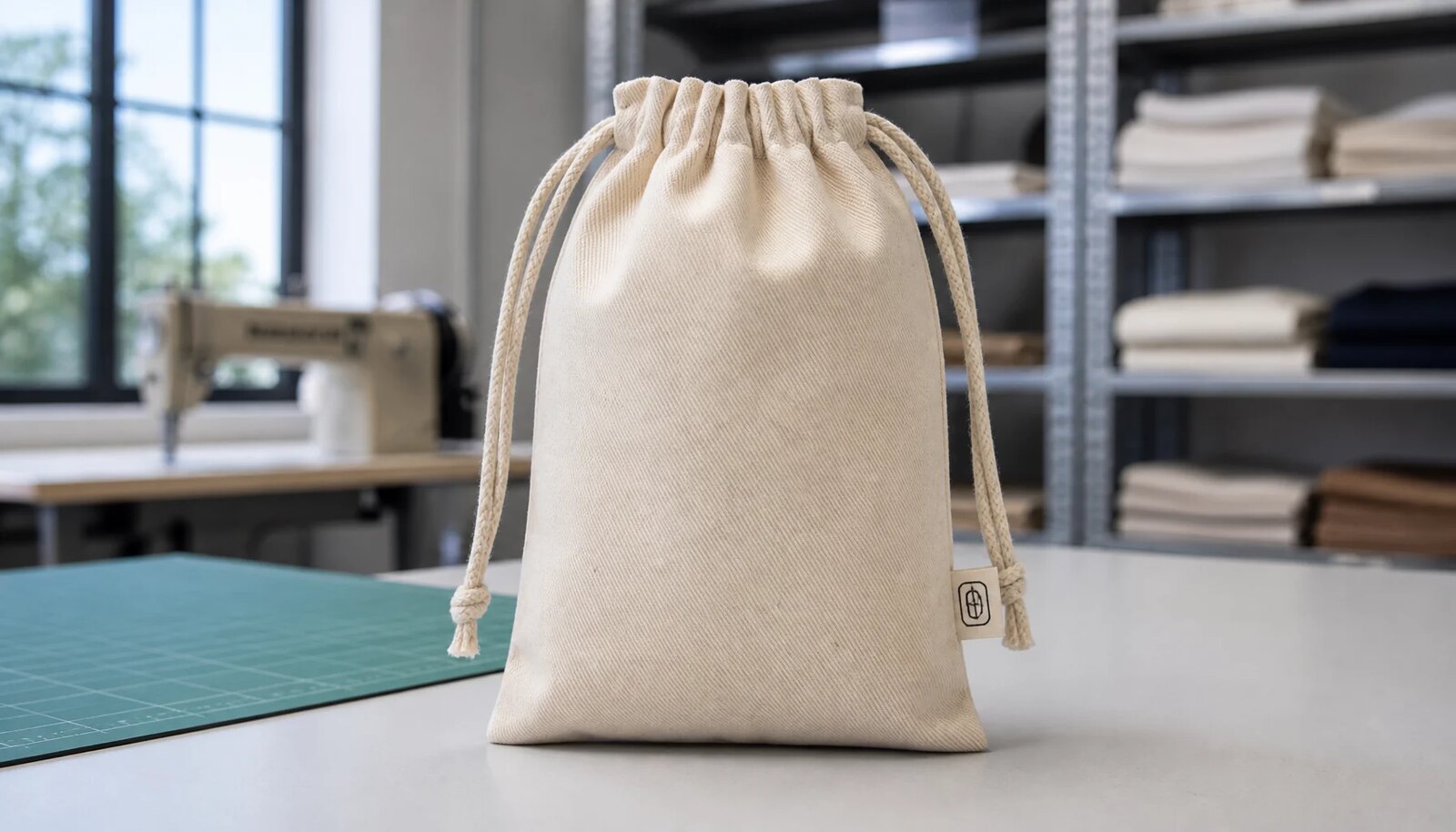
Define the Real Job of the Pouch
Durability starts with the use case, not the logo. A cotton drawstring pouch used as a dust bag inside an apparel carton has different risks from a pouch sold with a premium garment set or reused by the customer for travel. Before requesting prices, describe the packed product, the expected load, the number of open-close cycles, and the environment the pouch will pass through. That single step prevents a common sourcing problem: comparing quotes for products that look similar but are not built to perform the same job.
For light apparel inserts, buyers often consider 140 to 160 GSM cotton because it keeps unit cost and carton weight lower. For pouches that will be handled repeatedly, hold folded garments, or remain part of the customer experience, 180 to 220 GSM is usually a more realistic starting range. GSM is not a guarantee by itself, but it is a useful starting point when paired with weave, finish, seam construction, and cord quality.
Eco apparel brands also need to decide which sustainability claims must be supported by documents. Natural cotton appearance is not the same as organic cotton, recycled cotton, or certified material. If the pouch carries a claim, ask what evidence will be available before production starts, not after the goods are packed.
- Write the intended product load in kg, including any insert cards or accessories.
- Classify the pouch as packaging-only, reusable packaging, retail resale, or promotional kit.
- State whether the end customer may wash, wipe, fold, or travel with the pouch.
- Identify high-friction points: logo area, drawcord channel, bottom corners, and cord exits.
- List required claims and documents before the supplier quotes the order.
Lock the Specification Before Testing
Testing a loose sample spec gives loose results. The pre-production sample should match the bulk order in fabric, cord, thread, decoration, finish, size, and packing method. If the factory sends a showroom sample made from available cloth, treat it as a construction reference only. It should not become the approval sample unless the supplier confirms that the same materials and processes will be used for bulk production.
A strong pouch spec sheet should include finished width and height, gusset depth if any, fabric composition, GSM range, weave description, finish, seam allowance, stitch density, cord diameter, cord length, cord exit position, cord-end finish, print or label method, artwork position, and packing format. Add tolerances beside each measurable item. For example, finished dimensions may be approved at plus or minus 5 mm for many small and medium pouches, while print placement may be held to plus or minus 3 mm if the design needs tight alignment.
Also specify sequence where it matters. A pouch cut and sewn before washing may measure differently from one washed as fabric before cutting. A screen print applied after finishing may feel and age differently from decoration added before a wash process. If the order depends on a soft hand feel or stable dimensions, the production sequence belongs in the RFQ.
- Approve only samples made with the intended bulk material route.
- Record tolerance beside every critical measurement, not in a separate vague note.
- Confirm whether GSM is measured on greige, finished, washed, or production-ready cloth.
- Freeze cord diameter and cord length because they affect closure feel and carton packing.
- Attach final artwork files and placement measurements to the spec sheet.
Choose Fabric With Performance Evidence
Cotton fabric selection should be tied to the pouch's real load and life span. A heavier fabric can still fail if the weave is loose, the thread is weak, or the finish causes unexpected shrinkage. Ask suppliers for fabric construction details and a retained swatch from the fabric lot proposed for bulk production. For repeat orders, keep that swatch with the approved sample so the next shipment can be compared against the same baseline.
Finishing is a practical durability issue. Raw natural cotton may suit a low-cost or undyed look, but it can release lint, feel inconsistent across lots, or shrink more after washing. Prewashing, enzyme finishing, or compacting can improve hand feel and dimensional predictability, though they add cost and lead time. The right choice depends on whether the pouch is disposable packaging or a reusable item associated with the apparel brand.
When organic or recycled content is part of the brand promise, documentation matters. For organic cotton, buyers may need GOTS certification support or Organic Content Standard documentation, depending on the claim and sales channel. For general harmful-substance expectations, OEKO-TEX Standard 100 may be relevant. For recycled paper hangtags or cartons, FSC documentation may matter, but it does not validate the cotton itself. Ask what applies to the exact claim rather than collecting certificates that do not support the message.
- Pair GSM with weave, finish, and shrinkage expectation.
- Ask whether the fabric is stock, reserved, or custom milled for the order.
- Confirm expected shrinkage before approving patterns and print placement.
- Keep a bulk fabric swatch for reorder comparison.
- Match certificates and declarations to the specific claim being made.
Use a Practical Test Matrix
A useful durability plan focuses on likely failure modes: seam opening, cord pull-through, top-channel distortion, print wear, shrinkage, and packing damage. It does not need to copy a full luggage or garment test program unless the pouch is being sold for that purpose. The goal is to define a clear method, sample size, and pass/fail result so the supplier and buyer are judging the same thing.
For static load, avoid unsupported numbers. Instead, base the test on the intended packed load. A practical factory screening approach is to test at two to three times the expected filled weight for a defined hold period, such as 30 to 60 minutes, then inspect seams, cord exits, and dimensional recovery. If the pouch is intended to hold 1 kg of folded garments, a 2 kg or 3 kg screening load may be suitable. If it holds heavier kits, set the test higher and document why. For formal testing, ask the lab which textile seam strength, tensile, or component pull method is appropriate for the construction rather than inventing a lab standard.
Cycle testing is equally important. Open and close the pouch through a written number of cycles, such as 100 cycles for packaging that may be reused lightly or more for a reusable accessory program. After cycling, check cord movement, channel wear, cord fray, and top edge distortion. For wash exposure, use a named care condition where possible, such as ISO 6330 domestic washing procedures if a lab route is required, or a clearly written buyer-approved wash method for factory screening.
- Write the sample size, method, test load, hold time, and pass/fail criteria for each check.
- Base load tests on expected packed weight, not a generic number copied across all pouch sizes.
- Use cycle tests for cords and top channels because many failures happen after repeated pulling.
- Use third-party labs when a retailer, compliance team, or legal claim requires formal evidence.
- Photograph tested samples and keep them with the inspection record.
Inspect Seams, Cords, and Stress Points
Most cotton drawstring pouch failures start where force concentrates: the mouth seam, cord channel, cord exits, side seam, bottom corners, and any gusset intersection. These areas should be specified before production and measured during inspection. A pouch can look acceptable on the front face while loose threads, skipped stitches, or weak seam overlap inside the bag signal a high failure risk.
For many reusable cotton pouches, an 8 to 10 mm seam allowance and 8 to 10 stitches per inch on stress areas are reasonable buyer targets, provided the construction and fabric support them. These are procurement targets, not universal standards, so they should be confirmed with the factory sample and adjusted for very small pouches, heavy cloth, or special shapes. Bartacks or reinforcement at cord exits are often worthwhile because the cord transfers repeated force into a small area.
Cord quality deserves its own check. Confirm diameter, construction, color, and end finish. A loose spun cord may feel soft but fray quickly. A cord that is too thick for the channel may jam. A cord that is too thin can cut into the channel edge or look underbuilt. Inspect after cycle testing, not only when the pouch is new.
- Measure seam allowance on inspected units instead of judging by appearance.
- Reject open seams, broken top-channel stitches, and skipped stitches above the written limit.
- Check that cord exits match the approved reinforcement method.
- Measure cord diameter and compare it to the approved sample.
- Inspect the inside of the pouch for trapped loose threads and weak seam transitions.
Treat Decoration as a Durability Risk
Decoration is often where a pouch fails the brand experience. Screen print, transfer, embroidery, woven label, and side label each have a different risk profile. Screen print can be efficient and clean for one-color volume orders, but the ink system, cure, and fabric surface affect rub resistance. Woven labels and embroidery may last well, but they increase setup complexity and can change MOQ, lead time, and the way the pouch folds or packs.
Ask for the print method, ink type, cure process, artwork size, placement tolerance, and color standard. If formal testing is needed, dry and wet crocking can be assessed using recognized textile colorfastness approaches such as ISO 105-X12 or AATCC TM8, depending on the market and lab. For factory screening, define a simple rub method and acceptance limit in writing, such as no loss of logo legibility, no flaking, and no transfer above the approved visual reference after a stated number of rubs.
Placement also affects durability. Logos near the drawcord channel crease and abrade faster because the customer touches that area during every opening. Labels near bottom corners or hard garment hardware can rub during transit. A simpler decoration placed away from stress points may perform better than a richer decoration positioned where it will wear quickly.
- Approve final decoration on production fabric, not only on paper or digital mockup.
- Set artwork placement tolerance before bulk printing starts.
- Test dry rub and light damp rub when the pouch will be handled repeatedly.
- Keep logos away from cord channels and high-fold areas where possible.
- Confirm MOQ and lead time impact for labels, embroidery, multi-color art, and special inks.
Build Packing Into the Spec
Packing can create defects after sewing is finished. Over-compressed cartons can flatten cords, crease printed faces, and distort the top channel. Loose cartons can allow movement, abrasion, and edge wear. Cotton also absorbs moisture, so storage and transit conditions matter more than they do for some synthetic packaging items.
The packing spec should define units per bundle, bundle material, units per carton, carton dimensions, gross weight, carton marks, barcode or country-of-origin placement, and any plastic-free or recycled packing requirement. If the brand wants to reduce plastic, confirm the substitute material and the moisture risk. Recycled paper wrap may suit some routes, while long ocean transit or humid storage may require additional protection.
For higher-volume orders, request a pack-out photo before bulk release and consider a basic packed-carton drop or corner check. The goal is not to create a heavy test burden for a simple pouch. It is to confirm that the first cartons leaving the factory match the warehouse and retailer requirements.
- Approve packing before production finishes, not during final carton closing.
- Specify bundle count and carton count so warehouse receiving can audit quickly.
- Check that print faces are not rubbing directly against rough carton surfaces.
- Confirm carton strength, gross weight, and pallet pattern for large orders.
- Keep packing changes as approval items for reorders.
Compare Quotes Like a Buyer
A low unit price may hide a different product. One supplier may quote lighter fabric, another may exclude screen fees, and another may assume bulk packing when the brand expects retail-ready bundles. Ask each supplier to break out fabric, sewing, decoration, label, packing, carton, sample, testing, and courier costs. Then compare total cost, MOQ, lead time, and inspection evidence on the same sheet.
MOQ is usually driven by the least flexible process. Stock natural cotton and standard cord can keep MOQ lower. Custom dyed fabric, custom cord, woven labels, embroidery, special finishes, or multiple print colors can push MOQ up and add lead time. Ask the factory to name the MOQ driver instead of accepting a single unexplained number.
Lead time should be reviewed by step: material sourcing, sample making, pre-production approval, bulk cutting, sewing, decoration, inspection, packing, and export. If third-party testing or certification evidence is required, add it to the calendar before confirming a launch date. Durable sourcing depends on time discipline as much as stitch discipline.
- Compare total landed cost, not only FOB unit price.
- Ask suppliers to identify the main cost and MOQ drivers.
- Separate one-time setup costs from repeat-order costs.
- Confirm what happens if the buyer changes artwork after sample approval.
- Require written notice before any fabric, cord, ink, label, or packing substitution.
Approve Bulk With Measurable QC
Final inspection should convert the approved sample into measurable checks. Instead of saying the cord should pull smoothly, define the cycle count and failure conditions. Instead of saying print wear should not be visible, define the rub method and what counts as failure: cracking, peeling, bleeding, transfer, or loss of legibility. Instead of saying the carton should not be crushed, define carton condition, count accuracy, and whether compression affects saleable use.
Use a sampling plan appropriate for the order size and buyer risk. Many buyers and inspection teams refer to ANSI/ASQ Z1.4 or ISO 2859-1 sampling frameworks for lot inspection, but the exact AQL level should match the product, customer expectation, and defect type. Critical issues such as wrong material claim, unsafe contamination, wrong country-of-origin label, or unusable closure should not be treated like minor loose threads.
For reorders, keep a sealed golden sample, measurement sheet, artwork file, and packing record. If the supplier changes fabric lot, cord lot, ink, or label supplier, treat that as a new approval point. A repeatable QC routine protects the brand from quiet drift across seasons.
- Use measurable limits for dimensions, stitch defects, print placement, shrinkage, and cord performance.
- Classify defects as critical, major, or minor before inspection starts.
- Pull samples from the first, middle, and last cartons, not only the top layer.
- Record fabric lot, cord lot, ink batch, and label lot where available.
- Keep inspection photos and tested samples for reorder comparison.
Specification comparison for buyers
| Spec decision | Procurement tradeoff | Cost, MOQ, or lead-time impact | Inspection evidence to request |
|---|---|---|---|
| Fabric weight | 140 to 160 GSM can work for light packaging; 180 to 220 GSM is safer for repeated handling, folded apparel sets, or retail resale | Higher GSM usually increases unit cost and carton weight; custom fabric lots may raise MOQ and add mill lead time | GSM test record, fabric composition statement, approved swatch, and measurement from bulk cloth before cutting |
| Fabric finish | Raw natural cotton has a lower process cost; prewashed or enzyme-finished cloth gives better hand feel and more predictable shrinkage | Finishing adds cost and time, but can reduce size drift and customer complaints on reusable pouches | Finish description, shrinkage test result, shade approval, and confirmation whether GSM is measured before or after finishing |
| Cord type | Standard cotton cord is fast and affordable; custom dyed, thicker, or branded cord improves feel but adds variables | Custom cord color or diameter can raise MOQ and delay sampling if the cord is not in stock | Cord diameter measurement, pull test result, cord lot confirmation, and approved end finish sample |
| Seam build | Single-needle sewing may suit low-risk inserts; reinforced top seams and bartacks are better for reusable pouches | Reinforcement adds sewing time but is usually cheaper than replacing failed goods after shipment | Stitch density check, seam allowance check, photos of inside seams, and inspection of cord exit reinforcement |
| Decoration method | One-color screen print is efficient for volume; woven label, side label, or embroidery can improve perceived value and reduce print-wear risk | Screen setup fees affect small runs; labels and embroidery may have higher MOQ and longer approval time | Artwork placement sheet, color standard, dry and wet crocking or rub record, and approved pre-production print sample |
| Testing route | Factory screening is useful for early filtering; third-party lab testing is better when a retailer, internal compliance team, or high-value order needs evidence | Lab tests add cost and calendar time, so reserve them for defined risks or customer requirements | Test method name, sample size, pass/fail tolerance, dated report, and photos of tested samples |
| Packing route | Bulk packing lowers cost; bundle wrapping, carton dividers, or recycled inner wrap improves protection for prints and finished goods | More protective packing raises material cost and carton volume, but can prevent creasing and abrasion in transit | Pack-out photo, carton spec, units per carton, drop-check record, and gross weight confirmation |
| Sourcing route | Stock fabric and standard cord shorten lead time; custom fabric, dye, finish, or trim gives better brand control | Custom materials usually increase MOQ, sample rounds, and risk of shade or hand-feel variation | Material lot numbers, reserve quantity confirmation, certificate copies where relevant, and written substitution policy |
Buyer checklist before sampling
- Define end use: packaging only, reusable garment pouch, retail resale item, sample kit, or customer gift.
- State the intended packed product, expected load in kg, and whether the pouch will be washed, wiped, stored humid, or repeatedly opened.
- Freeze finished width, height, gusset if any, seam allowance, cord diameter, cord length, exit placement, and print or label position before sampling.
- Confirm fabric composition, target GSM, weave type, finish, shade, and whether weight is measured before or after finishing.
- Set measurable tolerances for finished size, shrinkage, stitch density, seam allowance, cord pull, print placement, and print wear.
- Request a pre-production sample made from bulk fabric, bulk cord, final thread, and final decoration method.
- Choose test routes: factory screening for early samples, third-party testing when retailer compliance, claim support, or order value justifies it.
- Ask for a quote that separates fabric, cutting and sewing, decoration, labels, packing, cartons, sample cost, testing, and courier charges.
- Confirm packing format, unit count per bundle, units per carton, carton dimensions, carton gross weight, and any recycled or plastic-free packing requirement.
- Collect documentation relevant to the claim: fiber content declaration, OEKO-TEX Standard 100 if required for harmful substance screening, GOTS or OCS transaction support if organic content is being claimed, FSC paper documentation for hangtags or cartons if applicable, and country-of-origin marking requirements.
Factory quote questions to send
- What fabric composition, weave, GSM, and finish are included, and is the GSM measured before or after washing, dyeing, or finishing?
- Will the pre-production sample be made from the same fabric lot, cord lot, thread, ink, and label material planned for bulk production?
- What seam allowance, stitch density, stitch type, and reinforcement will you use at the top channel, side seam, bottom corners, and cord exits?
- What cord diameter, cord construction, cord-end finish, and pull-force result can you document?
- Which durability checks can you run in-house, what method will you use, how many samples will be tested, and what pass/fail limit will be recorded?
- If third-party testing is needed, which lab can you support, what sample quantity is required, and how many days should be added to the schedule?
- What are the MOQ and price breaks by fabric, size, color, cord type, print method, label type, and packing route?
- Which costs are excluded from the unit price: sample fee, screen or plate fee, label mold fee, testing fee, carton fee, inner wrap, barcode sticker, or courier cost?
- What is the lead time for lab dips if any, salesman sample, pre-production sample, material procurement, bulk sewing, decoration, inspection, and packing?
- What is the overrun or underrun allowance, defect replacement policy, and rework process if bulk goods do not match the approved sample?
Quality-control points to confirm
- Finished width and height are within the approved tolerance, commonly plus or minus 5 mm for small and medium pouches or the buyer's written tolerance for larger sizes.
- Fabric GSM is within the agreed range, for example plus or minus 5 percent from the approved bulk fabric target unless another tolerance is written.
- Seam allowance measures at least the approved minimum, and stitch density stays within the agreed range, such as 8 to 10 stitches per inch on stress areas.
- No skipped stitch longer than 10 mm, no open seam, no broken top-channel stitch, and no loose thread longer than 15 mm on inspected units.
- Cord exits are reinforced as approved, with no tearing, hole enlargement over the agreed limit, or cord slipping into the channel during the cycle check.
- Cord moves through the channel without jamming after the agreed open-close cycle count, and cord-end fray does not exceed the approved limit.
- Static load or hang test uses the written load, hold time, and sample count; pass means no seam opening, no cord pull-through, and no permanent distortion beyond the approved dimensional tolerance after recovery.
- Print or label placement is within the approved tolerance, commonly plus or minus 3 mm for small logos or the buyer's artwork sheet tolerance.
- Decoration passes the agreed dry and damp rub check with no transfer above the approved grade or no cracking, peeling, bleeding, or loss of legibility under the written visual standard.
- Packing matches the approved count, bundle method, carton size, carton marking, barcode or origin label placement, and carton condition with no compression damage affecting saleable use.