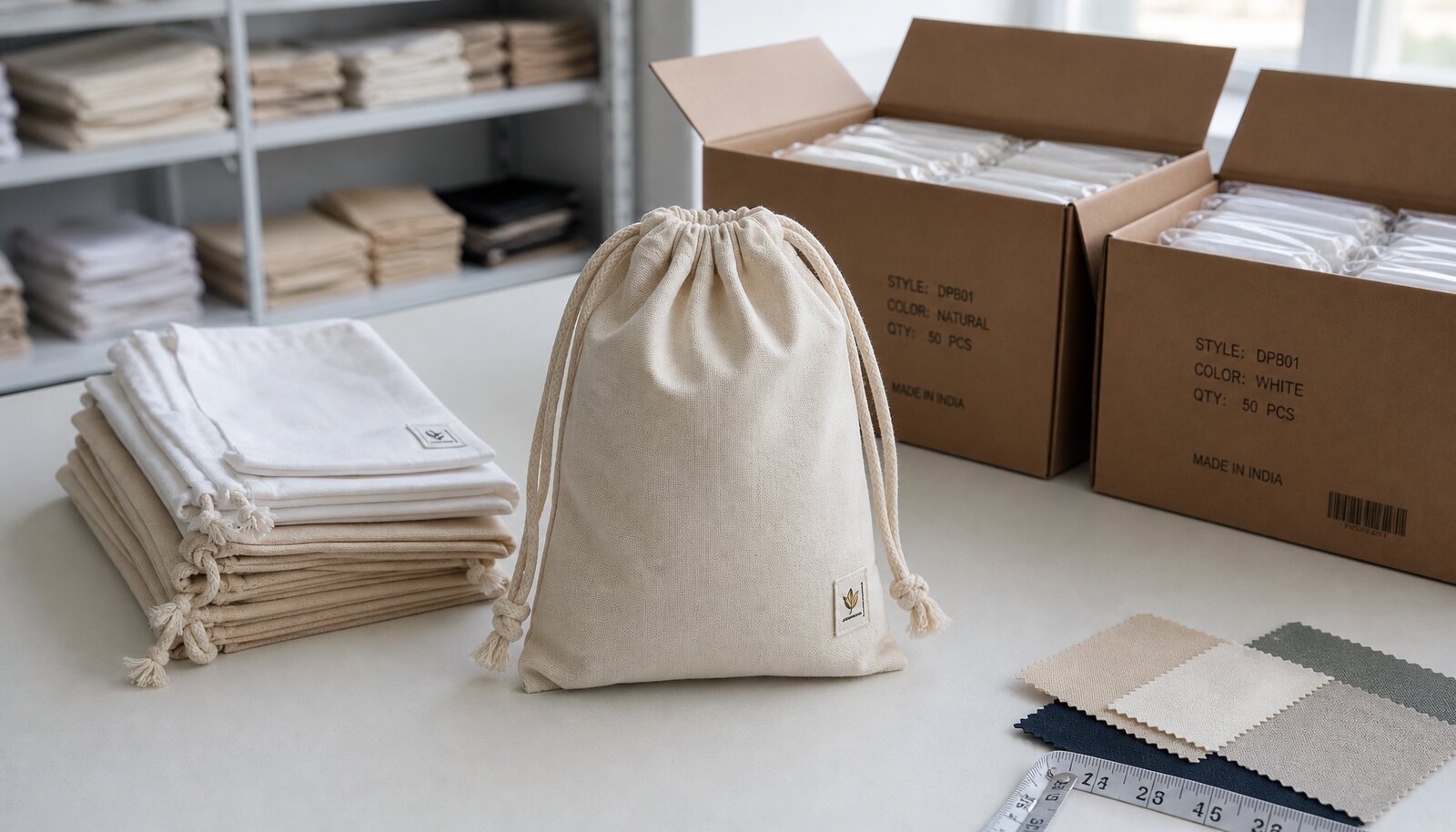
Why carton packing matters more than the pouch itself
For custom cotton drawstring pouches sold through gift shops, the product often fails at the handoff between sewing, packing, freight, and warehouse receiving, not at the point of manufacture. A pouch can look good in a photo and still create problems if the carton count is wrong, the labels do not match the PO, or the pack method leaves the fabric crushed by the time it reaches store replenishment. In that sense, carton packing is not a logistics afterthought. It is part of the product specification.
A proper carton packing plan protects three things at once: count accuracy, presentation quality, and handling efficiency. Gift shop buyers usually care about shelf-readiness, clean receiving, and predictable replenishment. If those requirements are not written into the RFQ, the factory will use its default packing habit, and the final offer will not be comparable from supplier to supplier. The cheapest quote can become the most expensive one once you account for rework, freight volume, and warehouse time.
- Packing affects damage rate, receiving time, freight volume, and store presentation.
- A clean carton pack can make the same pouch look retail-ready; a loose pack can make it feel unfinished.
- For gift shops, carton packing should be specified with the same discipline as fabric weight and print method.
Define the SKU structure before asking for a price
The first sourcing mistake is treating all drawstring pouches as one product. In practice, every change in size, color, print position, or label style is a separate SKU, and that matters when the order reaches packing and receiving. If your gift shop program includes multiple sizes or seasonal colorways, the supplier needs to know how the SKU matrix will be packed. A single clean SKU per carton is usually easier for receiving, easier to count, and easier to reconcile if there is a discrepancy.
If you are building an assortment for retail rather than a one-off promotion, map the SKU architecture before the RFQ goes out. A 3-size range with 2 fabric colors and 2 artwork versions is already 12 combinations if everything is allowed to mix. That can be fine for a display program, but it is a poor default for export or distributor receiving. The more variation you add, the more important it becomes to define whether cartons are single-SKU, inner packs are single-color, and pallet layers are kept separate by style.
- Write each size, color, and artwork version as a separate SKU unless you have a receiving reason to mix them.
- If you do allow mixed cartons, define the exact mix ratio and carton label format in writing.
- Seasonal gift-shop assortments usually work better with clear SKU separation than with mixed carton logic.
Choose fabric, size, and closure with packing behavior in mind
For most custom cotton drawstring pouches, 120-140 gsm is the practical starting range. It is heavy enough to give the pouch body and a more finished retail feel, but not so heavy that small sizes become bulky in the carton or expensive in freight. Below that range, the pouch can show the shape of the item inside and feel too light for gift presentation. Above that range, the unit may look premium, but the carton becomes heavier, the sewing can slow down, and the freight cost climbs faster than buyers expect.
Size and closure design matter just as much as cloth weight. A small pouch with a tight channel and short cord behaves differently in packing than a larger pouch intended for candles or boxed gifts. Natural unbleached cotton is often a sensible default for eco-oriented gift shops, while bleached white cotton works better when the logo needs a clean background or the assortment must look visually consistent on shelf. Cord material, cord length, and knot security also affect the pack. Weak cord ends can slip during handling, and inconsistent cord length makes the final packed pouch look uneven even if the sewing is correct.
- Use lighter cloth for low-ticket giveaways and heavier cloth for premium or reusable gift packaging.
- State the finished size clearly, not only the cut size, because folding and seam construction change the usable body area.
- Keep the cord and channel spec simple unless the brand has a clear retail reason to customize it.
Let the decoration method support the carton plan, not fight it
Decoration decisions should be made with the carton in mind. A simple one-color screen print is usually the most dependable choice for bulk gift-shop runs because it is easy to quote, easy to inspect, and usually stable enough for repeat orders. It also stays legible after the pouch is folded and stacked, which matters when the logo must still read clearly after warehouse handling. When the artwork is simple, screen print is often the cleanest answer for both price and quality control.
Woven labels, sewn side tabs, and other premium finishing details are useful when the gift shop positioning justifies them, but they affect how the pouch packs. A sewn label can create a raised edge, which may need a different fold direction to avoid crushing the label in transit. Heat transfer can work for short runs or complex artwork, but it is less forgiving when cartons are compressed or handled roughly. If color accuracy matters, make the factory quote the art size, placement, print count, and any Pantone reference rather than accepting a broad 'logo print included' line.
- Ask for print size in millimeters and placement relative to the pouch centerline.
- If the logo is color-sensitive, name the Pantone reference and the acceptable variation range.
- For premium gift-shop ranges, compare a simple screen print against a woven label plus print before deciding the final pack format.
Write the carton packing plan line by line
A usable carton packing plan is short, specific, and easy for a factory line to follow. It should answer five questions: how the pouch is folded, how many pieces go into each inner pack, whether the inner pack is polybagged, how many inner packs go into the export carton, and how the carton is marked. If any of those points are left open, the supplier will fill the gap with its own default. That is where count disputes, crushed labels, and incompatible carton sizes usually start.
A common starting point for many gift-shop pouches is one pouch per clear inner polybag, then a master carton count that keeps the box within a warehouse-friendly weight range. Smaller pouches can often ship in higher carton counts; larger or heavier pouches should ship in lower counts to reduce crush risk and make receiving easier. The carton should be sized to avoid excess void space, but not so tight that the drawcord area is compressed. If the pouch has a print on one side, approve which face points outward in the folded pack so the logo stays protected.
- State the folding method and include a packed sample photo in the approval set.
- Define the inner-pack count and the maximum gross weight per carton.
- Require the carton to show PO number, SKU, size, color, piece count, carton number, and any barcode your warehouse needs.
- If you expect palletized delivery, state pallet height, layer count, and whether cartons must stay single-SKU on each layer.
Compare quotes on landed cost, not just unit price
A low unit price is not a useful comparison unless the quotations are built on the same basis. One supplier may include carton packing, polybags, and a basic printed label. Another may quote only the sewn pouch and charge separately for packing, cartons, and sample approvals. If you are buying for a gift shop program that must be received cleanly and quickly, those hidden items are not optional. They are part of the real landed cost.
Lead time belongs in the same comparison. A supplier that ships a little faster may be more valuable than a marginally cheaper one if your retail calendar is seasonal. Ask each factory to quote the same assumptions: fabric weight, color, print count, folding method, inner-pack count, carton dimension, and shipment term. Then compare not just the price per piece, but also the freight volume, carton strength, and the risk of SKU mix at receiving. That is the level procurement buyers need if they want a defensible decision.
- Separate material cost, sewing cost, print cost, packing cost, and carton cost when you compare offers.
- Ask which items are included in the price and which ones are line-item add-ons.
- Request carton dimensions in the quote so you can estimate freight and warehouse fit before placing the order.
- If the supplier cannot state carton weight or pack count, the quote is incomplete for procurement use.
Sample approval should mirror the actual production method
A sample is only useful when it reflects how the bulk order will actually be made. For custom cotton drawstring pouches, a hand-finished prototype that uses different cloth, a different cord, or a loose fold tells you very little about the real production result. The approval set should be staged: first a fabric swatch, then a blank pre-production sample, then a printed approval sample, and finally a packed sample carton. Each stage answers a different question, and together they show whether the supplier can produce a repeatable retail-ready result.
The packed sample carton is especially important for gift shops because it shows whether the pouch still looks clean once folded, bagged, and stacked. It also gives the warehouse a chance to test carton labels, count logic, and unpacking sequence before the full shipment arrives. If the pouch is going to a distributor or a multi-store network, ask for a packed carton that mirrors the final line packing. That is far more valuable than approving a loose sample that never had to survive transport or pallet stacking.
- Check body size, channel height, cord length, and logo position on the approval sample.
- Inspect the packed sample to confirm fold direction, inner pack count, and carton fill.
- Use the sample carton to test whether labels are readable and whether the warehouse can receive the shipment without rework.
Use QC thresholds that catch real failure modes
QC for drawstring pouches should focus on the failure modes that matter in retail. The common problems are not exotic: weak seams, loose cord knots, print misalignment, shade drift, stain marks, and count errors. A buyer does not need a complicated inspection matrix to control those risks, but the thresholds do need to be written down before production starts. If the factory knows the seam allowance, logo position, and carton count it must hit, the line can inspect to those points instead of guessing.
For remote orders, ask the supplier to check top, middle, and bottom pieces from each carton so packing defects do not stay hidden. If the shipment lane is long-haul or ocean freight, pay attention to carton compression and gross weight. A carton that is overfilled may pass the factory's visual check and still fail at receiving because the corners collapse or the labels scuff off. For gift-shop buyers, a simple QC rule is better than a vague one: no mixed SKUs unless approved, no visible stains, no broken threads, no unreadable carton marks, and no count variance.
- Use agreed size tolerance, seam tolerance, and print placement tolerance instead of relying on visual judgment alone.
- Reject any carton with mixed contents unless mixed packing was approved in writing.
- Check smell, oil marks, shade variation, and label readability before shipment release.
- If the route is rough or the shipment is long, request a carton compression or top-load check from the factory.
Carton labels and palletization should match warehouse receiving rules
Carton labels are not just shipping decoration. They are the link between the factory pack line and your warehouse system. At minimum, a carton label should carry the PO number, SKU, size, color, piece count, carton number, gross and net weight if required, and any barcode or country-of-origin marking the destination market needs. If the buyer, forwarder, and warehouse all use different reference numbers, include the supplier code as well so the shipment can be traced without a phone call.
Palletization should be decided before the order is confirmed, not after production is complete. Some warehouses want cartons by single SKU, layer, or pallet, while others only care that the pallet arrives stable and readable. If your warehouse receives by pallet, confirm stack height, wrap method, and whether mixed-SKU pallets are allowed. For gift-shop replenishment, a stable pallet with clear labels usually saves time during receiving and putaway. The point is not to make the pallet look neat for its own sake. The point is to let the warehouse count it quickly and store it without re-sorting.
- Put the carton mark format in the RFQ so labels are quoted consistently.
- Confirm whether barcodes must scan at receiving and which barcode standard the warehouse uses.
- Specify pallet height, wrap type, and stack pattern if the shipment will be palletized.
- Keep cartons single-SKU unless your receiving team explicitly prefers mixed pallets.
Lock the spec so repeat orders do not drift
Repeat orders are where many otherwise good suppliers start to drift. The factory may keep the same pouch shape but change the fold, swap carton size, adjust the inner pack count, or use a slightly different cord supplier. Individually those changes can seem minor, but together they create a different receiving experience. The fix is simple: freeze the spec version. Keep the same finished size, fabric weight, print size, fold method, carton dimensions, label format, and pallet rules unless you deliberately authorize a change.
A change log is the right procurement tool for this product family. If you need to alter one variable, change only one variable and keep the rest stable. That makes it much easier to compare the next run with the last one and to trace any issue back to its cause. For gift-shop programs, consistency matters as much as originality. Buyers who run seasonal assortments or reorders will get better results when the spec is treated as a controlled document instead of an informal email thread.
- Freeze the approved sample set, carton spec, and label artwork as part of the PO record.
- Allow changes only through a written revision note so the warehouse and supplier stay aligned.
- Use the same packing and labeling logic for reorders unless the destination receiving rules change.
Specification comparison for buyers
| Spec decision | Recommended starting point | Landed-cost driver | Lead-time impact | Carton and pallet risk |
|---|---|---|---|---|
| Fabric weight | 120-140 gsm cotton for most gift-shop pouches | Heavier cloth raises material cost and shipping weight; lighter cloth can reduce cost but increases defect risk | Denser weaves can slow cutting and sewing slightly | Too light can crush or shadow product; too heavy increases carton weight and freight volume |
| Fabric color | Natural unbleached cotton or bleached white cotton | White usually needs tighter shade control; dyed colors can add dye-lot complexity | Color matching may require extra sample rounds | Shade drift across cartons creates receiving disputes in retail assortments |
| Print method | One-color screen print for most simple logos; woven label for premium positioning | Multi-color or detailed artwork adds setup and registration cost | More complex artwork usually adds prepress time and sample iterations | Poor print registration or weak rub resistance becomes obvious after folding and carton handling |
| Closure and cord | Single drawcord with secure ends and consistent cord length | Cord material and end finishing affect labor and component cost | Special cord colors or finishes can extend sourcing time | Loose knots or weak bar tacks create returns and warehouse complaints |
| Folding method | Flat fold that protects the print and keeps the pouch consistent in the carton | Custom folding adds labor but can improve pack density and presentation | A custom fold must be trained on the line and approved with a packed sample | An inconsistent fold increases carton variance and can crush labels or distort logos |
| Inner pack count | 1 pouch per clear inner polybag, then a SKU-specific master carton count | Polybags and counting labor add cost, but they reduce damage and mismatch risk | Custom pack counts slow the packing line a little | Overfilled cartons and mixed SKUs are a common source of receiving disputes |
| Carton spec | Strong export carton sized for the finished pack, with reasonable void space and controlled gross weight | Carton board grade and box size affect both material and freight cost | Custom carton dimensions may add lead time if the box must be sourced separately | Weak cartons crush in transit and are hard for warehouses to stack |
| Palletization | Palletized shipment if your warehouse receives by pallet or if the route is long-haul | Pallet wrap, pallet cost, and labor add to landed cost | Pallet build takes extra time but improves receiving efficiency | Mixed-SKU pallets slow down receiving and increase count errors |
Buyer checklist before sampling
- Lock the finished pouch size, and state whether the measurement includes the drawcord channel, seam allowance, or only the usable body size.
- Specify fabric weight, weave, natural or bleached color, and any shrinkage limit you need after pressing or handling.
- Approve the logo method, logo size in millimeters, print position, and Pantone reference if color matching matters.
- Define the fold direction and inner-pack count so the factory knows how the pouch should sit in the carton.
- Require carton dimensions, board grade, gross weight target, and the exact carton label content before bulk production starts.
- State whether each carton must be single-SKU or whether mixed packs are allowed, and give the mix ratio in writing if mixed packing is approved.
- Ask for a pre-production sample, a printed approval sample, and a packed carton sample before the bulk run is released.
- Record the revision number on the PO so the factory, buyer, and warehouse are all working from the same spec version.
Factory quote questions to send
- What exact finished size, cut size, and measurement tolerance are you quoting for this pouch?
- What gsm, weave, and shrinkage range are you using, and can you confirm that by spec sheet or sample reference?
- What is included in the unit price: fabric, sewing, print, woven label, inner polybag, carton packing, palletization, and sample charges?
- How will the pouch be folded before packing, and can you share a packed sample photo or video of the same method?
- How many pieces per inner bag and per master carton are you planning for this size, and what carton dimensions will that produce?
- What board grade and gross weight limit are you using for the export carton?
- Will each carton be single-SKU, and if not, how will the mixed SKU ratio be shown on the carton label and packing list?
- What carton marks can you print, including PO number, SKU, size, color, quantity, carton number, barcode, and country of origin if required?
- What sample stages can you provide first: fabric swatch, blank sample, printed sample, and packed sample carton?
- What are the lead times for sample approval, bulk production, and carton-ready packing after artwork sign-off?
Quality-control points to confirm
- Fabric weight must stay within the agreed gsm band, and the cloth should not show thin patches, uneven weave, or obvious see-through areas.
- Color shade should remain consistent across cartons and not drift in a way that changes the retail appearance of a matching set.
- Stitching on the side seams and channel seams must be straight, secure, and free of skipped stitches, broken threads, or loose tails.
- Cord length should match the approved sample, and the knots or end finishes must not slip under normal opening and closing force.
- Print placement must stay within the approved tolerance, and the print should not disappear into the fold or get cut off by the seam line.
- Print adhesion or rub resistance should be checked after folding and handling, especially if the pouch will be touched repeatedly in retail.
- The fold method must match the packed sample, and the logo should still read clearly after the pouch is packed and stacked.
- Each inner bag must contain the exact piece count shown on the pack spec, with no mixed sizes or colors unless the buyer approved the mix in writing.
- Each carton must match the labeled quantity, SKU, size, and color, and the carton label must remain readable after transit handling.
- Cartons should arrive clean, dry, and undamaged, with no smell, stains, oil marks, crushed corners, or overfilled lids that make warehouse stacking difficult.